


15,49 €
Mehr erfahren.
- Herausgeber: D.K. Printworld
- Kategorie: Geisteswissenschaft
- Sprache: Englisch
Creation is a process, where the potential insentient matter (prak¦ti) gets manifested into the gross form, to embody during the s¦ÈÇi, each of the sentient entities called the Àtmas with the suitable body either of deva, manuÈya, jaôgama or of sthÀvara. This glorious activity is orchestrated by the one and only Omnipresent, Omnipotent and Omniscient Reality called Brahman. But one question remains still an enigma, as to why a particular sentient entity gets a specified body and through whose direction that decision arrives? The ancient VedÀntic knowledge reinforced by the BrahmasÂtra and the BhagavadgÁtÀ establishes that it is, purely and solidly, the result (karma-phala) of earlier actions (karmas) of each one of the sentient entities. This is a strong and formidable solution to the unanswered questions like why does, one child being blessed to be born in either rich or healthy and sÀttvic family and another child being consigned to be born in a family living in poor conditions or unhealthy tÀmasic environment.
This book would engage the readers to think on those lines by supplying enough material on karma-adhikÀratva, jÁva-kart¦tva and Divine intervention.
Das E-Book können Sie in Legimi-Apps oder einer beliebigen App lesen, die das folgende Format unterstützen:
Seitenzahl: 355
Veröffentlichungsjahr: 2023
Ähnliche




















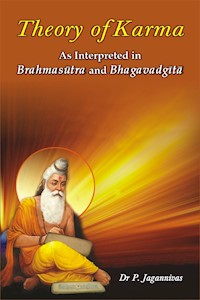
Theory of Karma
Theory of Karma
As Interpreted in Brahmasūtra and Bhagavadgītā
P. Jagannivas
Cataloging in Publication Data — DK
[Courtesy: D.K. Agencies (P) Ltd. <[email protected]>]
Jagannivas, P., 1938- author.
Theory of Karma : as interpreted in Brahmasūtra and
Bhagavadgītā / P. Jagannivas.
pages cm.
Includes passages in Sanskrit (Roman).
Includes bibliographical references.
ISBN 9788124610541
. Karma. 2. Hindu philosophy. 3. Bādarāyaṇa. Brahmasūtra.
. Bhagavadgītā – Criticism, interpretation, etc. I. Title.
LCC BL2015.K3J34 2021 | DDC 294.522 23
ISBN: 978-81-246-1194-4 (E-Book)
ISBN: 978-81-246-1054-1 (HB)
First published in India in 2021
© Author
All rights reserved. No part of this publication may be reproduced or transmitted in any form or by any means, electronic or mechanical, including photocopying, recording or any information storage or retrieval system, without prior written permission of both the copyright owner, indicated above, and the publisher.
Printed and published by:
D.K. Printworld (P) Ltd.
Regd. Office: “Vedaśrī”, F-395, Sudarshan Park
(Metro Station: ESI Hospital), New Delhi - 110015
Phones: (011) 2545 3975, 2546 6019
e-mail: [email protected]
Website: www.dkprintworld.com
Foreword
I am pleased to write the Foreword for this work Theory ofKarma: As Interpreted in Brahmasūtra andBhagavadgītā. Theory of karma is such a common subject dealt by many Western and Eastern scholars. The author in this book has something special to narrate because he has based it on scriptural pramāṇa.
Indian philosophy consists of various schools established by great and renowned thinkers. They are classified as orthodox and heterodox schools depending upon the views, propounded by each one of them. Some believe fully, some partially, some totally disbelieve in God, Veda including Vedānta, Creator and the creation. But all of them, except Cārvāka, believe in the concept of karma. Karma is the thread that stitches all these schools together, which is called Indian philosophy. Karma is a Sanskrit word which means both the deed and the result of such a deed.
Hinduism, which is one of the important systems in Indian philosophy, follows an unwritten law of being constrained by triple canons termed prasthānatrayī. These are three authoritative scriptures, viz. the Upaniṣads, the Bhagavadgītā and the Brahmasūtra. The Upaniṣads being far too many, feared to have contradictions though apparent, are reconciled by the fantastic work called the Brahmasūtra by Bādarāyaṇa. Many consider Bādarāyaṇa is none other than Vyāsa, known as Veda-Vyāsa because he compiled and codified Vedas in the form that is available to us today. Vyāsa is also the author of the mammoth work the Mahābhārata, in which the most popular Bhagavadgītā appears. Thus, Vyāsa seems to be involved in all the prasthānas.
While the Bhagavadgītā is quite a popular scripture, being often discussed by many speakers, both traditional and common, the Brahmasūtra is one work that is not known to the common person. Students of philosophy and Vaiṣṇavism or allied subjects might be familiar with this text, but there are not many works, particularly in English available to the common person.
Dr P. Jagannivas, a student of mine, had brought out in this exquisitely executed book the theory of karma as expressed in these prasthānas. Incidentally, he was appointed as an advisor in the same International Nutraceuticals firm from where he retired. Though he was very busy as the advisor, he sincerely devoted his additional time for doing this research and completed the thesis in excellent manner. I appreciate his zeal and sincere efforts.
While everyone, at least in these parts, accepts the concept of karma, s/he does not necessarily follow the tenets it lays down. The simple rule states: you reap what you sow. This concept is confused by many with determinism, destiny, fate and anti-free will. Whether people believe or not, the law prevails. It is the law of the sarvajña. It never fails. Accepting such a loaded concept is not easy, because the common pramāṇas like perception and inference do not prove it. We have to fall back on śabda-pramāṇa (verbal testimony) and there can be no greater authority than the prasthānatrayī. That is why the author has used them to authenticate the laid down principles and his conviction.
He has presented them from different viewpoints like, what is karma, who is karmaadhikārī (possessed of authority), jīva kartr̥tva nirṇayam (establishing thejīva as kartā), Divine intervention and finally karma-yoga to disentangle oneself from the vicious cycle of birth–death–rebirth. While the author extracted the information about the nature of karma, the kartā and kartr̥tvam from the Brahmasūtra, he highlighted karma-yoga from the Bhagavadgītā which is the epitome of knowledge, being the utterance of the Jagat-guru Śrī Kr̥ṣṇa. Thus, it is a book, which not only discusses the problem but provides the solution. It is a book that could possibly remove the misconceptions about karma through the Śāstric injunctions and therefore could be useful for not only the beginners but also to those who are not exposed to a scripture like the Brahmasūtra.
Professor M.A. Venkatakrishnan
Former Head, Department of Vaishnavism
University of Madras, Chennai
Prologue
Theory of Karma: As Interpreted in Brahmasūtra and Bhagavadgītā by Dr P. Jagannivas is a memorable work of scholarship, based on his doctoral thesis at the University of Madras. By this publication it is now thankfully available to a wider audience.
It is well known that much has been written on karma by Western scholars who study the texts, seeking out the implications of deeds good and bad, and making sense of the related notion of rebirth. Some of these scholars, particularly missionary scholars in past centuries, found in karma a very large obstacle to Christian mission, and so they sought to understand the doctrine in order to contrast it sharply with Christian doctrines of free will, sin and grace, punishment and redemption. In recent decades, other scholars have simply been interested in the distinctive doctrines of India’s traditions, of which karma is among the most important, a belief shared with many Buddhists and Jainas as well. Anthropologists proceed by fieldwork and interviews, seeking to understand how individuals balance fate and personal responsibility in everyday life.
What is too often missing are the views of a believing Hindu who takes up the topic of karma and reflects on it in light of tradition, with faith and guided by a staunch commitment to the views of his community, and energized by a desire to explain the community’s belief on karma calmly and clearly. To say that Dr Jagannivas breaks no new ground here might to some modern readers imply a lack or a disappointment, but I think he would rather be pleased to hear such a judgement: his views are, as he shows us, rooted in a calm reasoning that is based on old wisdom that has been around for centuries, particularly in the Bhagavadgītā and the Brahmasūtra as understood in Śrīvaiṣṇava tradition. His book is erudite in its own way, based on his studies under the expert guidance of Professors M.A. Venkatakrishnan and V.K.S.N. Raghavan. Yet it is free of jargon, so that anyone already familiar with Śrīvaiṣṇava tradition and the teachings of Śrī Rāmānuja will find it easy to follow the arguments, understand the terminology and think along with Dr Jagannivas as he thinks about karma in the twenty-first century.
And what does he tell us? He takes karma very seriously, and seeks to ground ethics and the moral life in the sense of responsibility, individual and communal, that is implied by karma. He does not rob individuals of freedom and free choice, as if we are merely prisoners of iron-clad karma that preordains our lives in a mechanical fashion. Nor does he imagine a free-wheeling world in which responsibility has force only when other humans catch us, and reward us or punish us. He resists overly literal interpretations of karma that pretend that we might scientifically explain what happens to us today based on what we did yesterday; he rejects melodramatic fancies about luridly described past lives catching up with us in this life. Nor does my bad karma justify your mistreating me, cruelly or coldly: “just deserts” may be the case, but each of us must by reason and faith find the best way to act together everyone around us. Ultimately, Dr Jagannivas is a teacher too – and has lectured regularly at the University and spoken at many conferences – who wants his readers to reflect more deeply on karma, not merely by lip service, but in order to detect the moral foundations of everyday life, such as are natural, grounded in Indian tradition, and not pushed aside by the views of people of other faiths or by secularism. Dr Jagannivas is an ardent Śrīvaiṣṇava believer. He does not want us to slip into fatalism, as if God too is merely a cipher, helpless at the prospect of an iron-clad chain of causes and effects. Grace is real, and God’s mercy is endless; but it is God’s plan for the world that we remain responsible, karma in effect serves as our great educator and disciplinarian, teaching us basic facts about life in this world, and how to make better moral choices, even as we finally realize that karma never makes divine love and mercy superfluous.
I, therefore, am pleased to applaud Theory of Karma: As Interpreted in Brahmasūtra and Bhagavadgītā. It is a work that will be appreciated by Śrīvaiṣṇavas everywhere, and by other readers who are curious to learn how believing intellectuals in India today think about karma and interpret it as a reality in their lives. I have known Dr Jagannivas for several decades now, and have always been blessed by his warm welcome during my many visits to Chennai and the University of Madras. His book is all about karma; but just as importantly, his own life is itself a powerful witness to how we are to balance moral and religious realities in the twenty-first century, in India and around the world.
25 July 2020
Francis X. Clooney, SJ
Parkman Professor of Divinity
Harvard University
Preface
This book is literally a reproduction of my thesis, for which I was awarded the doctorate degree by the University of Madras, in 2010. During my growing years as a teenager, one term which I often heard, i.e. karma, bothered me a lot. I found, the society consisted of people, some being very strong believers and some non-believers. That was because, I got to know, that the word karma was used in various contexts to provide various meanings. In Sanskrit, the word karma is spelt as karman to mean, work, action, deed, performance, religious rights (daily or routine, special or occasional, and for fruits desired) and religious duties performed as prescribed in the karma-kāṇḍa of the Vedas. It is also used to mean effect, fruits, object of an action, fate and consequence of actions performed earlier.
Listening to different ācāryas, I understood that karma was classified as prārabdha, āgāmī and sañcita. Another interesting concept was karma-phala (result accruing out of any action or karma). This principle of getting a result as a reaction to every action, though scientific, as mentioned by Newton in his “Third Law of Motion”, should be considered pertinent when karma is used to mean action. If so, is the result immediate, then and there, or is it effective at a later date? Further, many questions arise here. When does the result come into effect and who decides as to what should be the result? What are the actions (karmas) that produce immediate results and what are the actions that produce delayed results? If the results are delayed, where and how is the original karma recorded and who decides on the appropriate result, as a consequence? If this law is true in all circumstances, what happens if a person performs a karma during the last moment before one’s life comes to an end? When would that person have the effect of the karma performed and will he know that the result is because of his own earlier action? Can a commoner get convincing answers for these questions?
I found that there was no magic mantra to get to bottom of all these queries. One needed to understand the fundamental phenomenon governing this process. Perception (pratyakṣa) and inference (anumāna) are not enough to produce the answers. In the absence of answers through these two pramāṇas, one should depend on testimony like Śāstra particularly the Śruti. Knowing that self-study of Śruti pramāṇas is not in the realm of, particularly the uninitiated, I decided to follow the conventional route, namely formal education either through academic or traditional (kālakṣepa) study.
The Upaniṣads, the Brahmasūtra and the Bhagavadgītā are probably the only sourcebooks that could give us the answers. The outpouring of Āḷvāras, commentaries and insightful rendering by Vaiṣṇava ācāryas, the awe-inspiring philosophy by so many erudite and later ācāryas paved the way in resolving my enquiry. I realized that a clearer and deeper understanding of the enigmatic term karma would give me the answers that I was looking for. However, skimming through the voluminous literature available on the subject of karma by great thinkers was not a joke. It was not prudent to read and understand these revered Śāstras just from books. They needed an in-depth study. That was when, my wife and I decided to go back to the 150-year-old place of learning known as the University of Madras. The university has separate departments, apart from a full-fledged department of philosophy; it has dedicated departments for learning Christianity, Jainism, Buddhism, Śaivism and Vaiṣṇavism.
We registered as students in MA Vaishnavism. There were three erudite and dedicated teachers apart from some very knowledgeable visiting lecturers to impart an in-depth understanding of Vaiṣṇavism. The study only increased my eagerness to delve even more deeper. Fortunately, Professor M.A. Venkatakrishnan offered me an opportunity to do my doctorate under his guidance. He, along with Professor V.K.S.N. Raghavan, the then head of department, advised me to research into “Theory of Karma” as viewed in the Brahmasūtra and the Bhagavadgītā. The literature search of these two eternally great works of Prasthānatraya led me to look at one adhikaraṇa of the Brahmasūtra, i.e. Kartrādhikaraṇa and one śloka of the Bhagavadgītā, i.e. fourteenthśloka of eighteenth chapter. The result is this book.
All non-English words are in italics. In addition to italics, all Sanskrit words are spelled with diacritically marked alphabets. That way, one can be sure that one is reading the text, by pronouncing each word properly. I have taken care to provide the nearest meaning in English for all the Sanskrit words.
The guiding force for the PhD thesis, the personalities who contributed to its emergence as an interesting piece of an exposition of a difficult concept to explain, are mentioned separately in Acknowledgements. Such a thesis is being offered as a book for public consumption with the permission of the University of Madras. Hope you would enjoy reading it.
P. Jagannivas
Contents
Foreword
Prologue
Preface
Acknowledgements
Abbreviations
Scheme of Transliteration
Introduction
The Earth Is Flat
Āstika Religions
Anumāna (Inference)
Thinking Human Being
Dārśanika and Darśana
The Brahmasūtra
Sāṁkhya’s Pūrva-pakṣa
Vyāsa’s Reply
Methodology
1. Karma Adhikārī
Laws of Universal Causation and Karma
Definition of Sarīra
All Living Beings Have Adhikāra
Karmaṇi Virodhaḥ: The Contradiction
Relevance of Śabda
Law of Retribution
Properties of Ātmā
Determinism or Fate and Free Will
Jīva Is Nimitta-Mātra
Fate and Fatalism
Prārabdha Karma
2. Brahman: Jagat Kāraṇa
Sāṁkhya Mata Nirākaraṇa
Kārya-Kāraṇa Vibhāga-avibhāgāt
Satkāryavāda
Bhāṣyakāra’s Khaṇḍana
Purposeful Flow of Inert Milk
Antaryāmī Brahman
Satya-saṅkalpa of Īśvara
Śruti Virodha and Yukti Virodha
Conversion of Grass and Water into Milk
Purposeful, Skilful and Independent Activity of Pradhāna
Lame Guiding the Blind
Sattva, Rajas and Tamas: Inequilibrium
3. Jīva Kartr̥tva Nirṇaya
Puruṣa Is Akartā, but Is a Bhoktā?
Nirlepa Ātmā
Jīvātmā Is Kevala Bhoktā
Involvement of Five Entities Including Daiva
Japākusuma and Spaṭikamaṇi
Prakr̥ti Attains Jñātr̥tva
Jīva’s Svatantra
Anvaya-vyatireka (Logical Connection – Distinct)
Svādhīna Kartā
Dharmabhūta-Jñāna
Svayaṁ-prakāśa-Jñāna
Cit-chāyā
Cit-samparka
Cit-abhivañjaka
Kartr̥tva-Śakti and Karaṇa-Śakti
4. Divine Intervention
Divine’s Role in Jīva’s Kartr̥tva
Prayojaka Kartā and Prayojya Kartā
Pūrva-Pakṣa’s Justification of Nirīśvaratva
Ekadeśī mata
Hetu Kartā
AntaḥPraviṣṭaḥŚāstā Janānāṁ
Sāmānya Kāraṇa
Dayā (Compassion)
Paramātmā’s Anugraha and Nigraha
Sāpekṣa (Dependent) Kartr̥tva
Kr̥ta Prayatna Apekṣastu
Sarva Kāryāntara-sāmānyahetu
Tattvasāra Forty-sixth Śloka
5. Karma-yoga as Mokṣa Sādhana
Human Effort
Five Entities of Action
Antaryāmitva of Bhagavān
Jīva Alone Is Accounted for Retributive Kartr̥tva
Exhausting Puṇya–Pāpa
Karma-Yoga
Kartr̥tva, Mamatā and Phala-tyāgas
Triguṇas of Prakr̥ti Are the Cause for All Actions
6. Adhikaraṇasārāvali
Nitya and Anitya Dayā
Antaryāmitva
Jīvātma’s Discretion to Perform
Conclusion
Books for Further Reading
Index
Acknowledgements
I have to acknowledge with grateful thanks many illustrious personalities because, for a pharmacy graduate from the University of Madras and who retired as a successful corporate manager promoting drugs and nutrition as a career to be writing a book on karma is no easy task. Post-retirement, I had developed an urge to understand the more pertinent question as to “who am I” and “what is the purpose” of this janma. That took me back to rigorous and structured study. That thought not only influenced me, but also my wife, to decide to go back to school as day scholars. We landed at the University of Madras.
Thus, the second and more purposeful academic journey started in 2001. Joined as a student of MA Vaishnavism during the period of Professor M. Narasimhachary, who was about to retire as the head of the “Department of Vaishnavism”, one of the popular departments of “Philosophy of Religious Thought” conducted at the University of Madras. I was 63 years old. After MA it continued during the period of Professor V.K.S.N. Raghavan, as a PhD scholar, under the guidance of Professor M.A. Venkatakrishnan as my guide. These erudite and dedicated teachers advised me to research into “Theory of Karma” as viewed in the Brahmasūtra and the Bhagavadgītā. The entire thesis revolved around the two relevant portions of the Brahmasūtra and the Bhagavadgītā which needed a lot of help from authorities on the subject to help me decipher the depths of these pronouncements.
The Brahmasūtra, as we all know, is so cryptic a work that illustrious ācāryas like Śrī Śaṅkara, Śrī Rāmānuja, Śrī Madhva and many others have written exhaustive bhāṣyas based on their own siddhāntas. Obviously, those works needed later ācāryas to elaborate what they implied in their commentaries. Being a student of Viśiṣṭādvaita I had taken the Śrī-Bhāṣya the magnum opus of Śrī Rāmānuja for main consideration but also consulted the Śāṅkara-Bhāṣya of Śrī Śaṅkara because it was one of the earlier bhāṣyas of post-Buddhist era. Both the bhāṣyas needed elaboration by learned ācāryas. The expository work on the Śrī-Bhāṣya was called the Śrutaprakāśikā of Sudharśana Sūri. In addition, the recent work Bhāṣyabhāvacandrikā in two volumes by Śrī U.Ve. Perukkaranai Chakravarty Acharya Swamy, has rendered the original work in a much simpler style. It was my good fortune that I had the opportunity to study both the works under the same Perukkaranai Swamy in the traditional kalākṣepa style for a period of eight months. The Swamy, also took the trouble of teaching me the essence of what Śrī Vedānta Deśika elaborates about Parāyattādhikaraṇa (Brahmasūtra II.3.40/41) in his Adhikaraṇasārāvalī. I am indebted to the Swamy for having consented to teach me, as a single student because I had a special focus on only three adhikaraṇas of the Brahmasūtra. I must thank my good friend and erstwhile colleague of Glaxo days Mr R.N. Raghavan who introduced me to the Swamy and requested him to specially help me.
I had attended Swamy Paramārthānanda’s classes on the Bhagavadgītā series more than twice, but did not have the opportunity to attend his classes on the Brahmasūtra which he taught over a period of nine years. The Swamy suggested that I go through his CDs on the relevant adhikaraṇas of the Brahmasūtra and consult him if I had any doubts. I am indeed grateful to him for such brilliant lectures on how Śrī Śaṅkara interpreted the underlying thought of Śrī Bādarāyaṇa, particularly in handling pūrva-pakṣa and establishing the Vedāntic Siddhānta.
I have studied the Bhagavadgītā through the Advaitic school. I needed some directions and guidance from Viśiṣṭādvaita ācāryas to get a composite view to present in my thesis. Professor Narasimhachary had dealt Gītārthasaṁgraha of Śrī Ālavandār so elaborately and also seventh and ninth chapters during MA degree course which gave an inkling of Viśiṣṭādvaitic interpretations. Śrī Velukkudi Krishnan Swamy’s lectures on the TV spread over four years were diligently heard and recorded to get a clear picture of the Bhagavadgītā as interpreted by Śrī Rāmānuja in his Gītābhāṣya and elaborated by Śrī Vedānta Deśika in his Tātparyacandrikā. In addition, Professor Narasimhachary conducted some special classes only on the specific śloka, Bhagavadgītā XVIII.14. I am indeed grateful to all of them.
I must register my grateful thanks to Professor V.K.S.N. Raghavan, in whose tenure I enrolled for my PhD, but more importantly for all the guidance. He also constantly supplied me with relevant books and pertinent literature on the subject. I had even indulged in telephoning him at home and asking for some clarifications, which he readily offered.
It was at last the responsibility of my guide, the then Head and Professor of Vaiṣṇavism, University of Madras, Professor M.A. Venkatakrishnan who pooled all the knowledge and information I had gathered and knit them well into a thesis format. He also helped me build in the concept of Swamy Deśika as pointed out in the two important ślokas of Tattvasāra, which were quite relevant to the thesis. He not only guided me on the subject matter, but on the presentation of the thesis as well.
My special thanks are also to my wife A. Padmavathi, who holds a PhD, herself to help me understand the works of Āḷvārs and some other granthas that were in Tamil, which is neither my mother-tongue nor have I studied it in my school and college days. She was also a great inspiration and support, for not only completing the thesis, but also for reproducing it as a book.
This book is an improved version of the thesis, for which I was awarded the PhD presented in 2010.
Abbreviations
BG
Bhagavadgītā
Br̥Up
Br̥hadāraṇyaka Upaniṣad
BS
Brahmasūtra
ChāUp
Chāndogya Upaniṣad
KaṭhaUp
Kaṭha Upaniṣad
KauṣītakiUp
Kauṣītaki Upaniṣad
MahanārāyaṇaUp
Mahānārāyaṇa Upaniṣad
PraśnaUp
Praśna Upaniṣad
TaiĀ
Taittirīya Āraṇyaka
TaittUp
Taittirīya Upaniṣad
Introduction
The Earth Is Flat
The belief that the earth was flat was almost universal until about the fourth century bce, when the Ancient Greek scientists and philosophers proposed the idea that the earth was a sphere, or at least rounded in shape. However, Vedic literature which is the oldest available to mankind is full of references to show that earth is spherical. The usage of terms like aṇḍa meaning egg-shaped or golā meaning a sphere is so common. The works of the classical Indian astronomer and mathematician, Āryabhaṭa (476–550 ce), deal with the sphericity of the earth and the motion of the planets. The final two parts of his Sanskrit magnum opus the Āryabhaṭīya, which were named the kālakriyā (reckoning of time) and the golā (sphere), state that the earth is spherical and that its circumference is 4,967 yojanas, which in modern units is 39,968 km, which is only 62 km less than the current value of 40,030 km.1 The deviation is approximately 0.15 per cent only. He also stated that the apparent rotation of the celestial objects was due to the actual rotation of the earth, calculating the length of the sidereal day to be 23 hours, 56 minutes and 4.1 seconds, which is also surprisingly accurate. It is likely that Āryabhaṭa’s results influenced European astronomy, because the eighth-century Arabic version of the Āryabhaṭīya was translated into Latin in the thirteenth century.2
From the West, it was Aristotle who was one of the first thinkers to provide evidence of a spherical earth in 330 bce. Later on, Copernicus established that the earth is a sphere. But even today there are people who are still not convinced that the earth is not flat. The earth must in fact have the shape we see, shadowed on the moon in eclipses, namely a perfect circle. Therefore, the earth is not flat, as Empedocles and others thought; nor drum-shaped, as Leucippus; nor bowl-shaped, as Heraclitus; nor hollow, as Democritus; nor cylindrical, as Anaximander; nor does it extend infinitely downward, as Xenophanes taught; but it is perfectly round. There is a society under the name “The Flat Earth Society(also known as the International Flat Earth Society or International Flat Earth Research Society)” an organization that furthers the belief that the earth is flat rather than a sphere.
With the advent of recent advances in space research and astronomy, it is shown that the Universe consisting of some of the large planets like Antares, Betelgeuse, Aldebaran and Arcturus are larger than the sun, where sun itself appears like a small speck when compared to the largest Antares. Within our solar system, earth is comparatively smaller than Jupiter, Saturn, etc. and these planets of the solar system are smaller compared to the sun. Findings show that in such a scenario, human being is just an infinitesimally micro-sized organism and he sits in judgement over the very mind-boggling phenomenon called the Universe. It is such a glorious exhibition of a designer, whom this insignificant human being with its two ounces of a brain rationalizes and dares to proclaim that this Universe has evolved on its own without either a designer or a creator.
Some of the reports that appeared in recent times lay press “Scientific Insights into the Evolution of the Universe and of Life” which say “Science as a pursuit of knowledge about God’s creation”. Pope Benedict was supposed to have said:
There is no opposition between faith’s understanding of creation and the evidence of Empirical sciences. Galileo saw nature as a book whose author is God. …
As appeared in the news coloumn of a daily newspaper, Stephen Hawking, British cosmologist and wheelchair-bound scientist, had stated:
I believe the Universe is governed by laws of science. The laws may have been decreed by God, but God does not intervene to break the laws. …
“Cosmic question over longevity of Universe”, as reported in New Scientist,states:
... In fact, the poor old cosmos is in a rather delicate state, they say. Until recently, a common idea was that the energy unleashed in the Big Bang happened when a “false vacuum”, which is a bubble of high energy with repulsive gravity, broke down into a safe zero-energy “ordinary vacuum”. But new evidence places a cosmic question mark over this cozy thought. For one thing, cosmologists have discovered that the Universe is still expanding. And, they believe, a strange, yet-to-be-detected form of energy called dark energy pervades the Universe, which would explain why the sum of all the visible sources of energy fall way short of what should be out there. …
– The Hindu, 23 November 2007, p. 24
A simple theory, with the limited knowledge and experience a human being has, shows that anything however trivial can be produced only from something that existed prior to its appearance. Now the corollary of that is, if such a magnificent design were to develop, there should have been a prior cause from where this effect could appear. In the usual case of worldly production, we also need a causal material, an efficient cause like an intelligent being or a robot, and an instrumental cause like the equipment needed to produce. Even if the later two are discounted, without the first one, namely the causal material nothing concerning matter can ever be produced. If only it is possible then all the man-made laws of economics, property rights, ownerships and financial systems have to be redrafted.
The two most populous religions like Christianity and Islam (according to Genesis and Qur‘an) propound the theory that Lord God created the Universe and on the sixth day created the “Man”. Jainism clearly enunciates that Universe is not created but exists all the time and is evolving continuously. Buddhism believes that creation occurs repeatedly throughout time, beginning in each kalpa when spiritual beings who populated the Universe in the previous kalpa are reborn and eventually dissolves when all living creatures return to their original form.
Āstika Religions
Within the āstika religions that believe in Vedas like Sāṁkhya mata does not believe in God and thus proclaims that universe is created on its own design, without any intelligent being governing the design. Vedānta strongly asserts the role of God in the evolution of the subtle mūla-prakr̥ti through various stages of prakr̥ti, mahat, ahaṁkāra (sattva, rajas and tamas ahaṁkāras) up to the pañca-bhūta stage, as samaṣṭi sr̥ṣṭi and after pañcīkaraṇa through vyaṣṭi sr̥ṣṭi into the Universe we see. This extraordinarily fantastic design of the Universe, with its immaculate precision, is absolutely within the control of laws of the sarvajña. They are discovered today and nomenclatured as physical and chemical laws, which cannot happen by mere chance or on its own accord.
Like the modern-day scientist, even in the earlier days, the so-called nāstikas wanted proof in perceivable terms as they did not believe in evidence based on scriptures, more particularly Śrutis. When the discussion is about the beginning and the purpose of creation of this Universe, or Brahman,one can only provide śabda-pramāṇa (testimonial evidence), viz. evidence from Śrutiand not by the usual perception and inference route. Both perception (pratyakṣa)and inference (anumāna)are based on data as they are observed or collected. We will deal with śabda, pratyakṣa and anumāna in more detail in the next chapter. However, we would discuss anumāna briefly.
Anumāna (Inference)
Inference of fire by seeing smoke parvataḥ agnimān dhūmavatvāt yathā mahānte (पर्वतः अग्निमान् ध्ूमवत्वात् यथा महान्ते) in which there are four influencing factors involved like pakṣaḥ, sādhyam, hetuḥand dr̥ṣṭāntaḥ. In the above example, parvataḥis the pakṣa (focus of discussion), viz. whether mountain is on fire; agnimān(the fire) is the sādhya which is perceptible but not provable. It is like dharmin, the person is visible but the dharma he does is invisible. Similarly, in the usage of the term dhūmavatvāt meaning the mountain is smoky, smoke seen on the mountain is the hetu. But the cause of smoke is not visible. From what is visible one conceives that there should be fire because of one’s experience of mahānte, the olden day kitchen (using firewood), where you see smoke and know that it is caused by fire below. That is the dr̥ṣṭānta, where hetu is the smoke that is visible (pratyakṣa).
This kind of a phenomenon is called vyāpti-jñāna which is invariable coexistence of the fire along with smoke. Thus, vyāpya vākya is yatra yatra dhūmaḥ, tatra tatra agniḥ. In this sentence smoke is called vyāpyam and fire as vyāpakam. The coexistence is called vyāpti. Vyāpyam of the vyāpaka vākyam is the hetu in the anumāna vākyam. Vyāpakam becomes the sādhyam of the anumāna vākya. Therefore, yatra yatra hetuḥ, tatra tatra sādhyam. Only when proved thus, the anumāna is valid. The only way to validate the vyāpti vākyam is an earlier perception (seeing with one’s own eyes), viz. study based on examples like kitchen and smoke.
Scientists have used this method all along. The observed data helps one to arrive at the conclusion. Inference is based on observed data. The data collected from one object will help to draw conclusions about the same object only. “Data and conclusion will deal with the same object alone.” Therefore, hetu and sādhya will belong to same pakṣa. Hetu sādhyāyaḥ samānādikaraṇya niyama. Using this theory, all observed data being about matter, scientific reasoning has to be about matter only. Thus, they are called laukika anumāna (inference based on physical and worldly data) which can deal with only matter and not about spiritual subject like Brahman, also since Brahman is not observable. The sūtra tarkāpratiṣṭhānādapi (तर्काप्रतिष्ठानादपि) (Brahmasūtra II.1.11) states that with tarka,one cannot prove anything about Brahman. Thus, śāstrīya anumāna is what is used in the Brahmasūtra and not laukika anumāna.
The difference is about regard to the source. In laukika anumāna the data is collected based on pratyakṣam. But in śāstrīya anumāna the data is collected from śāstram and not from pratyakṣa (observation). As an āstika concept śāstramis accepted as valid means of collecting data. Even the scientist questions, may be, only the conclusion but never the observation or the observed data. That is sacrosanct. So, “I see because there is a thing” or “because there is a thing I see” is taken for granted. Similarly, the śāstra is not questioned by a philosopher just as a scientist does not question the observation.
That does not mean that laukika anumāna is not used in the Brahmasūtra. It is there also but it has a different application. It is never for establishing Vedānta. All the same laukika anumāna cannot disprove Vedānticteaching. It is not only for proving but also for disproving one needs the access to śāstra. Like when the colour of an object is to be accepted the faculty of the eye as an instrument for observation is used, both to prove and disprove. We cannot use eye (the instrument for observation) for proving and for the same observation use the ear (the instrument for hearing) for disapproving the same thing. Thus, scientific logic cannot disprove Vedānta by using laukika anumāna.
Some interesting factors of similarities and differences between laukika and śāstrīya anumāna are worth analysing to establish that what cannot be explained by mere reasoning, can be explained with Śruti pramāṇa (scriptural data). The similarity being that the data that is collected, either from inference or scriptures, are both dependent. Like scientists, one does not question the validity of data. However, the conclusions can be questioned. Moving on to the differences, laukika anumāna can deal with matter alone because it observes perceptual data. Scriptural anumāna,especially Vedānta, deals with Brahman, which is not observable. The fields being different, laukika anumāna has no judging capacity to prove or disprove brahma-vidyā. The Brahmasūtra,however, uses rarely laukika anumāna. When certain philosophers apply laukika anumāna to disprove Vedānta, though it is a wrong application in the first place, they are yet again using laukika anumāna itself to point out the fallacy. Vedānta is neither logical nor illogical. It is not within that gambit. It is supra or infra logical. Certain philosophies being nāstika systems do not accept Vedas. They try to arrive at the truth of Reality and the world using laukika anumāna. Truth can never be arrived by that means. The Brahmasūtra uses laukikaanumāna not to prove Vedānta, but to disprove arguments against Vedānta. Therefore, use of science is only for functional knowledge but never to understand truth.
Thinking Human Being
But still we keep saying that the whole evolution began from nothing and nowhere, and is evolving by mere chance. Since the insentient and inert objects do not question this rationale, it is the human being with the thinking equipment who questions not only the basic concept of creation, but even more complicated questions as “Why am I, What am I”, “Who am I”, “Where did I come from” and a plethora of such intriguing queries. Answering this query, if it is said that one gets this birth and this body by sheer chance it might tantamount to ridiculing the very phenomenon of creation – which of course is beyond the fathomable realm of human thought – let alone satisfy thinkers who shun superficial and evasive answers. Equally important are the consequences that arise out of such a logic.
A poor destitute questions, why he or she had been singled out as to what he or she see as a package of misery and desolation, while some others are placed in much happier situation. It has no particular reason except sheer chance that he or she got that particular birth and life, is like telling a person in a court, that by utter chance you are getting convicted and is hereby sentenced. When a judge has to pronounce a judgment, he needs reasonable evidence beyond doubt to convict a person and give him a simple punishment. That judgment has to justify and prove the crime the accused had committed. But when a person gets an entire life which is bound to be miserable without any palpable mistake conducted by the person in the past that he can think of, and to be disgraced by saying that you got this life by mere chance, the world is not being sympathetic to that person. At least for the person to accept that he got this life because of some reasons, whether or not one is convinced about it, there is reasonable probability of the person accepting it than by telling him, it is by chance.
Thus, the human being, who is bestowed with the faculty to think and question everything around him, also questions his own existence, birth, purpose and many related phenomena. Buddhi,being the svarūpa lakṣaṇa (inherent nature) of the śarīra in which he is embodied, perpetuates this process and he starts looking out for answers from his surroundings. He draws simpler conclusions from what are perceptible, but also indulges in inferring certain data and tries his hand in extracting information from scriptures. In philosophical terminology, pratyakṣa, anumāna and śabda, viz. perception, inference and śruti,respectively, are used to suit his quest for deciphering the enigmatic and hidden truths, if at all, that will throw light to illuminate the darkness, he visualizes and believes he is in. This rigmarole had introduced thinkers of great repute, who not only thought for themselves, they also propagated that thought to others, through verbal and written communications. They developed and capsulated their thoughts into systems and different schools of beliefs and theories.
Though this was a feature happening all over the world, Indian subcontinent had an overdose of this class of people. As much as they were all trying to understand the same truth, some of them were firm and rigid in stating that they would follow what they can perceive and they established their system on that basis. The human being who is considered a superior animal though some of the common features seen in animals exist in humans as well, like āhāra (eating), nidrā (sleeping), bhaya (insecurity) and maithuna (propagation of species), they had a special (extra faculty) called buddhi – evolved intellect or intelligence or power to reason. With this faculty, a human being is able to judge and set goals for himself. (This is lacking in animals.) Animals have an instinctive life. Human beings can work towards set goals. Some special or serious thinkers analyse, study and form a set of opinions. They study about life, particularly about six important things connected with human life, namely, jīva (living being), jagat (this universe), Īśvara (cause of above two), bandhaḥ (why is the human caught-up in bondage and suffering or misery, viz. saṁsāra), mokṣa (freedom from bondage, liberation) and sādhana or means (bridge from bondage to liberation).
Dārśanika and Darśana
Such a special thinker or being is called a dārśanika and the philosophy is called darśana. Such a thinker has followers. He becomes a propagator with lectures, books, etc. and such persons are called ācāryas. There are twelve such well-known darśanas. Six nāstika darśanasand six āstika darśanas. Nāstikas are those who do not accept Veda pramāṇa and who believe in pratyakṣa and anumāna most of the time. An āstika is one who accepts Vedas as a valid source of knowledge.
Six nāstika darśanas are:
1. Cārvāka (Materialism): This is supposed to be conceived by Br̥haspati(Devaguru)believed to mislead the asuras. Cārvāka




