


Erhalten Sie Zugang zu diesem und mehr als 300000 Büchern ab EUR 5,99 monatlich.
- Herausgeber: Grosvenor House Publishing
- Kategorie: Lebensstil
- Sprache: Englisch
A photo-packed, modern guide to keeping happy, healthy rabbits. Rebecca Bee BSc designed the Rabbit Care and Behaviour Courses for the staff at the Blue Cross animal charity whilst working there as an Animal Behaviourist. As well as a BSc in Animal Care Science and running her own rabbit rescue and behaviour service, the knowledge she imparts in this book offers owners a comprehensive guide to understanding rabbits and their unique needs. Rabbits are one of the most misunderstood companion animals; however, they can be fun and interesting pets when kept appropriately. When you change the way you interact with them and alter some aspects of their lifestyle, they can be transformed into animals who enjoy your company as much as you enjoy theirs. Having rabbits who excitedly run to you, as opposed to away, are a daily joy to greet! Key areas of rabbit care are covered, such as: rabbit behaviour, bonding (including group bonding), suitable housing, litter training, house rabbits, environmental enrichment, taming, nervousness and aggression, grooming, diet, fun training and adopting rescue rabbits. All areas put together result in more rewarding and lower maintenance rabbit care. This book will also help adults guide children in how to interact with their rabbits respectfully and in a way that enhances their relationship. The biggest problems with rabbit care and children are a result of outdated housing and handling information. The photos and easy read style assists owners in creating an environment where their rabbits will be happier, and children and adults can enjoy them without the nervousness and aggression traditional rabbit keeping often causes. Whether you already have rabbits or are preparing to bring them into your life, there is something for everyone in this book. It will help to improve your relationship with these amazing animals and give them the best life possible.
Sie lesen das E-Book in den Legimi-Apps auf:
Seitenzahl: 98
Veröffentlichungsjahr: 2022
Das E-Book (TTS) können Sie hören im Abo „Legimi Premium” in Legimi-Apps auf:
Ähnliche



















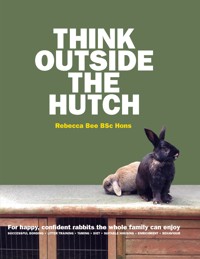
THINK OUTSIDE THE
HUTCH
Rebecca Bee BSc Hons
For happy, confident rabbits the whole family can enjoy.
COPYRIGHT
All rights reserved. No part of this book may be reproduced or transmitted in any form or by any means, electronic or mechanical, including photocopying, recording, or by any information storage-and-retrieval system, without written permission from the copyright holder Rebecca Bee. Brief passages (not to exceed 1,000 words) may be quoted for reviews.
2
CONTENTS
INTRODUCTION
RABBIT BEHAVIOUR
COMPANY
HOUSING
ENRICHMENT IDEAS
THE UNHANDLING PROCESS
5 19
2 15 3 27 4 49 5 57
65 6 69 7 73 8 79 9 85 10 89 11 91 12 93 13 95
RE-TAMING THE NERVOUS RABBIT
(A NOTE ON GUINEA PIGS)
RABBITS & CHILDREN
HEALTH CHECKS & GROOMING
DIET
HAVE FUN WITH YOUR RABBITS!
ARE RABBITS FOR US?
WHY RESCUE A RABBIT?
SUMMARY
RESCUES AND RESOURCES
3
4
INTRODUCTION
From keeping rabbits as a child to working as an animal behaviourist and running a rabbit rescue I have spent a tremendous amount of time with these fascinating animals. This book contains the many, many lessons learned along the way.
Whilst working at the Blue Cross Animal Charity as an Animal Behaviourist, I designed the Rabbit Care and Behaviour courses for the staff there. Much of the knowledge for these courses came from my experience of keeping rabbits as a child and stumbling across better ways to keep them which made them more enjoyable pets to spend time with. This was later enhanced by many years of studying Animal Science at College and University for an Honours Degree in Animal Care Science and a wealth of training with the Blue Cross.
When I was growing up, I was fortunate enough to have a huge enclosure that my father had built for our pet chipmunks. We had previously kept our pet rabbits in hutch-and-run combinations, but later began keeping them in the enclosure when it no longer contained chipmunks. It was there that I accidentally learnt so much more about rabbits and how to have a more rewarding, mutually respectful relationship with them. In the hutch-and-run combinations my relationship with them consisted of chase, catch, hold, get scratched or bitten and then put them back; a one-way relationship purely for my perceived benefit. The rabbits lived on their
own with very little space. In the chipmunk enclosure there was a lot of space and it was tall enough to walk in and spend time sitting with the rabbits. They could come and go as they pleased and interact with me as much as they chose to. This relationship was a much better one and interactions were far more positive for both of us.
During my time running a rabbit rescue and behavioural service for rabbit owners I expanded my knowledge and understanding of these beautiful animals even further. And I am keen to impart this knowledge wherever I can in order to raise awareness of their unique needs and what it takes to keep them in a way that is more fulfilling for both them and their human companions.
There are an estimated one million rabbits kept as pets in the UK and it is deeply saddening to think that the majority of them are confined to tiny hutches and runs. Many of these rabbits are in isolation, without the basic need of the company of their own kind being met.
Rabbits are highly intelligent, very social, playful, and inquisitive beings. You can train a rabbit to do many things, including using an agility course, just as you can do with a dog. They pick it up at the same speed, if not quicker than many dogs that I have trained over my career. When you watch them in a suitably sized enclosure, or in a secure
5
garden, you can observe that they explore EVERYTHING. They love jumping up onto different levels, running through tunnels, relaxing stretched out in the sun, cuddled up with their rabbit friends, doing excited high-speed laps with a binky (a unique leap and twist motion) thrown in for fun... and more. When they are confined to traditional, highly unsuitable housing, they cannot do any of these things and are forced to suffer in silence.
Although rabbits are the third most popular pet to own, unfortunately they are the most neglected. Much of the information available to us regarding rabbit care has been inspired by the care of rabbits for meat production. The housing used in this industry was not constructed with any consideration of the natural behaviours of rabbits and the need for a home that is enriched with plenty of things to do and enough space to prevent boredom.
Unhappy rabbits are not a pleasure to spend time with; however, happy rabbits can be a joy and very fulfilling pets for the whole family.
The hutch was created by the Victorians as a place to house rabbits before they ate them. We have evolved to keep rabbits as pets, but most of the rabbits kept today are still in Victorian era housing. In those days the rabbits were at least kept in groups, so they did not have to endure solitary confinement for their whole lives. For many of our rabbits now, life is in fact worse than during the nineteenth century; they are often housed in completely unsuitable conditions for their full life span.
This book will show you how to make changes to your rabbits lives in order to make your relationships based on mutual respect and trust, which will benefit both you and your special furry friends. Unfortunately, rabbits are not, as often referred to, cheap and easy first-time pets. They have complex needs and require a significant financial commitment like any other pet.
There are many hints and tips in this book that will actually make the general care of your rabbits easier in the long-term. However, it will require an investment of time and money in the short-term to create a suitable environment for your rabbits to enjoy and be enjoyed.
Rabbits need liberating from the lives humans have created for them. Now is the time to change the way we keep rabbits so that they have a life worth living and a more positive relationship with the human beings that choose to keep them.
We need to THINK OUTSIDE THE HUTCH!
6
Rabbits need to be understood...
...their body language and behaviour can tell us so much if we sit still and observe.
7
8
1
RABBIT BEHAVIOUR
It is important to understand the way animals live and behave in the wild so that we can keep them as happy and healthy as possible in captivity. When we understand the natural behaviour of rabbits, we can also understand why they react in certain ways. Often, changes in the way we care for rabbits are needed so that they can be rewarding pets to spend time with, who are happy in their environment.
RABBITS ARE PREY ANIMALS
In Spain rabbits are prey for over twenty predators. In Britain, these predators are: foxes, badgers, stoats, weasels, polecats, birds of prey, dogs, cats and man, to name but a few.
For rabbits, life is all about surviving. They are flight animals; their response to danger is to run to safety. As a last resort, they will fight when threatened. Their bodies have evolved in ways that improve their chances of survival.
LARGE EARS: Large ears are great for detecting the slightest sound; they are like big satellite dishes detecting every movement and sound around them. The position of a rabbits ears can tell you a lot. To show submission and fear, they flatten their ears tightly into their bodies to make themselves look as small as possible. Unfortunately, lop-eared rabbits have lost this method of communication and can often be misunderstood. It is important to read the whole body to get a full picture of what a rabbit is trying to communicate. A relaxed, happy rabbit will not have its ears pressed tightly against a tense body.
9
Above: The rabbit in this photo is very scared and is attempting to make itself appear as small as possible. This act of submission can also turn to aggression if the rabbit feels trapped.
EYES: Rabbits eyes are positioned on the side of their heads to give them the best all-round view to spot predators. The eyes will be wide and bulging when a rabbit is scared, as shown in the photo below.
LARGE BACK FEET: The back feet are used to thump the ground loudly, letting their rabbit friends know there is a potential danger. These powerful back feet also enable them to run at speed back to their burrows and bolt holes, where they can hide from predators. If caught by a predator, they will use these powerful feet to kick, in an effort to defend themselves. Foot thumping is a clear signal to all other rabbits that there is a potential threat approaching, and to retreat to a safe place. A captive rabbit who thumps its feet a lot is not a happy, relaxed rabbit.
Above: The rabbit in this photo is in a relaxed but alert state.
10
WHITE TAIL: In wild rabbits, the white tail acts as a signal to other rabbits to run to safety. As the rabbit runs, the tail moves up and down, showing a flash of white when the rabbit picks up speed. This is a clear signal to all other rabbits that there is a reason to run to safety; a great survival tool.
LUNGING: A rabbit that feels threatened may lunge aggressively in an attempt to keep you away. This can often be accompanied with a grunting noise. A rabbit will become aggressive as a last resort when all of its other subtle signals have been ignored. A wild rabbit will use aggressive lunging if it is cornered and has nowhere to escape to. Baby rabbits display this behaviour from a few days old if there is any disturbance to their nest.
SAFETY IN NUMBERS: Rabbits increase their chances of survival by living in large groups; the more eyes, ears, thumping feet, and bobbing tails the better, as far as a rabbit is concerned.
With all of this in mind, it is no wonder that many rabbits react with fear when a hand comes into their home and grabs them from above or behind, just as a predator trying to catch them for supper would! This is why most rabbits do not like to be lifted off the ground and held at height; some tolerate it better than others, but it is not an enjoyable experience for them.
When we look at the way a rabbit is designed to detect predators and escape from them, it becomes clear that the way we handle them can cause them to fear being picked up and held. A great deal of trust needs to be built first before your rabbit feels more comfortable to be held by you.
TOP TIPS
Observe your rabbits behaviour and learn what it is trying to communicate.
Remember, rabbits are geared for survival, and when scared they will resort to anything that increases their chances of staying safe. A hand coming into a hutch can be as threatening as a predator to some rabbits. If your rabbits are vocalising by grunting or squealing they are feeling extremely threatened.
Fearful and aggressive behaviour can be minimised or eliminated by following the methods outlined in this book.
11
12
Rabbits need company...
...life on your own is no fun.
13
14
2
COMPANY




