


1,49 €
Mehr erfahren.
- Herausgeber: Maria Tsaneva
- Kategorie: Geisteswissenschaft
- Sprache: Englisch
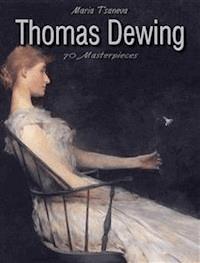
Thomas Wilmer Dewing (1851 – 1938) was an American painter working at the turn of the 20th century. He was a founding member of the Ten American Painters and taught at the Art Students League of New York. The Art Museum at the Smithsonian Institution has a room dedicated to his works. Dewing is best known for his tonalist paintings, a genre of American art that was rooted in English Aestheticism. Dewing's preferred vehicle of artistic expression is the refined, aristocratic female figure situated in a moody and dreamlike surrounding. Often seated playing instruments, writing letters, or simply communicating with one another, Dewing's sensitively portrayed figures have a detachment from the viewer that keeps the spectator a remote witness to the scene rather than a participant. His works are in private collections and museums in the United States. At the Freer Gallery of the Smithsonian Institution, a room is devoted to Dewing's paintings.
Das E-Book können Sie in Legimi-Apps oder einer beliebigen App lesen, die das folgende Format unterstützen:
Veröffentlichungsjahr: 2014
Ähnliche








Thomas Dewing: 70Masterpieces
By Maria Tsaneva
First Edition
Copyright © 2014 by Maria Tsaneva
*****
Thomas Dewing: 70Masterpieces
*****
Foreword
Thomas Wilmer Dewing (1851 –1938) was an American painter working at the turn of the 20th century. He was a founding member of the Ten American Painters and taught at the Art Students League of New York. The Art Museum at the Smithsonian Institution has a room dedicated to his works. Dewing is best known for his tonalist paintings, a genre of American art that was rooted in English Aestheticism. Dewing's preferred vehicle of artistic expression is the refined, aristocratic female figure situated in a moody and dreamlike surrounding. Often seated playing instruments, writing letters, or simply communicating with one another, Dewing's sensitively portrayed figures have a detachment from the viewer that keeps the spectator a remote witness to the scene rather than a participant. His works are in private collections and museums in the United States. At the Freer Gallery of the Smithsonian Institution, a room is devoted to Dewing's paintings.
Dewing was born in Boston, Massachusetts and was a lithographic apprentice as a boy or young man. He studied at the Académie Julian in Paris with Gustave Boulanger and Jules Lefebvre beginning in 1887. There he learned an academic technique; the careful delineation of volumetric form and meticulous but subtle evocation of texture were to be constant features of his work.
Upon his return to the United States from France in 1878, he returned to Boston.The following year he made the painting Morning of two women dressed in Renaissance gowns, which is said by biographer Ross Anderson to have the quality of Pre-Raphaelite paintings and emotion of a James McNeill Whistler work. He began teaching at the Art Students League of New York in 1881.
In New York he met and married Maria Oakey Dewing, an accomplished painter with extensive formal art training and familial links with the art world. They had a son who died while an infant. In 1885 their daughter Elizabeth was born. The Dewings spent their summers at the Cornish Art Colony in New Hampshire from 1885 to 1905.
He was elected into the National Academy of Design in 1888. Dewing was a founding member of the Ten American Painters in 1898, a group of artists who seceded from the Society of American Artists in 1897. He joined the Society of Landscape Painters, founded in 1899, where he was more aligned with other Tonalist artists.
Key collectors of his works were John Gellatly and Charles Lang Freer.
Paintingsand Drawings
Hymen
1884/1886, Oil and gold leaf on panel
Tobias and the Angel
1897, Oil on canvas




