


8,49 €
Mehr erfahren.
- Herausgeber: Atlantic Books
- Kategorie: Lebensstil
- Sprache: Englisch
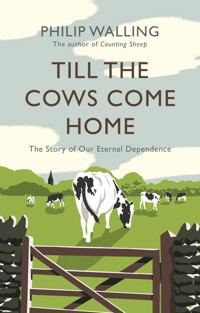
'A vital, thorough and accessible history that everyone who cares about the past or the future should read.' Rosamund Young, Sunday Times bestselling author of The Secret Life of Cows _______________________________ The story of the relationship between humankind and cattle, from the Sunday Times bestselling author of Counting Sheep. To tell the story of the relationship between humankind and cattle is to tell the story of civilisation itself. Since the beginning, cattle have tilled our soils, borne our burdens, fed and clothed us and been our loyal and uncomplaining servants in the work of taming the wilderness and wresting a living from the land. There has never been a time when we have not depended on cattle. As human societies have migrated from the country to the city, the things they have needed from their cattle may have changed, but the fundamental human dependence remains. Blending personal experience, recollection, interviews with farmers, butchers and cattle breeders and studding the narrative with little-known nuggets of technical detail, Philip Walling entertainingly reveals the central importance of cattle to all our lives.
Das E-Book können Sie in Legimi-Apps oder einer beliebigen App lesen, die das folgende Format unterstützen:
Veröffentlichungsjahr: 2018
Ähnliche


















For Libby, who will understand better than mostwhat this book’s about.
Contents
Acknowledgements
Preface
Introduction
1. Dairying
2. The Gloucester Cow
3. The Shorthorn
4. The London Dairies
5. The Channel Island Breeds
6. The Black-and-White Revolution
7. The Miracles of AI and Pasteurization
8. Raw Milk
9. My Little Herd of Heifers
10. To Hereford, to Hereford, to Buy a Big Bull
11. Ruby Red Devons
12. Scotch Black Cattle
13. The Irish Breeds
14. From Scotland to the High Plains of Colorado
15. Feedlots and the Grazing Cow: the Maker of Fertility
16. The Texas Longhorn: an Ancient Breed in a New Land
17. ‘Rascals with horns goin’ straight out’
18. The Spanish Fighting Bull
19. Sacred Cows
Glossary
Select Bibliography
Illustration Credits
Index
List of Illustrations
1.English Longhorn cows at Calke Abbey. Until the eighteenth-century agriculturalist Robert Bakewell ruined their milking capacity in the search for a beef carcase, Longhorns were the quintessential triple-purpose English cattle – traction, milk and meat – and found in nearly every part of the kingdom. Despite their formidable appearance, they were docile and gave a respectable yield of rich milk, ideal for cheese-making. They could turn almost any vegetation to their advantage over a long life, at the end of which they readily finished for the butcher.
2.Gloucester cow and calf showing the characteristic finching along the belly, up the tail and halfway along the back. It resembles the Kerry with its lyre-shaped horns and delicate dairy frame.
3.Gillray’s 1802 cartoon, ‘Vaccine-Pock hot from ye cow’, lampooning the widely held fear that introducing bovine tissue into human bodies would cause them to grow body-parts of cattle. Note the painting of the Golden Calf on the wall.
4.The Baynes’s pedigree Shorthorn and Ayrshire dairy cows in their spacious, comfortable, airy quarters at Marleycote Walls in Hexhamshire. Note the slats in the concrete floor through which the muck and urine falls, thereby keeping the wide passageways clean. The muck is stored in underground tanks for spreading as fertilizer on the cropping fields. Here the cows are inside for the night having been out to graze during the day; they move around as they please, making their way to one of the milking robots when they feel the need to be milked, or fancy a feed of cake.
5.The eighteenth-century sculpture built into the outside wall of the east transept of Durham Cathedral. It records the legend of the founding of Dunholme – Durham as it now is – and shows the Dun Cow, her milkmaid and the woman who directed St Cuthbert’s entourage to the place where the saint’s body should lie.
6.The classic wedge shape of a superior dairy cow, with a capacious, well-shaped udder and medium-sized, well-spaced teats. Note the bulging milk-vein under her deep belly. She is from the Richardson’s Jersey herd at Wheelbirks in Hexhamshire.
7.Slender feminine Holstein maiden dairy heifers before they have had their first calf.
8.A Luing bull calf on his home territory on the Isle of Luing. Emanating from a cross between a Highland cow and a Beef Shorthorn bull, this breed is marvellously adapted to the climate and terrain of the north and west of Scotland, where its thick coat keeps out the cold and sheds the rain. It can extract energy from the poorest herbage to grow a superior beef carcase.
9.A classic type of Hereford bull, just like my errant bull Jason. Note the finching running under the belly, up the dewlap and neck, to the characteristic ‘bald’ white face, the hallmark which the Hereford stamps on every breed it is crossed with.
10.South Devon bull and cow. The Guernsey inheritance is evident in their creamy skin, while the beefy shape and docile temperament comes from their Devon ancestors.
11.A breed ‘beautiful in the highest degree’ and unspoiled by the eighteenth-century improvers because it was unimprovable. This young Ruby Red Devon bull is from William and Richard Dart’s herd at Great Champson, which is founded on some of the oldest and best Devon bloodlines.
12.This diagram from 1800 shows London butchers’ cutting names and proportionate prices of a West Country (Devon) ox, ‘supposed about Christmas as the fairest season for valuation’. It is addressed to Arthur Young ‘FRS etc. etc. etc’ for inclusion in the Annals of Agriculture.
13.A ‘vast plateau of roast beef’ with ‘beef to the root of the lug’. This Aberdeen Angus bull from Andrew Elliot’s herd at Blackhaugh, Clovenfords, Galashiels, shows the best of modern Scottish beef breeding. Note the small head relative to the deep, long, square body, with weight in the hind quarters where all the valuable cuts of meat are to be found.
14.Prize-winning young Cumberland White Shorthorn bull being made ready for sale at Carlisle market. The first cross with a Galloway cow produces the wonderful Blue-Grey, a superb hybrid suckler cow for marginal land. The breed is local to the hard moorland of the Scottish Borders and a testament to the instinctive skill of stock-breeders in the Border country.
15.Galloway cow with Blue-Grey calves, the offspring of a Cumberland White Shorthorn bull that appears in the photograph above. The heifers fetch a premium for their hardiness, longevity and capacity to rear a fine beef calf from some of the poorest land in Britain.
16.Black and Dun Belted Galloways doing what they are bred for, turning indifferent moorland herbage into milk and meat and cow muck, balm to the soil, without which our marginal grazing would be much the poorer.
17.A plucky little Kerry cow with the breed’s characteristic lyre-shaped horns with black tips.
18.The North American buffalo, ‘the finest grass-eating creature on four legs’. Over millennia its dung made the American prairies some of the most fertile soils on the planet and its grazing created the thick mat of vegetation that stabilised the soil and protected it from drought, tempest and frost. At their most numerous, there were estimated to be a hundred million buffalo ranging from the Atlantic seaboard to California, from the Great Bear Lake to the Gulf of Mexico.
19.A blasted cottonwood tree stands beside the remains of a nester’s sod-walled cabin, poignant witness to broken dreams in ‘an immensity of grass’ on the High Plains of Colorado in June. It is almost beyond imagination what the hundreds of thousands of people must have suffered who trekked into this wilderness in the hope of making a new life for themselves.
20.A ‘mama cow’ from Kit Pharo’s Red Angus herd. These cows live as naturally as possible, like their precursors the buffalo, from the grass that clothes the prairie. They calve when growth begins in spring and their calves are weaned as it declines in the autumn.
21.A Red Angus bull on Kit Pharo’s ranch. With a thicker, hairier pelt and small horns he could easily pass for a buffalo. The Red Angus absorbs less sunlight than his black cousin and so endures extreme heat better.
22.One of the feedlot pens at Burlington Feeders Inc. in early June, when the bare earth floors are hard and dry but the stink is still there.
23.Taken from 25,000 feet, crop circles in Kansas created by centre-pivot irrigation drawn from the Ogallala aquifer. Each big circle fits into a square section, with the smaller ones half- and quarter-sections.
24.The morning Longhorn cattle drive from Fort Worth Stockyards. A combination of ‘living history’ and religious rite, the twice-daily ritual keeps a perpetual memory of the myth of the cowboy, so potent in the American psyche.
25.An ‘80 inches TTT’ cow in the Wampler T-Bar-W herd. She has distinctive Longhorn marking, slightly down-sloping ears hinting at Bos indicus ancestry, and the hind quarters deficient in beef that caused ranchers to be so disdainful of the Longhorn breed.
26.Pippin Star, one of the Wampler’s young heifers.
27.The Wampler’s stock bull about to serve an impressively horned cow.
28.The Osborne bull, now a cultural symbol of Spain, looming over an evening hillside in Andalusia.
29.A young Miura bull in the dehesa in December. ‘Muy peligroso!’
30.A representative sample of the numerous bulls’ heads mounted on the walls of the Restaurant Postiguillo in Seville. Each bull has his name, date of death, his breeder and the matador who fought and killed him inscribed on the brass plaque below his dewlap.
31.White Park cattle in Jonathan Crump’s herd. Note the black ‘points’ on the feet, muzzle, ears, round the eyes and the tips of the horns. This breed is of ancient British origin and would once have been found in most parts of the British Isles.
32.Landseer’s well-known painting of white Chillingham cattle in a romantic Highland setting that bears no resemblance to their home domain at Chillingham. The affecting tableau represents the ideal family and played strongly to Victorian sentimentality: the bull watches over his cow, while she nurtures their calf with tender maternal care. This painting did much to fix in the popular mind the erroneous claim that these were the noble remnant of wild cattle that were once the ‘unlimited rangers of the great Caledonian and British forests’.
ACKNOWLEDGEMENTS
As with the writing of any book, various influences and events, over many decades, have contributed to its final form, and many of them I have either forgotten or have not been conscious of their effect. It is easier to remember the people who have directly helped me and I must record with thanks the great kindness shown by all those I visited and spoke to. If I have unintentionally forgotten anyone, I beg their forgiveness.
William and Richard Dart at Molland Botreaux and the Shinner family at Buckfastleigh in Devon; Jonathan Crump and Charles Martell in Gloucestershire; the Baynes family at Marleycote Walls and Hugh Richardson at Wheelbirks in Hexhamshire; Mark Gray at Broom House Farm in County Durham; and Don Antonio Miura at Lora del Río in Andalusia. I owe particular thanks to Simon Gray for his tremendous encouragement and friendship. I must also thank Charlie Bennett, in Northumberland, whose little herd of wild Dexters reminded me why my cousin advised me not to have anything to do with them.
Until I went to America and visited the natives in their natural habitat, I had no idea how generous and welcoming they are. It’s a big country and it produces big-hearted people. I had never met any of them before I arrived in the US, but everyone treated me as if we had been friends all our lives. John and Rebecca Wampler spent two days showing me round the stockyards at Fort Worth, their ranch and their herd of Longhorn cattle. Rebecca was so generous with her time and enthusiasm, it is impossible to repay the debt; I can do no more than acknowledge how much I owe her. Russell Fairchild of the Longhorn Cattle Association, Gary and Kendra Rhodes in West, Texas, who made me feel so welcome, Kit Pharo and Tammy Fleischacker of the Pharo Cattle Company, with whom I spent a memorable summer day on the wide high plains of Colorado; the Yegerlehner family in Indiana, who impressed me with their quiet determination to farm against the American grain.
I regret having had no space to include an inspiring visit to Preston Correll in Kentucky, one of the most learned and intelligent men I have ever met; and a day spent with the wonderful Joel Salatin and his family and interns, in Virginia, whose often lonely evangelism for honest family farming has done much to show how the ravaged soils of North America can be healed.
My editor at Atlantic Books, James Nightingale, has been patience itself and I am grateful for his calm courtesy and wise advice. Jane Selley, my copy-editor, has done a sterling job, correcting many egregious mistakes; no doubt some will still remain, for which I take full responsibility.
Philip WallingScot’s GapApril 2018
Preface
WE ARE THE inheritors of a legacy of cattle breeding that stretches back into the ancient world. Without oxen to pull our ploughs and haul our carts, settled farming would have been impossible; without their manure, our soils would have been the poorer; without milk, our diet would have been deficient; and without their hides, we would have had no leather, or the myriad other things we take for granted. It is impossible to overstate the services rendered by the ox to the human race.
But humanity’s dependence on cattle is not merely a thing of history. In many ways we are more reliant on them today than we ever were, although the form of our dependence has changed. As Western (particularly American) ways of eating have spread out into most corners of the globe, the demand for beef and milk has grown prodigiously. From modest beginnings in California in 1940, McDonald’s now has 35,000 burger outlets worldwide. This American cultural and culinary influence has been achieved on the backs of the millions of cattle slaughtered annually to satisfy the apparently inexorable demand for minced beef in a bread bun – and, of course, the cow’s milk that goes to make the processed cheese they put with it.
As this demand for what cattle produce increases everywhere, and eating steak is seen as a badge of affluence, so the numbers of cattle worldwide must only increase in step, from the current 1,000 million worldwide. India has 300 million, with 225 million in Brazil, 100 million in China, 90 million in the US, 90 million in the EU and even 18 million in Russia, not to mention the 10 million in the UK.
Most people in the urban West have little idea about cows. They cannot identify the breed, let alone whether it is a beef or dairy type. For example, they do not know that a cow has almost the same gestation period as a human female, or that some dairy cows can give 30 times their body weight in milk in a ten-month period. Or that a bullock of a specialized beef breed can grow to weigh a ton entirely from eating grass. This book is an attempt to give a flavour of what our cattle do for us. It does not purport to be more than impressionistic; more is omitted than included. It is certainly not an encyclopedia. There are plenty of those. It is simply an account of one man’s recollection of his all-too-brief involvement with cattle.
I was 13 when my grandfather died and left me 50 acres of land, but I couldn’t get my hands on it until I was 21. I wonder whether knowing that it was coming affected my attitude to schoolwork, and had something to do with my getting poor grades in my A levels. Who knows? Anyway, after messing about in a spoiled adolescent kind of way, and needing an occupation and an income, I bought an old Grey Fergie tractor and a tipping trailer for a few hundred pounds and started to do all kinds of jobs for anybody who would pay me. I accepted almost any work that was offered, but I found I had a particular talent for building dry-stone walls and got quite a bit of work. A few times I bit off more than I could chew and was nearly defeated by a couple of bigger jobs, but I reluctantly came to accept my limitations.
One memorable job was building a wall around part of the graveyard of the Methodist chapel in the middle of Workington, just across the road from the bus station. This took me quite a long time. Every day I travelled the 12 miles there and 12 miles back on my old tractor (no cabs in those days), with the trailer loaded with sand and hundredweight bags of cement. I dug the foundations with a pick and shovel. In places my excavations were close to some gravestones, and one day I unearthed what I thought might be a human tibia – I remembered what they looked like from biology lessons. It was a bit creepy digging out half a decayed leg bone with a round joint on one end and a jagged break on the other. I wrapped it in a paper sack and stowed it under the tractor seat, intending to show it to the architect who was paying me to build the wall. Somewhere between Workington and home, however, it must have fallen off, because it was missing when I got back. I kept a careful lookout next morning on the road back to Workington, but I never saw it again. I’ve often wondered what happened to it.
During the summer, a neighbouring farmer asked me to help him for a few weeks. I had little idea about farming, but almost immediately I realized I had fallen in love with a world that had been closed to me even though I had been brought up alongside it. Here was adventure, pitting my physical strength against the land; working with my hands; the excitement of braving the weather; living with the changing seasons; driving tractors and machinery; working dogs, lambing ewes, calving cows and glorying in the earth’s annual increase. I looked forward to every day and realized I had shed the melancholy that overwhelmed me as summer passed into the darkening days of autumn. I came to see why for pastoral people the new year is 1 November, when the rams go in with the ewes and the eternal annual cycle begins afresh. And autumn is sale time, when the year’s increase turns into money and you feel secure to meet the winter with enough to see you through. It had more meaning than anything I’d been told at school.
Here was a world I could throw myself into; a world that ran along different lines from the one I’d been brought up in. I had stumbled upon a secret that had been there all along but that I’d never seen. Why were more people not desperate to get into this world? Why did people ever leave the land for those terraces of street houses I knew I could never have borne to live in?
There followed ten years of almost undimmed joy in my love affair with the land that passed almost in a flash. I can’t remember where the time went. And with a lot of effort and a deal of good luck, I found myself owning my own farm. I kept beef and dairy cows, and had a milk round in the village; fattened lambs; kept hens and sold free-range eggs (until the trading standards people stopped me); reared and killed geese for the Christmas market; even kept a couple of pigs and made them into bacon and ham.
Then one day, when I turned 30, I gave it all up. I think it was the twice-daily grind of milking cows that got to me. Either that, or some gnawing inner voice prevailed and convinced me that I had missed out on an education and had to make up the deficiency while I was still young enough. I didn’t know whether I would be clever enough to do a degree, but when I thought about the boys I had been at school with, most of whom had easily got into decent universities and were now doctors, lawyers or Indian chiefs, I couldn’t believe I could be much less clever than they were.
One school friend told me he envied my success in having my own farm, whereas I saw it as coming to terms with academic failure. Another friend who had gone to Cambridge and become a solicitor couldn’t understand why I wanted to give up farming. When I told him I rather fancied becoming a lawyer and farming on the side, he was incredulous: ‘The law’s just a job like any other; there’s no magic to it!’
But what neither of them understood was that I felt I had missed out on an essential rite of passage that they had gone through and I hadn’t. I needed that academic initiation to develop into adulthood, otherwise I would be stuck at an unformed stage for the rest of my life. I didn’t want to give up the farm, however, and I had a vague idea that once I had been to university I would go back home and resume farming, maybe combined with practising law.
But once I got to university, I found myself on a path that led away from the land and from my Cumbrian roots to the bar and London and eventually to selling the farm. I suppose I wanted the money, but also I fondly thought I would always be able to buy it back, or another one like it, in the future. I had loved my time farming and had been good at it, but it was more than farming itself that tapped deep emotions; there were spiritual reasons that made it a vocation that matched my true nature. And in giving up farming and selling the farm, I came to feel that I had turned my back on something that really mattered to me. I had rebuffed that tutelary spirit the Romans called geniusand the Greeks daemon; that personal guide that comes to everyone at birth and carries with it the fullness of our undeveloped powers. These it offers to us as we grow, and we can choose whether or not to accept and develop them in service to our genius, or turn our back on it.
Apuleius, the Roman author of The Golden Ass, wrote a treatise on the genius/daemon. He tells us that in Rome, on his birthday, it was traditional for a man to give something to his genius. In return, it would make him ‘genial’ – sexually potent, artistically creative and spiritually fertile. If a man cultivated through sacrifice and labour the gifts offered to him, his genius would eventually be liberated and, when he died, become a lar, a protective household god. But if a man ignored his genius because he felt no gratitude to it for its gifts, or he ignored its promptings, it would become a larva or a lemur when he died: a troublesome restless spirit left in bondage to prey on the living.
The farm was the most important thing in my life. My most prized possession. I can still close my eyes and visit every part of it. Doubtless the images are out of date, but I can see every hedge and wall, ditch and watering place, and every undulation in the land across every field on its 240 acres. I know where all the drains were, which were the walls with bad foundations that were liable to ‘rush’, the gates that swung and those that had to be lifted to open them. I had fenced the whole farm and laid most of the hedges while I was there, and rebuilt many of the dry-stone walls, so I knew the farm like a lover traces his love over every part of his beloved’s body.
And then I threw it all away. Was it an act of great folly or a necessary sacrifice to my genius/daemon as I passed from one stage of life to another? The Celts understood sacrifice, both symbolic and actual. They practised it with determination, particularly in those liminal places at the threshold between this world and the next where the veil that divides the two is at its thinnest. Marshy places, neither land nor water, were places of transition where sacrificing their most precious possessions would have greatest effect. That is why Celtic artefacts, including magnificent swords, have been recovered from bogs and fens all across Europe.
In Le Morte d’Arthur, Excalibur, the fabulous sword given to King Arthur by the Lady of the Lake as a symbol of his status, had to be returned to the waters by Sir Bedivere at the direction of the dying king. Bedivere thought it ‘sin and shame to cast away such a noble sword’. But his sovereign knew better. The sacrifice was necessary to mark his passage over the limen, the threshold, from life to death. And the lake represented a watery place of transition between this world and the next, where the sword could pass from the mortal knight to the immortal hand that rose from the waters to grasp it. One such beautifully forged sword, with jewelled and decorated pommel and now in the British Museum, was found at Embleton, in a boggy place, five miles from where I was born.
Since I parted with the farm and cast myself into exile from my roots in Cumberland, I have been trying to come to terms with my loss. Writing this book has been one way to attempt to get to the bottom of it all. Was it in defiance of my genius, or a necessary sacrifice as part of a rite of passage from one stage to the next? Why I couldn’t have settled for a tattoo, as many people do nowadays, rather than giving away my most treasured possession, I will probably never understand. And if it was a sacrifice, has it done justice to my genius? Whatever it was, this book is written in the earnest hope that it will be acceptable as just gratitude for the gifts I received at birth and in proper homage to my tutelary spirit.
Introduction
Modern history has been much too sparing in its prose pictures of pastoral life. A great general or statesman has never lacked the love of a biographer; but the thoughts and labours of men who lived remote from cities, and silently built up an improved race of sheep or cattle, whose influence was to be felt in every market, have no adequate record.
H. H. Dixon (1869–1953)
‘WHO KNOWS ANYTHING about wild flowers?’ asked Mr Bacon at the start of my very first botany lesson at grammar school. We were outside the biology lab and he was holding up the flower on the end of a stem of silverweed.
I put up my hand enthusiastically.
‘What is this called?’
‘Silverweed, sir,’ I replied.
‘No. I want to know the name of this part of the flower.’ And he pinched the pistil between his finger and thumb and held it in front of my face.
Over the previous five years, from the age of about seven, I had put together a considerable collection of pressed wild flowers, which I had pasted into three big scrapbooks. Wherever we travelled – and my parents were inveterate travellers all over Europe – I collected every wild flower I could find, identified them and pressed them between sheets of blotting paper, which I kept underneath the mats in the car until we got home. The first thing I did when we stopped for a picnic was to scour the immediate area to see if there was a flower I hadn’t got. I knew all their common names and could identify almost any wild plant on sight. My parents could do that for garden plants, but I had no interest in those.
It wasn’t a scientific interest. I was drawn to their beauty – and their names. Not their Latin names, but their traditional English ones. I didn’t care what the parts of the plant were called, or what they did. And I didn’t know, when Mr Bacon asked me to identify the constituent parts of a flower, that it was important.
‘What’s this part called?’ he asked, this time lifting a sepal with his forefinger. ‘Silverweed, sir!’ shouted out a sharp little boy whose name I didn’t yet know, but who would later become a comrade in rebellion. The whole class laughed and I was mortified.
I think that was the day I lost my passion for pressing flowers. I didn’t then know that it would be transmuted into something else – delight for the land.
It’s been a long time since ordinary people in industrial countries have had much idea where their food comes from. They’ve become increasingly isolated from its production and increasingly disdainful of the people who produce it. But it wasn’t always like this. At the beginning of the Industrial Revolution in Britain, farmers were valued as practical, intelligent and enterprising men who rose to the challenge of feeding an ever-expanding nation. They transformed England’s acres into some of the most productive land in Europe, despite the often unfavourable climate and poverty of the soil.
Farming under George III – ‘Farmer George’ – became the pursuit of kings. Landowners and gentry threw themselves enthusiastically into breeding livestock and farming, and granted secure tenancies on their estates to able and improving tenants on long leases protected under the common law, good against the whole world, including the landlord.
This, and more, meant that as the Industrial Revolution gathered pace and the population burgeoned, British farming took on the task of feeding the nation. As the British climate and terrain is more suited to growing grass than almost any other plant, it was livestock farming, particularly with cattle, that turned that grass into the energy and productivity needed.
It was not only food that the nation required in ever-increasing quantities. It also needed leather, for a vast range of essential uses from horse harness to pulley belts; tallow (candles were the main source of light); and oxen and later horses for nearly all the motive power. Without the concurrent revolution in farming, Britain would never have been able to turn itself into the first global powerhouse, whose ideas and inventions spread across the world. And at the heart of this were cattle. Without the fertility created by cow muck (farmyard manure, as it’s known euphemistically; FYM for short), none of it would have been possible.
Cattle are noble animals and their keeping is a noble endeavour. But in tune with the strange topsy-turvy world we currently inhabit, we have come to disdain the domestic animals upon which we depend and instead to revere the ‘natural’ world. We mostly treat our domestic animals with indifference, denying the extent of our dependence and consigning them to short, utilitarian, industrial lives, scientifically fed and efficiently slaughtered out of sight. We cannot reconcile their beauty with their necessary killing, so we no longer mark the death of an animal with ritual or thanksgiving, but keep it hidden, as if we are ashamed. We seem to find it hard to be capable of respect and gratitude for the lives of animals that have been given to us as a gift. Ironically, one of the few uses to which we put cattle where we do treat them with the respect due is the bullfight. Every bull is given a name, his life and death in the arena are dedicated to someone important to the matador, and sometimes his head is preserved and displayed.
Until recently, most domestic cattle had a triple purpose: traction, milk and meat (at the end of their lives), as well as all the other uses to which their carcases were put when they were dead. But as cattle have been forced to be more productive, the breeds have become more specialized and are now divided into either beef or dairy, depending on the animal’s dominant purpose, although there is some crossover because the males bred from dairy cows do supply a large proportion of our beef. There is a third category that are neither dairy nor beef, but are kept for some other purpose, even though they may well be eaten at the end; these include parkland cattle, such as the Chillingham; fighting bulls; Texas Longhorns, now kept for the length of their horn; and Heck cattle, which are bred to try to recreate the aurochs, in order to prove that domestic cattle came from a primitive ancestor. There are also those millions of cattle in India that will never be eaten because they are seen as avatars of a deity and protected by law from harm.
Wherever humans have migrated they have taken their cattle with them. They are our longest-serving domestic animals, which since the beginning have tilled our soil, borne our burdens, fed us, clothed us and been our uncomplaining servants in the work of taming the wilderness and wresting a living from it. There has never been a time when we have not depended on cattle. And even though many people have migrated from the land to the city and the things we need from cattle have changed, that fundamental dependence remains. Yet as people both in the West and across the developing world retreat further into a virtual world, isolated from the real one, where fantasy becomes reality generated by computers and electronic games, they come into contact less and less with the life of the land that underpins everything they depend on. In the space of three or four generations, we have lost touch with the source of our food.
Cattle are our oldest form of wealth. Amongst many central African tribes, they are still currency. In ancient Greece, even after metal coinage superseded cattle as a means of exchange, the image of an ox was stamped on the new coins to give them authenticity. The Latin for cattle is pecus (Proto-Indo-European peku and Sanskrit pasu), which gives us ‘pecuniary’. In Old Saxon, cattle was fehu (with the same root), from which we get ‘fee’. The English word ‘cattle’ was borrowed from the Norman French catel, which had come via medieval Latin capitale, ‘principal sum of money or capital’, from the Latin caput meaning ‘head’. Moveable assets are still described in English law as chattels. The word ‘cow’ came via the Anglo-Saxon cū, from an Indo-European word gōus meaning a bovine animal. The plural, cȳ, became ki or kie in Middle English, and then acquired an added plural ending, giving the Old English kine.
So where did they come from, these creatures upon which we depend so much? After Darwin, it became accepted wisdom that domestic European cattle – Bos taurus – are descended from the aurochs, the wild ox, Bos primigenius primigenius. Even its Latin taxonomic name, primigenius, the firstborn, supposes it to have been the original, the precursor, to the later Bos taurus. The words aurochs, urus and wisent have, in the past, been used interchangeably in English to describe this wild ox. The Romans borrowed the Germanic word ūr, compounded with ohso (‘ox’), giving ūrohso, to make urus (plural uri) in Latin to describe the wild beasts they found in central Europe. This then was borrowed back to become Aurochs in early modern German (singular and plural, meaning ‘primeval ox’ or ‘proto-ox’). It is directly parallel to the German plural Ochsen (singular Ochse) and echoes the English words ‘ox’ and ‘oxen’.
In his Gallic Wars, Julius Caesar describes the wild cattle he encountered in central Europe (with perhaps a touch of literary licence) as being ‘a little below the elephant in size, and of the appearance, colour, and shape of a bull. Their strength and speed are extraordinary; they spare neither man nor wild beast which they have espied.’ When Caesar saw these formidable beasts, they had existed for millennia; their remains (fragments of bone and horn) have been found from the Pliocene (5.3 million to 2.5 million years ago) into the Pleistocene period (which ended about 11,500 years ago), tending to show that their range expanded and contracted as the climate grew warmer and colder with various climatic cycles. As the world entered its current warm period and the last ice retreated, these ferocious ruminants proliferated across almost the whole European landmass into Asia and Siberia, except northern Scandinavia and northern parts of Russia and Ireland.
The last aurochs cow is said to have died in a wood in Poland in 1627. It was a separate species from the extant wisent, the European bison. The two have often been confused in the past, and some sixteenth-century illustrations show aurochs and wisents with similar features. People were less concerned with verisimilitude than the fact that these were large, dangerous and terrifying beasts of the European wildwood.
It was because they appear to have been so ubiquitous in the wild state that it has been assumed that the aurochs must have been the ancestors of at least some of our domesticated European cattle. But recent research disavows widespread European domestication and says it started with a few wild cattle in the Near East tamed by some of the first settled farmers, who took their cattle with them as they spread outwards into Europe and Asia.
Tracing their Levantine origin takes us to the Fertile Crescent, the ‘cradle of civilization’ that lies in a great arc from the lower valley of the Nile, up the eastern seaboard of the Mediterranean and sweeping round to encompass the Tigris and Euphrates rivers down to their delta in the Persian Gulf. In the late 1940s and early 1950s, on the eastern edge of this region, at Jarmo, in the Zagros Mountains (now in Iraqi Kurdistan), Robert Braidwood (1907–2003) found evidence of farming with domestic livestock dating from about 7000 BC. Digging unearthed what were believed to have been cattle enclosures, complete with bones. Despite the best modern analysis, it is not clear whether these bones are of domestic cattle or what might have been their wild ancestors. Researchers have made assumptions from the size and age of the sample – the bigger and older the bone, the wilder the animal is assumed to have been – but they have been unable to determine what exactly was grazing the land all those years ago.
However, in excavated kitchen debris Braidwood found that 95 per cent of the bones were of domestic animals – sheep, goats, cattle, pigs and dogs – while only 5 per cent were of wild animals. More recent digging at Chogha Golan, in the same Zagros Mountains, has revealed evidence of agriculture going back even further, to about 12,000 BC, showing that people had domestic cattle at least by this date – only a thousand years or so after the earth began to warm after the last ice retreated. It supports scholarly agreement that agriculture originated here and spread out across Europe and Asia over the ensuing millennia.
The two sites where the earliest remains of what are believed to be domesticated cattle have been found, Dja’de and Çayönü, are less than 150 miles apart, which suggests a limited area of domestication in the Levant. Recent mitochondrial DNA analysis (descent from mother to child of both sexes) supports this theory that there was little or no wider domestication of western European aurochs. Yet more recent research1 tends to the view that there were very few cattle originally involved – at most 80 and probably fewer – and that these are the ancestors of all European cattle. If that is right, then every living cow will be descended from those original cows and no others.
Other researchers will not concede this and assume there must have been other attempts at domestication across a wider area: early farmers must have tried to domesticate aurochs because they are believed to have been so ubiquitous. When it is pointed out that there is little or no evidence of any domestication of wild oxen in other places, they reply that early farmers could have tried and failed because the aurochs would have been too difficult to handle. This is a fine example of researchers looking for evidence to support a theory and not the other way round.
Recent work (2013) by Arne Ludwig at the Leibniz Institute in Berlin and Lawrence Alderson, a founder member of the Rare Breeds Survival Trust (and others), has traced the matrilineal descent of a White Park cow in Alderson’s Dynevor herd to a cow that lived in Britain 10,000 years ago. This tends to tell us that we should take a long view, not only of the length of time we have been keeping cattle in Britain, but also of the period over which they have been domesticated. In a word, nobody really knows. Results depend on whether researchers follow a haplogroup (a group of genes inherited from a single parent) through Y chromosomes (father to son) or through mitochondrial DNA (from mother to child of both sexes).
If we assume there was no domestication of aurochs in Europe, then the bulls painted 17,500 years ago on the walls of the caves at Lascaux must have been wild beasts that our ancestors hunted, and not the forebears of domestic cattle. And the paintings were probably done for the same reason as hunters today have themselves photographed with the heads of the game they have shot and mounted on their walls. Perhaps if our Neolithic ancestors had known the art of taxidermy, and their specimens had survived, we would have had a better record of what they hunted. Instead we must be content with those cave paintings that have only survived because of a happy accident of topography and climate.
There is another, older explanation for the origin of our cattle, which is rather outmoded now but which, by what might be more than a coincidence, leads us just up the road from the Zagros Mountains, to Mount Ararat, where Noah’s Ark came to rest after the Flood. Only a few years before Darwin published The Origin of Species, William Youatt, in the introduction to his great work Cattle (1834), traced the ‘native country of the ox, reckoning from the time of the flood … to the plains of Ararat, and he was a domesticated animal when he issued from the ark. He was found wherever the sons of Noah migrated, for he was necessary for the existence of man; and even to the present day, wherever man has trodden, he is found in a domesticated or wild state.’
Genesis tells us that our domestic cattle had been our necessary and constant companions since the creation of the world. Even before the Flood, Jabal, the son of Lamech (probably born during the lifetime of Adam), was ‘the father of such as dwell in tents, and of such as have cattle’. After the Flood, there are numerous biblical references to cattle forming part of the wealth of individuals. When Abraham went into Egypt to escape famine, Pharaoh gave him sheep and oxen and he became ‘very rich in cattle’. Both he and Lot, his nephew, owned so many cattle that they had ‘herdmen’ to look after them. These were almost certainly domestic cattle, because they are being looked after in herds.
The Bible is not the only source for these kinds of references. In Hindu scripture, the domestic cow was the first living thing created by the supreme deity after mankind, and as a result people are forbidden to harm it or shed its blood. Cows were not domesticated from wild species, but given by God as our servants, a separate order of creation from wild creatures. Out of gratitude for God’s gift they were to be treated with reverence; for example, neither Hindus nor Jews were allowed to muzzle an ox when it was threshing corn. Even the bloodthirsty Romans punished by exile anyone wantonly killing an ox, although that was more to do with its usefulness than out of any humanitarian concern for its welfare.
It is suggested that we should not be too quick to reject the biblical narrative, because when its modern rival is examined critically, it makes hardly any more sense and begs as many questions as it answers. Domestication is a hard thing to achieve. It is not the same as ‘taming’. Any wild animal can be taken when young enough and brought up away from its parents until it reaches adulthood. As a juvenile it will respond to its keepers in a broadly similar way to how it would respond to its natural parents. But once it is mature, its true nature will emerge and it will tend to behave according to its genetic inheritance, unless in some way its nature has been modified so that it is capable of being enfolded into human society, and that modification has become fixed and heritable.
Any scientific hypothesis that depends on our ancestors domesticating a few wild cows is also hard to accept on a practical, common-sense level. Have any of these scientists ever handled a difficult bull, like a wild Dexter, or encountered a Spanish fighting bull at close quarters? Yet these are both domesticated. At some point one wild beast of the kind that Caesar describes, violently hostile to mankind, must actually have been used to start the process. It can’t have been done over a short period of time, like training a dog, because it involves transforming its nature, or that of its offspring, from ferocious to docile. You can hand-rear an alligator from an egg and let it swim in your bath, but you will never turn it into a trustworthy domestic pet. And if that’s too extreme an example, consider the dingo. In certain states in Australia it is still illegal to keep one or to cross it with a domestic dog, because there is something in its nature that no amount of human handling can reliably domesticate.
Also it is by no means clear which came first. Did the domesticated ox give the first farmers the wherewithal to settle to farming; or, having determined to give up hunter-gathering, did they then domesticate the ox for the multiple purposes for which they needed it? And if they domesticated it first, why did they do it? If they had never seen such an animal before, how can they have known what they were looking for, or that it might have been possible to create an animal (from the ferocious type Caesar described) that would be docile enough to train to the cart and plough? And if they settled down to farming first, how did they till the soil and cart its produce before they had domesticated an ox? It is easy to imagine that at some point one or more aurochs bulls might have bred with already domesticated cows – it can’t have been the other way round, because the calves would have been reared with the wild herd and lost to domestication. But that does not answer the question of where they found the domestic cows in the first place.
I had enough trouble getting some newly calved Friesian heifers to stand still long enough not to kick off the teat cups when I first tried to milk them. With one in particular, I had to loop a piece of rope around her belly in a slip knot just in front of the udder and over her back, and pull it as tight as I could in front of the hip bone, so that she was nipped up in two segments, like a caterpillar. This stopped her from kicking out sideways. I also used an aluminium device with a crook at each end. One end went into the groin and the other pressed on the nerve near the hip bone. This was not as effective as the rope, but it was quicker to put on.
And this was an animal with 12,000 years of domestication behind it. I doubt our Neolithic forebears could have got within half a mile of an aurochs, let alone restrained one with a rope. Did they even have ropes in Neolithic times?
Derek Gow has experience of trying to work with the modern version of the aurochs. In 2009, he brought 13 Heck cattle from Belgium to his farm in Devon. These were descended from cattle bred in Germany at the beginning of the Weimar Republic in the 1920s and 30s by the brothers Heinz and Lutz Heck. Hermann Goering and the Nazis were ardent environmentalists, and supported the Heck brothers’ efforts to recreate the long-extinct aurochs by back-crossing breeds they thought might be their nearest living descendants. Lutz Heck was director of the Berlin zoological gardens and Heinz of the Munich equivalent. It took them 11 years to achieve what they believed to be success, each of them using different breeds. Lutz included Spanish fighting bulls in his melange, while Heinz preferred other varieties, one of which was wild Corsican cattle. None of Lutz’s cattle in the Berlin zoological gardens survived the Soviet occupation after 1945, but some of Heinz’s fierce throwbacks lived on as the ancestors of the modern Heck cattle.
Their breeding has been criticized as no more than fancy because they are just domestic cattle with a bit of wildness bred into them. They have also been denigrated as ‘Nazi cattle’, and it has been said that they do not resemble the aurochs – although their detractors can have little idea of what the true aurochs looked like. It is argued that the ancient aurochs would have been much bigger, fiercer, more muscular and with longer legs, and the modern version has no more of these characteristics than do, for example, the Spanish fighting cattle.
Gow’s 13 Heck cattle grew into a herd of over 20, which, like that other product of scientific experimentation, Frankenstein’s monster, ran out of control. By January 2015, he had to shoot all but six of his herd because they were simply too dangerous to handle. It is worth remembering that all the ancestors of these cattle had been through a process of domestication. None of them was a wild beast when the Heck brothers used them in their experiments to try to reverse domestication. Although they made them wild enough to be dangerous, it proved impossible to take domestic animals and breed the wild back into them. How much harder would it have been, without all the modern facilities, to take even one wild beast and domesticate it.
Until genetic evidence can be found to show that our domestic cattle have some aurochs DNA, it seems the best that can be said is that we have had domestic cattle for at least 10,000 years, not descended, but as a separate species from the wild variety. And that takes us back to the beginning of the Neolithic period, when we are told that people made the transition from hunter-gathering to settled farming. But as further evidence comes to light, and we find we are having to extend back into ‘pre-history’, the beginning of human agricultural settlement, it must follow that our domestic cattle, being at least as old as farming, have been with us for a very long time indeed. Where they came from I do not know, but as things stand, neither does anybody else. It pleases me to believe that we have had them as long as we have been human, as our constant companions and partners in the great endeavour of taming the wilderness.
For sheer dogged power, the ox could not be beaten. Pound for pound it was stronger, had more stamina, was cheaper to keep because it was a better converter than the horse of poor-quality roughage into energy, and was less demanding to look after. And it could be eaten when its time was up, without any of the revulsion and guilt that our society associates with consuming horseflesh. As oxen gradually gave way around 200 years ago to horses, partly for reasons of speed, cattle lost their ancient triple function and their breeding resolved itself into two distinct purposes. Just as sheep breeders had to decide between wool and meat, because it is impossible to improve the carcase of a sheep without the wool deteriorating, so the impossibility of improving the milk yield of a cow without its meat suffering caused cattle to become either dairy or beef producers. During this transition into specialization, many breeds retained their function of dual-purpose producers of milk and meat, but as the nineteenth century progressed, different breeds took separate paths. And in the last half-century, these differences have become ever more pronounced.
This book is an attempt to give a flavour of the very long road that our faithful cattle have trodden with us. For throughout history, whenever and wherever in the world we have needed their strength, their manure, their milk, their meat, and all that we get from their carcases when they are dead, our ever-dependable, uncomplaining oxen have been at our side, enriching our lives.
1 R. Bollongino et al., ‘Modern Taurine Cattle Descended from Small Number of Near-Eastern Founders’, Oxford Journal of Molecular Biology and Evolution (September 2012).
CHAPTER 1
Dairying
Believing agriculture to be well calculated to improve the virtue, and call forth the talents of men, I have taken every opportunity of showing its superiority to all other pursuits.
William Aiton (1731–93)
MILKING COWS IS a special form of slavery. The responsibility is relentless. Dairy cows, like all animals, are creatures of habit and they give of their best if they have a routine. They have to be milked at the same time, twice (sometimes three times) a day. Every morning the first thing you do is get up and milk the cows. It doesn’t matter what else is happening that morning; the cows have to be milked before breakfast. And whatever you are doing, wherever you are, you have to be back home by five o’clock for the milking, and unless you have help, you can’t take a single day off.
I had 60 milking cows, which took an hour to milk if I got a move on. I milked them in a byre converted into a milking parlour. Even back in the early 1980s, when milk fetched quite a good price, there wasn’t enough profit in it to employ anybody to help me. Every morning of the year, Christmas Day included, at half past eight, give or take five minutes, the milk tanker came to pick up the milk from that morning’s and the previous evening’s milking. It had to be cooled, otherwise the driver could refuse to take it. To get it down to the right temperature took about three quarters of an hour, so the milking had to be done by around 7.45, which meant that I had to start about 6.30.
On a summer morning, with the early sun creeping down the fellside and warming the still air, it was pure joy to plunge outside into the new day. But pulling on my overalls, stiff with cow muck, and dragging myself out of the house at six o’clock on a pitch-dark January morning, with freezing rain lashing the bedroom window, was less of a pleasure. Rolling over was out of the question; I simply could not fail to milk those cows. Illness had to be ignored because there was nobody else who could do the milking. There was no point in even allowing myself to admit to having flu, or a thumping hangover, or, on one occasion, food poisoning, because it just made the task even harder. Only once, when I was too ill to do it after I had suffered a welding flash, did my wife ask my neighbour from down the valley to milk the cows.
Once I got started, the milking had a way of creating its own momentum and I would lose myself in the mechanical repetition. I became focused on getting through it as fast as I could and tended to ignore everything but the diurnal work of keeping a dairy herd, with record-keeping and planning ahead falling by the wayside. I was particularly bad at recording when each cow had calved and when she had been served by the bull or artificial insemination (AI). And if I didn’t know how long a cow had been milking, I didn’t know when she ought to be dried off to give her a rest to prepare for her next calving and lactation.
Some farmers are suited to the routine and certainty of milking cows. They accept it as something that has to be done before the work of the day begins. And at one time it paid the bills, put a bottom in a farming business and was the financial salvation of many small farmers. But paradoxically, for many others, especially if they were one-man bands, it proved to be their nemesis. Milking became the focus of their day’s activity; once it had been done, they felt they could take it easy until the afternoon because they had made their money for the day. From being only one part of a well-run farm, the dairy herd began to consume most of their effort and attention.
For about ten years, maybe longer, after I gave up milking, I suffered a series of nightmares about the whole process. In fact I still have them now and again, but not as intensely as I once did. In one, I have forgotten to milk the cows for a long time – many days, maybe a week or more – and they are locked in their shed, where they haven’t been fed. Some have split and burst udders; others are lying in a khaki mixture of milk and their own liquid excrement, bloated and unable to get to their feet. Some are standing in agony with grotesquely swollen udders, milk streaming from their teats. Some are dead; one looks as if she died trying to give birth, a pair of hooves and a hideous head with grotesquely swollen and blackened tongue flopping from her vagina; pink froth like ectoplasm is congealed around its nostrils and cold dead muzzle. I am revolted by my criminal negligence and I do not know how to put it right.
In another dream I am milking eight cows side by side in the byre. I have attached the pulsing rubber cups, one to each of their four teats, and I can see the milk through the little glass inserts, coursing down the tubes up into the receiving jars. The dogs start barking and I go outside into the yard to investigate. A delivery van has arrived with a parcel to sign for. I take the parcel, sign the sheet and have a chat with the driver. When I get back to the cows, I find that time has played a trick on me and I have been away for more than an hour. During that time, the milking machines have milked the cows dry. Three of them are being sucked down into the teat cups; half of one cow has disappeared and the udders and bellies of the other two have gone. I rush to pull off the cups, but they have such a strong hold that I cannot remove them. As I am struggling with the first three, another cow is being sucked through the teat cups and down the milk line. The suction is too strong and the other cows are being hoovered up bit by bit to the rhythmic ker-plop … ker-plop … ker-plop of the milking machine, and there is nothing I can do to stop it.
I wake up in a desperate state. How could I have allowed this to happen? I am weighed down by terrible guilt that my neglect has caused such suffering to animals in my care, and I only gradually realize that it was a dream. Just as hearing the voice of his master after a slave has gained his freedom penetrates his soul and takes him back into a horror he can never leave behind, for many years hearing the sound of a milking machine took me straight back to the misery of that milking parlour all those years ago.
I’m not alone. Milking cows has driven many men mad.
One less than energetic local farmer, who didn’t enjoy early mornings or repairing his fences, or the work of mucking out his little herd of cattle, let them wander at will




