


5,99 €
Mehr erfahren.
- Herausgeber: Infinito edizioni
- Kategorie: Lebensstil
- Sprache: Englisch
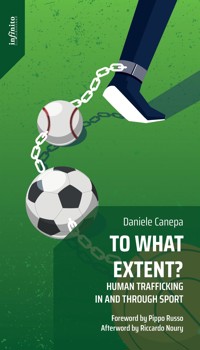
The athlete as a commodity to be bought or sold to make a profit and the athlete as a machine, from which the maximum possible performance is expected. It is in these two metaphors that the phenomenon known internationally as football trafficking has its roots, a definition that includes both cases of trafficking and human trafficking in football. The problem, which affects thousands of young people from economically poor areas, is also widespread in other sports. The most popular narrative attributes the blame to self-styled agents and intermediaries, who take advantage of the lack of education of young people who see football and sport as their only possibility of social mobility. However, the reality is much more complex, with responsibilities shared by all the players in the system - clubs, the media, federations and national and international political institutions and, sometimes, even the families of the children involved.
Das E-Book können Sie in Legimi-Apps oder einer beliebigen App lesen, die das folgende Format unterstützen:
Veröffentlichungsjahr: 2023
Ähnliche



















Daniele Canepa
To what extent?
Human trafficking in and through sport
Indice dei contenuti
Foreword
The Question at the Origin of the Problem
If Messi Were 13 Years Old Today
From Africa to Europe in 10 Steps
Academies
Not Only from Africa to Europe
Football and Migration - Recurring Historical Cycles
Not Only Football
Shared Responsibilities
Conclusions
Afterword
Acknowledgments
© Copyright Infinito edizioni, 2023
Foreword
by Pippo Russo
The dark side of the dream. Sport is a world that dispenses joy and positive feelings and football is the quintessence of it. It is the most beautiful game, certainly the most popular. It is even the fairest, thanks to the unpredictability of what happens on the pitch and equal access to the pitch for different social classes. But precisely because it is all of these things, football also risks being the cruellest of all games, the one in which the greatest dreams turn into the worst nightmares. Also because there are too many subjects who exploit its enormous popularity for their own interests, which are largely legitimate, but not insignificantly dubious, to the extent that they become explicitly cynical and criminal.
And here the short circuit occurs: on the one hand there is the dream of chasing a football on the pitches of the most important professional tournaments in the world. On the other hand there is the criminal cynicism of those who exploit this dream without worrying about causing suffering and humiliation. It is a crime against what is deepest in football: its humanity.
It is not easy to talk about this issue. It is not even a comfortable thing. We prefer to keep on telling uplifting stories of football, which leave its unpresentable aspects on the sidelines.
This is one of the reasons why Daniele Canepa's book is particularly worth reading. He ventures into the territories that remain in the shadow compared to those of the usual representation. But it also does much more, by associating personal stories with the overall picture of how the system works. It analyzes the socio-economic change in the football transfer market and connects it with the vast legal change that was triggered after the pronouncement of the Bosman ruling (December 15, 1995). It makes appropriate comparisons between football and other professional sports in which the transfer market of athletes and the routes of international migration are crucial factors. And above all, he focuses on that African sickness which is the worst sign of a bad conscience for world football. Canepa does this by looking at the continent that is struggling in football more than in any other industry. And it is precisely on this front that a new segment of exploitation is coming to the surface, close to a new type of slavery, to the detriment of those young players and their families dazzled by the dream and awakened in the nightmare.
The Question at the Origin of the Problem
“My dreams are two.
The first is to play a World Cup
and the second is to become world champion.”
(A teenage Diego Armando Maradona)
To what extent is it right to continue pursuing the dream of becoming a great footballer or a great sportsman?
The history of sport is rich with the tales of champions who were capable of transforming the setbacks and difficulties encountered at the beginning of their careers into motivations to push themselves on to becoming top players in their field. Michael Jordan didn't get through a trial at 15 to join a basketball team, and that experience prompted him to train even harder. Tom Brady, one of the greatest American football players of all time, got off to an uphill start because, on the University of Michigan roster that he was a member of, as many as six guys in his role were considered better than him. Roberto Baggio suffered a knee injury that put his career in jeopardy. He was only able to recover thanks to his unshakable determination and went on to become one of the most talented European footballers of the last 50 years.
But for every Maradona, Jordan, Brady or Baggio who “make it,” thousands of kids give up along the way. Some of them lack the necessary talent, others suffer injuries that compromise their careers and others cannot find the right environment, team-mates or coach to express their full potential. Whatever the reason, they are forced to turn towards other professional objectives and life goals, which can be very difficult if focusing everything on sport has meant, for instance, spending less time on friendships, family, studying or learning more about other interests.
If the discussion is limited to football, for a teenager today the competition is much more fierce than it was for the teenage Maradona who dreamt of the World Cup, and the chances of playing football at the highest level are very low. Statistically, if we take FIFA’s figures for the number of people playing football in the world — between 250 and 300 million — and we consider that the total number of players in the 5 best national leagues is equal to about 2,000, the success rate is equivalent to 0.0007 percent 1.
Then there is another aspect to consider: the more overwhelming the desire, the more one is ready to do anything to turn it into a reality. This can lead to decisions that, judged from the outside, could seem totally unreasonable, such as putting oneself in the hands of the wrong people, who are interested in exploiting those who want to achieve their goals at any cost, to their advantage.
Without this premise, it is difficult to understand the essence of football trafficking, an expression that refers to irregular migratory phenomena in or around the world of football.
There is also another element to consider. Imagine meeting a relative or friend of yours who tells you that they were sold by the company they work for to another company, in exchange for a certain amount of money. What reaction would you have? Surely indignation that your loved one has been “bought” just like you would buy a pair of jeans or a bunch of bananas. Yet, we do not flinch when we hear about the “transfer” of football players who are “bought” by a team in exchange for money. The commodification metaphor of the athlete has made us so addicted to the concept that we do not even realise its existence or how deeply entrenched it is in our way of conceiving football.
The fact that in football it is deemed normal to “buy,” “sell,” “send on loan” and “buy in co-ownership” human beings who are moved from one club to another, as you would do with pieces of furniture, is the ideal breeding ground on which football trafficking can thrive.
Is there, therefore, a “trafficking of footballers,” with criminal mechanisms similar to those of human trafficking aimed at organ trafficking or the exploitation of child labor and prostitution?
To answer this question, it is important to clarify what is meant by the word “trafficking”. According to the definition of the Protocol 2 on trafficking in human beings adopted by the United Nations (UN) and signed in Palermo in 2000, the term indicates:
“ The recruitment, transportation, transfer, harbouring or receipt of persons, by means of the threat or use of force or other forms of coercion, of abduction, of fraud, of deception, of the abuse of power or of a position of vulnerability or of the giving or receiving of payments or benefits to achieve the consent of a person having control over another person, for the purpose of exploitation.”
For the purposes of the issue we will address, it is also necessary to clarify the distinction between “trafficking” and “smuggling”. If, with international trafficking, the purpose is the exploitation of the migrant in the country of destination (as can be understood from the definition above), in the case of smuggling, the migrant and the trafficker generally stipulate an agreement that expires once the migrant arrives in their country of destination.
As we will see, the distinction between the two cases is not always clear, and in the particular case of football, it is often very subtle. Therefore, to speak exclusively of “trafficking” or “smuggling” in football would be inaccurate. For this reason, it seems more appropriate to use the expression “football trafficking,” as irregular migratory phenomena related to the world of football generally fall under this definition.
The use of these terms is not a futile distinction: the difference between trafficking and smuggling has a strong relevance in terms of punishment, or the severity of the sentence that is imposed on the person or persons found guilty of such crimes. The need for this distinction already gives us a glimpse into the complexity of the matter.
But which countries, and how many people, are involved in football trafficking?
The problem is widespread globally, as we will see through the experiences recounted by young people and adults more or less consciously involved in the phenomenon, and from the many testimonies of professionals who have lived in close contact with some of these young people.
On the other hand, providing a precise answer to the question relating to the amount of people involved is very difficult. In his investigative book, The Lost Boys - Inside Football's Slave Trade3 , author Ed Hawkins reports both the figure provided by the NGO Foot Solidaire, which calculated the involvement of about 7,000 young people a year starting in 2005, and the estimate of an official from the International Center for Sport Security, who made a more cautious evaluation, talking about between 2,000 and 3,000 children per year. Other sources 4 hypothesise that the phenomenon affects as many as 15,000 young people a year.
Whether one hypothesis or another is more correct, these numbers still convey an idea of the magnitude of the problem. In fact, taking even the most prudent figures into account, and considering that the phenomenon has been going on for more than 20 years, we would still reach a total of over 60,000 people.
It is difficult to have precise numbers for several reasons: let us anticipate them briefly.
Firstly, people who have fallen into the plots of football trafficking are often reluctant to come forward and give details about their experiences — the very concept of a “victim of football trafficking” will need to be further clarified. They have been victims of deception, false promises and fraud that have made them leave their homeland and loved ones and shattered their football dreams, and it is understandable how difficult it is for them to talk about a past that has left scars which are far from being healed.
There is also another aspect to consider: football moves huge amounts of money. In 2017, the turnover generated by the transfer of players alone amounted to 4.7 billion dollars, or more than 4 billion euros. I repeat, we are only talking about the money of the so-called “transfer market.”
An industry with such strong interests to protect tends to be reluctant to speak, and hardly leaves room for uncomfortable questions that could threaten its privileged position.
It is, therefore, no coincidence that literature and inquiries regarding football trafficking are still scarce, at least in proportion to the scope of the issue, just as it is no coincidence that some of the people I spoke to during my research for this book preferred to remain anonymous or appear under a pseudonym for fear of retaliation.
The expression “football industry” should also be understood in a broader sense. The billionaire interests of football are not only those of the clubs and their members, but also of everything that revolves around them, or that makes them move, depending on the point of view. To maintain the support of the people who purchase television subscriptions or click on the websites of the industry, it is necessary that the football system has an apparent respectability. We can therefore understand the reluctance of most of the media to investigate an uncomfortable phenomenon such as the trafficking and smuggling of young players.
“The issue exists, but it’s preferred to look elsewhere because too many parties are involved, inside and outside of sport,” says Lerina Bright, founder of Mission 89, an NGO created to raise awareness and educate on the problem of human trafficking in sport. In other words, the lid must remain sealed if there is suspicion that the contents are unwelcome among the public.
The result is a vicious circle whereby if a problem is not talked about, if it is given only little room or if it is difficult to access, it is as if it does not exist, and if it does not exist or is considered marginal, it is rarely the object of research.
But continuing to pretend that football is only confined to the playing pitch and to the goals scored in a match is tantamount to thinking that the ocean is just the crest of the wave, while the existence of underwater currents is ignored. Football is also the final score of last night's derby, the spectacular volley kick of a champion, the winning tactical move of a coach or the obvious penalty not awarded. But it is even more than that, and talking about football trafficking is a duty not only towards the young victims of the “football system,” but also towards the game itself.
Instead of threatening the good name of football and sport - as we will see, the problem does not only concern the sport that Americans call soccer - a deeper understanding of the phenomenon is needed in order to have a greater awareness of its interdisciplinary character, including the many elements of history, geography, economics, sociology and culture that it calls into question and that make it a human phenomenon which is, in spite of everything, still so interesting and popular.




