


8,99 €
Mehr erfahren.
- Herausgeber: Plexus Publishing Ltd.
- Kategorie: Lebensstil
- Sprache: Englisch
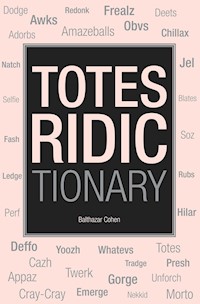
The Totes Ridictionary will help you survive life in a world where textmessage abbreviations and Twitter slang are dancing on the grave of the Oxford New English Dictionary. Everywhere you look – in emails, tweets, Facebook posts, text messages, blogs and even real-life conversations – words like'totes', 'amazeballs', 'obvs', 'adorbs' and 'ridic' are taking over. You've heard it, now understand it. Packed with 'hilar' illustrations and a satirical glossary that'll help you sort the 'jel' from the 'awks', The Totes Ridictionary takes a totally ridiculous look at what happens when language and technology collide.
Das E-Book können Sie in Legimi-Apps oder einer beliebigen App lesen, die das folgende Format unterstützen:
Veröffentlichungsjahr: 2014
Ähnliche


















CONTENTS
INTRODUCTION
“OMG! That’s Totes Ridic!”
THE INTERNET: WHERE LANGUAGE GOES TO DIE
Totes, amazeballs, adorbs, obvs. If you have an internet connection, chances are that you have at least a passing acquaintance with abbreviations such as these. And if you regularly spend time on social-networking sites like Twitter and Facebook, chances are that said abbreviations are either the bane of your life, or your second language.
If you like it, Beyoncé once sagely advised, put a ring on it. Online these days, it’s more a case of: if you like it, put a hashtag on it, abbreviate it, retweet it, or Instagram the shit out of it. We’re living through our phones and computers like never before, and, with little concern for sounding like speech-impaired halfwits, more and more of us are mixing up our typing and talking voices. (Particularly if we’re aged between 16 and 35 and nurse an iPhone addiction alongside a mild drinking problem.) It’s obvs totes ridic, but how did it get that way?
In the beginning, it was text messages. The average texter, whether jostling for space at a bar or on a train platform, running between meetings at the office, en route to the gym, or thumbing their phone under the desk during geography class, soon learned that brevity was the name of the game. Why waste your time executing six laborious button-pressings when two could just as easily suffice?
Thus, the population’s time-starved and phone-addicted – or simply those for whom correct spelling had never meant a great deal – began using abbreviations and acronyms of everyday words and phrases in their mobile-to-mobile communications.
There wasn’t a sentence or sentiment out there that couldn’t be simpler, shorter, faster. Thousands of words and expressions were nipped and tucked to order. “Are you okay?” became “R U OK?”. “Great. See you later” was whittled down to “Gr8 C U l8r”. “Have a good weekend” was sliced and diced until only “HV a GD WKND” remained. The dictionary went under technology’s knife and experienced dramatic weight loss – getting the bikini body it had always craved, but at what cost?
Our global dependence on email only served to quicken the disintegration of the English language’s self-image, and it wasn’t long before the World Wide Web often resembled little more than a churning digital whirlpool of ROFLs, LOLs, OMFGs, FFSs, FTWs, and NSFWs* – one that threatened to rob punctuation-lovers and sticklers for spelling of their sanity. (*For the uninitiated: Roll On the Floor Laughing, Laugh Out Loud, Oh My Fucking God, For Fuck’s Sake, For The Win, and Not Safe For Work.)
By the time social networking sites such as MySpace, Facebook and Twitter had successfully invaded our lives – used by everyone from pop stars to politicians – it sometimes seemed that abbreviations and acronyms were threatening to outnumber actual words, certainly online, but all too often in reality as well. Humanity spent half its time on the internet – gossiping, flirting, networking, self-promoting – but computers and phones alone couldn’t contain the constantly-mutating dialect they’d helped create.
“Oh my god” (spoken) had become “OMG” (written), only, several years down the line, to become “oh em gee” (spoken). It became, if not strictly acceptable, then certainly not unusual to hear someone deliver a deadpan “lol” mid-conversation. Totally originally rose to bored-sounding prominence on the lips of Californian valley girls in the 1980s; now totes, its syllabically-slimmed down modern equivalent, peppers the speech of social-network users worldwide. The boundaries between internet slang and plain old slang have blurred. The minimalist half-language of the Facebook status update can just as easily emerge from a mouth as appear on a screen.
Thanks to Twitter’s 140-character word limit, it soon seemed that – along with a thesaurus’s worth of online acronyms – abbreviations (or abbrevs) were here to stay. Obvs (obviously), def (definitely), jel (jealous), hilar (hilarious) – people often talked in the same way they texted and tweeted. It may have been ironic, or in the spirit of self-parody, or simply because everyone else was doing it – but whatevs, soon it was everywhere. In playgrounds and offices, in coffee shops and bars, on radio and television, you’d be hard pressed to find someone who hadn’t heard or used the defining phrase: “That’s totes ridic!”
So whether you’re a 24/7 tweeter used to communicating solely through emoticons, or a self-confessed technophobe who thinks the English language died along with Dickens, you’ll find something here to amuse you, inform you, or cause you to roll your eyes in recognition. Packed with an acid-tongued glossary of key abbreviations used by Totes Ridicheads, Facebook-addicted household pets, smartphone-savvy pop art, a totes-ridic reimagining of classic films, and the Twitter conversations of history and literature’s most argumentative couples, The Totes Ridctionary takes a skeptical and humorous look at the absurdities of language in the internet age.
So put the “amaze” in “balls” and prepare yourself. It’s time to become fluent in Totes Ridicularity.
TOTES RIDIC GLOSSARY
EVERYTHING’S ABBREVIATED
Abso: absolutely
Not to be confused with an ASBO (a British anti-social behaviour order commonly slapped on individuals prone to public displays of profanity and debauchery), abso is an abbreviation of absolutely. You might, for example, get abso smashed on Absolut Vodka. (Or whisky. Or tequila. Anything to numb the pain, really.)
“I abso love what you’ve done with this place.”
Adorbs: adorable
Instagram photos of babies in cute outfits, Tumblr pages devoted entirely to pug puppies, Facebook albums documenting trips to petting zoos, Ryan Gosling generally – all these things are adorbs. Because, sometimes, the additional letters necessary to form its less on-trend older brother, adorable, are more trouble than they’re worth. Particularly if you’re about to go over your 160-character text-message limit.
“OMG! Zayn tweeted a photo of Harry sleeping on the plane! That’s adorbs.”
Amazeballs: amazing
An adjective popularized by celebrity gossip blogger Perez Hilton and beloved of people who aren’t bothered if words don’t make sense, or simply enjoy wrapping their lips around an unnecessary set of balls. When something is so amazing that it grows a metaphorical pair of testicles, it is amazeballs.




