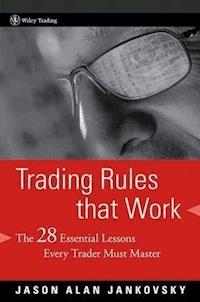
Table of Contents
Title Page
Copyright Page
Epigraph
Acknowledgments
Introduction
HOW THIS BOOK IS ORGANIZED
BEFORE YOU BEGIN
PART I - Getting in the Game
RULE #1 - Know Your Game
RULE #2 - Have a Trading Plan
SO HOW DO I CREATE A SOUND TRADING PLAN?
RULE #3 - Think in Terms of Probabilities
RULE #4 - Know Your Time Frame
FINDING CONGRUENCY IN YOUR TIME FRAME
WHICH TRADER ARE YOU?
PART II - Cutting Losses
RULE #5 - Define Your Risk
RULE #6 - Always Place a Protective Stop
MOVABLE STOPS
RULE #7 - Your First Loss Is Your Best Loss
RULE #8 - Never Add to a Loser
RULE #9 - Don’t Overtrade
PART III - Letting Profits Run
RULE #10 - Keep Good Records and Review Them
RULE #11 - Add to Your Winners
RULE #12 - Use Multiple Time Frames
RULE #13 - Know Your Profit Objective
RULE #14 - Don’t Second-Guess Your Winners
PART IV - Trader Maxims
RULE #15 - Know the Limits of Your Analysis
RULE #16 - Trade with the Trend
WHAT IS A TREND?
UPTREND
DOWNTREND
RANGE
BENEFITS OF CLEARLY APPRAISING TREND
RULE #17 - Use Effective Money Management
RULE #18 - Know Your Ratios
RULE #19 - Know When to Take a Break
RULE #20 - Don’t Trade the News
RULE #21 - Don’t Take Tips
RULE #22 - Withdraw Equity Regularly
RULE #23 - Be a Contrarian
RULE #24 - All Markets Are Bearish
RULE #25 - Buy/Sell 50% Retracements
HOW TO USE THE RULE
RULE #26 - The Only Indicator You Need
RULE #27 - Study Winning Traders
RULE #28 - Be a Student of Yourself
Conclusion
Recommended Reading
About the Author
Index
Founded in 1807, John Wiley & Sons is the oldest independent publishing company in the United States. With offices in North America, Europe, Australia, and Asia, Wiley is globally committed to developing and marketing print and electronic products and services for our customers’ professional and personal knowledge and understanding.
The Wiley Trading series features books by traders who have survived the market’s ever changing temperament and have prospered—some by reinventing systems, others by getting back to basics. Whether a novice trader, professional, or somewhere in-between, these books will provide the advice and strategies needed to prosper today and well into the future.
For a list of available titles, visit our web site at www.WileyFinance.com.
Copyright © 2007 by Jason Alan Jankovsky. All rights reserved.
Published by John Wiley & Sons, Inc., Hoboken, New Jersey.
Published simultaneously in Canada.
No part of this publication may be reproduced, stored in a retrieval system, or transmitted in any form or by any means, electronic, mechanical, photocopying, recording, scanning, or otherwise, except as permitted under Section 107 or 108 of the 1976 United States Copyright Act, without either the prior written permission of the Publisher, or authorization through payment of the appropriate per-copy fee to the Copyright Clearance Center, Inc., 222 Rosewood Drive, Danvers, MA 01923, (978) 750-8400, fax (978) 646-8600, or on the web at www.copyright.com. Requests to the Publisher for permission should be addressed to the Permissions Department, John Wiley & Sons, Inc., 111 River Street, Hoboken, NJ 07030, (201) 748-6011, fax (201) 748-6008, or online at http://www.wiley.com/go/permissions.
Limit of Liability/Disclaimer of Warranty: While the publisher and author have used their best efforts in preparing this book, they make no representations or warranties with respect to the accuracy or completeness of the contents of this book and specifically disclaim any implied warranties of merchantability or fitness for a particular purpose. No warranty may be created or extended by sales representatives or written sales materials. The advice and strategies contained herein may not be suitable for your situation. You should consult with a professional where appropriate. Neither the publisher nor author shall be liable for any loss of profit or any other commercial damages, including but not limited to special, incidental, consequential, or other damages.
For general information on our other products and services or for technical support, please contact our Customer Care Department within the United States at (800) 762-2974, outside the United States at (317) 572-3993 or fax (317) 572-4002.
Wiley also publishes its books in a variety of electronic formats. Some content that appears in print may not be available in electronic books. For more information about Wiley products, visit our web site at www.wiley.com.
Library of Congress Cataloging-in-Publication Data:
Jankovsky, Jason Alan, 1961-
Trading rules that work : the 28 essential lessons every trader must master / Jason Alan Jankovsky.
p. cm.—(Wiley trading series)
Includes bibliographical references and index.
ISBN-13 978-0-471-79216-1 (cloth) ISBN-10 0-471-79216-0 (cloth)
1. Speculation. 2. Investment analysis. 3. Futures. 4. Foreign exchange.
I. Title. I. Series.
HG6015.J36 2007
332.64—dc22
2006014076
The fault, dear Brutus, is not in our stars, but in ourselves, that we are underlings.
—William Shakespeare
Acknowledgments
Special thanks to those helped me stay focused on completing this manuscript on time: my editor, Kevin Cummins, who just let me work but reminded me that deadlines are part of the business; Emilie Herman at Wiley for being so patient with my lack of computer skills and endless questions; the staff at Infinity Brokerage and ProEdgeFX, who allowed me to work after hours with company equipment to finish the manuscript; Jim Cagnina and Jim Mooney at Infinity, who encouraged Wiley to sign with me even though this was my first real publishing opportunity; and my family, who encouraged me to stay with it when the work seemed overwhelming. Thank you all.
Introduction
My editor, Kevin Commins, and I were in the company conference room having a discussion about new book ideas. He wanted to publish a quality book on trading rules and had seen the 50 rules my company had published on its web site as a great starting point. Could we expand those basic ideas and produce a book on trading rules?
The owners were interested but really didn’t have the time to commit. I told Kevin that the reason so few good books on trading rules were out there is because trading rules are more like guidelines and completely subjective; in my opinion most of the rules don’t work anyway because most traders don’t know how to use them. He was surprised to hear that point of view, but he was open to seeing something different. We discussed the concept a bit, and that became the basis for this book—answering the question, “Why don’t the rules work?”
I discovered that is not an easy question to answer. For the first few months I had notes all over my home and office but nothing you could call a manuscript. After giving it substantial thought, I decided on a pathway of sorts to offer the reader a fair answer to “Why don’t the rules work?”
At the core level, all the trading rules, guidelines, trader maxims, or insights are a factor of trader psychology and market psychology. The markets provide the illusion of unlimited opportunity and complete freedom to pursue it; “rules” and behavior controls seem to be in opposition to that idea. It is only after we as traders get beaten up by the markets for a period of time do we begin to have the light go on. “Cut your losses” is not a rule, it is a point of view that leads to protecting yourself. But what exactly does that mean for me personally, and why do I need protection from myself? Why don’t I follow the rules?
In Edgar Allan Poe’s short story “The Purloined Letter,” he tells of a thief who has outwitted the best efforts of the police to recover a stolen document. As the story unfolds it becomes apparent to one of the outside observers that the letter must be hidden in plain sight; otherwise the police would have found it by that time seeing as no effort was spared in ransacking the home of the thief, nor was it ever found by his direct arrest and search. Working from this hypothesis, this observer was able to retrieve the stolen letter on his second visit to interview the thief; the letter was indeed “hidden in plain sight.”
The rules of trading are much like that stolen letter. We often accept the various rules that have been taught to us as traders, but the psychology behind those rules is so inherently assumed that we overlook it. The psychology that really makes those rules work is often hidden in plain sight. As traders, we all would agree that properly applying the rules will help us better achieve consistent trading success, and we all know from personal experience that breaking the rules has cost us money in the markets. None of us want to admit we break the rules (and some of us don’t even want to admit we need rules). So why don’t we follow the rules?
The purpose of this book is to outline the deeper psychology behind most of the accepted trading rules and provide you, the individual trader, a better understanding of how to make your rules work. The rules are actually guidelines grouped into four separate parts; the underlying, basic psychology of each individual part is explored as each rule guideline is shown in proper context. As most traders know, there are literally unlimited ways of interpreting price action, choosing execution points, or formulating a hypothesis of general market conditions or potential price action. The intention is not to provide you with another trading system—God knows there are enough of those—but rather provide you a way of showing you two things to improve your trade approach: how you think and how the market thinks.
When you stop and realize that most traders have net losses, yet we all know the rules, what could possibly be the defining factor that separates the winning trader from the losing trader? I believe that there is no clear and definitive answer to that, other than one trader consistently follows the rules he has adopted for himself and the other trader doesn’t; or worse yet has no rules. Because there is an unlimited number of ways to participate, I think the crucial issue is to find a way to personally apply the rules in a unique way that will work for you, and then do it all the time. It’s easy to say “Cut your losses,” but every trader will have a different way of defining that for themselves. The purpose of this book is to help you better define your personal trade approach by helping you interpret and apply the rules in a way that will work for your trading style. The rules are not the problem; it is making the rules work for you that is the problem.
HOW THIS BOOK IS ORGANIZED
The first step is getting a firm grip on exactly what you are doing when you participate. Part I, “Getting in the Game,” outlines the psychology of market price action, what that can only mean as far as your trade selection is concerned, and how to begin from the point of a strong market presence. Trading is not as simple as “buy low-sell high” it is learning to understand the how and why behind price movement and how to participate proactively without letting prices make your decision for you. You must buy weakness and sell strength to successfully trade, even if another trader would call that “picking tops or bottoms.” Your trade plan is a critical part of developing a mind-set that uses prices rather than reacting to them. Part of this process is learning to think in terms of probabilities, because no trading approach can be 100% accurate 100% of the time; that is not realistic for anyone. So Part I details what the game really is and how you can better participate from a more unbiased point of view.
Part II is “Cutting Losses.” Every trader has had losses, and every trader still participating every day will tell you how important cutting losses is for the long-term health of a trading account. In this section we explore the underlying psychology of the rules of self-protection and why it is so hard to enforce this much-needed protection for ourselves. Many traders have a subconscious need to be “right” and will not liquidate a losing trade quickly. Even if you are not one of those traders, you will have something in your personal trade approach that makes it difficult to cut losses quickly under certain conditions. Developing a set of personal trade rules uniquely designed for your trading style will help you protect yourself—even when it is emotionally difficult to do so. Sooner or later, you will meet your Waterloo if you have failed to develop and enforce rules designed for your protection. Knowing when you are setting yourself up for a loss, and what to do if you are already in the market when you discover that fact, is a huge part of cutting losses. Sometimes your protection strategy will dictate that it is simply better not to trade. Having all these options clear in your trade approach is half the battle.
Part III explores the opposite dynamic: “Letting Profits Run.” Every trader at one time or another has liquidated a winning trade, only to see that trade continue farther and farther in his favor. By applying a simple rule or two to remain in a winning trade, that trader might have taken a huge win from the market. Letting a profit run involves different things for each trader, but the underlying psychology is the same for everyone. Learning to develop an ever-expanding rule structure can help you hold your winners until the market has run out of potential in your favor; and that is rarely a function of price. Rather, it is related to the net order flow behind the price. Knowing when order flows are running out of potential for a winning trade is more important than the price at which it happens. Tracking this will involve multiple time frames, so a solid understanding of how those time frames are interrelated will help you write personal rules to maximize a winning trade.
Part IV is “Trading Maxims.” In Part IV we look at the some of the most common trading rules and how they have both negative and positive psychological implications. Some of these rules will simply not work for you personally, but because they make sense initially you might be tempted to adopt them into your trade approach. This is frustrating at best and self-destructive at worst. Some of these trade rules work best only under certain market conditions and should be used only under those conditions or not at all. The underlying problem with most of these rules is that while they all sound good at first, they are often misunderstood in relation to time frames or the psychology of your personal trade approach. Sometimes they are simply in conflict with your overall style.
For example, the trading rule “Buy the strongest member of the complex” is not a rule that would work well for a day trader. This rule was originally used by position traders attempting to diversify across the underlying strength of something like the grain complex. Not knowing which of the grains may advance farthest for the underlying bullish scenario, traders would buy all of them and leverage a little farther in the strongest potential performer. In this case, anticipating a drought, they would buy corn, soybeans, and wheat but buy a bit more soybeans because soybeans traditionally will move several dollars a bushel more during a drought than corn or wheat might. If you are not trading for the pull in the grains under those conditions, a modest correction in the soybeans will most likely take you out or cause a loss on the buy side, because soybeans have traditionally been subject to extreme volatility, more so than corn or wheat. Buying the break for a day trade (in the strongest performer) could easily be the worst move possible for a day trader if that market went offer shortly after your entry. In that illustration, the trade rule doesn’t work.
I’m not suggesting that you refrain from using a rule that you find valuable, but I think a solid understanding of what the rule was developed for, how successful traders use it, and whether your time frame could use it as well is a great way to determine if you could make that rule work for you personally.
In the final analysis, making the rules work is really about knowing your personal psychology and your market’s psychology well enough that you do two things every day: Limit your potential to hurt yourself, and maximize your market’s potential to pay you. Knowing the underlying psychology behind the rules will help, as well as personal study to apply them properly. During the time of your trader development you will most likely come to the same conclusion most successful traders have: The rules are unique to each trader, but every trader follows the same guidelines. All of the various rules, insights, guidelines, and trader maxims work together to do two things: prevent the trader from hurting himself, and allow the trader to get paid the most for his approach.
BEFORE YOU BEGIN
Before we get started, I would like to illustrate how this understanding helped me improve my personal trade approach. As a young trader, I would often shoot from the hip—I would make a snap judgment based on my point of view and execute instantly. Because I had no real rules for execution, I did my share of jumping the gun on trades that eventually would have worked from that side, had I waited. Once I learned to follow Rule #10, “Keep good records and review them,” I discovered that I was often correct on my initial observation about net price action, but being a day or two early (breaking Rule #4, “Know your time frame”) I was often stopped out for a loss just before the market would turn. After this happened several times, I would simply execute again immediately at my stop price for a reentry, resulting in another small loss as my tighter but deeper stop was elected (breaking Rule #7, “Your first loss is your best loss”). This would happen six or seven times (breaking Rule #9, “Don’t overtrade”) as the market went a significant distance against my original execution; then the market would turn. I would hold the winner but I would need to overcome a major loss to my equity before the trade had a net gain. On a 200-point move in Japanese yen, for example, I would net only 30 to 40 points because I had a 150-point deficit to overcome first.
After reviewing my notes, my observations, and my execution history, I decided that my skill at observing a trade was not the issue. My timing was usually a day or two early. I made a new rule for myself: “If I have three losses in a row, I cannot trade for 24 hours.” If my first three attempts to buy what I felt was a sell-off were losers, usually I would get another chance right in the same area or better within a day or so. By disciplining my execution in this manner, I would save myself three or four more losers, finally obeying the rules in Part II, and then I was often able to use the rules in Part III. Nothing really changed in my trade selection or my analysis, but following the rules better allowed me to get into position better and stay there better. I learned to make the rules work for me personally. The money to be made was always there.
PART I
Getting in the Game
RULE #1
Know Your Game
The longest journey begins with the first step.
—Lao Tzu, in the
Lesen Sie weiter in der vollständigen Ausgabe!
Lesen Sie weiter in der vollständigen Ausgabe!
Lesen Sie weiter in der vollständigen Ausgabe!
Lesen Sie weiter in der vollständigen Ausgabe!
Lesen Sie weiter in der vollständigen Ausgabe!
Lesen Sie weiter in der vollständigen Ausgabe!
Lesen Sie weiter in der vollständigen Ausgabe!
Lesen Sie weiter in der vollständigen Ausgabe!
Lesen Sie weiter in der vollständigen Ausgabe!
Lesen Sie weiter in der vollständigen Ausgabe!
Lesen Sie weiter in der vollständigen Ausgabe!
Lesen Sie weiter in der vollständigen Ausgabe!
Lesen Sie weiter in der vollständigen Ausgabe!
Lesen Sie weiter in der vollständigen Ausgabe!
Lesen Sie weiter in der vollständigen Ausgabe!
Lesen Sie weiter in der vollständigen Ausgabe!
Lesen Sie weiter in der vollständigen Ausgabe!
Lesen Sie weiter in der vollständigen Ausgabe!
Lesen Sie weiter in der vollständigen Ausgabe!
Lesen Sie weiter in der vollständigen Ausgabe!
Lesen Sie weiter in der vollständigen Ausgabe!
Lesen Sie weiter in der vollständigen Ausgabe!
Lesen Sie weiter in der vollständigen Ausgabe!
Lesen Sie weiter in der vollständigen Ausgabe!
Lesen Sie weiter in der vollständigen Ausgabe!
Lesen Sie weiter in der vollständigen Ausgabe!
Lesen Sie weiter in der vollständigen Ausgabe!
Lesen Sie weiter in der vollständigen Ausgabe!
Lesen Sie weiter in der vollständigen Ausgabe!
Lesen Sie weiter in der vollständigen Ausgabe!
Lesen Sie weiter in der vollständigen Ausgabe!
Lesen Sie weiter in der vollständigen Ausgabe!
Lesen Sie weiter in der vollständigen Ausgabe!
Lesen Sie weiter in der vollständigen Ausgabe!