


32,99 €
Mehr erfahren.
- Herausgeber: John Wiley & Sons
- Kategorie: Fachliteratur
- Serie: ASAE/Jossey-Bass Series
- Sprache: Englisch
There has never been so much pressure on nonprofit boards of directors to achieve a level of accountability that meets public and stakeholder expectations. Member-serving association boards may be especially challenged by their more complex affiliate structures and a greater emphasis on representative governance. But what does the journey to good governance look like? Markedly different from existing board development books, this modern approach focuses less on the behaviors and qualities of "high-performing boards" and more on the stages and processes that directors and their staff used to transform their boards. Based on research funded by the ASAE Foundation, the book fills a gap in the governance literature by emphasizing diagnosis and problem solving, using the actual tools and activities implemented by 85 transformed associations. Combining the credibility of scholarly research with lively and compelling stories, tools, and teachable moments, this book is designed to help associations and other nonprofit organizations achieve the entire journey to good governance, from first to last steps.
Sie lesen das E-Book in den Legimi-Apps auf:
Seitenzahl: 333
Veröffentlichungsjahr: 2015
Ähnliche


















CONTENTS
Cover
Title Page
Copyright
Foreword
Acknowledgments
Introduction and Study Design
Why Another Book on Governance?
Study Design
Organization of This Book
Terminology Used in This Book
Chapter 1: Where Does Board Change Begin?
Concepts and Application
Understanding the Nature of Change
Types of Change
Change Models
Change and Life-Cycle Theories
Summary
Chapter 2: Change and People
Concepts and Application
Using Organizational Culture to Support Recipients of Change
Using Emotional Intelligence to Support Recipients of Change
Habitualizing Change
Summary
Chapter 3: Catalysts and Watersheds
Concepts and Application
Summary
Chapter 4: Implementing Change
Concepts and Application
Dealing with Obstacles
Summary
Chapter 5: Leading Sideways: Influencing Change within the Board
Concepts and Application
Summary
Chapter 6: Leading Up: The CEO’s Opportunity
Concepts and Application
Summary
Chapter 7: Leading Forward: The Board Chair's Opportunity
Concepts and Application
Summary
Chapter 8: Working with External Consultants
Concepts and Application
Summary
Chapter 9: Getting the Most from Assessment and Evaluation
Concepts and Application
Summary
Conclusion: Strategies and Resources for Success
Summary
Appendix: Tools and Resources
Tools
Team Ground Rules
Sample Communications Guidelines
Board Member Agreement
Board Orientation
Board of Directors' Meeting Evaluation Form
Resources
References
About the Authors
Index
End User License Agreement
List of Tables
Table 1.1
Table 2.1
Table 3.1
Table 3.2
Table 3.3
Table 4.1
Table 4.2
Table 4.3
List of Illustrations
Figure 1.1
Figure 1.2
Figure 2.1
Figure 5.1
Figure 5.2
Figure 5.3
Figure 5.4
Figure 5.5
Figure 6.1
Figure I.1
Figure I.2
Guide
Cover
Table of Contents
Begin Reading
Chapter 1
Pages
i
ii
v
vi
vii
viii
x
xi
xii
xiii
xiv
xv
xvi
xvii
xviii
xix
xx
xxi
xxii
xxiii
xxiv
xxv
xxvi
1
2
3
4
5
6
7
8
9
10
11
12
13
14
15
16
17
18
19
20
21
22
23
24
25
26
27
28
29
30
31
32
33
34
35
36
37
38
39
40
41
42
43
44
45
46
47
48
49
50
51
52
53
54
55
56
57
58
59
60
61
62
63
64
65
66
67
68
69
70
71
72
73
74
75
76
77
78
79
80
81
82
83
84
85
86
87
88
89
90
91
92
93
94
95
96
97
98
99
100
101
102
103
104
105
106
107
108
109
110
111
112
113
114
115
116
117
118
119
120
121
122
123
124
125
126
127
128
129
130
131
132
133
134
135
136
137
138
139
140
141
142
143
144
145
146
147
148
149
150
151
152
153
154
155
156
157
158
159
160
161
162
163
164
165
166
167
168
169
170
171
172
173
174
175
176
177
178
179
180
181
182
183
184
185
186
187
188
189
190
191
192
193
194
195
196
197
198
199
200
201
202
203
204
205
206
207
208
209
210
211
212
213
214
215
216
217
218
219
220
221
222
223
224
225
226
227
228
229
230
231
232
233
234
235
236
237
238
239
240
241
242
243
244
245
246
247
248
249
250
251
252
253
254
255
256
257
258
259
260
261
262
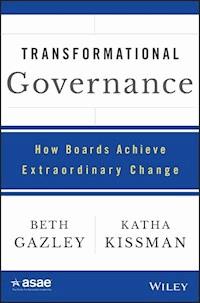
Transformational Governance
How Boards Achieve Extraordinary Change
Beth Gazley and Katha Kissman
Cover design: Wiley
Copyright © 2015 by The American Society of Association Executives. All rights reserved.
Published by John Wiley & Sons, Inc., Hoboken, New Jersey.
Published simultaneously in Canada.
No part of this publication may be reproduced, stored in a retrieval system, or transmitted in any form or by any means, electronic, mechanical, photocopying, recording, scanning, or otherwise, except as permitted under Section 107 or 108 of the 1976 United States Copyright Act, without either the prior written permission of the Publisher, or authorization through payment of the appropriate per-copy fee to the Copyright Clearance Center, 222 Rosewood Drive, Danvers, MA 01923, (978) 750-8400, fax (978) 646-8600, or on the web at www.copyright.com. Requests to the Publisher for permission should be addressed to the Permissions Department, John Wiley & Sons, Inc., 111 River Street, Hoboken, NJ 07030, (201) 748-6011, fax (201) 748-6008, or online at www.wiley.com/go/permissions.
Limit of Liability/Disclaimer of Warranty: While the publisher and author have used their best efforts in preparing this book, they make no representations or warranties with respect to the accuracy or completeness of the contents of this book and specifically disclaim any implied warranties of merchantability or fitness for a particular purpose. No warranty may be created or extended by sales representatives or written sales materials. The advice and strategies contained herein may not be suitable for your situation. You should consult with a professional where appropriate. Neither the publisher nor the author shall be liable for damages arising herefrom.
For general information about our other products and services, please contact our Customer Care Department within the United States at (800) 762-2974, outside the United States at (317) 572-3993 or fax (317) 572-4002.
Wiley publishes in a variety of print and electronic formats and by print-on-demand. Some material included with standard print versions of this book may not be included in e-books or in print-on-demand. If this book refers to media such as a CD or DVD that is not included in the version you purchased, you may download this material at http://booksupport.wiley.com. For more information about Wiley products, visit www.wiley.com.
Library of Congress Cataloging-in-Publication Data:
Gazley, Beth, 1961–
Transformational Governance: how boards achieve extraordinary change/Beth Gazley and Katha Kissman.
Pages cm
Includes bibliographical references and index.
ISBN 978-1-118-97672-2 (hardback); ISBN 978-1-118-97674-6 (ebk);
ISBN 978-1-118-97673-9 (ebk)
1. Boards of directors. 2. Nonprofit organizations—Management. 3. Organizational change. 4. Corporate governance. I. Kissman, Katha. II. Title.
HD2745.G39 2015
658.4′22—dc23
2015005241
Foreword
In my work with BoardSource, I often interact with individuals who are skeptical about the role that boards can play in advancing an organization's mission. Experiences with underperforming or dysfunctional boards have left them unconvinced about the positive value and potential for boards. They cite ineffective meetings, toxic interpersonal dynamics, and other all-too-common board frustrations; and they challenge the idea that investing in building an exceptional board is worth it, or even possible.
In our work, we aim to overcome this pessimism about the potential for boards and provide support to boards that are committed to strengthening their own impact. And each and every day we see boards that are making impressive and important leaps forward as they work to build their leadership potential and serve their missions better.
But the unfortunate fact remains that truly exceptional board leadership is not the norm—a reality documented in BoardSource's report, Leading with Intent: A National Index of Nonprofit Board Practices 2015. Leading with Intent found that, overall, boards received a performance rating average of B minus. This underwhelming review of board performance helps explain the uphill battle that we face when challenging boards to aspire for truly exceptional leadership. More nonprofit leaders—board and staff alike—have experienced poor or mediocre board performance than have seen the transformational potential of a truly exceptional board.
That is why the stories of transformative change outlined in Transformational Governance: How Boards Achieve Extraordinary Change are so powerful. They are proof positive that investing the time and energy that it takes to build a strong and effective board is not only possible, but worth it. The organizations profiled are on the other side of that hard work and can point to stronger financial results, more engaged membership communities, and more satisfied executive leadership as a result of the investment that they have made in thoughtful and intentional board change.
Transformational Governance is not, however, about defining a desired outcome and mapping the path to get there. Instead, it is a study of the path itself.
It paints a picture of what the process of transformative change can look like for a nonprofit board. Carefully documented case studies are presented against a backdrop of quantitative research on high-performing association boards and useful frameworks for understanding change and human behavior.
It shares how boards have been able to move past “the way things have always been” to find a new way of leading their organizations into the future. And it offers practical guidance and first-person advice about how to identify, build the case for, and implement change at the board level.
The insights and practical guidance that Transformational Governance provides enable each nonprofit leader to gather their own observations and ideas for creating board change, and offer tangible suggestions about how to anticipate and overcome potential road blocks. Drawing heavily from established frameworks for leading change, the book connects readers with a broader community of change leaders, and builds confidence that positive, mission-focused, and results-oriented change is possible.
The heroes in the book are the board and staff leaders who share—with tremendous vulnerability and candor—what it took for their boards to transform themselves. As you read their stories, you are invited into the challenges, frustrations, and eventual successes of their change processes. They share what worked and what to watch out for, what they wish they had known and what they might have done differently. The experience of reading their stories leaves you with the feeling that you've received trusted counsel from a friend or colleague.
They also share why their investment in board change was worth it, how it positioned them to serve their missions and their members better, how it enabled them to embrace new opportunities or address longstanding issues, and in many cases, why they wish they had started their change process sooner.
As a result of their transformative changes, many of the nonprofit leaders profiled also reported a new orientation to change itself. Instead of viewing themselves as being at the end of a change process, they had embraced change as a way of being. They described a new culture of openness and dynamism, a commitment to flexible and adaptive leadership, and an awareness that truly exceptional board leadership means never being done growing and changing.
That is the challenge to each of us as readers. Transformational Governance is a hopeful and optimistic statement about the power of nonprofit board leadership. And it is a gentle but powerful call to action to nonprofit leaders. Strong board leadership is not only possible; it is worth the effort. And it's what our missions deserve.
Anne Wallestad
President and CEO
BoardSource
Acknowledgments
This book came about due to the vision and stewardship of the ASAE Foundation and John Wiley & Sons, Inc. In particular, the authors would like to thank Keith Skillman, CAE, vice president, publications, ASAE; Sharon Moss, PhD, CRA, CAE, chief research officer, and Chelsea Killam, director, research, both of the ASAE Foundation, along with the members of the ASAE Research Foundation Research Committee; and also Alison Hankey, former executive editor, Business Management, John Wiley & Sons, and Matthew Davis, senior editor, Wiley Business.
Lesen Sie weiter in der vollständigen Ausgabe!
Lesen Sie weiter in der vollständigen Ausgabe!
Lesen Sie weiter in der vollständigen Ausgabe!
Lesen Sie weiter in der vollständigen Ausgabe!
Lesen Sie weiter in der vollständigen Ausgabe!
Lesen Sie weiter in der vollständigen Ausgabe!
Lesen Sie weiter in der vollständigen Ausgabe!
Lesen Sie weiter in der vollständigen Ausgabe!
Lesen Sie weiter in der vollständigen Ausgabe!
Lesen Sie weiter in der vollständigen Ausgabe!
Lesen Sie weiter in der vollständigen Ausgabe!
Lesen Sie weiter in der vollständigen Ausgabe!
Lesen Sie weiter in der vollständigen Ausgabe!
Lesen Sie weiter in der vollständigen Ausgabe!
Lesen Sie weiter in der vollständigen Ausgabe!
Lesen Sie weiter in der vollständigen Ausgabe!




