


5,99 €
Mehr erfahren.
- Herausgeber: tredition
- Kategorie: Lebensstil
- Sprache: Englisch
You do not have to traverse Africa by bicycle, solo extreme climbing routes or snowboard down glaciers in order to have an adventure. Between the extreme adventurer who craves for the adrenaline rush and the tourist who avoids any danger is the traveller. He or she also seeks adventure but without risking life and limb. The memories of seven decades published here show that the average person can also travel adventurously. They contain early travel experiences that made a lasting impression, episodes of youthful wanderlust, hitchhiking trips, long cycling tours, epic road trips through the Balkans and the United States and extensive journeys in South America. Hikes and climbs in the Andes, in Africa and in the Alps round off the picture. Travelling not only makes us experience the present, it also brings us back to the past. How can we walk the border between Austria and Italy in the Dolomites without remembering the First World War? How can we ignore history when we visit Sarajevo or Mostar? And how can we stand in front of La Moneda, the presidential palace in Santiago de Chile and not think about the original Nine Eleven that took place there in 1973? Exploring new regions and foreign countries without relying on tour operators is not entirely risk-free but the independent traveller is rewarded with intensive experiences and unforgettable memories.
Das E-Book können Sie in Legimi-Apps oder einer beliebigen App lesen, die das folgende Format unterstützen:
Seitenzahl: 339
Veröffentlichungsjahr: 2021
Ähnliche















About the Author
Herbert Herzmann was born in Vienna, Austria. He studied German literature and history at the Universities of Salzburg and Vienna. From 1975 to 2006 he was a senior lecturer in German at University College Dublin.
His publications include numerous articles and books on German and Austrian literature and theatre.
In 2006 tredition published his book on the question of national identity: Nationale Identität. Mythos und Wirklichkeit am Beispiel Österreichs.
He lives in Dublin and Vienna. His hobbies are travel, mountain walking and climbing.
Why this book?
One need not fly to the end of the world and risk life and limb to experience adventures. A week’s cycling tour, a drive of several days by car without a clear plan, a hut to hut walk in the Alps or the exploration of a foreign country under one’s own steam can be very exciting. The independent traveller may at times face difficulties, as things do not always turn out as expected. However, the reward will consist of surprises and intense experiences. Maybe this book will encourage some readers who are reluctant to travel independently to go out and take on the world.
Parallel to this edition, a German-language version is published by tredition under the title Reiseabenteuer 1950-2018. Europa, die Americas und Africa.
The most dangerous of all worldviews is the worldview of people who have not looked at the world. Alexander von Humboldt
Herbert Herzmann
Travel Adventures 1950 - 2018
Europe, the Americas and Africa
© 2021 Herbert Herzmann
Verlag: tredition GmbH, Hamburg
ISBN:
978-3-347-22900-6 (Paperback)
978-3-347-22901-3 (Hardcover)
978-3-347-22902-0 (E-Book)
Das Werk, einschließlich seiner Teile, ist urheberrechtlich ges-chützt. Jede Verwertung ist ohne Zustimmung des Verlages und des Autors unzulässig. Dies gilt insbesondere für die elektronische oder sonstige Vervielfältigung, Übersetzung, Verbreitung und öffentliche Zugänglichmachung.
Bibliografische Information der Deutschen Nationalbibliothek:
Die Deutsche Nationalbibliothek verzeichnet diese Publikation in der Deutschen Nationalbibliografie; detaillierte bibliografische Daten sind im Internet über http://dnb.
Information der Deutschen Nationalbibliothek:
Die Deutsche Nationalbibliothek verzeichnet diese Publikation in der Deutschen Nationalbibliografie; detaillierte bibliografische Daten sind im Internet über http://dnb.d-nb.de abrufbar.
Contents
Thanks
Prologue
Chapter 1: First travels and early dreams
1.1 Vienna and Salzburg after World War II
1.2 Sun over the Adriatic
Chapter 2: Switzerland and France by bicycle
1.1 The way from Salzburg to Paris
1.2 The way back
Chapter 3: Yugoslavia 1966 - 1998
3.1 A vanished country
3.2 Novi Pazar and the Adriatic coast
3.3 Mostar 1966, 1990 and 2001
3.4 Slavonic hospitality
3.5 A journey into history
Chapter 4: Ireland 1971 and 2011
4.1 Arrival in Ireland
4.2 The Skelligs 2001
Chapter 5: USA 1993; an epic car journey
5.1 Why do we travel?
5.2 An epic car journey
Chapter 6: The German Democratic Republic 1994
6.1 The Iron Curtain
6.2 Dresden and Leipzig
Chapter 7: Ecuador 1995 – 2001
7.1 Quito 1995
7.2 Rucu Pichincha 1995; an adventure in the Andes
7.3 Guayaquil 1995
7.4 Lost on Cotopaxi 2001
7.5 The Avenue of the Volcanoes; Baños around 2000
7.6 Ethnic diversity
7.7 The girl from the jungle
7.8 The man from the jungle
Chapter 8: Chile
8.1 Santiago de Chile
8.2 Viña del Mar on Election Day
8.3 The Pan-American Highway; Christmas and New Year in Chile
Chapter 9: Venezuela 2000
9.1 First impressions of Caracas
9.2 Dangers
9.3 Hiking on El Avila
9.4 Taxis, robbers and Siemens-girls
Chapter 10: Brazil 2003 and 2004
10.1 Land of the future
10.2 A dream became reality: Brasilia
10.3 Fortaleza
10.4 The Favelas of Rio de Janeiro
Chapter 11: Africa 2003
11.1 Moshi and Mount Meru
11.2 Mount Kilimanjaro
Chapter 12: Argentina
12.1 Córdoba and Buenos Aires
12.2 La Plata
12.3 Salta
12.4 A trip to Iguazu
Chapter 13: The Austrian Alps 2007, 2013 and 2018
13.1 In praise of slowness
13.2 The Gesäuse National Park
13.3 Climbing-adventures
13.3.1 A long alpine traverse 2007
13.3.2 A climb with an exciting finish 2013
13.4 From hut to hut on the Austro-Italian border 2018
Instead of an epilogue: declaration of love to Spain
Pictures
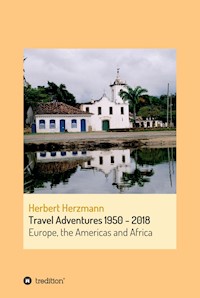
Cover Photo: Paraty, Brazil
Wounds of war in Mostar
The author on Benchoona Mountain, County Mayo
San Francisco Church in Quito
Scrambling route to the summit of Rucu Pichincha
El Cotopaxi
The crater of Cotopaxi as seen from the summit
Market in Otavalo
Lago Caburga and Volcan Villarica
Canyons of Morro Branco
The summer palace of the Emperor of Brazil
Paraty
Samba dancer
View of Kilimanjaro from Mount Meru
In the village of Marangu
Las madres de la Plaza de Mayo
La Gran Aventura
On the Michelli Strobl via ferrata
Wolayersee Hut, Karnischer Höhenweg
Austrian shelter from World War I
Uncle Erich in World War I in the Dolomites
A section of the Karnischer Höhenweg
Thanks
Travelling in good company increases the joy and diminishes the pain and frustration if things go wrong. I am very grateful to all who have accompanied me on my journeys over the years and to those who have been my hosts in faraway places. Many of them figure in this book. Here I would like to mention three of them: my father Albert Herzmann, my uncle Erich Braumüller, and my wife Ursula Willig. My father planted the seed of wanderlust in me when he was reminiscing about his holidays by the Adriatic Sea in Croatia before the Second World War. Uncle Erich has made me love the mountains. Ursula has been a superb travel companion over the past four decades.
My first readers were Ursula, Gray Cahill and Siobhan Parkenson. Their comments and critique have helped me a lot. David Herman, David Jabobs and Gray Cahill undertook the arduous task of proofreading and helping me with my English. I would like to say a big thank you to all of them!
Prologue
Dear Reader,
Apparently you like to travel. If not, then you would not be reading this book. But what do you expect from a trip? Are you seeking the security of the familiar enriched by sunshine and a deep blue sea, or are you looking for adventures? If you belong to the latter category and not take adventure to mean playing with death this is probably the right book for you. Opening up to new experiences may not be entirely risk-free but it enriches life and creates precious memories. If, on the other hand, you prefer lying on a sunny beach and have no desire to explore the country where you are holidaying, I hope that reading this will encourage you to be a little more daring. Maybe you are worried that you will not be able to communicate in a foreign language or that you may be robbed or get into other difficulties. Travelling under your own steam is not as dangerous as you may think. You do not have to risk life and limb by riding on your bicycle through Africa or snowboarding from a Himalayan peak in order to have an adventure.
I always loved travelling. By this I do not only mean visiting faraway places but also trips near home. A short break in an alpine resort or by the sea can be as rewarding and exciting as a tour of the Amazonas. A car journey without a clear destination, a week on a bicycle in your own country, a few days hiking in the mountains can be adventurous and satisfying.
Nowadays we are used to flying everywhere. This is fine when one has little time, but arriving in a few hours at the destination deprives one of experiencing the journey toward it. I have always preferred to travel slowly: by train and by bus, by car, by hitchhiking, on bicycle and on foot. A worthwhile journey should not be rushed. The way is as important as the destination. Without reaching it, the traveller is still left with the memories of attempting to get there and back.
For this book I have selected the episodes of the journeys I remember best. These include holiday trips, travels I undertook in connection with my work as well as hikes and climbs in the mountains. We are not talking here about great and dangerous expeditions into the unknown, but about the kind of journeys anybody can take who wants more than sun sand and sea.
Bon voyage!
Chapter 1: First travels and early dreams
1.1 Vienna and Salzburg after World War II
I grew up in Austria in the years following the Second World War. My mother died in June 1945 from diphtheria in a camp in Bavaria a few months before the war ended. Mothers with young children had been moved there from Vienna, to escape the bombings by the Allies. My father was unable to take care of his children. My sister, Ilse, who was four years old, was taken in by our father’s sister, Aunt Hanna in Vienna, and I, who was a year and a half, was raised by the brother of our deceased mother and his wife in Salzburg. There I lived with Uncle Erich and Aunt Friedl until I was ten and finished primary school. After that our father decided to look after us. My sister and I lived with him in Vienna for a few years. When I was fourteen, our father died unexpectedly. My sister was taken back by Aunt Hanna and I returned to my uncle and aunt in Salzburg.
The post war years were hard times. Austria regained her independence in 1955 and the economy was in a poor state. My foster parents had enough income to provide for the necessities of life. I was dressed and fed very well. Aunt Friedl was a good seamstress and made most of my clothes, and she was an excellent cook. Our apartment was rented, and it was in a house that dated back to the first half of the 17th century. It had been, so I was told with a certain pride, in the possession of the archbishop of Salzburg during the time of the Thirty Years War. It was spacious and comfortable. Although we lived well enough there was no money for anything beyond the essentials. My foster parents would have liked to own a car but could not afford one. They also dreamt of buying a piece of land and building their own house. Uncle Erich spent many evenings designing our future house, which never became a reality.
During the summer vacations we went either to the nearby mountains or to the lakes. Both were nearby. Salzburg is blessed with a splendid environment. It is surrounded by the Alps and the lakes of the Salzkammergut. My uncle was a passionate alpinist and my aunt loved the lakes. Her favorite was the Wallersee just half an hour’s busride from Salzburg.
The first memories of travel I have are the rail journeys to the alpine town of Werfen, 30 km south of Salzburg, where we were picked up by a mule-drawn cart and transported to the Mordegg, a mountain hotel at the foothills of the mighty Tennengebirge. I still remember the smell of the spicy alpine air and the marvellous view from the wooden terrace across the valley to the rugged peaks of the Steinernes Meer. I can still see the fat cows grazing in front of the hotel.
Another early memory is that of a trip to Bad Gastein where I spent a few weeks with Aunt Hanna and Ilse. Once we went for a ride in a horse-drawn coach. I had a windmill made of paper, which I dropped from the coach. I started such a terrible row that the coachman had to stop so that my aunt could rescue the precious object. I have a vague memory of the blue walls of the hotelroom and the whistling of a train passing nearby. For a long time to come the whistling of a train would awaken in me the desire to go to faraway places. Another day we went on a chairlift. Aunt Hanna took me on her lap and I found it very exciting to see the pastures and the trees gliding by below.
Several times I travelled from Salzburg to Vienna to visit my Viennese family. I was always accompanied by an adult. Austria was then still occupied by the victorious allies. The country was divided into four zones: French, British, American and Russian. Salzburg was under American occupation. The East of Austria was controlled by the Soviets. Vienna was in the middle of the Russian zone and divided into four sectors each of which was under the rule of one of the four allies. Vienna’s situation was like that of Berlin. East of Linz, at the city of Enns, the train crossed from the American into the Russian zone. The train stopped at the checkpoint and Russian soldiers, in brown uniforms, scrutinized our passports. To this day I remember the air of fear that gripped the passengers when the Russians boarded the train. It seemed that everybody was afraid to be ordered out and God only knew what might happen then. As far as I know nothing ever happened. In fact, the Russian soldiers were mostly very friendly to me, they seemed to like children.
My father’s flat in Vienna was situated in the British sector, Aunt Hanna’s lived in the Siebensterngasse in the American sector. Opposite her apartment was a cinema, the Kosmoskino. American soldiers and their Austrian girl friends went there to see Hollywood films in the orginal language.
A few blocks away, as one walked along the Siebensterngasse towards the nearby city centre was an abandoned sports hall. It had played a crucial role in July 1934. A gang of Nazis assembled there before they went to the Ballhausplatz and assassinated the chancellor Engelbert Dollfuss. The putsch failed, however. It was to take another four years before the country fell to the German invaders. When the Nazis finally took over in 1938, they renamed the Siebensterngasse to Straße der Julikämpfer (Street of the Fighters of July) in memory of the members of the assassins, who were then worshipped as heroes. After the end of the war the street got its old name back.
Walking further towards the centre of Vienna, one soon enters the Ringstrasse, the glorious architectural monument of the reign of Emperor Franz Joseph I and from there further into the centre and into the past of Vienna: the baroque buildings, the medieval cathedral and the remnants of the Roman period. Between the Ringstrasse and the city centre one passes the splendid Heldenplatz (heroes’ square) with the statues of the military leaders Prince Eugen of Savoy and Archduke Karl. On the balcony of the Imperial Palace, flanking the Heldenplatz, stood Hitler on 15th March 1938 proclaiming Austria’s return into the German Reich in front of a huge and enthusiastic crowd.
Walking two or three kilometres one passes through many layers of Austrian and European history. Very early I learned to associate travelling with experiencing different ways of life, political situations and historic memories.
Aunt Hanna owned a weekend house in Essling, East of Vienna in the Russian sector. The journey from the Siebensterngasse to Essling was an odyssey. First we took the tramway number 49 as far as the Bellaria on the Ringstrasse. From there we continued with tram T as far as the third district to very near where my father lived. There we had to change onto number 25 that brought us as far as the Prater, Vienna’s legendary fairground. We changed tram once again and passed through the village of Aspern. There stands a monument representing a lion. It commemorates the battle of Aspern in 1809, where Napoleon lost the nimbus of invincibility. Archduke Karl inflicted the first, albeit minor, defeat on the Grande Armée in the swamps near the Danube. From the final tram stop we had to walk for about twenty minutes across a Russian military airfield to the weekend house. War planes thundered above our heads as they landed and took off.
The journeys between Salzburg and Vienna were the furthest I undertook in my childhood. But, even small train journeys were an adventure. Aunt Friedl had relations in Bad Ischl whom we sometimes visited. In the early fifties we travelled by the famous Ischler Bahn, which was a narrow-gauge railway that had been built by Uncle Erich’s father. A few years later the Ischler Bahn was dismantled in spite of heavy protests and replaced in the name of progress by a bus service. The preparations for the journey had started the day before our departure and there always seemed to be an incredible amount to be done before finally taking the tram to the railway station. We had tons of food with us as if we were to set out for an expedition into the unknown. Sometimes the preparations for these momentous journeys caused so much anxiety to my poor aunt that she woke up with a terrible headache in the morning and decided that she could not face the journey to Ischl, so that we all ended up staying at home.
1.2 Sun over the Adriatic
After finishing primary school I moved to Vienna and lived with my father and my sister in a flat beside the Großmarkthallen. These two enormous halls of iron structures housed an abundance of food stalls. One was the Fleischmarkhalle that sold meat products, the other, the Gemüsemarkhalle, sold fruits and vegetables. They were similar to Les Halles in Paris, which were known as the belly of the French capital. Neither the Großmarkthalle nor Les Halles exist any longer. Les Halles were replaced by an underground shopping and amusement complex, the Großmarkthallen had to give way to an enormous shopping mall of no architectural merit.
Our father was always short of money. He had so little that there was no point in even dreaming of buying a car or drawing designs for a future house, as Uncle Erich in Salzburg did. He had other dreams, however. He had grown up in Banja Luka and in Bosanski Novi in Bosnia where his father, my grandfather Eduard Herzmann, was head surgeon. Our mother was born in Sarajevo. She met our father in Belgrade, where she gave birth to my sister Ilse in 1941. A few days after Ilse’s birth, on 27th March 1941, the Germans bombed Belgrade. Our parents fled with Ilse to Vienna, where I was born two years later.
When they lived in Yugoslavia before the war our parents spent many holidays on the Dalmation coast. Whenever our father talked about the Adriatic Sea, which is called Adria in German, his eyes lit up and he put all the enthusiasm of his bygone youth into the word. He extended the a-vowel thus giving it a magical sound. Very soon this caused in my sister and myself a desperate longing to see this wonderful blue Aaadria.
Our father often took us to the cinema. Once we saw the film Sonne über der Adria (Sun over the Adriatic). In one scene René Carol, a popular German singer of that time, was sitting on a stone wall, the blue sea behind him, and accompanying himself with his guitar to a song that contained the words: Sonne über der Adria, das ist Sonne für uns zwei….. (The sun shining over the Adriatic is the sun for the two of us). My sister and I became determined to visit the Adria and pestered our father to take us there in the summer holidays instead of taking us for long walks in the Vienna Woods or for a swim in the Alte Donau, a still side arm of the Danube.
Ilse came up with a brilliant plan. Why not save a small amount of money, say ten Schillinge, every day? After a year or two this should amount to enough to pay for a family holiday in Dubrovnik or Split. Immediately this plan was put into action and every day ten Schillinge were placed into a special box which began to fill up promisingly. Unfortunately, our father was forever in financial difficulties. He owed money to many friends whom he sometimes had to pay back, there were nasty bills to be paid for such trivial things as gas and electricity and there was the rent. And on top of all this we had to eat. When a financial crisis arose, our father was forced to borrow some money from our box. He promised to repay it, but somehow this proved to be impossible. In time the box was depleted and no more money was put in. A beautiful dream had come to an end.
My longing to see das Meer, the sea, remained unfulfilled for some time to come. When I was fifteen – I was again living with Aunt Friedl and Uncle Erich in Salzburg after my father’s death – I was determined to become a sailor. My dream was to be a captain and to travel round the world. Hamburg was das Tor zur Welt (the door to the world). I had read this expression somewhere, perhaps in a book by the then well known German travel writer A. E. Johann. My foster parents had given me one of his books that bore the title Große Weltreise: A Big Travel Round the World. On its cover was a beautiful oceanliner – this was still the time of the big steam ships. My desire to see the Adriatic Sea was replaced by an irresistable wish to visit Hamburg.
When I was sixteen I hitchhiked with my schoolmate Friedemann Bachleitner from Salzburg through Germany and Holland. Our aim was to get to Bremen and to Hamburg, cities whose names for me had an almost sacred aura. In Cologne on the Rhine, Friedemann had the idea to go to the harbour and try hitch a lift from one of the trawler ships to Rotterdam. If one can travel per Auto-Stopp why should it not be possible to go per Schiff-Stopp? To my surprise the strategy worked. The first skipper we asked was a Dutchman who agreed to take us to Rotterdam. The journey would take two days with one overnight on the ship. It was my first time on a ship. It was not an ocean going ship but it was a ship and I was in heaven. For two days and a night I was in my element as a future captain. In Rotterdam I saw a real harbour for the very first time in my life. The harbour of Rotterdam was then the biggest in the world. And then, in Scheveningen, I had my first experience of the sea stretching out into infinity. I was simply overwhelmed by all of this.
I was impressed by the views into eternity the sea offered and I discovered that a flat countryside, like that of Holland had its attractions. The sunsets are wonderful and there is a sense of expanse, which one does not get when surrounded by mountains. However, after a few days I began to miss the mountains. I mentioned this to a Dutchman who gave us a lift in his car. He told me that when he was in Innsbruck he missed the views into the distance. He felt hemmed in by the mountains. I never felt hemmed in by mountains. They were there to be summited! From the top of a mountain one could see even further than when standing on a Dutch plain.
All these sensations, impressions and experiences made me aware of my dependence on nature for my emotional wellbeing. For the past forty years I have lived in Ireland surrounded by the sea. I love the sea, but when I am back in Austria I do not miss it. However, I seek out the mountains wherever I am. I hike regularly in the Dublin and Wicklow Mountains, on the doorstep of the city, but I really love the mountains of Connemara and Kerry, in the West and Southwest of the island, for their alpine flair. The Maam Turks and the Twelve Bens remind me very much of the Tennengebirge where Uncle Erich brought me hiking with his schnautzer dog Puck. I am most happy in landscapes where there are mountains. I have not become a sailor.
A good few more years had to pass before I finally saw the Adria. I was studying German Literature and History at the University of Vienna when I fell in love with an American girl, who spent a year in Austria, in order to learn German. She was a student of Art History and it was a requirement, imposed by her course directors, that she would learn that language. Ann’s field was Byzantine Art and the University of Vienna had an internationally renowned Byzantinist, Otto Demus, under whom she hoped to study. Her parents had bought her a Volkswagen. With this small vehicle we undertook an epic journey, in the summer of 1966, to what was then still Yugoslavia. We spent two weeks in Serbia, Kosovo and Macedonia in search of Byzantine monasteries with their fabulous fresco paintings of the 13th and 14th centuries. It was a wonderful world which I had known nothing of until then. And it was in that summer that I saw for the first time the Aaadria I had longed to see for so many years.
To this day the Dalmation coast to me is the most beautiful coast in the world. It is a rocky coast with the mountains rising steeply up to one side of the road. There are innumerable little inlets with small and pebbly beaches. Often one has to climb down to them with difficulty and then plunge into the water from some rockface. More than thousand islands line the coast.
But not only nature offers stunning sights. The cities are equally beautiful. There is the medieval gem of Zadar, the Roman city of Split with the palace of Diocletian and the wonder of the sea, Dubrovnik, founded by the Venetians. My father had often mentioned Dubrovnik. However, he did not call it by that name but by its former name Ragusa. Pronouncing Ragusa he lengthened the u vowel in a fashion similar to the one he extended the a in Adria, in this endowing the name of this city with all his Heimweh and Fernweh.
The North Sea had impressed me very much a few years earlier, but the Adriatic Sea was what I really had been looking for. It may well have been that being in love added to my emotional high. Be that as it may, all the dreams of my youth, my romantic Fernweh and Wanderlust found complete fulfilment.
Chapter 2: Switzerland and France by bicycle 1962
2.1 The Way from Salzburg to Paris
I love cities. Whenever I visited my aunts in Vienna in the 1950s and early 1960s I was fascinated by the historical layers one could walk through in a very short time. The great cities of Europe are preserving our history in stone and brick, in paintings, institutions, and customs etc. In Vienna one finds Europe’s history compressed into a few square miles. With her glorious architecture, Vienna is also very pleasing to the eye. So are other European capital cities, most of all Paris. Apart from dreaming of the Adria I had always wanted to see the City of Light. After finishing high school I did not want to wait any longer. Since I had nobody to accompany me, I decided to cycle from Salzburg to Paris on my own.
I left Salzburg at the beginning of July. Cycling through the Tyrol and Vorarlberg was tough as I had to cross the Arlberg Mountain Pass. It took me a few days to get to the Swiss border. My first destination was Dornach near Basel. There was (and still is) the Goetheanum, the world centre of anthroposophy. A school friend, Mario, was an anthroposopher and had a summer job in the Goetheanum. He had said I could stop in Dornach en route to Paris, work in the Goetheanum for some time and earn money for the continuation of my journey.
Before I arrived in Dornach I knew nothing about anthroposophy. During my stay I learned that the Waldorf schools were run by the anthoposophic movement on anti-authoritarian and holistic principles, that anthroposophy favoured organic farming or biodynamic agriculture, that there was an alternative anthroposophic medicine that treated not only the physical side of the illness but considered the patient as a totality of mind and body. There also was an anthroposphic architecture of which the Goetheanum was a prime example. It influenced some important architects of the 20th century such as Richard Neutra, Le Corbusier, Henry van de Velde, Eero Saarinen, Frank Lloyd Wright, Erich Mendelsohn and Hans Scharoun. The founder of the movement was the Austrian philosopher Rudolf Steiner (1861 – 1925).
Mario introduced me to Mr. K, who was the head of the cleaning brigade and who agreed to take me on. He was a short, slim man who permanently had a thick cigar in his mouth. He ran the cleaning of the Goetheanum like a military operation. The cleaners were paid according to how many hours they spent on their knees scrubbing the floors of the innumerable rooms. Hard working cleaners were rewarded with lots of cleaning time and thus given the opportunity to earn good money. Lazy cleaners got less work and thus less pay.
Every day Mr Kumm made a delicious muesli. He put sour milk, fruit, nuts and oats into a big open barrel and stirred the mixture while holding his burning cigar in his mouth. If a bit of ash was added to the mush it did no harm. Whenever we felt like it we dipped our mugs and spoons into this mixture. All modern day rules of hygiene were completely ignored. Mr K’s muesli tasted out of this world. Never again have I tasted one like it.
The cleaners were accommodated in the boiler house whose chimney stack was shaped like a flame. We slept there and we had a kitchen where we could cook our meals. There were about ten cleaners, all in their late teens and early twenties and of many different nationalities. A Dutch guy called Theo did most of the cooking. He was a good cook unhampered by worry about health and safety. He wore an apron that was never washed and he used the same cloth for mopping up the floor and drying the dishes. Nobody ever got ill.
All the anthroposphers I met in the Goetheanum were lovely people. They displayed a gentle and tolerant nature and were committed pacifists. Most of them were spending a few weeks there to take part in courses or attend concerts, theatre performances and lectures. Once I attended a concert. A string quartet by Mozart was performed and simultaneously translated into movements by a dance ensemble. The holistic world view held that everything is connected to everything. Thus, for example, the musical movements had their counterpart in the movements of the body.
On another day I saw a performance of Alexanders Wandlung, a play written in 1953 by Albert Steffen, who after the death of Rudolf Steiner in 1925 became president of the Anthroposophical Society. It is a very long four-act play of which I did not understand a word. Later I read that the play depicts the journey of Alexander the Great, after his death, through the regions of the spirit till his return to earth. Parallel to Alexander’s journey through these higher regions we are shown the ever changing events on earth. What made an impression on me was the way the actors spoke. They did not speak “normally” nor in a manner in which actors emphazise the lines of elevated prose in classical drama. What I heard was something between the spoken and the sung word. But it was not recitative either. Some vowels were lengthened inordinately, important passages were cited in higher pitch, others in lower pitch, some loud, some almost inaudible. Language was not just language as we normally use it. It was an expressive (or expressionist) language of music, rhythm, emotion and movement. I was told that on certain occasions Goethe’s complete Faust was performed in this way.
One day I was cheerfully cleaning away while whistling the tune of Papageno’s song Der Vogelfänger bin ich ja of Mozart’s Magic Flute. I was approaching a corner and stopped whistling because I had run out of breath. Next moment I heard someone round the corner taking up the tune. It was Tony, an English student who was there with his friend Phil, also from England. Their plan was to get to Salzburg and attend some of the performances at the Salzburg Festival. They had stopped over in the Goetheanum in order to earn enough money so that they could carry on with their journey. As Tony and Phil were not very hard workers Mr K had little time for them and thus gave them little work. He always referred to them as die Tommies. As a consequence they did not earn enough money to go to Salzburg. Although their work ethos may not have been up to Swiss standards, Tony and Phil were lovely fellows and we became good friends. They were students of history and on the path of becoming teachers.
The following year Tony travelled to Salzburg and spent part of the summer holidays with me, (or rather with Aunt Friedl and Uncle Erich). In the same summer I went with him to England and spent the rest of the holidays with his parents in Littleport near Ely. Tony was very interested in local history. He knew a lot about Ely Cathedral and could show me parts of that wonderful building that were not normally open to the public.
Travelling between Britain and Central Europe was cumbersome compared to today. Those were the times before cheap flights. England and Austria were connected by rail and ferry. As students we could avail of reduced fares through the Anglo-Austrian society. It took two days to get from Austria to England. I lost contact with Phil after a while, but Tony became a lifelong friend.
2.2 The way back
I had another experience on my way back from Paris that made a lasting impression on me. After a day of cycling away from Paris in an easterly direction I came to Fère Champenoise, a small village in the Marne region. As night was approaching I looked for a place to stay. No hotel or hostel was anywhere in sight. In my poor French I asked a woman who was passing by if she might know where I could stay. She very kindly offered me a place in her house. Because of my poor language skills we could not strike up a lively conversation as we walked to her house. After a few minutes of silence she asked me where I was from. When I said Autriche her eyes lit up and she exclaimed: Ah, Österreich, ich bin aus der Tschechoslovakei! She was Czech by birth, spoke good German and was pleased to meet somebody from a country that shared so much history with her own. She treated me with the same enthusiasm as she would have treated a Czech compatriot. Her husband was French and they lived in a very comfortable house. I was given a great dinner with wine, a room for the night and a good breakfast. Madame D told me that she owned a small flat in Neuilly sur Seine very near Paris and that I would be welcome to stay there if I wanted to return in the future. When I left in the morning, she gave me home made Powidltascherl, a Czech-Austrian sweet speciality, and a bottle of wine for the journey.
I stayed in contact with Madame D for some time. When after a few years I thought of visiting Paris again, I wrote to her and asked if her offer still stood. A letter came back from her husband telling me the shocking news that a few months earlier my kind hostess had been hit by a car outside her house and died.
My time in Paris fell between these two unforgettable events. Paris had been my destination, but my memories of this wonderful city are vague. However, I remember vividly my time in the Goetheanum and the beginning of my friendship with Tony that ended only a few years ago when he died. And the kind Madame D will always live in my memory. The way to Paris and the way back home left a deeper impression than Paris itself.
There is no need to describe that city and praise her cultural monuments and her wonderful urban flair. I visited as many of the famous sights as I could pack in with the result that my memory of what I saw is somewhat blurred. I stayed in a hostel run by UNESCO. We got a breakfast of café au lait and a baguette with butter. As money was tight I used public transport sparingly, instead, I cycled and walked a lot. I often had to ask for directions, which gave me the opportunity to practice the little French I had. Contrary to what many travellers say about the Parisians, I found them extremely friendly and charming. Sometimes I teamed up for my sightseeing tours with other guests of the hostel. I remember a young man from India who wanted to know what constituted the difference between a Romanesque building and one from the high middle ages. I was always hungry, as all I could afford was hot dogs and pommes frites. No wonder that after a week I was totally exhausted and felt that it was time to start the arduous journey back home.
I had planned to visit Versailles but lacked the energy to do so. My lovely Czech hostess in Fère Champenoise expressed great surprise when I told her that I had not seen Louis’ XIV architectural extravaganza: What, you have been to Paris and you have not seen Versailles?! Perhaps this was the reason she offered me her apartment in Paris. Many years later I visited Paris with Ursula. It was November and we took the train to Versailles where we got a guided tour in English. The guide was excellent and we were only five people in the group. What a privilege it was to get a tour of that palace through which thousands of tourists are normally pushed every day!
After leaving Madam D it took me two days to reach Strassburg and there my resolve to carry on left me. I went to the railway station and found out that a train to Salzburg was leaving in the morning. After spending the night on a bench outside the station I boarded the train. Thus ended my first journey to the City of Light.
Chapter 3: Yugoslavia 1966 – 2007
3.1 A vanished country
All through my childhood Yugoslavia to me was first and foremost the country by the Adriatic Sea. My parents and grandparents on my father’s and mother’s side had lived there before I was born. My father’s father was a surgeon in Bosanski Novi (today Novi Grad) near Sarajevo, which was part of the Austro-Hungarian Monarchy till the end of the First World War. My father, my mother and Aunt Hanna were born in Bosnia. After 1918 the different countries and regions of the Southern Slavs united and formed the Kingdom of Yugoslavia. The new state consisted of what today are Bosnia, Slovenia, Croatia, Macedonia, Kosovo, Montenegro and Serbia. Up until 1918 Bosnia, Slovenia, Croatia and a part of Serbia were part of Austria-Hungary.




