


8,49 €
Mehr erfahren.
- Herausgeber: Ingemar Fredriksson
- Kategorie: Fachliteratur
- Serie: A Few Percent More
- Sprache: Englisch
This book has been a top-ten business book
in Sweden for more than ten years.
Now it"s available in English!
"How did you...?" Is a question Ingemar Fredriksson has heard many times since he first reversed negative trends at a company threatened with closure, turning years of red ink into growth that averaged 25% annually for five years, with profitability hitting 26% at its best!
Mr. Fredriksson asserts this involves getting "a few percent more" from several parts of operations, and in his book series by the same name he offers concrete ideas about how to go about doing this.
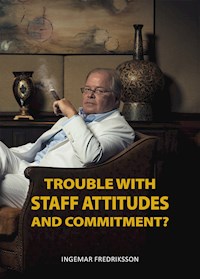
Trouble with staff attitudes and commitment? Addresses the art of motivating the entire organization to pull together in the same direction. And it covers what"s needed to get your employees to perform better and increase their commitment. This book, his first, was appointed as one of the best business books by the magazine Chef (The Manager) when published and has since it was published appeared on the top-ten lists for business books for more than ten years in Sweden.
Ingemar Fredriksson has long-standing experience in management, business development and marketing. He has worked in both family-owned businesses and large international groups, including senior group management, board member and chairman for almost thirty years.
Mr Fredriksson have also been appointed as public investigator on how to increase usage of IT in SMEs and as board member of Swedish Airport and Air Navigation Services (LFV) by the Swedish government. Other board assignments include Chairman of Miss Sweden and several private owned companies in various industries as well as vice Chairman of Företagarna, Swedens largest organization for privately owned business representing 70000 companies. In recent years he has successfully handled growth and increased profitability in both established companies and start ups in MedTech, fashion, tourism, manufacturing, inclusion services and other industries. He is currently chairman of Fnatic Gear, owned by one of the most successful epsorts teams in the world and also holds several other board positions in various industries alongside with being founder of the website freefortourists.com.
So far he has published four business books, which have all appeared on the top list in their category and they have all received positive reviews in Swedish media. The following books are about profitability development, Chinese tourists (the larges group of tourists since 2012) and product storytelling. All of his books have been praised by both media and readers for being straightforward and containing simple advice on how to implement changes rather than being academic.
He adds to his own experiences those of others from his years as consultant and active in different companies as CEO, chairman and board member so he can provide a rich flora of examples to share with you. Each book contains concrete tools and models, including what he has developed himself and found through research, which he presents, in a way enabling readers to easily apply them to their own operations.
Das E-Book können Sie in Legimi-Apps oder einer beliebigen App lesen, die das folgende Format unterstützen:
Seitenzahl: 158
Veröffentlichungsjahr: 2020
Ähnliche


















Ingemar Fredriksson
Trouble with staff attitudes and commitment?
A handbook for how you get everyone to contribute towards good results.
Cover photography: Talal Berkdar,
at Sheraton, Abu Dhabi
Layout: Myr Design
Translation: Deane Goltermann
© Ingemar Fredriksson
www.procentforlaget.se
ISBN 978-91-984366-0-0
E-book production: Axiell Media, 2017
Foreword
“Who said that?” is the question you get many times you make a claim. Especially when that person is male. Men think in hierarchies, and before he will take a position on whether the claim is interesting, useful, correct, or can have any worth, he wants to know who said it to know how he should relate to your claim. Or more likely, whether he needs to do anything at all. He won’t even think about addressing the claim until after finding out.
With this in mind (and knowing from the Swedish edition that most readers likely be men), I’ll begin by telling who I am, or more correctly, why you might get something out of reading this book, and why my answers are the right ones.
If we start with the latter, it is simply my conviction that there are no correct answers to how you can successfully create profitability and growth in a company. In any case, there are no universal answers. Every person and every company has their own truth, and this is built from so many factors, each interacting with the others in different ways, so it becomes impossible to convey success factors from one individual to another, or any specific company to the next. This book certainly relates concrete research findings which can be accepted as truths. It also presents many facts and experiences about what can be done to bring an entire organisation along the right way, but every reader has to choose which parts work for themselves and for their operations.
But, when it comes to how you create profitability, I have a wellfounded, basic view of how this can be achieved. And that is by getting those few added percent out of several parts of your operations. By coaxing a few percent out of your staff’s commitment and efficiency, and a few percent more from higher prices, a few percent from lower costs, and a few more out of improving working capital turnover, you build up your company’s profitability. I don’t believe anyone can create good profitability by steering with a single large wheel (except temporarily). The best, longest lasting, and most effective way to do so is by turning many controls. This is the basic principle behind the book series A few percent more. The idea is for each book in the series to tell how you can coax that few percent more from any specific area in your operations.
This book addresses how you can achieve enormous change in operations regarding profitability and growth by getting your staff behind you. My experience is that this is the single most important factor, and the least costly one at that, in improving results in any business. You’ll find an enormous force within every group of people who fully commit to a task. And getting to experience this force as a leader is the greatest reward I have experienced as a manager. Carl von Clausewitz describes this phenomenon as: “Courage and the spirit of an army have, in all ages, multiplied its physical powers, and will continue to do so equally in the future…”
So, the books in this series have their basis in my own personal experiences – in creating strong growth and extremely good profitability. I became CEO rather young, and after a time I had the benefit of being part of creating exceptionally good results in a company that was on the brink of being closed down. I usually describe that experience as character-building, as it was something of a shock stepping into such a poorly performing company being as young, and cocksure, as I was. It was also educational to be confronted with how fundamentally central it is for any company to make money simply to survive. As manager, standing with my back to the wall and knowing that if we didn’t succeed in making that unit profitable, everyone there, including myself, would be out of a job. In a smaller community, as was the case here, the consequences are starker still, since there wasn’t much else in terms of nearby employment opportunities, and where so many families would suffer. That experience and insight has remained deeply imprinted in my psyche and is likely the reason for my extreme focus on the importance of profitability in any operation. Another reason for concentrating on profitability, is likely because I have worked so many years in a family owned company where this is a truism -- simply that there is no difference between a company’s finances and the owners’ wallets. The second factor that I concentrate on closely is growth, but this comes from a will to create something. I usually describe what happened at that failing company in short as me getting lucky, and being able to bring the entire staff along in a positive way. After six months, we had climbed back to profitability, and we grew an average of 25 per cent annually for five years in a row. Operating profit hit 26 percent at their highest, and were 14 percent at the lowest (where comparable competitors couldn’t manage more than 10 percent).
The short story of the continuation is that I then worked with business development and marketing in the group that held this first (failing) company of mine. After several years, I went my own way to start a consulting business. Through my consulting years, I’ve often been asked “How did you do it?” by the companies I was working with.
In all honesty, I never had a good answer to that question, other than to repeat the basic principles I just related -- good profitability comes from coaxing those few percent more from many different sources. But, how do you get those few extra percent? This is what I’ve tried to describe in this and my subsequent books. In this effort, I have chosen to supplement my own experiences from the many years as business leader and then as consultant, with the many valuable ideas I’ve picked up from the people and companies I’ve worked with through the years. I then expand further on this common base of experience by going through some of the most important research findings related to what it is that makes people feel good and perform. Altogether, this offers you, the reader, many concrete ideas, tools, and pointers about how you can bring your staff along in a positive spirit and then use this to enjoy the fruits of improved profitability.
Herrljunga in November 2005
Abu Dhabi in August 2017
Ingemar Fredriksson
“In all labour there is profit”
Proverbs, ch 14, v 23
Companies are there to make money
Essentially, this is rather obvious. People go to their jobs to do something that someone else is willing to pay them for. However, this someone else isn’t the company, but rather, in the end, it is always the customer. If the customer isn’t satisfied with the work performed – or to put this more concretely – if the customer doesn’t think the value of the work performed corresponds to what they are willing to pay, then they move along taking their business elsewhere. And with it, the reason for doing the work in the first place. Thus far everything is certainly clear? Sure, for almost everyone, but there are still some who believe they work for other reasons. But this is not the case, and this book largely covers this – a company is an economic organisation whose purpose is to create a result. End of discussion. If the company fails to generate a positive economic result, it can’t exist for long. “To generate a profit,” in other words, is the absolutely most basic task any company has. Naturally, a company can’t stop at that, as it still has to ask how they can do this. Often, this involves finding a need that someone, or many more, is ready to pay to have met, and then offer to provide for that need competitively. That I insist on emphasizing that companies are there to make money, is due to the huge demands placed on so many companies that cause entrepreneurs and managers to sometimes forget this simple truism. They can become so weighed down by demands for working conditions of their employees, their social responsibility, their environmental responsibility, and so on, that they forget this basic fact. I have seen many businesspeople accept declining profits year after year and employed managers who can’t stand up for the idea that their company must make money. In either case, both the employees and the company lose when bankruptcy or closure is the end result. That companies must make money isn’t an ideological issue, nor is it a question of equality or fairness, it is simply a fundamental fact!
In recent years companies have been criticized for management not taking responsibility and merely chasing short-term gains. As to responsibility, companies must follow a variety of laws and regulatory frameworks in many areas. As well, companies generally take significant responsibility in the communities where they operate by offering gainful employment, and by paying taxes. That companies often come under criticism for failing to take responsibility despite having done so is partly explained by unrealistic expectations. Many people want to see companies as some kind of good parents whose task is to take care of their employees, but this is actually not among the basic tasks of any business. Expectations of this type are likely remnants of the company town mentality where it was natural that the employer from the large estate took care of infrastructure and other necessities since they own the major part of the environs and was the only person with the resources to deal with these issues. As well, the employer had to offer living quarters for their employees to ensure they were available and close to their work tasks on the estate. Early in industrialisation, it was also common for employers to offer living quarters near their factories. It is likely these kinds of traditional employer commitments that remain in a somewhat romantic image of what a company should do for their employees. But what is forgotten in this ideal is that employers took on these commitments simply to have access to labour at all – not merely out of goodwill.
As I’ve already mentioned, the company’s basic task does not include providing infrastructure or social security, it is to generate an economic surplus. Thanks to this surplus, the company can pay taxes and employ people who both earn their pay, and pay taxes in their turn. These remunerations are what employees and the community they live in have at their disposal to build infrastructure and create social security.
The criticism of short-term profits often comes when a company implements a change process (as with staff redundancies) even when they show positive results. Naturally, for public relations this isn’t the most appropriate time to implement cut-backs, but still could be the right move for the company. Restructuring in organisations is often brought on by factors that management determines will happen going forward while the annual results presented report events already taken place.
Companies must also consider that individual consumers now have other opportunities to express their viewpoints about company accountability, including through using new technologies. There are many ways to use the Internet or email to spread dissatisfaction and drive campaigns against company misconduct. The media are also thankful recipients of stories where they can easily take the side of the weaker party, to present themselves in a positive light. We can exemplify this in an article about poor 78-year-old Hazel who was misled by multi-national Giant, but where Evening Newspaper X has intervened to help highlight Hazel’s difficulties, or even got the company to give in. This shows that companies are indeed regulated by a wide variety of means – politicians, authorities, consumers, and the media. Every company is fully aware of this and they do take appropriate consideration of it in their actions. What’s more, companies are run by managers who are also people – which is forgotten at times.
Their decisions are influenced by empathy, which leads to them taking responsibility for their fellow humans and for the community where they live and operate.
Clearly, there are sufficient controlling functions to regulate corporate accountability. On the other hand, the staff’s responsibility for the good of the company has been obscured by what is discussed more often – employee rights. Absurdly, it has become fully legitimate to place demands on a twelve-year-old to perform and excel for their football team, but nearly unthinkable for a company manager to tell an adult to work a little harder. As manager, you’re more likely expected to apologize. This is why many managers apologize when they start presenting organisational changes. They say apologetically that naturally this won’t add to anybody’s work load – No …, ‘we’re going to work smarter, not harder’ – exemplifying the ‘Muffin Syndrome’ that I detail in the chapter with that name later in this book.
A female manager I spoke with related that after twelve years as manager at the same company she was still met with suspicion from staff when she presented organisational changes. Though she’d never lied about the reasons for or the consequences of the changes, there was always a few staff who asked about a hidden agenda behind the information or what she was hiding from them. Suspicion against a manager can be deeply rooted this way, but the foundation is laid in an ingrained perception held by many that managers are the bad guys. That managers cannot demand greater performance is justified today by reference to the increasing incidence of burnout syndrome. This is blamed by some as entirely related to the workplace, which is a completely absurd claim. That people today react in different ways to the increasing information flows (adverts, media, new communications channels, and similar), in combination with insecurity about the future (climate change, globalisation, erosion of welfare systems, and changes to pension systems) is something entirely different from work environment problems.
Being continually exposed to desires through adverts while handling all types of new technology, home electronics, taking over your own pension, and such, naturally brings greater pressure on people. That this causes problems is certainly not surprising.
Those who study these things will tell you that the phenomenon of burnout isn’t really new. As early as 1869, American neurologist G.M. Beard introduced the diagnosis of neurasthenia. This is described as “a medical condition characterized by lassitude, fatigue, headache, and irritability together with hypersensitivity which was seen as being a result of exhaustion of the central nervous system,” and which mostly affected upper-class women.
Another common complaint at companies today is that production is transferred to low-cost countries. But this complaint is unwarranted for two reasons. First is that companies themselves cannot determine the correct price for a product or service. The customer always decides this. And that customer is you or I, which means that we are all part of globalisation and its impact. None of us can stand with our shopping cart full of products that declare ‘Made in China,’ and still think it’s wrong that jobs have moved there without understanding that we all play an active role in that process.
The second reason is that the search for a better source of supply is a quintessentially human behaviour that has always been part of our existence and always will. When humans lived as hunter gatherers, they roamed widely to find the best hunting and fishing grounds. Having later settled into farming, we moved to areas around the world with better soils for this. Moreover, what we now associate with ‘outsourcing’ or jobs relocation to low cost countries has been part of the industrial landscape for hundreds of years – as I elaborate in the later chapter I can’t protect you.
Any ethical or ideological conflict relating to a company’s profitability shouldn’t reasonably lie in how short-sighted or large it is, but rather, how it is used and distributed. Most political leaders today understand that companies are important for growth and that these companies need to make money. All this is seemingly fine, but then suddenly people start remembering what’s known in Sweden as the Law of Jante (yes, there’s a wikipedia page for it! https://en.wikipedia.org/wiki/Law_of_Jante).
Most people have no problem with those who have been wealthy continuing to be so, or even richer (“the rich get richer and the poor…”) On the other hand, many have a problem when a regular person is able to become wealthy, and especially if they do this by entrepreneurship. Personally, I believe this is partly down to most of us being able to live with the fact that we aren’t as gifted as, say Wayne Gretzky in hockey, or as talented as Celine Dion is in singing. That these people earn enormous sums on their talent is therefore easier to live with. That an entrepreneur makes money on their talent is likely more difficult for many since just about anyone can actually get into business. If someone else does it and succeeds, then we are confronted with our own inability. If we can then link our unwillingness in such a situation to a historical idea that entrepreneurs make their money by sucking it from others, it’s easier to lean back in the couch in front of the TV and live our lives the same way as the figures in Plato’s cave. This gives rise to the paradox that almost everyone feels it is entirely acceptable for companies to make money, as long as no specific individual does so. Which in itself raises implications for the entrepreneurship of start-ups, but that’s another issue and something for policy-makers to address.
What you as a leader have to work on is the negative attitude many people have towards the company’s profitability. I hope these lines have shown you that this negative attitude is often unjust and unjustifiable. And I hope this awareness can provide you with the strength to stand up for profitability. As already said, profitability is the foundation for any company’s existence.




