


Erhalten Sie Zugang zu diesem und mehr als 300000 Büchern ab EUR 5,99 monatlich.
- Herausgeber: Plataforma
- Kategorie: Fachliteratur
- Sprache: Spanisch
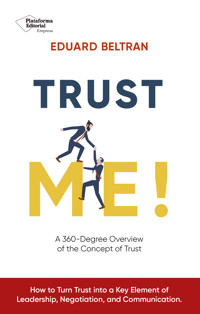
Trust is the foundation of all human relationships—friendship, love, and business alike. In Trust Me!, Eduard Beltran explores the crucial role of trust in professional and personal success, offering insights from psychology, philosophy, and economics. Drawing from his expertise in negotiation and leadership, he provides essential tools to build and sustain trust over time. In a world that values transparency and reliability, mastering this skill is key to creating stronger, lasting connections and unlocking new opportunities.
Sie lesen das E-Book in den Legimi-Apps auf:
Seitenzahl: 150
Veröffentlichungsjahr: 2025
Das E-Book (TTS) können Sie hören im Abo „Legimi Premium” in Legimi-Apps auf:
Ähnliche
















Trust me!
A 360-Degree Overview of the Concept of Trust
Eduard Beltran
Original title Confía en mí
originally published in Spanish in 2023 by Plataforma Editorial
First English edition: January 2025
© Eduard Beltran, 2024
© Translation by Donal Cregg, 2024
© Current edition: Plataforma Editorial, 2025
Plataforma Editorial
c/ Muntaner, 269, entlo. 1ª – 08021 Barcelona
Tel.: (+34) 93 494 79 99 – Fax: (+34) 93 419 23 14
www.plataformaeditorial.com
ISBN: 979-13-87813-16-1
Front cover: Pablo Nanclares
Photocomposition by: Grafime S. L.
All rights reserved. Any reproduction of this work in its entirety or partiality is strictly prohibited without express authorisation of the copyright owners. Reproduction by any medium or procedure, including reprography, digitalised treatment and distribution of digital copies via lending or public loans is punishable under established legal sanctions. If photocopies or a reproduction of any fragment of this work are required please contact the editor directly or visit CEDRO (www.cedro.org).
To my son Teo:
I wish that you can trust many people
and that many people trust you.
Contents
Introduction: The reason behind this book
I. How do we define trust?
II. What does trust give us and why is it so important?
III. To trust or not to trust: the seven factors that intervene in the decision-making process
IV. How to create trust in others—face-to-face
V. Regaining lost trust
VI. New technologies and trust: the challenges
Conclusion
Acknowledgements
Bibliography
Landmarks
Cover
Title Page
Copyright Page
Dedication
Contents
Start reading
Acknowledgements
Bibliography
Notes
Colophon
Introduction: The reason behind this book
Anyone who ever gave you confidence, you owe them a lot.
Truman Capote (1924-1984)
Trust is a concept that is present in almost all walks of life, but we know little about it, which may seem paradoxical.
In fact, trust is not studied at school or in university, and businesses seldom have a Chief Trust Officer or Trust Department.
However, the consequences of lack of trust are evident in our personal relationships, in business, and, of course, in public bodies.
Trust is a key element to personal and professional success. Without trust, we have nothing: not friends, no love, no business.
Trust is a feeling that accompanies us in our lives although we are not always aware of its presence.
When, as students, a teacher advises us to take one path instead of another, we remember that teacher years later.
When a boss trusts in us at the beginning of our careers, it confirms our decisions without us realising it.
When a client reaches out to us for a new project, it is also a question of trust.
It is all these moments that mark our lives and push us forward; it is trust that has helped us build our lives, our careers, our successes.
However, at the same time, when we lose someone’s trust or when someone does not trust us, life stops: we no longer have relationships, friendships, love or even business deals.
The notion of trust is simply, all around us, it is an asset for companies, for organisations and for individuals. It is an asset for success in life, and the news is full of examples of the price that must be paid when there is a lack of trust.
In this book, I have opted to examine the idea in all these fields, mining my many years of experience on the ground in the area of negotiation and leadership, and using more academic research, referencing authors who have already dealt with the topic.
The aim is to popularise the concept and present the tools necessary to all professionals who deal with these issues, those who want to inspire trust in those they are speaking to.
This book is aimed at all professionals, whether it be large groups, directors, managers, operational managers, those with liberal professions, journalists, civil servants…, basically, all professionals concerned with trust in their personal and professional relationships.
I propose to take a 360º trip around the idea of trust: what it means to have it, what it means to not have it, and how to earn it. This is very useful for today’s business world, but even more so for the world of tomorrow, as people are increasingly more aware of the concept of trust.
Due to social media pressure and an increasing demand for transparency, trust has become a central issue that affects all businesses and both public and private institutions. The main issue is how to inspire and develop trust.
If we find the key to inspire this confidence, we’ll have the key to success in our social, personal and professional interactions.
Trust me!
I.How do we define trust?
The best way to find out if you can trust somebody is to trust them.
Ernest Hemingway (1899-1961)
The origins of trust
The Latin word for “trust” is confidentia which is made up of two terms; con, which means “together with” and fidere, which means to ‘believe’. Thus, confidentia, or ‘trust’, means a belief or security you have with someone or something.
From this we can learn that trust implies the idea of being “together with” someone or something in the sense that we can place our faith, security, and credibility in that person or thing. It is an act of believing in integrity, the abilities, or the honesty of someone, which can lead to the feeling of safety, calm, and comfort in personal, social, and working relationships.
Trust is the bedrock for the building of solid, successful, relationships both on a personal and professional level. By trusting others, we show a willingness to take them at their word regarding the fulfilment of commitments and good intentions. This reciprocated belief encourages cooperation, collaboration and teamwork, which can lead to the achievement of common goals.
Nevertheless, trust is not developed overnight. It is a gradual process built over time through positive experiences and consistent demonstrations of reliability. At the same time, it is fragile and can break if promises are broken and expectations undermined.
Trust is an individual feeling however, that is born from an opportunity to commit yourself to the respect of a person or other living creature, an institution or deity to be consolidated, broken or lost. It is a tool capable of becoming a valuable social driver, which emerges from the core of the family.
Along this path, we find the figure of the confidant, from the latin confidens, someone we make a participant in our worries, reservations and our joys.
In sociology and social psychology, trust is the belief that a person or a group are willing and able to act accordingly in a given situation and to do so with certain thoughts. Trust, therefore, will strengthen based on our actions or values.
According to Laurence Cornu, “trust is a supposition of the future behaviour of another. It is an attitude that concerns the future in the sense that said future depends on the actions of another. It is a form of gamble, that requires us to not worry about our lack of control over the other and our lack of control over time.”1 The poet Wallace Stevens, for his part, claims that, like art, trust never gives all the answers, but it allows one to be open to all questions.
Most theories on trust define it as a temporary suspension of the basic situation of insecurity regarding the actions of our peers. Thanks to this, we can assume a certain degree of regularity and predictability in social actions which simplifies how a society works.
This typically functional explanation corresponds to the theoretical orientation of most authors who have dealt with the topic. In Structural-Functional Theory, trust is often considered as the foundation of all institutions and works as a correlate and contrast of power, consistent in its capacity to influence in the actions of others to oblige them to adjust to our own expectations.
The term applied to an organisation or company depends on various factors such as the quality in the manufacturing of their products, and therefore the quality assessment, the ethical codes and its culture or workplace environment. However, above all it is reflected in the ethos of the company, that defines its character and its characteristics that make it stand out from others.
What is trust?
Social Psychology and Sociology cast a wide net when dealing with the topic of trust. They explain that it deals with a type of feeling or belief in oneself that allows the subject to achieve different objectives, goals or situations. Both sciences consider the term as a supposition of a psychological foundation regarding the behaviour of human beings with those of their species.
The certainty of belief in others may be reinforced or reduced depending on what transpires in the life of an individual. In fact, it is said that as long as you have confidence in yourself, you can achieve any goal you set for yourself. This is due to the belief and faith you possess, the feeling of self-sufficiency and that of those around you, and your ability to lead.
However, apart from confidence in oneself, there is another conceptualisation of the term: a vote of confidence, which is based on the faith one has in oneself or in those around them. The vote of confidence consists in allowing other people in power to carry out certain actions, whether it be in relation to friendship, work etc. This is important as not everyone gains the goodwill or the affection needed to be a collaborator. For example, the manager of a company will not share detailed information about the business with all their employees. There is always one trusted employee as there is also a previously established connection due to a friendship or pride in their work.
It is also possible to consider trust as a value, as it contains respect and sincerity. Most friendships are forged in trust. Without trust, there is no foundation on which to maintain the friendship.
There is an example that we find the following typical sentences regarding trust: “I don’t mind you making a fool of yourself in front of me, there’s enough trust between us and I know you well”, “You can tell me anything that’s going on with you, that’s why we trust you. You have my full confidence”. These examples show how trust may be strengthened or weakened. It all depends on the reaction of the other party.
It’s the fact that people are willing to reveal or show a part of themselves to those around them, but if they see the slightest sign of discomfort or rejection, they pull back, and from that the opposite of trust emerges: distrust. If someone doesn’t trust others too much, they tend to be more reserved in many aspects of their life. However, precisely because of this, conversations built on trust occur, strengthening bonds of friendship, work, and even love.
It’s also possible to refer to trust in beliefs beyond the physical, such as in religion or in the gods in whom people place their faith. Many Christians faithfully maintain their trust in God, whether it’s to bring them something good or to help them out of a risky or uncomfortable situation.
The term refers to the temporary or permanent suspension of uncertainty that a person might have regarding the intentions or actions of those around them. In friendships and even in the workplace, the period of trust can vary, hence the reference to the temporary suspension of others’ intentions.
Generally, trust is the foundation of all existing relationships, enhancing positivity in humanity and security in work, love, and friendship. Evidently, trust is also a fundamental ingredient in leadership, negotiation, and communication.
Therefore, it is highly desirable to learn to be good leaders, to have strong communication and negotiation skills, to be part of successful teams in the company we work for or in any other activity we undertake. However, when we study these skills, their characteristics, and requirements, we find a fundamental and common ingredient in all cases: trust.
A good leader must build trust, which develops in the initial stage of team formation. Feedback, for example, inspires trust in the other person. Likewise, to carry out a successful negotiation, it’s essential to start by establishing trust between the parties. But in this context, let’s ask ourselves: what, exactly, is trust?
We all believe we know what trust is, as we’ve all trusted or distrusted someone at some point. However, even if we have an idea of the answer, it’s not always easy to find the exact words to describe it. Sometimes, it can be very easy to trust someone, while other times, the opposite happens. This depends greatly on each person’s personality and the situation or environment in which they meet and interact.
John Maxwell, in his book Everyone Communicates, Few Connect, explains the importance of efficient communication in the relationships and connections people have and therefore increase their influence over others. He mentions three aspects:
Worry about others.
Help others.
Trust others (the most critical aspect).
It’s about being worthy of trust—that is, being able to create trust in others and thus build stronger relationships that enhance our abilities. But what about us? Should we always trust others, trust everyone, or only a few?
As German philosopher Friedrich Nietzsche said “What worries me is not that you lied to me, but that from now on I can no longer believe in you.”
Those who blindly trust others without proof tend to be unrealistic and are often left disappointed. On the other hand, those who discourage personal relationships due to lack of trust often miss out on opportunities.
The book Smart Trust by Stephen M. R. Covey and Greg Link describes why individuals and companies need to reestablish trust as a basic operating principle and management philosophy. According to the book, trust-based relationships and cultures foster greater “prosperity, energy, and joy.” Smart trust is a blend of the “propensity to trust,” which comes from listening with the heart, and “analysis,” which comes from listening with the mind. The book also outlines five steps to achieve smart trust:
Step 1: “Decide to believe in trust.”
Step 2: “Self Confidence: start with yourself first.”
Step 3: “Declare your intentions… and assume that the intentions of others are positive.”
Step 4: “Do what you said you would.”
Step 5: “Take initiative by showing trust in others.”
Understanding and applying these steps can be an effective way to build strong, trust-based relationships:
Choose to believe in trust. At the start of this journey, make a conscious decision to believe in trust as a fundamental element in your relationships. Trust serves as the foundation upon which strong connections are built.
Self Confidence. Start with yourself: before you can trust others, it’s essential to have confidence in yourself. Work on building strong self-trust by recognizing your abilities and believing in your capacity to keep your promises.
Declare your intentions… and assume the best in others. In your interactions, communicate your intentions clearly. At the same time, assume that others’ intentions are positive until proven otherwise. This attitude fosters an atmosphere of goodwill and openness.
Do what you said you would. Consistency is key to building and maintaining trust. Fulfil your commitments and words. When you follow through on your promises, you demonstrate reliability and responsibility.
Take initiative by showing trust in others. Finally, encourage trust in others by demonstrating that you trust them. Delegate responsibilities, give them autonomy, and allow them to prove their worth. This mutual display of trust strengthens bonds and promotes strong relationships.
By following these steps, you can cultivate an environment of trust in your personal and professional relationships, promoting cooperation, collaboration, and mutual growth.
What is the historical origin of trust?
In her book Les historiens, la confiance et la question de la “modernité”, Claire Judde de Larivière examines the historical element of trust. The terms “to trust,” “trust,” as well as “faith,” “fidelity,” and “to entrust,” all refer to the idea of having faith in something or someone and being faithful to that faith. In the vocabulary of medieval politics, these notions are always closely linked, particularly due to the Christian foundations of medieval political philosophy.
Few works have successfully reconstructed the slow genesis of the modern conception of trust. The modern period—chronologically situated between the 16th and 19th centuries according to various authors—marks a break in how trust organises and builds societies. Societies before the Modern Age were based on mutual knowledge and direct relationships without intermediaries. Ancient and medieval societies were, therefore, small-scale societies where people knew each other and formed relationships precisely for that reason. To simplify the model: “I know my neighbour, so I know I can trust him.” Due to this situation, people interacted as neighbours, friends, relatives, and loved ones; they bonded, married, socialised, and conducted business because they knew and trusted one another. Community ties were strong, especially during the Middle Ages.
In mediaeval societies, great importance was placed on reputation, which allowed for the evaluation of the social credit of peers within a complex system based on honour and judgement of equals. This reputation was what enabled individuals to establish or forgo relationships and to engage or not engage in business dealings.
From the 16th century onwards, population growth was such that it became impossible to know everyone. With this came the globalisation of trade and European expansion, which meant that it was no longer feasible to conduct business solely among close friends and neighbours; it became necessary to rely on partners from other communities, be they nearby or far away. This new distance between people necessitated finding ways to ensure trust, and it was also during this time that the so-called modern state emerged, capable of creating institutions that guarantee trust and the accompanying documents (particularly the birth of identification documents).
The focus of trust according to different disciplines
Here we will analyse the different definitions of trust from various perspectives: psychologically, sociologically, philosophical and economical.




