


5,85 €
Mehr erfahren.
- Herausgeber: Life Publications
- Kategorie: Ratgeber
- Sprache: Englisch
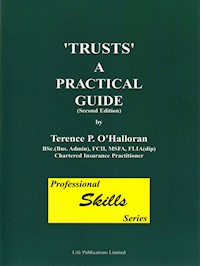
Within the genre of financial self-help, ‘Trusts A Practical Guide’ is an invaluable and rare resource for financial experts and members of the public alike who need a reference work on a subject that is, on the face of it, complex but which undeniably affects many people’s lives at one point or another.
Whatever your occupation or background, you are almost certain at some time to need some understanding of this subject, whether in your own financial planning or in advising those around you – and this guide is particularly helpful when dealing with a relative’s probate or the complex issues arising from an inheritance.
After thirty-five years at the top of his profession, FSA member Terry O'Halloran writes passionately and informatively, not only about his subject but also about the importance of spreading the word to others. He has seen many times first hand the benefits of well-organized and implemented financial planning on people’s lives. More poignantly, he has seen what can happen when such matters are left to chance.
Using famous historical characters, placing them in recognizable situations and using real life case histories, he explains the organization and procedure of Trusts simply and easily bringing his subject alive by putting it in a perspective that is easily assimilated by the layman.
Terry O'Halloran clearly explains the intricacies of Trusts and confronts their realities with real-life examples such as a family case involving a number of ex-wives, a business partnership that goes very expensively wrong and even the attempted murder of a director and removal of the would-be assassin (as a Trustee).
Building the full picture from simple steps, the author explains the merits or otherwise of trusts and their uses with life assurance and pension products.
“Trusts are the most important adjunct to life assurance, business protection, estate planning and pension provision. A basic understanding is essential,” he insists.
After searching in vain for a book for his own use, the need for a reference book on this subject was clear. “I needed a reference book that I could refer to during the working day but which would also be simple enough for any of my clients to understand. So I wrote one – in fact I had to write it because there was simply nothing suitable in existence. Moreover, I use it all the time. My own copies are dog-eared from use.
“I believe,’ Trusts’ is a practical tool for the professional’s everyday use and a good guide for the layman.”
"
Das E-Book können Sie in Legimi-Apps oder einer beliebigen App lesen, die das folgende Format unterstützen:
Seitenzahl: 294
Veröffentlichungsjahr: 2017
Ähnliche







Design and layout: Life Publications Limited
The Work Copyright © 1997 and 2002 Terence P. O’Halloran
The right of Terence P. O’Halloran as the author of this work has been asserted in accordance with the Copyright, Design and Patents Act 1988.
Second edition published Copyright © 2002 Life Publications Limited, 88 Newland LINCOLN LN1 1YA Internet Site: www.lifepublications.co.uk E-mail: [email protected] Tel No +44 (0) 1522 522858 Fax No +44 (0) 1522 540442
All rights reserved. No part of this publication may be reproduced, stored in a retrieval system, or transmitted in any form whatsoever, or by any means, electronic, mechanical, photocopying, recording or otherwise, without prior permission in writing of the publisher.
Printed and bound in Great Britain by Hackman Print Group, Cambrian Ind. Park, Clydach Vale, Tonypandy, Rhondda, CF40 2XX.
A catalogue record for this book is available from the British Library.
Front cover artwork Life publications Ltd.
ISBN 978-1-9506314-5-5
Other books by the same author:
You Sign (the Little Cheque and We Sign the Big One) Mountains out of Molehills Stakeholder Pensions – A Practical Guide If Only Politicians Had Brains
Video Seminars by the same author:
(Running) A FEE-BASED Practice …. Seminar double video
Trusts – A Practical Guide …. Seminar double DVD
Trusts – A Practical Guide ….Book on 8 CDs (includes advanced case studies)
AUTHOR'S PREFACE
This is a book that you need to read from cover to cover and then use over the next 20 years to dip into as a point of reference. The end of the book is simply to provide an overview for the basic tenets surrounding the use of trusts, their construction and meaning, and the constraints imposed by them.
“Trusts – A Practical Guide” is a workbook that will take you through professional examinations, a reference book that will assist you in understanding and dealing with practical trust applications whether they are being created in work that you are doing or being dealt with in a problem that has arisen.
Trusts are a fundamental focal point of financial planning. Therefore an understanding of how they work and what they can achieve is essential in dealing with ordinary family circumstances through Wills or protective life assurance moving through pensions and the safe guarding of precious resource to more complex investment, partnership, business protection and the inter generational transfers of wealth.
This book is unique in its style. This second edition bears testimony to the value that those who owned and used the first edition placed upon it. Many have used it as a passport to success in professional examinations, which have taken them on to higher levels in their professional fields. Others use it as a source of reference, many we are told several times a week, when dealing with Trusts and the huge variety of circumstances that arise from using them.
This second edition has been thoroughly updated to enable you to examine the past, work in the present and take the future in your stride. New trusts develop all the time but the fundamentals remain very much the same and this book is about fundamentals. Not case law or precedent; although they are included, but why trusts are necessary, how they are formed and how they interact with other financial instruments to provide financial comfort and direction with a high degree of certainty.
Divorce and single parenting are high priority topics as are ageism and tax planning. There are constraints imposed by the use of trusts. These are dealt with within the framework of this book in an endeavour to cover exit routes and practical mechanisms for dealing with changed circumstances. One can make the complex complicated. This book’s function is to achieve the reverse and assist you in understanding the topic of trusts and give you the confidence and ability to work with these extraordinary legal mechanisms.
The book starts with a simple analysis of family circumstances, which most readers will readily identify with. They are known characters in known circumstances. The body of the book is case history based, taking you from the simple to the more complex application of trusts and the socioeconomic structures affected by their presence.
In the closing sections of the book you will find all of the information examined in the previous chapters brought into cogent relief as the topics of overseas and partnership trusts along with Will trusts are examined in more detail.
As the Author it has been my objective at the very planning stage of this book to give you a practical understanding of the use of trusts in financial planning terms. I have endeavoured to avoid jargon in order to help you with your daily endeavours. This second edition of “Trusts – A Practical Guide” rises on the success of its predecessor and seeks to work for your success.
Terence P O’Halloran BSc FCII MSFA FLIA [dip] Chartered Insurance Practitioner
Foreword
The subject of trusts has always been a tortuous one. I have been involved in advising in this area for well over twenty years now and seen many published works on it, ranging, in general, from fairly complex to the downright incomprehensible!
It is refreshing, therefore, to read Terry’s book, which sets as its main aim, to explain the concepts associated with trusts in as simple a fashion as possible. The text is given in a clear and concise manner which could be understood and enjoyed by anyone.
Terry’s book ‘'Trusts' A Practical Guide’ seems to me to be an excellent publication to set a beginner in the trusts field out on the right road to learning what is necessary to cover the groundwork. It would also, I am sure, prove extremely useful as a preliminary work to study when embarking on a course to lead to a professional qualification in which trusts is an integral part of the syllabus.
The book will also prove particularly valuable to those who are looking at the specific uses of trusts in the field of financial services.
I have actually known Terry O’Halloran for more years than I care to remember and, in that time, the one lasting principle that he has shown me is that he cares deeply about the financial services industry and about giving his clients thorough and proper advice. In undertaking the writing of this book, he brings this attitude out in his ways of explanation with his liberal use of illustrations and case studies. This makes the text interesting and meaningful to the reader.
I wish Terry well with the book – it is a second edition. (I understand that the first edition was a complete sell-out!) I am sure this will be just as successful a venture.
BRIAN LAWLESS LL.B(Hons)., F.C.I.I., M.S.F.A., A.L.I.A(dip).,F.R.S.A., TEP., Chartered Insurer
Senior Tax Consultant – AXA Sun Life, and;
Group Technical Adviser – Jelf IFM Financial Services Ltd. (Part of the Jelf IFM Group)
Why not use Terence O’Halloran, aka Ed Upson, for your next conference or sales meeting.
Technical Topics made interesting.
O’Halloran Financial Management Services/Life Publications LtdSt James Terrace, 88 Newland, LINCOLN LN1 1YA
Phone: +44 (0) 1522 537491Fax: +44 (0) 1522 540442 Email: [email protected]@[email protected] Web: www.lifepublications.co.ukwww.ohalloran.org.uk
**********************
Also by Terence O’Halloran
BOOKS
You Sign (the Little Cheque and We Sign the Big One)Mountains Out of Molehills ‘Stakeholder Pensions’ - a Practical Guide If Only Politicians Had Brains Pensions - Pillars of Wisdom
VIDEO SEMINARS
Trusts a Practical Guide - Double DVD Running a Fee Based Practice
AUDIO CASETTE
A Fee Based Practice ************ Copy this page and fax or ‘e’ ****************** Please send me details of ……………………………………….
Name…………………………………………………………………….
Address………………………………………………………………………
………………………………………………………………………
……………………………. Postcode …………………………….
E-mail Address: ……………………………………………………
Contents
Foreword
Preface
Acknowledgements
ChapterTitle1Trust Skills2The Personalities3Start of a Trust in History4The Structure of a Modern Trust5An Element of Discretion6A Need for Change – Statutory Protection7Attributes of Family Trusts8Flexible Trusts9Conversion Rights and Options Exercisable Within a Trust10Investments Within Trusts11When Trust Fails12The 'Bucket and Trust' Scheme13Wills, Partnerships, Property and Trusts14Pension Trusts15Loans: Trusts Governing Small Self-Administered and Small Self-Invested Pension Schemes16When 'Trust' in Trustees is Misplaced17Trusts and Partnership Insurance18Loans to Trusts for Tax Planning19Offshore Trusts20The Attributes of Trusts ReviewedGlossaryPart i Statutes Relating to Trust ProvisionsPart ii Forms of TrustPart iii Trusts - Technical TerminologyIndexChapter 1Trust Skills
Many people are apprehensive of the use of Trusts in any number of circumstances. Some argue that they are right to be so.
'Trust' is a very emotive word. It implies integrity as its foremost principle. If we trust someone then we have utmost faith in their ability to do whatever is expected of them. In effect we put our lives in their hands and if not our lives, then our possessions. More importantly we put our faith in their integrity.
Trustees are people who control 'other people's' property and have a legal responsibility that transcends everything else in life.
They are responsible for taking the Settlor's (the person creating the Trust) wishes and enacting those wishes with regard to, and for the benefit of, the beneficiaries that the Settlor specifies, in a specific prescribed manner.
A Trust is rather like a box with a key.
BOX 1.1
The Settlor places property, physical or notional, into the metaphoric box, locks it and hands the key and the box to the custodians, the Trustees, who are trusted individuals or 'legal' individuals, in the form of a Limited Company known as a Trust Corporation.
The Trustees will open the box at the appropriate time and deliver its contents to the beneficiary, or beneficiaries, as directed by the Settlor. It is at this point that the legal ownership of the property is changed.
An appropriate time for deliverance of the contents of the Trust to the beneficiaries will be specified in a Trust Deed. The Deed is a legal document that tells the Trustees:
[a]Who put the property into the box (The Settlor')[b]Who will benefit when the property comes out of the box (The Beneficiary)[c]Whether the nomination of those people who benefit when the property comes out of the box can be altered or not (Discretion)[d]On what occasion the box can be opened (The Event)[e]The fees that can be charged for administering the work of the Trust (The Charging Clause)[f]What restrictions and powers are imposed upon those who have responsibility for the box (Enacting Clause)There may be powers to change the rules or there may be definite instructions that the rules cannot be changed.
There is considerable authority within the Trust Deed.
It is because of the power of the Trust Deed and the responsibility of the Trustees that this book has been written.
There need be no fear where there is knowledge.
Chapter 2The Personalities
Let us take a closer look at who the personalities are. First of all let us examine those involved in the creation of a Trust.
An individual, such as a parent or grandparent, a group of individuals, a limited company, may wish to establish a set route, or passage, to the destination for their property; which might be a house, a factory, a car, furniture, gold bullion, works of art, an estate, investments and so on. Real property. Physical property.
On the other hand, they may wish to determine the distribution of the proceeds of a contract, a life assurance, or a pension plan - something not tangible at the time of a Trust being formed but which will become so in the future:
[a]On death[b]Resulting from a disability[c]On attaining a certain age[d]Prior to attaining a certain age[e]As a result of achieving a certain marital status.The Trust can relate to business property or a private individual's personal wealth.
As we have already seen, the party that places the property into a Trust is called 'The Settlor'. They will settle the estate (make arrangements for its movement from their ownership into the Trust's ownership) via the Trust document. To all intents and purposes the Settlor is disposing of the asset to a third party's control.
The Trust document may be very specific as to who will benefit from the Trust. It may well stipulate that there can be no variation from the individual nominated to benefit. The beneficiary is said to have ABSOLUTE and UNEQUIVOCAL access to the contents of the Trust with no exceptions in the event of certain circumstances manifesting themselves. The trust may 'vest' immediately or at some later date.
On the other hand, 'The Settlor' might want to change his or her mind as to who benefits in the future. We will see later what 'Aunt Nellie' might do for her favourite nephew. But what might she want to do if an equally eligible niece or second nephew comes on the scene? What about if Aunt Nellie has her own children and 'wouldn't it be nice', instead of giving the Trust property to her children to give it to her grandchildren? It may be more tax efficient to do so. Auntie would like to take a discretionary decision in this instance.
She may make the proceeds of the Trust available to the first nephew; but leave it to the discretion of the Trustees (of whom she may be one) to nominate alternative beneficiaries should circumstances change.
When it comes to financial planning the use, or non-use, of Trusts is paramount. A practitioner may not subscribe to the view that the majority of life insurance policies should be written under Trust. They certainly should not. The aspirations and objectives of the potential Settlor need to be taken into account, but not without due reference to the likelihood of future events as some of the case studies later in the book will show.
Chapter 3The Start of a Trust in History
Richard was in deep trouble. Events were taking place overseas that greatly disturbed him. He felt it necessary to gather together some of the ablest men in the land and take them to where the action really was, 'to sort things out'. This was not something that could be dealt with by 'remote control'.
His dilemma stemmed from the fact that if he went, personally, to confront the problems abroad, and he knew that this was not a five-minute job, it could take years; he had to know that his property left behind in England was secure.
Who had the ability and integrity to ensure that his possessions were safe? How could he be sure that when he returned from his mission abroad, he would have 'something' to come home to?
Richard's main concern was that his property should be looked after, that his wealth should not be squandered, that those children and close relatives to whom he had a special responsibility would receive sufficient income and perhaps an advance of capital should they need it whilst he was gone.
What would be your advice to Richard in the circumstances?
BOX 3.1
RICHARD NEEDED SOMEBODY THAT HE COULD TRUST!
How would you have dealt with Richard's situation?
BOX 3.2
The Richard we are referring to is, of course, King Richard the First, popularly known as the Lionheart.
Richard the Lionheart and the big landowners of his time, knights of the realm, had a huge problem if you consider the situation. They owned vast areas of land: farming and hunting estates. They were responsible for huge work forces comprising whole families, towns and villages.
These noblemen had an obligation to go where duty dictated, to fight alongside their king. The enterprise would cost them a considerable amount of money, a significant amount of personal risk and, of course, the certain knowledge that a large number of them might never return.
The problem was not so much who would look after things day by day. There were employees who performed that function as land agents, they would still be in place. They would still be looking after the estate and hopefully generating income.
However, what if the cost of the enterprise that Richard and his nobles were entering into was so heavy financially that they became destitute, in effect bankrupt? What would happen to the special people in their lives and to what they, the landowners of the time, considered to be the heritage for their heirs?
How could they 'ring fence' (to use a modern idiom), their favoured possessions against creditors, hardship, theft or misappropriation?
Exercise your mind with this particular problem.
BOX 3.3
BOX 3.4
This exercise is an important part of grasping the basic tenets of the topic that we are considering – Trusts.
Richard had to create what we now know as a Trust.
1
Richard needed a legal arrangement that set out what was to happen if, or when, the following circumstances arose:
[a]
His death
[b]
Being held to ransom
[c]
His return
[d]
Beneficiaries changing
[e]
A custodian of property no longer fulfilling their function because of either death, disability or resignation
2
Very close relatives or trusted friends would be tasked with the responsibility of caring for the assets.
3
The attributes of those responsible would be to:
[a]
Be faithful
[b]
Have integrity
[c]
Be aware of the 'Settlor’s' risk/reward profile
[d]
Have knowledge of the personal priorities of the 'Settlor'
[e]
Be alive to the possibilities of what might happen
[f]
Be sufficiently youthful to survive the 'Settlor’s' death under normal expectations of life
[g]
Be completely trustworthy.
Is it enough just to trust someone and say to them, “John; you know I am going away, promise that you will look after everything whilst I am gone.”
Now, as I understand the history books Richard’s conversation with his brother would have been something like:
“Brother John, I am going away. Promise me that you will take care of everything whilst I am away!”
And, of course, as soon as Richard's back was turned, what would John be up to?
Seriously, the noblemen of the time devised a legal mechanism which was called quite simply, a 'Trust'. A legal device. A written agreement, signed by the parties concerned and probably sealed with the imprint of their signet ring in a huge red clot of molten wax.
A Trust is a contract in equity. A person, or group of people, agreeing at the behest of someone else to look after their property, the subject of the Trust, in the event of certain developments.
Returning to the story of King Richard. We know that John did not seek to usurp his brother's home and possessions, nor his authority – not, that is, until he was quite sure that Richard would not return alive to these shores to reclaim them. (John did everything that he could to stop Richard's return.)
Trustees need irrefutable proof that the required 'happening' has taken place so that they can then discharge their duty in an honourable manner and give the proceeds of the Trust to the beneficiaries.
How was this Trust created then? Who were the parties to it?
Richard the Lionheart, if we continue to use him as our example, would have settled his property into the hands of those who were going to administer the Trust (i.e. The Trustees).
The first act could be compared to packing a case. A list of all the property would be made and that list of items apportioned to a metaphoric box. These days, King Richard would be known as the Settlor. He would create the list and determine the size and shape of the box. FIG 3.1 illustrates how this is done.
FIG 3.1
King Richard's problem would be; who should look after the metaphoric box - the Trust - whilst it is in storage.
You have to think laterally for this particular concept because, of course, everything in the box is still working. This exercise is not like putting items in your attic. The land, the house, the servants, the chattels all continue to perform their normal functions. They would not actually go anywhere. But on paper they had been listed and their ownership transferred to the custodians of the box, the Trustees.
I do not profess to be an expert on English history but I believe that the Trustees of King Richard's affairs may well have been his brother John and perhaps the Bishop of Ely. Whoever they were, they were entrusted with the welfare of all of the king's possessions. Money would be provided by that authority to repair the house, replace the chattels, hire and fire employees, work the land, sell its produce and reinvest the proceeds.
What would King Richard now need to specify in the legal document that he had created?
He had nominated the property that he was concerned with, that he was going to settle into the Trust. He had nominated the people that he wanted to have responsibility for the property in his box. There were two more things that he needed to stipulate.
King Richard had to decide when the Trustees needed to do whatever they had instructions to do. What would trigger their action? That trigger might have been his death, his imprisonment or a disability. There could have been some other circumstance.
When and on what occasion?
King Richard would need to decide to whom the benefit of the Trust should be given. Who would have title to his house, his crown, his chattels, his land, the income from his estates and so on? Who was going to benefit from the Trust? Who would be the beneficiaries?
The beneficiaries could be anybody that Richard nominated, but again consider the circumstances in Richard's terms and see if it can be determined who would benefit and in what way.
Just jot down in BOX 3.5 below the following:
BOX 3.5
Richard, as King of England, would have had to make provisions for the heir to the throne: not necessarily on his death, but also in the event that he were incarcerated or, worse still, rendered unable to act as monarch through disability. Would that be something that he would wish to 'spell out'?
We know from the stories that Lady Marian Fitzwalter, popularly known as 'Maid Marian', was his ward. Marian would need income and perhaps there were certain possessions that would pass to her once she attained the age of majority (today we might call this an 'Accumulation and Maintenance Trust').
Having mentioned John, what would happen if John pre-deceased Richard?
The Royal heritage would pass without reference to a written Trust, but what would happen to Richard's personal wealth in the event that his brother was not there to inherit it?
At least now you have a flavour of how Trusts started and how they are constituted and in general terms what their functions are.
Trusts should not be confused with a Last Will and Testament.
A 'Will' is an entirely different matter, although a 'Will' may indeed contain the mechanism for creating a Trust and some aspects of this will be mentioned in the case studies.
CONCLUSION
[1]
A Trust has a Settlor, the person who creates the metaphoric box into which property of one type or another is placed.
[2]
The Trust is administered and looked after by the Trustees, people with integrity in whom the Settlor has faith.
[3]
The recipients of the property within the Trust are known as the beneficiaries; in line to receive either property, income or both as determined by the Settlor and administered by the Trustees.
Chapter 4The Structure of a Modern Trust
Let us assume that Richard, the Lionheart that is, was alive today and going off to a crusade. How would he deal with his affairs using Trusts? Let us also assume that the monarchy is Richard's greatest possession; and that he actually has a right to determine to whom that monarchy passes.
BOX 4.1
The monarchy has to pass to a specific person. We will call it his 'prized possession' just to avoid confusion. The 'prized possession' has to pass to a specific person. There can be no other route and the only time that any deviation from that route would occur is in the event of the death of the recipient.
BOX 4.2
The Trust can be an Absolute Trust. Richard's wish is definitive, he as the Settlor is stating to the Trustees, "this is what I want to happen, no variation, absolutely." An Absolute Trust.
The first thing that we need to do is to establish a hierarchical schematic drawing. We must assume for the sake of this exercise Richard's father had two sons, Richard and his brother John (FIG 4.1). The governing factor and the reason that a Trust is so pertinent in Richard's circumstances is that Richard himself does not have the right to dispose of the asset wherever he feels he should. His father had in fact conferred an obligation on Richard to dispose of this particular asset in a certain way. Richard had no issue (i.e. no children) and neither had John at that time.
FIG 4.1
Let us first of all examine an Absolute Trust.
DOC 4.1
What is an Absolute Trust? Technically it is an irrevocable legal instrument in which the Settlor, Richard in this case, defines a beneficiary, John, and there can be no variation.
Throughout this book we will look at a variety of wordings. However, the legal books of precedent have a vast number of wordings, particularly with regard to forms of Trust wordings and their development over the years. This work is only a general guide to give you a 'feel' for the topic. The correct 'interpretation' of the form of words is very important.
A straightforward Trust then, which in plain English says:
'I, Richard The Lionheart, being of sound mind leave everything upon my death in Trust for my brother John. The Trustees shall be myself, Prince John and a professional adviser that I can trust, the Bishop of Ely and the whole thing shall take effect if I do not return alive from the Crusade.'
Is that what Richard generally wanted to say?
In his circumstances it probably was, but, consider what Richard's father said should happen to the 'prized possession'. Henry II decreed that the 'prized possession' should pass to Richard and then to Richard's children, but if there were no children then it would pass to his closest relative, which would be his brother John, 'whom failing' – another legal expression – John's children or a more remote relative.
Is the simple Absolute Trust that has already been described going to achieve what Richard's father wanted his son to achieve?
It would do in the circumstances at the time of the Deed because Richard had no children.
If Richard fathered a child, would the Trust, as we suggested it could be written at that time, satisfy the requirements of the new circumstances?Would the child inherit?Would the Trust match up to the fact-find requirements?Try some wordings in BOX 4.3 and see how you get on.
BOX 4.3
The schematic in FIG 4.2 shows more of what has to happen than we had originally uncovered.
Originally, Richard had stated that the 'prized possession' had to pass to John.
On many occasions clients will give what they see as the natural course of action (as related to their current circumstances). However, as a financial adviser one has to probe more deeply to see if there are any other requirements or consequences of action that should be taken into account. In this instance, probing determined that Richard has an obligation to pass this particular asset to his 'issue' (his children), in preference to his brother.
It is only if King Richard has no children (no 'issue'), which admittedly is his current circumstance, that John can assume ownership of the 'prized possession'. (See FIG 4.2)
FIG 4.2
The Trust can still be an Absolute Trust because Richard's wish is definitive. He, as 'the Settlor', is stating to the Trustees that this is what he wanted to happen absolutely. No variation. Absolutely. An Absolute Trust.
An outline of the Trust Deed is at DOC 4.2 and basically this is saying:
“I, Richard, King of England, place into Trust my 'prized possession' for the benefit of any children of my marriage in succession and in the event of there being no issue to my brother John absolutely. The Trustees are myself, John and a professional adviser whom I can trust - the Bishop of Ely.”
Are we getting any nearer to the requirements as originally outlined?
Consider the revised wording shown in DOC 4.2:
DOC 4.2
The reason that we are working through in this format is merely to illustrate to you just how important the thought process is when compiling a Trust document. Richard, as your client, would be seeking to achieve a certain outcome. In this instance Richard was considering his death. The subject matter could be any event.
Your position now is to think through the combination of possible, as well as probable, circumstances that could arise and affect the outcome of the Deed of Trust that is being considered. You are the person nearest to the person creating the Trust.
Incidentally, why can Richard not just use the simple expediency of his Last Will and estament to do what is required?
The terms of a Will can be changed.A Will becomes defunct upon marriage.A Will is not a permanent instrument.A Will only provides for what happens after the death of the testator – in itself the Will does not exert any control upon the recipients of the property subject to it.What is the effect of the document (DOC 4.2) that has been produced so far? If the words have not secured Richard's objectives, what more needs to be done in that regard?
FIG 4.3
In respect of the 'prized possession' it may still be that there is a requirement to adjust the Trust just a little bit more to meet the precise wishes of the client, Richard. A male heir would take precedence over a female heir. Therefore, if the second or third child was a boy he would take precedence in inheriting the 'prized possession' over his elder sisters.
The document clearly defines:
Who is making the settlementWho is responsible for the property, the Trustees What event has to take place for the Trust to come into force – ( i.e. death) Who the beneficiaries are - his eldest surviving child 'whom failing' brother John.What would happen if Richard's child was aged seven (or at least under the age of majority) when he became entitled to an absolute interest in the 'prized possession'? Somebody that Richard trusted would have to take care of the administration of the 'prized possession' and make the decisions commensurate with the responsibilities attendant to the 'prized possession' which, of course, a minor would not be mature enough to do. That is notwithstanding the other legal reasons and impediments that might pertain to a head of state.
A Trust, in this instance, an Absolute Trust:
Gives firm direction Is a permanent instrument Satisfies all of the requirements uncovered through our fact-find.Unfortunately the wording is still not quite good enough. At the time of this Trust’s drafting females could not inherit the 'prized possessions'.
The only thing that now needs to be done is the incorporation of that extra piece of this legal jigsaw, which is to create an Absolute Trust for the benefit of the eldest surviving son, and if there are no male children then to John.
The official document might look as illustrated below. (DOC. 4.3)
DOC 4.3
In plain English what the above is basically stating is that:
“I, Richard, Coeur de Lion, hereby place into Trust my prized possession, which will pass upon my death to my eldest son, or in the absence of a male heir to my brother John absolutely. The Trustees will be myself, John and my professional adviser, the Bishop of Ely.”
FIG 4.4
Trusts are administered under the law of 'Equity'. The law does not look so much to the form of the words as is the case in other areas of the law, but rather refers to the intention of the person who created the Trust.
CONCLUSION
If an individual has a specific and absolute requirement for the passage of real property, or a promise of value, to a specific individual or series of individuals without variation then an Absolute Trust may well be the most appropriate form of Trust to use:
[a]The Settlor achieves a specific desired objective[b]The beneficiaries are defined and cannot be altered[c]Trustees can be varied and new Trustees appointed[d]The event required to trigger the enactment of the provisions of the Trust is clearly defined[e]An Absolute Trust might also be known as an 'Express Trust' giving form to the express wishes of the Settlor without variation.Chapter 5An Element of Discretion
The Bishop of Ely, Richard's confidant and adviser, would then have moved further into the financial planning of the King's Estate and noted that there was a substantial amount of land producing a significant income. Richard had no children of his own but he did have a 'ward'. The 'ward' in this case was Maid Marian and Richard was responsible for her welfare until she reached the age of twenty-five (say).
Note: As a 'Ward of Court' Marian would be Richard's legal responsibility until she reached that certain age or her marital status changed.
Richard had to use the income from the land to provide for Marian's current needs and, therefore, arranged to have paid to her an annual bursary out of that income. He wanted that to continue in the event of his death until Marian reached the stipulated age, say twenty-five.
In the event of his death Richard required that some of the land be permanently attributed to Marian's welfare, at least until she got married or was self-supporting. If she did not get married then she would have the land until her death, along with all the income from it.




