



14,39 €
Mehr erfahren.
- Herausgeber: Fernhurst Books Limited
- Kategorie: Lebensstil
- Sprache: Englisch
For most sailors, boat tuning may seem a mystery understood only by sailmakers and the like. In this book, sailor, chandler and championship winner, Ian Pinnell, unravels this daunting subject and will help improve your boatspeed as a result. Since most races are won or lost by a difference of less than 2% of racing time, you will soon be moving up the fleet. With hundreds of photos and diagrams to illustrate every point, the book clearly explains what each control does and how to set it up optimally for different conditions. Additional troubleshooting and skills sections take things even further, making this the bible of dinghy tuning.
Das E-Book können Sie in Legimi-Apps oder einer beliebigen App lesen, die das folgende Format unterstützen:
Veröffentlichungsjahr: 2016
Ähnliche


















.
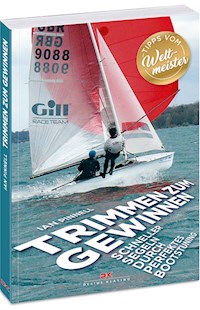
TUNING TO WIN
TUNING TO WIN
Ian Pinnellwith Tim Davison
.
Copyright © 2016 Fernhurst Books Limited
62 Brandon Parade, Holly Walk, Leamington Spa, Warwickshire, CV32 4JE, UK Tel: +44 (0) 1926 337488 | www.fernhurstbooks.com
All rights reserved. No part of this publication may be reproduced, stored in a retrieval system or transmitted, in any form or by any means, electronic, mechanical, photocopying, recording, scanning or otherwise, except under the terms of the Copyright, Designs and Patents Act 1988 or under the terms of a license issued by The Copyright Licensing Agency Ltd, Saffron House, 6-10 Kirby Street, London EC1N 8TS, UK, without the permission in writing of the Publisher.
Designations used by companies to distinguish their products are often claimed as trademarks. All brand names and product names used in this book are trade names, service marks, trademarks or registered trademarks of their respective owners. The Publisher is not associated with any product or vendor mentioned in this book.
This publication is designed to provide accurate and authoritative information in regard to the subject matter covered. It is sold on the understanding that the Publisher is not engaged in rendering professional services. If professional advice or other expert assistance is required, the services of a competent professional should be sought. The Publisher accepts no responsibilty for any errors or omissions, or for any accidents or mishaps which may arise from the use of this publication.
A catalogue record for this book is available from the British Library ISBN 978-1-909911-48-2 (paperback) ISBN 978-1-909911-81-9 (eBook) ISBN 978-1-909911-82-6 (eBook)
All photographs © Fernhurst Books Limited or Pinnell & Bax, except: p15 (right) © Selden; p19 (right) © Mark Dunkley; p53, 62, 67 © Lee Whitehead; p60, 64, 66, 68, 73 © Tim Olin; p76, 77 (left) © Alistair Mackay; p79 © Tom Gruitt
Front cover photograph © Christophe Favreau
Designed by Rachel Atkins Illustrated by Maggie Nelson
.
IAN PINNELL
MULTIPLE CHAMPION, SAILMAKER & CHANDLER
Ian Pinnellfirst learnt to sail at Dorman Long Sailing Club on Teeside aged 10 in 1971. He progressed to Tees Sailing Club, began winning races and became a sailmaker at Storrar & Bax. This business started off in Newcastle and then moved to Northampton and was renamed Pinnell & Bax.
The business has moved from initially being a sailmaker to now having five departments: manufacturing & sailmaking, shop & mail order, repair, rigging and new boats.
Ian has been winning championships since the early 1980s and is continuing to do so over 30 years later. He has over 40 World, European or National Championship titles to his name in classes as diverse as the Enterprise, 505 and Mumm 30.
World Championships
505
Enterprise (x 4)
Fireball (x 2)
European Championships
505 (x 3)
Fireball (x 5)
National Championships
505 (x 11)
Enterprise (x 2)
Fireball (x 8)
Miracle (x 2)
Mumm 30 (Tactician) (x 2)
National 12 (x 2)
Ian was co-author ofHelming to Winwith Lawrie Smith in the originalSail to Winseries. He is the only sailor to have written a book in both the original and new series, confirming his longevity at the top of dinghy sailing.
.
CONTENTS
FOREWORD
INTRODUCTION
PART 1GETTING READY
Assembling The Gear
What Each Control Does
PART 2TUNING
Preparing Your Boat
The Initial Set-Up
Refining The Set-Up
Offwind Settings
Spinnakers
Two Boat Tuning
Troubleshooting
PART 3SKILLS
Equipment Needed
Attaching Fittings To The Hull
Ropework
Boat & Foil Repairs
Rigging
Sail Care & Repairs
END NOTE
.
FOREWORD
Whether you race an Optimist, Laser, Finn, Star or America’s Cup foiling catamaran (or anything in between) there are two things that will determine your results: the skill of the sailors and the way your boat is set up. The former is determined by latent talent and training, the latter is more complex. Tuning a boat to give you maximum boatspeed is not easy. There are so many variables to consider – it is multidimensional.
In my sailing career I have been lucky enough to work with the best. Pre-eminent among them is, of course, Andrew ‘Bart’ Simpson. As Bob Fisher stated in his obituary in The Guardian:
“All sailors have their specialities: Simpson’s extended from his search for speed into the nuts and bolts of how it might be obtained. His meticulous boat preparation was second to none... Simpson spent many hours working on their Star and was rewarded with unsurpassed boat performance”.
It is only fitting that this new book in theSail to Winseries, about boat tuning, is supporting the Andrew Simpson Sailing Foundation.
Ian Pinnell, who has won more championships than most of us can dream of, explains with clear text, photographs and diagrams how to tune your dinghy for maximum boatspeed. Once you have that, you can concentrate on your own performance.
Good luck!
Iain Percy
2 x Olympic gold medallist, 1 x Olympic silver medallist, 3 x World Champion, 3 x America’s Cup challenger
.
INTRODUCTION
Boatspeed is a vital ingredient in winning, but many races are won by only a few boat lengths or seconds. Given that most dinghy races last somewhere between 30 minutes and an hour, you are talking about tiny difference in boatspeed. A 30-second lead in a 30-minute race only equates to the winner going less than 2% faster than the other boat!
We are talking about fine margins here and small changes to your boat’s tuning can easily make that sort of difference to your boatspeed.
This book will help you understand how the rig and foils generate boatspeed. It will show you how to alter the controls to power up or down, depending on wind strength, and how to alter the rig for upwind and downwind sailing. In short, it aims to give you blinding speed and get you pointing so high that you never need to sail on port tack!
The book is organised into three parts:
Part 1: Getting Ready
Focussing on what needs to be done or known before you start tuning, this section begins with how to assemble a hull, foils and gear so that you have compatible kit to tune. Every bit of standard rigging (the things you set up ashore) is then explained, moving onto the effects of the control lines (the ropes you tweak as you sail round the course).
Not every type of boat will have all the equipment and controls described here, but that doesn’t matter, you can just learn how to use the ones that you do have!
Part 2: Tuning
The second part of the book covers boat tuning itself, beginning with the initial set up (which is always for light wind beating), and going on to modifying this set up for beating in medium and strong winds, along with information on reaching and running.
A section on two boat tuning details how you can refine your settings even further, and a dedicated troubleshooting section will help pull you back from the brink when it’s all gone horribly wrong.
Part 3: Skills
The last section of the book covers all the skills you need to make the boat work, be it splicing control lines, replacing a slot gasket or threading a new halyard through the mast.
Armed with this knowledge you will have the confidence to get in the groove right from the start, be able to concentrate on all the other things that need your attention in a race, and work your way up the leaderboard!
.
PART 1
GETTING READY
.
Assembling The Gear
Your first decision is whether to buy new or second-hand. Provided you buy from an expert builder, a new boat should have systems that work, are calibrated and are less likely to fail. The sails are new and the boat should be fast right out of the box. If not, the builder will give you advice and support. Of course, this all comes at a cost – it is very time consuming to fit out a new boat. (For example, it takes our team at P&B 55 hours to set up a 505, and an amateur would probably take twice as long.)
A second-hand boat will be cheaper, and may be fast if you buy a proven boat or can re-tune an unsuccessful one. If you aren’t in a hurry then a cheap boat will give you an introduction to the class and a better idea of what you want when you do move on to a new boat.
Buying A New Boat
Unless the manufacturer supplies a complete boat, you will need to buy the hull, foils, spars and sails.
The Hull
You must buy the hull from someone who is an expert in the class, particularly if you want them to fit it out. Look for:
• Championship results
• Build quality
• Quality of finish
• Under weight
Foils
The rudder wants to be as small as you can handle, to give less drag. It must be stiff.
The centreboard should be stiff in light / medium winds but have enough flex to depower in a gust. How much it needs to flex depends on your crew weight – the lighter you are the more it should flex. Check this by clamping the board, hanging a 15 kg weight on the tip and comparing it with others (right). The spec of the laminate alters the board’s stiffness. If yours turns out to be the wrong stiffness for your weight, you may need a new board.
Think long and hard about the slot gasket, which is vital for speed. It must be in good condition and tensioned properly (which also improves the seal around the board).
Checking centreboard stiffness
The slot gasket is vital for speed
Aluminium (top) and carbon (bottom) cross sections
Mast
The first decision is carbon or aluminium. If the class rules allow, go for carbon every time. These masts have a smaller section, are lighter and recover from big loadings (e.g. hitting the bottom in a capsize) better than their metal counterparts.
Unfortunately, carbon spars cost 2-3 times more and don’t like having holes drilled in them.
Next choose your mast manufacturer, if necessary in conjunction with your sailmaker. There may be a number of sections to choose from: go for the one that best suits your crew weight by asking the mast supplier.
Section
Illustration
Sailor Weight
Stiffness F/A
Stiffness Athwart
Description
C Sleeved
< 75 kg
14.1
9.8
The mast for the lighter members of the fleet, giving greater flexibility and bend.
D Plus
75-90 kg
20.0
13.8
Perfect all-rounder for the Solo, providing good gust response and flexibility for the rougher sea states with enough stiffness to maximise pointing in the flatter inland venues.
Cumulus
> 90 kg
20.4
14.4
Stiffer than C section up to the hounds, but flexible fore and aft, and stiff sideways in the topmast. For heavier sailors.
The table illustrates various Solo masts available from Selden
Sails
Choose a sailmaker who has good results in your class, has good tuning data and offers a good service.
He will cut the sail to fit your mast, crew weight and the expected conditions.
Heavier cloth lasts longer but, of course, gives weight aloft. Lighter cloth gives more speed initially, but wears out quicker. And remember, Dacron stretches with use whereas Mylar shrinks, so don’t mix them!
Crosscut sails are simple to make. Radial sails are more complex, but each panel has the warp lined up with the direction of stress so the sails are more stable. As a result they can be made in lighter cloth, but they are more expensive.
If you’re unhappy with a sail, your sailmaker can re-cut the luff. One or two centimetres here makes a big difference, and he will seldom need to adjust the panels.
Since the key variations are so small, I’m afraid you won’t learn much by laying the sail out yourself on a flat surface. Leave the analysis to your friendly sailmaker.
Crosscut sail
Radial sail
Buying A Second-Hand Boat
If you can afford it, buy a proven boat. You’ll know it’s fast, and the seller will give you the settings. If you get on well he might even help you at regattas.
If you can’t find a boat with a winning record, you will have to look at whatever is on the market. Go back to the manufacturer for the boat’s history, then check the boat’s condition yourself. Pay particular attention to:
• The finish of the hull and foils, and the fit of the slot gasket.
• The weight of the hull: check this yourself to the best of your ability. Be suspicious if there are no correctors, indeed you should really only buy a boatwithcorrectors.
• The rig set-up (see Part 2). For example, check that the spreaders are symmetrical and that the mast isn’t bent sideways but does bend evenly fore and aft.
• The sails.
Spread the main and jib on the floor and look for signs of the cloth breaking down. Creases are suspicious, as is marbling (white crazing lines, below). Examine the clew area of the jib and area around the inboard ends of the main’s batten pockets.
Hold the spinnaker out horizontally by the corners and check the cloth. Do the leeches look tighter than the rest of the sail? The sail will stretch with age but the leeches won’t. If you have a sail like this you’ll probably need a new one.
Hopefully though, everything will be ok, in which case you’re in business!
If the leeches are tighter than the rest of the sail it has stretched and needs replacing
Marbling is an indication of the cloth breaking down and the need for a new sail




