


Erhalten Sie Zugang zu diesem und mehr als 300000 Büchern ab EUR 5,99 monatlich.
- Herausgeber: Fernhurst Books Limited
- Kategorie: Lebensstil
- Serie: Ultimate Adventures
- Sprache: Englisch
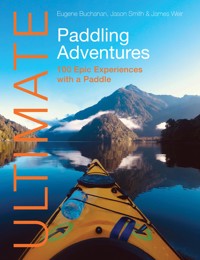
Ultimate Paddling Adventures takes you on a thrilling tour around the world's best paddling spots – from the frozen expanses of Alaska to the tropical rivers of South America. Explore the rivers and seas of Europe and visit the stunning waters of the Far East, Australasia and the Pacific. There are exciting adventures that will appeal to everyone from novice to expert. Stunning, full-page photographs put you at the heart of the action, while inspirational descriptions allow you to dream of being there. It's perfect for planning your next paddling adventure, or alternatively allows you to indulge in some armchair paddling in places to which only the most adventurous will go. From a leisurely SUP in a breathtaking Swedish archipelago, where you can stay in the King of Sweden's bed (for free!), to an adrenaline-fuelled whitewater kayak down Chile's Inferno Canyon, this book has it all. This includes gentle lakes and rivers, crashing surf, dramatic coasts and the oceans beyond them. All types of paddle craft are included from canoes and kayaks to SUP boards and packraft. Every continent is covered, so expect to find places you've paddled alongside those you never knew existed. Each entry is accompanied by useful information such as the experience required, how to get there and what else to do once you are there. Discover where you will paddle next – in reality or in your imagination.
Sie lesen das E-Book in den Legimi-Apps auf:
Seitenzahl: 303
Veröffentlichungsjahr: 2023
Das E-Book (TTS) können Sie hören im Abo „Legimi Premium” in Legimi-Apps auf:
Ähnliche



















AUTHORS & DEDICATIONS
Eugene Buchanan, Jason Smith & James Weir
Guest contributors:
Andy Burrows & James van Drunen (p30 & 48)
Caroline Dawson (p52 & 88)
Rob Estivill (p8, 50 & 102)
Emma Hepplewhite (p80)
Chris Scott (p62, 118)
Dedications:
‘To Brooke and Casey. Hopefully you’ll get on as many of these waterways and experience as many of these different cultures around the world as I have’ – Eugene
‘For Mum, who passed on to a bigger adventure during the writing of this book, and Faye and Darcy the bedrocks of my life’ – Jason
‘For Zoe, Max and Lilli, I look forward to sharing many ultimate canoe adventures with you together’ – James
CONTENTS
Europe
River Danube, Europe
Allier Gorge, France
River Guil, France
Rizzanese River, Corsica
Verdon Grand Canyon, France
Crete, Greece
Annamoe & Glenmacnass Rivers, Ireland
Irish Coast
Amalfi Coast, Italy
Venice, Italy
Ticino River, Italy
Tara River Gorge, Montenegro
Friesland, The Netherlands
Voss & Sjoa, Norway
Masurian Lake District, Poland
Lake Baikal, Russia
Soča River, Slovenia
Bakio, Spain
Costa Brava, Spain
Mallorca, Spain
Mundaka, Spain
Santa Pola, Spain
Kungsleden, Sweden
Sankt Anna Archipelago, Sweden
Tessin, Switzerland
Vorderrhein River, Switzerland
Wastwater, Lake District, England
Devizes to Westminster, England
Regent’s Canal, London, England
Norfolk Broads, England
Lundy Island, England
River Dart, England
Isles of Scilly, England
River Tweed, Scotland
Outer Hebrides, Scotland
Glen Etive, Scotland
Falls of Lora, Oban, Scotland
Loch Ard, Scotland
Anglesey & Holy Island, Wales
Bitches Tidal Race, Wales
Fairy Glen, Snowdonia, Wales
Trefor, Llŷn Peninsula, Wales
Africa & Asia
The White Nile, Uganda
Morocco
Seychelles
Orange River, South Africa
Mana Pools National Park, Zimbabwe
Zambezi River, Africa
Nam Suang & Seng Rivers, Laos
Karnali River, Nepal
Madi Khola River, Nepal
Phang Nga Bay, Thailand
Hạ Long Bay, Vietnam
Australasia & Pacific
Peron Peninsula & Shark Bay, Australia
Freycinet National Park, Tasmania, Australia
Franklin River, Tasmania, Australia
Fitzroy River, Australia
Whitsunday Islands, Australia
Fiji
Hawai’i
Abel Tasman National Park, New Zealand
Great Barrier Island, New Zealand
South Island, New Zealand
South-east Pacific
North America
Bowron Lake National Park, Canada
Skookumchuck Narrows, Canada
Dipper Creek, Canada
Lachine Rapids, Montreal, Canada
Nahanni National Park, Canada
Mountain River, Canada
Algonquin Provincial Park, Canada
Ottawa River, Canada
Inland Rivers, Greenland
Sermiligaaq-Tasiilaq Fjord, Greenland
Kongakut River, Alaska, USA
Glacier Bay National Park, Alaska, USA
Talkeetna River, Alaska, USA
Grand Canyon, Arizona, USA
Buffalo River, Arkansas, USA
Big Bend Paddling Trail, Florida, USA
Payette River, Idaho, USA
St Croix & St John Rivers, Maine, USA
Acadia National Park, Maine, USA
Lake Superior, Michigan, USA
Boundary Waters, Minnesota, USA
Raven Fork River, North Carolina, USA
Labyrinth & Stillwater Canyons, Utah, USA
Gauley River, Virginia, USA
San Juan Islands, Washington, USA
Little White Salmon, USA
Central & South America
Bahamas
Belize
Costa Rica
Rio Alseseca, Mexico
Rio de Oro, Mexico
Sea of Cortez, Mexico
Manso River, Argentina
Lake District, Chile
Futaleufú River, Chile
Ecuador
Europe
RIVER DANUBE, EUROPE
Paddling across borders – don’t forget your passport
Experience
Novice
Getting there
Fly into Bucharest and from there drive 135 miles (217km) to Constanta and another 76 miles (122km) to Tulcea
In this location
To canoe the Danube’s headwaters like MacGregor did in the Rob Roy, start near the town of Beuron, Germany, and run a shuttle to Sigmaringen (near the Hohenzollern family castle, one of the most powerful dynasties in Germany). Just beware the small weirs, which require portaging or sliding over
On land
Take some time out of your boat to explore the nearby town of Constanta, founded by the Greeks in 600 BC and later taken over by the Romans. Highlights: the Orthodox cathedral, Tatar-Turkish Mosque and archaeological museum (with Roman glass from 100 BC)
Want to paddle the most international river on the planet? J-stroke over to Europe’s Danube, whose course runs across, or forms the partial borders of nine countries, including Germany, Austria, Slovakia, Hungary, Croatia, Serbia, Romania, Bulgaria and Ukraine. It also winds through four capitals, including Vienna, Bratislava, Budapest and Belgrade.
If that’s not enough to get you packing, set hull to its upper reaches and you’ll be retracing the route reflected in one of the earliest books ever covering the sport. The Danube was one of several waterways traversed by John MacGregor, the author of 1866’s A Thousand Miles in the Rob Roy Canoe on Rivers and Lakes of Europe, and one of his most cherished. Dip a blade in it today, either on its lower delta or upper headwaters, and you’ll revisit the waters MacGregor plied in his seven-foot (2.1m), covered, oak canoe, dubbed the Rob Roy, with a two-bladed paddle.
When it comes to the Danube, it’s easy to see why MacGregor felt compelled to turn his copious notes and insights into a tome. The Danube flows 1,788 miles (2,878km) from its headwater springs in Germany’s Black Forest near Donaueschingen all the way to the Black Sea, where it forms the second largest and best preserved of all of Europe’s deltas. In all, the delta at the river’s terminus in Ukraine comprises 2,200 square miles (5,700km2) of rivers, canals, marshes, lakes and reed islands, all of which make it a bird watcher’s paradise.
Formed around the three main channels of the Danube is its crown jewel: the Danube Delta Biosphere Reserve. The reserve has the third largest biodiversity in the world, exceeded only by Australia’s Great Barrier Reef and Ecuador’s Galapagos Islands. In all, it contains more than 1,700 plant and 3,450 animal species, including 300 species of birds, many of which migrate annually from as far away as China and Africa. Ply its delta waters in the spring-through-summer bird-watching season and you’ll see cormorants, white tailed eagles, pelicans (millions of Egyptian white pelicans arrive annually to raise their young), geese, ibises and more interspersed among such land features as floating reed islands, forests, pastures and dunes.
You can spend as much time as you like exploring its passages, lakes and maze of willow-lined canals. Most paddlers begin their excursions in the Danube Delta by launching out of Tulcea, Romania, about a two-hour drive from Constanta on the west coast of the Black Sea. From here you can paddle such popular waterways as 36 Channel, Sireasa and Papadia canals, and Câslita, Furtuna and Rotundu lakes. Wherever you go, you’ll relive what MacGregor noted about the upper Danube all those years ago: ‘No river I have seen equals this Danube … I found it a noble river, steady and swift, as if in the flower of age …’
ALLIER GORGE, FRANCE
Gorgeous Allier: white water packrafting
Experience
Expert
Getting There
Take the train to Langogne, which is on the Nimes – Clermont Ferrand line, approximately 6-7 hours from Paris. If you are going by car you can drive to Langeac and then catch the train up to Langogne with your paddling gear
In this location
You can keep going down the Allier if you fancy a longer trip, all the way to Brioud or even further. Expect calmer conditions and more beautiful landscapes
On Land
The wild countryside around the gorges is perfect for hiking and biking. The volcanic landscape is dotted with castles and picture-postcard medieval villages that are worth a visit, such as Prades, Pradelles or Lavoûte-Chilhac. Head over to the Puyen-Vélay for a deeper dive into the region’s history and culture
This is the longest continuous section of white water that can be paddled in France and has it all: gnarly rapids, extreme isolation, a preserved natural landscape and easy access by train. It is a run made for packrafting. The section here described covers 46 miles (74km) from Langonge to Langeac with an altitude loss of 1,300 feet (400m). The descent can be done in three or four days.
Most of the itinerary is inaccessible by road, with few points of entry along the way. Only the train line follows the natural valley created by the river, tunnelling through the rocky cliffs and crossing the Allier on several magnificent viaducts. If you catch the train before doing the run, it will give you the opportunity to see the rapids from above.
From the train station in Langogne there is a short hike to the put-in. This first section is the most technical and one of the most isolated, starting off with a few class 3 rapids before speeding up to some class 4 drops, the most famous being the Triple Chute. The second part is similar in difficulty with the highlight being the class 4 Freycenet rapid. A few more class 3 rapids will take you all the way to Chapeauroux and out of the upper section. It is quite long (12 miles [20km] with rapids that need to be scouted) so start early.
The river calms down between Chapeauroux and Alleyras. The scenery is still gorgeous though, with several granite blocks rising out of the water. From Alleyras, keep going into the Poutès reservoir. The dam has been lowered recently to allow salmon to reach the upper part of the river and it is now legal to paddle beneath it. To get around the dam there is a steep path on river left. A carry path should also be built across the dam but was not finished at the time of writing.
The gorge below is the wildest part of the entire trip as the train line no longer follows the river. It often has reduced water levels and is an easy class 3. The water drawn off at Poutès is restored at Monistrol. If you need supplies, here is the place to stop before the classic white water run of the valley, with lots of rafts in summer and nice rapids.
Things quieten down again as you near Prades, a beautiful village with some impressive basalt columns just above the river. Fields start to appear on either side as the river slows down: keep paddling to Langeac.
With stations at Chapeauroux, Alleyras and Monistrol, it is possible to reduce the length or difficulty of the trip. For example, the section between Chapeauroux and Alleyras is a perfect one-day paddle for those who would like to try an easier and shorter version of the gorge.
RIVER GUIL, FRANCE
Alpine dreaming
Grade
2-5
Experience
Intermediate – Expert
Getting there
The Guil is situated in the Hautes-Alpes department of southeastern France and most paddlers will base themselves in or around the Durance Valley while staying in the region. The nearest airport is at Grenoble
In this location
You’ll have a plethora of awesome whitewater runs in the vicinity. Fine sport is to be found on the Guisane, the Gyr, the Onde and the Ubaye
On land
This is the Alps, so mountain sports rule, mountain biking, gorge walking and rock climbing are all easily accessible. The area also has some stunning Via Ferrata high-level routes if you like heights!
The crashing mountain torrents of the French Alps have long exercised a strong pull on kayakers. Its dramatic mountains and challenging and exciting rivers, all within reach of each other, make it a fantastic whitewater destination.
No river in the region offers such a range of experiences along its length as the Guil. A barrage now tames its lower gorge, but the Guil still offers enough action in its upper reaches to keep the most hardened of whitewater addicts satisfied.
The action starts just above the imposing Château Queyras, which sits high above the steep-sided gorge of the same name. This, and the Guardian Angel Gorge, which lies below, are seen as test-piece sections of the Guil and, indeed, as rights of passage to the ranks of the true alpine paddler. Once you enter the Queyras Gorge it’s tricky and you need to be on your game. It’s very tight and in places the width of the gorge isn’t much more than the average kayak’s length. In many ways it’ll feel a little like being flushed down a U-bend! There’s an infamous undercut corner halfway down and care should be exercised, as it is very difficult to protect.
The Guardian Angel Gorge follows fairly swiftly after and the remains of an old road bridge signal the beginning of its challenges. It has many shoots and slides around and over high boulders and also hides some treacherous siphons and undercuts, so treat it with care and respect. It’s difficult water throughout and there’s one ugly looking drop, in a walledin section that’s impossible to portage and hard to inspect. It all adds to the adventure though and if you take your time, use good judgement and take care, you’ll be raving about it in the bar that night. The section finishes where you meet the main road again, close to the L’Ange-Gardien Bridge.
The next section down to Maison du Roy will rank as many paddlers’ favourite section of river in the French Alps. It starts with a bang at an impressive series of drops known as Triple Step, which is trickier than it looks as each drop slows you and pushes you to the right and more than one kayaker has taken a rinsing in the bottom hole under the infamous Curtain. From here the section down to the road bridge at La Chapelue is fairly chunky water, with a few drops that call for inspection, and possibly safety cover. Eventually you’ll come to a large road tunnel on river right. There used to be a nasty slot rapid here, but flooding has now changed the river’s features here considerably. From here it’s all excellent read-and-run fun with some good, punchy holes until you get to the take-out at Maison Du Roy, where the river becomes a lake above the barrage.
RIZZANESE RIVER, CORSICA
Free-falling on the Isle de Corse
Grade
4-5
Experience
Expert
Getting there
To get to Corsica take either a ferry from the French mainland or fly into any of Corsica’s 4 international airports. It’s possible to fly to nearby Sardinia and catch a ferry over
In this location
Corsica is blessed with a cornucopia of exciting and challenging whitewater rivers. The Fium’ Orbo, the Golo and the Taravo all come highly recommended. Its coastline is also considered a world-class sea kayak destination
On land
With an impressive range of mountains, over 6.560 feet (2,000m), running down its centre walking, hunting, fishing and mountain biking are all popular pursuits. It’s also home to the famous GR20 Grande Randonnée high-level walk, which usually takes 10-12 days to complete
Corsica was a groundbreaking destination for early European whitewater kayaking pioneers. They were drawn to its Mediterranean climate, raging torrents and deep, impenetrable canyons. The rivers of Corsica reflect its people, hard, tough and uncompromising. Treat them with respect and they’ll offer you a memorable welcome. But slight them at your peril. Of all the fantastic rivers of this granite isle, nowhere is this comparison more true than with the Rizzanese.
The Rizzanese starts with a bang and from the beginning it presents you with drop after drop, building steadily in intensity as you work your way down. Most of its rapids are complicated boulder gardens or slides and it demands focus and commitment. Interspersed amongst these are larger falls, varying in height and difficulty. As the run builds, one rapid flows quickly into the next and you’ll become totally immersed in the rhythm of boat scouting, running strong lines and inspecting the next section. The river itself can be so engaging that you have to remind yourself to look up and take in the stunning surroundings. The canyon walls and surrounding hillside are covered in the maquis scrub for which Corsica is famous.
In the middle of the run, and for many the highlight, is a clean 30-foot (9m) waterfall. There’s a pool right on the lip, so you can scout your line and there is also a portage option on river left, although this is certainly harder and probably more hazardous than running the fall itself. The traditional line is to run hard right because an old guidebook said there were ‘leg-breaking’ rocks in the centre and left. But in modern times many paddlers opt for a centre line launching off a natural spout.
Whatever line you choose, as you slide over the lip and see how far away the landing is your heart will be beating hard before you crash down into the foaming pool below. More rapids follow but care should be taken on the very last fall. The river left shoot is walled in, and severely undercut and forms a deadly tow-back in most water levels. A safer option is to run down the right-hand side of this particular drop. All that is left after that is to paddle the now meandering river to the take-out and then head to a local bar to let the adrenaline subside, while you relive the day’s adventure over a glass of Corsican wine and a slice of local wild boar sausage.
VERDON GRAND CANYON, FRANCE
Cave kayaking in the Grand Canyon of Europe
Grade
3-4
Experience
Intermediate
Getting there
Nearest towns are Castellane and Moustiers. You can put in directly at Point Sublime but this involves winding steps. Alternatively you can put in further upstream at Pont de Carajuan. The water levels on the Verdon Grand Canyon are dam controlled and it’s important to check whether there is a release or not
In this location
It’s a fair drive to the paddling centres of the French Alps, but there is nice paddling in the upper sections above Castellane and on the ‘pre-canyon’ section from Pont de Taloire to Point Sublime
On land
In the summer this is a busy tourist destination so there’s mountain biking, pony trekking and bungee jumping available
The Verdon Grand Canyon has a remarkable limestone canyon (average depth of 1,640 feet [500m]) with awe-inspiring cliff walls that attract the best rock climbers in the world to test themselves. Far below these intrepid rock jocks, the river snakes its way through some spectacular geology, creating some fantastic, unusual and dangerous rapids.
It may be somewhat smaller than its American cousin in Colorado, but it shares the same grandeur and inaccessibility. Although the rapids on the Verdon are not particularly difficult, once you’ve passed the entry to the Canyon at Point Sublime you are committed to a long and demanding day.
Due also to its limestone nature, the Canyon is riddled with dangerous siphons. It has claimed many lives over the years and it is a sobering reminder to look up from an eddy above the L’Estellié rapid and see brass plaques fixed to its fearsome limestone walls in memory of those who paid the ultimate price for a mistake on the river.
Apart from its raw beauty, the thing that sets the Verdon apart is the uniqueness of some of its rapids, where you literally paddle underground. The most famous of these is the Styx, which translates as The Gateway to Hell. And it may feel like that as you approach the cave!
The next subterranean experience will be the Chaos de l’Imbut. A tricky rapid, with a very dangerous siphon, that leads down to what appears to be a chasm in the sheer rock for which you are heading. As you enter, the speed of the water drops off, and as your eyes adjust you will feel both trepidation and exhilaration at what is to come. Underneath you the water gurgles and swirls as it flows around and under the rock. After scraping along in darkness punctuated only by small spots of light from the odd hole in the roof you will emerge into a chamber. Now you have to exit your boat and climb out into daylight.
More rapids follow and the Canyon walls can almost feel like they are closing in upon you. Le Rideau (the curtain) is another heart stopper. As you approach it will appear that the whole river is blocked by a massive rock with the river running underneath it. At the last moment you will see a gap on river left where you can put your paddles by your side and use your hands to guide you through.
More quality rapids follow until you finally emerge on to the calm waters of the Pont de Galétas where, if you’ve made it out before darkness falls, it can be surreal to suddenly find yourselves amongst pedalos and sun worshippers. That pretty much sums up the Verdon Grand Canyon: a surreal, challenging, but very special experience.
CRETE, GREECE
Touring the land of ancient Greek gods
Experience
Novice
Getting there
Fly direct to Crete (3 airports) or fly to Athens and take an overnight ferry to the island
In this location
While Crete offers one of the best places to sea kayak, the Greek islands also offer several other paddling options. Try circumnavigating the islands of Mykonos and Delos, whose turquoise seas are home to several water-based wildlife refuges
On land
Bring hiking shoes for a walk through the Gorge of Samarian, one of the most popular national parks in all of Greece. Bonus points: touring the Minoan Palace of Phaistōs
You’ll be paddling in the wake of such ancient Greek gods as Zeus, Apollo, Artemis, and yes, even Poseidon himself, with a sea kayaking excursion to Crete.
But even in the presence of these deities, it’s the area’s beauty that truly takes your breath away. With more than 650 miles (1,046km) of glassy, turquoise coastline to explore, Crete, the largest of Greece’s islands at 163 miles (262km) long, is as sculpted for sea kayaking as were the marble statues of ancient gods. And sticking out from its precipitous mountains is the island’s base rock of limestone, the building block of marble, that makes it such prime paddling.
Rising above the sparkling Libyan Sea, whose infinite shades of blue and green are so clear you can see a hundred feet (31m) down to the bottom, limestone towers and cliffs permeate the rocky, jagged coastline, letting you dart across bays, poke your bow into nooks and crevasses, and even explore the occasional sea cave. A favourite pastime of paddlers in the region is to play Acapulco cliff diver and jump from them into the tranquil waters below. The white cliffs are also interspersed with beaches to lunch and lounge on throughout the day’s paddle.
And as well as traversing the lair of ancient gods, paddling around Crete also provides a chance to polish up on more terrestrial history. Famous in mythology as the birthplace of Zeus, the island lies at the crossroads of three continents – Europe, Africa and Asia – making it a true cradle of civilisation. En route, you’ll be plying the same waters as the ancient Minoans, who sailed the same sea in the Bronze Age more than 4,000 years ago. Parallelling its coastline, you’ll revisit the romping grounds of everyone from the first Stone Age inhabitants in 6000 BC up through the Minoan Bronze and Dorian Iron Ages.
As for the actual paddling, many tourers start in the protected bay at the village of Matala, which lets you explore the ruins of ancient Minoan and Greek palaces, including Knossos, the famous Minoan palace outside Heraklion. You’ll also be able to visit ancient Venetian castles and turreted Turkish fortresses, before paddling by the area’s famous caves to such other southern coastal towns as Agios Pavlos. There you can visit an eleventh-century chapel built in honour of St Paul before steering your rudder along the coastline to Marmara Beach, the water-access-only town of Loutro and Sweetwater Beach, where you’ll find a gurgling freshwater spring.
As for overnighting, you can stay in family-owned inns and seaside tavernas along the way, offering everything from a comfortable bed to home-cooked cuisine and vibrant local wine – courtesy, of course, of Greek god Dionysus.
ANNAMOE & GLENMACNASS RIVERS, IRELAND
Combine Dublin’s bright lights with Irish whitewater
Grade
3-5
Experience
Intermediate – Expert
Getting there
Dublin has an international airport and 4 ferry routes with connections to England, Wales and France. From Dublin head south out of the city towards the Wicklow Mountains and Laragh
In this location
If the rain is falling and the rivers are high then there’s some fantastic whitewater sport to be had. Other notable runs include the Dargle, the source of the Liffey and the Upper Liffey
On land
The Wicklow Mountains are a magnet for outdoor sports enthusiasts and there are some beautiful lakes dotted throughout the region. Walking, horse riding, mountain biking and field sports are all popular and easily accessible in the region
Although they both rise in the wonderful Wicklow Mountains, and are in reach of the bars, restaurants and other myriad attractions of Dublin, the Annamoe and Glenmacnass are two very different beasts. One’s a mellow and fun run with an exciting finale, and the other’s a white knuckle, boulder-strewn blast that is quite probably the hardest river that is regularly run in Ireland!
The Annamoe is predominantly a grade 3 run that provides good sport until it reaches the mini-gorge, which heralds the arrival of the ‘main event’ – Jackson’s Falls. The river crashes over a sloping ledge to form a sticky recirculating hole with a powerful back eddy, that’s very adept at feeding unfortunate paddlers, boats and various bits of kit back in to the grip of the hole. This has been the venue for a whitewater kayak race in years past and Jackson’s draws big crowds eager to see the carnage unfold. In higher water it becomes a big thrashy hole that needs a steady nerve and a strong stroke to punch your way through. There’s a second small fall at the end of the gorge and then steps down a gear and the Glenmacnass joins before you reach the take-out ready for a well-earned pint of the black stuff in the nearby Lynham’s Hotel.
The Glenmacnass is a very different kettle of fish indeed. Throughout, the run is tight, steep and technical. The pace is fast and the difficulty high and there is always the added hazard of fallen trees. If you can tear your concentration from the screaming river below you, the surrounding woodland scenery is striking. It’s very constricted and tight, and many sections are gorged in. Boiling eddy lines and powerful hydraulics litter the run. Your knuckles will be white, but your eyes will be shining as you rocket through Laragh Gorge and arrive at the Soldier’s Hole, the adrenaline coursing through your veins! The Glenmacnass then gives you a brief respite as it takes its foot off the gas, just for a while, before going foot to the floor for the final section down to the confluence with the Annamoe.
All that’s left to do now is to load up and head off to Dublin in search of stout, song, whiskey and craic to celebrate your Irish river running double.
IRISH COAST
Circumnavigate Ireland by sea kayak
Experience
Intermediate – Expert
Getting there
From abroad, your best bet is to fly into Dublin, Shannon or Belfast International airport, and plan your logistics from there. If you’re coming from the US, it’s about a six-hour flight from the East Coast
In this location
Are you kidding? If you still want more paddling after circumnavigating Ireland, you’re a nut job
On land
Take time before, after or even during your circumnavigation, to take in the country’s sites, including castles, the Cliffs of Moher, the UNESCO World Heritage Site of Giant’s Causeway, the Ring of Kerry, the Rock of Cashel, and, of course, the tour of Irish pubs
To sea kayak around Ireland you don’t have to hallucinate and finish with a 140-mile (225km), 54-straight-hour push. Even though that’s what Jeff Allen and Harry Whelan did in 2011 when they set a new record of 25 days, bettering the 20-year-old record of 33 days. The record now stands at 23 days, set by Mick O’Meare in 2015. While some people take a month or two to complete the journey, others take entire summers, paddling when the weather permits and staying put in pubs when it doesn’t (which is often).
What most people share when they attempt this journey is the direction. Whether you start from Ardmore, Dublin, Dingle or West Cork, head out clockwise to take best advantage of the prevailing winds. Regardless, be prepared for a haul. The shortest distance around the country is about 1,000 miles (1,609km), but that entails cutting across bays wherever possible and dealing with the ensuing swell, currents, wind chop and exposure. Try to stay close to shore the whole way and you’ll easily double the distance. In general, expect the distance to be between 1,000 and 1,200 miles (1,609-1,931km).
No matter your route, you’re in for a unique, cockpit-view glimpse of the country, from the beauty of the Donegal coast to the majesty of the Aran Islands. And whether you’re travelling solo or tandem, expect plenty of companionship en route. Expect to cavort with dolphins (circumnavigator Jasper Winn shared the waters with a trusty old dolphin named Fungi) and paddle with everything from whales and gannets – a colony of 50,000 of which nest on Little Skellig rock – to even sharks. While most of the latter will be harmless basking sharks, round Brandon Head prepare for the occasional great white – sightings of these toothy behemoths have become more common in the Irish Sea.
Also expect to have close communion with Mother Nature, in the form of rain, wind and cold. Tales abound of winds pinning paddlers down on remote headlands, desolate islands and deserted beaches for days on end. Weather will also affect your crossings. One of the most formidable is the paddle from the Ring of Kerry to Dingle. Another tough spot, where you’ll feel the full force of the Atlantic swell, is near Ireland’s most northern point, Malin Head. You’ll encounter similar exposure rounding the Blaskets.
Thankfully, you can always find willing ears and refuge in local pubs, where locals will ply you with Guinness to hear your tales and might even offer you a warm bed and meal. Just remember: in the end, the trip is no easy feat and you’ll likely curse the elements. There’s a reason the documentary Allen and Whelan made of their record-setting trip is called Into the Wind.
AMALFI COAST, ITALY
A multi-day trip with no need for camping kit
Experience
Intermediate – Expert
Getting there
Take the train or fly into Naples or Salerno and then bus to the main coastal towns. The nearest train station to the Amalfi coast is Vietri sul Mare-Amalfi, but you’ll still need to get a bus to the coast
In this location
Head out for the coves and inlets of Cilento and Vallo di Diano national parks for even more Italian touring
On land
From Naples, head to Pompeii and Mt Vesuvius, site of the tragic volcanic eruption burying the town of Pompeii and Herculaneum
Molto buono. That’s what you’ll be saying after a delicious pasta supper washed down with wine as you live la dolce vita on a sea kayaking trip along the rugged Amalfi coast of the Sorrentine Peninsula in the Province of Salerno in southern Italy.
Named a UNESCO World Heritage Site for its towering cliffs, serpentine canyons and pristine coastline, you can paddle 25 miles (40km) from Maiori to Positano, stopping to stay in one of 13 municipalities along the way. If your itinerary allows, you can also include a circumnavigation of Capri Island, a resort since the early Roman days.
The beauty of this trip is that you can leave the camping gear at home, staying instead in quaint Italian villas, chalets and B&Bs along the way, packing picnics of fresh Italian bread, wine and cheese for each day’s kayak. If you’d rather stop for a cappuccino and dine at a local restaurant, you can do that too at any number of small towns. And don’t restrict yourself to wine; the region is also known for its limoncello liqueur.
One popular paddling route starts from the beach in the town of Amalfi and takes you through deep blue waters along the coast toward Salerno. Stop number one: the town of Minori, where you can visit an authentic villa museum and, if you’re lucky, hit the Ravello Music Festival during your stay. Continuing on along the convoluted coastline, you can explore nooks and crannies, cast glances to the towering cliffs or full reach of the Mediterranean Sea, and stop to pull over wherever you please. With 13 towns along the way, you can pull in at a small port town to refuel or for the night. One possible overnight stop is the village of Positano, whose steep streets lead to a perfect viewpoint of the waters you have just paddled.
Towards the end of the stretch you can continue along a more remote section of coastline to Recommone, where you can marvel at ancient towers and explore Turkish ruins. A side-trip from there takes you to the protected Isca Island, where bird and marine life abound, and further on lies Marina de Cantone and the Isle of Capri, which requires crossing the open waters of the Gulf of Naples. Your reward is another night of quaint Italian charm offering views of the entire Amalfi coastline. If you’re feeling sociable try to jockey with the commercial rowboats and paddle into the Blue Grotto, a sea cave known for its deep blue reflections thanks to two entrances letting in light (you can also catch a taxi or bus or motorboat there from Marina Grande).
Other island highlights include Marina Piccola (Little Harbour), the Belvedere of Tragara, a high promenade lined with villas, ruins of Imperial Roman villas, and tall limestone crags / sea stacks rising out of the water.
VENICE, ITALY
A voyage down the Grand Canal
Experience
Novice – Expert
Getting there
It is possible to drive to the outskirts of Venice, but the easiest ways to arrive are by train or by plane. The Marco Polo International Airport services Venice. The airport is on the mainland; the water taxis or waterbuses to Venice are only a few minutes’ walk from the terminals
In this location
There’s plenty of scope for interesting sea kayaking in this region of Italy. Head south and you enter the waters of the Mediterranean. Head north and the area around Trieste offers opportunities of day and overnight trips
On land
There are so many museums, galleries, sites of artistic, architectural, cultural and historic interest and restaurants they could fill a guidebook! Why not take in an opera at Musica A Palazzo or visit the impressive Doge’s Palace
The northern Italian city of Venice has a fair claim as the most spectacular city in the world. A city as flooded with colourful history, breathtaking architecture and amazing art as it is with water. Queen of the Adriatic, City of Water, City of Bridges, City of Canals and The Floating City are just a few of the names that Venice has borne and give a clue to why it is such an unusual, but fantastic, place to explore in a kayak. Venice stretches across 117 small islands in the marshy Venetian Lagoon along the Adriatic Sea. In Venice the boat is everything! Where other cities have cars, buses and roads, Venice has gondolas, spandolo, vaporetti (water-taxis) and canals.
To get around you must either walk or travel by boat, which makes it the only major city in the world that you can explore completely by kayak. The scope for kayak trips is extensive, from exploring the various islands in the lagoon (almost impossible as a normal tourist), or exploring the coastline, to paddling between the ancient walls of the city’s buildings, travelling along the Grand Canal and visiting world-famous landmarks such as the Piazza San Marco (St Mark’s Square). Sea kayaks make the ideal craft to experience the city. As the hordes of tourists jostle through its narrow, tangled streets, you glide below, the very picture of serenity, as you take in the city’s delights from a singularly unique perspective. To walk across the Bridge of Sighs is certainly a special experience but to paddle under it is truly sublime.




