


Erhalten Sie Zugang zu diesem und mehr als 300000 Büchern ab EUR 5,99 monatlich.
- Herausgeber: The History Press
- Kategorie: Lebensstil
- Sprache: Englisch
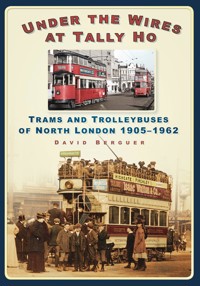
Today pollution-free transport is high on the political agenda yet it is sometimes forgotten that electric vehicles ran on the streets of London from the early 1900s until 1962. This book tells the story of that period and describes both the vehicles themselves and the effect they had on the development of the suburbs. Local historian David Berguer has endeavoured to paint a picture of what life was like in the capital during this golden age, travelling and working on the trams and trolleybuses, and includes material based on newspaper reports, council and official minutes and oral histories from those involved. With many previously unpublished photographs and detail on the vehicles and routes themselves, there is even a chapter on the colourful pirate buses which competed against trams in the 1920s. Full of local interest and insights into daily life on north London trams and trolleybuses, this celebration of the glory days of electric street traction in the suburbs of North London is bound to capture the imagination of both transport and local historians alike.
Sie lesen das E-Book in den Legimi-Apps auf:
Seitenzahl: 200
Veröffentlichungsjahr: 2011
Das E-Book (TTS) können Sie hören im Abo „Legimi Premium” in Legimi-Apps auf:
Ähnliche



















UNDER THE WIRES AT TALLY HO
UNDERTHE WIRESAT TALLY Ho
TRAMS AND TROLLEYBUSES OF NORTH LONDON 1905–1962
DAVID BERGUER
First published 2010
The History Press
The Mill, Brimscombe Port
Stroud, Gloucestershire, GL5 2QG
www.thehistorypress.co.uk
This ebook edition first published in 2013
All rights reserved
© David Berguer, 2010, 2013
The right of David Berguer to be identified as the Author of this work has been asserted in accordance with the Copyright, Designs and Patents Act 1988.
This ebook is copyright material and must not be copied, reproduced, transferred, distributed, leased, licensed or publicly performed or used in any way except as specifically permitted in writing by the publishers, as allowed under the terms and conditions under which it was purchased or as strictly permitted by applicable copyright law. Any unauthorised distribution or use of this text may be a direct infringement of the author’s and publisher’s rights, and those responsible may be liable in law accordingly.
EPUB ISBN 978 0 7509 5353 5
Original typesetting by The History Press
CONTENTS
REFLECTIONS
INTRODUCTION
MAP OF TRAM & TROLLEYBUS ROUTES
CHAPTER 1
A PROTRACTED BIRTH
CHAPTER 2
THE TRAMS AT LAST
CHAPTER 3
THE SYSTEM EXPANDS
CHAPTER 4
HOW THEY WORKED
CHAPTER 5
THE BUS PIRATES
CHAPTER 6
TRAM DEVELOPMENTS
CHAPTER 7
TRAM MEN & WOMEN
CHAPTER 8
EVERYDAY OCCURRENCES
CHAPTER 9
SCRAP THE TRAMS
CHAPTER 10
A FOND FAREWELL
CHAPTER 11
A NEW BEGINNING
CHAPTER 12
THE WAR & AFTERWARDS
CHAPTER 13
TROLLEYBUS MEMORIES
CHAPTER 14
THE END
APPENDIX 1:
TRAM & TROLLEYBUS CHRONOLOGY
APPENDIX 2:
MET TRAM SERVICES
APPENDIX 3:
MET TRAM SPECIFICATIONS
APPENDIX 4:
INDEPENDENT MOTOR BUS ROUTES
APPENDIX 5:
LGOC (‘GENERAL’) BUS ROUTES
APPENDIX 6:
TROLLEYBUS ROUTES
APPENDIX 7:
TROLLEYBUS SHORT WORKINGS
APPENDIX 8:
TROLLEYBUS SPECIFICATIONS & ALLOCATIONS
RECOMMENDED READING
TRANSPORT MUSEUMS
REFLECTIONS
A tribute to the London trolleybus (not forgetting the dear old trams):
A distant singing in the wires
And the sound of rubber tyres,
She hoves in view, no mess or fuss
The London Transport trolleybus.
Slowing now from those who race;
Gliding in with style and pace.
Thankful for a pleasant ride.
In standard red she looks so grand,
With down her length a neat cream band.
Step aboard and take a seat
With safety rails and patterns neat.
Seating for three score and ten
To terminus and back again.
Climb the stairway; look around
A better view high off the ground.
No need for lines to guide the way
The trackless vehicle now holds sway,
No hill or vale will worry her.
With powerful motor’s steady purr
She travels on with high esteem
To take her place in the transport scene.
The trams before had served us well
With clanking wheels and clanging bell.
As ‘electrics’ came upon the scene
To places where we had not been
They opened up a wider scheme
And some fulfilled a waiting dream.
As time moved on and lines went far.
For those of us without a car
Could travel to our work each day
And have more time in which to play.
As public transport played its part
The engineers and those in art
And so good friend you carved your name;
Brought in an age when in its prime
Pullman trams now on the line
Years ahead beyond their time.
With population growing fast
We asked how long that this could last
With competition gaining hold
A new-found plan would now unfold;
And so in nineteen thirty three
We saw the name LPTB.
New ideas with some in haste
The tramcar soon would be replaced.
A new type vehicle we will see
With charm and grace and dignity,
A six wheeled giant now would be shown
With speed and power as yet unknown.
While some change gear and others try
The trolleybus goes sailing by.
Growing now from strength to strength
With names emblazoned down her length,
New routes planned are now unfurled
The largest system in the world.
Through war-time London safely brought
They carried on when fuel was short.
At football matches we would see
They moved the crowds efficiently.
Used by many, not just the few
We journeyed off to pastures new,
From leafy lanes to the city’s swell,
This silent workhorse served us well.
But later on, beyond our fears,
We entered the affluent years.
More private transport would appear,
The future too becoming clear,
While winding down was taking place
Others too would join the race.
The trolleybus has passed its prime
Just a question now of time.
And so in nineteen sixty two
We said goodbye to one so true
The system closed and final days
Saw great events in different ways.
And so good friend you carved your name;
The London scene won’t be the same
You played your part through sun and rain.
Will we see your like again?
In this modern age we need
To stop and think as once decreed.
As I look back on happier time,
I think it best to end this rhyme.
I found contentment in my abode
When the trolleybus once ruled the road.
© Ron Kingdon
INTRODUCTION
I have been interested in transport for as long as I can remember, but my involvement in local history only began in 1990, when I took early retirement and was searching for something that was not too demanding to occupy me. I joined the Friern Barnet & District Local History Society or, rather, I helped to form it, since it then consisted of a handful of people who were only just thinking about setting up a group to look into the history of the area.
Our area of interest covers the boundaries of the old Friern Barnet & District Urban District Council which was swept away in the changes to local government in 1965 and became part of the London Borough of Barnet. The ‘and District’ part in the Society’s name covers New Southgate, North Finchley and Whetstone so this book covers the operation of trams and trolleybuses in this area, but it ranges as far north as Barnet and as far south as Central London.
There have been many admirable books on London’s transport and many of them tend to concentrate on the vehicles themselves. It would be pointless to go over ground already covered by Ken Blacker in his excellent books The London Trolleybus Volumes 1 and 2 and C.S. Smeeton’s exhaustive The Metropolitan Electric Tramways Volumes 1 and 2, so I have tried to paint a different picture, one that would chronicle the events surrounding the introduction and subsequent operation of trams and trolleybuses, and also try and capture the feel of the times. For those of you who are more technically minded, I have included brief details of the vehicles and routes in the appendices. I have also included details of bus routes so that the kind of competition the trams faced can be more easily seen. Thanks are due to the tireless work of the London Historical Research Group of the Omnibus Society for this information and to David Ruddom for kindly supplying it. I also have devoted one chapter to the workings of the pirate bus operators as their short-lived activities initially affected tram operators in London.
I am indebted to several people whose knowledge is much greater than mine and whose help has therefore been invaluable: Ron Kingdon for his reminiscences and photographs; Hugh Taylor who knows more about trolleybuses than practically anyone else; Alan Williams whose love of trams, particular those of MET, was an inspiration; Fred Ivey for his infallible memories of his days spent photographing London’s buses and trams; Percy Reboul for allowing me to use his oral histories of tram drivers; Richard Testar for his reminiscences of boyhood days riding on trolleybuses; Beatrice Dobie for her memories of her grandfather; and for everyone who has allowed me to use their memories. Special thanks go to Yasmine Webb and Hugh Petrie of Barnet Local Studies and Archives, who patiently put up with me spending hours in their company. My thanks are also due to Mel Hooper and the late John Donovan of the Friern Barnet & District Local History Society for their support and encouragement.
No transport history would be complete without photographs of the vehicles themselves and my thanks are due to all the photographers who spent many hours on the streets of London recording trams and trolleybuses and incidentally capturing the surrounding street scenes. I have acknowledged the source of the photographs and am particularly grateful to Transport for London for permission to use their copyright photographs which are lodged in the London Transport Museum collection.
Special thanks are due to my wife Patricia who not only put up with being dragged round various transport museums and being forced to ride on ancient vehicles without complaining, but also acted as my proofreader.
I hope that not too many errors have crept into the text; if you spot any please contact me at [email protected] and I will include any revisions in future editions of this work.
Tram and trolleybus routes. For full details of tram and trolleybus routes in the area, please consult Appendices 2 and 5 on pages 107 and 120.
CHAPTER 1
A PROTRACTED BIRTH
The Barnet Press of 3 June 1905 carried the following editorial comment:
For our part we are firmly convinced that the tramcars will actually be in full swing some day. In any case we ought to be grateful to whoever has this enterprise in hand for adding to our limited stock of figures of speech. Nowadays when Finchley people want to indicate a date that will never arrive they say ‘when the tramcars are running’.
The timing of this remark was somewhat odd because exactly a week later, under the heading ‘Electric Cars at Last’, the paper reported that ‘the ratepayers of Finchley and that part of Hornsey which borders on the Archway-road had the pleasure of the cars started for service on Wednesday at midday.’
So what had led to this sense of frustration? Why did it take so long for trams to come to Finchley? After all, the London Street Tramways and the North Metropolitan had been running trams from Central London to the Archway Tavern since 1874. Admittedly these were horse-drawn, but they were still quicker and more comfortable than the horse-drawn omnibuses that the people of Finchley and district were forced to use.
It was around the end of the nineteenth century that electric tramways became a real possibility and the newly formed London County Council (LCC) introduced its first electric tram in 1901. However, as early as 1899, Finchley Urban District Council was resisting proposals by Middlesex County Council (MCC) for the construction of an electric tramway. This was because Finchley Council wanted to build its own tramway. The Finchley Council minutes of 12 April 1899 record:
The committee recommended that it be referred to the Clerk and Surveyor to take such steps as they may consider necessary for promoting a scheme of Light Railways under the Light Railways Act between the Boundary of the District with Hornsey at the Archway Road to Totteridge Lane and that application for an order enabling the Council to construct a Light Railway to be made to the Light Railway Commissioners in May next and that in his discretion the Clerk to be authorised to instruct Mr Forbes to act on behalf of the Council in carrying out this proposal.
On 29 May 1899 Finchley resolved:
That in reply to the letter from the Middlesex County Council dated 4th inst a letter be sent that this Council are themselves applying in conjunction with the Hornsey Urban District Council for an order authorising the construction of light railways through the district between the Archway Tavern and the Boundary of the District with Barnet that the Council have determined upon any scheme this Council would be glad to confer with them generally.
It is worth recalling that Middlesex then covered virtually a quarter of outer North London from the River Colne in the west to the River Lea in the east and from the River Thames in the south to Potters Bar in the north. The MCC was therefore a very powerful body and, as well as controlling services like education and public health, was also responsible for the upkeep of roads and bridges. Not surprisingly, in this battle of David and Goliath, the big guy would win and the dispute between Finchley Council and Middlesex was only going to end one way.
In 1899, the MCC applied to the Railway Commissioners for an order authorising the construction of a light railway (‘light railways’ included tramways). Although the MCC would build the lines and make the necessary infrastructure improvements, they would not operate the tramways themselves, but would grant a lease to Metropolitan Electric Tramways (MET), part of the British Electric Traction (BET) Group, which would expire at the end of 1930. MET would supply and operate the generating equipment and overhead wires and supply and operate the tramcars themselves and maintain the track.
The turn of the century was the time when electricity was just starting to find its way into all aspects of life, not just transport, and private firms and local councils were all anxious to promote its use. Whilst Finchley Council’s desire to operate its own electric tramway might be put down to a sense of self-importance, they actually saw it as an excellent opportunity to use some of the power from their own generating station in Squires Lane. At this time, of course, few homes had electricity and those that did only used it for lighting as domestic appliances had not yet arrived, so the demand for power was heavily biased towards the hours of darkness; clearly a tramway operating throughout the day would prove to be an excellent way of smoothing out demand. However, in a report to Finchley Council dated 12 March 1907, their chief electrical engineer stated that they had 1,111 customers (out of a population of around 12,000) together with 661 public lamps and a total of 40,652 lamps of 8-candlepower and, with an estimated 20,000 lamps needing to be supplied by the end of 1909, the existing generating capacity was insufficient and that new plant would have to be installed at a cost of £18,808 (equivalent to around £880,000 today). Thus can be seen the futility of local councils trying to supply their own electricity.
Finchley briefly had the support of Hornsey Council for the construction of a tram line from Archway northwards to Finchley and Whetstone, but when this support was withdrawn, they finally capitulated, but not without some continued sniping. The council minute for 5 March 1900 states:
On the motion of Mr Todd seconded Mr Paul. Urgency be declared for a motion that the Council is of the opinion that the Cross Country scheme of Light Railways as promoted by the Middlesex County Council and the Tramways & Omnibus Co. Limited in their order No. 1 and by the Middlesex County Council in their order No. 2 is at present unnecessary and unlikely to be remunerative so far as such schemes affect the District of Finchley this Council is of the opinion:
1.That the proposed Railway in Oakleigh Road is unnecessary.
2.That the proposed Railway in Woodhouse Lane is unnecessary.
3.The proposed Railway along Ballards Lane and Regents Park Road, without means of access to London, is useless and the expense of its construction will be wholly out of comparison with a revenue dividend from purely local traffic.
On 20 May 1905 the Finchley Press commented:
One fact that ought not to be forgotten, in connection with Finchley’s electric trams, is that it is largely – indeed we may say entirely – due to the vigorous action of Mr Todd and those councillors who supported his policy that the current is to be supplied by the Finchley Council’s electricity department. One of the reasons why the Council fought so tenaciously for the control of the trams in Finchley was that by supplying the power for the trams the Council would be able to generate the total current consumed in the parish at a cheaper rate than they otherwise would, and thus the individual consumer and the ratepayers as a whole would be the gainers. Although the Council did not succeed in its efforts to become the tramway authority in Finchley, it is some satisfaction that the electrical power used in driving the cars is to be purchased from the Council.
However, the victory was to be relatively short-lived. In 1904 Northmet, a sister company of MET, had opened its own power station at Brimsdown which supplied the required power not only to other MET lines in Wood Green and Edmonton but also to domestic consumers in a large area of West Essex, South Hertfordshire and North Middlesex. The Finchley lines were eventually supplied by Northmet from Brimsdown from about 1908 onwards. In fact, the tramways were to consume 50 per cent of Northmet’s generating capacity until 1914.
Another cause of delay was the siting of a depot for the trams. When the MET were first considering building a tramway in the area they looked at several sites. Church End and East End Road were considered, but in 1903 they finally decided in favour of a site at Tally Ho Corner. Protracted negotiations with the site’s owner, the local builder C.F. Day, meant that work did not begin until September 1904. The depot backed onto Christchurch Avenue and a new road, Rosemont Avenue, had been specially constructed to facilitate access via Woodberry Grove. The new depot, which opened on 7 June 1905, had been built at a cost of over £18,000, had room for sixty cars and there were fifteen tracks inside.
CHAPTER 2
THE TRAMS AT LAST
On Wednesday 7 June 1905 car No. 125 was inspected at Finchley depot and then made a trial run to the terminus at a point opposite The Green Man in Whetstone and then down the Great North Road to Archway, after which it entered public service at noon. The trams terminated under Archway Bridge, which was the boundary between Middlesex and the LCC area. Passengers wishing to continue their journey into London were obliged to walk down to the bottom of Archway Road where they could then catch an LCC horse-drawn tram. In the same week the Finchley Press reported:
A correspondent calls our attention to the notice affixed to the centre poles and containing the information where trams will stop for passengers to alight. The writer says he took a friend the other night after dark to show him the various stopping places along the High Road. To his amazement he found these important notice boards were useless after daylight. The electric lights are so attached to the centre poles that the necessary information to persons willing to know where they can enter the trams or alight is obscured. This is comforting information for dark winter nights.
Despite this small criticism, business was brisk and there were long queues throughout the day until the trams ceased shortly after 11p.m. Not surprisingly, the horse-drawn omnibuses soon reduced their fares in competition but the local paper reported that few people patronised them. Trams ran every few minutes, and the fares, which were a penny cheaper than the horse buses had been charging, were:
Whetstone to Squires Lane
1d
Tally Ho Corner to East Finchley
1d
Squires Lane to Muswell Hill Road
1d
East Finchley Station to Archway
1d
Whetstone to Highgate Station
2d
Tally Ho Corner to Archway
2d
All the way
3d
Workmen’s cars from Whetstone ran from 5a.m. till 7.27a.m. The first car from Highgate left at 5.35a.m. The last car ‘down’ was at 11.47 and the last car ‘up’ was at 11.12p.m. Journey time from Whetstone to Highgate was 30 minutes.
Initially the service was operated by twenty-seven tramcars costing £800 each. Each tram could carry sixty-eight passengers, thirty inside and thirty-eight on the upper deck. Although passengers riding upstairs did so without any form of cover and on wooden slatted seats, those choosing to sit inside could do so on upholstered benches which ran the length of the car; they even had heavy curtains at the windows and cut glass lampshades. Trams were noisy, but they were quick, frequent, brightly lit and cheap. Within a week, horse buses were being described as ‘dull and antiquated and cumbrous and generally antediluvian. The very horses seem to have an extra air of despondency as they toilsomely climb the hill up from East Finchley Station.’
On Whit Monday, the cars were crowded all day and people wishing to ride had to wait in some instances nearly an hour. At one time no less than 700 people were waiting at the Whetstone terminus and there were big crowds at Tally Ho Corner and at the Bald Faced Stag in East Finchley.
Within a few weeks, horse bus fares were reduced again to half their original level, but they had already lost the battle for passengers. The whole aspect of the highway had been transformed. The thoroughfare was crowded, the whole locality was animated, and people were taking rides – especially women with babies – just for the fun of the thing. The most upto-date saying at the time in Finchley was, ‘Have you had a ride on the tram?’
On 24 June the Finchley Press reported that all buses plying between Charing Cross and North Finchley were being withdrawn and put on the route to Muswell Hill with the probability that a service of buses would be started along Colney Hatch Lane. Not surprisingly, some enterprising local businessmen were soon taking advantage of the new tram service. On 8 July an advertisement for property in Squires Lane appeared saying, ‘Cheapest Villas in North London. Just off electric tram route.’
The first serious accident involving a tram took place on the second morning of operation at North Finchley, outside the offices of the Finchley Press, which must have pleased the reporters. A horse bus was heading towards Charing Cross, followed by a tram. The tram driver rang his bell but there was a collision and the tram forced the bus on to the pathway, ripping the stairs completely off in the process. The ironwork of the steps at the front of the tram was slightly damaged and had to be forced off with a piece of iron. Fortunately, the bus conductor was inside the vehicle and escaped unhurt. The only passenger, a lady from Friern Park, was said to be ‘so severely shaken that she had to be removed to her house in a cab’. There is no record of what happened to the horse; hopefully it survived uninjured. In July a less fortunate beast had both knees chipped and the inside of its hocks cut when the hay cart it was pulling was hit by tramcar No.130 near Woodside Lane. The front of the tram was damaged but the cart completely overturned and the nearside axle was broken.




