


11,99 €
Mehr erfahren.
- Herausgeber: Uniform
- Kategorie: Geisteswissenschaft
- Sprache: Englisch
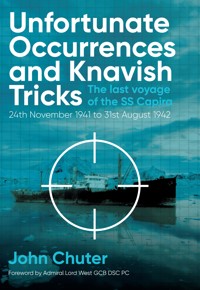
In war, it is not just the knavish tricks of the enemy but also the home grown unfortunate occurrences that result in disasters. This book chronicles the circumstances surrounding an aging Panamanian freighter, the SS Capira, on her last voyage in convoys PQ 15, QP 13 and SC 97. During the period between November 1941 and September 1942 she witnessed a number of significant losses brought about by allied actions that far outweighed those caused by the enemy. John Chuter tells SS Capira's story using primary archive material from the UK, USA, Canada, Russia and Germany as well as interviews, letters and previously unpublished contemporaneous eyewitness accounts. He recounts the political, strategic, tactical and technical issues that shaped the events, as well reliving the accounts of the extraordinary sailors who took part in the action.
Das E-Book können Sie in Legimi-Apps oder einer beliebigen App lesen, die das folgende Format unterstützen:
Veröffentlichungsjahr: 2021
Ähnliche




















3
2
Dedicated to the memory of the seamen and sailors of all nations who served on Arctic convoys, especially those who did not return.
boreas domus, mare amicus
Contents
Acknowledgements
I am indebted to many individuals and organisations for assisting me in bringing this account together. Among the latter, I am especially grateful to the staffs of the National Archives at Kew, the Guildhall Library London, the UK Maritime & Coastguard Agency, the UK Ministry of Defence (Naval Historical Branch), the US National Archives & Records Administration, the US Department of Transportation (Maritime Administration), the Embassy of the Russian Federation London, the Imperial War Museum and the National Maritime Museum. Special thanks must be given to the staff of the Caird Library at Greenwich for uncovering Tom Chilvers’ unpublished diary containing an account of convoys PQ16 and QP13, plus an account of life in Murmansk during the period covered by this book. Tom Chilvers’ son Stuart also provided much background on his father that proved invaluable to putting times and characters in context.
Among other individuals who have assisted and encouraged me, special thanks must go to my friend Austin Byrne. He provided many a vivid account of life as a DEMS gunner on the ill-fated SS Induna during its passage in convoy PQ13, and his subsequent experience surviving four days in an open boat before being picked up by a Russian destroyer and taken to Murmansk. A number of friends in Russia have also given me much information and encouragement. Among them, specific acknowledgement must go to the late Ekaterina (Katya) Ermolina, who provided a number of photographs and pointed me towards the unpublished account of wartime Murmansk by Vladimir Loktev. In Iceland Fridthor Eydal provided valuable information on the rescue of survivors from QP13. For information on the US Navy’s Armed Guard, I am indebted to the late Matty Louchran and other unsung heroes of that wartime organisation who corresponded with me during this project including Richard M. Bryant, Reginald W. Curtis, Joseph E. Dulka, Russell L. Gillespie, Josh Jones, Stafford Ricks and Allen A. Stager. I would also wish to acknowledge the family of the late Lieutenant T.B. Johnston RNVR of HMS Niger for permitting publication of extracts from his letters and Jill Britton for allowing me access to her father, Tom Heley’s, Service 8Record and related papers which allowed me to put the technicalities of radar in a more human context.
Finally, I have been given much encouragement and advice from a wide circle of friends and colleagues who have given freely of their time to comment on the text. Their efforts have proved invaluable, but the conclusions and any remaining errors are entirely mine.
John Chuter Braithwaite Village, West Yorkshire, July 2020
Foreword
The Battle of the Atlantic was the longest campaign of the Second World War. It started on its first day 3 September 1939 with the sinking of the liner SS Athenia and ended 2,074 days later with the sinking of SS Avondale Park on the night of 7 May 1945, the evening before Germany surrendered. During that period 5,140 ships totalling 21,500,000 tons were sunk and some 30,000 merchant seamen died, most with the sea being their only grave. This loss represented 1 in 4 of the men involved a horrifying casualty rate for any force. We owe them so much.
Winston Churchill in his memoirs said of the Battle ‘The only thing that ever really frightened me during the war was the U-boat peril… I was even more anxious about this battle than I had been about the glorious air fight called the Battle of Britain.’ Most members of the British public are completely unaware of these facts. If we had lost the Atlantic battle we would have lost the war.
One part of the Battle, now recognised as a separate campaign by the award of the Arctic Star, were the Arctic convoys supplying crucial goods to North Russia between 1941 and 1945. Some 4,000,000 tons of goods were supplied by 1400 merchant ships. 85 of those and 16 RN cruisers, destroyers and escorts protecting them were lost. Apart from attacks by U-boats, dive bombers, torpedo bombers and surface ships, the weather was the cruellest enemy of all. Huge raging seas and incredible cold meant that men only survived for minutes once in the water. Winston Churchill called it the ‘…the worst journey in the world’.
The sheer scale of these events makes them hard to comprehend so it is useful to personalise things and see how they influenced one man and indeed one ship. Brigadier Chuter has achieved just that using the papers of his late father, a merchant mariner, to show the impact on one man and the ship in which he served over a period of nine months of his ten years at sea.
The American freighter, the SS Capira was nothing special but typical of so many ships undertaking these hazardous voyages. The period covered 24 November 1941 to 31 August 1942, the day she was torpedoed and 10sunk, was when the outcome of the Battle of the Atlantic lay in the balance. Russian convoys were coming under growing attack and the convoys PQ 15 and QP 13, in which the author’s father and the SS Capira took part, are worthy of study. There is considerable debate about the use of intelligence: whether local commanders or commanders-in-chief ashore had the best overall picture of what was going on. Often commanders had very little information on which to base their life and death decisions.
The Soviet authorities always tried to downplay the importance and sacrifice of those taking part in the Arctic convoys but now Russia acknowledges how important they were to her survival. There is a close bond between Arctic convoy and Russian veterans with visits and events often focused aboard HMS Belfast (an Arctic veteran herself) moored above Tower Bridge.
I welcome this book which adds a human dimension to the great events engulfing the world at that time.
Admiral the Right Honourable Lord West of Spithead GCB DSC PC
Preface
I am not, by any stretch of the imagination, an historian. Nevertheless, in writing this account I have endeavoured to take an historian’s approach; relying on primary sources and eyewitness accounts wherever possible, tempered by later analysis in order to get as close as possible to the reality of what happened during the last voyage of the SS Capira. Whether or not I have been successful, I leave for the reader to judge. However, I hope that in some small way, this account demonstrates what the enthusiastic amateur historian can achieve with the resources now at his (or her) disposal. Deep in the dusty archives at Kew, the Caird Library at Greenwich, the Guildhall Library in the City of London, the Imperial War Museum, or further afield in North American depositories in Washington, New York and Nova Scotia, lay a treasure trove of primary documentation providing a tangible link with the past. A link that is more than palpable, especially when handling original cabinet papers initialled in red ink by the prime minister when one can, with a little imagination, detect the lingering aroma of a Cuban cigar. Copies of some of this material are also available through the internet, either free or for a modest sum. A careful trawl through the internet itself, provided one does so with a critical eye, will also pay dividends for the avid researcher. I have also been privileged to talk to some of those who were witness to these events, and to gain some idea of what it was like at the individual level, infused (and sometimes confused) with all those conflicting emotions that war intensifies. Sadly, this is a fast diminishing resource. The events recorded here will soon pass from living memory, and become mere syllables of recorded time for successive generations of historians to pore over, dissect and reinterpret within new and as yet unexplored contexts. However, their efforts will no longer benefit from the privilege of engaging first hand with that visceral narrative provided by those who were there.
This book chronicles the circumstances surrounding the last voyage of an aging American freighter, the SS Capira, sailing under a Panamanian flag during the Battle of the Atlantic. It spans the period between November 1941 and September 1942 and in particular her passage in convoys PQ15, 12QP13 and SC97. During this period, a number of tragic events directly associated with these convoys occurred and went largely unreported at the time. These events were subsequently overshadowed by the destruction of convoy PQ17 that took place during Capira’s return passage from Russia, and they have received little detailed analysis since then. Although they have been separately documented to a greater or lesser extent elsewhere, I have brought them together in an attempt to render a comprehensive picture in the context of that phase of the war when victory was by no means certain and defeat still a possibility. I have also attempted to convey the formidable challenges faced by all those involved from high command to deck hand and, in spite of their best endeavours to meet the immediate situation with an appropriate response, the tragic consequences that often ensued.
Capira’s last voyage coincided with events elsewhere that had a profound significance for the Battle of the Atlantic and hence the survival of this country during the Second World War. The strategic backdrop included the attack on Pearl Harbor that brought the United States into the war and occurred just as Capira set out on her voyage along the east coast of the UK prior to joining an Atlantic convoy bound for New York. Less than six months later, whilst Capira was discharging her cargo in north Russia, the US Navy was scoring a strategic victory at Midway. Midway not only marked the apogee of Japanese conquest in the Pacific but also enabled American unfettered commitment to the Battle of the Atlantic knowing that its western seaboard was now secure from the onward march of Japanese forces. Off the eastern seaboard, however, German U-boats were celebrating their second ‘Happy Time’, causing havoc among the unprotected merchantmen who plied those waters from the Caribbean to Nova Scotia, before joining the Atlantic convoys that provided the lifeline to the United Kingdom. Even further east, continuing German successes on land against Russia provoked a major concern that Russia might sue for peace. As a consequence, a concerted diplomatic and logistic effort was initiated by the United States and the United Kingdom to keep her in the war. The security of the supply route from the USA via Iceland to the north Russian ports of Archangel and Murmansk therefore grew in strategic importance becoming a target for German naval and air forces. This was also a time when naval signals intelligence dried up due to changes made to the German naval version of the Enigma encryption 13machine. As a consequence for most of 1942 the Allies were unable to read Dönitz’ intentions for his U-boats in the Atlantic. This reinforced the need for well-coordinated air surveillance and offensive measures if the U-boat menace was to be countered. However, arguments for the redeployment of aircraft from the bomber offensive against Germany to the protection of convoys were robustly resisted by the RAF, with inevitable consequences.
It was against this strategic backdrop that the polyglot crew of the Capira continued to make their living as merchant seamen. Oblivious no doubt of the bigger picture these men and thousands more like them struggled against the elements and the enemy to keep Britain and Russia fed and supplied for war. Although technically civilians, their pro-rata casualty rate was higher than for any of the armed forces. It should also be remembered that German U-boat crews also suffered high casualty rates, mirroring in number the 30,000 merchant seamen who have no grave but the sea.
In spite of the tactics employed by the allied navies and the best endeavours of individuals to protect them, it is a tragic irony that Capira’s last voyage should be marked by more casualties caused by unfortunate occurrences of our own making than any knavish tricks inflicted by the enemy. The casualties, both in human lives and shipping, that were self-inflicted during this passage far outweighed any damage wrought by German planes or U-boats.
This then is the account of the circumstances surrounding that particular wartime voyage from the UK to Murmansk, and back via Boston and New York, in Convoys PQ15, QP13 and SC97.
Time Zones: A number of different time zones were used by merchant ships, naval warships and U-boats in this account and I have endeavoured to point out the differences where they may confuse the narrative. In general, the Royal Navy used GMT and would indicate that by suffixing a ‘Z’ to timings in its signal traffic. Convoys plying the Atlantic routes were usually 2 hours behind GMT. German U-boats, on the other hand, used MESZ – Mitteleuropäische Sommerzeit at the time of year covered here. This was the same time as in the German capital city of Berlin and was known as German Central Time or Berlin Time and was 2 hours ahead of GMT.
Spelling: US English spelling has been retained when quoting from US documents.
Maps
List of Abbreviations
1
CAPIRA
(24 NOVEMBER TO 5 DECEMBER 1941)
I must go down to the seas again, to the lonely sea and the sky,
And all I ask is a tall ship and a star to steer her by,
And the wheel’s kick and the wind’s song and the white sail’s shaking,
And a grey mist on the sea’s face, and a grey dawn breaking.
From SeaFeverby John Masefield
Anyone flying into London’s City Airport today will no doubt spot the Millennium Dome situated like a large ‘O’ on a bend in the river Thames below. Either side of this prominent landmark sit two groups of docks. To the west is the Isle of Dogs with the West India and Millwall Docks, and to the east are the Royal Victoria, Royal Albert and King George V Docks, with the City Airport and its runways squeezed between them. Before the advent of container ships, these were London’s major sea trade terminals, with all the associated paraphernalia of dockland. Dockers, stevedores, riggers, splicers, crane drivers, winch men, lighter men and tugboat men all have since gone. Little if any sea trade takes place there now, since the large container berths were built upriver at Tilbury in the 1960s. However, there is now trade of a different kind as these areas have been developed into the large business and conference complexes of Canary Wharf and the ExCel Centre. Modern dockland remains a vibrant place, but is now of a far different hue; with its pubs, cafés, shops and light railway conveying commuters daily to and from their high-rise places of work. Practically all vestiges of its previous role as one of the country’s major seaports has been erased; but if one could be transported back in time to the dark days of the Second World War, a very different picture and purpose would emerge.
On Monday 24 November 1941, a young seaman walked into the Merchant Marine office at London’s Victoria Dock. His apparent youth belied over four years’ experience at sea, roughly half of which had been at war. Barely 21a month before, he had crossed the Atlantic from Sydney, Nova Scotia in convoy SC48, that had unexpectedly run into a number of German U-boats hunting as a ‘wolf pack’. In the ensuing battle, that had lasted several days, nine merchant ships and two naval escorts went to the bottom, in addition to leaving one of the escorting destroyers badly damaged. Fortunately, his ship had survived the onslaught, arriving safely in the Thames the month before. And now he was about to sign on a ship ultimately bound for one of the north Russian ports via the United States, thereby facing the prospect of running the Atlantic gauntlet twice over again before sailing onwards into the even more hostile waters of the Barents Sea.
The ship was the SS Capira, an ageing freighter originally laid down in 1920 in Seattle as the SS West Campgaw. She was sailing under a Panamanian flag, and was showing her age following the battering she had received during her last voyage as part of convoy PQ1 to the Russian port of Archangel; the destination she was ultimately scheduled for at the end of this voyage. Capira was typical of many a freighter that plied the world’s oceans between the wars. Displacing 5,050 tonnes and, on a good day, capable of around 10kts [18.5km/hr] she measured 133m from bow to stern and was 17m in the beam. Later wartime service necessitated protective additions to her superstructure, but her pre-war profile revealed a conventional layout. A single funnel abaft of a prominent bridge situated roughly amidships, masts both fore and aft, with derricks conveniently placed to load cargo into the holds. During the war, use was also made of her upper deck space to carry cargo that would not go into the holds, such as vehicles and crated materiel. Radio antennae were mounted on and between the ship’s masts and the foremast had a crow’s nest for observation. Since radar was still in its infancy and the associated technologies a closely-guarded secret, merchant ships would continue to rely on human observation for station keeping in convoys throughout the war and Capirawas no exception to this. Moreover, ship-to-ship communication relied on visual signals during periods of radio silence, thus emphasising the need for a sharp lookout being maintained at all times.
Capira’s crew of 39 were a hardworking and hard-worked body of men. Crew numbers were not lavish, quite the contrary; owners would not pay for more on-board effort than was absolutely necessary. The master, his three 22officers, the chief engineer and the boatswain ran the ship. These six key appointments, that on the Capira were filled by highly-skilled men hailing from five different countries, amounted to a combined experience of over a hundred years at sea. Under them were around ten seamen on general duties, a further dozen or so tending the engines, and around ten cooks and stewards, not forgetting a carpenter and the radio operator. Crews varied from voyage to voyage, as merchant seamen opted to change ships or shipping lines as economic and other factors dictated. For example, when Capira docked at New York in July 1942, at the end of her last voyage to Russia, only 13 of the crew of 39 had been aboard when she last docked in the United States in early January. At the conclusion of the July passage, the ship’s master and the chief steward were the only two of the crew not to be discharged1. Even specialist appointments crucial to the operation of the ship, such as that of the chief engineer, were not carried over to the next voyage; individuals had to re-engage with the owners. Although many signed on again for the next passage, continual employment with a single shipping line, or in a particular ship, was not the right of the ordinary merchant seaman. Indeed, for a man independent in mind and character this may have suited him well. If he wanted a spell ashore he could have it, albeit without pay. Alternatively, if he wanted to sign on again and see a different part of the world on a different ship, nothing stood in his way. Provided he could find the right ship and shipmates to suit his temperament, any port of call was within his reach. In these and many other respects, merchant crews were very different from their navy counterparts. Such differences became even more apparent during wartime, when naval ships’ companies were diluted with conscripted men who had little or no previous experience of life at sea. Training these individuals in the skills required to operate a warship, not to mention the need to subordinate individuality in the interests of the team, necessitated a strict disciplinary regime. In certain respects, this was also true of merchant ships. However, some of the more traditional methods of discipline required to run a warship were of little relevance to a merchant seaman. For example, spit and polish, apart from that required in large passenger liners, seldom (if ever) entered into his routine. That is not to suggest, however, that routine on board was not ordered, or that merchant ships were in any way less than ‘shipshape’; making allowances of course for their age and the parsimony 23of their owners in matters of non-essential maintenance. When on board as when on shore, the merchant seaman wore what was most appropriately functional and was usually purchased by himself. Apart from the officers and the crew of large liners, it was not usual for uniforms to be issued by the owners. Whether his boots were polished, his face shaved, his trousers pressed or his shirt starched was of little consequence. Although technically a civilian, wartime service did on occasion invite him to acquire some military skills in addition to his seafaring ones. In the case of Capira’s crew, this extended to training in servicing and operating the guns fitted to the ship after she was requisitioned by the US authorities on her return to the United States the following March. However, it must be remembered that the overarching consideration in engaging these civilian-cum-combatant seamen lay in the knowledge and skills they possessed. These were not only essential for the profitability of the shipping lines and their owners, but also proved critical for the survival of the country.
The ship’s master was Enjar Jensen, a Dane. In his mid-thirties, with just over twenty years at sea, he held the sole responsibility for his ship and its crew. He was accountable to the ship’s owner who, from April 1942 when Capira was requisitioned for war service, was in effect the United States Government. Through the government, he also had a responsibility whilst at sea to a convoy commodore for the deployment and handling of his ship. This brought with it considerable restrictions; something of an unwelcome imposition for a man who had laboured hard for the relative independence synonymous with command that he had now achieved. Although he was the master, Jensen was by no means the oldest crew member. His British chief engineer Thomas Kinnear and a Chinese mess man, Heng Leon, were 55. The latter also had a total of 40 years seagoing service; more than anyone else on board. Born around 1887, and going to sea at the very beginning of the twentieth century aged 15, Heng Leon would have been more than familiar with the age of sail and may have even served in sailing ships. By contrast, there were two eighteen-year-olds in the crew. One of them, Vernon Jones, a British able seaman, declared that he had already served 4½ years at sea; therefore he would have begun his merchant service at the tender age of 13 or 14. If this was indeed the case, he had more than proved his mettle as a fast learner and competent able-bodied seaman. The other was Edward Nix, 24a British Canadian who worked in the engine room as a wiper. A wiper was the most junior crewmember in the engine room, responsible for cleaning the engine spaces and machinery, invariably a dirty task and not one to be envied.
Also numbered among the crew was a radio operator who, before the onset of hostilities, would have spent much of his time communicating, mostly in Morse code, with passing ships, land-based stations and other communication centres within radio range. Progress during the ship’s passage would have been broadcast, monitored and reported to its owners and other interested parties such as Lloyds, the shipping insurers. On the outbreak of war, this changed. Radio communications monitored by the enemy could not only provide vital intelligence but also be used to triangulate and target individual ships and convoys. Wartime passages were therefore conducted where possible under radio silence. The transmitter was usually sealed and the seal could only be broken in extreme and well-defined circumstances such as when attacked by the enemy. Thus, the radio operator’s wartime lot became one of monitoring transmissions and listening out; a boring task even at the best of times, but nevertheless vital to the ship’s safety and security.
Not least among the diversity inherent in members of Capira’s crew was their polyglot nature. Capira’s officers had the challenge of welding men from ten nations and as many languages into an effective team. In war this was even more challenging, considering the heightened tension and additional vigilance required, especially when in convoy. English was the native tongue of just under half Capira’s crew; however, only six were British – the remaining English speakers comprising nine Canadians and one each hailing from South Africa, Malta and Belgium. Added to the North American contingent were two French Canadians, but apart from the US Navy Armed Guard who joined the ship in March 1942 there were no Americans in the crew. However, there was one man, William Owens, a British crew member working in the engine room employed as a fireman, who was a United States resident. Excepting a Swedish seaman and the eight Chinese seamen who traditionally serviced the galley and laundry on these ships, the remainder were by now technically refugees or displaced persons, their countries having been overrun by the Nazi war machine. Of these unfortunates, including Capria’s Danish master, three were Dutch, three Norwegian, one Belgian (Flemish), one Latvian and finally a 25Slovenian Yugoslav who was close to Marshal Tito. Given his communist connections and presumed anti-fascist outlook he remained fearful for his life, and consequently always kept a pistol close at hand. From the crew manifest we know that all of Capira’s crew could read, or at least claimed they could. Their weights and heights are also recorded, not to mention their physical marks and peculiarities. Taken together the average age of the crew was 32, each with an average of 12 years sea-going service. What is not recorded, however, is the faith, if any, of individual crew members. Those of the Jewish faith were acknowledged as being at significant risk if taken prisoner by the Germans and were offered false names and identities, with the accompanying paperwork, whilst employed as merchant seamen. On balance, therefore, Capira was manned by a highly diverse but otherwise experienced, competent, versatile and hardened crew well used to plying their various trades on the world’s oceans.
In company with naval vessels, life on board a merchantman was regulated by dividing up the twenty four hours into watches. During their time on watch, members of Capira’s crew were employed according to their trade and also called upon to carry out the many other activities required to run a ship in peace and now in war. Naturally, maximum effort was required whilst loading and unloading before and after a voyage. However, maintaining the ship, especially its fabric, also required the investment of considerable time and effort throughout the passage, as owners were loath to have their ships spend time in dock for anything but a major overhaul. Preserving the ship from the ravages of seawater was an imperative, therefore painting both the interior and exterior of the ship was high on the list of priorities. Crew members on the SS Empire Baffin during its passage to Russia in convoy PQ16 recorded painting masts, funnels and derricks as well as the heads in-between fighting off air and submarine attacks. Washing down the decks and flats (corridors) and squaring away equipment spaces that were always in danger of dislodging their contents in heavy seas became a constant task; one undertaken mostly in cramped, not to mention dangerous, circumstances and invariably in poor weather. Clearing ice from the superstructure to prevent the ship becoming top heavy on Arctic voyages was a particularly hazardous but essential task, especially in heavy weather. Under the watchful eye of a competent officer, 26some members of the crew took a turn at the wheel, or helped out on other tasks such as maintaining the radio watch or on lookout as the need arose. Before the outbreak of war, crews, including in some cases cooks, began to be trained on the operation of the rudimentary armaments being mounted on merchantmen. This was so that they could assist the specialist gunners drawn from the Army, Royal Marines, Navy and occasionally RAF who were deployed in small detachments on armed merchant ships. Other tasks associated with the weaponry, such as cleaning and filling magazines, as well as servicing the guns during enemy attacks, were also taken on by anyone who happened to be available. Once off-watch, crew members’ time was taken up with personal administration, made all the more difficult whilst at sea; especially during wartime. Unless one was in a larger, more modern vessel that had its own condensers, fresh water was at a premium. Sea water showers were common. Messing and sleeping spaces were tight and privacy therefore uncommon. Fresh rations seldom lasted throughout the voyage. Bad weather limited the preparation of hot food, and sometimes sandwiches had to be served instead. Negotiating one’s way from the galley to the mess deck with a plate of food also proved impossible on occasions, and it was carried in large metal cans instead. The result was the same, however; the food arrived cold. Although there was no professional barber on cargo ships, there was always someone prepared to take on the task for a tot of rum. Unless someone in the crew had brought along an instrument that they could play, there was very little by way of recreation or indeed the time to indulge in it. Sometimes merchant ships carried passengers who might have something to offer. Such was the case on convoy PQ16 where Alexander Werth, TheTimes’ Moscow correspondent and an expert on the Soviet Union, gave talks whilst on passage to Murmansk in the SS Empire Baffin. Otherwise, off-duty time was spent in eating and, if possible whilst in hostile waters, sleeping2.
So, these were men for whom the sea was not only the means of making a living, albeit a difficult and precarious one, but also a way of life. Added to which they now faced the danger of enemy attack from beneath, on or above the waves, and the increased prospect of a watery grave. Even so, a merchant seaman’s role was not particularly well appreciated. They were not well-rewarded by the owners, well-served by the authorities, or understood by the public. As previously mentioned, the vast majority 27were casually employed for a single voyage only. Seamen signed Articles of Agreement when they joined a ship. This designated the point at which their paid employment aboard a ship began and ended. The Articles remained in force until the voyage came to an end and the seaman was duly paid off. His pay then ceased until he signed on the same or another ship again. Understandably, his pay would also cease if he jumped ship in a port during a voyage, or left for any other reason. Any other reason also extended to circumstances where his ship was sunk either by natural disaster or enemy action. If this happened to be his unfortunate lot, then his pay was stopped immediately, the Articles having been deemed to have come to an end. In many cases, this not only affected the seaman but also those to whom he had allotted a portion of his wages. For a married man this was invariably his wife, and the allotment also ceased immediately the ship went to the bottom, potentially leaving his family destitute.
For British merchant seamen, this callous situation was rectified in May 1941 with the introduction of the Essential Work (Merchant Navy) Order. This established a Merchant Navy Reserve Pool, and to ensure that seamen would always be available for service the government paid them to remain in the pool even when they were ashore. As far as British merchant seamen were concerned, therefore, casual employment was replaced by continuous paid employment and a comprehensive system of registration made possible. All those who had served at sea during the preceding five years, plus those intending to serve during the war, were required to register. As a consequence, they were not liable for conscription into the armed services and retained their status as civilians within a reserved occupation, although the majority fought (and many died) alongside their navy counterparts. Official estimates vary slightly, but approximately 30,000 merchant seamen deaths during the Second World War were notified to the Registrar General. This included foreign seamen serving in British ships, and British seamen serving in foreign ships chartered to or requisitioned by the British government.3 Pro rata, there were more merchant seaman casualties than in any of the three armed services. This pattern of casualties was replicated for the US Merchant Marine which suffered 3.9 percent casualties, a rate that exceeded even the US Marine Corps.4 Those merchant seamen who served during that conflict, although dwelling in a civilian-cum-combatant twilight zone, deserve to take 28their rightful place and counted among their brothers-in-arms.
Perhaps no more fitting tribute to merchant seamen has been given than that by Captain Leslie Saunders RN, the Captain of the ill-fated HMS Trinidadwho wrote:5
My admiration for the sheer guts of these merchant seamen defies description. We in the Navy were trained for war; we were provided with the offensive and defensive means for waging it. They were trained for peace; their ships so vulnerable that a single shell, bomb or torpedo would sink them, or set them on fire. They could not hit back, but no Hun was going to stop them sailing the seas. I felt uncomfortable when I allowed myself to think of it – I so well equipped for, and they so exposed to, the horrors of war, especially in these Arctic waters.
The fact that he was required to stand and serve alongside his navy counterparts did not deter the authorities from continuing to treat the merchant seaman as a civilian, subject to the same controls and strictures as the rest of the civilian population. Two examples serve to demonstrate this.




