


79,99 €
Mehr erfahren.
- Herausgeber: John Wiley & Sons
- Kategorie: Geisteswissenschaft
- Sprache: Englisch
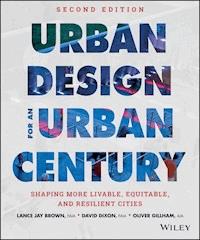
This book offers a comprehensive introduction to urban design, from a historical overview and basic principles to practical design concepts and strategies. It discusses the demographic, environmental, economic, and social issues that influence the decision-making and implementation processes of urban design. The Second Edition has been fully revised to include thorough coverage of sustainability issues and to integrate new case studies into the core concepts discussed.
Sie lesen das E-Book in den Legimi-Apps auf:
Seitenzahl: 651
Veröffentlichungsjahr: 2014
Ähnliche




















Contents
Acknowledgments
Introduction
Chapter 1: Roots of Western Urban Form: Centralization
First Cities
Rebirth of European Cities: “Organic” Cities of the Late Middle Ages
Reintroduction of Classical Learning: “Geometric” Cities of the Renaissance
The Emergence of Merchant Cities: Integrating Renaissance Ideas and the Marketplace
The Grid Reaches the New World
The Industrial Revolution
Notes
Chapter 2: Decentralization: The Rise and Decline of Industrial Cities
Proto-Urban Design: Rejecting a Classical Past to Shape an Industrial Future
Notes
Chapter 3: Recentralization: The Forces Shaping Twenty-First-Century Urbanism
Walkability Displaces Cars as the Genesis of Urban Form
Forces Shaping Twenty-First-Century Urbanism
Notes
Chapter 4: Recentralization: Twenty-First-Century Urbanism Takes Shape
Traveling Along the Smart Growth Transect
The Costs of Success
Balancing Individual and Community: The Public Realm
Notes
Chapter 5: Theories of Urbanism
Formal Urbanisms
Syncretic Urbanism
Notes
Chapter 6: Urban Design for an Urban Century: Principles, Strategies, and Process
Principles
Strategies for Achieving the Principles: Policies, Planning, and Placemaking
Process that Supports the Principles
Notes
Afterword
Supplemental Images
Index
End User License Agreement
List of Illustrations
I.1 “LasVegas . . . [was] where we could discover the validity and appreciate the vitality of the commercial strip and of urban sprawl, of the commercial sign whose scale accommodates to the moving car and whose symbolism illuminates an iconography of our time. And where we thereby could acknowledge the elements of symbol and mass culture as vital to architecture, and the genius of the everyday, and the commercial vernacular as inspirational as was the industrial vernacular in the early days of Modernism.” —Robert Venturi, FAIA, accepting the 1991 Pritzker Prize (from www.pritzkerprize.com)
I.2 Merneptah’s Mortuary Temple (ca. 1200 BCE) served as a religious, bureaucratic, and economic center. It also suggests the political significance of early planned urban development. A stele proclaimed: “The kings are overthrown, saying: ‘Salaam!’ / Not one holds up his head among the nine / nations of the bow. / Wasted is Tehenu / The Hittite Land is pacified / Plundered is the Canaan, with every evil / Carried off is Askalon / Seized upon is Gezer / Yenoam is made as a thing not existing. / Israel is desolated, her seed is not. / Palestine has become a [defenseless] widow for Egypt. / All lands are united, they are pacified; / Every one that is turbulent is bound by King Merneptah.”
I.3 A reconstruction of Babylon’s Ishtar Gate from the seventh century BCE, at the Pergamon Museum, Berlin, suggests the feeling the gate might have evoked in its creators: awe of the protective power of the gods that dwelt inside the city.
I.4 Designers working under authoritarian regimes often had the freedom to create monumental spaces and long vistas, as in Paris.
I.5 As factories multiplied in cities, many residents found the resulting noise, smoke, and soot intolerable.
I.6 For the well-to-do, suburban housing offered an escape from crowded industrializing cities.
I.7 Highways of the urban renewal era often cut large swaths through dense older neighborhoods.
I.8 These same highways cut very different swaths across formerly rural areas—dispersing the economy of America’s cities from older neighborhoods to miles of strip development.
I.9 a,b Philadelphia created Independence Mall in the early 1950s—a three-block swath whose stated rationale of commemorating historic events served as an excuse for an urban renewal project that buffered downtown from deteriorating neighborhoods to the east and cleared “slum neighborhoods” to create sites for new office buildings.
I.10 Robert Moses viewed his Battery Bridge project (1939) as a high-profile opportunity to modernize the image of New York City. The Battery Tunnel was constructed instead.
I.11 Skidmore, Owings & Merrill’s design plan for Moynihan Station in Manhattan recaptures much of the grandeur of McKim, Mead & White’s Pennsylvania Station, demolished in 1963. The current, underground station would relocate across the street to the dignified Farley Post Office Building, also a McKim design. The plan responds to a widespread yearning for the urban qualities lost to urban renewal and subsequent years of disinvestment.
I.12 The SOM plan grafts a glass superstructure onto the neoclassical Farley Building to define a striking arrival area that serves as a memorable new transit-oriented entry to New York.
I.13 A 1910 Hughson Hawley rendering of Penn Station and the Farley Post Office complex.
I.14 In 2000, the Boston Society of Architects (BSA) sponsored the first regional smart growth initiative in New England. In the wake of a yearlong grassroots effort that culminated in a weekend conference that drew hundreds of participants, five major environmental organizations joined the BSA to form the Massachusetts Smart Growth Alliance. The Alliance has evolved into an effective advocate for smart growth legislation and public policies.
I.15 In 2003, the Boston Society of Architects (BSA) joined with the Massachusetts Smart Growth Alliance and the American Institute of Architects to organize Density: Myth and Reality, the first national conference on population density. Concerned that smart growth would remain unattainable without support for greater density in urban centers, the BSA saw the conference as a way to confront widespread fears about density. Policy makers considered density so controversial that just the word’s presence in the conference title prompted more than one public agency to threaten to withdraw its sponsorship. Today, planners and public officials view denser urban development as a key economic and environmental strength of cities and, increasingly, suburban centers.
I.16 Four hundred attendees at the 2003 density conference called for heeding architect and urban designer Josep Lluís Sert’s call for recentralization, almost fifty years after Sert delivered his initial speech on the topic at Harvard University in 1956.
1.1 Plan of Miletus (fifth century BCE). Reconstruction of the Greek colony in Asia Minor—carried out after being sacked by the Persians—followed a gridiron plan, with square blocks radiating from a central agora. As they established subsequent colonies around the Mediterranean, the Greeks replicated the Miletian plan.
1.2 Dubrovnik, Croatia. The Byzantine empire inherited the Miletian plan from Rome and prescribed the grid that still distinguishes Dubrovnik’s historic center from development outside its walls, which were begun in the ninth century and completed during the Renaissance.
1.3 Piazza del Campo (fourteenth century), Siena, Italy. The Piazza del Campo broke with an important medieval city-building tradition. Instead of serving as the setting for a cathedral, the piazza’s focus is a secular building, the Palazzo Pubblico, seat of the Sienese republic. The square prefigured the modern idea of secular civic space.
1.4 Palmanova, Italy (1593). The strict geometry of the plan for Palmanova—a defensive fort east of Venice—grew out of military necessity, but it influenced town planning for centuries. Its straight, wide boulevards and idealized plan surfaced in baroque-era plans across Europe. Purely geometric inside a broad band of earthen bulwarks, it also inspired designs as varied as English garden cities and twentieth-century visionary projects like Arcosanti in Arizona.
1.5 Piazza San Pietro (1656–67), Vatican City. Bernini’s quintessential baroque plan for a plaza and colonnade masterfully blends Renaissance knowledge of perspective with the baroque penchant for grandeur and illusion to orchestrate the experience of approaching St. Peter’s Basilica.
1.6 The Plan of the Three Canals (1607), Amsterdam. The Three Canals Plan, adopted by the municipality, introduced a baroque sense of geometry and order into expansions of the medieval city. Amsterdam’s novel approach to the plan’s execution proved influential in the United States: the municipal government identified the plan area and set guidelines for construction, but it left realization of the plan to private developers.
Lesen Sie weiter in der vollständigen Ausgabe!
Lesen Sie weiter in der vollständigen Ausgabe!
Lesen Sie weiter in der vollständigen Ausgabe!
Lesen Sie weiter in der vollständigen Ausgabe!
Lesen Sie weiter in der vollständigen Ausgabe!
Lesen Sie weiter in der vollständigen Ausgabe!
Lesen Sie weiter in der vollständigen Ausgabe!
Lesen Sie weiter in der vollständigen Ausgabe!
Lesen Sie weiter in der vollständigen Ausgabe!
Lesen Sie weiter in der vollständigen Ausgabe!
Lesen Sie weiter in der vollständigen Ausgabe!
Lesen Sie weiter in der vollständigen Ausgabe!
Lesen Sie weiter in der vollständigen Ausgabe!
Lesen Sie weiter in der vollständigen Ausgabe!
Lesen Sie weiter in der vollständigen Ausgabe!
Lesen Sie weiter in der vollständigen Ausgabe!
Lesen Sie weiter in der vollständigen Ausgabe!




