


7,49 €
Mehr erfahren.
- Herausgeber: A.J.Kingston
- Kategorie: Geisteswissenschaft
- Sprache: Englisch
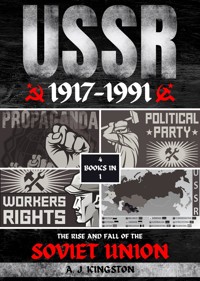
Discover the captivating story of the Soviet Union with our book bundle "USSR: 1917-1991: The Rise and Fall of the Soviet Union." Immerse yourself in the dramatic events, ideologies, and personalities that shaped one of the most significant political entities of the 20th century. This comprehensive collection takes you on an insightful journey through the key periods and transformative moments in Soviet history.
Book 1: "Building the Socialist State: Industrialization and Collectivization in the USSR (1921-1932)" explores the early years of the Soviet Union, a time of immense ambition and radical transformation. Dive into the efforts to industrialize a vast nation and witness the controversial implementation of collectivization, as the Soviet Union strives to build a socialist society.
In Book 2: "Cold War Chronicles: The USSR and the United States in the Nuclear Age (1945-1962)," experience the intense rivalry and global tensions that defined the Cold War era. Uncover the intricate dynamics between the Soviet Union and the United States as they engaged in a high-stakes ideological struggle, nuclear arms race, and proxy conflicts.
Book 3: "Thawing the Iron Curtain: The Soviet Union's Era of Destalinization and Khrushchev's Reforms (1953-1964)" takes you through a period of significant change within the Soviet Union. Witness the de-Stalinization campaign led by Nikita Khrushchev and the subsequent thawing of political and cultural restrictions, challenging the status quo and setting the stage for a new era.
Finally, in Book 4: "Perestroika and the Collapse of the Soviet Empire: Gorbachev's Reforms and the End of the USSR (1985-1991)," witness the remarkable rise of Mikhail Gorbachev and his ambitious reform agenda. Explore the profound changes brought about by perestroika and glasnost, and the subsequent unraveling of the Soviet Union that marked the end of an era.
This book bundle provides a comprehensive and engaging exploration of the Soviet Union's history, taking you on a journey through its rise, its role on the global stage, and its eventual collapse. It delves into the grand ambitions, ideological struggles, and human stories that shaped this complex and enigmatic nation.
Whether you are a history enthusiast, a student of political science, or simply curious about the fascinating story of the Soviet Union, this book bundle is an invaluable resource. Gain a deeper understanding of the political, social, and cultural forces that shaped the Soviet Union and its impact on the world.
Don't miss this opportunity to immerse yourself in the captivating story of the Soviet Union. Order the "USSR: 1917-1991: The Rise and Fall of the Soviet Union" book bundle today and embark on an unforgettable journey through one of the most compelling chapters in modern history.
Das E-Book können Sie in Legimi-Apps oder einer beliebigen App lesen, die das folgende Format unterstützen:
Veröffentlichungsjahr: 2023
Ähnliche















USSR
1917-1991
THE RISE AND FALL OF THE SOVIET UNION
4 BOOKS IN 1
BOOK 1
BUILDING THE SOCIALIST STATE
INDUSTRIALIZATION AND COLLECTIVIZATION IN THE USSR
(1921-1932)
BOOK 2
COLD WAR CHRONICLES
THE USSR AND THE UNITED STATES IN THE NUCLEAR AGE
(1945-1962)
BOOK 3
THAWING THE IRON CURTAIN
THE SOVIET UNION'S ERA OF DESTALINIZATION AND KHRUSHCHEV'S REFORMS
(1953-1964)
BOOK 4
PERESTROIKA AND THE COLLAPSE OF THE SOVIET EMPIRE
GORBACHEV'S REFORMS AND THE END OF THE USSR
(1985-1991)
BY A.J. KINGSTON
Copyright © 2023 by A. J. Kingston
All rights reserved. No part of this book may be reproduced or transmitted in any form or by any means, electronic or mechanical, including photocopying, recording, or by any information storage and retrieval system, without permission in writing from the publisher.
Published by A. J. Kingston
Library of Congress Cataloging-in-Publication Data
ISBN 978-1-83938-347-2
Cover design by Rizzo
Disclaimer
The contents of this book are based on extensive research and the best available historical sources. However, the author and publisher make no claims, promises, or guarantees about the accuracy, completeness, or adequacy of the information contained herein. The information in this book is provided on an "as is" basis, and the author and publisher disclaim any and all liability for any errors, omissions, or inaccuracies in the information or for any actions taken in reliance on such information.
The opinions and views expressed in this book are those of the author and do not necessarily reflect the official policy or position of any organization or individual mentioned in this book. Any reference to specific people, places, or events is intended only to provide historical context and is not intended to defame or malign any group, individual, or entity.
The information in this book is intended for educational and entertainment purposes only. It is not intended to be a substitute for professional advice or judgment. Readers are encouraged to conduct their own research and to seek professional advice where appropriate.
Every effort has been made to obtain necessary permissions and acknowledgments for all images and other copyrighted material used in this book. Any errors or omissions in this regard are unintentional, and the author and publisher will correct them in future editions.
Join Our Productivity Group and Access your Bonus
If you're passionate about history books and want to connect with others who share your love of the subject, joining our Facebook group (search for “History Books by A.J.Kingston”) can be a great way to do so. By joining a group dedicated to history books, you'll have the opportunity to connect with like-minded individuals, share your thoughts and ideas, and even discover new books that you might not have come across otherwise. You can also access your FREE BONUS once you joined our Facebook group called “History Books by A.J.Kingston”.
>> Click Here to Join Our Productivity Group <<
One of the biggest advantages of joining our Facebook group is the sense of community it provides. You'll be able to interact with other history book enthusiasts, ask questions, and share your own knowledge and expertise. This can be especially valuable if you're a student or someone who is just starting to explore the world of history books.
>> Click Here to Follow A.J. Kingston <<
>> Click Here to Download your Free Bonus <<
If you love audiobooks, then joining our YouTube channel that offers free audiobooks on a weekly basis can be a great way to stay entertained and engaged. By subscribing to our channel, you'll have access to a range of audiobooks across different genres, all for free. Not only this is a great opportunity to enjoy some new audiobooks, but it's also a chance to discover new authors and titles that you might not have come across otherwise.
>> Click Here to Join our YouTube Channel <<
Lastly, don’t forget to follow us on Facebook and YouTube by searching for A.J. Kingston.
Table of Contents – Book 1 - Building The Socialist State: Industrialization And Collectivization In The Ussr (1921-1932)
Introduction
Chapter 1: The Seeds of Revolution: The October Revolution and the Formation of the Soviet Union (1917-1921)
Chapter 2: War and Chaos: The Russian Civil War and the Struggle for Power (1918-1922)
Chapter 3: Lenin's Vision: The New Economic Policy (NEP) and the Path to Industrialization (1921-1924)
Chapter 4: From NEP to Five-Year Plans: Stalin's Rise to Power and the Shift towards Collectivization (1924-1929)
Chapter 5: "Shock Brigades" and Industrialization: Transforming the Soviet Economy (1929-1932)
Chapter 6: Urbanization and the Growth of Cities: The Industrial Boom and the Rise of the Proletariat (1921-1932)
Chapter 7: Collectivization of Agriculture: Peasants, Kulaks, and the Agricultural Transformation (1928-1932)
Chapter 8: Famine and Resistance: The Great Famine and Peasant Rebellions (1930-1932)
Chapter 9: The Human Cost: Forced Labor, Repression, and Political Purges (1921-1932)
Chapter 10: Consolidating Power: Stalin's Triumph and the Impact of Industrialization (1921-1932)
Table of Contents – Book 2 - Cold War Chronicles: The Ussr And The United States In The Nuclear Age (1945-1962)
Chapter 1: The Birth of the Atomic Age: The Manhattan Project and the Soviet Union's Nuclear Program (1945-1949)
Chapter 2: Potsdam Conference: Tensions and Rivalry between the USSR and the United States (1945)
Chapter 3: The Iron Curtain Descends: Soviet Expansionism and the Truman Doctrine (1945-1949)
Chapter 4: The Berlin Blockade and Airlift: The First Major Confrontation of the Cold War (1948-1949)
Chapter 5: Nuclear Arms Race: Testing and Stockpiling of Atomic Weapons (1950-1953)
Chapter 6: Korean War: Proxy Conflict between the USSR and the United States (1950-1953)
Chapter 7: Space Race Begins: The Soviet Union Launches Sputnik and the Race for Space Dominance (1957-1958)
Chapter 8: Cuban Missile Crisis: The Tense Confrontation between the USSR and the United States (1962)
Chapter 9: The Space Race Intensifies: Yuri Gagarin's Historic Journey and Apollo Moon Landing (1961-1969)
Chapter 10: The Berlin Wall: Symbol of Divided Europe and Cold War Stalemate (1961-1989)
Table of Contents – Book 3 - Thawing The Iron Curtain: The Soviet Union's Era Of Destalinization And Khrushchev's Reforms (1953-1964)
Chapter 1: The Death of Stalin: Power Struggles and Khrushchev's Ascension (1953-1955)
Chapter 2: De-Stalinization Begins: Denouncing the Cult of Personality and Political Thaw (1955-1956)
Chapter 3: The Secret Speech: Khrushchev's Address to the 20th Party Congress (1956)
Chapter 4: The Hungarian Uprising: Challenges to Soviet Control in Eastern Europe (1956)
Chapter 5: Thawing Relations: Khrushchev's Diplomatic Engagements and the "Spirit of Geneva" (1955-1959)
Chapter 6: Virgin Lands Campaign: Agricultural Reforms and the Drive for Increased Grain Production (1953-1964)
Chapter 7: Space Achievements: Soviet Triumphs with Sputnik, Vostok, and Luna Missions (1957-1964)
Chapter 8: Cuban Revolution and the Missile Crisis: Soviet Influence in the Western Hemisphere (1959-1962)
Chapter 9: Cultural Thaw: Literature, Arts, and Cinema in the Khrushchev Era (1953-1964)
Chapter 10: Ousting Khrushchev: Power Struggles and the End of an Era (1964)
Table of Contents – Book 4 - Perestroika And The Collapse Of The Soviet Empire: Gorbachev's Reforms And The End Of The Ussr (1985-1991)
Chapter 1: Gorbachev's Rise to Power: From Young Communist to General Secretary (1985)
Chapter 2: Glasnost: Opening up Soviet Society to Transparency and Political Reforms (1985-1986)
Chapter 3: Perestroika: Economic Restructuring and Market-oriented Reforms (1986-1987)
Chapter 4: Arms Control and Detente: Gorbachev's Initiatives for Peaceful Coexistence (1985-1988)
Chapter 5: Chernobyl Disaster: Environmental Catastrophe and Government Crisis (1986)
Chapter 6: Nationalist Movements: Struggles for Independence within the Soviet Union (1987-1991)
Chapter 7: Soviet-Afghan War: Escalation and Withdrawal (1979-1989)
Chapter 8: Baltic States' Independence: The Breakaway from Soviet Rule (1989-1991
Chapter 9: August Coup: The Failed Attempt to Remove Gorbachev from Power (1991)
Chapter 10: Dissolution of the Soviet Union: The Final Days and Legacy of the USSR (1991)
Conclusion
About A. J. Kingston
Introduction
Welcome to the book bundle "USSR: 1917-1991: The Rise and Fall of the Soviet Union." This comprehensive collection takes you on a captivating journey through the turbulent and transformative history of one of the most influential nations of the 20th century. From its tumultuous birth in the aftermath of the Russian Revolution to its dramatic collapse at the end of the Cold War, the Soviet Union left an indelible mark on the global stage.
Book 1, "Building the Socialist State: Industrialization and Collectivization in the USSR (1921-1932)," explores the early years of the Soviet Union, a time of intense ideological fervor and ambitious nation-building. Witness the rapid industrialization efforts and the controversial implementation of collectivization, which aimed to transform agrarian society and lay the foundations for a socialist utopia.
In Book 2, "Cold War Chronicles: The USSR and the United States in the Nuclear Age (1945-1962)," delve into the heart of the ideological struggle that defined the second half of the 20th century. Experience the tense competition between the Soviet Union and the United States as they vied for supremacy, engaged in proxy conflicts, and grappled with the threat of nuclear annihilation.
Book 3, "Thawing the Iron Curtain: The Soviet Union's Era of Destalinization and Khrushchev's Reforms (1953-1964)," transports you to a period of significant change within the Soviet Union. Witness the de-Stalinization campaign led by Nikita Khrushchev, which challenged the repressive legacy of Joseph Stalin and ushered in a period of political and cultural thaw. Explore the impact of these reforms on Soviet society and the global dynamics of the Cold War.
Finally, in Book 4, "Perestroika and the Collapse of the Soviet Empire: Gorbachev's Reforms and the End of the USSR (1985-1991)," witness the final act of the Soviet Union's grand narrative. Follow the transformative leadership of Mikhail Gorbachev as he initiates far-reaching reforms, aiming to rejuvenate the stagnating Soviet system. However, these reforms ultimately set in motion a chain of events that led to the collapse of the Soviet Empire.
Through these four books, you will delve deep into the key events, ideologies, and personalities that shaped the rise, evolution, and ultimate demise of the Soviet Union. You will witness the grand ambitions, ideological struggles, and human stories that unfolded within the borders of this vast and enigmatic nation.
Join us on this captivating journey as we unravel the complexities of the Soviet Union's history. Discover the triumphs and tragedies, the victories and defeats, and the hopes and aspirations of a nation that forever altered the course of world history. Prepare to embark on an exploration of a fascinating era that shaped the global landscape and continues to resonate in our world today.
BOOK 1
BUILDING THE SOCIALIST STATE
INDUSTRIALIZATION AND COLLECTIVIZATION IN THE USSR (1921-1932)
BY A.J. KINGSTON
Chapter 1: The Seeds of Revolution: The October Revolution and the Formation of the Soviet Union (1917-1921)
The vast and magnificent empire of Russia, stretching across the boundless steppes and mighty rivers, was not immune to the murmurs of discontent that plagued societies throughout history. In the heartland of this sprawling dominion, a deep undercurrent of socioeconomic strife ran through the veins of its people, threatening to undermine the very foundations of an empire built on autocracy and serfdom. This essay shall delve into the multifaceted causes and consequences of the socioeconomic discontent that simmered beneath the surface of Imperial Russia.
At the core of this discontent lay the antiquated system of serfdom, which shackled the majority of the Russian population to the land and subjected them to the arbitrary whims of their noble masters. Serfs, bound to their masters' estates like mere chattel, toiled ceaselessly to enrich the aristocracy, while their own aspirations for social mobility were stifled. The harsh and degrading conditions under which serfs lived served as a breeding ground for resentment and discontent, a ticking time bomb threatening the stability of the entire empire.
Moreover, the backwardness of Russia's agrarian economy exacerbated the socioeconomic disparities within the empire. As Europe surged ahead with the winds of the Industrial Revolution, Russia found itself mired in the stagnation of a feudal order. The absence of a robust middle class, the backbone of any prosperous society, perpetuated a stark divide between the privileged few and the destitute many. The vast estates of the aristocracy stood in stark contrast to the squalor of the peasantry, creating an ever-widening chasm that fueled popular grievances.
The economic policies of the imperial government further exacerbated the plight of the common people. The state's heavy taxation, coupled with the burdensome obligations imposed on the peasantry, served as a constant drain on their already meager resources. While the coffers of the state swelled, the common folk languished in poverty, their dreams of a better life crushed under the weight of an oppressive fiscal regime. The glaring absence of a fair and equitable system of taxation only heightened the sense of injustice that permeated the social fabric of Imperial Russia.
The discontent of the Russian people found expression in various forms, from sporadic acts of peasant rebellion to the formation of secret societies advocating for political change. The Decembrist uprising of 1825, spearheaded by disenchanted members of the military, stands as a testament to the growing dissatisfaction with the autocratic rule of the Tsars. The seeds of revolution were sown, germinating in the hearts and minds of a populace yearning for a more just and equitable society.
However, it would be remiss to view the socioeconomic discontent in Imperial Russia solely through the lens of peasantry and serfdom. The emerging class of urban workers, disenchanted with the exploitative practices of industrial capitalists, also played a significant role in fanning the flames of discontent. Factory conditions were often abysmal, with long hours, paltry wages, and hazardous working conditions becoming the norm. The proletariat, excluded from the fruits of industrialization, harbored a seething resentment towards the ruling elite and agitated for their rights through strikes, demonstrations, and the formation of labor unions.
The consequences of this socioeconomic discontent were manifold and far-reaching. The frequent outbreaks of peasant uprisings, fueled by grievances against their noble masters, disrupted the fragile social order and challenged the authority of the state. The violence and destruction that accompanied these revolts served as a stark reminder of the simmering discontent that threatened to plunge the empire into chaos.
Furthermore, the growing revolutionary fervor, fueled by socialist and anarchist ideologies, posed an existential threat to the autocratic regime. Intellectuals, inspired by the ideals of the European Enlightenment and the revolutionary spirit of the French Revolution, began to question the very foundations of tsarist rule. Radical thinkers and activists, such as Alexander Herzen and Mikhail Bakunin, emerged as the vanguards of dissent, their words and actions sowing the seeds of a revolution that would eventually engulf the empire.
In summary, the socioeconomic discontent that pervaded Imperial Russia was a potent force that shook the very foundations of the empire. The archaic system of serfdom, the backwardness of the agrarian economy, and the oppressive policies of the state all contributed to the deep-seated grievances of the Russian people. Peasants and urban workers alike found common cause in their struggle against an unjust social order, paving the way for the eventual upheaval that would transform the face of Russia forever. The echoes of this discontent continue to resonate in the annals of history, reminding us of the profound impact socioeconomic disparities can have on the destiny of nations.
The reign of the Tsars in Imperial Russia was marked by a unique set of challenges that tested the mettle of their autocratic rule. From internal strife to external pressures, the Tsars navigated a tumultuous landscape as they sought to maintain their authority and preserve the integrity of their vast empire. This essay shall explore the multifaceted challenges faced by Tsarist rule and the responses of the ruling elite.
One of the central challenges faced by the Tsars was the sheer size and diversity of the Russian Empire. Spanning across continents and encompassing numerous ethnic groups, languages, and cultures, the empire presented a complex tapestry that required careful management. The Tsars faced the constant task of balancing the interests and demands of various regions and populations, striving to maintain a sense of unity amidst diversity. However, their efforts often fell short, as ethnic tensions and nationalist aspirations simmered beneath the surface, threatening to unravel the fabric of the empire.
Another significant challenge arose from the socioeconomic disparities within Imperial Russia. The vast majority of the population, comprising peasants and serfs, lived in abject poverty and oppression, while a small aristocratic elite enjoyed immense wealth and privilege. The inherent inequality of the feudal system and the oppressive conditions faced by the common people bred discontent and fueled calls for social justice and reform. The Tsars had to grapple with the demands of the peasantry while ensuring the loyalty of the nobility, a delicate balancing act that often proved elusive.
In addition to internal challenges, the Tsars faced external pressures that tested their rule. The geopolitical landscape of Europe was marked by rivalries and power struggles, and Russia was not exempt from these dynamics. The expansionist ambitions of neighboring powers, such as the Ottoman Empire, posed a constant threat to Russian interests. The Tsars had to navigate the treacherous waters of international diplomacy and military conflict, often resorting to expansion and territorial acquisitions to safeguard their borders and assert their dominance.
Moreover, the forces of modernization and enlightenment sweeping through Europe presented a formidable challenge to the traditionalist Tsarist regime. Intellectuals and reformists, inspired by Western ideas and ideologies, began to question the legitimacy of autocratic rule and advocate for political and social change. The Tsars faced the dilemma of embracing these progressive ideas to secure their own survival or fiercely resisting them to preserve their traditional authority. This tension between tradition and modernity would prove to be a recurring theme throughout the history of Tsarist Russia.
The consequences of these challenges were profound. Internal dissent, fueled by socioeconomic grievances and nationalist aspirations, periodically erupted in rebellion and revolution. The Decembrist uprising of 1825 and the more significant and transformative events of the 1905 and 1917 revolutions were poignant reminders of the inherent fragility of Tsarist rule. The inability of the Tsars to effectively address the concerns of the people and adapt to the changing times ultimately led to their downfall.
In summary, Tsarist rule in Imperial Russia faced a multitude of challenges that tested the very foundations of autocratic authority. The complexities of governing a vast and diverse empire, the socioeconomic disparities within society, external pressures, and the clash between tradition and modernity all posed significant obstacles to the Tsars. Their responses to these challenges, whether through repression, limited reforms, or strategic maneuvering, shaped the destiny of Imperial Russia. Ultimately, the inability to navigate these challenges effectively contributed to the erosion of Tsarist rule and the emergence of a new era in Russian history.
The emergence of revolutionary ideologies and movements in various parts of the world throughout history has often been a response to perceived injustices, inequalities, and oppressive systems. These ideologies and movements seek to challenge existing power structures, advocate for change, and envision alternative socio-political orders. This essay will explore some of the prominent revolutionary ideologies and movements that have shaped the course of history.
One of the most influential revolutionary ideologies is Marxism, developed by Karl Marx and Friedrich Engels in the 19th century. Marxism analyzes society through the lens of class struggle, asserting that history is driven by the conflict between the bourgeoisie (capitalist class) and the proletariat (working class). Marx envisioned a revolution led by the proletariat, leading to the establishment of a classless society where the means of production are collectively owned. Marxism has inspired numerous movements and revolutions worldwide, with varying degrees of success and adaptation to local contexts.
Another significant revolutionary ideology is anarchism, which seeks the abolition of all forms of hierarchical authority, including the state. Anarchists argue that the state is inherently oppressive and advocate for decentralized forms of governance based on voluntary cooperation and mutual aid. Anarchism encompasses a wide range of perspectives, from peaceful forms of direct action and civil disobedience to more militant approaches. Prominent anarchist thinkers, such as Mikhail Bakunin and Emma Goldman, have played crucial roles in shaping revolutionary movements and challenging established power structures.
Nationalism, while not inherently revolutionary, has often been a driving force behind independence movements and revolutions seeking self-determination and the establishment of nation-states. Nationalist movements draw upon shared cultural, linguistic, or historical identities to mobilize people and challenge colonial or imperial rule. Throughout history, nationalist movements have led to the overthrow of foreign domination and the creation of new states, shaping the geopolitical landscape.
Feminism, as a revolutionary ideology, seeks to challenge and dismantle gender-based inequalities and oppressive structures. Feminist movements advocate for equal rights, reproductive rights, and social, political, and economic empowerment for women. The waves of feminism, from the suffrage movements of the late 19th and early 20th centuries to the feminist movements of the 1960s and beyond, have been instrumental in raising awareness, changing societal norms, and advocating for gender equality.
The struggle against racial oppression and colonialism has also given rise to revolutionary ideologies and movements. Movements such as anti-colonialism, civil rights, and Black liberation have sought to challenge and dismantle systems of racial discrimination, exploitation, and marginalization. Figures like Mahatma Gandhi, Martin Luther King Jr., and Frantz Fanon have been influential in these movements, advocating for justice, equality, and liberation.
It is important to note that the impact and outcomes of revolutionary ideologies and movements have been diverse and often contentious. While some movements have achieved significant social and political change, others have faced violent repression or failed to bring about their desired transformation. The complex interplay of social, economic, and political factors, as well as the responses of established powers, often shape the trajectory and ultimate success of revolutionary movements.
In summary, revolutionary ideologies and movements have played a vital role in shaping the course of history, challenging oppressive systems, and advocating for social, political, and economic change. From Marxism to anarchism, nationalism to feminism, these ideologies have inspired individuals and communities to question existing power structures, mobilize for justice, and envision alternative futures. While the outcomes of these movements have been varied, their influence and legacy continue to resonate in struggles for equality, freedom, and social transformation.
The February Revolution of 1917 stands as a watershed moment in Russian history, marking the overthrow of the autocratic Tsarist regime and paving the way for a new era of political change. This essay will delve into the causes, key events, and consequences of the February Revolution, which toppled the Romanov dynasty and set the stage for the subsequent Russian Revolution.
The underlying causes of the February Revolution can be traced back to a combination of social, economic, and political factors that had long simmered beneath the surface of Russian society. The First World War had placed an immense strain on the Russian Empire, leading to widespread discontent, food shortages, and a crumbling economy. The war effort exacerbated existing grievances, as the burdens of the conflict fell disproportionately on the shoulders of the common people, while the ruling elite remained insulated from the hardships faced by the population.
The catalyst for the February Revolution came in the form of widespread protests and strikes in Petrograd (formerly St. Petersburg) in February 1917. Factory workers, soldiers, and other segments of the population took to the streets, demanding an end to the war, bread, and political reform. As the protests intensified, the Tsarist regime, under the leadership of Tsar Nicholas II, found itself increasingly isolated and unable to quell the unrest.
The key turning point occurred when the military, originally called upon to suppress the protests, began to defect and join the revolutionary cause. Soldiers sided with the demonstrators, refusing to fire upon the crowds and instead fraternizing with the protesters. This shift in loyalty dealt a severe blow to the Tsar's authority and marked a critical moment in the revolution.
Under mounting pressure, Tsar Nicholas II abdicated the throne on March 2, 1917, effectively ending the Romanov dynasty that had ruled Russia for centuries. The Provisional Government, composed of liberal politicians, took power in the wake of the Tsar's abdication, with Prince Lvov serving as its first prime minister. However, the Provisional Government's authority was tenuous, as it faced challenges from various political factions and lacked widespread support.
Simultaneously, another power emerged in the form of the Petrograd Soviet, a council representing workers, soldiers, and peasants. The Soviet, dominated by socialist and radical factions, wielded significant influence and served as a parallel authority to the Provisional Government. The duality of power between the Provisional Government and the Soviet created a complex political landscape, with competing visions for the future of Russia.
The consequences of the February Revolution were far-reaching. The overthrow of the autocracy and the establishment of the Provisional Government marked a significant shift in Russia's political landscape. It opened up possibilities for political reform, civil liberties, and the prospect of a more democratic system. However, the Provisional Government's inability to address key issues, such as the war and land reform, coupled with its failure to meet the rising expectations of the population, led to widespread disillusionment and a loss of confidence in its ability to bring about meaningful change.
The February Revolution also laid the groundwork for the subsequent October Revolution, which brought the Bolsheviks, led by Vladimir Lenin, to power. The dual power structure, with the Provisional Government and the Soviet competing for influence, created a power vacuum and a sense of instability that the Bolsheviks would exploit to their advantage. Their promise of "peace, land, and bread" resonated with the discontented masses, leading to the Bolshevik seizure of power and the establishment of the Soviet Union.
In summary, the February Revolution of 1917 was a pivotal moment in Russian history, as it marked the overthrow of the autocratic Tsarist regime and set in motion a series of events that would ultimately lead to the establishment of a socialist state. Driven by social, economic, and political grievances, the revolution saw the abdication of Tsar Nicholas II and the rise of the Provisional Government and the Petrograd Soviet. The revolution opened up new possibilities for political change and unleashed forces that would shape Russia's destiny for years to come.
The concept of dual power played a crucial role in the dynamics of the Russian Revolution, particularly in the period following the February Revolution of 1917. Dual power refers to the coexistence of two centers of authority, namely the Provisional Government and the Petrograd Soviet, each representing different segments of society and vying for control over Russia's political direction. This essay will explore the concept of dual power and its significance in the rise of the Bolsheviks to power.
Following the overthrow of the autocracy in February 1917, the Provisional Government, composed of liberal politicians, assumed power. It was initially seen as a transitional authority that would guide Russia towards a more democratic system. However, the Provisional Government faced numerous challenges and lacked popular support. Its commitment to continuing Russia's participation in World War I, the slow pace of reforms, and its failure to address pressing issues such as land redistribution and workers' rights led to widespread disillusionment.
At the same time, the Petrograd Soviet emerged as a powerful alternative authority, representing workers, soldiers, and peasants. The Soviet was a council-based organization, composed of delegates elected by various groups and factions. It aimed to articulate the interests and demands of the masses and exerted significant influence over public opinion and popular sentiment. The Soviet became a platform for various socialist and radical factions, including the Bolsheviks led by Vladimir Lenin.
The dual power structure created a complex and tense political environment. The Provisional Government had formal authority and control over the state apparatus, but its legitimacy was increasingly questioned. The Petrograd Soviet, on the other hand, had popular support and represented the aspirations of the working class and the disenfranchised. This duality of power led to a constant struggle for control and influence, as both entities sought to shape Russia's future.
The Bolsheviks, under the leadership of Lenin, skillfully maneuvered within this dual power system to advance their revolutionary agenda. Lenin recognized the disillusionment with the Provisional Government and the potential for a radical transformation of Russian society. Through their slogans of "peace, land, and bread" and their promise to end the war, redistribute land to peasants, and improve the conditions of the working class, the Bolsheviks gained increasing support and influence.
As the months progressed, the Bolsheviks' influence grew within the Petrograd Soviet and among the urban working class and soldiers. Their message of radical change, combined with their organizational skills and revolutionary fervor, resonated with the masses. Lenin's April Theses, which called for "All power to the Soviets," further solidified the Bolsheviks' stance against the Provisional Government and their push for a socialist revolution.
The turning point came in October 1917 (according to the Julian calendar, or November in the Gregorian calendar), when the Bolsheviks, with the support of the Petrograd Soviet, orchestrated the October Revolution. They seized key government and military installations, disbanded the Provisional Government, and established a new form of governance based on Soviet power. The Bolsheviks' ability to exploit the dual power structure, capitalize on popular discontent, and offer a clear revolutionary alternative led to their rise to power.
In summary, the concept of dual power, with the coexistence of the Provisional Government and the Petrograd Soviet, played a pivotal role in the dynamics of the Russian Revolution. The disillusionment with the Provisional Government and the rise of the Petrograd Soviet created fertile ground for the Bolsheviks to assert their revolutionary agenda. Through their adept navigation of the dual power structure and their appeal to the masses, the Bolsheviks emerged as a dominant force, culminating in the October Revolution and the establishment of Soviet power in Russia.
Chapter 2: War and Chaos: The Russian Civil War and the Struggle for Power (1918-1922)
The Bolshevik consolidation of power following the October Revolution of 1917 marked a tumultuous period in Russian history. The Bolsheviks, led by Vladimir Lenin, faced significant challenges as they sought to solidify their rule and transform Russia into a socialist state. This essay will explore the key events and factors that shaped the Bolshevik consolidation and the subsequent outbreak of the Russian Civil War.
The October Revolution saw the Bolsheviks seize key government and military installations in Petrograd, effectively toppling the Provisional Government and establishing a new form of governance based on Soviet power. The Bolsheviks' radical vision, combined with their organizational skills and revolutionary fervor, allowed them to mobilize support among workers, soldiers, and peasants. However, their grip on power was far from secure, as they faced opposition from a range of political factions and societal forces.
One of the immediate challenges facing the Bolsheviks was the outbreak of the Russian Civil War. The civil war was a multifaceted conflict, with a diverse array of anti-Bolshevik forces, collectively known as the Whites, vying for control against the Bolshevik Red Army. The Whites encompassed a wide range of factions, including monarchists, liberal democrats, nationalists, and foreign interventionist forces. They sought to overthrow the Bolshevik government and restore a more conservative and anti-communist order.
The Civil War was fueled by a combination of political, ideological, and socioeconomic factors. The Whites enjoyed the support of foreign powers who opposed the Bolshevik regime and were motivated by fears of communist revolution spreading beyond Russia's borders. Meanwhile, the Bolsheviks sought to defend their revolutionary gains, consolidate their power, and reshape society according to their socialist vision.
During the Civil War, the Bolsheviks implemented a series of measures to strengthen their position. They established the Red Army as a disciplined fighting force and implemented a policy of War Communism, which centralized economic control, requisitioned resources from the countryside, and imposed strict state control over industry. These measures were aimed at consolidating Bolshevik power and ensuring the survival of the revolution in the face of external and internal threats.
Additionally, the Bolsheviks undertook a process of political repression and consolidation. They disbanded rival political parties, suppressed dissenting voices, and established a one-party system with the Communist Party as the sole ruling authority. This consolidation of power allowed the Bolsheviks to centralize decision-making, solidify their control over the state apparatus, and pursue their revolutionary objectives.
The Civil War raged on for several years, with both sides engaging in brutal tactics and committing atrocities. The Red Army, under the leadership of Leon Trotsky, emerged as the dominant force and gradually pushed back the White forces. The Whites, plagued by internal divisions, lack of coordination, and conflicting agendas, were unable to mount a unified front against the Bolsheviks. By 1922, the Bolsheviks had emerged victorious, and the Russian Soviet Federative Socialist Republic was established as the core of the new Soviet Union.
The Bolshevik consolidation and the victory in the Civil War had profound consequences for Russia and the world. The establishment of the Soviet Union as a socialist state marked a significant departure from traditional forms of governance. The Bolsheviks embarked on a program of social transformation, nationalizing industry, collectivizing agriculture, and implementing a command economy. This period also witnessed the emergence of the New Economic Policy (NEP), which introduced limited market reforms to revive the economy and alleviate some of the hardships faced by the population.
In summary, the Bolshevik consolidation of power following the October Revolution was a challenging and tumultuous period in Russian history. The Bolsheviks faced opposition from a range of political factions during the Civil War, but their organizational skills, ideological commitment, and ruthless tactics allowed them to emerge victorious. The consolidation of Bolshevik power marked a radical shift in Russia's political landscape, paving the way for the establishment of the Soviet Union and the implementation of socialist policies.
Opposition to Bolshevik rule during the Russian Civil War came in the form of the White Armies, a diverse coalition of anti-Bolshevik forces that sought to overthrow the Bolshevik government and restore a more conservative and anti-communist order. In addition to the internal opposition, the Bolsheviks faced foreign intervention from various countries that supported the anti-Bolshevik cause. This essay will explore the nature of the White Armies, the motivations behind foreign intervention, and the impact of these factors on the Russian Civil War.
The White Armies encompassed a wide range of factions and ideologies, united by their opposition to Bolshevik rule. They included monarchists who sought to restore the Romanov dynasty, liberal democrats who favored a more Western-style democracy, nationalists who desired independence for their respective regions, and various other anti-Bolshevik groups. While united in their opposition to the Bolsheviks, the Whites often struggled with internal divisions, conflicting goals, and a lack of unified leadership.
The White Armies enjoyed support from various quarters. Foreign intervention in the Russian Civil War was driven by a combination of geopolitical, ideological, and economic interests. Western countries, including Britain, France, and the United States, were motivated by a fear of the spread of communism and sought to prevent the establishment of a socialist state in Russia. They viewed the Bolshevik regime as a threat to their own political and economic systems.
Foreign intervention also had economic motivations. Many foreign powers had invested heavily in Russia's pre-revolutionary economy and sought to protect their financial interests. Moreover, they saw the disintegration of the Russian Empire as an opportunity to secure favorable economic concessions and access to resources within the region. Foreign intervention took the form of military support, including troops, weapons, and supplies, provided to the White Armies.
The impact of the White Armies and foreign intervention on the Russian Civil War was significant but complex. While the Whites initially enjoyed some success, capturing key territories and even threatening Moscow, they faced challenges that hampered their efforts. The Whites suffered from internal divisions, competing ambitions, and a lack of unity, which undermined their effectiveness as a fighting force. Additionally, their reliance on foreign assistance often created dependencies and limited their autonomy.
The Bolsheviks, on the other hand, benefited from their centralized control over the Red Army, a disciplined fighting force led by experienced leaders such as Leon Trotsky. The Bolsheviks were able to exploit their superior organizational skills, ideological commitment, and revolutionary fervor to mobilize support and counter the White forces. They also utilized brutal tactics and the policy of War Communism, which allowed them to requisition resources and impose strict state control over the economy, bolstering their war effort.
Ultimately, the Red Army, under the leadership of the Bolsheviks, emerged victorious in the Civil War. The Whites were gradually pushed back, their territories recaptured, and their resistance weakened. Foreign intervention, while providing support to the Whites, did not alter the outcome of the war significantly. The Bolsheviks' ability to withstand internal and external opposition, along with their control over the state apparatus and military, proved crucial in their ultimate triumph.
In summary, the White Armies and foreign intervention posed significant challenges to Bolshevik rule during the Russian Civil War. The Whites represented a diverse coalition united by their opposition to the Bolsheviks, but their internal divisions and lack of unified leadership undermined their effectiveness. Foreign intervention, driven by geopolitical, ideological, and economic interests, provided support to the Whites but did not alter the course of the war decisively. In the end, the Bolsheviks' organizational skills, ideological commitment, and control over the state apparatus allowed them to emerge victorious and solidify their rule.
The Russian Civil War, fought between the Bolshevik Red Army and various anti-Bolshevik forces, was characterized by a series of military campaigns and strategies that shaped the outcome of the conflict. This essay will explore the frontlines and battlefields of the Russian Civil War, highlighting key military campaigns and strategies employed by both sides.
The frontlines of the Russian Civil War were fluid and constantly shifting, reflecting the dynamic nature of the conflict. The war was fought on multiple fronts throughout the vast expanse of the former Russian Empire, with significant battles and campaigns taking place in different regions.
One of the key theaters of the war was the Eastern Front, where the Red Army faced the forces of the anti-Bolshevik Czechoslovak Legion, which had gained control of the Trans-Siberian Railway. The Czechoslovak Legion, initially formed to fight against the Central Powers during World War I, found itself embroiled in the Civil War as it sought to secure its passage back to Europe. The Red Army, under the leadership of Trotsky, launched a series of offensives to regain control of the railway, resulting in intense battles and ultimately the defeat of the Legion.
In the South, the conflict centered on the Ukrainian and Cossack territories. The Red Army and Ukrainian nationalist forces, led by Symon Petliura, engaged in fierce battles for control of the region. The Whites, including the Volunteer Army under General Anton Denikin, launched multiple offensives to support Ukrainian nationalists and advance towards Moscow. The Red Army, however, successfully defended its positions, gradually pushing back the Whites and securing victory in the region.
In the Northwest, the Baltic Front witnessed intense fighting between the Red Army and a coalition of anti-Bolshevik forces, including Baltic Germans, White Russian units, and Finnish and Estonian forces. The Whites sought to establish independent states and secure their own territories. The Red Army employed a combination of military tactics and political maneuvering to defeat the coalition and regain control of the region.
Throughout the conflict, both the Red Army and the anti-Bolshevik forces employed various military strategies to achieve their objectives. The Red Army, under the leadership of Trotsky, emphasized the use of disciplined and centralized forces. Trotsky implemented conscription and created a core of professional soldiers loyal to the Bolshevik cause. The Red Army also employed propaganda and ideological indoctrination to boost morale and maintain discipline among its troops.
The anti-Bolshevik forces, on the other hand, relied on a more decentralized and diverse array of troops, including former imperial soldiers, Cossacks, and various nationalist groups. They aimed to capitalize on local grievances and regional aspirations to gain support. However, their lack of unified leadership and internal divisions often hindered their coordination and effectiveness.
Foreign intervention also played a role in shaping military campaigns during the Civil War. Various foreign powers, including Britain, France, and the United States, provided support to the anti-Bolshevik forces. Foreign troops were deployed in different regions, engaging in battles and military operations. However, the impact of foreign intervention was limited, and the presence of foreign troops often created tensions and complexities within the anti-Bolshevik forces.
In summary, the military campaigns and strategies of the Russian Civil War were diverse and spanned multiple fronts. The Red Army, with its disciplined forces and centralized command, gradually pushed back the anti-Bolshevik forces, employing a combination of military tactics and political maneuvering. The anti-Bolshevik forces, characterized by their decentralized nature and internal divisions, faced challenges in coordinating their efforts. Ultimately, the military campaigns and strategies, coupled with other factors such as political repression and economic control, contributed to the Bolshevik victory in the Civil War and the establishment of the Soviet Union.
During the Russian Civil War, the Bolsheviks implemented two significant policies: the Red Terror and War Communism. These policies were aimed at consolidating Bolshevik power, suppressing opposition, and reshaping society according to their revolutionary vision. This essay will explore the nature of the Red Terror and War Communism, their impact on Russian society, and the consequences of these policies.
The Red Terror was a period of intense political repression and violence carried out by the Bolsheviks against perceived counter-revolutionary elements. It involved the establishment of the Cheka, the Bolshevik secret police, which was tasked with identifying and eliminating individuals deemed to be enemies of the revolution. The Red Terror targeted a wide range of individuals, including political opponents, former members of the Tsarist regime, bourgeoisie, and suspected spies or saboteurs.
The Red Terror was characterized by extrajudicial executions, mass arrests, and the suppression of dissent. It aimed to eliminate potential threats to Bolshevik rule and maintain control over the country. The Cheka operated with great authority and employed brutal tactics to instill fear and enforce loyalty to the Bolshevik cause.
War Communism, on the other hand, was an economic policy implemented by the Bolsheviks during the Civil War. It involved the centralization and nationalization of industry and agriculture, as well as the implementation of strict state control over the economy. Under War Communism, the Bolsheviks requisitioned grain from peasants to feed the Red Army and urban population, and they imposed strict rationing and price controls.
War Communism aimed to ensure the survival of the revolution in the face of external and internal threats. However, it had severe consequences for the economy and the population. The requisitioning of grain and the state control of resources led to food shortages, famine, and a collapse of agricultural production. The urban population suffered from scarcity and starvation, while peasants resisted the policy, leading to a breakdown in relations between the state and the countryside.
The impact of the Red Terror and War Communism on Russian society was profound. The Red Terror created an atmosphere of fear and suspicion, silencing opposition and stifling dissent. It resulted in the loss of countless lives and the suppression of political freedoms. The policy generated a climate of distrust and polarization within society, pitting Bolshevik loyalists against perceived enemies of the revolution.
War Communism had devastating consequences for the economy and the population. The requisitioning of resources and the collapse of agricultural production led to widespread famine and economic dislocation. The policy exacerbated existing social inequalities and created resentment among the peasantry, who bore the brunt of the food shortages and state control. The urban working class also suffered, as factories faced disruptions and shortages of essential goods.
The combined impact of the Red Terror and War Communism contributed to a climate of social and political instability. The policies generated opposition to Bolshevik rule and fueled support for anti-Bolshevik forces during the Civil War. The discontent and disillusionment caused by these policies laid the groundwork for future challenges to Bolshevik power, such as the Kronstadt rebellion in 1921 and the rise of the New Economic Policy (NEP) as a shift away from War Communism.
In summary, the Red Terror and War Communism were two significant policies implemented by the Bolsheviks during the Russian Civil War. The Red Terror involved intense repression and violence to suppress opposition, while War Communism sought to centralize and control the economy. Both policies had far-reaching consequences, including political repression, economic dislocation, famine, and social upheaval. These policies played a role in shaping Russian society, generating opposition to Bolshevik rule, and laying the groundwork for future shifts in economic and political policies.
The Russian Civil War, a protracted and brutal conflict, concluded with the triumph of the Bolshevik Red Army and the establishment of Bolshevik dominance over Russia. The victory of the Reds had profound implications for the future trajectory of the country and marked the consolidation of Bolshevik power. This essay will explore the key factors and events that led to the Bolshevik victory and the end of the Civil War.
Several factors contributed to the Bolsheviks' triumph in the Civil War. Firstly, the Reds possessed organizational strength and discipline within their ranks. Under the leadership of figures like Leon Trotsky, the Red Army was able to coordinate military operations effectively, implement conscription, and maintain a degree of cohesion that the disparate White factions often lacked. The Red Army's ability to mobilize resources, maintain supply lines, and project force across multiple fronts was a crucial advantage.
Secondly, the Bolsheviks capitalized on ideological fervor and political commitment. The Red Army, comprising soldiers who were ideologically aligned with the Bolshevik cause, fought with a sense of purpose and dedication to the revolutionary project. The Bolsheviks' emphasis on propaganda, indoctrination, and the dissemination of socialist ideals helped to foster loyalty and maintain morale among their forces.
Thirdly, the Bolsheviks took advantage of internal divisions within the anti-Bolshevik forces. The Whites, composed of a broad range of factions and interests, struggled to unify under a single command and coordinate their efforts effectively. The lack of cohesive leadership and conflicting objectives among the Whites undermined their military capabilities and weakened their overall position.
Foreign intervention on behalf of the Whites, while initially concerning for the Bolsheviks, ultimately did not provide the decisive advantage that the anti-Bolshevik forces had hoped for. Foreign powers, including Britain, France, and the United States, provided military and financial support to the Whites, but their intervention was limited in scope and effectiveness. The Whites failed to capitalize on the foreign assistance and overcome their internal challenges.
The Red Army's successful implementation of military strategies and tactics also played a significant role in the Bolshevik victory. The Reds employed a combination of offensive and defensive maneuvers, exploiting weaknesses in the White lines and launching decisive offensives. Figures like Trotsky demonstrated military acumen, adapting to changing circumstances, and effectively deploying resources to achieve strategic objectives.
The final stage of the Civil War witnessed a series of pivotal battles that sealed the Bolsheviks' triumph. The defeat of the White forces in crucial battles, such as the Battle of Tsaritsyn (later renamed Stalingrad) and the Battle of Perekop, marked turning points in the conflict. The Red Army's ability to seize key strategic locations and cut off supply lines weakened the Whites and forced their retreat.
By 1922, the Bolsheviks had emerged victorious in the Civil War, establishing their dominance over Russia. The White forces were largely defeated, and the remaining anti-Bolshevik resistance was gradually crushed. The Bolsheviks, led by Vladimir Lenin, solidified their control, dismantled opposition groups, and established the Soviet Union as a socialist state.
The victory of the Reds in the Civil War had far-reaching consequences. It resulted in the consolidation of Bolshevik power, the suppression of political dissent, and the establishment of a one-party system. The Bolsheviks implemented policies that transformed Russian society, including the collectivization of agriculture, nationalization of industry, and the establishment of a command economy. The triumph of the Reds also paved the way for subsequent developments, such as the New Economic Policy (NEP) and the rise of Joseph Stalin.
Chapter 3: Lenin's Vision: The New Economic Policy (NEP) and the Path to Industrialization (1921-1924)
The aftermath of the Russian Civil War presented the Bolsheviks with a daunting task of rebuilding a nation that had been devastated by years of conflict, economic collapse, and social dislocation. The war had left deep scars on Russian society, with widespread destruction, loss of life, and a fractured economy. This essay will explore the challenges faced by the Bolsheviks in the aftermath of the Civil War and their efforts to rebuild and transform Russia.
One of the primary challenges confronting the Bolsheviks was the economic reconstruction of the war-ravaged country. The war had resulted in a severe breakdown of infrastructure, disruption of agricultural production, and scarcity of essential goods. The Bolsheviks sought to address these challenges through the implementation of policies such as the New Economic Policy (NEP), which aimed to revive the economy by allowing limited market mechanisms and private enterprise. The NEP brought a degree of stability and helped to alleviate some of the immediate economic hardships.
Another significant challenge was the task of social reconstruction. The war had caused immense social upheaval, with millions of people displaced, families torn apart, and communities shattered. The Bolsheviks launched programs to provide relief and support for war victims, refugees, and those affected by the conflict. They also implemented social policies, such as the promotion of education and healthcare, with the aim of improving the well-being of the population and rebuilding social institutions.
The Bolsheviks faced challenges in terms of political consolidation and maintaining control over the vast territory of the former Russian Empire. The war had created pockets of anti-Bolshevik resistance and opposition, and the Bolsheviks had to contend with sporadic uprisings and discontent. The suppression of political dissent and the establishment of a one-party system allowed the Bolsheviks to consolidate their control, but it also led to a climate of repression and limited political freedoms.
Additionally, the Bolsheviks faced the task of reconciling the diverse ethnic and national aspirations within the Russian Empire. The war had amplified nationalist sentiments, and the Bolsheviks had to navigate the complex dynamics of nationality and self-determination. They implemented policies that recognized and attempted to address the national aspirations of different groups, such as the formation of the Union of Soviet Socialist Republics (USSR) as a federation of socialist republics.
Rebuilding a devastated nation also required addressing the human cost of the war. The Bolsheviks had to contend with the loss of life, the physical and psychological trauma endured by the population, and the challenge of reintegrating veterans into society. Efforts were made to provide support for war veterans, create social welfare programs, and establish mechanisms for the commemoration of those who had sacrificed their lives in the conflict.
In the midst of these challenges, the Bolsheviks embarked on a program of social transformation and ideological consolidation. They aimed to reshape society according to their socialist vision, implementing policies such as land redistribution, nationalization of industry, and the promotion of collective farming. These measures sought to establish a more equitable social order and create the foundation for the construction of a socialist state.
The aftermath of the Civil War also saw the emergence of a new political elite and leadership. Figures such as Vladimir Lenin and Joseph Stalin played pivotal roles in shaping the post-war era and consolidating Bolshevik power. Lenin's policies and ideas, encapsulated in works like "State and Revolution," guided the direction of the Bolshevik regime and laid the groundwork for subsequent developments.
In summary, the aftermath of the Russian Civil War presented the Bolsheviks with immense challenges in rebuilding a devastated nation. Economic reconstruction, social transformation, political consolidation, and addressing the human cost of the war were among the key tasks they faced. The Bolsheviks implemented policies and programs aimed at reviving the economy, rebuilding social institutions, and consolidating their control. The post-war era marked a period of profound change and set the stage for the subsequent developments that would shape the course of Soviet history.
The New Economic Policy (NEP), introduced by the Bolsheviks in 1921, marked a significant shift in economic policy in post-revolutionary Russia. It represented a departure from the previous policy of War Communism and aimed to revive the economy, restore stability, and alleviate the hardships faced by the population. This essay will explore the reasons for the introduction of the NEP, its key features, and its impact on Russian society and the economy.
The NEP was implemented in response to the dire economic conditions and social dislocation caused by the Russian Civil War and the policies of War Communism. War Communism, characterized by the centralization and nationalization of industry, requisitioning of grain, and strict state control over the economy, had led to food shortages, famine, and economic collapse. The Bolshevik leadership recognized the need for a new approach to rebuild the country and address the immediate challenges.
The key features of the NEP included a partial retreat from state control and the reintroduction of limited market mechanisms. Under the NEP, small-scale private enterprises, known as "NEPmen," were allowed to operate in agriculture, trade, and light industry. The NEP also enabled peasants to cultivate their own land and sell surplus produce in the market. Additionally, the policy allowed for foreign investment and the establishment of joint ventures with foreign companies.
The introduction of the NEP had a significant impact on Russian society and the economy. In the agricultural sector, the NEP led to increased productivity as peasants were incentivized to cultivate their land and sell their surplus. This resulted in improved food production and a gradual recovery from the famine that had plagued the country. The NEP also created a class of prosperous peasants, known as "kulaks," who became wealthier through agricultural entrepreneurship.
In industry, the NEP led to a revitalization of small-scale private enterprises and trade. It brought a degree of market competition and increased consumer goods availability. The NEP also stimulated foreign investment and trade, which helped to replenish depleted resources and modernize certain sectors of the economy. This period saw the emergence of a new class of businesspeople and entrepreneurs, as well as the growth of a consumer-oriented urban middle class.
The NEP also had political and social consequences. It allowed for a degree of economic liberalization, which created space for a diversity of ideas and practices. However, it also generated tensions within the Bolshevik Party, as some members were concerned about the potential erosion of socialist principles and the rise of a capitalist class. The NEP led to a temporary shift in the balance of power, with the state relying on taxation and regulation rather than direct control.
Despite its initial successes, the NEP faced challenges and limitations. The policy generated inequalities and disparities in wealth, as some individuals and regions prospered more than others. The NEP also faced opposition from conservatives within the Bolshevik Party who advocated for a return to stricter socialist policies. Moreover, the NEP was viewed by some as a temporary measure, and debates over its future direction and duration emerged within the party.
Ultimately, the NEP came to an end in the late 1920s with the rise of Joseph Stalin and the implementation of the First Five-Year Plan. Stalin shifted the country towards rapid industrialization and collectivization, marking a return to more centralized and state-controlled economic policies.
In summary, the introduction of the New Economic Policy marked a significant shift in economic policy in post-revolutionary Russia. It aimed to revive the economy, restore stability, and alleviate the hardships faced by the population. The NEP brought limited market mechanisms, private enterprise, and foreign investment, leading to increased agricultural productivity, the emergence of a new class of entrepreneurs, and a temporary liberalization of the economy. However, the NEP also generated tensions and debates within the Bolshevik Party and had limitations in addressing deeper structural challenges.
The New Economic Policy (NEP) introduced by the Bolsheviks in 1921 marked a period of significant economic reforms in post-revolutionary Russia. It represented a shift from the earlier policy of War Communism and aimed to revive the economy through the introduction of market-oriented measures and the reintegration of elements of private enterprise. This essay will delve into the implementation of the NEP, its impact on the economy, and the mixed economy that emerged during this period.
Under the NEP, the Bolsheviks implemented a series of measures to promote economic recovery and alleviate the hardships caused by the Russian Civil War and the policies of War Communism. One of the key features of the NEP was the reintroduction of market mechanisms, allowing small-scale private enterprises to operate in various sectors of the economy, including agriculture, trade, and light industry. This departure from strict state control allowed for increased flexibility, entrepreneurship, and market competition.
In agriculture, the NEP enabled peasants to cultivate their land and sell their surplus produce in the market. The policy encouraged individual farming and the establishment of small private farms. Peasants were permitted to freely trade their agricultural products, which led to increased productivity and a revival of agricultural production. The NEP also led to the emergence of prosperous peasants, known as kulaks, who were able to accumulate wealth through agricultural entrepreneurship.
In industry, the NEP introduced market-oriented reforms that revitalized small-scale private enterprises and trade. State control over industry was relaxed, and a certain degree of autonomy was granted to individual enterprises. Under the NEP, some factories and workshops were allowed to operate independently and generate profits. This led to increased production, improved efficiency, and a diversification of goods available in the market.
Foreign investment and trade were also encouraged under the NEP. Joint ventures with foreign companies were established, allowing for the infusion of capital and technology into the Russian economy. This helped to modernize certain industries and replenish depleted resources. Additionally, foreign trade agreements were pursued to foster economic cooperation and expand access to international markets.
The implementation of the NEP resulted in the emergence of a mixed economy in Russia, characterized by the coexistence of state-controlled sectors and privately owned enterprises. The state retained control over key industries, such as heavy industry, transportation, and banking, while allowing private enterprise to flourish in other sectors. This mixed economy sought to strike a balance between socialist principles and the need for economic recovery and growth.
The NEP had a significant impact on the Russian economy. Agricultural production rebounded, leading to improved food availability and a reduction in famine. The revival of small-scale industry and trade contributed to economic growth and the diversification of the economy. The NEP era also witnessed an increase in consumer goods and a rise in the standard of living for certain segments of the population.
However, the NEP also faced challenges and limitations. The policy generated socioeconomic disparities and inequalities, as some individuals and regions prospered more than others. It led to the emergence of a capitalist class, which raised concerns among some Bolsheviks about the potential erosion of socialist principles. The NEP was seen by many as a temporary measure to be gradually phased out as the economy stabilized and socialist transformation advanced.
The NEP era came to an end in the late 1920s with the rise of Joseph Stalin and the implementation of the First Five-Year Plan. Stalin shifted the country towards rapid industrialization and collectivization, marking a return to more centralized and state-controlled economic policies.
In summary, the implementation of the New Economic Policy in post-revolutionary Russia introduced market-oriented reforms and a mixed economy. The NEP allowed for the reintroduction of market mechanisms, the revival of small-scale private enterprise, and increased agricultural productivity. While it brought some economic recovery and improvements in living standards, the NEP also faced challenges and limitations. Ultimately, the NEP was superseded by more centralized economic planning under Stalin's leadership.




