


88,99 €
Mehr erfahren.
- Herausgeber: John Wiley & Sons
- Kategorie: Fachliteratur
- Sprache: Englisch
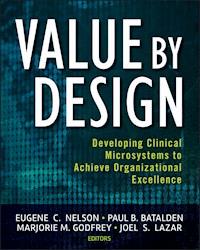
Value by Design is a practical guide for real-world improvement in clinical microsystems. Clinical microsystem theory, as implemented by the Institute for Healthcare Improvement and health care organizations nationally and internationally, is the foundation of high-performing front line health care teams who achieve exceptional quality and value. These authors combine theory and principles to create a strategic framework and field-tested tools to assess and improve systems of care. Their approach links patients, families, health care professionals and strategic organizational goals at all levels of the organization: micro, meso and macrosystem levels to achieve the ultimate quality and value a health care system is capable of offering.
Sie lesen das E-Book in den Legimi-Apps auf:
Seitenzahl: 641
Veröffentlichungsjahr: 2011
Ähnliche


















Table of Contents
Cover
Table of Contents
Half title page
Title page
Copyright page
FIGURES AND TABLES
FOREWORD
PREFACE: IMPROVEMENT AT THE FRONT LINE OF CARE
ACKNOWLEDGMENTS
THE EDITORS
THE CONTRIBUTORS
CHAPTER 1 INTRODUCING CLINICAL MICROSYSTEMS
MICROSYSTEMS IN HEALTH CARE
A BROADER VIEW OF SYSTEMS AND MICROSYSTEMS
RESEARCH ON MICROSYSTEMS IN HEALTH CARE
THREE CONCEPTUAL IMPERATIVES IN THE WORK OF VALUE IMPROVEMENT
CONCLUSION
SUMMARY
KEY TERMS
Chapter One Action Guide
INTRODUCTION TO THE 5PS
THE CLINICAL MICROSYSTEM PROCESS AND STRUCTURE OF THE 5PS MODEL
EXTERNAL MAPPING TOOL
MICROSYSTEM ASSESSMENT TOOL (MAT)
CHAPTER 2 PARTNERING WITH PATIENTS TO DESIGN AND IMPROVE CARE
THE AIM OF HEALTH CARE AND THE NEED TO PARTNER WITH PATIENTS
CONCEPTUAL FRAMEWORKS FOR PARTNERING WITH PATIENTS
TACTICS FOR PARTNERING WITH PATIENTS
PATIENTS AS INFORMANTS AND ADVISORS
CONCLUSION
SUMMARY
KEY TERMS
Chapter Two ACTION GUIDE
GAINING CUSTOMER KNOWLEDGE
INSTITUTE FOR PATIENT AND FAMILY-CENTERED CARE MATRIX
VALUE STREAM MAPPING
DEFINITIONS OF SELECTED VALUE STREAM MAPPING TERMS
CHAPTER 3 IMPROVING SAFETY AND ANTICIPATING HAZARDS IN CLINICAL MICROSYSTEMS
CASE STUDY OF ORGANIZATIONAL FACTORS TO PROMOTE A CULTURE OF SAFETY
DISCUSSION
DEFINITIONS
IDENTIFICATION OF MEDICAL ERRORS AND ADVERSE EVENTS
FREQUENCY OF ADVERSE EVENTS AND MEDICAL ERRORS
CONCLUSION
SUMMARY
KEY TERMS
Chapter Three ACTION GUIDE
5S METHOD
CHECKLISTS
FAILURE MODE AND EFFECTS ANALYSIS
REHEARSALS OR SIMULATIONS
DESIGNING PATIENT SAFETY INTO THE MICROSYSTEM
THE LINK BETWEEN SAFETY, THE MICROSYSTEM, AND MINDFULNESS
CONCLUSION
CHAPTER 4 USING MEASUREMENT TO IMPROVE HEALTH CARE VALUE
MEASURING WHAT MATTERS AT ALL LEVELS OF THE SYSTEM
TIPS AND PRINCIPLES TO FOSTER A RICH INFORMATION ENVIRONMENT
DESIGNING INFORMATION FLOW TO SUPPORT HIGH-VALUE CARE
CONCLUSION
SUMMARY
KEY TERMS
Chapter Four ACTION GUIDE
PATIENT VALUE COMPASS
BALANCED SCORECARD
MEASURE WHAT MATTERS WORKSHEET
EXAMPLES OF DATA WALLS
CHAPTER 5 STARTING THE PATIENT’S CARE IN CLINICAL MICROSYSTEMS
THE ENTRY FUNCTIONS OF CLINICAL MICROSYSTEMS
CONCLUSION
SUMMARY
KEY TERMS
Chapter Five ACTION GUIDE
PROCESS MAPPING WITH FLOWCHARTS
ACCESS MEASURES AND TOOLS
CARE VITAL SIGNS
CHAPTER 6 DESIGNING PREVENTIVE CARE TO IMPROVE HEALTH
THE WORK OF PREVENTIVE HEALTH CARE
AN ACTION-BASED TAXONOMY OF PREVENTIVE HEALTH SERVICES
CONCLUSION
SUMMARY
KEY TERMS
Chapter Six ACTION GUIDE
RADIOLOGY MICROSYSTEM PREVENTIVE ACTIVITY OF MAMMOGRAPHY AND VAP BUNDLES IN CRITICAL CARE
CHAPTER 7 PLANNING FOR RESPONSIVE AND RELIABLE ACUTE CARE
ANTICIPATING THE NEEDS OF ACUTELY ILL PATIENTS
DEFINING ACUTE CARE NEEDS OF PATIENTS AND FAMILIES
AN OVERVIEW OF DESIGN REQUIREMENTS FOR ACUTE CARE
ADVANCED ACCESS AND EFFECTIVE CARE TRANSITIONS
CONCLUSION
SUMMARY
KEY TERMS
Chapter Seven ACTION GUIDE
CHAPTER 8 ENGAGING COMPLEXITY IN CHRONIC ILLNESS CARE
AN INVITATION TO COMPLEXITY
THE EXPERIENCE OF CHRONIC ILLNESS
THE BURDEN OF CHRONIC ILLNESS
THE GOALS OF CHRONIC ILLNESS CARE
CLINICAL COMPLEXITY IN CHRONIC ILLNESS CARE
DESIGNING FOR COMPLEXITY THROUGH ALIGNMENT OF PROBLEMS AND PRACTICE SOLUTIONS
THE NATURE OF COMPLEX ADAPTIVE SYSTEMS
THE CHRONIC CARE MODEL
CARE COORDINATON AND TRANSITIONS
PATIENT SELF-MANAGEMENT
CONCLUSION
SUMMARY
KEY TERMS
Chapter Eight ACTION GUIDE
STAR GENERATIVE RELATIONSHIPS
CHAPTER 9 SUPPORTING PATIENTS AND FAMILIES THROUGH PALLIATIVE CARE
THE NEED FOR PALLIATIVE CARE IN MODERN AMERICA
END-OF-LIFE EXPERIENCE YESTERDAY AND TODAY
PRINCIPLES OF PALLIATIVE CARE
REDUCING VARIATION IN END-OF-LIFE CARE
CORE PROCESSES IN PALLIATIVE CARE
CARE COORDINATION NEAR THE END OF LIFE
FORMAL PALLIATIVE CARE AND HOSPICE PROGRAMS
PLANNING FOR BOTH LIFE AND DEATH WITH ADVANCE DIRECTIVES
CONCLUSION
SUMMARY
KEY TERMS
Chapter Nine ACTION GUIDE
MENTAL MODELS
USING THE LADDER OF INFERENCE TO EXPLORE MENTAL MODELS
CHAPTER 10 DESIGNING HEALTH SYSTEMS TO IMPROVE VALUE
FROM PARTS TO WHOLE
NEW VISION OF INTEGRATED SYSTEMS TO PRODUCE HIGH VALUE
THE EXECUTION TRIANGLE
LEADING CHANGE AT ALL LEVELS
CHANGING LOCAL CULTURE
THE PATH FORWARD FOR MAKING HIGH-VALUE HEALTH SYSTEMS
SUMMARY
KEY TERMS
Chapter Ten ACTION GUIDE
MICRO-, MESO-, AND MACROSYSTEM MATRIX
Index
VALUE BY DESIGN
Copyright © 2011 by The Center for Leadership and Improvement at The Dartmouth Institute for Health Policy and Clinical Practice. All rights reserved.
Published by Jossey-Bass
A Wiley Imprint
989 Market Street, San Francisco, CA 94103-1741—www.josseybass.com
No part of this publication may be reproduced, stored in a retrieval system, or transmitted in any form or by any means, electronic, mechanical, photocopying, recording, scanning, or otherwise, except as permitted under Section 107 or 108 of the 1976 United States Copyright Act, without either the prior written permission of the publisher, or authorization through payment of the appropriate per-copy fee to the Copyright Clearance Center, Inc., 222 Rosewood Drive, Danvers, MA 01923, 978-750-8400, fax 978-646-8600, or on the Web at www.copyright.com. Requests to the publisher for permission should be addressed to the Permissions Department, John Wiley & Sons, Inc., 111 River Street, Hoboken, NJ 07030, 201-748-6011, fax 201-748-6008, or online at www.wiley.com/go/permissions.
Readers should be aware that Internet Web sites offered as citations and/or sources for further information may have changed or disappeared between the time this was written and when it is read.
Limit of Liability/Disclaimer of Warranty: While the publisher and author have used their best efforts in preparing this book, they make no representations or warranties with respect to the accuracy or completeness of the contents of this book and specifically disclaim any implied warranties of merchantability or fitness for a particular purpose. No warranty may be created or extended by sales representatives or written sales materials. The advice and strategies contained herein may not be suitable for your situation. You should consult with a professional where appropriate. Neither the publisher nor author shall be liable for any loss of profit or any other commercial damages, including but not limited to special, incidental, consequential, or other damages.
Jossey-Bass books and products are available through most bookstores. To contact Jossey-Bass directly call our Customer Care Department within the U.S. at 800-956-7739, outside the U.S. at 317-572-3986, or fax 317-572-4002.
Jossey-Bass also publishes its books in a variety of electronic formats. Some content that appears in print may not be available in electronic books.
Library of Congress Cataloging-in-Publication Data
Value by design : developing clinical microsystems to achieve organizational excellence / Eugene C. Nelson . . . [et al.].
p. cm.
Includes bibliographical references and index.
ISBN 978-0-470-38534-0 (pbk.); 978-0-470-90133-5 (ebk.); 978-0-470-90134-2 (ebk.);
978-0-470-90135-9 (ebk)
1. Medical care. 2. Medical protocols. 3. Organizational effectiveness. I. Nelson, Eugene C.
RA443.V35 2011
362.1–dc22
2010047562
FIGURES AND TABLES
Figures
Figure P.1 Clinical Microsystem Model.
Figure P.2 Infrastructual and Experiential Domains of the Clinical Microsystem.
Figure 1.1 Many-to-One Diagram.
Figure 1.2 The Simplest Clinical Microsystem.
Figure 1.3 Anatomy of a Microsystem.
Figure 1.4 Embedded Provider Units in a Health System.
Figure 1.5 Supporting Microsystems for a Clinical Microsystem.
Figure 1.6 Panoramic View of a Health System.
Figure 1.7 External Mapping of a Clinic in the United Kingdom.
Figure 1.8 The Success Characteristics of High Performing Clinical Microsystems.
Figure 1.9 Jönköping County’s Child Healthcare Collaboration.
Figure 1.10 Panoramic View of Jönköping County’s Maternity and Newborn Mesosystem.
Figure 1.11 Mesosystems as a Connector Entity.
Figure 1.12 Annotated Sustainable Improvement Triangle.
Figure 1.13 Improvement Equation Annotated: Linking Evidence to Improvement.
Figure 1.14 Simple, Complicated, Complex Framework.
Figure AG1.1 Microsystem Anatomy Model.
Figure AG1.2 Primary Care Profile.
Figure AG1.3 Specialty Care Profile.
Figure AG1.4 Inpatient Profile.
Figure AG1.5 External Mapping Tool.
Figure AG1.6 Microsystem Assessment Tool.
Figure AG1.7 Microsystem Assessment Tool (MAT) Scores.
Figure 2.1 Clinical Microsystem Model.
Figure 2.2 Kano Model for Understanding Customer Satisfaction.
Figure 2.3 Deming Model: Organizing as a System of Care.
Figure 2.4 Chronic Care Model.
Figure 2.5 Amy’s Breast Cancer Care Journey.
Figure AG2.1 Continuum of Methods for Gaining Customer Knowledge.
Figure AG2.2 Through the Eyes of Your Patients.
Figure AG2.3 Observation Skills Worksheet.
Figure AG2.4 Microsystem Lenses Model.
Figure AG2.5 Tips and Lenses Worksheet.
Figure AG2.6 Flying a Plane and Conducting an Interview.
Figure AG2.7 Interview Worksheet 1.
Figure AG2.8 Interview Worksheet 2.
Figure AG2.9 Analysis and Interpretation.
Figure AG2.10 Framework for Family Involvement in Quality Improvement.
Figure AG2.11 Value Stream Map Worksheet.
Figure AG2.12 Value Stream Map Page 1.
Figure 3.1 Terms Related to Patient Safety.
Figure 3.2 The Swiss Cheese Model of How Defenses, Barriers, and Safeguards May Be Penetrated by an Accident Trajectory.
Figure 3.3 Principles of Developing and Implementing Patient Safety Interventions.
Figure AG3.1 5S Method.
Figure AG3.2 5S Evaluation and Improvement Worksheet.
Figure AG3.3 Procedure Checklist.
Figure AG3.4 Patient Safety Scenario.
Figure AG3.5 Haddon Matrix.
Figure AG3.6 Patient Safety Matrix.
Figure 4.1 Multiple Functions of Measurement Within Embedded Levels of a Health System.
Figure 4.2 Patient Value Compass for a Typical Spine Patient.
Figure 4.3 The Spine Center Design for Information Flow.
Figure 4.4 Value Compass Measures Over a Lifetime.
Figure 4.5 Patient Value Compass: Herniated Disk Patients.
Figure 4.6 Balanced Scorecard: Spine Center Business Unit.
Figure 4.7 Cascading Metrics Using Adverse Event Rates as an Example.
Figure 4.8 Cascading Metrics.
Figure 4.9 Sample Layout: Measures for Improvement.
Figure AG4.1 Clinical Value Compass Side A.
Figure AG4.2 Clinical Value Compass Side B.
Figure AG4.3 Strategic Performance Compass.
Figure AG4.4 Measure What Matters Page 1.
Figure 5.1 Change Concepts for Advanced Clinic Access.
Figure 5.2 Patient Access to Care from the Catwalk.
Figure 5.3 The Catwalk of Post-Anesthesia Care.
Figure 5.4 Handoff Communication Checklist for Surgery.
Figure 5.5 RN to RN Handoff Tool.
Figure 5.6 SBAR Patient Report Guideline for Perioperative Services.
Figure 5.7 I Pass the Baton Handoffs and Health Care Transitions.
Figure 5.8 Orientation Process for Parents Whose Infant Has Been Transferred to a Neonatal Intensive Care Unit.
Figure AG5.1 High-Level Flowchart.
Figure AG5.2 Drill Down Flowchart.
Figure AG5.3 Flowchart Symbol Key.
Figure AG5.4 Deployment Flow Diagram.
Figure AG5.5 Deployment Flow Example.
Figure AG5.6 CARE Vital Signs Page 1.
Figure AG5.7 CARE Vital Signs Page 2.
Figure 6.1 Clinical Improvement Equation.
Figure 6.2 Knowledge Elements in Clinical Improvement.
Figure AG6.1 Radiology Flowchart.
Figure 7.1 Pneumonia Deployment Flowchart.
Figure 7.2 Pneumonia Care Algorithm.
Figure 7.3 Who Seeks Care Where? Ecology of Medical Care 2001.
Figure 7.4 Change Concepts.
Figure 7.5 Asthma Action Plan.
Figure AG7.1 Microsystem Transitions and Handoffs.
Figure 8.1 Aligning Levels of Problem and Practice Complexity.
Figure 8.2 Chronic Care Model.
Figure 8.3 Clinical Value Compass.
Figure 8.4 Embedded Systems.
Figure 8.5 Radial Handoffs and Transitions in Chronic Illness Care.
Figure 8.6 The 5As Cycle of Self-Management Support.
Figure 8.7 My Action Plan.
Figure 8.8 Implementing the 5As Model in Clinical Microsystems.
Figure AG8.1 Generative STAR 1.
Figure AG8.2 Generative STAR Worksheet Page 1.
Figure AG8.3 Generative STAR Worksheet Page 2.
Figure 9.1 Typical Trajectory of Health Status Preceding Death Before the Twentieth Century.
Figure 9.2 Typical Trajectory of Health Status Preceding Death for Chronic Illnesses with Slow Decline and Periodic Crises.
Figure 9.3 Typical Trajectory of Health Status Preceding Death for Chronic Illnesses with Steady Decline and Short Pre-Terminal Phase.
Figure 9.4 A Continuum of Care Model for Palliative Care.
Figure 9.5 Total Medicare Spending for Chronically Ill Patients During the Last Two Years of Life, by State (Deaths Occurring 2001–2005).
Figure 9.6 Exploring the External Context of Coordinating Palliative Care.
Figure 9.7 The Palliative Care Team.
Figure 9.8 Disease Modifying Care, Palliative Care, and Hospice Care.
Figure 9.9 Palliative and Hospice Care Overlap.
Figure AG9.1 Ladder of Inference.
Figure AG9.2 Ladder of Inference for Advocacy and Inquiry.
Figure AG9.3 Ladder of Inference Worksheet.
Figure 10.1 New Percutaneous Coronary Intervention.
Figure 10.2 A Framework for Execution.
Figure 10.3 Aligning CCHMC Microsystem Improvement with Organizational Strategic Plan.
Figure AG10.1 Micro-Meso-Macro Framework: M3 Matrix.
Tables
Table 1.1 Bridging the Gaps: Jönköping, Sweden, Research Studies
Table AG1.1 Assessing Your Practice Discoveries and Actions: The 5Ps
Table AG1.2 Supporting Microsystem 5Ps
Table AG1.3 Microsystem Assessment Tool (MAT) Definitions
Table AG1.4 Microsystem Assessment Tool (MAT) Worksheet
Table 2.1 Ten New Rules for the Twenty-First Century Health Care System
Table 2.2 Patient Education Program
Table AG2.1 Opinion Survey
Table 3.1 Workplace and Human Factors (WHO) Examples
Table 3.2 Methods to Identify Medical Errors and Adverse Events
Table AG3.1 Failure Mode and Effects Analysis
Table AG3.2 Linkages to Safety
Table 4.1 Tips to Foster a Rich Information Environment
Table 4.2 Some Distinguishing Characteristics of the Value Compass and the Balanced Scorecard
Table 5.1 Critical Steps in the Health Care Journey
Table 5.2 Methods for Improving Access and Flow in Clinical Mesosystems
Table 5.3 Steps and Methods for Analyzing and Improving the Orientation Process
Table 6.1 Sample List of Preventive Care Activities
Table 6.2 Overarching Care Needs of Patient and Family
Table 6.3 An Action-Based Taxonomy of Preventive Health Care
Table 6.4 Questions to Stimulate the Design and Improvement of Preventive Care
Table 7.1 Overarching Care Needs of Patient and Family
Table 8.1 A Comparison of Acute and Chronic Disease
Table 8.2 Overarching Care Needs of Patient and Family
Table 8.3 Common Chronic Diseases in the United States
Table 8.4 Number of Chronic Conditions per Medicare Beneficiary
Table 8.5 Three Essential Goals of Chronic Illness Care
Table 8.6 Three Types of Activities: Simple, Complicated, and Complex
Table 8.7 Aligning Simple, Complicated, and Complex Activities with Appropriate Solutions
Table 8.8 Features of Complex Adaptive Systems, Design Implications, and Examples
Table AG8.1 STAR Acronym Defined
Table 9.1 Death in 1900 and in 2000: A Comparison
Table 9.2 Overarching Care Needs of Patient and Family
Table 9.3 Activities That May Help Prevent Burnout
Table AG9.1 Carl’s Ladder of Inference
Table 10.1 Overarching Care Needs of Patient and Family
Table 10.2 Tight and Loose Coupling: Features, Characteristics of Features, and Actions for Improvement
Table 10.3 The Six Universal Challenges Facing Health Systems That Seek to Organize for Quality Health Care
FOREWORD
Elliott S. Fisher
The problems confronting the U.S. health care system are widely recognized: a rising burden of chronic disease;1 limited capacity to deliver safe, reliable, and effective care (even when the evidence for specific treatments is strong);2,3 fragmented and poorly coordinated patient care that is frequently impersonal, insensitive to socioeconomic, cultural or ethnic contexts, and poorly aligned with patients’ preferences;4 and rising costs that threaten individual, corporate, and government budgets.5,6
As our recognition of the scope of the problems has grown, so has our understanding of the underlying causes of these problems. Although some of the responsibility for poor care rests with our still inadequate health insurance coverage, most policy experts recognize that expanding insurance coverage will do little to address the underlying causes of poor quality and rising costs that afflict even those with excellent insurance. The critical underlying causes include:
Unclear Aims: failure to be clear about the aims of health care (Is health care a commodity and thus just about making money? Or about better care and better health?);Limited Information: inadequate information systems and inadequate information on the risks and benefits of common treatments and the performance of local health systems and providers;Disorganized Care: a fragmented and disorganized delivery system that is limited in its capacity to learn or to measurably improve care;Flawed Incentives: a payment system that reinforces fragmentation and fosters little or no accountability for the quality and costs of care.The United States now has an unprecedented opportunity to address these problems. The National Priorities Partnership, a broad multistakeholder coalition including all the major federal health agencies, employers, provider organizations, and consumer groups, has achieved consensus on aims, making explicit the need to improve care, improve health, and reduce costs.7 The American Reinvestment and Recovery Act (2009) made major policy and funding commitments to improving health information systems, performance measures, and comparative effectiveness research. And the recently passed Affordable Care Act (2010) includes numerous provisions intended to foster delivery system and payment reform. These include: the requirement that the Secretary of Health and Human Services develop a national quality strategy; the creation of a new Center for Medicare and Medicaid Innovation to identify, develop, and test new models of care and payment; authorization and funding to test a broad array of pilot programs (ranging from use of decision-aids to support informed patient choice to the creation of “Health Innovation Zones”); and the creation of a new payment model under Medicare (Accountable Care Organizations) under which physician groups and other providers can take responsibility for defined populations—and be rewarded financially for improving quality and lowering costs. These provisions will set in motion a marked change in the organizational structure, performance measures, and payment methods of the U.S. health care system.
The success of reform, however, will depend upon whether clarity of aims or changes in organization, policy, and payment methods can lead to actual improvements in the health and function of patients, in their experiences of the care, and in the affordability of health care. Policy alone can’t change practice: health care professionals must change how they care for patients. The success of reform thus depends upon changes at the front lines of practice—where patients are touched by their clinicians—and in the organizations and systems that support those frontline clinicians.
This book is essential reading for everyone who wants to improve the care that they provide, whether a nurse in the emergency room frustrated by patient flows, a physician in a small office practice trying to improve care for diabetic patients, or a leader of a major health system considering how to become an Accountable Care Organization.
The authors build on decades of work applying scientific principles of improvement to health care and add a key insight drawn from the research of James Brian Quinn:8 value in health care is produced in small functional units—clinical microsystems—where one or more health professionals work with patients (and their families) to produce a specific health outcome. Microsystems have clinical aims (effective treatment of primary care patients with diabetes), business aims (maintaining income, covering expenses), and shared technology and information. Most importantly, microsystems have inputs, processes, and outputs (including clinical outcomes) that allow their performance to be measured and improved.
Building on this conceptual foundation, the authors describe how health professionals can work with patients, families, and team members within a microsystem to systematically improve performance. The first half of the book focuses on general principles: the theory of microsystems (Chapter 1); engaging patients as partners (Chapter 2); improving reliability (Chapter 3); creating the needed information environment (Chapter 4); and developing plans for how patients traverse a microsystem (Chapter 5). The next four chapters describe specific examples across the care continuum. Finally, Chapter 10 provides a spectacular discussion of how health care leaders can build effective, high-performing delivery systems on the foundation of high functioning clinical microsystems.
Better value is what we badly need in health care. Value by Design can help us get there.
References
1. Thorpe, K. Factors accounting for the rise in health care spending in the United States: The role of rising disease prevalence and treatment intensity. Public Health, 2006, 120(11), 1002–1007.
2. Institute of Medicine, Committee on Quality Health Care in America. To err is human: Building a safer health system. Washington, DC: National Academy Press, 2000.
3. McGlynn et al. The quality of health care delivered to adults in the United States. New England Journal of Medicine, 2003, 348(26), 2635–2645.
4. Institute of Medicine Committee on Quality Health Care in America. Crossing the quality chasm: A new health system for the 21st century. Washington, DC: National Academy Press, 2001.
5. Orszag, P., & Ellis, P. The challenge of rising health care costs—a view from the Congressional Budget Office. New England Journal of Medicine, 2007, 357(18), 1793–1795.
6. Orszag, P., & Ellis, P. Addressing rising health care costs—a view from the Congressional Budget Office. New England Journal of Medicine, 2007, 357(18), 1885–1887.
7. National Priorities Partnership. National priorities and goals: Aligning our efforts to transform America’s healthcare. Washington, DC: National Quality Forum; 2008.
8. Quinn, J. Intelligent enterprise: a knowledge and service based paradigm for industry. New York: Free Press; 1992.
9. Schaeffer, L. The new architects of health care reform. Health Affairs (Millwood), 2007, 26(6), 1557–1559.
PREFACE: IMPROVEMENT AT THE FRONT LINE OF CARE
Moreover, we must not be content in modern health care to guarantee only clinical quality or only safety or only patient satisfaction or only cost reduction. Instead we must design and manage health systems that are capable of achieving all of these goals all of the time. We will need to do this, finally, in a manner that also increases pride and joy in work of physicians, nurses, and all health professionals who, for the most part, entered this line of work because they wanted to help people and to make a difference.
We have written this book, Value by Design, to offer specific guidance on building and improving clinical microsystems. We direct our attention especially to the front line of care because this is where clinical service is actually rendered, success is measured, health care teams learn from experience and modify their work appropriately, patients and families develop their loyalty to the health care system, and patients hopefully recover, maintain, or even generate health. The clinical microsystem is the locus of value creation in health care.
The timing of this book’s publication is fortuitous. We believe a cultural shift is taking place in the health care quality and safety movement. Until recently, this field was led by a small and tightly linked community of authors and leaders who knew each other well. Only a limited number of high-quality publications were circulated, and new events and developments were communicated quickly and easily among thought leaders in the field and among their colleagues, associates, and acquaintances. This small community was richly connected by shared interests and by collaborative projects and friendship networks that created a generative and enabling context and a fidelity to shared principles, concepts, and methods. The focus of work was on patients, populations, and health professionals.
More recently, however, the culture of the quality movement has shifted. Robust demonstrations of health care improvement are now widely dispersed across multiple sites that are delivering care, conducting research, and educating the next generation of health professionals. Multiple journals and scores of Web sites and blogs now address questions of quality and safety. These provide myriad portals into numerous topics, themes, and programs, both nationally and internationally. Although the primary focus remains on patients, populations, and health professionals, active efforts now align health care delivery with public and community health promotion. Keeping up-to-date in this burgeoning field requires a vigilance that may not be attainable among even well-intended quality practitioners.
We believe the time is therefore right to consolidate, in a single volume, some of what we have learned about what works to improve value in health care. We wish to explore durable concepts and methods that have proven useful to clinical microsystems endeavoring to effect meaningful change in diverse real-world settings. We wish to share, as well, a practical framework that has successfully stimulated learning and improvement in microsystem participants and in students who aspire to enter the growing community of quality leaders and practitioners.
The Dartmouth Institute’s Clinical Microsystems Course
In a sense, we (Batalden and Nelson) have been working on this book for more than fifteen years. In 1994 Paul Batalden left the Hospital Corporation of America (HCA) to rejoin forces with Eugene Nelson, who had moved from HCA to Dartmouth in 1992. Dartmouth Medical School’s Center for the Clinical Evaluative Sciences (now the Dartmouth Institute for Health Policy and Clinical Practice), under the leadership of Jack Wennberg and Gerry O’Connor, had begun a novel master’s degree program to prepare health professionals in health policy, epidemiology, biostatistics, and quality improvement. Dartmouth recruited Batalden to lead the new quality improvement track in the master’s degree program and to develop a core curriculum on the fundamentals of modern improvement in health care. The capstone course in this quality track that provides both the content and the structure of our present book was formally named “Continually Improving the Health and Value of Health Care for a Population of Patients: The Design and Improvement of Clinical Microsystems.” Offered initially in 1995 and every spring since that time, the Microsystems Course (as it is less formally known) remains popular among graduate students, health care administrators, and experienced health care professionals.
The Microsystems Course continues to evolve as new insights are gained and as new applications of modern improvement in health care are tested (and found to work) in the real world. Marjorie Godfrey joined the faculty team in 1999 and has developed numerous useful tools (many of which are featured in this book’s action guides) to guide clinical microsystems in the hands-on work of practice self-assessment and change. More recently, Tina Foster and Joel Lazar have joined the core group as well, and have helped further align course principles with the experiential realities of patients, families, and frontline caregivers. The course’s theoretical and practical underpinnings come from many sources, with special debt to W. Edwards Deming, James Brian Quinn, Kerr White, Karl Weick, Edgar Schein, Donald Berwick, and Tom Nolan. As time has passed and knowledge has grown, the Dartmouth-based group has authored numerous journal articles on clinical microsystems and a book titled Quality by Design: A Clinical Microsystems Approach.
The present book, however, represents our first effort to organize our capstone course material into a single volume for both teaching and value improvement purposes. Value by Design: Developing Clinical Microsystems to Achieve Organizational Excellence may be used either as a textbook in health courses like our own, or as a practical guide in the real-world improvement of health care. Because (as we discuss in greater detail in Chapter One) the functions of better patient outcomes, better professional development, and better systems improvement are inextricably linked, we hope and expect our book will serve both purposes simultaneously.
Organization of the Microsystems Course
The Microsystems Course is based on action-learning methods, skips back and forth from classroom to real-world clinical programs and clinical units, and is outrageously fun to teach. Our own course has thirty to forty students each spring and is made up of an almost equal mix of physicians, nurses, mid-career health professionals, and recently graduated undergraduates. Students organize themselves into teams of three or four; each team is then matched with a particular real-world clinical microsystem that becomes the locus of action-learning throughout the semester. The ten or so clinical microsystems are selected from the surrounding region and are picked to represent different parts of the health care continuum. Our most recent year’s sites (2009) included a family practice, a general internal medicine clinic, a pediatric surgery program, an electroconvulsive therapy (ECT) psychiatric treatment center, an ear-nose-and-throat program, a home health agency, a blood bank, an inpatient oncology unit, an infectious disease group, and an ultrasound testing service.
During the course of a ten-week academic term, student teams spend (each week) one half-day in the classroom and one-half to one full day in the field studying their clinical microsystem. The team’s study of each particular clinical microsystem is guided by ideas, concepts, and methods covered in class and is specifically based on the clinical microsystem model. Student teams complete weekly assignments that contribute to their two final academic products: (1) a twenty-plus page case report assessing the clinical microsystem and making recommendations for improvements, and (2) a poster summarizing the students’ assessment of their microsystem and recommendations for improvement. For more detailed information on the Microsystems Course, see the course syllabus, action guides, and three final microsystem case reports written by student teams. These and other resources are available at our Web site, www.clinicalmicrosystem.org.
The Clinical Microsystem Model
Although specific care processes will of course vary greatly from one clinical microsystem to the next, we have found that a core model is common to the flow of activity in virtually all microsystems. Patients and families enter a system of care with specific health needs; they participate in clinical processes of orientation, assessment, intervention, and reevaluation; and they emerge from that system hopefully with a large or small health benefit, through satisfactory meeting of their needs. Students’ and caregivers’ rich knowledge of this model permits detailed exploration of care processes and outcomes. This exploration in turn facilitates development and improvement of specific workflows that may improve health outcomes and patient experience, enhance system safety, and reduce associated costs. This is value by design! The general clinical microsystem model is shown in Figure P.1. The clinical microsystem model is sometimes referred to as the physiology model (see discussion in Chapters 1 and 2.) The model provides an overarching framework for the spring Microsystems Course, as it does for the present book. The model’s strength is its adaptability to any microsystem in any part of the care continuum. We have seen it successfully applied to emergency departments, intensive care units, inpatient medical-surgical units, home health programs, physical rehabilitation programs, nursing home units, outpatient surgical settings, and medical specialty and primary care practices. The model works because, in virtually all caregiving settings, care itself is built from the same types of core processes.
Studying Figure P.1 and the clinical microsystem model, we observe the following: the microsystem’s work begins when an individual with a particular health need leaves his everyday environment and enters (most often physically but sometimes virtually) a clinical microsystem. This individual can be recognized as one of a population of patients cared for by the microsystem. Attributes of his baseline health status may be depicted with a value compass (see discussion in Chapter Four). The value compass reveals the patient’s clinical and functional condition, expectations for goodness of care, and historical costs associated with getting health care and with being ill or injured.The individual next receives some orientation to the particular microsystem as well as an initial workup and plan of care, which in turn lead to the delivery of a mix of services (preventive, acute, chronic, palliative), based on the patient’s health status, preferences, and available resources.As time passes, the individual exits the particular clinical microsystem (which can be thought of as exit/transition from the microsystem’s perspective) and either returns to the everyday social environment or enters another adjacent clinical microsystem for the next step in care.The goodness of the outcomes of time spent in (or in relationship with) the clinical microsystem can be registered on this individual’s value compass (measured or unmeasured) at this new point in time. Once again, the individual can be recognized as one member of the population the microsystem has served.Two important processes contribute to the linear flow of this model and to the improvement of microsystem performance. The first process is measurement and monitoring, which permits assessment of key clinical and performance metrics, primary outputs and outcomes, and establishes the degree to which services result in satisfaction of need over time. The second process is knowledge acquisition about patients, families, and other beneficiaries of microsystem service. This beneficiary knowledge is specific to immediate needs and to realms of experience external to contact with the microsystem.FIGURE P.1 Clinical Microsystem Model.
Organization of This Book
We have organized Value by Design as we have organized the Microsystems Course itself. Each of the book’s ten chapters corresponds to one week in our ten-week course and to detailed exploration of one component of the clinical microsystem model. When we teach the Microsystems Course, the model is shown at the start of every class meeting to orient learners to each new step in their own explorations and to each new step in the clinical care journey of patients, families, and the microsystem itself. At the start of each chapter we provide learning objectives for the unit to indicate what will be covered in the subsequent text. Each chapter concludes with a brief summary, list of key terms, study questions, and discussion topics that serve to broaden and deepen the chapter’s (week’s) explorations.
Chapters One through Five explore infrastructure elements of the clinical microsystem and show how these elements may be conceptualized, analyzed, designed, and improved to optimize service to patients and families. In Chapter One we define basic terms and explore key concepts that provide a foundation for microsystem design and improvement more generally. Chapter Two highlights the importance of patients as partners, not only in generating caregiving knowledge, but also in creating clinical value. Chapter Three introduces the paired themes of safety and reliability, which are essential to the efficacy and integrity of microsystem care. In Chapter Four we examine the microsystem functions of measuring and monitoring; we observe that these activities entail much more than simple registering of numeric outputs. Indeed, they support and guide our improvement of caregiving activities. Chapter Five directs our attention to the function of patient entry into clinical microsystems: important core processes here include orientation, data acquisition, reliable access, and effective care transitions.
In weeks six through nine of the Microsystems Course, and in the corresponding chapters of this book, we maintain the same clear focus on quality improvement and value creation while shifting our perspective. Where our attention previously focused on microsystem processes and infrastructure that support patient care, we now explore more deeply the clinical experiences of patients and families. In Chapters Six through Nine we consider the unique clinical needs, challenges, and opportunities of preventive, acute, chronic, and palliative care.
But we do not view the content of these latter, care-focused chapters as distinct from the infrastructure explorations that preceded them. Quite the contrary, the discussions in Chapters One through Five gain greater relevance as their implications and applications are examined in the context of unique forms of clinical and caregiving experience. As depicted in Figure P.2, we conceptualize the entire microsystem model as something of a grid, with infrastructural domains (such as safety and reliability and measurement and monitoring) represented as vertical columns and clinical experiential domains (preventive, acute, chronic, and palliative care needs) represented as horizontal rows. Throughout the text the reader is invited to give special attention to each of the resulting squares at the intersection of these domain axes. As suggested earlier in this Preface, it is at these points of connection between patients’ clinical needs, resources, and care processes that microsystems generate quality, safety, outcomes, and costs that contribute to value.
FIGURE P.2 Infrastructual and Experiential Domains of the Clinical Microsystem.
In Chapter Ten we consider the subject of value creation from one further perspective. After reexamining fundamental principles and discrete practices from earlier chapters, we expand our focus beyond clinical microsystems to meso and macrosystems where quality, safety, and value are achieved on a larger scale. How do we connect the front line to the front office, so that the building blocks of improvement in local contexts support and strengthen one another and stimulate improvement, innovation, and reform across entire health systems?
Additional Features and Online Resources
We wrote this book with the aim of creating a multifunctional text. Value by Design may serve as a course textbook, since its content and structure already reflect the Dartmouth Institute’s Clinical Microsystems Course. Alternatively (or in addition), it may function as a practical guide for real-world improvement in actual clinical microsystems and may function to enhance value in health care settings already familiar to readers. We have made liberal use of case studies, sidebars, and chapter-specific action guides (derived from the Internet-based Clinical Microsystem Action Guide) to add texture, tools, depth, and scope. (See www.clinicalmicrosystem.org and select Materials and select Workbooks and select Clinical Microsystem Action Guide).
In using the book as a textbook, educators and learners may take advantage of the model course syllabus for overall planning and management and may then proceed sequentially through each chapter’s learning objectives, core material, review questions, and discussion questions. In addition, a set of PowerPoint slides accompanies each chapter and can be accessed at www.clinicalmicrosystem.org. This Web site, developed and administered by one of the editors (Godfrey), has many useful materials and resources, including the Dartmouth Institute Microsystems Course Syllabus, PowerPoint slides, and case studies completed by the Dartmouth Institute Microsystems Course graduate students. Readers should explore the Web site’s Resources and Materials sections. Educators will also find a helpful Instructor Guide to offer support in teaching Value by Design.
In using the book as a value improvement guide, we recommend that readers familiarize themselves with the content of Chapters One through Five and then selectively explore Chapters Six through Ten and relevant action guides, based on their interests and improvement challenges. Again, this material can be richly enhanced through full use of www.clinicalmicrosystem.org, the free educational Web site where many colleagues from around the world find and contribute resources and knowledge.
One final function of our book and of the Clinical Microsystems Course that informs it is to serve as an invitation. We will have succeeded in our efforts only if we engage educators and students, clinicians, nurses, and other health professionals, leaders and administrators, and, of course, patients and families in the ongoing and essential work of health care improvement. Our health system is deeply in need of improvement, and those of us who work with an awareness of the clinical microsystems are uniquely positioned to perform this necessary work. We invite you to participate, knowing that only by working together can we achieve our common goal of value creation in health care.
We leave you with one further invitation. Our Microsystems Course, like the health care system itself, is an appropriate target for continuous improvement. Fifteen years of design and changes have brought our course to its current state, but there is certainly more work to be done. We expect our readers to experiment with the course material, to modify its content to appropriate educational and clinical contexts, and to engage new learners (new participants in the community of quality improvement and value creation) in ways we have not anticipated. We thus invite all readers of Value by Design to share with us their own discoveries. How have the model and materials helped your educational and clinical work? What would be more helpful? Please share your own experiences and insights with us at www.clinicalmicrosystem.org so we can learn together how best to achieve high-value health care, best outcomes for patients and families, and genuine pride in work for health professionals, support staff, and system leaders.
ACKNOWLEDGMENTS
The principles and practices explored in this text have emerged through nearly two decades of rich conversation and interaction with literally hundreds of individuals and organizations. We are grateful for ongoing engagement with students and system leaders, with health professionals and administrators, and with frontline clinical microsystems and high performing macrosystems around the world. We have been especially touched and influenced by patients and families who have shared their personal health care journeys, deeply informing our own reflections and insights into health care systems. We wish to acknowledge and thank some of the many collaborators who have contributed materially or intangibly to this collective work and who have asked for so little in return. We ask simultaneously for forgiveness from many others who have made important contributions and yet have been overlooked. It is fitting for teachers to first acknowledge the generative relationships with students, including those involved in the formal education programs of the Dartmouth Institute for Health Policy and Clinical Practice, as well as those we have taught in several parts of the world in short courses during the last fifteen years. These students’ curiosity, questions, and critical reflections have made enormous contributions to our thinking about and understanding of clinical microsystems.We wish to thank both past and present leaders of our health system home, Dartmouth-Hitchcock (including Stephen Plume, James Varnum, Nancy Formella, Thomas Colacchio, and Jim Weinstein) for their enduring support and encouragement. These leaders have collectively built our institution into an action-learning lab to test and refine concepts and methods in many clinical programs, including the Spine Center (Bill Abdu, Jim Weinstein), Intensive Care Nursery (Bill Edwards, Caryn McCoy), Children’s Hospital at Dartmouth (Paul Merguerian, Sam Casella), Plastic Surgery (Carolyn Kerrigan, Barbara Reisberg), Breast Cancer Program (Dale Collins Vidal), PainFree Program (George Blike, Joe Cravero), Regional Primary Care Center (Cathy Pipas, Diane Andrews, Linda Patchett), and others too numerous to mention.
We also thank leaders of our academic home, the Dartmouth Institute for Health Policy and Clinical Practice at Dartmouth Medical School (including Jack Wennberg, Elliott Fisher, and Gerry O’Connor) for providing a solid platform for our teaching and research on microsystems and high performing health systems.
Our work grows from not only a physical home base, but also an intellectual one. The conceptual underpinnings of this book build directly upon insights from well-known thought leaders in what we consider to be an evolving, worldwide quality and efficiency movement. W. Edwards Deming, James Brian Quinn, Karl Weick, Kerr White, Michael Porter, Paul Bate, Edgar Schein, Donald Berwick, Brent James, and Thomas Nolan are just a few authors and mentors we hold in high esteem whose work has influenced our own thinking, teaching, and writing. Brenda Zimmerman’s and Paul Plsek’s contributions in the field of complexity science have been essential to our work as well.
We received important assistance early in our study of high performing microsystems in the real world. First, the Institute of Medicine’s committee responsible for the groundbreaking Crossing the Quality Chasm report also provided support for Julie Johnson and Molla Donaldson to conduct field research on select clinical microsystems. Later, the Robert Wood Johnson Foundation provided generous funding to launch the Clinical Microsystem Research Program. This project generated crucial information we used in our research on microsystems and in our teaching about microsystem performance improvement.
The principles, concepts, and methods upon which microsystem thinking is based have been adapted, advanced, and reinvented by a large number of very progressive health systems (and health system leaders) in the United States. We have learned a great deal from these institutions’ efforts to achieve sustainable improvements in performance. Exemplary health systems (and their leaders) include Cincinnati Children’s Hospital Medical Center (Jim Anderson, Uma Kotagal, Stephen Muething), Cooley Dickinson Hospital (Craig Melin, Carol Smith), U.S. Department of Defense (Diana Luan), Helen DeVos Children’s Hospital at Spectrum Health (Joan Rikli, Amy Atwater), Geisinger Health System (Glenn Steele, Bruce Hamory, Al Bothe, Karen McKinley, Scott Berry), Akron Children’s Hospital (John McBride, Elizabeth Bryson, Christine Singh), Maine Medical Center (Rich Peterson, Marjorie Wiggins, Peter Bates, Doug Salvador), North Shore Long Island Jewish Hospital (Fatima Jaffrey, Harry Steinberg), Visiting Nurse Service of New York (Joan Marren), Texas Health Resources (Michael Deegan, Linda Gerbig), and the Veterans Integrated Service Networks 1 (Michael Mayo-Smith, Jim Schlosser, Allan Shirks).
Microsystems are being strategically developed in many other countries as well. We have been grateful for very productive relationships with the Jönköping (Sweden) Academy for the Improvement of Health and Welfare (Johan Thor and Boel Andersson-Gäre) and with the Jönköping County Council Health System, which also leads and hosts the Annual International Clinical Microsystems Network Festival (Göran Henriks, Matts Bojestig, Sven-Olof Karlsson, Agneta Jansmyr, Gerd Ahlström). We have learned a great deal as well from performance improvement leaders in Armenia (Marine Grigoryan, Lusine Hovhannisyan, Karmela Poghosyan), France (Gilles Rault, Karim Laaribi), Northern Ireland (Pedro Delgado), Japan (Shiro Yuasa), Norway (Alf Andreason, Aleidis Skard Brandrud, Hans Asbjørn Holm, Christian von Plessen), Sweden (Michael Bergstrom, Staffan Lindblad, Helena Hvitfeldt), the United Kingdom (Helen Bevan, Laura Hibbs), and Singapore (Peter Chow, Phui Ching Lai).
Several national and regional health profession organizations and programs are making great strides by devising novel ways to deploy microsystem-based improvement across communities of practice. Some of these bright and shining stars are American Board of Internal Medicine (Eric Holmboe, Dan Duffy), Cystic Fibrosis Foundation (Bruce Marshall, Leslie Hazle, Robert Beale, Preston Campbell), Vermont Oxford Network (Jeffrey Horbar, Kathy Leahy), Vermont Program for Healthcare Quality (Cy Jordan), Jeffords Institute at Fletcher Allen Health Care (Randall Messier), Accreditation Council for Graduate Medical Education (David Leach, Ingrid Philibert), American Association of Colleges of Nursing (Joan Stanley), and Indian Health Services through the Institute for Healthcare Improvement (Cindy Hupke). In addition, some extremely talented teachers, advisors, and coaches (including AnnMarie Hess, Kathleen Iannacchino, Lisa Johnson, Neil Korsen, Karen McKinley, Richard Brandenburg, Linda Patchett, and Victoria Patric) have intelligently and energetically transported microsystem thinking to diverse organizations.
We extend sincere thanks to Paul Gennaro who created our Web site’s design and Timothy Good who maintains our Web site, www.clinicalmicrosystem.org, based at Dartmouth Medical School. We are grateful for the graphic work of Coua Early, who has been a frequent collaborator on microsystem diagrams and figures. In addition, our excellent administrative team, Carol Johansen and Joy McAvoy, continue to manage our home base with consummate skill and grace.
We owe a special debt to three terrific people who have opened vital communication channels to the world around us: Andy Pasternack (senior editor, Jossey-Bass, a Wiley imprint), who worked with us on our first microsystem book and who has facilitated our production of this new volume; Steve Berman (executive editor, Joint Commission Journal on Quality and Patient Safety), who put in the extra effort required to publish two multipart series on clinical microsystems; and the conscientious and indefatigable Linda Billings, who served as graphic designer and manuscript central for our writing team and who prepared the final version of this entire document in highest quality form. We could not have completed our book without her talent and energy.
Finally, we appreciate the great extent to which our own commitment of time and energy has been sustained by similar commitment from our families. We express our deepest gratitude to Sandy, Alexis, Lucas, and Zachary Nelson; to LaVonne, Maren, and Sonja Batalden; to Tim, Elizabeth, and Jenna Godfrey; and to Barbara, Daniel, and Ben Lazar. Their love and support continue to guide and to inspire us in our work.
THE EDITORS
Paul B. Batalden, MD, is professor of pediatrics and professor of community and family medicine at Dartmouth Medical School. He is the associate director of the Dartmouth-Hitchcock Leadership Preventive Medicine Residency, a combined residency program. He teaches about leadership of improving health care quality, safety, and value at the Dartmouth Institute for Health Policy and Clinical Practice, the Institute for Healthcare Improvement (IHI), and in the Jönköping Academy for the Improvement of Health and Welfare in Sweden. Batalden has helped found, create, or develop many other educational programs, including the IHI Health Professions Educational Collaborative. He is currently researching the multiple knowledge systems that inform the improvement of health and health care.
Marjorie M. Godfrey, MS, RN, is co-director of the Dartmouth Institute Microsystem Academy and instructor for the Dartmouth Institute for Health Policy and Clinical Practice at Dartmouth Medical School. Godfrey is a national and international leader of designing and implementing improvement strategies with a focus on adapting clinical microsystem theory. She coaches, consults, and supports health care organizations across the United States and throughout Europe and Asia. She is program advisor and faculty member for many major professional organizations, including the Institute for Healthcare Improvement, the National Cystic Fibrosis Foundation, and the Veterans Administration Health System. Godfrey also collaborates with the American Association of Colleges of Nursing (AACN), developing curriculum to advance nursing faculty knowledge and skills specific to quality, safety, and improvement. She currently is researching the effect of coaching interdisciplinary health care professionals in achieving strategic health care improvement.
Joel S. Lazar, MD, MPH, is assistant professor of community and family medicine at Dartmouth Medical School and section chief of Family Medicine at Dartmouth-Hitchcock Medical Center. He serves a diverse clinical population as medical director of Dartmouth-Hitchcock Family Medicine, where he also leads development of practice-based innovation in primary care as director of quality improvement and as a Leadership Steering Committee member of Dartmouth-Hitchcock’s Regional Primary Care Center. He served previously as a family physician with the Indian Health Service, and was named chief of staff of Northern Navajo Medical Center in Shiprock, New Mexico, from 1995 to 1996.
Eugene C. Nelson, DSc, MPH, is director of Population Health and Measurement for the Dartmouth-Hitchcock Medical Center and professor of community and family medicine at Dartmouth Medical School. He teaches value improvement and population health at the Dartmouth Institute for Health Policy and Clinical Practice. He is a national leader in health care improvement and the development and application of measures of system performance, health outcomes, and population health. He is recipient of the Joint Commission on Accreditation of Healthcare Organizations’ Ernest A. Codman award for his work on outcomes measurement in health care. Nelson helped launch the Institute for Healthcare Improvement and served as a founding board member from 1992 to 1998.
THE CONTRIBUTORS
Paul Barach, MD, MPH, professor of anesthesia and emergency medicine, Centre for Patient Safety, Utrecht University Medical Centre, Utrecht, Netherlands
Frances C. Brokaw, MD, MS, assistant professor of medicine and assistant professor of anesthesiology, Dartmouth Medical School; Palliative Medicine Section, General Internal Medicine Section, Dartmouth-Hitchcock Medical Center
Tina Foster, MD, MPH, MS, associate professor obstetrics and gynecology and community and family medicine; program director, Dartmouth-Hitchcock Leadership Preventive Medicine Residency Program; associate director, Graduate Medical Education, Dartmouth-Hitchcock Medical Center, Lebanon, New Hampshire
Julie K. Johnson, PhD, MSPH, associate professor and deputy director, Centre for Clinical Governance Research, Faculty of Medicine, University of New South Wales, Sydney, NSW 2052 Australia
Eliza Philippa Shulman, DO, MPH, clinical instructor, Department of Population Medicine, Harvard Medical School; physician, Harvard Vanguard Medical Associates
Gautham K. Suresh, MBBS, MD, DM, MS, associate professor of pediatrics and associate professor of community and family medicine, Dartmouth Medical School; adjunct faculty, the Dartmouth Institute for Health Policy and Clinical Practice; program director, Neonatal-Perinatal Medicine Fellowship Program, Dartmouth-Hitchcock Medical Center
Lesen Sie weiter in der vollständigen Ausgabe!
Lesen Sie weiter in der vollständigen Ausgabe!
Lesen Sie weiter in der vollständigen Ausgabe!
Lesen Sie weiter in der vollständigen Ausgabe!
Lesen Sie weiter in der vollständigen Ausgabe!
Lesen Sie weiter in der vollständigen Ausgabe!
Lesen Sie weiter in der vollständigen Ausgabe!
Lesen Sie weiter in der vollständigen Ausgabe!
Lesen Sie weiter in der vollständigen Ausgabe!
Lesen Sie weiter in der vollständigen Ausgabe!
Lesen Sie weiter in der vollständigen Ausgabe!




