Table of Contents
Title Page
Copyright Page
Preface
About the Cover
Acknowledgements
CHAPTER 1 - Introduction
Today’s Challenges
Value Methodology
Why Use Value Methodology?
Project Management and Value Methodology
Value Methodology and Teamwork
History of Value Methodology
SAVE International
Current VM Applications
Summary
CHAPTER 2 - Value
The Concept of Value
Value Theory
Reasons for Poor Value
Summary
CHAPTER 3 - Value Methodology Job Plan
The Value Methodology Job Plan
Value Metrics
Summary
CHAPTER 4 - Preparation
Preparation Phase
The Value Team
Summary
Appendix 4A: Case Study
CHAPTER 5 - Information
Information Phase
Gather and Analyze Project Scope Information
Gather and Analyze Project Schedule Information
Gather and Analyze Project Cost Information
Life Cycle Costing
Gather and Analyze Project Risk Information
Conduct Value Study Kick-Off Meeting
Conduct Site Visit
Summary
Appendix 5A: Case Study
CHAPTER 6 - Function
Function Phase
Defining Functions
Classifying Functions
Evaluating Functions
Summary
Appendix 6A: Case Study
CHAPTER 7 - Speculation
Speculation Phase
Creativity
Roadblocks to Creativity
Creativity Techniques
Summary
Appendix 7A: Case Study
CHAPTER 8 - Evaluation
Evaluation Phase
The Evaluation Process
Evaluation Techniques
Selecting Ideas for Development
Summary
Appendix 8A: Case Study
CHAPTER 9 - Development
Development Phase
Develop Value Alternatives
Review Value Alternatives
Summary
Appendix 9A: Case Study
CHAPTER 10 - Presentation
Presentation Phase
Selling Change
Assess Value—Value Metrics
Conduct Exit Briefing
Prepare and Submit Value Study Report
Summary
Appendix 10A: Case Study
CHAPTER 11 - Implementation
Implementation Phase
Managing Change
Review and Assess Value Alternatives
Resolve Value Alternatives
Develop Implementation Plan
Track and Audit Results
Summary
Appendix 11A: Case Study
CHAPTER 12 - Value Leadership
Value Leadership
Characteristics of Value Specialists
Value Methodology Professionals
Professional Standards of Conduct
Summary
Notes
Suggested Reading
About the Author
Index
Copyright © 2010 by John Wiley & Sons, Inc. All rights reserved.
Published by John Wiley & Sons, Inc., Hoboken, New Jersey. Published simultaneously in Canada.
No part of this publication may be reproduced, stored in a retrieval system, or transmitted in any form or by any means, electronic, mechanical, photocopying, recording, scanning, or otherwise, except as permitted under Section 107 or 108 of the 1976 United States Copyright Act, without either the prior written permission of the Publisher, or authorization through payment of the appropriate per-copy fee to the Copyright Clearance Center, Inc., 222 Rosewood Drive, Danvers, MA 01923, (978) 750-8400, fax (978) 646-8600, or on the Web at www.copyright.com. Requests to the Publisher for permission should be addressed to the Permissions Department, John Wiley & Sons, Inc., 111 River Street, Hoboken, NJ 07030, (201) 748-6011, fax (201) 748-6008, or online at www.wiley.com/go/permissions.
Limit of Liability/Disclaimer of Warranty: While the publisher and author have used their best efforts in preparing this book, they make no representations or warranties with respect to the accuracy or completeness of the contents of this book and specifically disclaim any implied warranties of merchantability or fitness for a particular purpose. No warranty may be created or extended by sales representatives or written sales materials. The advice and strategies contained herein may not be suitable for your situation. You should consult with a professional where appropriate. Neither the publisher nor author shall be liable for any loss of profit or any other commercial damages, including but not limited to special, incidental, consequential, or other damages.
For general information on our other products and services or for technical support, please contact our Customer Care Department within the United States at (800) 762-2974, outside the United States at (317) 572-3993 or fax (317) 572-4002.
Wiley also publishes its books in a variety of electronic formats. Some content that appears in print may not be available in electronic books. For more information about Wiley products, visit our Web site at www.wiley.com.
Library of Congress Cataloging-in-Publication Data
Stewart, Robert B., 1968-
Value optimization for project and performance management / Robert B. Stewart.
p. cm.
Includes bibliographical references and index.
eISBN : 978-0-470-62295-7
1. Project management. 2. Value analysis (Cost control) 3. Value. I. Title.
HD69.P75S746 2010
658.4’04—dc22
2009051055
Preface
A wise man named Larry Miles once said, “Poor value is a people problem.” If he is right, and I believe he is, then value is ultimately more about communication than things such as financial markets and monetary policy. Value begins when a need is expressed by one person and subsequently fulfilled by another. The communication involved in that exchange is fundamental yet essential in providing a framework for value for both the producer and the consumer.
Sadly, communication is seldom efficient in framing value and yet it is really the only means we have to do so. It begins with the abstract nature of thought, which is subjected to the ambiguity of language and then further diluted by the countless cognitive biases that stand between perception and meaning. One cannot help but marvel that we are able to communicate effectively at all.
This book is first and foremost about framing value. This value framework is built upon its constituent elements: performance, cost, time, and risk. These are in turn communicated through a common language—that of function. If the language of function is the lingua franca, then each of the aforementioned elements possesses its own vernacular. This book attempts to show how fluency in each of these variables is essential to understanding value.
The rise of the professional fields of project and program management has created a kind of renaissance in the managerial sciences. Projects are largely about things, whereas traditional management is mostly about people. The merger of these concepts has created a demand for knowledge in how to best manage both through the synthesis of theory and applied techniques. The management of scope, cost, schedule, communications, quality, and risk are all core knowledge areas within the modern practice of project management. The theories and techniques of Value Methodology provide a means of considering the synergistic effect of all of these components within the context of project management as they relate to project value.
Many management improvement processes and fads have come and gone in the past several decades. Value Methodology, as presented in this book, has withstood the test of time as a proven means of improving value. It is one of a handful of methodologies to have been formally legislated by government bodies at all levels. Value Methodology is scalable to meet the needs of any project. It has been applied to the simplest manufactured items and to unimaginably large and complex infrastructure projects. Value Methodology is reproducible in that it provides a framework and toolset that can be duplicated on project after project. Finally, Value Methodology is timeless in its relevance. Though it can be elusive, value is the measure of what will make a project a success or a failure.
The primary audience for this book is those involved in the development and delivery of projects and programs. This includes project and program managers, designers, engineers, architects, purchasing agents, cost estimators, schedulers, and risk managers, as well as those seated within upper management who have a vested interest in developing a working fluency with Value Methodology. Management consultants will find this book particularly well suited to their needs. Students will also find this book useful, as it is written in plain English and does not demand any prerequisite skills or experience other than a healthy thirst for knowledge.
This book provides an in-depth survey of both the theory and application of Value Methodology. Examples relevant to design and construction, manufacturing, industrial design, management processes, services, and systems design are presented in a clear and concise manner. Each technique is demonstrated using examples that flow through the entire book so that readers may witness how the process unfolds with each new step of its execution.
Chapter 1:The body of knowledge known as Value Methodology (VM) is introduced. This chapter explores the history and evolution of VM; its relevance to today’s economic challenges and the practice of project management; and examples of its current application within the public and private sectors.
Chapter 2:The theory of value is considered and the concept of functional value is presented. The nine most common factors that commonly lead to poor project value are explored. These range from the insidious (preoccupation of internal value rather than customer value) to the banal (habits and attitudes).
Chapter 3:The Value Methodology framework, commonly referred to as the Job Plan, is presented. This chapter provides an overview of the process from start to finish and lays the groundwork for subsequent chapters.
Chapter 4:The first phase of the VM Job Plan is presented: preparation. Topics range from the selection and timing of value studies to the composition of value teams. This chapter also introduces a case study, that of a construction project, that demonstrates each step of the VM Job Plan that is carried through Chapter 11.
Chapter 5:The organization and analysis of project information is the focus of this phase of the VM Job Plan: information. Life cycle costing is discussed, as is the use of cost modeling techniques. The use of schedules and sequence flowcharts are examined and risk analysis techniques are presented. Finally, the unique process of performance and value measurement, called Value Metrics, is discussed at length.
Chapter 6:The powerful concept of functions is introduced in this chapter. The definition, classification, and analysis of functions are discussed in great detail. The technique of FAST diagramming is also presented, as well as methods for dimensioning them with various types of project information to increase their potency.
Chapter 7:Creativity is the focus of this chapter. A variety of creativity techniques are explored with an emphasis on those that will yield the greatest results in the shortest amount of time. The dichotomy of left- versus right-brain thinking is explored and methods for breaking down roadblocks to creative thought are discussed.
Chapter 8:Critical thinking is often taken for granted. This chapter explores the mental shortcuts that are often employed, called heuristics, and how they can often lead our thinking astray. A number of group evaluation techniques are presented that will help improve critical thinking and help teams evaluate ideas more thoroughly and thoughtfully.
Chapter 9:This chapter is about the development of ideas. Good development requires that the information supporting a new idea is synthesized in a way that addresses performance, cost, time, and risk. Techniques for developing alternative concepts are presented and numerous examples are provided to illustrate these principles.
Chapter 10:The best idea in the world is worthless if it falls upon deaf ears. This chapter focuses on techniques for presenting ideas both concisely and effectively. The assembly and presentation of performance, cost, time, and risk information culminate in a simple but elegant expression of value.
Chapter 11:The job isn’t finished until all those great ideas are implemented. The critical and final phase of the VM Job Plan, Implementation, is explored. Techniques for implementing change and monitoring its progress are presented.
Chapter 12:Improving value takes leadership. This chapter focuses on the qualities and characteristics of value specialists. The professional aspects of VM are discussed and the nuances between the roles of leader and facilitator are explored.
This book is the culmination of three generations of knowledge and experience in the field of Value Methodology. Throughout history there has always been a desire and need to improve upon the value in our world and our daily lives. It is my hope that the knowledge contained within this book will help address this driving force and can therefore be applied toward the betterment of society, the environment, and the human condition.
Supplements to this book, the author’s blog, contact information, useful links, and additional resources, including software, are available at www.valueoptimization.net.
About the Cover
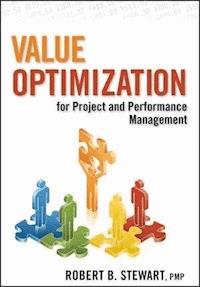
Bo Diddley once said that you can’t judge a book by its cover. He may be right, but I figure people, being creatures of habit, will probably do it anyway. So I thought it might be a good idea to select a graphic for the cover that was somehow representative of its contents. This wasn’t an easy task for a book like this one. The image of the five figures in five different colors represents the five key concepts of this book: performance, cost, time, risk, and value. Guess which one holds the missing piece?
Acknowledgments
There is a long list of people that I would like to thank in helping me write this book. I would like to first thank my grandfather Robert H. Mitchell, who initially piqued my interest in Value Methodology, took me under his wing, and pointed me in the right direction. Through your example you have shown me what can be accomplished through hard work, persistence, self-confidence, and a wee bit of charm.
Without Terry Hays I would not have been able to write this book. He has been a wonderful friend, business partner, and teacher who has not only given me room to grow but has encouraged it through the years.
In what I would consider the ultimate test of friendship, Eric Trimble devoted countless hours of his time in reviewing and editing this work. What drudgery. His attention to detail has greatly contributed to the value of this book. Thank you.
Special thanks to George Hunter for his help and support in developing Value Metrics during the early years. Thanks also to Dr. Jong-Kwon Lim, my South Korean connection and brother-in-arms. Keep up the fantastic work.
Thanks to Dr. Thomas Saaty and his two dynamic sons, John and Dan, for their groundbreaking work in the creation and continued development of the Analytic Hierarchy Process and Decision Lens. Their contributions to the decision sciences and assistance with this book have been invaluable.
Thanks to Ginger Adams, Jill Woller, and Michael Holt for their contributions to this book.
Thanks to everyone at the Lawrence Delos Miles Value Foundation for their inspirational work and dedication to the proliferation of Value Methodology. You are the keepers of the flame.
I am greatly indebted to those that have contributed to my knowledge and appreciation of Value Methodology: Jerry Kaufmann, Ted Fowler, Art Mudge, and Carlos Fallon. Although I never met Carlos, every time I read his words, it feels like I have. You were way ahead of your time.
Thanks to everyone at VMS. It is an honor to work with such a lovable collection of misfits.
Last year I became a father for the first time. My daughter, Daphne, has developed to the point now where she is getting into everything and, as a result, I find myself saying “No.” She just looks at me, smiles blithely, and carries on. It hasn’t begun to sink in yet, but soon it will. When it finally does, I will have succeeded in making the first step toward introducing her to critical thinking at the expense of presenting her with her first roadblock to creativity. Alas, life is all about trade-offs. Thanks to you, Daphne, for teaching me this lesson every day.
Finally, thanks to my father, Ken, and my mother, Terri, for instilling in me the values I hold dear. I wouldn’t have written this were it not for you. And of course, thanks to my wife Vanessa for her love and support. Without love, what’s the point?
CHAPTER 1
Introduction
© Magixl 2009, www.magixl.com
Poor value is a people problem.
—Larry Miles
Lawrence Delos Miles was born in 1904 to Delos Miles, a public school superintendent, and Vinetta Miles, an elementary school teacher in Harvard, Nebraska. Miles was very bright, and he graduated from high school in three years rather than the usual four. He attended Nebraska Wesleyan University in Lincoln, Nebraska, with a degree in education. In 1925, he was a teacher and high school principal in Winnebago, Nebraska. In 1926, he made a career change and moved into banking. Dissatisfied with this, he returned to college to study engineering. In 1931, Miles graduated from the College of Engineering at the University of Nebraska with a degree in electrical engineering.
In 1932, Miles began a long and productive career at General Electric Co. in Schenectady, New York. His first assignment at GE was that of a design engineer in the Vacuum Tube Engineering Department. Over a six-year period in this position, he earned 12 patents for vacuum tubes and related circuitry. During this time, Miles developed awareness for unnecessary costs and began seeing the need for developing better ways of doing things.
This sensitivity to cost earned him a transfer to GE’s purchasing department, and in 1938 he was promoted to the position of purchasing engineer. During this time, Miles worked closely with vendors to reduce costs associated with electronic components, eventually moving on to precision-machined parts. In 1944, Miles was transferred to a subsidiary of GE called Locke Insulator. While at Locke, he began the development of the process that has now evolved into the function-oriented problem solving methodology known today as Value Methodology.
Miles was instrumental in the initial development and spread of Value Methodology. In 1959, he helped create the Society of American Value Engineers and served as its first president between 1960 and 1962. He was the author of the first book on the subject, Techniques of Value Analysis and Engineering, which was published in 1961. He taught seminars and lectured extensively throughout the United States and the rest of the world.
Larry Miles received many accolades and awards during his career, but none were greater than the honor bestowed on him by Japan. In 1984, he was posthumously awarded the Third Order of Merit with Cordon of Sacred Treasure by the emperor of Japan. The Japanese bestowed this honor on Miles due to the major impact that the use of Value Methodology had on making Japan an industrial and economic powerhouse. In addition, he received international recognition from Germany and South Africa for his contributions.
The story of Larry Miles is a fitting introduction to this book. Without him, the writing of this book would not have been possible. 1 Larry Miles also exemplified the role that Value Leadership can play in improving the value of products, services, and facilities. While other leaders in business improvement, like Dr. W. Edwards Deming and Phillip Crosby, have received greater notoriety, the work of Larry Miles has created a quiet legacy that endures today.
Lesen Sie weiter in der vollständigen Ausgabe!
Lesen Sie weiter in der vollständigen Ausgabe!
Lesen Sie weiter in der vollständigen Ausgabe!
Lesen Sie weiter in der vollständigen Ausgabe!
Lesen Sie weiter in der vollständigen Ausgabe!
Lesen Sie weiter in der vollständigen Ausgabe!
Lesen Sie weiter in der vollständigen Ausgabe!
Lesen Sie weiter in der vollständigen Ausgabe!
Lesen Sie weiter in der vollständigen Ausgabe!
Lesen Sie weiter in der vollständigen Ausgabe!
Lesen Sie weiter in der vollständigen Ausgabe!
Lesen Sie weiter in der vollständigen Ausgabe!
Lesen Sie weiter in der vollständigen Ausgabe!
Lesen Sie weiter in der vollständigen Ausgabe!
Lesen Sie weiter in der vollständigen Ausgabe!