


7,49 €
Mehr erfahren.
- Herausgeber: A.J.Kingston
- Kategorie: Geisteswissenschaft
- Sprache: Englisch
🌟
Introducing: Victorian Era 1837-1901: Rise Of The Modern World Book Bundle 🌟
Step back in time and journey through the captivating pages of the Victorian Era, a period that forever shaped the course of history and paved the way for the modern world we know today. Immerse yourself in the most comprehensive exploration of this era with our exclusive four-book bundle, "Victorian Era 1837-1901: Rise Of The Modern World."
📚
The Ultimate Victorian Experience: Embark on an enlightening adventure that spans four meticulously curated volumes, each offering a unique perspective on the intricate tapestry of the Victorian era. From the opulent reign of Queen Victoria to the brink of the 20th century, this bundle unveils the transformative forces that redefined society, culture, technology, and the global landscape.
📖
What You'll Discover:
Book 1 - Victorian Visions: Society And Culture In The Early Reign (1837-1850): 🔮 Explore the dawn of a new era as Queen Victoria ascends the throne 🎨 Immerse yourself in the cultural renaissance that shaped art, literature, and philosophy 🏰 Witness the emergence of a stratified society and the changing roles of women
Book 2 - Whispers Of Change: Industrialization And Reform In Mid-Victorian England (1851-1870): 🏭 Experience the clash of progress and human cost during the industrial revolution 🌍 Dive into the reform movements that reshaped society's foundations 🚂 Uncover the stories of labor movements and technological marvels that defined an era
Book 3 - Shadows Of Empire: Exploring Colonialism And Global Influence In Late Victorian Era (1871-1890): 🌐 Discover the far-reaching consequences of empire, colonialism, and globalization 🌍 Explore the cultural encounters and economic ties that linked nations and continents 🌍 Examine the complex dynamics of power, resistance, and identity on a global scale
Book 4 - Elegance And Entropy: Decadence And Transition In The Fin De Siècle Victorian Era (1891-1901): 🍷 Delve into an era of elegance, decadence, and philosophical introspection 🎭 Uncover the artistic expressions and societal reflections that defined the late 19th century 🕰️ Witness the transition from the Victorian era to the brink of a new century
🎁
What You'll Receive: 📚 Four meticulously researched and beautifully written volumes 📖 A comprehensive exploration of the Victorian era from multiple perspectives 🔍 In-depth insights into societal, cultural, technological, and geopolitical transformations 💡 Illuminating connections between the past and the modern world
👉
Limited-Time Offer: Don't miss the opportunity to own this unparalleled journey through history. Dive into the Victorian Era and understand the roots of the modern world like never before.
📚
Order Now and Save: Secure your copy of "Victorian Era 1837-1901: Rise Of The Modern World Book Bundle" today and enjoy an exclusive discount. Immerse yourself in a world of opulence, innovation, struggle, and triumph, and discover how the echoes of the past continue to shape our present.
🚀
Unlock the Past, Illuminate the Present: Get ready to experience the Victorian Era like never before. Order your bundle now and embark on a journey through time that will reshape your understanding of the world we live in today.
👇 Click the link below to order your "Victorian Era 1837-1901: Rise Of The Modern World Book Bundle" today! 👇
Das E-Book können Sie in Legimi-Apps oder einer beliebigen App lesen, die das folgende Format unterstützen:
Veröffentlichungsjahr: 2023
Ähnliche














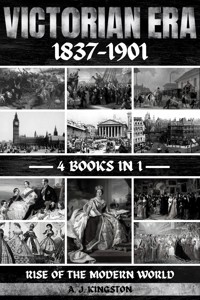
VICTORIAN ERA
1837-1901
RISE OF THE MODERN WORLD
4 BOOKS IN 1
BOOK 1
VICTORIAN VISIONS: SOCIETY AND CULTURE IN THE EARLY REIGN (1837-1850)
BOOK 2
WHISPERS OF CHANGE: INDUSTRIALIZATION AND REFORM IN MID-VICTORIAN ENGLAND (1851-1870)
BOOK 3
SHADOWS OF EMPIRE: EXPLORING COLONIALISM AND GLOBAL INFLUENCE IN LATE VICTORIAN ERA (1871-1890)
BOOK 4
ELEGANCE AND ENTROPY: DECADENCE AND TRANSITION IN THE FIN DE SIÈCLE VICTORIAN ERA (1891-1901)
BY A.J. KINGSTON
Copyright © 2023 by A. J. Kingston
All rights reserved. No part of this book may be reproduced or transmitted in any form or by any means, electronic or mechanical, including photocopying, recording, or by any information storage and retrieval system, without permission in writing from the publisher.
Published by A. J. Kingston
Library of Congress Cataloging-in-Publication Data
ISBN 978-1-83938-425-7
Cover design by Rizzo
Disclaimer
The contents of this book are based on extensive research and the best available historical sources. However, the author and publisher make no claims, promises, or guarantees about the accuracy, completeness, or adequacy of the information contained herein. The information in this book is provided on an "as is" basis, and the author and publisher disclaim any and all liability for any errors, omissions, or inaccuracies in the information or for any actions taken in reliance on such information.
The opinions and views expressed in this book are those of the author and do not necessarily reflect the official policy or position of any organization or individual mentioned in this book. Any reference to specific people, places, or events is intended only to provide historical context and is not intended to defame or malign any group, individual, or entity.
The information in this book is intended for educational and entertainment purposes only. It is not intended to be a substitute for professional advice or judgment. Readers are encouraged to conduct their own research and to seek professional advice where appropriate.
Every effort has been made to obtain necessary permissions and acknowledgments for all images and other copyrighted material used in this book. Any errors or omissions in this regard are unintentional, and the author and publisher will correct them in future editions.
Join Our Productivity Group and Access your Bonus
If you're passionate about history books and want to connect with others who share your love of the subject, joining our Facebook group (search for “History Books by A.J.Kingston”) can be a great way to do so. By joining a group dedicated to history books, you'll have the opportunity to connect with like-minded individuals, share your thoughts and ideas, and even discover new books that you might not have come across otherwise. You can also access your FREE BONUS once you joined our Facebook group called “History Books by A.J.Kingston”.
>> Click Here to Join Our Productivity Group <<
One of the biggest advantages of joining our Facebook group is the sense of community it provides. You'll be able to interact with other history book enthusiasts, ask questions, and share your own knowledge and expertise. This can be especially valuable if you're a student or someone who is just starting to explore the world of history books.
>> Click Here to Follow A.J. Kingston <<
>> Click Here to Download your Free Bonus <<
If you love audiobooks, then joining our YouTube channel that offers free audiobooks on a weekly basis can be a great way to stay entertained and engaged. By subscribing to our channel, you'll have access to a range of audiobooks across different genres, all for free. Not only this is a great opportunity to enjoy some new audiobooks, but it's also a chance to discover new authors and titles that you might not have come across otherwise.
>> Click Here to Join our YouTube Channel <<
Lastly, don’t forget to follow us on Facebook and YouTube by searching for A.J. Kingston.
Table of Contents – Book 1 - Victorian Visions: Society And Culture In The Early Reign (1837-1850)
Introduction
Chapter 1: A New Era Dawns: The Ascension of Queen Victoria
Chapter 2: Industrial Metamorphosis: Technological Advancements and Urban Growth
Chapter 3: Social Stratification and Class Dynamics
Chapter 4: Literary Resonance: Romanticism, Realism, and Victorian Literature
Chapter 5: Changing Roles of Women: Domesticity and Emerging Voices
Chapter 6: Victorian Values and Moral Frameworks
Chapter 7: Exploring Empire: Expansion and Imperialism
Chapter 8: Artistic Expressions: Visual Arts and Architecture of the Early Victorian Era
Chapter 9: Challenges to the Status Quo: Chartism and Social Reform Movements
Chapter 10: The Great Exhibition of 1851: A Reflection of Progress and Innovation
Table of Contents – Book 2 - Whispers Of Change: Industrialization And Reform In Mid-Victorian England (1851-1870)
Chapter 1: The Crystal Palace and Beyond: The Impact of the Great Exhibition
Chapter 2: Steam and Steel: Industrialization and Technological Advancements
Chapter 3: Society in Flux: Urbanization and Its Consequences
Chapter 4: Progress and Discontent: Labor Movements and Working Conditions
Chapter 5: A Changing Canvas: Art and Culture in Mid-Victorian England
Chapter 6: Scientific Pursuits and Intellectual Ferment
Chapter 7: Voices of Reform: Social Change and Philanthropic Endeavors
Chapter 8: Shaping Perspectives: Media, Literature, and Public Opinion
Chapter 9: Political Evolution: The Road to Parliamentary Reforms
Chapter 10: The Transatlantic Thread: Mid-Victorian England and the Global Stage
Table of Contents – Book 3 - Shadows Of Empire: Exploring Colonialism And Global Influence In Late Victorian Era (1871-1890)
Chapter 1: The Scramble for Africa: European Powers and Imperial Ambitions
Chapter 2: Imperial Rivalries and Global Power Dynamics
Chapter 3: The Colonial Experience: Conquests, Administration, and Resistance
Chapter 4: Cultural Encounters: Perspectives on Colonialism and Identity
Chapter 5: Economic Exploitation and Trade Networks
Chapter 6: Victorian Orientalism: Art, Literature, and Representations of the East
Chapter 7: Resistance and Rebellion: Challenges to Imperial Authority
Chapter 8: The Imperial City: London as a Hub of Global Exchange
Chapter 9: Scientific Exploration and Ethnographic Studies
Chapter 10: The End of an Era: Late Victorian Reflections on Empire and Legacy
Table of Contents – Book 4 - Elegance And Entropy: Decadence And Transition In The Fin De Siècle Victorian Era (1891-1901)
Chapter 1: The Closing Curtain: The Spirit of the Fin de Siècle
Chapter 2: Artistic Aesthetics: Symbolism, Aestheticism, and Art Nouveau
Chapter 3: Decaying Morality: Society's Reflections in the Late Victorian Era
Chapter 4: Scientific Advancements and the Quest for Understanding
Chapter 5: Women's Liberation and the Suffrage Movement
Chapter 6: Unveiling the Unconscious: Psychology and the Mind
Chapter 7: Flickers of Modernity: Technological Innovations and Urban Shifts
Chapter 8: The Twilight of Empire: Challenges and Consequences
Chapter 9: From Gaslight to Electric Glow: Changing Urban Landscapes
Chapter 10: The Turn of the Century: Navigating Change and Embracing the Future
Conclusion
About A. J. Kingston
Introduction
Welcome to a captivating journey through time and transformation, an exploration of an era that laid the foundation for the modern world we know today. In the pages of "Victorian Era 1837-1901: Rise of the Modern World," we invite you to embark on an immersive voyage through one of the most influential periods in history.
This meticulously curated book bundle takes you on a voyage across the vast expanse of the Victorian era—a span of time that witnessed the rise of Queen Victoria to the throne of the British Empire, an era that began in 1837 and concluded in 1901. These decades are not merely pages in history but a dynamic tapestry of societal shifts, cultural evolutions, and technological leaps that reverberate in our lives to this day.
Within the four volumes that constitute this bundle, you'll traverse the landscapes of a changing world, witnessing the kaleidoscope of human experience as it unfolds across generations and continents. Each book offers a unique lens through which to view this transformative era, examining the intricacies of society, culture, industry, empire, and the very essence of what it meant to be Victorian.
"Book 1 - Victorian Visions: Society and Culture in the Early Reign (1837-1850)" invites you to step into the dawn of Queen Victoria's reign—a time of innovation, optimism, and the forging of a new identity. Explore the shifting dynamics of society's strata, from the opulent salons of the aristocracy to the bustling streets of the emerging middle class. Delve into the cultural tapestry of the time, where literature, art, and philosophy reflect the aspirations and contradictions of an evolving world.
As you journey onward, "Book 2 - Whispers of Change: Industrialization and Reform in Mid-Victorian England (1851-1870)" presents a landscape marked by the relentless pace of industrialization. Experience the rise of factories, the surge of technological innovation, and the birth of labor movements as they challenge the status quo. Witness the struggles and triumphs of a society grappling with change, the echoes of progress reverberating against the backdrop of reform and social consciousness.
In "Book 3 - Shadows of Empire: Exploring Colonialism and Global Influence in Late Victorian Era (1871-1890)," the narrative shifts to a global stage. The British Empire extends its reach, casting shadows and sparks of influence across continents. Uncover the complexities of colonialism, the intertwining of cultures, and the intricate dance between power and resistance. This volume unveils the dynamics that shaped the trajectory of nations and individuals caught in the web of empire.
Finally, as the 19th century draws to a close, "Book 4 - Elegance and Entropy: Decadence and Transition in the Fin De Siècle Victorian Era (1891-1901)" casts a spell of introspection and anticipation. Enter an era of artistic exploration, societal decadence, and philosophical contemplation. Peer through the lens of fin de siècle, where elegance meets uncertainty, and the boundaries between tradition and innovation blur.
This collection encapsulates the essence of an era that paved the way for the modern world. Through meticulous research, vivid storytelling, and the exploration of diverse perspectives, we invite you to dive into the past and emerge with a deeper understanding of the present. As you journey through these pages, you'll traverse the landscapes of history, culture, society, and technology, witnessing the rise of the modern world through the lens of the Victorian era.
Prepare to be immersed in an extraordinary journey of discovery, as you navigate the intricate tapestry of "Victorian Era 1837-1901: Rise of the Modern World." Your adventure begins now, spanning continents, minds, and time, inviting you to explore the rich heritage that continues to shape the world around us.
BOOK 1
VICTORIAN VISIONS
SOCIETY AND CULTURE IN THE EARLY REIGN (1837-1850)
BY A.J. KINGSTON
Chapter 1: A New Era Dawns: The Ascension of Queen Victoria
In the early 19th century, a young monarch ascended the British throne, setting the stage for one of the most transformative periods in history. Queen Victoria, at the tender age of 18, embarked on a reign that would span over six decades. Her reign, from 1837 to 1901, encapsulated the entire Victorian era, leaving an indelible mark on society, culture, and politics.
Victoria's ascension to power was marked by a mixture of excitement and uncertainty. Born in 1819, she was fifth in line to the throne, but due to a series of unforeseen events, she became Queen at a relatively young age. Her father, the Duke of Kent, was one of the many descendants of George III. However, Victoria's uncle, King William IV, had no legitimate heirs. This unexpected turn of events placed Victoria next in line, thrusting her into a world of responsibility and protocol.
The young monarch's rise was met with a wave of hope and curiosity. She was seen as a breath of fresh air, bringing youthful energy to a monarchy that had been marred by scandal and instability. Victoria's reign heralded a new era, transitioning from the Georgian sensibilities to a more refined Victorian ethos. Her youth and enthusiasm injected new life into the royal court and captivated the imagination of her subjects.
As she took the throne, Victoria's character began to shape her rule. Despite her youth, she possessed a strong sense of duty and a deep attachment to the principles of constitutional monarchy. Her upbringing, guided by her governess and future confidante, Baroness Lehzen, instilled in her a respect for tradition and an awareness of her role as a figurehead for the nation.
Victoria's early years on the throne were marked by a series of pivotal decisions. Her marriage to her cousin, Prince Albert of Saxe-Coburg and Gotha, was a love match that also had far-reaching political implications. Albert's influence on Victoria was profound; he served as her trusted advisor and played an active role in matters of state. Their partnership was not without its challenges, but it laid the foundation for the Victorian ideals of family, morality, and social responsibility.
The young monarch navigated the complexities of a rapidly changing society. The industrial revolution was in full swing, transforming the British landscape and giving rise to a burgeoning urban population. As factories sprung up and cities expanded, Victoria's reign saw the birth of the modern urban experience. This shift presented both opportunities and challenges, and the monarchy faced the task of addressing the needs of an evolving society.
Victoria's reign also coincided with a flowering of artistic and intellectual achievement. The Romantic and Victorian eras overlapped, resulting in a rich tapestry of literature, art, and culture. Writers like Charles Dickens, the Brontë sisters, and Oscar Wilde captured the essence of the times, exploring themes of social inequality, love, and human nature. This literary output became an essential part of the Victorian legacy, reflecting the aspirations and anxieties of the age.
In her early years as queen, Victoria's influence extended beyond the borders of the British Isles. Her marriage into various European royal families connected her to the continent, but also tied her to political alliances and conflicts. These intricate relationships would later play a role in shaping the landscape of Europe during a period of immense change and upheaval.
The young monarch's reign was characterized by her steadfast dedication to her role. Despite the challenges and personal losses she endured, Victoria remained a constant presence, a symbol of stability in a world undergoing rapid transformation. Her reign saw the expansion of the British Empire, the development of parliamentary democracy, and the emergence of a distinctly Victorian identity.
As the years rolled on, the young queen transformed into a matriarch, guiding her family and her nation through the trials and tribulations of the 19th century. Her legacy is a testament to the enduring impact of a young monarch who embraced her responsibilities with determination and grace. The early years of Queen Victoria's rise were only the beginning of a reign that would come to define an entire era.
The influence of royalty on Victorian culture was profound and far-reaching, permeating every facet of society during the 19th century. Queen Victoria, who reigned from 1837 to 1901, and her consort, Prince Albert, played instrumental roles in shaping the values, fashions, and sensibilities of the era. Their presence on the throne set the tone for a new age, leaving an indelible mark on the cultural landscape of Victorian England.
One of the most significant ways in which royal influence was felt was through the promotion of moral and social values. Queen Victoria, often regarded as the "Grandmother of Europe" due to her numerous royal connections, set an example of family life that resonated with the middle class. The royal family, portrayed as the epitome of virtue, stability, and domesticity, became a model for Victorian households. Victoria and Albert's strong marital bond and their devotion to their nine children became aspirational ideals, reinforcing the importance of family values in Victorian society.
Royal patronage also played a pivotal role in shaping artistic and intellectual pursuits. Victoria and Albert were both avid supporters of the arts, and their patronage helped establish the framework for the Victorian art and culture scene. Prince Albert, in particular, was deeply interested in the promotion of education and culture. He championed the Great Exhibition of 1851, a landmark event that showcased industrial and artistic achievements from around the world. This exhibition not only highlighted technological advancements but also underscored the importance of beauty and design in everyday life.
The royal couple's fascination with art and culture extended to the fields of architecture and design. Prince Albert's influence on the Gothic Revival movement, for instance, brought about a resurgence of interest in medieval architecture. The construction of the Royal Albert Hall and the transformation of Osborne House reflected the couple's commitment to blending historical inspiration with modern sensibilities.
Fashion was another domain profoundly impacted by royal influence. Queen Victoria's wedding to Prince Albert in 1840, where she wore a white gown, marked a departure from the traditional red or silver wedding attire. This choice set a trend that still endures today. Additionally, the Queen's mourning attire after the death of Prince Albert led to the popularization of black clothing for mourning purposes.
Royal tours and public appearances were instrumental in fostering a sense of national identity and pride. The royal family's travels across the British Isles allowed citizens from all walks of life to catch glimpses of their sovereigns, creating a sense of connection and loyalty to the monarchy. These tours also showcased local industries, boosting regional economies and encouraging a shared cultural identity.
The Victorian era was marked by a growing interest in charity and philanthropy, often spurred by the royal example. Queen Victoria herself was actively involved in various charitable endeavors, and her influence helped raise awareness and funds for numerous causes. The establishment of institutions like the Victoria and Albert Museum, as well as the support for nursing reforms through Florence Nightingale, showcased the royal family's commitment to societal improvement.
However, royal influence was not without criticism. As the century progressed, the monarchy's portrayal as a symbol of morality and stability faced challenges. The complex realities of society, including the plight of the working class and the limitations of Victorian values, led to a growing disillusionment with the image projected by the royal family.
In summary, the influence of royalty on Victorian culture was a multi-faceted phenomenon. Queen Victoria and Prince Albert's emphasis on family values, arts, education, and social responsibility helped shape the moral and artistic landscape of the era. Their impact extended to architecture, fashion, and even the development of a national identity. While their influence had both positive and critical aspects, there is no denying that the Victorian culture was deeply intertwined with the ideals and activities of the royal family.
The early Victorian era, spanning from 1837 to the mid-19th century, was a transformative period that saw the emergence of a distinct societal and cultural identity. This identity was shaped by a complex interplay of historical, social, economic, and political factors, all of which converged to create the defining characteristics of the era.
At the heart of shaping the early Victorian identity was the young monarch herself, Queen Victoria. Her ascension to the throne at the age of 18 marked the beginning of an era defined by her influence and reign. Victoria's youthful enthusiasm and dedication to her role as a constitutional monarch played a pivotal role in setting the tone for the era. Her values, personality, and public image resonated with the broader public and helped define the moral compass of the time.
Central to the early Victorian identity was the overarching theme of morality and propriety. The Victorian period is often associated with a rigid set of moral standards and an emphasis on respectability. This emphasis was partly a reaction to the perceived excesses and moral laxity of the preceding Georgian era. Queen Victoria herself championed these values, and her own personal commitment to a virtuous and upright life resonated with her subjects. This focus on morality permeated various aspects of society, including literature, art, and even daily conduct.
The industrial revolution, which was well underway during this period, had a profound impact on shaping the early Victorian identity. The rapid urbanization and industrialization brought about significant changes to the social fabric. While it led to increased economic opportunities and technological advancements, it also gave rise to urban poverty, labor exploitation, and social inequalities. These shifts fueled a growing sense of social responsibility and a call for reform.
The emergence of the middle class as a significant social and economic force played a crucial role in shaping the early Victorian identity. The rise of this new class, composed of professionals, merchants, and skilled workers, brought about changing attitudes towards education, social mobility, and cultural aspirations. The middle class valued self-improvement, hard work, and respectability, and their values became closely aligned with the broader societal ethos.
Religion also played a pivotal role in shaping the early Victorian identity. The era was marked by a significant religious revival, with a resurgence of Evangelicalism and a renewed focus on faith and morality. The Victorian belief in progress, social reform, and charity was often grounded in religious principles. Religious institutions played a key role in providing social services and facilitating charitable activities, contributing to the broader sense of community and responsibility.
Gender roles and expectations were another defining aspect of the early Victorian identity. The era upheld a strict division of gender roles, with women largely confined to the domestic sphere and expected to embody virtues such as piety, modesty, and maternal love. These expectations were both reinforced and challenged by the literature and cultural productions of the time, as well as by the early stirrings of the women's rights movement.
In summary, the shaping of the early Victorian identity was a complex process influenced by a multitude of factors. Queen Victoria's personal values and character, the societal response to industrialization, the rise of the middle class, religious revival, and evolving gender roles all contributed to the distinct moral, social, and cultural framework of the era. This early Victorian identity set the stage for the subsequent decades of the Victorian period and left an enduring legacy that continues to influence perceptions of the era today.
Chapter 2: Industrial Metamorphosis: Technological Advancements and Urban Growth
The convergence of steam power and the Industrial Revolution marked a transformative period in human history that reshaped economies, societies, and daily life. The utilization of steam power was a pivotal catalyst for the rapid industrialization that characterized the 18th and 19th centuries, driving unprecedented technological advancements and changing the course of human progress.
Steam power, harnessed through the steam engine, revolutionized production processes and transportation systems. The steam engine, perfected by inventors like James Watt, enabled factories to mechanize previously manual tasks, leading to higher productivity, increased efficiency, and the mass production of goods. This transition from traditional craftsmanship to mechanized production laid the foundation for the Industrial Revolution.
The textile industry witnessed a profound transformation due to steam-powered machinery. The mechanization of spinning and weaving processes significantly boosted textile production, making textiles more affordable and accessible to a broader population. Factories equipped with steam-driven looms and spinning machines outpaced cottage industries, contributing to the rise of urban centers as hubs of manufacturing.
Steam power also played a pivotal role in transportation, reshaping the movement of goods and people. The development of steam-powered locomotives revolutionized land transportation. The construction of railroads, powered by steam engines, facilitated the efficient movement of raw materials, finished products, and passengers across vast distances. Railroads connected previously isolated regions, spurred urbanization, and contributed to economic growth.
In addition to land transportation, steam power transformed maritime travel and trade. The introduction of steamships replaced traditional sailing vessels, enabling faster and more reliable sea voyages. Steam-powered ships could navigate against currents and winds, reducing travel times and enhancing global connectivity. This advancement was particularly significant for international trade, as it facilitated the movement of goods between continents with greater speed and regularity.
The widespread adoption of steam power had profound social and economic implications. Urbanization surged as people flocked to factory towns and industrial centers in search of employment opportunities. The migration from rural areas to cities reshaped demographics and altered traditional family structures. The factory system required a disciplined workforce, leading to the establishment of working hours, routines, and labor regulations.
While steam power and industrialization brought forth significant progress, they also introduced challenges and societal upheaval. The shift to factory work often led to harsh working conditions, long hours, and inadequate wages for laborers, giving rise to labor movements and calls for reform. The industrial landscape also impacted the environment, as increased production led to pollution and resource depletion.
Steam power's impact extended beyond economic and societal realms. It transformed the way people perceived time, as regular train schedules and factory shifts demanded greater punctuality. Additionally, the Industrial Revolution sparked intellectual and artistic responses. Writers like Charles Dickens captured the human experiences of the era, portraying the contrasts between newfound wealth and persistent social disparities.
In summary, the intertwining of steam power and the Industrial Revolution forged a remarkable period of progress and change. Steam power's application in factories, transportation, and maritime endeavors propelled unprecedented technological innovation and economic growth. However, its impacts were multi-faceted, affecting society, labor, and the environment. The era marked a pivotal transition from agrarian economies to industrialized societies, leaving an indelible legacy that shaped the modern world.
Urbanization, the rapid growth and concentration of population in urban areas, was a central feature of the 19th century and a hallmark of the Industrial Revolution. The shift from agrarian societies to urbanized ones brought about profound changes in the landscape, culture, and social dynamics of cities, reshaping the very fabric of daily life and society.
As industries boomed and factory jobs became more prevalent, rural populations flocked to urban centers in search of employment and better opportunities. The transformation was particularly pronounced in regions that underwent industrialization, such as Western Europe and parts of North America. This mass migration from rural to urban areas led to the exponential growth of cities and the creation of new urban landscapes.
One of the most visible effects of urbanization was the physical transformation of cityscapes. New factories, mills, and warehouses sprang up, often situated near transportation hubs like railways and ports. Skyscrapers and towering factory chimneys began to dominate the skyline, symbolizing the might of industrial progress. Traditional architectural styles gave way to functional designs suited to the demands of urbanization, and the density of buildings increased as available land became scarce.
City infrastructure had to evolve to accommodate the influx of people. Roads were paved, street lighting became more common, and public transportation systems like horse-drawn trams and later, electric streetcars, were introduced to move large numbers of people efficiently. The layout of cities began to change, with central business districts emerging alongside residential neighborhoods. The distinction between urban and rural areas became more pronounced, giving rise to the concept of the "urban-rural divide."
The rapid population growth and density of urban areas led to challenges in housing and sanitation. As cities swelled, inadequate housing led to overcrowding, with families often crammed into small and unsanitary living spaces. Tenements, multi-story apartment buildings, emerged as a response to the housing crisis. These often lacked proper ventilation, natural light, and sanitation facilities, giving rise to slums in many urban areas.
The changing cityscape also influenced social interactions and community dynamics. Urbanization led to greater anonymity and diversity, as people from different backgrounds and regions converged in cities. This diversity brought about cultural exchange and new forms of entertainment, such as theaters, music halls, and museums, which catered to the varied tastes of the urban population. Additionally, the expansion of public spaces like parks and squares provided areas for leisure and socializing.
Urbanization had profound implications for the role of women in society. As more men left rural areas to seek work in cities, women often remained behind to manage farms and households. However, the growing urban job market offered new opportunities for women to enter the workforce, particularly in areas like textiles and domestic service. This shift began to challenge traditional gender roles and paved the way for evolving notions of women's roles in the public sphere.
The challenges brought about by urbanization also gave rise to social reform movements. Activists and philanthropists became increasingly concerned about the living conditions of the urban poor. Organizations like the Settlement House movement sought to improve living conditions, provide education, and offer support to disadvantaged urban residents.
In summary, urbanization during the 19th century led to a profound reshaping of cityscapes and social structures. The influx of people into urban areas transformed the physical landscape through the construction of new buildings and infrastructure. The resulting challenges in housing, sanitation, and social dynamics prompted responses ranging from architectural innovation to social reform movements. The era marked the beginning of the modern urban experience, setting the stage for the continued growth and development of cities in the centuries to come.
The profound impact of the Industrial Revolution extended beyond economic growth and urbanization; it also had significant implications for labor and working conditions. As factories sprang up and mechanization advanced, the nature of work underwent a transformation that shaped the lives of countless individuals, leading to both positive advancements and serious challenges.
The introduction of machinery and factory systems led to a shift from traditional artisanal work to factory-based production. While this allowed for increased production and efficiency, it also changed the nature of labor. Workers were now expected to adhere to strict schedules, performing repetitive tasks in often crowded and noisy environments. The division of labor became more pronounced, as each worker focused on a specific task in the production process.
The increased demand for factory labor resulted in a significant migration of rural populations to urban areas, seeking employment opportunities. This led to the growth of working-class neighborhoods around factories and mills. However, the influx of workers often outpaced the creation of adequate housing and infrastructure, leading to overcrowding and substandard living conditions in areas often referred to as "slums."
Working conditions in factories were often harsh and unforgiving. Long hours, typically 12 to 16 hours per day, were the norm. Workers, including women and children, endured strenuous physical labor in dangerous environments, often with minimal breaks. Safety regulations were virtually nonexistent, and accidents were common due to the lack of protective measures and proper training.
Child labor was particularly prevalent during this period. Children as young as five or six were employed in factories, mines, and mills, performing tasks that were often hazardous to their health and well-being. While child labor provided additional income for families, it came at the cost of their education, health, and childhood experiences.
The dire working conditions and exploitation faced by laborers led to the emergence of labor movements and trade unions. Workers began to organize to demand better wages, reasonable working hours, and improved safety standards. Strikes and protests became more frequent as workers sought to advocate for their rights and push for reforms. The Combination Acts of the early 19th century had restricted workers' ability to organize, but as public sentiment shifted, these laws were gradually repealed.
In response to the growing pressure from labor movements and the public, legislative efforts were made to improve working conditions. The Factory Act of 1833, for example, limited working hours for children and established basic health and safety requirements in textile mills. Subsequent acts expanded protections for workers, gradually improving conditions and safety standards.
Despite the challenges, the Industrial Revolution also brought about positive changes. The growth of factories provided job opportunities for many who previously relied on agriculture. The rise of factories and urbanization gave rise to a new sense of community and solidarity among workers, fostering a sense of shared identity and purpose.
In summary, the impact of the Industrial Revolution on labor and working conditions was a complex and multifaceted phenomenon. While it led to economic growth and technological advancements, it also brought about exploitative working conditions, child labor, and dangerous environments. The struggles of workers and the emergence of labor movements laid the groundwork for improvements in labor rights and workplace conditions in the years to come. The era marked a pivotal turning point in labor history, highlighting the challenges of industrialization and the need for social and legislative reform.
Chapter 3: Social Stratification and Class Dynamics
The 19th century saw significant changes in the role, status, and influence of the aristocracy and upper class, often referred to as the "upper crust." As industrialization, urbanization, and social reforms reshaped societies, the traditional privileges and power held by the aristocracy underwent a transformation, leading to a complex interplay of continuity and change.
Historically, the aristocracy held immense social, political, and economic power in many societies. They were often the landowners, holding vast estates and enjoying privileges that came from their hereditary status. However, the Industrial Revolution brought about shifts in economic power, as industrialists and entrepreneurs amassed significant wealth through new industries. This economic transformation led to a redistribution of influence, and the aristocracy's monopoly on power began to erode.
One of the most notable changes in the role of the aristocracy was the emergence of the "gentlemanly capitalism." Many aristocrats adapted to the changing economic landscape by investing in and participating in industrial ventures. Some nobles became shareholders in factories, mines, and railways, diversifying their income sources beyond traditional land ownership. This shift signaled a blending of the old aristocratic order with the new economic realities of the industrial age.
Social changes also impacted the aristocracy's influence. The rise of a middle class, fueled by industrialization, challenged traditional hierarchies. The middle class valued education, social mobility, and self-made success, often placing less emphasis on hereditary privilege. As a result, the aristocracy found itself sharing the stage with an increasingly powerful middle class that was gaining political and economic prominence.
Urbanization and the expansion of the industrial economy played a role in reshaping the aristocracy's social standing. The growth of cities led to the creation of new wealthy elites who were not part of the traditional aristocracy. These nouveaux riches, often referred to as the "new money" class, acquired wealth through commerce and industry, further diversifying the social landscape.
The aristocracy's response to these changes was varied. Some embraced the shifts and actively participated in modernization efforts, adopting aspects of the industrial age and incorporating new ideas into their lifestyles. Others clung to traditional values and practices, resisting the changing societal norms and attempting to preserve their old ways of life.
While the aristocracy's political power diminished, they retained a significant influence over cultural and social domains. Many continued to be patrons of the arts, supporting artists, writers, and musicians. The aristocratic elite played a role in shaping cultural tastes and trends, helping define the cultural identity of the era.
The 19th century also saw increased scrutiny and criticism of the aristocracy. The changing societal landscape led to calls for greater social equality, political reform, and accountability. Writers like Charles Dickens, in his novels, highlighted the disparities between the upper class and the working poor, shedding light on social injustices and contributing to public awareness of the plight of the lower classes.
In summary, the 19th century marked a period of significant change for the aristocracy and upper class. The Industrial Revolution, urbanization, and the rise of the middle class led to shifts in economic power, social dynamics, and cultural influence. While the aristocracy's traditional hold on political power waned, their role in cultural patronage and societal norms persisted. The era was characterized by a complex interplay between continuity and adaptation as the aristocracy navigated the challenges and opportunities brought about by a rapidly changing world.
The 19th century witnessed the rise of the middle class as a powerful social and economic force, bringing with it distinct aspirations and values that shaped the fabric of society. As industrialization and urbanization transformed economies and societies, the middle class emerged as a dynamic group with its own set of ideals and ambitions.
One of the core aspirations of the middle class was social mobility and upward mobility. Unlike the aristocracy, which was largely defined by hereditary privilege, the middle class believed in the potential for self-improvement and success through hard work, education, and determination. This aspiration drove individuals to pursue education and acquire skills that would enable them to secure better employment opportunities and higher social status.
Education played a central role in middle-class values. The middle class placed a high premium on knowledge and learning, recognizing education as a means to both personal growth and social advancement. The establishment of schools, academies, and educational institutions catered to the demands of the middle class for quality education. The rise of literacy rates within the middle class not only expanded access to knowledge but also fostered a culture of intellectual curiosity and critical thinking.
The middle class also emphasized respectability and morality. As the societal strata shifted and the middle class expanded, there was a desire to distinguish themselves from the working class and align with the values traditionally associated with the upper class. This included an emphasis on decorum, etiquette, and proper behavior. Respectability was seen as a key factor in social acceptance and upward mobility.
Work ethic and self-discipline were fundamental values embraced by the middle class. The belief in the virtue of hard work and diligence was not only driven by economic factors but also by the desire to prove one's worthiness for success. The middle class believed that their achievements were earned through their own efforts, contrasting with the hereditary privileges of the aristocracy.
Home and family life held great significance for the middle class. The middle-class household became a symbol of respectability and order. Homes were considered private sanctuaries, and the nuclear family structure became central to middle-class identity. The domestic sphere, often led by the female head of the household, played a crucial role in maintaining the values of morality, education, and social refinement.
The rise of the middle class also had political implications. With increasing economic power and education, the middle class sought political representation and a say in governance. Movements for political reform and expanded voting rights gained traction among the middle class, reflecting their desire to have a voice in shaping the policies that affected their lives.
The middle class contributed significantly to the cultural and artistic landscape of the 19th century. As patrons of the arts, they supported and shaped cultural trends, fostering the development of literature, music, and visual arts. The Victorian era saw a flourishing of literature that explored the experiences and values of the middle class, capturing their concerns, aspirations, and dilemmas.
In summary, the rise of the middle class during the 19th century brought about a distinctive set of aspirations and values that left an indelible mark on society. Aspirations for social mobility, emphasis on education, respectability, hard work, family values, and political engagement defined the ethos of the middle class. Their impact reached far beyond economic prosperity, shaping cultural, educational, and political landscapes and helping to define the values of an era marked by rapid transformation and change.
The working class struggle during the 19th century was a response to the profound changes brought about by industrialization, urbanization, and the transformation of economies and societies. As factories expanded and labor conditions deteriorated, the working class faced challenges that led to collective action, labor movements, and calls for social reform.
One of the primary struggles faced by the working class was harsh working conditions. Factory work often entailed long hours, grueling physical labor, and dangerous environments. Workers were subjected to monotonous and repetitive tasks, leading to physical and mental exhaustion. The absence of safety regulations and protective measures resulted in frequent accidents and injuries.
Low wages and inadequate pay were also significant issues. Despite their integral role in driving industrial production, many workers received meager wages that barely covered basic necessities. Families often relied on the income of multiple family members, including children, to make ends meet. This economic precarity contributed to cycles of poverty and limited opportunities for social mobility.
Child labor was a particularly distressing aspect of the working class struggle. Young children were often employed in factories, mines, and mills, performing tasks that were not only physically demanding but also detrimental to their health and development. The exploitation of child labor drew attention to the urgent need for labor reforms and the protection of vulnerable members of society.
The working class struggle also included a lack of legal rights and representation. Early labor unions and workers' associations were met with resistance from factory owners and government authorities. In many regions, workers were denied the right to organize, strike, or advocate for their rights. This often resulted in clashes between workers and authorities as the working class sought to assert their collective power.
Collective action and labor movements were central to addressing these challenges. Workers began to organize and form labor unions to advocate for better wages, improved working conditions, and the protection of workers' rights. Strikes, protests, and demonstrations became common ways for the working class to voice their grievances and demand change. These movements marked a shift from individual struggles to collective efforts to improve working conditions and ensure fair treatment.
The Chartist movement in Britain and the formation of labor unions across various countries were notable instances of the working class struggle. The Chartist movement sought political reform, including expanded voting rights and parliamentary representation, with the aim of giving the working class a greater say in governance. Labor unions, on the other hand, focused on negotiating with employers for better wages and working conditions.
The working class struggle had a profound impact on shaping labor laws and regulations. Over time, governments began to respond to the demands of workers, enacting labor laws that addressed issues such as working hours, child labor, and workplace safety. The Factory Acts in Britain, for example, established minimum age requirements for factory work and limited the working hours of women and children.
In summary, the working class struggle during the 19th century was a response to the challenges posed by industrialization and rapid societal changes. Harsh working conditions, low wages, child labor, and lack of legal rights prompted workers to organize, form unions, and advocate for labor reforms. Their collective efforts contributed to changes in labor laws, improved working conditions, and increased awareness of workers' rights, marking a pivotal chapter in the history of labor movements and social progress.
Chapter 4: Literary Resonance: Romanticism, Realism, and Victorian Literature
Romantic idealism was a profound cultural and literary movement that emerged during the 19th century in response to the changes brought about by industrialization, urbanization, and scientific advancements. It was characterized by a celebration of emotion, imagination, nature, and the individual, and it found its expression in various forms of literature that sought to evoke intense emotional experiences and capture the essence of the human spirit.
At its core, romantic idealism emphasized the power of emotions and imagination as a counterbalance to the rationalism and materialism of the industrial age. The movement celebrated individualism, valuing the unique experiences, emotions, and perspectives of each person. This emphasis on the individual's inner world and subjective experiences marked a departure from the Enlightenment's focus on reason and empiricism.
Nature played a central role in the romantic idealist worldview. Romantics saw nature as a source of inspiration, solace, and transcendence. Nature was often depicted as a mirror of human emotions and a reflection of the sublime—awe-inspiring and beyond human comprehension. This reverence for nature led to the portrayal of landscapes, the countryside, and natural settings in literature as places of spiritual and emotional renewal.
Romantic idealism found its expression in various forms of literature, ranging from poetry to novels to essays. Romantic poets such as William Wordsworth, Samuel Taylor Coleridge, Lord Byron, Percy Bysshe Shelley, and John Keats wrote poems that explored the beauty of nature, the complexities of human emotion, and the spiritual dimensions of existence. Their works often evoked a sense of wonder, mystery, and emotional intensity.
The novel also played a significant role in expressing romantic ideals. Novels like Mary Shelley's "Frankenstein" examined the moral and ethical consequences of scientific progress, while Charlotte Brontë's "Jane Eyre" and Emily Brontë's "Wuthering Heights" delved into the depths of human emotion and psychology. These novels explored themes of love, passion, longing, and the complexities of human relationships.
Gothic literature, a subgenre of romanticism, often blended elements of horror, mystery, and the supernatural with the romantic emphasis on emotion and imagination. Writers like Edgar Allan Poe created stories that captured the eerie and unsettling aspects of human experience, while still tapping into the broader themes of romanticism.
Romanticism also influenced the essay form, with writers like Ralph Waldo Emerson and Henry David Thoreau exploring transcendentalist ideas that emphasized the connection between humans, nature, and the divine. These essays celebrated individual intuition, spiritual insight, and the search for a deeper understanding of the self and the world.
In summary, romantic idealism was a cultural and literary movement that emerged in response to the changing societal landscape of the 19th century. It celebrated emotions, imagination, nature, and individualism as a reaction to the industrial age's emphasis on reason and materialism. The movement found its expression in various forms of literature, including poetry, novels, and essays, and its legacy continues to influence artistic expression and the exploration of human experiences to this day.
Realism had a profound influence on Victorian writing, shaping the literary landscape and providing a counterpoint to the romantic ideals that had dominated earlier periods. The Victorian era, spanning much of the 19th century, saw a shift towards a more nuanced and detailed depiction of everyday life, society, and human experiences. Realism emerged as a literary movement that aimed to portray reality as faithfully and accurately as possible, often focusing on the mundane aspects of life, social issues, and the complexities of human psychology.
Here are some ways in which realism influenced Victorian writing:
Accurate Depiction of Society: Realism sought to provide a truthful representation of society, capturing its diverse social strata, class differences, and the realities of daily life. Writers like Charles Dickens and Elizabeth Gaskell depicted the struggles of the working class, the challenges of industrialization, and the stark contrasts between different segments of society.
Character Depth and Psychological Realism: Realist authors delved into the psychological complexities of their characters, presenting them as multidimensional individuals with their own motivations, flaws, and conflicts. This shift from one-dimensional characters to more realistic portrayals paved the way for in-depth character studies. Works like George Eliot's "Middlemarch" and Thomas Hardy's novels explored the inner lives and moral dilemmas of their characters.
Observational Detail: Realism emphasized the use of meticulous observational detail in describing settings, scenes, and characters. Writers aimed to create an immersive experience for readers, allowing them to vividly visualize the environments and situations described in the narrative. This attention to detail added depth and authenticity to the stories.
Focus on Everyday Life: Realism often portrayed the mundane aspects of daily life, presenting both the ordinary and extraordinary moments that make up human existence. While earlier literature might have focused on grand romantic gestures or dramatic events, realism celebrated the significance of the ordinary and the everyday.
Social Critique and Reform: Realist writers used their works as a platform to critique societal issues, including social injustices, economic disparities, and political corruption. Novels like Dickens's "Hard Times" and Gaskell's "North and South" highlighted the negative consequences of industrialization and advocated for social reform.
Narrative Technique and Style: Realism brought a shift in narrative technique and style. Authors began to experiment with new narrative structures that mirrored the complexity of human experiences. Multiple perspectives, stream of consciousness, and nonlinear timelines were used to create a more authentic representation of thought processes and emotions.
Dialect and Dialogue: Realist authors paid close attention to dialect and dialogue, using authentic language patterns and speech to accurately represent the various social classes and regions depicted in their works. This added depth to the characters and contributed to a more immersive reading experience.
Critique of Romanticism: Realism emerged as a reaction to the lofty ideals of romanticism. Realist writers aimed to dispel the romanticized notions of life and instead provide a more grounded and truthful representation of the world. This critique led to a more balanced and nuanced portrayal of human experiences.
In summary, realism significantly influenced Victorian writing by shifting the focus from idealized and romanticized portrayals to a more accurate representation of reality. Through detailed observations, nuanced characterizations, social critique, and a commitment to authenticity, realist authors reshaped the literary landscape of the era, contributing to a more diverse and rich body of literature that continues to be appreciated and studied today.
Literature has long been regarded as a mirror that reflects the complexities, values, beliefs, and challenges of society. Throughout history, literary works have offered insights into the cultural, social, political, and psychological dimensions of the human experience. From the ancient epics to modern novels, literature serves as a powerful lens through which we can understand and interpret the world around us.
Cultural and Historical Context: Literature often provides a snapshot of a specific time and place, offering readers a glimpse into the cultural norms, customs, and historical events that shaped a particular society. For example, Shakespeare's plays provide a window into the Elizabethan era, revealing social hierarchies, political intrigue, and the language of the time.
Social Issues and Conflicts: Literature frequently tackles social issues and conflicts that are prevalent in society. Authors use their works to address topics such as racism, gender inequality, class divisions, and human rights. Harper Lee's "To Kill a Mockingbird," for instance, explores racial prejudice in the American South during the 1930s, shedding light on the injustices of the time.
Critique and Commentary: Literature serves as a platform for authors to critique and comment on societal norms and practices. Satires and allegories are common literary forms used to challenge the status quo. George Orwell's "Animal Farm" is a political allegory that critiques the abuses of power and totalitarian regimes.
Representation of Marginalized Voices: Literature has the power to amplify the voices of marginalized groups whose perspectives might be overlooked in mainstream discourse. Authors from diverse backgrounds often use their works to shed light on the experiences of minority communities, fostering empathy and understanding. Toni Morrison's novels, such as "Beloved," explore the African American experience and the legacy of slavery.
Evolution of Language and Thought: Literature reflects the evolution of language and thought throughout history. The shifts in vocabulary, syntax, and linguistic structures within literary works provide insights into linguistic changes and cultural shifts over time.
Moral and Ethical Considerations: Many works of literature grapple with moral and ethical dilemmas faced by characters and societies. These narratives prompt readers to contemplate complex ethical questions and consider their own values. Fyodor Dostoevsky's "Crime and Punishment" examines the psychological and moral consequences of a murder.
Archetypes and Universality: Literature often explores universal themes and archetypal characters that resonate across cultures and time periods. These themes, such as love, friendship, betrayal, and the quest for identity, speak to shared human experiences and emotions.
Impact on Social Change: Literature can inspire social change by shedding light on injustices, promoting empathy, and encouraging critical thinking. The works of authors like Charles Dickens and Upton Sinclair have played a role in advocating for labor rights and social reform.
In essence, literature provides a dynamic reflection of society that transcends its time of creation. It captures the intricacies of human existence, offering readers a deeper understanding of the world they inhabit. As a mirror and a prism, literature both reflects society's realities and refracts them through the lens of creativity, imagination, and human emotion.
Chapter 5: Changing Roles of Women: Domesticity and Emerging Voices
The Cult of True Womanhood, also known as the Cult of Domesticity, was a prevailing ideology during the 19th century that prescribed a set of virtues and behaviors expected of women in Western societies. Emerging in the United States and Europe, this cultural ideal emphasized four key qualities: piety, purity, submissiveness, and domesticity. The Cult of True Womanhood played a significant role in shaping gender roles, societal expectations, and the lives of women during this era.
At the heart of the Cult of True Womanhood was the notion of piety, which emphasized a woman's religious devotion and moral virtue. Women were expected to exhibit deep religious faith and moral rectitude, positioning them as moral compasses for their families and communities. This piety was closely intertwined with the idea that women possessed a unique moral influence that could shape the character of their children and husbands.
Purity was another cornerstone of the cult, emphasizing the importance of women's sexual innocence and modesty. This concept was rooted in the belief that a woman's worth was tied to her virtue and chastity. Women were expected to maintain their purity until marriage, and any deviation from this norm was often met with social ostracism and shame. This emphasis on purity reinforced the idea that a woman's value was determined by her sexual innocence and adherence to societal norms.
Submissiveness was a key trait prescribed by the Cult of True Womanhood, advocating for women to be obedient and subservient to the authority of their husbands and male relatives. This idealized portrayal of women as meek and submissive perpetuated traditional gender hierarchies and reinforced the power dynamics within households. Submissiveness was presented as a virtue that promoted harmony and stability within the family unit.
Domesticity was perhaps the most defining aspect of the cult. Women were expected to be dedicated homemakers, focusing their efforts on creating a comfortable and nurturing environment for their families. The domestic sphere was portrayed as a woman's rightful domain, where she could exercise her nurturing and managerial skills. This ideology both limited and elevated women, confining them to the home while simultaneously elevating their role as the heart of the family.
The Cult of True Womanhood was reinforced through various mediums, including literature, religious teachings, and educational institutions. Women's magazines, for instance, offered advice on homemaking, child-rearing, and maintaining the virtues of piety and purity. Religious sermons often upheld these ideals, portraying women as virtuous mothers and wives. Educational institutions emphasized subjects that were considered relevant to a woman's role as a homemaker, such as sewing, cooking, and etiquette.
While the Cult of True Womanhood provided a sense of identity and purpose for some women, it also imposed rigid constraints and limitations. The strict adherence to these virtues could lead to a suppression of individuality and ambitions beyond the domestic sphere. Women who sought to pursue careers, education, or roles outside of traditional gender norms often faced societal backlash and resistance.
The cult's influence extended beyond individual lives to impact broader social and political discussions. It contributed to the suffrage movement as women began to question their restricted roles and demand political rights. The limitations imposed by the cult also led to the emergence of feminist voices that challenged the restrictive ideology and advocated for greater gender equality.
In summary, the Cult of True Womanhood was a powerful cultural and societal force that shaped the lives of women during the 19th century. It prescribed ideals of piety, purity, submissiveness, and domesticity as defining qualities of womanhood. While providing a sense of identity and purpose, this ideology also limited women's opportunities and autonomy. The cult's influence extended into various aspects of society, including education, religion, and literature, and its legacy has spurred ongoing discussions about gender roles, identity, and equality.
Education has played a pivotal role in advancing women's social progress throughout history. From the 19th century to the present day, access to education has been a catalyst for change, breaking down barriers, challenging gender norms, and empowering women to contribute meaningfully to society. The impact of education on women's social progress is multi-faceted, encompassing economic, political, and cultural dimensions.
In many societies, access to education was historically limited for women. The prevailing belief was that women's primary role was within the domestic sphere, and their educational opportunities were often constrained by this narrow view of their capabilities. However, the 19th century witnessed the beginnings of a transformative shift as women began to demand educational opportunities equal to those of men.
Education provided women with a platform to challenge gender stereotypes and societal expectations. As women gained access to formal education, they were exposed to new ideas, knowledge, and perspectives that expanded their horizons beyond traditional roles. The ability to read, write, and engage in intellectual pursuits empowered women to question the status quo and advocate for their rights.
One of the key areas where education contributed to women's social progress was in economic empowerment. Access to education equipped women with skills and knowledge that allowed them to enter the workforce in new capacities. As women gained education and training, they were able to pursue careers in fields traditionally dominated by men, breaking the glass ceiling and shattering gender-based occupational barriers.
Education also had a transformative impact on women's political participation. As women became more educated, they became more aware of their rights and their potential to influence societal change. The suffrage movement, which sought to secure women's right to vote, was significantly driven by educated women who understood the importance of political representation. Education provided them with the tools to effectively communicate their ideas, mobilize support, and advocate for policy changes.




