


23,99 €
Mehr erfahren.
- Herausgeber: Hatje Cantz Verlag
- Kategorie: Geisteswissenschaft
- Serie: Hatje Cantz Text
- Sprache: Englisch
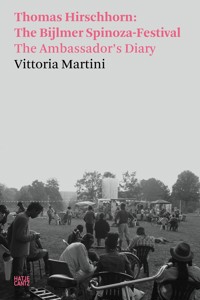
The Bijlmer Spinoza-Festival is an artwork, a sculpture, created by Swiss artist Thomas Hirschhorn in a peripheral borough of Amsterdam's south-east known as the Bijlmer in 2009. This book recounts the event through the eyes of its "Ambassador", art historian Vittoria Martini, who was invited by the artist to be an eyewitness to the existence of this "precarious" work. A term Hirschhorn sees as positive and creative: a means of asserting the importance of the moment and of the place, of asserting the Here and Now to touch eternity and universality. Appreciating the art historian's presence as a central element of his sculpture, Hirschhorn consciously challenged the certainties of the profession by empowering and activating the role, thus leading Martini to find a new working methodology that she calls "precarious art history". Accompanying the readers through her experience of the physical existence of The Bijlmer Spinoza-Festival, Martini's commentary leads to the profound understanding of how a work that no longer exists physically, can live on in the mind—elsewhere, at some other time—because in the meantime it has become universal. Paris-based artist THOMAS HIRSCHHORN (*1957, Bern) is best known for his sculptures in public space—monuments, kiosks, and altars. Questioning the autonomy, the authorship, and resistance of a work of art, he asserts the power of art to touch and transform the other. He represented Switzerland at the 54th Venice Biennale in 2011 and received numerous awards, including the Prix Marcel Duchamp and the Joseph Beuys Stiftung Prize. VITTORIA MARTINI (*1975, Kinshasa) is an independent art historian living in Italy. She has a doctorate from Università Ca' Foscari/Università Iuav di Venezia. Since 2013 she teaches History of exhibitions and curatorial practices and holds the Art Writing workshop at CAMPO – Program of curatorial studies and practices established by the Fondazione Sandretto Re Rebaudengo (Turin, Italy). Her research focuses mainly on the institutional structures that produce exhibitions.
Das E-Book können Sie in Legimi-Apps oder einer beliebigen App lesen, die das folgende Format unterstützen:
Seitenzahl: 267
Veröffentlichungsjahr: 2023
Ähnliche




















The Bijlmer Spinoza-Festival
Thomas Hirschhorn: The Bijlmer Spinoza-Festival
The Ambassador’s Diary
Vittoria Martini
Colophon
Author
Vittoria Martini
Project management
Fabian Reichel
Copyediting
Aaron Bogart
Translation
Elisabetta Zoni
Graphic design
Neil Holt
Typeface
Arnhem
Production
Vinzenz Geppert and Thomas Lemaître
Reproductions
DruckConcept, Berlin
© 2023 Hatje Cantz, Berlin,
and authors
© 2023 for the reproduced images: VG Bild-Kunst, Bonn, Thomas Hirschhorn and Vittoria Martini
Published by
Hatje Cantz Verlag GmbH
Mommsenstraße 27
10629 Berlin
www.hatjecantz.com
A Ganske Publishing Group Company
isbn 978-3-7757-5262-6
isbn 978-3-7757-5264-0 (e-PUB)
isbn 978-3-7757-5263-3 (e-PDF)
Thanks to the support of the Fondation Jan Michalski
I will never be grateful enough to Thomas Hirschhorn, who by believing in me forever changed the attitude and positioning toward my profession and my life.
Much gratitude and a lot of love to Michele Bertolino and Bernardo Follini for convincing me that it was worth getting back to working on my diary.
To my sœur de cœur Giorgina Bertolino, who was my first and most precious reader and to Irene Calderoni for her unconditional and constant friendship.
Without the perseverance of Tommaso and all our mots bleus, this book would not exist.
Note to the Reader
Introduction
Thomas Hirschhorn, The Bijlmer Spinoza-Festival, 2009
Thomas Hirschhorn, Presence and Production, 2009
Thomas Hirschhorn, Assignment, 2009
May 2 — May 17
Marcus Steinweg, Spinoza Theater, 2009
May 19 — May 20
What Does It Mean to Be the Ambassador, March 19, 2009
May 24
Letter to Lisa Lee, First Exchange on The Bijlmer Spinoza-Festival, May 26, 2009
May 26
Letter from Lisa Lee, May 26, 2009
May 27
To Be an Art Historian at The Bijlmer Spinoza-Festival, May 29, 2009
May 30 — June 9
Letter to Mignon Nixon, About Sculpture, June 6, 2009
June 16
Letter to Claire Bishop, About the Ambassador, June 17, 2009
Thomas Hirschhorn, Toward “Precarious Theater”, June 18, 2009
Letter from Mignon Nixon, June 19, 2009
Letter from Claire Bishop, June 19, 2009
Letter to Claire Bishop, Thanks for Your Thoughts, June 21, 2009
June 22 — June 28
Thomas Hirschhorn, Faith, June 2009
Note to the Reader
On January 13, 2009, Thomas Hirschhorn invited me to be the “Ambassador” for his forthcoming project in the public space called The Bijlmer Spinoza-Festival, which was to be held in the Bijlmer neighborhood of Amsterdam-Zuidoost from May 1 to June 28, 2009.
At the time, I was studying the work of Hirschhorn and whenever I had a doubt about something, I wrote to him, and he always answered me. But, it seemed to me, that his answers, while they resolved one aspect or part of my question, always opened up another, leaving me continually frustrated in my understanding—I seemed to be unable to fully grasp and articulate his work. I continued to have the feeling that, although he was an artist already part of the art-historical canon, present in the largest international exhibitions and collections, represented by well-known galleries, he kept screaming to the world out of a deep urgency, and above all through his “presence and production” works in the public space.1
Once in the Bijlmermeer, my task as Ambassador (which in the “Assignment” he described as a kind of simple archivist), morphed into something hard to describe, and something I had not envisaged it to be. As a matter of fact, The Bijlmer Spinoza-Festival is not another “monument,”2 but something that Hirschhorn has affirmed as a “sculpture.”3 Here my troubles started.
Although invited to be the Ambassador of art history and not of The Bijlmer Spinoza-Festival, my being an art historian inevitably led me to a strenuous search for understanding and definition of the work that was being created before my eyes, and that would no longer exist at the end of my mandate, which coincided with the dismantling of the sculpture itself.
Hirschhorn invited me not only to be an eyewitness to the creation and existence of the most hybrid and experimental work he made up to that point in public space, but he forced me to give shape to one of the elements of his sculpture: the figure of the Ambassador, who appeared for the first time ever at The Bijlmer Spinoza-Festival.
The Ambassador took shape through the writing of a diary.
In what follows, we have printed my exact diary entries to offer an accurate account of my insights, thoughts, and feelings during my two-month stint as the Ambassador, which corresponds to the material life and time of The Bijlmer Spinoza-Festival. Interspersed in my diary entries are other texts that are distinguished by a different typography than the diary. These are: texts that Thomas Hirschhorn produced about this work, the Ambassador’s statements, an excerpt from the text of the Spinoza Theater edited by Marcus Steinweg for this book, the letters sent and received from various art critics with whom I corresponded during my stay in the Bijlmer, and a few photographs just to give an atmosphere. Cumulatively, the texts provide the reader with a sense of what it was like to live and work in the “here and now” of The Bijlmer Spinoza-Festival.
This book is intended as raw material that can be used by anyone who wants to study this wonderful, poignant, unique work by Thomas Hirschhorn, starting with eyewitness testimony. The reader will be able to follow the reasoning and the flow of thought that accompanied the experience in its making, which is the very existence of the work.
1 Actually, at the time, I was precisely trying to fully grasp this kind of work by Thomas Hirschhorn. To understand what Hirschhorn means by “presence and production” projects, see Hirschhorn’s website, http://www.thomashirschhorn.com/guideline-presence-and-production/
2 Thomas Hirschhorn realized four monuments: Spinoza Monument (Amsterdam, 1999), Deleuze Monument (Avignon, 2000), Bataille Monument (Kassel, 2002), and Gramsci Monument (New York City, 2013).
3 See Hisrschhorn’s website, http://www.thomashirschhorn.com/the-bijlmer-spinoza-festival/
Introduction
“The Bijlmer Spinoza-Festival will not be ‘just another project’ amongst others. Because of its complexity, its irreducibility, its location, its exaggeration, its becoming possible and the extreme situation of solitude. The Bijlmer Spinoza-Festival is a hyper-complex and extra-ordinary incomparable project.”1
T. Hirschhorn
“I have tried not to lose hold of the first movement of things as it appears in the notebooks, the tripping from day to day.... I could hardly believe that each morning there were new things to see in the pictures, new things to think about, words for them ready to hand.”2
T. J. Clark
If I find myself writing the introduction of this book ten years after the dismantling of The Bijlmer Spinoza-Festival, it is because this work has never ceased speaking to me all this time. It’s kind of like when you are in the midst of research and the object of your study seems to fit with every stimulus you receive, with everything you see or hear, even when it doesn’t seem to logically, automatically, or directly fit.
During this time, I experienced a first phase of physical recovery, which was followed by a longer period of psychological recovery: living for two months, every single day, for ten hours a day, deeply immersed into The Bijlmer Spinoza-Festival, sleeping a step stone away from it, with its presence carved even into my evenings. It was an experience that would push anyone to their limit. The last week there I clearly felt the first physiological symptoms due to a heterotopic feeling—as precisely described by Michel Foucault. This condition was amplified by the excessive production and the repetitive automatism of pursuing the same actions, the same routine, every single day. There was the constant pression of time, a time that, although defined tightly by the daily program, had led me to live in a state of exception, of alienation, of extreme solitude. A prolonged exposure in an elsewhere without a specific place, although very defined, where it had become impossible to locate myself, not knowing where I ended and where the others began. A suspended but concentrated time where every gesture and every relationship became significant. Living in the “here and now” is like being constantly present to yourself, in the instant of the lived moment that does not contain a memory of the past, but only an awareness of that precise moment, with its amplified and memorable being endlessly forming intricate layers of memory.
Distance was needed, a gaze from afar, in order to be able to distill and analyze the experience. Distance was needed from the “here and now.” Distance was needed in space, and distance was needed in time.
This time has passed, and the work has started to resonate. It has become what Thomas Hirschhorn wrote in his initial statement, well before it came to life in its material form: a sculpture that can be transplanted “first of all in the mind.”3 The lapse in time has allowed the disappearance of aphasia and The Bijlmer Spinoza-Festival has exploded in my head, with all its strength and beauty—a beauty as tough as the reality of a life lived consciously in the here and now, like an incredibly vivid memory that has reemerged of the presence of my body in that space.
Gilles Deleuze explains it with a great deal of clarity: through Spinoza, the human being can come to understand that the happiness of each of us is triggered by what happens accidentally in our lives, but only if we learn to distinguish what it is good for us (and makes us better) from what hurts us (and makes us weaker); then, we could all reach a state of bliss and joy in this life. The effort of living lies exactly in this constant choice.
It is precisely the conatus that resounded every day as the only understandable word to me from the Dutch text of the Spinoza Theater. It was staged every evening: “CONATUS, which holds everything together. / In the here and now of the only world.”5Conatus: the power of being true to one’s nature and, in the case of human beings, to one’s own body. Conatus as effort, attempt, impulse that can also lead to failure, but which allows you to continue being yourself, to nourish what Spinoza defines as Appetitus, which in the human being is driven by the will and becomes Desire.6 The human being is then seen as a body that constantly desires to strengthen itself by trying to avoid Tristitia for Laetitia. “The ethical task is to do everything you can,”7 as Deleuze notes in his explanation of how the body is at the center of everything for Spinoza, because it is with the body that the human being “extends his strength as far as possible.”8 Basically, the more I am and the more I desire, the happier I could become. Joy and desire are the engines of being; they are the vital power of the body itself and everything lies in the awareness that you conceive of yourself.
In retrospect, it becomes crystal clear why Thomas Hirschhorn chose Spinoza for such a sculpture/festival:9 because he is the philosopher who most of all recognizes joy in the awareness of living itself and as the engine of vital energy. That is why, I guess, he kept repeating (often laughing: we laughed a lot there), that the word “nostalgia” should not even have been said at The Bijlmer Spinoza-Festival.
It becomes clear why, among all the propositions of Spinoza’s Ethics, he underlined with a pink highlighter the thirteenth proposition of the third book: “Love is Joy accompanied by the idea of an external cause.”10 As a matter of fact, The Bijlmer Spinoza-Festival is an artwork about “coexistence” and that is the definition of “love” for Spinoza.
It becomes evident why this complex evolving sculpture carries in its title, together with Spinoza, the word “festival,” immediately declaring its nature as an event and, as such, with a limited duration in time and space. The sculpture is desperately here and now, there is no possibility to experience it elsewhere, there will be no possibility to experience it in the future.
And yet it becomes fully understandable why, in a conversation about The Bijlmer Spinoza-Festival with Jacques Rancière in 2010, Hirschhorn defined the “Presence and Production” as a “challenge, a warlike affirmation . . . a gift, an offensive and even aggressive gift.”11 As a matter of fact, according to Spinoza, this dynamic that leads to happiness must be perpetual, active, consciously played in every moment that makes up days, and this is at the center of Hirschhorn’s “Presence and Production”—and this is exhausting not only for him, but for anyone who agrees to be involved in his work. But the effort highlights the preciousness of time, of the moments of beauty and grace visible only to those who are ready to see them even in the banality of the place where they find themselves living their daily lives, and it is only by producing that their presence in the world acquires meaning. This dynamic of empowerment of our presence in the world, and of the expansion of our being as far as possible, automatically leads to a self that is inclusive, a self that welcomes others in itself as active elements of production of desire and therefore of power, vitality.
Now, all this theoretical Spinozian discourse, turn it upside down in a precise “here” that is a sculpture, an artwork, a finished form that exists as such, and in a precise “now” that is May and June 2009. This work no longer exists on a specific date, not only in that space and that time, but in absolute terms: its materiality no longer exists. It is not a lost or destroyed artwork, but one that was conceived with an obsolescent formality and that makes sense for the history of art precisely because it contains the formal temporality inscribed in its own being: without that precarious element, The Bijlmer Spinoza-Festival would no longer exist. The thought eludes . . . It seems an oxymoron, but the power of the work is given by its existence in a time and place that have been so precise and yet have become universal. Since the moment it formally ceased to exist, its life as a work of art in its entirety began.
The Bijlmer Spinoza-Festival has become an archetype and a metaphor because it is a machine that allows the experience of art itself and does it through the productive philosophy of Spinozian existence. The Spinozian productive philosophy, applied in the here and now that is a work of art, has defined its existence as such.
It became so clear that my physical and mental exhaustion following the experience was the precise and concrete result of Spinoza’s philosophy of life as well as Thomas Hirschhorn’s artistic production methodology (“Energy yes! Quality no!” which he repeats like a mantra). Do everything you can, exaggerate, overproduce—like soldiers in the trenches, you must fight every moment against resignation, nostalgia, all “affections” that bring weakness because it is art that requires it, because it is life itself that requires it in one of the most vital and joyful affirmations that can be encountered. And being next to Thomas Hirschhorn is exhausting, dreadful: it requires constant effort, it is a continuous challenge to your own certainties without refuge to shelter, without space for thought to rest. At the same time, you desire to be beside him so much as he is charismatic, he is giving off, constantly and endlessly, vital energy.
Maybe it is for this reason that in his works of “Presence and Production” he invites a few people to accompany him, since you cannot make such a journey in solitude: you need companions to never lose faith in what is being done, which is very difficult. It is necessary to start the journey with a group of “faithful” to share the experience from the first moment and help each other maintain clarity.
My understanding of each detail of this work has also been a journey of its own: it was made up of fully lived and sweaty steps, one by one, and has corresponded to a gradual awareness of me being transformed by the experience.
Nothing will be the same as before when you learn to listen to life if defined as a set of every acted moment. I know now that everything I did afterward was influenced by what I experienced at Bijlmer. It left the appreciation, the deep appreciation, of the importance of every single moment, the marked attention to the small moments of happiness and beauty, the awareness that a lived moment will never return, but that it has been lived and as such you don’t have to feel nostalgia. This augmented perception completely transforms the viewpoint on the outside world. The beauty of time that passes in an accumulation of days, weeks, months—the body certainly ages like the structure of The Bijlmer Spinoza-Festival wore out with bad weather, but it is the only way we can acquire the experience, the knowledge, the awareness, the beauty that accumulates in that legacy that makes one’s life a small masterpiece.
I have never felt more alive than when I was at The Bijlmer Spinoza-Festival, and I have not stopped living fully in every moment, and it is very hard—it is exhausting—but I continue to feel alive.
I smile, now, when I think I did not understand what Thomas meant when he wrote “art because it’s art, has the power of transformation, the power to transform each human being.”12 He seemed like a fanatic: he made me feel it on my own skin.
This is the only way to understand the energy, the strenuous struggle, the enormous effort that Thomas Hirschhorn refers to describing his work, in which “coexistence” is central and he is a central part of it. He claims there may not be many other similar projects and the reason is that such projects consume him deeply, as only war or passionate love can consume.
Now I understand why many times during the past ten years I took Thomas’s invitation to participate in the “Presence and Production” of The Bijlmer Spinoza-Festival as a precious, but offensive and even aggressive gift—a “challenge, a warlike affirmation,” indeed.
Thomas Hirschhorn made it clear from the beginning that the only form that would allow The Bijlmer Spinoza-Festival to exist in its materiality would be a book. His “Letter for a Possible Editor for the Book about The Bijlmer Spinoza-Festival” was posted from day one on the wooden billboard that welcomed the audience to the spot of the work. And if you look at the production of his precarious works, they always exist in the form of a book, from the Deleuze Monument (2000) to the Gramsci Monument (2013); documentation and daily chronicles affirm the life of the work in the details of its material existence.
Through The Bijlmer Spinoza-Festival, Hirschhorn pushed his work over many fronts, and, among them, he created the role of “Ambassador.” By inviting an art historian (me in this case) to take on the role of the Ambassador and forcing her to be present and produce, he inserted an element of further complexity in his sculpture. He consciously challenged the certainties of the art historian’s profession itself by empowering and activating the role, conceiving it as a central element of his sculpture and thus forcing him or her to find a new way of thinking, a new methodology for writing the history of his works of art.
He had a similar approach and target by challenging the theater in the here and now of The Bijlmer Spinoza-Festival, through the Spinoza Theater. It was the theater that led me to react frantically to find a new working method that, for me, can now be defined as “precarious art history.”13
Forcing an art historian, me in this case, to be present and to produce, destroys her chances of being able to use her tools of the trade, forcing her to live immersed in the experience of art in its making. This leads to trench writing, to the fragment, in which she is forced to use as the sole instrument of analysis her experience and her sensations, forcing her to take responsibility for the first-person narrative, constraining her to use just the previous knowledge because the fast speed of production does not allow time to read or study, but only to act, to react.
Reflecting in retrospect, the Ambassador invited to the “Presence and Production” at the Gramsci Monument (2014), Yasmil Raymond, kept a diary, a collection of notes about the daily routine that constituted the existence of that work. So did the Dandelion Collective, invited to the “Presence and Production” at the Robert Walser-Skulptur (2019). They, too, kept a diary of the days. Because the days of resistance are so many and all the same, but at the same time each profoundly different from each other: each one constitutes a testimony in life of the work, and every little detail can be useful to the art historians who will come to produce more articulate essays and critical reflections.
I was still in my aphasic period when Anne Dezeuze’s book on the Deleuze Monument (2000) came out.14 She published the book fourteen years after having been in Avignon, and she used the chronicle, namely the art historian’s personal experience, as a modality to articulate that work by Thomas Hirschhorn.
In that very moment the book Hal Foster suggested to me came back to my mind; as a matter of fact, when we came to the Bijlmer, I relayed to him my frustration as an art historian, and he suggested that I read The Sight of Death by T. J. Clark.15 I went to look for it in my library and it was there. I purchased it years before and never opened it, always in the wake of rejection that characterized the period after The Bijlmer Spinoza-Festival. I opened it. The subtitle is “An Experiment in Art Writing.” I read it in one sitting and I had a kind of illumination: the narration of the experience of an artwork in its making can be a productive scholarly tool for the historical analysis. This confirmed that my “production” at The Bijlmer Spinoza-Festival has been a reaction shared by other art historians who had placed themselves in the position of analysis through direct experience.
I had finally identified the cause of my aphasia and my rejection of that artwork for many years: I felt inadequate with respect to the role I had been given by an artist whose work has been addressed by many great art historians. I was crushed by the responsibility of my profession, which I thought of in a traditional way and, therefore, believed required the articulation and argumentation of the complexity of The Bijlmer Spinoza-Festival. I was the only one who owned the knowledge of this work, and this terrified me. Instead, I understood Thomas had pushed me to be daring, to have the courage to take responsibility.
This is how I got the courage not only to recover the diary that I had kept during the two months at The Bijlmer Spinoza-Festival, but to read it, and to face the power of that experience as it was recorded. It is through this period that I finally realized the need, the urgency, and the reasons of my delay in pulling it out of the drawer. This awareness must be shared like an essential message about the life of the work itself, in words, in images, as the result of my presence and my production at that time and in that place. For all the art historians, then, it will be possible to write the history of this work, except for the Ambassador who, having lived the experience in the first person, has no other task than to pass the embassy on.
As T. J. Clark writes, Paul Valéry argued that “a work of art is defined by the fact that it does not exhaust itself,” adding that it “offer[s] up what it has to offer—on the first or second or subsequent reading. Art-ness is the capacity to invite repeated response.”16 This resonates in Hirschhorn’s words when he says “an active work, a work whose activity never ceases. This activity is the act of thinking.”17The Bijlmer Spinoza-Festival, or rather my experience of The Bijlmer Spinoza-Festival, is proof of this.
Unlike Clark, who recounts his prolonged daily experience of viewing an enduring pictorial work, in this book you will find the story of a prolonged daily experience of a work that contains its precariousness from its conception. But Poussin’s work, as analyzed by Clark, becomes a universal metaphor for the experience of art that leads to a writing of history different from the canonical one: it is a chronicle, an intimate diary, a writing that becomes political. In this kind of narrative even the weather is a fundamental element for understanding the work: in the case of Clark, a painting in front of which, depending on the light, it is possible to notice different details. In the case of The Bijlmer Spinoza-Festival you wouldn’t understand the continuous similarity with life in the trenches if I hadn’t reported the difficulty that consists in living with the cold, in being in rain-soaked clothes for whole days, or the grace of a sunny day. An apparently trivial and obvious aspect such as the weather becomes so central to the profound understanding of Thomas Hirschhorn’s work (and writings): the difficulty of continuing to believe every moment that a work of art is being made despite the frustrating physical difficulty of the cold or the rain or the wind. In Clark it is “looking generated out of writing”—a writing that activates the passive experience of observing a painting; while in Hirschhorn it is case of the writing being generated by the contingency of the direct experience, on one’s own skin, of the making of the artwork.
This diary, although edited to be made as readable as possible, has been deliberately preserved in its excited, fragmented, exaggerated writing form—because that is precisely the form it took at The Bijlmer Spinoza-Festival. It is the voice that has made every moment I lived there vividly reemerge years later, and it is the voice that I hope will speak to the reader.
It is not possible to set the narration of this work outside the time and space in which it is narrated. Here, the narration is captured at the very moment in which the work was made, like photographs: it is a raw material that must be refined in order to be used. Refinement is not the role of the Ambassador, and this book is the book written by the Ambassador. The “repeated responses” that emerge from The Bijlmer Spinoza-Festival are related both to the historical time period in which it existed, a time at the dawn of the hyperconnected society, and the time in which I am writing now.
So far, I have written from the era of the repetition, where it is possible to recover everything that has been lost in a kind of constant present. But as a matter of fact, in every historical time period, The Bijlmer Spinoza-Festival resists in its autonomy as an “active work, a work whose activity never ceases,” a metaphor for every aspect of reality, for the experience of art itself. It is a metaphor for an unrepeatable experience that becomes a metaphor of a timeless, universal experience, a metaphor for the artistic methodology of Thomas Hirschhorn.
Finally, this diary ends when the Spinoza-Festival was dismantled as planned from the beginning, and the green lawn that hosted it was left empty. The heterotopic bubble had been pierced and we all returned to our lives, which had been suspended in that crystalized time, and reality reaffirmed itself.
Vittoria Martini, October 2022
1 Thomas Hirschhorn, “6 Concerns about ‘The Bijlmer Spinoza-Festival’” (2009), online text from Thomas Hirschhorn’s website, http://www.thomashirschhorn.com/6-concerns-about-the-bijlmer-spinoza-festival/
2 T. J. Clark, The Sight of Death: An Experiment in Art Writing (New Haven, 2006), p. 9.
3 Thomas Hirschhorn, “The Bijlmer Spinoza-Festival,” in Lisa Lee and Hal Foster, eds., Critical Laboratory: The Writings of Thomas Hirschhorn (Cambridge, MA, 2013), p. 299.
4 Gilles Deleuze, Spinoza e il problema dell’espressione (Macerata, 1999), pp. 201–13.
5 Marcus Steinweg, “Spinoza Theater. An Ontological Comedy in Twenty-six Scenes,” unpublished work. Marcus Steinweg edited an excerpt of the work for this publication where it appears for the first time translated into English.
6 Baruch Spinoza, Ethics, Part III, Proposition 13.
7 Deleuze, Spinoza (see note 4), p. 211.
8 Ibid.
9 I refer here to the fact that Thomas Hirschhorn made a monument to Spinoza in 1999 in Amsterdam.
10 Baruch Spinoza, Ethics, Part III, Proposition 13.
11 Thomas Hirschhorn, “Conversation: Presupposition of the Equality of Intelligences and Love of Infinitude of Thought: An Electronic Conversation between Thomas Hirschhorn and Jacques Rancière,” in Lee and Foster, eds., Critical Laboratory (see note 3), p. 373.
12 Thomas Hirschhorn, “6 Concerns about ‘The Bijlmer Spinoza-Festival’ (2009),” online text from Hirschhorn’s website, http://www.thomashirschhorn.com/6-concerns-about-the-bijlmer-spinoza-festival/
13 In the making of the Spinoza Theater when at the Bijlmer, Thomas Hirschhorn wrote “Towards a Precarious Theatre.”
14 Anna Dezeuze, Thomas Hirschhorn: Deleuze Monument (London, 2014).
15 T. J. Clark, The Sight of Death: An Experiment in Art Writing (New Haven, 2006).
16 Ibid., p. 115.
17 Thomas Hirschhorn, Flamme Eternelle, press release, Palais de Tokyo, Paris, 2014.
18 “Once or twice in the pages that follow I step back for a moment and think about the implications of what I am doing—in particular about how the kind of writing on art exemplified by the sequence of diary entries at the heart of the book relates to other more current and normal kinds, including kinds I have done myself.” T. J. Clark, The Sight of Death (see note 2), p. vii.
19 Ibid., p. 131.
Thomas Hirschhorn, The Bijlmer Spinoza-Festival
Bijlmer
“The Bijlmer” is a neighborhood southeast of Amsterdam. Because it is the location for the setup of The Bijlmer Spinoza-Festival, this neighborhood is both the place that hosts and the place for which The Bijlmer Spinoza-Festival is destined. That is why “The Bijlmer” has given its name.
Spinoza
I am a fan of Spinoza. His book Ethics still remains sharp and necessary to fight philosophical obscurantism and idealism. To read Spinoza means: to accept, to insist on receptivity and sensuality, without giving up the idea of a certain infinity. To get started in philosophy, Deleuze would say, read Spinoza’s Ethics. I, myself, open this book very often. Spinoza presents a concept without transcendence and without immanence. It is the concept of the “here and now” as was shown by Deleuze. It is the concept of Life, the concept of the life of a subject without God. This subject is an active subject, a subject of delight and leisure. It is a responsible subject, joyful and affirmative. I like the fact that I do not understand everything when reading Spinoza, and I like the fact that there is always much more to understand when reading Spinoza.
Festival
The Bijlmer Spinoza-Festival is an artwork, it is a sculpture. The title includes the name Festival so it can state clearly its character of event, its vocation of encounter, its time limitation, its transplantablity—first of all in the mind, but then physically—elsewhere, at some other time. I assert that a Festival is also a sculpture and that a Festival can be a sculpture.
Presence and Production
The Bijlmer Spinoza-Festival follows the Presence and Production “guidelines.”




