


9,99 €
Mehr erfahren.
- Herausgeber: Glagoslav Publications B.V. (N)
- Kategorie: Lebensstil
- Sprache: Englisch
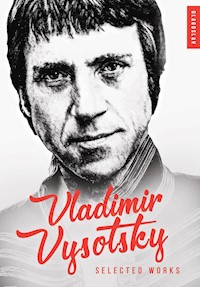
Legendary singer, songwriter and poet Vladimir Vysotsky (1938-1980) is loved and admired like no other. A recent survey placed him as the most important cultural figure of twentieth century, and some say he is the greatest Russian poet since Pushkin; others talk of him as the Russian Bob Dylan, or Jacques Brel.
His songs championed the underdog, and even today, forty years after his death at a tragically young age, people in countries as far apart as Bulgaria and Kazakhstan weep at the mere mention of his name. Yet remarkably this is the first landmark collection of his lyrics and poetry in English.
The translators set themselves the hard task of translating Vysotsky’s songs as first of all songs, not poetry, enabling readers to perform them in English. This collection of lyrics also includes sample sheet music for six Vysotsky’s songs.
Vysotsky himself used the seven string guitar; the songs are adapted here to the western six string classical guitar by John Farndon and West-End singer Anthony Cable.
Sie lesen das E-Book in den Legimi-Apps auf:
Seitenzahl: 95
Veröffentlichungsjahr: 2022
Ähnliche
















Vladimir Vysotsky: Selected Works
(English Edition)
Vladimir Vysotsky
Translated byJohn Farndon
Translated byOlga Nakston
Glagoslav Publications
Vladimir Vysotsky:
Selected Works
Translated from the Russian by John Farndon with Olga Nakston
Proofreading by Richard Coombes
Published with the support of the Institute for Literary Translation, Russia
Publishers Maxim Hodak & Max Mendor
Original songs © 2022, Heirs of Vladimir Vysotsky
Translator’s note @ 2022, John Farndon
Cover art, book cover, and book layout by Max Mendor
English translation © 2022, Glagoslav Publications B.V. and John Farndon
www.glagoslav.com
ISBN: 978-1-914337-65-9 (Ebook)
First published in English by Glagoslav Publications B.V. in May 2022
A catalogue record for this book is available from the British Library.
This book is in copyright. No part of this publication may be reproduced, stored in a retrieval system or transmitted in any form or by any means without the prior permission in writing of the publisher, nor be otherwise circulated in any form of binding or cover other than that in which it is published without a similar condition, including this condition, being imposed on the subsequent purchaser.
Contents
About This Book
Translating Vladimir Vysotsky
Selected Works
Stubborn Horses
A City Romance
A Ballad about Guns
The Wolf Hunt
The End to the Wolf Hunt, or Hunting from Helicopters
He Has Not Come Back from the Fight
The Crown Is Smashed to Smithereens
Ice below and Ice above
In This Moment, I Love You
A Parable about Truth and Lie
A Song about a Friend
A Song about New Times
Brodsky’s Song
She’s Been to Paris
The Height
Masks
Morning Gymnastics
A Ballad about the Bath-House
My Tastes and Habits Are Unusual
Mass Graves
A Song about Nothing, or What Happened in Africa?
Katerina, Katya, Katerina
About our Meeting
All the Sons Leave for War
A Song about Reincarnation
What’s the Point in me Talking to You?
Ships Will Stay for a While
White Silence
A Ballad about Love
I Don’t Like
About Love in the Middle Ages
Cholera
A Song about Rumours
From Moscow to Odessa
The Fir Fronds Tremble
The Mountain Lyric
Again It Seems I’m Struck Down with the Chills
A Song about Stars
The Crystal House
Farewell to the Mountains
Ice
A Song about the Earth
Every Night, Candles Are Lit for Me
In the Beginning Was the Word, of Sadness and of Pain
Summit
The Parrot’s Song
In Spite of All the Things I Do on Land
To the Cold
To the Top
Save our Souls
Lads, Send Me a Letter
Rock Climber
So Many, Many Years
They Keep Telling Us Sincerely
A Song about Time
My Hamlet
About the Translators
Appendix. Sheet music
Notes
About This Book
Amongst Russians and people of the former USSR, legendary singer, songwriter and poet Vladimir Vysotsky is loved and admired like no other. His songs championed the underdog, and even today, forty years after his death at a tragically young age, people in countries as far apart as Bulgaria and Kazakhstan weep at the mere mention of his name. Yet remarkably this is the first landmark collection of his lyrics and poetry (“Ice below and Ice above”, “My Hamlet”) in English.
The translators set themselves the hard task of translating Vysotsky’s songs as first of all songs, not poetry, enabling readers to perform them in English. This collection of lyrics also includes sample sheet music for six Vysotsky’s songs. Vysotsky himself used the seven string guitar; the songs are adapted here to the western six string classical guitar by John Farndon and West-End singer Anthony Cable.
Translating Vladimir Vysotsky
Singer-songwriter and poet Vladimir Vysotsky (1938-1980) is one of the most extraordinary artists of the twentieth century. Some talk of him as the Russian Bob Dylan, or Jacques Brel, but that doesn’t really convey how much he was loved and revered across the Soviet Union.
Remarkably, very few of his hundreds of songs were officially recorded, or even bought on record. Instead, countless people heard his songs on scratchy reel-to-reel tape recordings passed on from friend to friend. In Soviet cities of the time, summer evenings were often filled with the latest crackly sound of a new Vysotsky song filtering through an open window.
When Vysotsky died, tragically young at just 42 in 1980, he was mourned by tens of millions. It was the time of the Moscow Olympics, and the KGB were anxious to keep this uncomfortable voice out of the news. Even so, over 30,000 gathered in Moscow to pay tribute, despite a KGB ban. “Volodya” was, for them, the voice of truth. “You understood what our lives are like – work, work, hellish work and nothing else,” wrote one mourner, while another said: “We’re here because he spoke the truth, not the half-truths we hear all the time – he wrote about our life.”
His impact spilled into the next generation, and his language was absorbed into Russian culture. I have a cleaner from Bulgaria, Zhivka Hristova, who must have been very young when Vysotsky died. When she saw a book of Vysotsky’s songs on my table, she at once burst into tears. Her sister Lydia wrote this note to explain why: “They say Jesus spoke parables to his contemporaries. For the people of my generation, Vysotsky was like him – he taught us his songs. Whatever happened, we said: on this occasion, in one of his songs, Vysotsky says the following… He was our banner in those times!”
A recent opinion poll in Russia put Vysotsky as the second most important Russian popular figure of the twentieth century after only the cosmonaut Yuri Gagarin, while some consider him Russia’s most important poet since Alexander Pushkin. And yet he is almost unknown to people in the West. Even Russophiles in the English world, steeped in Tolstoy and Akhmatova, Chekhov and Brodsky, are often almost entirely ignorant of the work of Vysotsky.
A New York Times article, published a year after his death, attempted to explain why this was: “because his ballads rarely dealt explicitly with politics, because the street language he used with such effect is almost untranslatable and because the life he sang about is so alien to the West.”
And yet to me, it still seems remarkable that the work of such a towering poet, songwriter and cultural icon has not yet been translated into English, beyond countless scattered attempts online by Russian fans. That’s why I, maybe foolishly, embarked on this collection...
As well as a singer-songwriter, Vysotsky was a brilliant actor, famed for his legendary Hamlet with the equally legendary Taganka Theatre, and his songs and performances draw heavily on his theatrical life. In his songs, he tells stories and creates characters, often so powerfully that listeners believed he must have been one of the soldiers or gangsters he sang about.
He wrote songs in a genre of the “author-song,” which is a very distinctive feature of post-war Russia. “Generally speaking,” Vysotsky explained in an interview, “they are not songs even but poems on a rhythmical base...” He accompanied them on guitar alone because of its simplicity. “Author’s songs give me a chance to tell you what worries me, what is of concern to me, that sort of thing.” But that modest explanation belies the extraordinary power of his storytelling, his complex use of alliteration, assonance, internal rhyme, and, of course, his unforgettable, gravelly voice which can switch from an intimate whisper to an epic crescendo in moments.
He explained in the same interview how author-song writers are criticised for their simple “primitive” melodies. But his answer was this: “I believe that nothing should interfere with the perception of the text, the meaning... I wanted the songs to enter not only the ears, but the souls right from the beginning.”
Particular themes crop up again and again in his songs, and people often divide them into types like his “street songs” and his “mountain songs.” His theatrical background is clear, because unlike many western singer-songwriters he rarely sings personal confessions but as a character, whether it is a sleazy thug, or a lonely soldier.
He sings so often, and so believably, of war that people often insisted he must have been a soldier himself. He explained that he writes about “men who look death in the face, men in extreme situations.” Nowhere is this better illustrated than in one of his most famous songs, “Stubborn Horses” which opens with the lines: “Along the edge of a rocky ledge,/ A steep precipice on hell’s abyss...” But of course he also wrote the tenderest, most intimate love songs.
Translating Vysotsky’s lyrics is perhaps the most challenging translation task I have ever undertaken, and I must express my deep thanks to Olga Nakston, who has been my co-translator, providing me with literal translations of all the song. I have translated Pushkin and Lermontov, Abai and Pessoa, and each presents unique challenges, but recreating Vysotsky’s words into English was the biggest challenge of all.
First of all, it was crucial that my English words are lyrics, not poetry. They are there for English people to sing, not simply read on the page, or for readers to read as they listen to Vysotsky himself singing. So the English words must match the melody and rhythm, pacing and intonation, with the kind of precision that is almost never demanded in translating written poetry. Many of the translations have been tested by a great singer friend of mine Anthony Cable, who has sung these songs in English for the first time – and this showed that I cannot afford even the slightest looseness, since it makes the words unsingable.
I am lucky to be a songwriter myself, as well as a poet and translator, so I know how lyrics need to work with the melody – how the melody often dictates the flow of words, and vice versa. Moreover, the rhythms in songs are very different from the rhythms in written poetry, and that presents an entirely new challenge for the translator.
Secondly, Vysotsky is an absolute master of the Russian language. His lyrics are dense and linguistically inventive in a way few Russian poets can match. He uses consonants, for instance, in brilliant staccato volleys of words which, combined with his unique voice and delivery, create an extraordinary energy that is genuinely thrilling for Russian listeners. The sound of the English language is very different, and it’s almost impossible to recreate these verbal fireworks exactly, so I have had to work hard to find equivalent effects in English, but I urge you to listen to Vysotsky singing himself while reading to hear the full effect – even if you don’t speak Russian.
Thirdly, many of the characters and situations in Vysotsky’s songs were instantly identifiable to people in the Soviet Union of the time, but entirely alien to English readers, as the New York Times article quoted above suggested. Bridging the gap is a real challenge, but Vysotsky is a man of the theatre, and his characters have distinctive voices, so it seemed to me that the way to transfer these characters into English was to give them a voice that would help English people identify.
My brilliant editor, Ksenia Papazova, who knows and loves Vysotsky, pointed out Vysotsky hardly used swear words, and his genius was to stay within the literary canon while appealing to people in all walks of life. In just two places, I have used the word “fuckit” and “fucked,” breaking with Vysotsky, but this, I felt, was important to give the songs the “voice” and impact that would be identifiable instantly in English.




