


11,99 €
Mehr erfahren.
- Herausgeber: Luath Press
- Kategorie: Geisteswissenschaft
- Sprache: Englisch
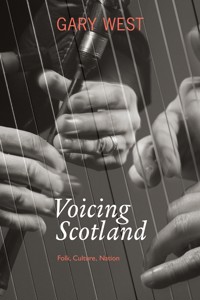
Voicing Scotland takes the reader on a discovery tour through Scotland's traditional music and song culture, past and present. West unravels the strings that link many of our contemporary musicians, singers and poets with those of the past, offering up to our ears these voices which deserve to be more loudly heard. What do they say to us in the 21st Century? What is the role of tradition in the contemporary world? Can there be a folk culture in the digital age? What next for the traditional arts? REVIEWS Can folk stay true to tradition and still be genuinely contemporary? Can its pride in place counter globalisation- without collapsing into narrow nationalism? The answer for, Gary West, is a resounding Yes. SCOTSMAN Voicing Scotland...is an engrossing assessment of where Scottish Traditional Music standsl, at a time of resonant political developments in the nation's history but also of globalisation and the threat of cultural homogenisation in todays 'liquid society'. SCOTSMAN
Das E-Book können Sie in Legimi-Apps oder einer beliebigen App lesen, die das folgende Format unterstützen:
Seitenzahl: 318
Veröffentlichungsjahr: 2013
Ähnliche



















GARY WEST is a senior lecturer in Scottish Studies at the University of Edinburgh. He is also an active traditional musician and teacher, and presents a weekly programme,Pipeline, on BBC Radio Scotland. Originally from Pitlochry in Perthshire, he played for many years with the innovative Vale of Atholl Pipe Band, winning the Scottish and European Championships. In his late teens he moved sideways into the folk scene, playing, recording and touring with the bands Ceolbeg and Clan Alba, and becoming a founder member of the ceilidh band Hugh MacDiarmid’s Haircut. He has performed on around 20 albums, including his debut solo release,The Islay Ball, and his most recent collaboration,Hinterlands, with harpist Wendy Stewart.
Voicing Scotland
Folk, Culture, Nation
GARY WEST
LuathPress Limited
EDINBURGH
www.luath.co.uk
First published 2012
eBook 2012
ISBN (Print): 978-1-908373-28-1
ISBN (eBook): 978-1-909912-35-9
The publisher acknowledges the support of
Creative Scotland
towards the publication of this volume.
The author’s right to be identified as author of this book under the Copyright, Designs and Patents Act 1988 has been asserted.
© Gary West 2012
Table of Contents
Acknowledgements
Introduction
Chapter 1 - Understanding Tradition
Chapter 2 - Music and Custom at Home
Chapter 3 - Voicing Place
Chapter 4 - Voicing War
Chapter 5 - Lands and Lyrics
Chapter 6 - Cultural Contexts
Endnotes
Bibliography
For Mum and Dad
Acknowledgements
I am very grateful to all those artists or their families who have given permission to quote from their work: Dick Gaughan, Patsy Seddon (for her late husband, Davy Steele), Adam McNaughtan, Rod Paterson, Michael Marra, Nancy Nicolson and Kirsten Bennett (for Martyn Bennett), and to the Gordon Duncan Memorial Trust. Thanks also to the European Ethnological Research Centre at the University of Edinburgh for permission to quote from work I have previously published in their series, Scottish Life and Society: A Compendium of Scottish Ethnology, to Neill Reay, editor of the magazine Scottish Life, to Ian Green of Greentrax Recordings, to bbc Scotland, to Shannon Tofts Photography, to Agnes Rennie at Acair Books, and to Nathan Salsburg of the Alan Lomax Collection, American Folklife Center, Library of Congress. Thanks also go to all of my colleagues and students in Celtic and Scottish Studies at the University of Edinburgh for debates and discussions over the years which have inevitably informed my thoughts, and in particular for help with oral and photographic archive material to Cathlin MacAulay, Caroline Milligan, Stuart Robinson and Colin Gateley, and to the department’s late photographer, Ian MacKenzie, sadly missed. I’m grateful too, to Iain MacInnes, my producer on the BBC Radio Scotland programme Pipeline, whose knowledge I draw on weekly, and which I’m sure has found its way into these pages in many ways. I would also like to thank Wendy, Charlie and Eilidh for their patience and help at home, and all at Luath Press, especially Gavin MacDougall and my editor, Jennie Renton, whose keen eye, wide knowledge and (mostly!) gentle prodding has helped turn my notes and thoughts into an actual book. Finally, I offer my sincere gratitude to all those writers, singers, poets, musicians and ‘ordinary folk’ whose voices form the foundation of this book, many of whom I have had the pleasure of knowing and working with personally over the years. I offer this small tribute back to them in return.
Gary West
Edinburgh, July 2012
Introduction
WE LIVE, WE ARE told, in a ‘post-traditional’ world. This is the world of globalisation, of instant communication, of a sprint down the fast lane towards ‘progress’. It is a world where community is often virtual, our interaction electronic, where more and more of us blog and tweet our way through our days. Ours is a liquid society, where nothing stays still long enough to solidify into anything of substance, where roots are tethers and cultural baggage a debilitating burden. To successfully negotiate this world, to ‘get on’, we must be fleet of foot, ready to divert elsewhere at a moment’s notice; crucially, we must be mobile. Our skills must be varied, flexible and transferable rather than creatively crafted and carefully honed, and to manage anything at all we must show that we can ‘drive through change’.
This is a picture of our modern world painted for us by many commentators, the sociologist Zygmunt Bauman chief amongst them. Bauman has set up quite an industry for himself in the production of a plethora of books explaining the concept of ‘liquid modernity’, arguing that recent decades have witnessed a fundamental shift in how we operate and organise ourselves in western society.1Globalisation means that ‘traditional’ ways of thinking and acting lack the reach required, and conventional politics, the way we control and influence where we want to go, is a toothless endeavour. He is not, I should stress, advocating all this, simply asserting that we already have it.
Is this the kind of world we actually now live in? Is Bauman right? We will all no doubt have differing views, but I suspect most of us recognise at least some truth in this picture. When did you last read a professional job description that did not ask for evidence of success in managing change? What was the most recent ‘crash’ of the world’s finances if not the catastrophic pile-up of an overcrowded fast lane? Perhaps the sight of the wreckage will slow us down a little. Perhaps.
This view of modernity is sometimes termed ‘negative globalisation’, and we can add to it the fear that the fast lane of progress is leading inexorably towards a universal sameness. Even if this is confined to ‘the west’ it predicts an homogenisation of cultural values and forms which will see us all eat the same food, listen to the same music, watch the same films, read the same books, while wearing the same clothes. A more encouraging picture might be painted, however, if we see globalisation as having a much more positive side to it. This philosophy might see mass and instant communication not as a threat, not as a vehicle for the inevitable homogenisation of the world’s cultures, but rather as a wonderful means to recognise, display, share, understand and celebrate cultural difference. In such a vision, ‘tradition’ remains entirely relevant – indeed, crucial – to the modern world. For it is partly within tradition that cultural difference is stored, that the vast richness of human creativity is represented and that place, locality and belonging are given meaning. It is this realisation that has led to UNESCO’s preoccupation with heritage, and in particular, with what it now terms ICH – ‘intangible cultural heritage’. There is a fascinating story behind this – it involves hammers, nails, sparrows and snails – which I shall come back to a little later, but in short this is about recognising and celebrating the non-material cultural traditions to be found throughout the world. Rather than revering only buildings, artefacts, landscapes and monuments, this is about song, music, storytelling – it is about voicing the community, the region, the nation. In Scotland we now tend to call these ‘the traditional arts’, and it is from amongst these arts that the themes of this book are drawn.
What is their role in the modern world? What have they got to say to us about the big themes which we must wrestle with in the 21st century? What do these voicings tell us about humanity, inhumanity, morality, conflict, place, identity, belonging, environment? Do these arts belong in the present, or should they be consigned to the past? How might they shape the future? I raise these questions within the spirit of what I’d like to call ‘positive globalisation’, which has at its root a basic philosophy of understanding something like this: start with the local, build towards the national, and aim, from there, for the global.
Tradition is not the antithesis of change. As I hope to show, change is a crucial ingredient within the process of tradition itself: it does move and develop and reshape itself to fit into each new manifestation of the present. If it does not, it tends to disappear. A favoured metaphor for such progress here in Scotland is Hamish Henderson’s idea of a carrying stream – the stream of tradition flows through time, picking up new flotsam as it goes, leaving some things on its banks in the process. At any given point, then, its content and form may be a little bit different to other places further up or down stream, yet it remains recognisable as the same tradition. As a conceptualisation this is not without its limitations, but the key thing is that it reminds us that tradition flows, that it, too, is liquid. It is not static, it is not a pond, which is perhaps a better metaphor for ‘convention’, where things do tend to remain unchanged. A convention is encoded in strict rules which are unthinkingly adhered to because ‘it has always been this way’. A convention is a dead tradition.
Yet change within tradition tends not to be revolutionary or even rapid, but incremental, considered, evolutionary. That is not to say that radical new ideas or approaches do not appear within a tradition on occasions. They do, but time tends to be the judge, the barometer of acceptability, the arbiter of taste. Roots are important, as is an appreciation of where things have come from, where we stand within the stream, and how to use that knowledge to create fresh and meaningful art going forward. Tradition, then, can be of great use in a liquid modern world, a questioning, solidifying force, and a reminder that society cannot spend its entire time in the fast lane. Yet it can still help us to move forward, to move positively, and to embrace the future with the confidence that comes from knowing where we’ve been.
You will have guessed by now that I generally think well of tradition, that I view it as a largely positive part of our cultural landscape, or cultural ecology, to use a phrase which is coming into common currency here in Scotland. But there is a caveat to that, for we must recognise that tradition can sometimes be used as a negative force, as an excuse for not changing, even when change is clearly needed. We can sometimes hide behind tradition, use it to persecute, to fuel intolerance, to justify the unjustifiable. UNESCO, to its credit, is wise to this, and has built a defence into its ICH charter to ensure any application for official recognition based on such unethical use of the concept is rejected. It doesn’t mean it doesn’t still happen, of course, but it is a start, and we will do well to follow their lead in at least keeping an eye out for it.
I’ll turn now to the geographical focus of this book. What of Scotland? What might our place be within the spirit of a philosophy of positive globalisation? We live in interesting times, for constitutional debate and change has led to the conceptualisation of the beginning of the 21st century as bringing a ‘new’ Scotland into being. You may well be reading this with the referendum already in the past, you may be in an independent Scotland, or in an ‘enhanced devolution’ Scotland. In either case, the ‘new’ label will probably be justified. Or you may indeed be in a Scotland which is constitutionally identical to the one in which I am writing this sentence, in 2012. Indeed, you may not be in Scotland at all, but simply looking in from afar, or from next door, and wondering what all the fuss is about.
But even now, pre-referendum, plenty has happened over the last dozen or so years to give credence to the idea that many aspects of ‘the old’ Scotland have been replaced with something fresh or revived, and in some cases at least, entirely new. Some of these changes relate to the political process, the creation of the Scottish Parliament at Holyrood being the obvious example, while many involve the cultural fabric of the nation. The National Museum of Scotland on Edinburgh’s Chambers Street, a long long time in coming, is now a teenager, and proudly displays ‘Scotland to the world’, adding to the grand building next door which for a century and a half has been displaying ‘the world to Scotland’. It, too, has had not so much a face-lift as a complete reworking, and reopened its doors to a chorus of a million approving voices in 2011. Likewise, the National Portrait Gallery on Queen Street in the capital has received a complete overhaul, revitalising a space which was beginning to feel daunting in its darkened deference to the faces of the great and good of the nation displayed on its walls. In Glasgow we now have the excellent Riverside Museum to add to the city’s already extensive cultural landscape, a magnificent new concert hall graces the centre of Perth, and the architects Page and Park have created a marvellous new set of spaces with their complete refurbishment of the Eden Court Theatre in Inverness. As I write, the brand new Mareel Centre in Lerwick is about to open and we are soon to welcome a radical new-build on the Tay with the arrival of the V&A at Dundee. There are many more examples of new capital investment in Scotland’s cultural sector and the message we can take from this is that Scotland has been gearing herself up well to ensure her cultural infrastructure is fit to face the challenges ahead.
As well as buildings, the organisational framework for the support of the arts within Scotland has also been reshaped, with the founding, after a somewhat protracted gestation, of Creative Scotland, in 2010. Bringing together the former Scottish Arts Council and Scottish Screen, the seeds of the idea of a new body can be traced back through various Scottish governments or executives. The key stepping stones were the Cultural Commission, chaired by James Boyle and established in 2004, and the National Cultural Strategy which preceded it. Clearly, ‘culture’ has been very much on the mind of our Scottish parliamentarians from the outset.
Not all of us will agree about how this commitment to culture should be handled, and whether what has emerged from this process of reflection and consultation is as good as it could possibly be, but what is not in doubt, surely, is that there is a burgeoning degree of cultural confidence in Scotland these days. We seem to have got past the tired old struggles and squabbles between traditional sparring partners – ‘high’ art versus ‘popular’, east versus west, urban versus rural – and are moving forward with a new-found vigour. We have international recognition for the quality of our creativity, with Edinburgh as a UNESCO City of Literature and Glasgow being awarded the equivalent accolade as a City of Music. The National Theatre of Scotland, founded in 2006, has produced some excellent work, again internationally acclaimed, as indeed have the other nationally supported companies in the fields of dance and classical music. Cultural festivals take place virtually all year round now in Scotland, with over 350 annual offerings at the latest count, while across the length and breadth of the country individual artists, venues, teachers, promoters, and all manner of organisations combine to make Scotland a culturally rich and diverse nation.
We are aiming high. Creative Scotland’s ten-year vision includes an ambition for us to be recognised as one of the world’s leading cultural nations and one of the world’s top ten places to visit for culture, to have the highest levels of participation in the arts within the UK, and to be an international leader for the arts among children and young people.2 While such things are of course difficult to measure, they are nonetheless achievable aims, and the plan which supports this vision is aimed at investing in Scotland’s culture in a way which gives ourselves every chance of reaching these heights. ‘Investing’ does not just mean giving out cash to venues and artists, but goes much wider into the whole infrastructure, providing support and advocacy for audience development, education, international links, cross-sector initiatives and all of the other needs of a healthy cultural community.
I realise I am painting a very positive picture of Scotland’s cultural ecology here, and I know that not everyone will agree with me. Of course there are less rosy stories to be told too, with some organisations falling by the wayside, others struggling just to make ends meet and keep their doors open, and artists who give up as they just cannot get the start or the break they need. Yet, looking at the bigger picture, I remain convinced that there is much to be positive about.
And so what of the traditional arts? Where do they fit into this? In many ways, the story follows a similar plot, for there is much to celebrate. We have come a long way over the last generation, with traditional music, song, storytelling and dance now much further up the national cultural agenda than has ever been the case before, and they are seen to have a crucial part to play in helping to bring a unique stamp to the nation’s creativity. Having commissioned a detailed report into the traditional arts sector, published in 2010,3the Scottish Government’s formal response confirms its strong commitment to these art forms, and outlines its views on the need for ongoing development and support. As the Cabinet Secretary for Culture and External Affairs, Fiona Hyslop, commented:
the traditional arts make a significant contribution to the cultural heritage of Scotland not just as a legacy, but because they actively provide a way of taking forward that heritage, shaping the culture of our future generations and ensuring their contribution to wider public life.4
How are we doing that? What are the roots of these arts? What is the story of ‘tradition’ in Scotland? How has it been voiced? These are some of the issues I would like to pick up as we move through this book.
I begin with an overview of what tradition actually is, or rather with what various people and institutions and movements consider it to be, for in actual fact there is no universal agreement on this. In Scotland we have been trying to make sense of tradition for rather a long time, mainly through ‘collecting’ it, and in many respects we have been international leaders in this. I notice that Brenda Chapman, one of the writers of the Disney-Pixar animation Brave, has mentioned that she considers the film to be a fairy tale in the tradition of the Brothers Grimm, but there is little need to look to Germany for such inspiration given the strength of the oral narrative tradition here in Scotland. The Grimms themselves looked to Scotland for their own guidance, and in particular to a schoolmaster from Badenoch who enjoyed his own equivalent of a Hollywood blockbuster in the mid-18th century, taking his own native oral tales of ancient Celtic heroes and weaving them into the seamless garment which brought him international fame and not a little controversy. Chapter One picks up this story and others, and sketches out a framework of how we have come to perceive, view and explore cultural tradition down to the present day.
All of this was part of the long pre-history of the 20th century folk revival in Scotland, and one of the outcomes of that was the links it forged between the culture of our local communities and the creative output of the ‘professional’ artists. In many respects, the revival wasn’t actually ‘reviving’ very much at all, it was simply reminding us of what had slipped our minds, but which still existed in the mouths and homes of us all. That great bothy ballad singer from the north-east, Jock Duncan, complained to me recently that there is no need to call it a revival. It never went away. But it did disappear from our national view, and so in Chapter Two I take a quick peek into the homes of a few generations of the people of Scotland to see and hear just what did happen by way of ‘tradition’ before it left the kitchen and made for the stage and the archives.
Thereafter, I move in to explore the creativity of those whose work, rightly or wrongly, has usually been ‘filed under folk’. We lend our ears to those who have added their own stones to the cairn of tradition, who have seen themselves as belonging to it, who are part of the continuum of the carrying stream, but who take on the responsibility of shaping its future. These are the songwriters, the singers, the composers, the dramatists and the performers who voice the tradition in their own terms. What do they have to say to us? How are they speaking to the world? What are their themes, their preoccupations, their philosophies? What is their value to us here in the 21st century? How, if at all, are they moving us along the road towards a positive form of globalisation? Are they bringing a sense of solidity to this liquid society? Chapters on ‘Voicing Place’, ‘Voicing War’ and ‘Lands and Lyrics’ are my attempts to explore some of these questions and to contemplate how they are ‘voicing’ Scotland.
In Chapter Six, by way of conclusion, I explore the wider cultural contexts of tradition within Scotland. In many respects, this has been a story of both survival and revival, for the course of tradition seldom runs smooth, but rather tends to ebb and flow, wither and thrive as society develops and changes through time. We have been a rather self-examining nation at times, asking ourselves what our culture really is, whether it is healthy, to what extent it needs re-shaped or even whether it should be ripped apart and thrown away, clearing the path for a fresh start. That, indeed, was the radical suggestion put forward by some in the 1980s, and before that, in the 1930s, periods that gave rise to complaints about the dominance of ‘Balmorality’ and ‘Tartanry’ and the reliance on a hackneyed set of romanticised representations. Folk culture played a complex role in this, as for some it was part of the problem, while others saw it as having the potential to contribute to the solution. Revivalism was a key ingredient, as Scotland fed off what was happening in the folk movement across the Atlantic where the likes of Woody Guthrie, Leadbelly, Pete Seeger and Bob Dylan were forging a new and politically charged approach to popular music-making. Our own version of the revival took root, but in different cultural soils, producing different kinds of crops.
I should take a moment to explain where I myself am coming from – this is my pre-emptive strike on potential accusations that my journey through this theme is very partial, and that there is much more which has been left out than put in! I am certainly not making any claims for comprehensiveness here, or putting this book forward as a detailed study of the traditional arts in Scotland today. I say next to nothing about those traditional art forms which I have not been directly involved with myself, especially the area of dance, and as it has been dealt with very well elsewhere I say little about formal storytelling either.5 Rather, I have been guided by my personal experience as a musician, band member and teacher, and most of the artists and creators I write about here are people I have known personally and have worked with over the years. In that respect, this is a very personal journey, almost autobiographical in places, and is more of an account of those who have inspired me than an objective work of academic rigour. Having said that, highly reflexive works of ‘auto-ethnography’ are all the rage within academic circles these days, so I do hope that I have something useful to say here to formal students of culture as well. But I have tried to throw off the fancy gowns of my day job as a university scholar, keeping footnotes to a minimum and ridding myself of the self-congratulatory jargon that seems to be increasingly demanded in the academy.
It may be helpful to briefly sketch out my own journey through folk culture, if only to justify my credentials for writing on this topic. Born in Aberfeldy and brought up in Pitlochry, Highland Perthshire was my stomping ground until my late teens, although with a maternal grandmother from the north coast of Sutherland I’ve always had a fascination for the ways of the Gaels too. Hours spent listening in on family chats in both counties seemed to spark an interest in ‘the old days’ centred around Lowland farming and Highland crofting, and although I had never heard the phrase, oral tradition was all around me when I was growing up.
From around the age of three or four I was apparently fascinated with the sound and sight of the local pipe band, the Vale of Atholl. At that time it was mainly a parade band and didn’t compete, but the pipe major, Alan Cameron, retired and a young local lad, Ian Duncan, took over. Ian is the eldest son of the above mentioned Jock Duncan, one of the finest traditional bothy ballad singers of the north-east, whose work had taken him to the Hydro schemes of Perthshire some years before. Ian knew that if the band was to survive then it needed new blood coming through, and so Alan agreed to become the teacher to the next generation. I jumped at the chance to get involved, and began learning the chanter at the age of six along with several others, including Ian’s younger brother, Gordon Duncan, who went on to become one of the finest traditional musicians this nation has ever produced.
We all worked hard at our piping and drumming, viewing it very much as a serious musical commitment and not just a spectacle to serve the tourist industry, and success came fairly quickly as we moved up through the grading system, taking our place as one of the world’s top five pipe bands within seven or eight years. The pipe band system is actually one of Scotland’s great musical training grounds, run entirely on a voluntary basis, and encouraging thousands of young people across the country and well beyond to develop advanced musical knowledge and skills. Its highly international following and participation makes it a very fine contributor to ‘positive globalisation’, and I have seen a lot of places in the world I would never have had the chance to visit if it wasn’t for piping. The band was also my introduction to folk music, for LPs and cassette tapes of the likes of Silly Wizard, The Tannahill Weavers, The Bothy Band and Planxty were passed around and played on the bus trips wherever we went.
It was perhaps inevitable, then, that on taking up a place at the University of Edinburgh in 1984 I should be drawn to the School of Scottish Studies. I vaguely knew of it as a place which collected and taught about folk culture, although I had little idea what that actually meant in academic terms, but discovered that they had just begun to offer a degree in ‘Scottish Ethnology’ and so decided that this was the course for me. Most of the great scholars who have been associated with the department were still there, and I found myself listening with fascination to the likes of Hamish Henderson, Alan Bruford, Donald-Archie MacDonald, John MacInnes, Ian Fraser, John MacQueen, Peter Cooke, Margaret Bennett, Margaret MacKay and Morag MacLeod, all hugely knowledgeable and inspiring in their sheer zest for their subject. Together they taught me what culture and tradition is all about, how to capture it on tape, how to nurture the relationships that allow us to do that, and how to make the links between its constituent parts. I realised for the first time, for instance, that piping was not an art which was set apart, but that it linked in so many ways to other branches of the traditional tree. I learned, too, that there is nothing parochial or small-minded in studying one’s own culture, for these were all people who looked outwards, linking with the traditional arts of other peoples and nations, seeking out common links, searching for a mutual understanding. I was hooked, and so stayed on after graduation to secure my PhD, and was then lucky enough to be appointed to the staff in 1994.
It was in those undergraduate years that my piping took me on a different path, away from the pipe band movement towards the folk scene. Playing in sessions around the city, I got to know many musicians who were very welcoming and it was wonderful to hear the kinds of songs and tunes I’d been listening to for years ringing out round a table in Sandy Bells, the Green Tree and the Tron Bar. Peter Boond and Davy Steele of Ceolbeg were regulars, and invited me to join the band when my pal Gordon Duncan, who had been with them for three years, left to join the Tannahill Weavers. I already had some experience in that line, as in 1986 some mates and I started a ceilidh band, we all admired Scotland’s greatest modernist poet, but were particularly taken with his quaffed ‘Barnet’. I’m happy to say that 25 years and a thousand dances later, Hugh MacDiarmid’s Haircut is still going strong!
These Ceolbeg days were my main grounding in the performance of tradition, the manifestation of the theories and ideas I was being exposed to within its academic study. There is much work involved in the translation of folk culture from the page to the ears and I came to enjoy the challenges of that process greatly. I still do. Touring widely overseas was a real education too, especially playing at festivals where we got to meet fellow musicians from many parts of the world, sharing songs and tunes and discovering the connections between our respective traditions as well as the idiosyncrasies of each. At that time I also enjoyed a couple of years with a newly founded eight piece band, Clan Alba, working with some of the best traditional musicians in the land who I had listened to as a boy, Dick Gaughan chief amongst them. Making the decision to leave in order to pursue my academic career was very hard indeed, but since then I’ve been lucky to get the chance to work with a wider range of fine musicians on a number of projects, particularly with the harp player, Wendy Stewart, and immersing myself too in the bellows pipes revival which has been ongoing since the 1980s. And since 2002, presenting the weekly BBC Radio Scotland programme Pipeline, has provided another luxury in getting the chance to delve deeply back into my Highland piping roots.
The thoughts which lie behind this book have emerged from the meshing of all of these experiences. It is about the activity of voicing cultural tradition, and so it is about sound more than vision, ears more than eyes. Therein lies a central problem, of course, for how can we capture that on the page? When the singer and songmaker Nancy Nicolson sent me the lyrics of some of her songs while I was gathering material for this project, she reminded me that ‘words are only half a song: there is a vast range of mood contained in these and it needs the tune to set that’. Nancy is absolutely right, of course, and it is for that reason that wherever possible I’ll point you towards the places that you can hear the voicings for yourself.
It will not have escaped your notice that my tone tends towards the celebratory. Yes, I do believe our cultural tradition in Scotland deserves to be celebrated. That is not to say that there isn’t stuff out there that should probably be left on the banks of this carrying stream, and so that is exactly what I have done with it! But there is plenty that flows on, confidently, proudly and productively. Let’s head off there now and explore.
Chapter 1
Understanding Tradition
Accept, to begin, that tradition is the creation
of the future out of the past.1
AS THE AMERICAN FOLKLORIST Dorothy Noyes points out, there is ‘a tradition of talking about tradition’.2Scholars in various fields which deal with the relationship between the past and the present are fascinated with this rather slippery idea, this label for things that seem to flow through time but which we cannot quite define.
Most of us understand that tradition began somewhere in the past, that it covers a fairly wide range of cultural forms, and we tend to think we recognise it when we meet it. Perhaps its origins are unknown, ‘lost in the mists of time’, as we might say. Perhaps some of it is very old indeed, although we realise everything must start somewhere, and that ‘new’ traditions must therefore be possible. Indeed, since the phrase ‘the invention of tradition’ became common from the early 1980s, following publication of a hard-hitting book of that name,3we might actually be rather suspicious of tradition, questioning its ‘authenticity’ and wondering whether the whole thing is just a modern creation masquerading as something much older.
Some of us might view tradition in a positive light, considering it to be part of our ‘heritage’ and ‘identity’, and therefore a welcome companion as we move through our lives. Others may see it as old-fashioned, irrelevant and a hindrance to our attempts to develop and grow as individuals and as a society, being quite happy to see it disappear altogether. And some of us may well be torn between the two. The author Neil Gunn was one such:
At the mere mention of the word ‘tradition’ some of us grow impatient, feeling that we have had too much of the stuff, that the world at the moment is all too literally and painfully sick of its effects, and that until we sweep its encumbering mess into limbo we shall have no new brave world.… There is something invigorating and hopeful in a clean sweep and a fresh start.4
‘The world at the moment’ is the phrase which gives us a clue as to the source of his feelings, for he was writing these words in 1940, in a war-torn world where people were sick of many things, and in which tradition and ideas about the purity of ‘folk’ culture were being used as a destructive and evil force. Within a paragraph or two, however, Gunn moves to a more positive view of the kind we might expect from the man who gave us The Silver Darlings and Highland River, both novels dripping with tradition:
Fortunately, the study of tradition is not an unrelieved study of evil. On the contrary, it is largely the study of our greatest good. Only inside his own tradition can a man realise his greatest potentiality; just as, quite literally, he can find words for his profoundest emotion only in his own native speech or language. Tradition would thus, on all counts, appear to be a very important thing indeed…
Tradition, then, can be a cause for good and for bad. It can also mean different things to different people at different times, and it is very easy to get bogged down in its myriad meanings. A close look at all its uses and interpretations can easily leave us even more confused than ever, but fortunately some scholars have done an excellent job in pulling all the sources together for us already.
In an impressively wide yet succinct survey of the varying meanings people have bestowed upon tradition, spanning centuries and many cultures, Dorothy Noyes distils it down to three broad concepts. First of all, tradition can be seen as a form of communication, whereby ideas, information, philosophies and creativity are transmitted through time and diffused through space, linking generations and peoples. It is a manifestation of the way its holders think and feel and believe, and is a window upon their philosophy of life or their preferred way of being. Embedded into it are all manner of clues as to their thoughts on such things as morality, humanity, relationships, family – the whole spectrum of life’s concerns. It has to be organised, however, and so tends to be codified into certain recognised forms as opposed to a random selection of bits and pieces. This gives us stories, songs, customs, beliefs, rites, ways of acting and ways of doing.
The means through which such tradition is communicated can be adapted to the society it finds itself in at any given time: for most of our human history it has been orally transmitted – voiced – but when literacy comes to the masses it finds its way onto the page too. We can now add the screen to this list, for in this concept of tradition it can happily coexist with modernity. There has probably never been as much tradition circulating, therefore, as there is in the digital and internet age, as this understanding of tradition is not set up in opposition to modern society, but remains part of it.
The second conceptualisation of tradition is as ‘temporal ideology’ in which it does become the opposite of modernity. This view suggests that tradition inevitably erodes through time, and that it is indeed inconsistent with technological advancement. Because it erodes and is therefore doomed to disappear, it must be rescued, preserved and understood, and the further back in time we look, the ‘purer’ and more ‘authentic’ is its form.




