


Erhalten Sie Zugang zu diesem und mehr als 300000 Büchern ab EUR 5,99 monatlich.
- Herausgeber: The Crowood Press
- Kategorie: Lebensstil
- Sprache: Englisch
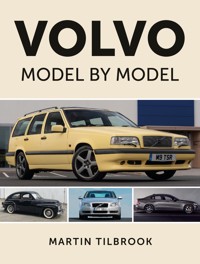
The book invites the reader, both Volvo fans and those with a more general interest in motoring – on board the company's landmark cars. Volvo Model by Model brings Volvo to life with the feel of the cars from behind the wheel, from the side-valve ÖV4 to the electric C40, with legends like the 240, the XC90 and the 850 in between. Volvo's marketing strategies from safety to sporty and back again are examined, with thoughts from contemporary road tests. So buckle up your Volvo-patented three-point safety belt, and prepare for the ride. In the 2020s Volvo is undergoing a resurgence, gaining mainstream desirability with record sales for six consecutive years. There is also huge interest in wider Scandinavian culture and design. Volvo Model by Model is a new look at the cars and cultural impact of Volvo. Always daring to be different, no other car manufacturer encapsulates its home nation so completely, accounting for one third of the Swedish dream Villa, Volvo, Vovve. Volvo started in 1927 but the open-topped ÖV4 didn't sell well in the harsh Swedish climate. This was a rare misstep, although there have some challenging aesthetics on the way like the 760. Volvo survived a failed marriage with Ford, which still produced one of the company's all-time best sellers. Volvo now has another home, China. Parent company Geely enables Volvo to freely express its Scandinavian style, and today's slick Swedes were voted the best-designed range of cars by British motorists. Concept Recharge points the way to an electric future.
Sie lesen das E-Book in den Legimi-Apps auf:
Seitenzahl: 303
Veröffentlichungsjahr: 2023
Das E-Book (TTS) können Sie hören im Abo „Legimi Premium” in Legimi-Apps auf:
Ähnliche


















First published in 2023 by
The Crowood Press Ltd
Ramsbury, Marlborough
Wiltshire SN8 2HR
www.crowood.com
This e-book first published in 2023
© Martin Tilbrook 2023
All rights reserved. This e-book is copyright material and must not be copied, reproduced, transferred, distributed, leased, licensed or publicly performed or used in any way except as specifically permitted in writing by the publishers, as allowed under the terms and conditions under which it was purchased or as strictly permitted by applicable copyright law. Any unauthorised distribution or use of this text may be a direct infringement of the author’s and publisher’s rights, and those responsible may be liable in law accordingly.
British Library Cataloguing-in-Publication Data
A catalogue record for this book is available from the British Library.
ISBN 978 0 7198 4212 2
Dedication
To Mum, Dad and Arabella. Always in our thoughts.
Acknowledgements
Thank you to the following:
Chris Wickers at Volvo Driver magazine.
Volvo Cars UK, especially Barnaby Jones and Roger Collins for sharing the heritage fleet and answering relentless questions. Andrew and Julie Anderson for sharing their wonderful cars and their kind hospitality.
Everyone at Volvo Car Corporation (‘Volvo Cars’) in Gothenburg - Eleonor Goffin for arranging a wonderful morning’s visit, Hans Hedberg for a behind the scenes tour of Volvo’s museum, Lars Gerdin for the archive images and the Brand Experience team for the fascinating tour and the very Volvo reminder to secure laptops in the car to prevent nasty accidents.
The dealers who let me loose with their valuable stock: Ray Chapman Motors Malton (XC60 I and V60 I), Hutton Bros (960), Dyrdals (XC90 I), Classic and Sports Car Centre (Amazon).
Jonathan Jacob for some fabulous photographs with minimal direction.
Martin Wilkinson, Nigel Chadwick and Đoˆ~ An Khôi for their help with the photoshoot of the XC40, XC60, XC90 and V60 and V90 at Longcross. Helen for all her support, and for sharing the Gothenburg experience. And another thank you to Martin, for helping start the whole thing rolling with his willingness to sit in a £600 Volvo for four consecutive days on that roadtrip to Geneva. Crowood for their patience and advice.
Photographic Credits
All photos are courtesy of the Volvo Car Corporation apart from the following:
Aston Martin, 75 (top); Geely, 128, 130; Jonathan Jacob, front cover main image, 37, 38, 62, 64, 65 (bottom), 89, 90, 91 (left), 122, 123, 124, 139, 141 (top), 142, 143 (top/left), 144, 145, 147, 148, 149, 150, 151, 153 (top), 154; Jaguar Land Rover, 75 (bottom); Helen Tilbrook, front cover (bottom left) 20, 47, 65 (top); Martin Tilbrook, 29 (left), 72; Volvo Bus Corporation, 85 (bottom); Volvo Construction Equipment, 86; Volvo Penta, 82, 84 (top), 85 (top); Volvo Trucks, 83, 84 (bottom). Images coming from Volvo Car Corporation are copyright protected and published courtesy of Volvo Car Corporation.
The ‘Volvo’ name is owned by Volvo Trademark Holding AB, which is jointly owned by Volvo Car Corporation (“Volvo Cars”) and AB Volvo/Volvo Group, split since the sale by AB Volvo of Volvo Cars to Ford in 1999. Where ‘Volvo’ has been used in the text this refers to ‘Volvo Cars’, with the exception of Chapter 16 which covers Volvo Group’s products.
Cover design by Design Deluxe
CONTENTS
Introduction: Vad är en Volvo?
Volvo Timeline
CHAPTER 1 EARLY VOLVOS, 1927–58
CHAPTER 2 PV444/PV544/PV445 DUETT, 1946–59
CHAPTER 3 AMAZON, 1956–70
CHAPTER 4 MOTOR SPORT, 1959–
CHAPTER 5 P1900 SPORT/1800, 1956–73
CHAPTER 6 140, 1966–74
CHAPTER 7 240: GOTHENBURG’S GREATEST, 1974–93
CHAPTER 8 GOING DUTCH, 1975–2004
CHAPTER 9 700/900: THE CAR THAT SAVED VOLVO, 1982–98
CHAPTER 10 850, S/V70 I: ALL CHANGE AT GOTHENBURG, 1991–2000
CHAPTER 11 S80 I: LAST CHANCE SALOON, 1998–2006
CHAPTER 12 THE FORD YEARS, 1999–2010
CHAPTER 13 V70 P2: ESTATE OF THE NATION, AND S60 P2, 2000–2009
CHAPTER 14 THE HEAVY SQUAD: VOLVO GROUP TRUCKS AND MARINE, 1927–
CHAPTER 15 C70, 1996–2005
CHAPTER 16 XC90 I: SWEDISH UTILITY VEHICLE, 2002–14
CHAPTER 17 C30/S40/V50, 2003–12
CHAPTER 18 CONCEPTS, 1976–
CHAPTER 19 S80 P3/V70 P3: UNSUNG HERO, 2006–16
CHAPTER 20 XC60 I: BLOCKBUSTER, 2009–16
CHAPTER 21 S60 II/V60 I/V40 II, 2010–19
CHAPTER 22 WHEN GOTHENBURG MET GEELY, 2010–
CHAPTER 23 XC90 II: A NEW ERA, 2014–
CHAPTER 24 S90/V90/V90 CC, 2016–
CHAPTER 25 XC60 II: BLOCKBUSTER II, 2017–
CHAPTER 26 XC40: TOUGH LITTLE ROBOT, 2018–
CHAPTER 27 S60 II/V60 II, 2018–
CHAPTER 28 C40 RECHARGE, 2022–
Further Reading
Index
INTRODUCTION: VAD ÄR EN VOLVO?
What, indeed, is a Volvo? If this question has been bothering you, you’ve come to the right place. But let’s be clear on one point: Volvo is different.
Superficially Volvos lack the ferocious focus of car companies born from the vision of one man: Enzo Ferrari’s obsession with racing, Henry Ford’s devotion to production efficiency and André Citroën’s infatuation with innovation. But from the start Volvo’s founders Assar Gabrielsson and Gustaf Larson embedded safety and quality into their cars.
Volvo co-founders Assar Gabrielsson and Gustaf Larson.
No other car company so completely encapsulates its native land, and vice versa. Witness the uncompromisingly rocky terrain of Torslanda, the site of Volvo Cars’ HQ. Houses are fitted around or perched on top of these immense outcrops. Even here, in Sweden’s south, night temperatures struggle to stay above freezing for four months of the year.
In short, the climate and landscape must be respected. Sharing the roads with super-size wildlife like 850kg bull elks also draws the mind away from the delights of delicate sports cars. Against this background, the 240’s no-nonsense angularity and sturdy construction start to make sense. A Volvo is the ultimate expression of Swedish reasonableness. So entrenched is Volvo in the Swedish psyche, it accounts for exactly one-third of the somewhat ironic Swedish dream Villa, Volvo, Vovve (‘House, Volvo, Dog’), alongside somewhere to live and man’s best friend.
But it’s not all sensible shoes stuff. There are subversive undercurrents, with 5-litre V8s shoehorned into innocent-looking but quietly rabid 960s and pensioner-spec 300s living second lives as drift cars. It’s not unusual to see slammed, big-rimmed V70s cruising around Gothenburg, at odds with their image in the UK. Volvo itself has an oddball sense of humour, epitomised by the collie-carrying BTCC 850 estate at Thruxton in 1994 and surreal scenes of crash dummy family outings.
A crash course in parenting.
In one of his more thoughtful moments, serial XC90 owner Jeremy Clarkson succinctly summed up the whole Volvo thing in these fifteen words: ‘Volvos are generally not that great to drive, but are, on the whole, enormously pleasant.’ In 2020 Autocar said, ‘Volvo has finally re-emerged as the cool choice for those who find German brands a touch bombastic.’
On a more personal note, when I was looking for a cheap car to get me to Geneva for a few hundred pounds, and preferably back again, I didn’t look at anything else. From ÖV4 to C40, we salute you.
Unless otherwise stated, all photographs and illustrations are from Volvo Car Corporation. Images coming from Volvo Car Corporation are copyright protected and published courtesy of Volvo Car Corporation.
VOLVO TIMELINE
1924
Volvo AB founded in Gothenburg by Assar Gabrielsson and Gustav Larson
1927
Volvo’s first vehicle, the 28bhp ÖV4, on sale. A reinforced chassis is used in 1928 for the Series 1 LV4 truck and Volvo’s first bus
1929
PV651 and PV652 deliver 55bhp. A longer PV651 wheelbase is used in 1931 for the TR671 seven-seat taxicab
1936
PV51 and PV52, the first Volvos with all-pressed sheet steel bodies
1944
PV444, Volvo’s first international success. Production delayed until 1947
1950
Volvo Construction Equipment set up after purchase of AB Bolinder Munktell
1953
PV445 chassis adapted for the Duett, Volvo’s first estate car, also available as a van
1956
120 Amazon, Volvo’s first modern four-door family car. An estate version followed in 1962
1961
P1800 introduced with 1.8-litre B18 engine. An 1800S of 1966 passed 3 million miles in 2013
1963
Volvo opens plant in Ghent, Belgium, to secure access to the EEC
1964
Main plant at Torslanda comes on stream
1966
100 series, Volvo’s first million seller, introduced with the 140
1968
Volvo Buses established
1974
200 series introduced, headed by the 240
1975
Volvo takes share in the Dutch company DAF. The first result is the Volvo 66
1982
760, ‘the car that saved Volvo’
1986
480 ES, first production Volvo with four-wheel drive
1991
850 fitted with SIPS (Side Impact Protection System)
1996
C70 convertible launched
1998
S80 introduced
1999
Ford buys rights to Volvo brand on passenger cars. AB Volvo retains commercial vehicles and non-automotive products. Ford’s recent purchases consolidated into the Premier Automotive Group (PAG)
2001
Volvo sells its interest in DAF to Mitsubishi
2002
XC90 SUV launched
2009
XC60 I mid-sized SUV goes on to sell almost 967,000 worldwide
2010
Ford sells Volvo to Geely
2011
C30 Electric tests the European market for electric cars
2016
S90s built for export in Daqing, Heilongjiang province
2017
Geely buys a $3 billion stake in Volvo AB. Launch of XC60 II
2018
XC40 mini-SUV production starts in Ghent. S60 production starts in Charleston, South Carolina
2022
C40 Recharge all-electric crossover
CHAPTER 1
EARLY VOLVOS, 1927–58
Heading north on the E6, the landscape towards Gothenburg changes from cereals to grass then forests, a lake or two and cuttings driven through rocky outcrops. You might notice that your ageing S80 negotiates anti-clockwise roundabouts just fine, instead of stumbling and cutting power as it does on a clockwise circulation. Maybe it knows it’s on home soil. Or it might be that some joker plugged the ABS into the traction control module to ward off an MoT-failing warning light. The S80, answering to the name Sven, has already shrugged off a trip to Geneva in the company of Mr Wilkinson, who features in a number of subsequent Volvo-related adventures that will be related in these pages for your convenience. Now Sven is bound for Nordkapp. Just after Ängelholm (home of Swedish supercar maker Koenigsegg), the E6 climbs 200m over the isolated Hallandsas ridge, the first hill of any sort since leaving Britain. It then carries on over miles more flat land as though nothing has happened.
PV 654 detail.
After negotiating rush-hour traffic, you’ll find Sweden’s second city buzzes with pavement cafés, restaurants and busily clanging trams. It’s a functional, working city with some pretty corners of canals, parkland and a side order of grit and grime. Gothenburg is powered by industry and creativity.
Two statues sum up the city. Evert Taube stands by the water’s edge in the harbour, looking something like a Hobbit on his way to a fishing-themed fancy dress party. It turns out Taube was one of Sweden’s most respected poets and musicians of the twentieth century, just behind Agnetha, Anni-Frid, Benny and Björn (the last of these, by the way, also born in Gothenburg, along with a whole heap of death metal groups). In contrast, in the industrial corner, the sculpture of one Charles Felix Lindberg properly depicts a Victorian shipping magnate striding purposefully on the spot for eternity with his cane, bowler hat, fearsome beard and a look to suggest that musical Hobbits had better not get in his way.
Göteborgsandan, the Gothenburg Spirit, is exemplified by both a great will and ability to cooperate between politicians, industry and academia, with an absence of politically motivated conflict. This leads to ideas: ideas like pharmaceutical giant Astra Zeneca, purveyors of vaccines to the masses, and bearing manufacturer SKF. And Volvo. Forbes ranked Gothenburg the twelfth most inventive city on the planet. That is punching well above its weight. Its two universities must help. Make that three, for Volvo runs its own. The downside is that this lack of challenge has led to charges of corruption, but nobody’s perfect.
Leaving the city behind, the old S80 steadfastly climbs the looping slip road onto the kilometre-long Älvsborg Bridge, suspended more than 45m above the Göta älv (‘River of the Geats’) with a drone’s eye view towards the home of Volvo cars and AB Volvo. Torslanda, the land of Thor, is a land of huge rocky outcrops, petrochemical plants and neatly styled running lights named after the tetchy Nordic god’s hammer. Approaching Volvo’s Torslanda plant on the aptly named Torslandavägen dual carriageway, a sign acknowledges the connection between dangerous Norse deities and safety-led car companies. ‘Volvo Torslanda Gods’, it says. To be strictly accurate, it says ‘Volvo Torslanda gods’, and is more prosaically the factory’s goods entrance. But we’ve arrived.
ÖV4, 1927–8
Volvo was actually hatched 470km north-east of Gothenburg over a lunch of crayfish at Stockholm’s Sturehof restaurant. Accounts differ. Some say suave sales director Assar Gabrielsson and rough-hewn engineer Gustaf Larson arranged to meet, others that they bumped into each other by chance. It does seem fairly certain that the idea of Volvo was born that day in August 1924. Gabrielsson had spotted an opportunity: Sweden was belatedly industrialising, including high-quality steel manufacturing, and incomes were rising. There was a fledgling market for cars. Richard Dredge states that of the 15,000 sold in Sweden in 1924, all but twenty were imported from North America. Conditions in 1920s Sweden were similar to those prevailing in the States at the time with extremely rough, potholed roads (much like twenty-first-century Britain).
The 4-cylinder ÖV4 open tourer of 1927 was Volvo’s first design.
Design of a 2-litre, 4-cylinder open car started in mid-1925. Volvo chose Skövde-based marine engine company Pentaverken to supply the 28bhp, 2-litre, sidevalve 4-cylinder engine rather than attempt in-house manufacture. The first car allegedly reversed back into the factory as the differential had been assembled incorrectly. This seems to have been a practice run, and there was time for some hasty re-assembly before the press arrived. Second time around, sales manager Hilmar Johanssen emerged gloriously into the Gothenburg sun astride the first Volvo in forward motion.
By now, Mr Wilkinson was also fully embroiled in the quest to bring almost every Volvo to life for you, with the exception of the S40 (sorry, S40 fans). Mr W is also called Martin, hence this slightly clunky exposition as the multiple Martin references might otherwise get confusing. Volvo UK’s press and heritage fleets had supplied the current cars and a good number of the earlier models for examination. The Volvo Museum and a mix of franchised and independent dealers had filled most of the gaps. Not altogether surprisingly, however, pre-Second World War Volvos are somewhat rare, especially in the UK. But Mr Wilkinson and I had heard of a mysterious Dr Double-A, head of the shadowy VOC organisation, who allegedly kept several examples captive in a secret bunker somewhere off the coast of Iceland. Doggedly, we tracked him down. It was actually quite easy. Contrary to the scenario cooked up in our overheated imaginations, Andrew Anderson turned out to be a Peterborough-based GP and a director of the Volvo Owners’ Club. His phone number is in Volvo Driver. Andrew and Julie were only too pleased to share their ÖV4, PV651, PV36 and PV60. They even gave us lunch. So here’s the procedure for starting an ÖV4, as demonstrated by Andrew after lunch. Open the tap for the gravity-fed header tank on the bulkhead. An inlet manifold vacuum pump brings fuel from the main tank. Prime the carb. Full choke to start, half choke immediately after firing (as full choke is almost all petrol). Cross fingers. But the starter grinds, and the ÖV4 settles into a strong, confident tickover.
Open the narrow, front-hinged door, somehow slide in behind the ship-sized wooden wheel and into the driver’s seat. There’s a conventional three-pedal layout, but everything else is a bit alien. It’s narrow up here, as the ÖV’s body is shaped like a boat seen from above, tapering into the bonnet. It means the windscreen is also narrow, the hood overhanging on each side. The wooden hood hoops rest on your head, which is not ideal. There’s more room behind, more width and much more headroom as the hood rises towards the rear of the car. There’s some lovely detailing. The radiator case and Volvo logo are a beautifully solid one-piece casting. Embossed leather Volvo symbols on the door pockets are another nice touch. There’s no other luggage room at all.
Underway, the hood acts as a parachute, scooping air into the car. That narrow windscreen means rear-seat passengers sit outside it. There’s no side glass. Even at 15–20mph wind chill is noticeable. You would need to be dressed up in a Swedish winter. Meanwhile, if it’s raining, the driver has to juggle driving (including double declutching) with manipulating the single manually operated wiper.
The brakes don’t, not really. They’re operated by cables on the rear wheels only. But in between bouts of fuel starvation the UK’s only ÖV4 runs very well. The engine stops until the fuel supply catches up and refills the carb, when the cycle can begin again. It gives us a few seconds for Mr Wilkinson and I to talk with Dr Double-A. A hundred metres from home, the engine cuts again. ‘No problem,’ says Andrew confidently, ‘we can coast’. The road is gently downhill all the way. We can coast. The only thing is, Andrew’s drive is uphill, and not all that gently. It becomes obvious he has no intention of pushing the Volvo into the garage. This ninety-four-year-old car, which, let me emphasise, is just six years old short of its century, swings left off the road pretty much horizontally and dives into the rack-lined garage like a Chorkie into a flower pot. A strategically placed railway sleeper stops us from crashing through the glass door into Andrew’s home office: the brakes weren’t interested in helping out. ‘That was slightly terrifying,’ I squeak. ‘Slightly?’ Martin queries, opening his eyes. ‘You guys!’ says Andrew, turning around with a grin. Maybe he does this all the time. It’s quite a party trick.
ÖV4 (Source: Volvo)
Variants
ÖV4 TV (Pick up), ÖV4 Chassis
Produced
275 (of which 205 delivered with open tourer body)
Body
Open tourer, or as a chassis
Engine
In-line 4-cylinder with side valves; 1944cc; 75 × 110mm; 28bhp at 2,000rpm
Transmission
3-speed, non-synchromesh
SKÖVDE
Pentaverken, which started producing internal combustion engines in Skövde in 1907, was taken over by Volvo in 1935. Skövde became Volvo’s first climate-neutral plant in 2018. Volvo announced an investment of SEK700 million (£55 million) in 2020 to produce electric motors for its EVs, but still supplies the now separate Volvo Group AB with diesel engines and components for trucks.
PV4, 1927–9
An ÖV4, but enclosed. A Good Idea.
PV651 AND PV652, 1929–33
The big news is that the PV651 is covered, with windows and everything. The first 6-cylinder Volvo was longer and wider than the fours. Standard versions were designated 651. Deluxe versions with hydraulic brakes were designated 652. The 3-litre side valve straight-six made a mind-blowing 55bhp, almost precisely doubling the ÖV4’s output.
The deluxe PV652 looks like a gangster car from the Prohibition era.
This 1931 PV651 came from Skellefteå Museum, and was subject to comprehensive restoration in Sweden during the 1950s. The PV651 has the look of a late Prohibition-era gangster car, sitting on wooden spoke wheels with 19-inch Dunlops and detachable rims. The body carries over the ÖV4’s boat shape, so there’s not much room in the individual front seats. The back is the place to be, in the upright, glassy, wooden-framed, metal-skinned body. It’s still very much coach-built, in the sense of coach and horses. With plush, buttoned upholstery, vases with 1950s artificial flowers and reading lights behind you, it’s like sitting in an upmarket theatre. There’s a wind-up clock. That big chromed vacuum cleaner head is the screen demister.
The front seats fold down, bridging the gap to the rear bench to make a double bed. Beautifully chunky solid metal mechanisms are everywhere, like the light switches and seat adjusters. In a bold move for luggage capacity, a big heavy luggage trunk sits on the rear rack. The bonnet-mounted chromed spotlight swivels through 360 degrees and is good for making out house numbers in the dark, apparently (or possibly interrogation). Front-mounted swing-out trafficators can’t be seen from behind due to the 651’s tapering nose.
We wait for the retro-fit electric petrol pump to stop ticking when it’s up to pressure. The 651 fires immediately off the foot-operated starter. Under way, second gear whines a bit like a Morris Marina, but this disappears in third (top). You can start off in second if you like. The old Volvo will stretch out to a slightly optimistic indicated 72km/h (45mph), but feels much happier at around 60km/h, just under 40mph. You need to keep an eye on the thermometer screwed straight into the radiator cap. The all-wheel hydraulic brakes (this 651 is something of a hybrid) make night and day difference compared to the ÖV4’s bicycle-sized efforts. That wooden-framed body shudders a little and it’s bouncy in the back, sat as you are behind the rear axle, a bit like a bus. But the PV651 feels like it will get you anywhere, if you have enough time, and unexposed to the elements.
PV651 (Source: Volvo)
Variants
PV652, PV650 Chassis, 650 Special
Produced
2,382
Body
Saloon or convertible
Engine
In-line 6-cylinder with side valves; 3010cc; 76.2 × 110 mm; 55bhp
Transmission
3-speed, non-synchromesh
PV653–659, 1933–7
Externally similar to the 651/2, but the engine was taken out to 3.2 litres, yielding 65bhp in the 653, 654 and 655. Later versions were 3.6 litres with 80bhp. The same standard/deluxe nomenclature as 651/2 applied.
PV653–9
Variants
PV653 Standard, PV654 Luxury, PV655 Chassis variant of PV653/654, PV656 Chassis, PV657 Standard, PV658 Luxury, PV659 with glass division
Produced
653 (PV653–5), 542 (PV656–9)
Body
Saloon
Engine
653–5: In-line 6-cylinder, side valves, 3266cc, 65bhp at 3,200rpm658–9: In-line 6-cylinder, side valves, 3670cc
Transmission
3-speed with free wheel, floor lever
TR671–679, 1930–35
TR701–704, 1935–7
In March 1930 Volvo introduced its first 7-seat, purpose-built taxicabs based on the PV651–655 but with longer wheelbases. Urban versions came with partitions to shield the driver from passengers overdosed on Absolut and, conversely, protect passengers from the driver’s unsolicited opinions on politics, economics and the offside rule. Rural versions came without, to facilitate goat-carrying and impromptu midwifery. TR stands for trafikvagn, Swedish for taxi. This makes sense. TR701–704 were based on the PV656–659.
PV801–810, 1938–47
PV831–834, 1950–58
Also available in chassis form, the PV800 and the PV810, the latter having a longer wheelbase. Nicknamed the ‘Sow’ (I’m not sure why), both versions could carry eight people, thanks to additional folding seats. The 821–824 versions were uprated to 90bhp.
In 1950 Volvo launched the 830 series, featuring a lower profile bonnet with headlights set back in the front wings, much like the PV444.
The PV830 Disponent of 1953 was meant for chauffeur-driven executives.
‘Disponent’ might sound like something you’d take for indigestion, but was actually a luxury version of the PV830. Launched in 1953, it was intended for important corporate visitors and came in suitably regal maroon metallic or dark blue.
The interior of the PV831, seen through the division window, shows its taxi origins.
According to Volvo, these cars were virtually impossible to wear out as taxis and a couple of them were used until the 1980s. In addition to the taxicab version, the 800 Series could be delivered as a bare chassis for use as ambulances, estate cars or small vans.
PV831–834 (Source: Volvo)
Variants
PV831 (Taxi with glass division)PV832 (Taxi without glass division)PV833 ChassisPV834 Chassis, extended
Produced
6,216
Body
7- or 8-seater taxi or chassis, for example for ambulance duty
Engine
In-line 6-cylinder, side valves; 3670cc; 90bhp at 3,600rpm
Transmission
3-speed manual, steering column gear change
PV36 CARIOCA, 1935–8
Not to be confused with boozy office party renditions of ‘Love Shack’, which is in fact karaoke, the Carioca is also confused with the 1934 Chrysler Airflow. Neither found mainstream popularity, unlike karaoke. Photos might show details like the PV36’s bullet rear lights (similar to the PV60) and art deco rear spats, but don’t convey the coherence of its gangster-style gorgeousness and stance, crouching low to the ground compared to the later PV60. It’s a very big car at 5m long and 1,660kg, but it doesn’t look that huge, again testament to its styling. Under that streamlined bonnet was the trusty 3.6-litre sidevalve straight-six.
PV36 parked outside the Röhsska Museum of Design and Art, Gothenburg, in the late 1930s.
You open the suicide front door to find a simple interior with two bench seats. There’s a huge floor-mounted gear lever, shaped like a bent S, reaching up to the wheel, mated to the three-speed gearbox with an H-pattern gate. The PV36 looks more modern than the 1946 PV60, but feels decidedly vintage, with crashes and bangs from the suspension. But I refer you back to the styling. The Carioca didn’t work out for Volvo – it took three years to sell just 500 cars – but we’re glad they tried.
PV36 (Source: Volvo)
Variants
PV 36 Chassis
Produced
500 + one chassis
Body
6-seater saloon
Engine
In-line 6-cylinder, side valves; 3670cc; 80bhp at 3,300rpm
Transmission
3-speed with floor lever
HANDBOOKS
The handbooks of these cars show the progression in attitudes and expectations of manufacturers and owners over two decades. The ÖV4’s twelve-page handbook explains what it is rather than how to use it. The PV651/2’s manual is illustrated with wiring diagrams, lubrication points and engineering cut-aways of differential and engine, perhaps in the expectation of handing the car over to a garage (or possibly blacksmith) without specialised knowledge of Volvos. Volvo were clearly proud of the PV36’s independent front suspension. Its handbook is illustrated with beautiful engineering drawings together with a wiring diagram that’s noticeably more complicated than earlier cars. By 1949 the PV60’s forty-page handbook is more like a modern ‘how to use’ guide. Some great cartoons make a serious point, such as the Grim Reaper visiting an owner running their PV60 in a garage and a man’s hat being blown off his head after taking the cap off a hot radiator. There’s a bar chart of the rising cost per kilometre with increasing speed, the bars represented by growing columns of coins. It lost the engineering diagrams, but gained some wonderful marketing illustrations, like the railway posters of the 1930s.
PV51–57, 1936–45
The PV51 launched in December 1936. Lindh states that Volvo could compete with cheaper imported cars for the first time since the 1920s. The PV51 and its deluxe version, the PV52, were the first Volvos with all-pressed sheet steel bodies. Earlier cars used a section of fabric for the roof as Volvo were previously unable to produce panels large enough for a one-piece steel roof. However, the cars were still based on a separate welded frame. Absent wheel spats aside, the PV51 carried over much of the PV36’s styling. It was narrower and lighter at 1,500kg, with the same 3.6-litre straight-six, and reverted to cheaper beam front suspension. According to Lindh, the choice of PV51 rather than the more logical 37 to follow on from the 36 was a marketing gimmick as ‘a real 5-1’ is a Swedish phrase meaning ‘spot on’.
The PV51 was Volvo’s first design with an all-pressed sheet steel body.
For the PV53–56 models, the appearance was modified with a new bonnet line and a V-shaped grille. The PV57 was also sold as a rolling chassis.
PV51–57 (Source: Volvo)
Variants
PV51 (Standard)PV51 ChassisPV52 (Luxury)PV53 (Standard with visible spare-wheel pressing)PV54 (Standard with convex luggage boot cover)PV55 (Luxury with visible spare-wheel pressing)PV56 (Luxury with convex luggage boot cover)PV57 chassis
Produced
6,905
Body
Saloon
Engine
In-line 6-cylinder, side valves; 3670cc; 86bhp at 3,400rpm
Transmission
3-speed with floor lever; optional overdrive and free wheel
PV60–61, 1946–50
Intended for 1940 introduction, but interrupted by the World War II, the PV60 was a pre-war design in terms of looks, separate chassis construction and its 90bhp, 3.6-litre sidevalve straight-six. The 60 was Volvo’s last 6-cylinder passenger car until the 164 of 1968. Industrial action delayed launch until 1946, and in the words of Classic & Sports Car, the PV60 was living on borrowed time.
Note the spotlight fitted on the driver’s side of this PV60.
The PV60 looks upright and old-fashioned compared to the Carioca. You’re sat almost XC90 high. The PV60 seats three across both bench seats. There’s a three-speed column shift, and a hand-operated throttle (in addition to the pedal), which acts like a primitive cruise control.
The sidevalve six cruises easily at 50mph, the PV feeling solid, its all-hydraulic brakes well up to modern road conditions. The ride is just fine on its 16-inch Avon HM Tourist tyres. Classic & Sports Car said ‘The PV60 is a soft-hearted easy-to-live-with old cruiser with no obvious failings.
Interior of the PV60, with the spotlight handle on the extreme left.
Suspension is soft without being wallowy, and progress is always serene and untaxing.’ Does that sound familiar?
PV 60–61 (Source: Volvo)
Variants
PV61 Chassis
Produced
3,006
Body
Saloon or chassis
Engine
In-line 6-cylinder, side valves; 3670cc; 84.14×110mm; 90bhp at 3,600rpm
Transmission
3-speed with overdrive, steering column gear change
Volvo was still a small-scale, predominantly domestic car manufacturer, selling a not very grand total of 19,114 cars in the twenty years from 1927 to 1947. It wasn’t lack of appetite for the automobile, at least on a global scale – Ford was shifting around 2 million Model Ts a year from 1923 to 1925. Ford, of course, had the advantage of the huge domestic US market. Volvo needed to be involved. The little black car that sat alongside the PV60 in Stockholm’s Royal Tennis Hall in 1944 would see to that.
CHAPTER 2
PV444/PV544/PV445 DUETT, 1946–59
The PV444, one of Volvo’s ‘Doves of Peace’, was its first car to achieve international success and its last designed before the forty-year reign of Jan Wilsgaard.
PV 445 Duett.
PV444, 1946–58
The entire Volvo group took over Stockholm’s new Royal Tennis Hall on 1 September 1944, looking ahead to the likely end of the war following D-Day in June and the continuing success of the Allies on all fronts in Europe and Asia. Alongside two new cars (Volvo’s ‘doves of peace’) Volvo exhibited everything from tanks, which seems a bit at odds with the ‘doves of peace’ theme, to tunnel-boring machinery. But the two cars, although launched within a year of each other, represented different eras. The body-on-frame sidevalve PV60 harked back to the pre-war era. The smaller and cheaper unitary, overhead-valve-engined PV444 attracted more attention. It was christened 444 as it had 40hp, four seats and four of something else. In this case, it referred to Volvo’s first 4-cylinder engine since the ÖV4, squeezing its 40bhp from 1.4 litres of B14, which corresponded to a racy specific output of 28bhp per litre, double that of the ÖV4. It might have looked small against the PV60, but the ‘little’ 444 was just 3 inches shy of that 1970s executive icon, the Granada Mk 1. It gave 8 inches away to the Granada in width, and towered 7 inches above it, which might explain the hunchback looks.
Recreation of the launch of the PV444 outside Stockholm’s Royal Tennis Hall in 1944.
Interior of the PV444.
In January 1942 the US Government froze production of private cars as efforts were directed to military vehicles. German cars had made up over 30 per cent of the Swedish pre-war car market. Much of the German automotive industry had been destroyed or diverted to armaments and would take some time to get underway again. In neutral Sweden, Volvo spotted an opportunity. Volvo enlisted Helmer Petterson to help improve their charcoal-fired producer gas units. Petterson then suggested to Assar Gabrielsson that Volvo should build a small car (perhaps it was no coincidence that he had a few ideas for one). Petterson was given the role of sounding out the market, but design began in earnest in May 1943, when a team of engineers led by Erik Jern was assigned to the project. Jern was able to commit Petterson’s ‘sometimes rather wild ideas’ to paper (Lindh).
The smaller and more economical PV444 was designed for post-war conditions.
The smaller, less resource-intensive, more economical car looked like the future in austere post-war conditions, even if Petterson’s design resembled a 1940s Ford ‘gone through a dryer’, according to a listing on www.hemmings.com. It was also a non-running prototype. Nonetheless Volvo say that 2,300 sale agreements were taken during and in the days after the exhibition at 4,800 kronor apiece. Emboldened, Gabrielsson slated a production run of 8,000 cars, although Volvo had sold a maximum of 2,000 of any single model to that point.
Britain’s unitary economy car, the Morris Minor, didn’t land at Earl’s Court until 1948. So the Volvo was pretty far ahead of its time, although its three-speed gearbox wasn’t. Production was delayed until 1947 by steel shortages, by which time the list price had increased to 6,050 kronor (the old-fashioned but larger PV60 cost 8,600 kronor). Volvo honoured the prices agreed for the cars sold in 1944.
PV444s of the 1950s featured roof-mounted indicators, which were christened ‘Fixlight’ by Volvo, although, according to Björn-Eric Lindh, everyone else called them ‘the Cuckoo on the roof’. Assar Gabrielsson was a fan, but Volvo’s engineers were less enthusiastic as drilling the necessary fixing holes in the roof increased the potential for leaks. Again according to Lindh, the device was outlawed in Sweden from 1 January 1953: citing a somewhat Trumpian conspiracy theory, Gabrielsson later claimed the United Nations had intervened to outlaw it.
Two-point seat belts were fitted in 1946, but the later three-point versions were much safer.
Set in context with most of its contemporaries the PV444 looks relatively modern, or at least less prehistoric. The windscreen was enlarged in 1954, but still consisted of two divided, flat panes for easier and cheaper repair (allegedly something of a Gabrielsson obsession) but the enlarged rear window was now one piece. Lindh relates an anecdote about the metal stamped out for the PV444’s rear window being used to make shovels at the Olofström body plant. Shovels became harder to source with the one-piece rear window but, on the plus side, it let more light into the previously claustrophobic rear.
The post-war world still used pool petrol and the magazine tests of the time noted arcane and archaic measurements like piston area per ton. Reviews found a light, uncomplicated, orthodox but thoroughly modern and efficient car. In 1956, over a decade after its launch, Autocar said the PV444 had few faults. The engine was a little noisy and rearward visibility below average, but it was a ‘thoroughly sound, inherently honest design’ with exceptionally good performance.
IT’S A GAS
Many wartime PVs ran on charcoal-fired producer gas units. Sweden has no oil, but it does have forests – lots of them. According to Low Tech




