


Erhalten Sie Zugang zu diesem und mehr als 300000 Büchern ab EUR 5,99 monatlich.
- Herausgeber: The History Press
- Kategorie: Geisteswissenschaft
- Sprache: Englisch
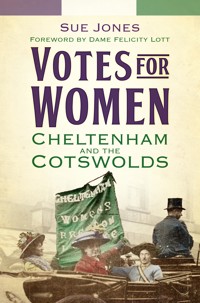
In 1918, after years of campaigning, many British women over the age of 30 gained a parliamentary vote. Cheltenham was the hub of activity in the Cotswolds, and before the First World War it had a number of vigorous societies and individuals. From being imprisoned for trying to approach the prime minister to refusing to be counted in the 1911 census, local women – and many men – from across the region fought a valiant and dignified campaign to make their voices heard. At a time when women had very little power inside or outside the home, this is the story of how they supported each other to demand a say in the affairs of the country. Richly illustrated and featuring previously undiscovered material, this is the first book to investigate the women's suffrage movement in the Cotswolds and to celebrate the many who supported the cause.
Sie lesen das E-Book in den Legimi-Apps auf:
Seitenzahl: 329
Veröffentlichungsjahr: 2018
Das E-Book (TTS) können Sie hören im Abo „Legimi Premium” in Legimi-Apps auf:
Ähnliche




















In memory of my father, Ron West, who passed on his love of local history, and of Aunty Edna who told me intriguing stories of her encounters with suffragettes.
First published 2018
The History Press
The Mill, Brimscombe Port
Stroud, Gloucestershire, GL5 2QG
www.thehistorypress.co.uk
© Sue Jones, 2018
The right of Sue Jones to be identified as the Author of this work has been asserted in accordance with the Copyright, Designs and Patents Act 1988.
All rights reserved. No part of this book may be reprinted or reproduced or utilised in any form or by any electronic, mechanical or other means, now known or hereafter invented, including photocopying and recording, or in any information storage or retrieval system, without the permission in writing from the Publishers.
British Library Cataloguing in Publication Data.
A catalogue record for this book is available from the British Library.
ISBN 978 0 7509 8713 4
Typesetting and origination by The History Press
Printed and bound in Great Britain by TJ International Ltd, Padstow, Cornwall
eBook converted by Geethik Technologies
CONTENTS
Acknowledgements
Foreword by Dame Felicity Lott
Introduction
Glossary and Abbreviations
Select Bibliography
1 ‘The Suffragette Outrage at Cheltenham’
2 The National Context and Local Beginnings
3 Suffragists in Cheltenham: The Non-Militant Approach
4 The Militants Arrive in Cheltenham
5 Cheltenham Women Fight for the Vote and Other ‘Causes’
6 Militancy and the Census Boycott
7 The Suffragettes and the Cheltenham By-Election
8 Cheltenham WSPU: The Realities of Existence as a Branch
9 Cheltenham Suffragists Expand: Tewkesbury and Winchcombe Emerge
10 Cirencester: An Uphill Struggle
11 Stroud: Two Men Lead the Way
12 ‘The Book of Revelation’ – Who Supported the Movement?
ACKNOWLEDGEMENTS
I am very grateful to the archivists and librarians in Cheltenham, Gloucester, Cirencester and Stroud, and at the Museum of London and the Women’s Library, LSE: they have all been unfailingly helpful with advice and assistance with my technical shortcomings! The archivists at both Cheltenham Ladies’ College and North London Collegiate School kindly spent much time in searching out relevant material: in turn, I hope they can use some of the information I have uncovered about their ex-pupils and staff.
Many personal friends have offered encouragement, as have a number of people I have met through local history links who have also pointed me towards other sources. I should particularly like to thank Hilary Simpson, Linda Viner and Elaine and Geoff North. Neela Mann has been invaluable in her support, practical help and detailed advice. Most of all, my husband Paul deserves huge thanks for his work on the illustrations, IT advice – and his forbearance!
FOREWORD
As I cycled daily to Pate’s Grammar School for Girls from my home in Alstone Croft, I had no idea that a cyclist from the same road was a witness to a dramatic part of the women’s suffrage story in Cheltenham. The grand house nearby, Alstone Lawn, was long gone by the time my parents bought the small house where I grew up. In 1913 it was set on fire by two members of the suffragette movement and the incident was reported by a man cycling home from work to Alstone Croft.
While Sue and I were at school together, we never learned about the women’s suffrage campaign, let alone any bits of the local story. So I have found it fascinating to find out about it and to be able to relate many parts to the area which I knew when I was young. I am so pleased to be invited to write this foreword: Sue and I took different paths, she to be a History teacher and I to be a singer, but we have remained friends all our lives.
Now we have a record number of women MPs who all have reason to be grateful to the women who protested and fought so bravely over 100 years ago against the tyranny of men!
Dame Felicity LottJuly 2017
INTRODUCTION
February 2018 sees the centenary of the first granting of the parliamentary vote to women in Britain. This was a momentous step for women, but only for some. The vote was limited to those women over 30 who were householders, the wives of householders, occupiers of property with an annual rent of more than £5 or graduates. All men over 21 were given the right to vote in the same Act; in fact, it was aimed more at them than at the women. The Act meant that not all the women who had campaigned so hard for the vote would have been granted it.
This book is an attempt to show how the local women’s suffrage movement, in all its fragmented parts, developed. Cheltenham was the centre of activities, with ‘outreach’ work to Tewkesbury and surrounding areas. However, Cirencester and Stroud had their own stories although again Cheltenham often provided the initial spur to activity. I say ‘fragmented parts’ because it is often assumed that the suffragettes were the sum total of the movement. That could not be further from the truth and in this book I aim to show the true breadth of activity, of the suffragettes (the militants) and the suffragists (the constitutionalists).
Most researchers into women’s suffrage in the early twentieth century are faced by a lack of branch and membership records. This is particularly so for the militants because many records were destroyed in order to stop them falling into the hands of the police. Reliance on newspaper accounts, both local and organisational, is necessary. However, the discovery in Gloucestershire Archives of an apparently insignificant book of signatures has transformed my study. This dusty and crumbling book contains the signatures of both leaders and foot-soldiers of the local movement in 1912. It was presented to the local MP James Agg-Gardner as thanks for his sponsoring of a women’s suffrage bill in the Commons. By cross-referencing to the 1911 census and other sources, I have been able to fill out the profiles of many of those involved and to discover many women, and men, who would otherwise have remained hidden. So much richness and detail has been added to what would have been a much more fragmentary picture.
The 1912 book of thanks to James Agg-Gardner, MP for Cheltenham, for his support for women’s suffrage. The signatures of nearly 500 men and women transformed the picture of supporters in the area. (D5130/6/6, Gloucestershire Archives)
My interest in the women’s suffrage movement was sparked by the stories an elderly aunt told me when I was a child. She had been a student at Stockwell Training College, London, from 1912–14 and had witnessed some of the suffragette scenes and been in an alleged bomb scare at a church (though I think she exaggerated all this for effect!). She had also shared a dormitory with another girl from Derby, as she was, and this girl was from a strong suffragette family.1 There was a hint that my aunt may have accompanied her to a meeting as the students were not allowed out alone.
When I took early retirement from teaching, I decided to pursue this interest and studied the movement in the North East where I was then living. This involved delving into the lives of women in mining communities and, in contrast, of those in wealthy merchant families in Newcastle. Returning to my home area of the Cotswolds a few years ago, I was keen to see what the movement was like here. Just as I had assumed that the male-oriented social and economic atmosphere of the North East would snuff out the women’s movement, I assumed that the ‘gentility’ of Cheltenham might not be conducive to feminism. I have been proved wrong on both scores! While the anti-suffrage movement was probably better organised than in the North East, particularly in Cirencester, it was still possible for women to cause a stir.
And women did cause a stir! The genteel patina of Cheltenham was rocked by demonstrations, rowdy meetings and defiance of the law. Cirencester women battled against the forces of the Bathurst family and its local political dominance and, in Stroud, the MP’s antagonism to women’s suffrage was challenged. In smaller centres such as Winchcombe, Tewkesbury and Nailsworth, women emerged who were prepared to defy the convention that only men occupied public political spaces. Spirited and determined women fought on a number of fronts and their stories are fascinating. But the role of supportive men is often forgotten in the story of women’s suffrage and they too emerge in the following pages.
_____________
1 This was Winnie Wheeldon who, with her mother and husband, was in 1917 imprisoned for attempting to poison Lloyd George as part of their pacifist agitation. There is currently an attempt to clear their names as it seems that they were ‘set up’ by a government agent.
GLOSSARY AND ABBREVIATIONS
Women’s suffrage groups:
Actresses’ Franchise League (AFL)
Conservative and Unionist Women’s Franchise Association (CUWFA) – suffragist
National Union of Women’s Suffrage Societies (NUWSS or WSS) – suffragist
Women’s Freedom League (WFL) – suffragette breakaway from WSPU
Women’s Social and Political Union (WSPU) – suffragette
Men’s Political Union (MPU)
Newspapers and Journals:
The Common Cause (CC) – NUWSS paper
The Conservative and Unionist Women’s Franchise Review (CUWFR)
The Vote – WFL paper
Votes for Women (VFW) – WSPU paper
The Suffragette – WSPU paper after 1912
Cheltenham Chronicle and Gloucestershire Graphic (CCGG)
Cheltenham Chronicle (Chronicle)
Cheltenham Looker-On (Looker-On)
Cheltenham Examiner (Examiner)
Gloucestershire Echo (Echo)
Wiltshire and Glos Standard (Standard)
Stroud News
Stroud Journal
Gloucester Journal
Gloucester Citizen
Other abbreviations
Independent Labour Party (ILP)
Cheltenham Ladies’ College (CLC)
Archives
Suffragette Fellowship Archive, Museum of London (SF Archive)
SELECT BIBLIOGRAPHY
Elizabeth Crawford: The Women’s Suffrage Movement: A Reference Guide. 1866–1928 (London; UCL Press, 1999)
Elizabeth Crawford: The Women’s Suffrage Movement in Britain and Ireland (London; Routledge, 2005)
Roger Fulford: Votes for Women ((London; Faber & Faber, 1957)
Jill Liddington: Rebel Girls (London; Virago, 2006)
Jill Liddington: Vanishing the Vote (Manchester; MUP, 2014)
Sylvia Pankhurst: The Suffragette Movement (London; Virago, 1977)
Martin Pugh: The March of the Women (Oxford; OUP, 2000)
Martin Pugh: The Pankhursts (London; Penguin, 2001)
‘THE SUFFRAGETTE OUTRAGE AT CHELTENHAM’
(Gloucester Journal, 27 December 1913)
‘ALSTONE LAWN SET ON FIRE. UNKNOWN WOMEN ARRESTED ON SUSPICION.’
Gloucestershire Echo, 22 December 1913
‘ARSON IN CHELTENHAM … UNKNOWN WOMEN ARRESTED ON SUSPICION.’
Cheltenham Chronicle, 27 December 1913
These headlines are of the kind which many associate with the struggle for women’s suffrage and they would appear to suggest that Cheltenham was in the grip of a wave of suffragette ‘terrorism’ which characterised the struggle elsewhere. This is wrong on two counts. Firstly, the incident at Alstone Lawn was an isolated one, perpetrated by outside itinerant fire-raisers. Secondly, the campaign for women’s suffrage included non-militant groups who were at least as important as the militants.
Nevertheless, headlines like this expressed the fear and outrage among many sections of society and were frequently articulated by the local and national press. So what actually happened and how was it reported?
In the early morning of Sunday, 21 December 1913, a fire was reported to the fire station in St James’ Square and to Cheltenham police. Alstone Lawn, a large but empty house in seven acres of grounds on the corner of Gloucester Road and Alstone Lane, was ablaze. The man who had seen flames darting from the roof was a gasworker, Edward Batson, who was cycling home to Alstone Croft from his job at the gasworks in Gloucester Road. He raced to the fire station in St James’ Square to raise the alarm. Such was the concern that both divisions of the brigade were ordered out and twenty men arrived to find the police already there. The house and grounds were surrounded by an eight-foot wall, some of which had an additional fence on the top and so they had to break into the stable yard and then into the house. The source of the fire was located in the wooden staircase which ran from the bottom to the top of the building. The hydrants were quickly employed, so the services of the engine were not needed and the fire was brought under control in half an hour. At 8.30 a.m., Fire Officer Such decided that the brigade could leave, though one man together with a number of police officers remained at the premises. A big hole had been made in the roof, damage was estimated at £300–400 and it was later decided that the house should be pulled down and the estate sold in small lots for further development.
What of the culprits? It was quickly established that the cause was arson, as a two-gallon oil can, still wet with paraffin, was found near the seat of the fire and it appeared that there were oil marks on the wallpaper nearby. A window to the conservatory on the ground floor was found open and, as the firemen and policemen had not used it, it was assumed that this was the method of entry. This theory was reinforced by the discovery of imprints of stockinged feet, one with a prominent large toe, on the floor of the same room. Suffrage literature was found in the grounds of the house. By 9.30 a.m., two women coming from the direction of Arle and the Cross Hands Inn were arrested in the Tewkesbury Road by Sergeant Welchman, whose suspicion was aroused by a strong smell of paraffin. It was also alleged that they had been seen by a policeman in the area of Alstone Lawn about half an hour before the fire was discovered. At the police station, paraffin was found on their stockings, boots and on the shorter woman’s cloak. Neither woman was prepared to give her name or address, they protested against ‘man-made laws’, began a hunger-and-thirst strike and were locked up.
Alstone Lawn, the magnificent though deserted house, set on fire in December 1913 by two suffragettes. (The Cheltenham Trust and Cheltenham Borough Council)
The Cheltenham firemen based at St James’ Square fire station, who dealt with the blaze at Alstone Lawn. (Cheltenham Chronicle and Gloucestershire Graphic, 6 December 1913)
At the police court appearance on the Monday morning, the women were labelled ‘Red’ and ‘Black’. As well as the unusually good photograph we have of them coming out of the police station, we have the details circulated by the police:
When arrested, one of the women, whose age is 21 or 22, and who stands 5ft 1in or 5ft 2in., was wearing a navy blue skirt with white silk blouse, a dark grey rainproof coat, and a navy blue felt hat, with silk band. She was wearing a pair of black shoes, grey gloves, and a blue woollen scarf. This woman, who is well-built, has brown hair and blue eyes, and a full face.
The second prisoner is 23 years of age and about 5ft. 3in. in height. She has a small face, with brown hair and eyes. She is very slightly built, and has prominent teeth. When apprehended she was wearing a navy blue dress, with lace on the sleeves, a red ‘Teddy-bear’ cloth coat (with large black buttons, a turned-down collar, and a strap at the back), a red felt hat with fur band, a black veil, and sized four Derby shoes.
Both were therefore well-dressed in ‘respectable’ clothes and in no way were trying to avoid notice. Much was made of their appearance and demeanour in the press, the fact that they seemed to have been in high spirits when they arrived in court (‘they bounced into the box evidently in a very happy frame of mind with themselves’, CCGG 27/12/13), that both had their hair loose (not a sign of ‘respectability’) and with some comments on who was the better-looking. The tone was of mild wonderment and, at the same time, disapproval. The local press did not report what The Suffragette newspaper said – that the police had refused to allow them shoes, stockings or hairpins, the former because they were allegedly needed in evidence, as was the coat of one of them, the hairpins presumably as they could be used to self-harm or attack others.
Lilian Lenton and her accomplice Olive Wharry, coming out of Cheltenham Police Court after being found guilty of the fire at Alstone Lawn. (Cheltenham Chronicle and Gloucestershire Graphic, 27 December 1913)
One curious aspect of the case was that the charge which was made against them included the allegation that they intended to injure the owner of the property, Colonel B. de Sales la Terriere. This would not have held up in court if the case had been argued as the house had been empty since the death of the colonel’s mother in September 1911, the contents had been sold at auction in May 1912 and the whole estate had been unsuccessfully put up for sale. The fact that the surrounding boarding fence was described as dilapidated in places added to the impression that the property was deserted and it was a typical target for the suffragettes, who never sought to hurt people, only property.
The women refused to answer to the ‘male court’ and were therefore remanded in custody. They left the police court in a taxi to the Midland Station to catch the train to Worcester, where they were to be held in gaol. Again, the local press commented on their appearance as they left the court, both barefoot and with their hair loose, and also on the fact that they were greeted by at least two lady sympathisers, one of whom, ‘in a long brown coat’, followed them to the station and was allowed by the police escorts to chat freely to them. It was noted that at both the police station and the railway station they attempted to hide their faces from photographers. One senses continuing disapproval but perhaps grudging admiration for their resolute courage from the Gloucestershire Echo and the Cheltenham Chronicle and Gloucestershire Graphic, but the Gloucester Journal was less forgiving. It spoke of ‘dastardly’ acts, ‘nefarious work’ and ‘suffragette firebrands infesting the country’.
Throughout all the reporting, it was assumed that these women were suffragettes and certainly the evidence pointed in that direction. Apparently the fire chief had even sent one of the divisions back to the fire station when he had assessed the situation at Alstone Lawn, as fire brigades throughout the country had been warned always to leave some men on duty, it being believed that ‘when Suffragettes intend to make a big attack on property by fire they will probably create a small fire elsewhere as a ruse whereby to detract the attention of the firefighters.’ This was not the case here.
The two women, ‘Red’ and ‘Black’, were released from Worcester Gaol on 25 December under the terms of the ‘Cat and Mouse’ Act of April 1913. Officially the Prisoners’ Temporary Discharge for Ill Health Act, it had been passed by a jittery government to prevent there being a suffragette death on their hands at a time when hunger strikes by the women prisoners had become a political embarrassment. Prisoners suffering from ill-health because of hunger/thirst strikes could be released on licence until they had recovered sufficiently to be imprisoned again. ‘Red’ and ‘Black’ were supposed to reappear at Cheltenham on Monday, 29 December but proved to be elusive ‘mice’, who went into hiding and whom the government and police ‘cats’ could not catch.1
A Home Office surveillance photograph of arsonist Lilian Lenton in prison, probably June 1913, before her Cheltenham offence. (Wikipedia, public domain)
It was, however, reported that fingerprints had been obtained and that it should soon be possible to identify the culprits. This seems to have been a reasonable assumption as, after the passing of the ‘Cat and Mouse’ Act, it had become more important for the police to be able to identify the ‘mice’ who had escaped or were evading recapture. Fingerprinting and covert photographing of prisoners were being developed and, in June 1913, when the young suffragette Lilian Lenton was in Armley Gaol (Leeds), a telegram was sent to the Home Office to ask whether, ‘in the Event of Liberation on Bail should photo and fingerprints be taken’ (Liddington: Rebel Girls, p.280). The prompt response was ‘Yes’, and this is the photo which was undoubtedly taken of Lilian Lenton and which was later one of a strip of photographs circulated to police forces by the Home Office. She was evidently one of the two culprits. On 9 May 1914, the Gloucester Journal reported that she had been arrested at Birkenhead and steps were being taken to bring her before the Cheltenham bench for the Alstone Lawn attack, but her continued pattern of arrest, hunger-striking, temporary release and further escape prevented this ever happening and she was still legally a ‘mouse’ when the war broke out.
Lilian Lenton was, effectively, a professional itinerant arsonist for the Women’s Social and Political Union (WSPU) as the suffragette organisation was officially known. She was involved in a number of high-profile attacks on property, notably Kew Gardens tea house. It was her near-death from septic pneumonia caused by force-feeding in Holloway Prison in February 1913 that had helped propel the government to pass the ‘Cat and Mouse’ Act. Some of the suffragettes undoubtedly embellished accounts of their activities in later years (and conversely some never spoke of them at all) but Lilian Lenton’s 1960 interview for the BBC proudly recalled that she had announced at WSPU headquarters in February 1913 that ‘I didn’t want to break more windows but that I did want to burn some buildings,’ so long as ‘it did not endanger human life other than our own’ (transcript, Museum of London, Suffragette Fellowship collection). She recalled that ‘my object was to burn two buildings a week’. What drew her to Cheltenham and Alstone Lawn cannot be known although her parents were living in Bristol at this stage, but she must somehow have acquired the knowledge of the empty property and one wonders whether this was via a very local informant.
Kew Gardens teahouse after the fire caused by Lilian Lenton and Olive Wharry, February 1913. (Postcard, author’s collection)
It is likely that the other woman was Olive Wharry. She had been jointly charged with Lilian Lenton for the Kew Gardens fire and was responsible for a number of other incidents, sometimes going under the alias Joyce Locke or Phyllis North. The daughter of middle-class parents and a few years older than Lilian Lenton, she was at least as determined as her ultimately more famous companion and has left a revealing scrapbook, now in the British Library, of her time in Holloway Prison earlier in 1913. During this time, she purports to have been on hunger strike for thirty-one days and to have lost over two stone in weight.
The story of the Alstone Lawn incident is interesting in its own right, for the light it sheds on the effect of WSPU militancy on a local area and on aspects of the national campaign. However, two fascinating intersections with other parts of the Cheltenham women’s suffrage movement occur in this story. When ‘Red’ and ‘Black’ were brought before the court in December 1913, on the bench was Alderman Margrett, who had proved himself to be a supporter of the women’s suffrage cause over a number of years, but of the non-militant wing of the movement. This confrontation with women whose objective he supported, but whose methods he did not, must have tested his professionalism.
Perhaps more intriguing because he chose to put himself in that position, rather than found himself there as Alderman Margrett did, is the appearance in court in January 1914 of the Cheltenham solicitor Dr Earengey. He was a very prominent supporter of other women’s suffrage organisations and his wife led the Women’s Franchise League in Cheltenham. Much more will be said about them in later chapters. Dr Earengey was appearing for an agent of ‘Red’ and ‘Black’ to request the return of money and jewellery which had been taken from them on their arrest. He pointed out that it was acceptable that clothing and shoes might be needed for forensic purposes but saw no reason for the retention of the other items, particularly as the jewellery had belonged to the mother of one of them. He promised to hand over the money and articles to the women or to someone authorised to pass them on. However, he failed in his plea because he did not know the names or whereabouts of the women and had no proof of being appointed to act on their behalf. Superintendent Hopkins also made it clear that, if found guilty, the money found on them might be held against the costs of the trial or the damage to the property (Gloucester Journal 17/01/14).
The position of Dr Earengey was ambiguous – who was the ‘agent’ who had approached him to appear before the court? Had he fully considered how his appearance on behalf of the two women might be construed by his fellows in the non-militant movement? The last question is perhaps partly answered by the somewhat unusual, and perhaps unpremeditated, exchange between him and the chairman at the end of the proceedings:
Dr Earengey: I would like to ask the indulgence of the Court one moment longer, and to say that so far as I am concerned in the application this morning, I appear simply as an advocate … I should like to add that, so far as I am concerned, I entirely reprobate the proceedings which have taken place, and which led to the arrest of the two women.
Chairman: We don’t doubt that.
Dr Earengey: I wished to make that statement because sometimes one’s attitude is misconstrued.
This statement attempted to clarify his position.
The drama of the fire at Alstone Lawn and its perpetrators was not typical of the women’s suffrage movement in the Cotswolds, and it can be argued that the spectacular events had less overall impact on people’s views than the unspectacular – although most of the press would wish to believe otherwise. Whichever is the case, in the course of exploring what happened in the area, one encounters women of great character and perseverance, and seams of activities and opinions of fascinating richness. It is these which are explored in the following chapters.
_____________
1 There is a 1960 interview with Lilian Lenton in the BBC archives where she describes being driven from Cheltenham to a house in Birmingham on Christmas Day 1913, and managing to evade the Birmingham police who arrived too late to observe her escape. She had obviously forgotten that she had been in gaol in Worcester rather than in Cheltenham.
THE NATIONAL CONTEXT AND LOCAL BEGINNINGS
As the new century dawned in 1900, there was much anticipation of new political directions. The embryonic Labour Party was in the process of being formed with the objective of getting working men’s representatives in Parliament. Also, the women’s suffrage movement was about to take a leap forward with the formation in 1903 of the Women’s Social Political Union (WSPU). So, although in many ways, my decision to look at the local women’s suffrage movement from 1900 might seem an arbitrary one, it has the merits of reflecting the national scene. In the case of Cheltenham, it reflects the fact that a women’s suffrage society had just been re-formed and was slowly gaining support.
National anxieties
Yet these were not wholly optimistic times: the Boer War was bitterly dividing public opinion to the extent that political parties and many communities experienced real anguish. Revelations of army brutality and the setting up of British concentration camps caused opponents of the war to vent their disgust while those with a strong imperialist or nationalist belief tended to support British action. The two future leaders of the women’s suffrage movement, Millicent Fawcett and Emmeline Pankhurst, were also on opposing sides. An example of the intensity of feeling is Mrs Pankhurst’s youngest daughter, Adela, having a book thrown in her face at school because of her mother’s criticism of British policy (Liddington: Rebel Girls p.2). In a town such as Cheltenham, with its strong army and colonial presence, these tensions were undoubtedly present.
The war also revealed dire statistics about the physical health of the nation: the army attracted many volunteers but approximately one third of them were rejected on grounds of slight stature or physical problems. This raised questions about working-class lifestyles, their economic well-being and, amongst some commentators, about the role of mothers in providing the nation with healthy young men (and women!). These questions about national poverty had been raised previously by investigators such as Charles Booth in London and Joseph Rowntree in York, but the politicians only really took notice when the impact of poverty on foreign/imperial policy became apparent. As a result, the years before the First World War saw the beginnings of the welfare state with the introduction of school medical inspections, free school meals, old age pensions and National Insurance to provide sickness benefit and unemployment benefit to some groups of workers.
This is important for understanding the debate about women’s suffrage, as many of its opponents argued that a woman’s role was clearly domestic; her energies should be concentrated on ensuring that she managed the household efficiently and wisely and brought up healthy children to serve their country. However, these arguments were clearly directed primarily at working-class women and few campaigners argued for the immediate enfranchisement of that group. The argument that women as ‘angels of the home’ contributed something different from men could be used to support both sides of the debate, either that this was where they should remain, or that they could bring their unique contribution to the realm of public affairs.
With the death of Queen Victoria in January 1901, the nation was also plunged into some uncertainty. Nevertheless, the whole tone of Edwardian England was still set by a consciousness of imperial glory and by a very wealthy elite who dominated society and, if they were male, politics. The campaigns of the women had to unsettle this cosy elite, and it is testimony to their success that they were able to break into some of these circles and recruit supporters from the aristocracy.
Women’s position in society
There had been some progress in women’s position in society in the last half of the nineteenth century. Some had been legal progress, such as the right to divorce (1857), the right to retain ownership of her own property gained either before or after marriage through the Married Women’s Property Act of 1884, and limited rights for married women over their children in 1886. Some were social: at long last there were academic schools for girls such as Cheltenham Ladies’ College, women had finally been allowed to qualify as doctors in 1876 and there were 212 of them by 1901 (and many became involved in the women’s suffrage movement, particularly in Cheltenham), universities were opening to women and some even allowed them to be awarded degrees! The hated Contagious Diseases Acts, which subjected women to humiliating medical examinations and had been the subject of perhaps the fiercest campaign, were repealed in 1886.
Some gains were political – in 1869, single women ratepayers were given the right to vote in municipal elections. This was extended in 1894 to all women property-owners, and women could also become Poor Law Guardians and be elected to school boards. Women Poor Law Guardians were selected in both Cheltenham and Cirencester, making women’s presence felt in the towns. These measures gave many women a taste of political participation and contributed to the argument that, if they were allowed to exercise this power, why could they not have the parliamentary vote? The response was often that women were able to experience the working of a town council, a local school or poor law supervision but could not gain experience or understanding of imperial or military matters, which many saw as the most important function of government. The fact that many men did not have this experience either was brushed aside, as was also the fact that many women whose fathers or husbands were in the army or colonial service did have some understanding, albeit at second hand.
It is clear that most of the above gains benefited middle- and upper-class women, and most of the women’s suffrage proposals were to benefit the same groups. But this is not to detract from the urgency with which women who had tasted these relative freedoms sought further change – and Cheltenham in particular had many women of this kind. It was a town with many female heads of household, either wealthy in their own right or the widows of wealthy husbands. The presence of Cheltenham Ladies’ College meant that there were also many educated women with ambitions for their pupils.
It is often not realised that only about 60 per cent of men had the right to vote in the early twentieth century. Those disqualified included men receiving poor relief, those who rented rooms below £10 a year, those who moved house often1, men who lived with their parents, live-in servants and soldiers living in barracks. Most women’s campaigns demanded equality with the existing male qualifications. The case for universal suffrage, the vote for all men and women, was much harder to present to an essentially conservative elite and even the newly formed Labour Party was divided on the issue
Background of the Women’s Suffrage Movement
During the second half of the nineteenth century, the demand for women’s suffrage was very much integrated into a movement demanding a number of reforms to improve the status of women. These included entry into the medical profession, higher education and the right of married women to own property. As has been seen above, much of this was achieved, but not without a determined and well-organised fight. However, many women argued that, with the vote, they could have influence on a wider range of issues that affected women and so it should be their priority.
From the 1860s, both a national framework and local societies were set up but there were a number of splits and splinter groups and the London bases found it hard to liaise with the regional groups and vice versa. The nature of their campaigning was focused primarily on achieving support of individual members of Parliament in order that a private member’s bill might be successful. Petitions and debates with politicians were the order of the day.
Stroud, the 1866 petition and an outraged Queen!
The first significant petition was presented to Parliament in 1866 by the MP and philosopher John Stuart Mill. It contained 1,499 signatures (1,521 according to a parliamentary re-count!) of women from a wide range of backgrounds, collected via friends’ networks. In the Cotswolds, there were thirty-one signatories from Stroud and its immediate area, a healthy number from such a small town, and one from Cirencester! There were none from Cheltenham, Gloucester or anywhere else in the county until one reaches Bristol. The sole representative from Cirencester was the Rev. Thomas O. Daubeny, who in the 1871 census was living at Perrotts Brook, with his wife, three children and three servants, and was Vicar of Poulton. One can imagine that one of the organisers or leading lights must have been a personal friend.
Analysis of the Stroud area signatories is interesting. Twenty-three of the thirty-one have been identified through the 1861 and 1871 census material. (Age given is that in 1866, when the petition was presented.)
Stroud signatories to 1866 Petition
What emerges seems to be a random collection of people with little in common in terms of occupational background, but occasional neighbourhood links! Did they have some religious affiliation in common? Children from families who attended the dissenting Lady Huntingdon’s Connection Chapel run by Mrs Jacob’s husband might well have been pupils at the British School where Mrs Webb taught, for example. However, it has been suggested that the signatures were collected through the efforts or influence of Lady Kate Amberley, who was then living at Rodborough Manor. She and her sister, Rosalind, the Countess of Carlisle, were fervent women’s rights campaigners. Lady Amberley moved in a circle of women radicals (usually Liberal) including the first woman doctor, Elizabeth Garrett Anderson, who became her own doctor. Her campaigning, particularly a very famous speech in Stroud in 1870, earned her a biting attack from Queen Victoria.
The audience who came in 1870 to hear Lady Amberley deliver a lecture on the rights of women was more ‘respectable’ than ‘cloth-capped’ which perhaps explains why, according to her journal, there was hardly any applause and her speech seemed to ‘fall very flat’. By that date, she had apparently managed to recruit only twelve members to form a local Suffrage Society.6 Moreover, a woman addressing a public platform in 1870 was still highly controversial. Could a woman lecture and still remain a lady? Local landowner and JP, Sir John Dorington of Lypiatt Park, took the chair, lending the meeting respectability but, while her speech was accepted peacefully in Stroud, it caused an uproar elsewhere. The Letters page of The Times was buzzing with argument and counter-argument. But Queen Victoria’s comments to Sir Theodore Martin, the official biographer of Prince Albert, were stinging. She wrote, ‘The Queen is most anxious to enlist everyone who can speak or write or join in checking this mad, wicked folly of Women’s Rights, with all its attendant horrors, on which her poor feeble sex is bent, forgetting every sense of womanly feeling and propriety. Lady Amberley ought to get a good whipping’ (Sir Theodore Martin: Queen Victoria As I Knew Her, p.69). These comments were not revealed until forty years later, but the sentiments would have been shared at this date by many thousands of women.
Cheltenham’s early experience
The Cheltenham experience was typical of the national mixture of impetus and decline. A branch of the National Society for Women’s Suffrage was set up in 1871, one of only twenty-one in the country. It is fascinating that the first branch secretary was Mrs Eliza Griffith, wife of the minister of Bayshill Unitarian Chapel, and a link with this chapel was maintained right up to 1914, albeit through two different ministers.7 The treasurer was Mrs Eliza Robberds, the wife of another retired Unitarian minister. A similar early Unitarian link is seen in Cirencester through the person of Rev. Austin, minister of the chapel there.
Meetings were held but it is difficult to establish how frequent these were and how far they were initiated by local women, as the leading speakers were often national figures or from the larger and more forceful Bristol movement. Petitions were collected and presented, those of 1869 and 1871 being presented to Parliament by their Liberal MP Henry Samuelson, and a ‘memorial’ demanding equality for women ratepayers was drawn up in 1880 to be presented to Gladstone by a deputation from the town.




