


6,99 €
Mehr erfahren.
- Herausgeber: Open Book Publishers
- Kategorie: Geisteswissenschaft
- Sprache: Englisch
From ‘folk devils’ to ballroom dancers, Waltzing Through Europe explores the changing reception of fashionable couple dances in Europe from the eighteenth century onwards.
A refreshing intervention in dance studies, this book brings together elements of historiography, cultural memory, folklore, and dance across comparatively narrow but markedly heterogeneous localities. Rooted in investigations of often newly discovered primary sources, the essays afford many opportunities to compare sociocultural and political reactions to the arrival and practice of popular rotating couple dances, such as the Waltz and the Polka. Leading contributors provide a transnational and affective lens onto strikingly diverse topics, ranging from the evolution of romantic couple dances in Croatia, and Strauss’s visits to Hamburg and Altona in the 1830s, to dance as a tool of cultural preservation and expression in twentieth-century Finland.
Waltzing Through Europe creates openings for fresh collaborations in dance historiography and cultural history across fields and genres. It is essential reading for researchers of dance in central and northern Europe, while also appealing to the general reader who wants to learn more about the vibrant histories of these familiar dance forms.
Das E-Book können Sie in Legimi-Apps oder einer beliebigen App lesen, die das folgende Format unterstützen:
Veröffentlichungsjahr: 2020
Ähnliche



















WALTZING THROUGH EUROPE
Waltzing Through Europe
Attitudes towards Couple Dances in the Long Nineteenth Century
Edited by Egil Bakka, Theresa Jill Buckland, Helena Saarikoski, and Anne von Bibra Wharton
https://www.openbookpublishers.com
© 2020 Egil Bakka, Theresa Jill Buckland, Helena Saarikoski and Anne von Bibra Wharton. Copyright of individual chapters is maintained by the chapters’ authors.
This work is licensed under a Creative Commons Attribution 4.0 International license (CC BY 4.0). This license allows you to share, copy, distribute and transmit the text; to adapt the text and to make commercial use of the text providing attribution is made to the authors (but not in any way that suggests that they endorse you or your use of the work).
Attribution should include the following information:
Egil Bakka, Theresa Jill Buckland, Helena Saarikoski and Anne von Bibra Wharton (eds.), Waltzing Through Europe: Attitudes towards Couple Dances in the Long Nineteenth-Century. Cambridge, UK: Open Book Publishers, 2020, https://doi.org/10.11647/OBP.0174
Copyright and permission for reuse of many images included in this publication differ from the above. Copyright and permissions information for images is provided separately in the List of Illustrations.
In order to access detailed and updated information on the license, please visit
https://doi.org/10.11647/OBP.0174#copyright
Further details about CC BY licenses are available at https://creativecommons.org/licenses/by/4.0/
All external links were active at the time of publication unless otherwise stated and have been archived via the Internet Archive Wayback Machine at https://archive.org/web
Updated digital material and resources associated with this volume are available at https://doi.org/10.11647/OBP.0174#resources
Every effort has been made to identify and contact copyright holders and any omission or error will be corrected if notification is made to the publisher.
ISBN Paperback: 978-1-78374-732-0
ISBN Hardback: 978-1-78374-733-7
ISBN Digital (PDF): 978-1-78374-734-4
ISBN Digital ebook (epub): 978-1-78374-735-1
ISBN Digital ebook (mobi): 978-1-78374-736-8
ISBN XML: 978-1-78374-737-5
DOI: 10.11647/OBP.0174
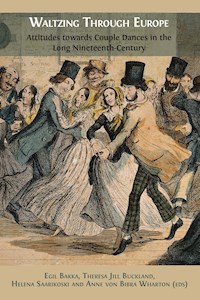
Cover image: A Drunken Scene in a Dancing Hall with a Sly Customer Eyeing a Young Girl (1848). Coloured etching by G. Cruikshank, after himself. Wellcome Collection, CC BY 4.0. Cover design: Anna Gatti.
Contents
Preface
vii
1.
The Round Dance Paradigm
Egil Bakka
1
2.
The State of Research
Egil Bakka
27
3.
A Survey of the Chapters in the Book
Egil Bakka
53
4.
The Waltz at Some Central European Courts
Egil Bakka
63
5.
The Polka as a Czech National Symbol
Daniela Stavělová
107
6.
Decency, Health, and Grace Endangered by Quick Dancing? The New Dance Style in Bohemia in 1830
Dorota Gremlicová
149
7.
Reception of Nineteenth-Century Couple Dances in Hungary
László Felföldi
177
8.
The Waltz among Slovenians
Rebeka Kunej
239
9.
Dancing and Politics in Croatia: The Salonsko Kolo as a Patriotic Response to the Waltz
Ivana Katarinčić and Iva Niemčić
257
10.
Waltzing Through Europe: Johann Strauss (the Elder) in Hamburg and Altona in 1836
Jörgen Torp
283
11.
Continuity and Reinvention: Past Round Dances in Present Estonia
Sille Kapper
317
12.
The Ban on Round Dances 1917–1957: Regulating Social Dancing in Norwegian Community Houses
Egil Bakka
343
13.
Dance and ‘Folk Devils’
Mats Nilsson
375
14.
Nostalgia as a Perspective on Past Dance Culture in Finland
Helena Saarikoski
395
15.
A Twenty-First Century Resurrection: The Potresujka, the Croatian Polka Tremblante
Tvrtko Zebec
417
List of Illustrations
433
Contributor Biographies
449
Index
453
Preface
This collection of essays is the result of several meetings, conducted over many years, of the international research group, the Sub-Study Group on Round Dances — 19th Century Derived Couple Dances. Operating within the Study Group on Ethnochoreology, under the auspices of the International Council on Traditional Music (ICTM), this collective was launched in 2002 at the 22nd Symposium of the Study Group on Ethnochoreology, Szeged, Hungary. It was initiated by Norwegian ethnochoreologist and dance historian Egil Bakka, who not only remained as its secretary and chair throughout but also led this research and editorial project.
The initial meeting was held in Prague (3–6 April 2003) and hosted by Daniela Stavělová and Dorota Gremlicová at the Academy of Performing Arts. The participants were: Anca Giurchescu, Anna Starbanova, Dalia Urbanavičienė, Daniela Stavělová, Dorota Gremlicová, Egil Bakka, Elsie Ivancich Dunin, Eva Kröschlova, Iva Niemcic, László Felföldi, Mats Nilsson, Rebeka Kranjec, and Theresa Buckland. Grażyna Dąbrowska and Aenne Goldschmidt contributed material to the meeting, even though they were not able to be present.
The group elected to work on and contribute material to four parallel tracks:
Analysis and classification of round dance movement patterns, including musical parameters.
Dancing masters/dance teachers and their material on round dances.
Political, ideological and socio-cultural discourses on round dances.
Organisational contexts for round dances.
Work continued on all four tracks at each of the subsequent meetings (2002–2016) with the intention to publish a monograph. It became clear, however, that track three presented the most fruitful theme to prioritise for publication of shared findings.
This edited collection could not have been realised without the generous help and support of a number of different colleagues and institutions in hosting our meetings which enabled work to be shared in person and our discussions to progress. These include: The Academy of Performing Arts, Prague, Czech Republic, April 2003, May 2011, December 2012; The Council for Protection of Ethnic Culture, Vilnius, Lithuania, October 2003; Elsie Ivancich Dunin in her home in Zaton in the Dubrovnik area, Croatia, June 2004; The Institute of Ethnology of the Academy of Sciences in Prague, September 2004; The Folk Dance Department of the Hungarian Academy of Sciences in Budapest, June 2005; The Institute of Ethnomusicology, Scientific Research Centre of the Slovenian Academy of Sciences and Arts in Ljubljana, April 2006; The Academy of Performing Arts, Prague, Czech Republic, October 2007; The Tanzarchiv, Leipzig, February 2007; The Voivodeship House of Culture in Kielce, Poland, November 2009; Institut za etnologiju i folkloristiku in Zagreb, Croatia, October 2009; The Council for the Protection of Ethnic Culture, Vilnius, Lithuania, May 2012; and the Institute of Ethnomusicology of the Scientific Research Centre of Slovenian Academy of Science and Arts, November 2016. Participants also took advantage, where practicable, of the symposia and conferences held by the parent Study Group on Ethnochoreology and the ICTM. In 2005, the Sub-Study Group gave a panel presentation on selected research outcomes to date at the 38th World Conference of the ICTM.
In addition to the authors and editors listed as contributors to this volume, several other members from the Study Group on Ethnochoreology have attended meetings and contributed to the research project. We would like to thank Aenne Goldschmidt, Anca Giurchescu, Anna Starbanova, Eva Kröschlova, Gediminas Karoblis, Grażyna Dąbrowska, Judy Olson, Kateřina Černíčková, Katerina Silna, Lisa Overholser, Marianne Bröcker, Mirko Ramovš, Vaida Naruševičiūtė, and Volker Klotsche.
Our grateful thanks are due to the Faculty of Humanities, Norwegian University of Science and Technology (NTNU) and to the Norwegian Council for Traditional Music and Dance for their generous financial assistance in supporting the publication of this project.
We also wish to express our appreciation to the International Council for Traditional Music and the Study Group on Ethnochoreology for the organizational framework in which we have carried out our research and for granting us permission to use its logos on this publication.
Throughout the book, links and QR codes allow readers to view samples of the dances discussed. In order to access these recordings, follow the links or scan the QR code which appears alongside the relevant link. The editors want to stress that the many video examples given are a selection of what is available on the internet, we have not had the means to take material from specialised archives. We have selected material that gives an impression of the dance forms. It may not always do justice to the forms in terms of historicity, or quality of dancing. For more video links and further discussion, please see the additional resources tab on the listing for this book on Open Book Publisher’s website (https://www.openbookpublishers.com/product/995).
Egil Bakka, Theresa Buckland, Helena Saarikoski, and Anne von Bibra Wharton
1. The Round Dance Paradigm
Egil Bakka
© Egil Bakka, CC BY 4.0 https://doi.org/10.11647/OBP.0174.01
This book explores the European phenomenon of rotating couple dances, such as the Waltz and the Polka, which, for much of the nineteenth century, were collectively known as round dances. My introduction is divided into three sections: the first presents a brief survey of round dances as dance structures and forms, proposes terminological approaches, and discusses how the dances were situated historically and geographically. The second section reviews the current state of knowledge and research with reference to selected principal works, before the third and final section introduces and contextualises the new studies of round dances that constitute the main body of this book.
Structures and Forms — Geography and History
Round dances are a group of dances that rose to fame with the Waltz around 1800 and stayed in fashion until the end of the nineteenth century. Although they had lost their fashionable status by the twentieth century, some of these dances remained popular in many countries alongside the new African-American1 dances such as the Tango and Foxtrot throughout the twentieth century. The round dance group includes dances such as the Waltz, the Polka, the Mazurka, and the Schottische, many of which are recorded in the manuals of dancing masters, but there are also forms that developed and spread independently from the masters.2 Much of the material about these dances is available to us through their continued practice, as well as in documentation, such as films, mainly from the twentieth century. This can augment historical sources. We contend that the round dance group has a profile that allows us to delimit and study it as a relatively cohesive phenomenon in terms of structure and form. The way it is situated historically and geographically also contributes to its cohesiveness.
This does not mean that the term ‘round dance’ exists wherever these dances are performed; nor are they always understood as a group. The aim of this section is to describe and discuss this contended cohesiveness and to enable the reader to understand the various dance practices whose reception is scrutinised in this book. The authors are all European and write about European countries, and, for the sake of making the task manageable, the book is restricted to Europe. There is a vast amount of material about round dance forms outside Europe, as well as non-European descriptions of and reactions to them. They spread very rapidly to the Americas and Australia but also to other parts of the world that had large diasporas or populations of European descent. However, this discussion lies outside the scope of the present volume.
Structure of the Material
Round dances as considered here constitute a repertoire of social dances practised in most countries of Europe, and our diverse group of contributors generally write about the countries from which they come.
To name cultural elements is a very complex process, not least when colloquial terms and expert terminology meet in a historical context. To describe and discuss a large body of dances, it is necessary to establish sharp and well-defined terminology. What we propose here does not aim to be universally applicable, but it will offer a way of defining, thinking about and understanding the movement material3 we are going to discuss.
Dance Type — Realisation — Concept — Event
The term dance type will be used to mean a movement pattern that reoccurs during the social dances of a community. Typically, this refers to the dances in a local repertoire, for instance, the Waltz, the Polka, the Mazurka, and the Schottische. The community members conceive each reoccurrence as a realisation of the same dance and usually identify the pattern by a name, ‘they dance the Waltz again’. In simple terms, the dance types in a local community are the dances for which the locals have names. By starting at this level, and the names used in such a context, we have a concrete and precise point of departure for developing grounded definitions.
The community members will often consider similar dance forms in other communities as the same dance type as theirs. Researchers can base similar contentions upon more careful analysis, with more systematic tools to survey larger amounts of data. Then they can use the term dancetype in their research terminology, considering many local dance types to belong to a regional dance type in order to systematise variation within a geographical area. In Norway, the local types of Mazurka on the eastern side of the country are distinctively different from the local types in other areas, so they represent different regional types. Waltz, Vals or Walzer might be the name for an item in a local repertoire, but it can also be used as a research term for an internationally known dance type with shared characteristics and patterns of variation.
The term realisation will be used for the actual dancing of a certain local dance type. So, when Peter dances a local Polka type three times at a dance party, and considers them all to be the same Polka, he has danced three realisations of the local Polka. The term dance concept will be used to mean ‘the potential of skills, understanding, and knowledge that enables an individual or a dance community to dance that particular [local dance type] and to recognise and relate to each particular realisation of it’.4 It is Peter’s dance concept (his skills and knowledge about the Polka) that enables him to dance the Polka in accordance with his own and his fellow dancer’s understanding of what a Polka is. The concept usually includes variations, so that even if Peter dances a bit differently each time, he and the others still consider it to be the local Polka.
The dance parties are typical examples of dance events for social dancing, and when we talk about the reception of the round dances, we do not refer to the dance movements or music as independent ‘texts’ standing on their own. The places, occasions, intentions and whole layout of their realisation make up the complete texts with which we must engage, as argued by Owe Ronström.5 This book will focus on events at which a group defined by their social class, their geographical situation or regular interaction of other kinds come together to dance for pleasure or to fulfil their social duties. There are, of course, dance events that treat dance theatrically, and dance events where theatrical elements and non-theatrical dancing merge in many ways. Our focus here is on dance events that do not split the practitioners formally into audience and performers. Here, realisations play out through named dances, and, in accordance with the conventions of the ruling dance concepts, their constraints can operate differently. At the dancing master’s ball, the master tries to impose his conventions and a strict layout as best he can, but when the peasants dance outdoors, the realisations are still based upon valid dance concepts and the layout of conventions. The latter might be more flexible and less strict, and the consequences for breaking some of them might be less, but they still depend upon the unwritten norms of the group in question.
Dance Form — Dance Paradigm
The term dance form will be used to mean the total content of movement and music, of a dance realisation or a local dance concept or dance type, including all the constituent elements and their interrelations.
We will apply the term dance paradigm to the phenomenon we are investigating, i.e., round dances. I originally proposed to use this term to signify a set of basic and constitutive conventions that govern the organisation of a specific kind of dancing and provide an ongoing basis for its practice.6 I suggest that the following criteria constitute a new dance paradigm:
When a set of conventions for the design and organisation of dancing are so radically different from what is already in use that they are perceived as something completely new in the place where they take root.
When the set of conventions is stable enough to remain in use over a long period of time, for instance half a century, and is inspirational and fruitful enough to give rise to a large number of dances.
When a group of characteristics can be used to define which dances belong to the paradigm, although no characteristic is necessary or sufficient to include all dances of the paradigm (polythetic classification).
7
Not all dance forms necessarily belong to a specific paradigm. Each realisation needs to be assessed to determine whether it is an instance of a certain paradigm.
This book deals with a dance paradigm that conquered a large number of European dance floors and dance spaces and became dominant during the nineteenth century: the round dance.
Oskar Bie divided the history of European fashionable dancing—as promoted by the dancing masters—into three eras: Italian styles held sway until the early seventeenth century; French and English dances were dominant until the beginning of the nineteenth century; and, finally, German and Slavic styles were preeminent until the start of the twentieth century. This model has certain similarities with our paradigm model, in that we argue the round dances sprang from German and Slavic roots in the nineteenth century.8 Common roots or origins could, in fact, be seen as another criterion for dance paradigms, although we do not adopt it here.
In conclusion, we deal with the round dances as social dances, whether in the ballrooms of the upper classes, in the hands of the dancing masters or at the parties among the lower classes, and the term dance type links them to their concrete use at any kind of dance party. We then place large numbers of similar dance types into groups at regional or international level, in order to survey the material. The third level is the paradigm, and we do not use terms such as dance families or dance genres in a specific way.
It seems often to be assumed that dances either develop thanks to an inventive genius, or else one established dance form metamorphoses into the next. When studying the often-mythical stories of origin, as well as the written sources that describe how new dances come into being at certain points in time and space, it is easy to reach such a conclusion. However, when we dig into the actual movement structures of which dances consist, we see reoccurring basic elements and techniques that shape the paradigm. Some of these have generative potential: that dancers discover and use to create new variants, new types and, eventually, perhaps even new paradigms. The couple-turning technique I shall discuss next represents this kind of generative potential.
Characteristics of the Round Dance Paradigm
The contributors to this book started out with a working definition, based on a small set of tentative criteria, to delimit the core of the round dance genre. The aim was to try to identify essential material — such as descriptions, films and notations — and to find similarities across Europe, rather than differences. These were the preliminary criteria upon which we agreed:
One couple can realise a complete version of a dance.
Couples turning along a circular path is a major characteristic of round dances.
Couple-turning in which both partners face each other is a major characteristic of round dances.
Our focus will be on unregulated
9
dances with many melodies. We consider one-melody/regulated (sequence) dances to be a separate group, outside but nonetheless connected to the round dances, and we do not look closely at dances of this type.
10
Fig. 1.1 Video: The folk-dance group Springar`n at Ås, Norway dancing the Waltz to Enebakk Spelemannslag. Note how the couples dance counter-clockwise on an approximately circular path: this is typical for round dances. ‘Vals og Folkedanslaget Springar`n sin avslutning i HD format’, 7:08, posted online by Svein Arne Sølvberg, Youtube,12 May 2010, https://www.youtube.com/watch?v=LolpphyIWS8
Fig. 1.2 Victor Gabriel Gilbert, The Ball or an Elegant Evening, c.1890, showing couples dancing on a mostly circular path turning counter-clockwise. Wikimedia Commons, Public Domain, https://commons.wikimedia.org/wiki/File:Une_soir%C3%A9e_%C3%A9l%C3%A9gante_par_Victor_Gabriel_Gilbert_(A).jpg
Fig. 1.3 Video: The Klapptanz is a typical one-melody dance found in similar versions in many countries; this example is performed by a folk-dance group in Brazil wearing traditional German or Austrian dress. ‘Klapptanz’, 1:20, posted online by Stefan Ziel, Youtube, 17 August 2009, https://www.youtube.com/watch?v=aJ6CVIAn5u0
Fig. 1.4 The Hombourg Waltz, with characteristic sketches of family dancing, 1818. The two couples show the position of the feet when waltzing. Coloured engraving, British Cartoon Prints Collection (Library of Congress), Wikimedia Commons, Public Domain, https://upload.wikimedia.org/wikipedia/commons/1/1d/The_Hombourg_waltz%2C_with_characteristic_sketches_of_family_dancing_LCCN2006688900.jpg
The subtlest criterion is point three, which stresses the couple-turning as a key element. These couple-turning patterns require that the partners place themselves more or less face to face, and it is critical that the right foot of each partner is placed between the feet of the other and that the left foot remains on the outside. While dancing, the couple may hold their upper bodies slightly to one side of each other. Depending on how closely they are dancing, the right foot might not be placed squarely between their partner’s feet, but at a small distance from the space. This precise foot placement is crucial for the basic turning technique: dances in which the partners turn with both feet on one side of their partner fall into another category, The Czardas, a dance described by László Felföldi in Chapter Seven, a very interesting example of a dance related but not belonging to the round dances according to this criterion.
This said, the central criteria are intended to function with the flexibility of polythetic11 classification. Twenty-first-century digital technologies make dance documentation available and analysable. This enables the writing of the history, not only of dancing, but also of dances. Then, classification of dances in a modern, updated version will be vital.
Fig. 1.5 Couples dancing on a circular path moving slowly counter-clockwise. Photo from Bangsund, Norway, 1981. Photo by Egil Bakka, CC BY 4.0.
The Main Dance Types of the Round Dance Paradigm
The movement content of the different dance types belonging to the round dance paradigm is not the subject of this book, even if some of the chapters deal with certain aspects of it. Nonetheless, a basic comprehension of the different dance types, their characteristics, their names and how they are related is necessary. It is not possible to discuss the reception of round dances without distinguishing the different types, since they were not received in the same way and at the same time in each country. For this reason, there will be only a short discussion about the movement content of the main types of the paradigm in the book itself, but a broad selection of video links is given to illustrate various examples of the types.
Dance histories discussing round dances have mainly been based on sources from high society and the work of dancing masters.12 Round dances, however, have also had an important place in the dance repertoires of the lower classes. The dances taught by dancing masters were certainly used by the lower classes, but so were dances that the dancing master hardly ever touched. There is, in other words, an important part of the round dance paradigm that has been ignored in most discussions about its history. I argue that if we explore the full scope of the paradigm, new light will be shed upon its genesis as well as upon its further development, migration and reception. There is not space here to examine more comprehensively the form and structure on which these contentions are based: a deeper study will follow in later publications.
The round dance paradigm had its roots in a kind of dancing called ‘Walzen’, or ‘Walzen und Drehen’ (waltzing and turning). These terms were used in German lands from at least the last third of the eighteenth century.13 They were even mixed into the zwiefacher, as seen in Fig. 1.6.
As Christian Heinrich Theodor Schreger explains, the moderate, easy, effortless, moral dancing at not too crowded, draft-free places, preferably in small circles of friends and family under the eyes of a watchful elder, belongs to the appropriate movements of this age. That does not include the bacchanical ‘Walzen und Drehen’, whirling until the dancer falls about, nor the wild, unruly flying around in the ‘Schleifer’, in the rapid, fiery Schottische, or in the shattering ‘Hopsanglaise’ on public dance floors, especially when the ball is opened [with this kind of dancing] at once after the meal.14
Fig. 1.6 Video: A programme about a dance that mixes steps of Walzen und Drehen danced to melodies which mix bars of the Waltz and the Polka. ‘Woher kommt der Zwiefache? Verzwickter Tanz’, 12:00, posted online 27 February 2016, BRMediathek,https://www.br.de/mediathek/video/woher-kommt-der-zwiefache-verzwickter-tanz-av:584f862a3b467900119cdb27
From the expression alone, it is not clear if people at this time used the two terms about distinctively different forms or as interchangeable names for more or less the same thing. The dancing master Johann Heinrich Kattfuss claims that ‘Walzen, Drehen, Ländern’ (waltzing, turning and Ländler dancing) have no difference in the steps, and he gives a description of the Waltz.15 There is, however, a dance manual from Ernst Chr. Mädel that describes the Dreher,16 and the description coincides with, for instance, the description by Rudolph Voss17 and with those in Aenne Goldschmidt’s book.18 The latter is an authoritative survey of German folk dance. There is also a description of the Waltz from 1806 from the Baltic dancing master Ivensenn, which coincides with later descriptions and contemporary practice of the Waltz as a social dance.19
Fig. 1.7 Young couples waltzing, 1802. Aquatint, 117 x 18.5 cm. From John Dean Paul, Journal of a Party of Pleasure to Paris in the Month of August, 1802 (London: Cadell & Davies, 1802). Probably the earliest known picture of the Waltz. Wellcome Collection, CC BY 4.0, https://wellcomecollection.org/works/stggecfr
Fig. 1.8 Eadweard Muybridge, A Couple Waltzing, colour lithograph presented in a phenakistoscope, 1893. This is a representation of an older description of a Waltz, using one of the short-lived technologies designed to create moving images at the end of the nineteenth century.20 Wikimedia Commons, Public Domain, https://commons.wikimedia.org/wiki/File:Eadweard_Muybridge%27s_phenakistoscope,_1893.jpg
These descriptions, made by people who were trained dancers, show that the Dreherand the Walzer are at the core of two clearly different dance techniques, even if both have the characteristics of the round dance paradigm.21 A Nordic project, which I shall discuss further, also made a distinction between the two, and named them ‘eintaktssnu’ (one-measure turning, in which the couple turns 360° during one measure of the music), which corresponds to the Drehen technique, and ‘totaktssnu’ (two-measure turning, in which the 360° turn takes place over two measures of music), which corresponds to the Walzen.22 This is still the case: the techniques are still practised today.23
The waltzing in 3/4 as well as 2/4 has one turn across two bars of music, which means that six paces can be used. According to Goldschmidt’s survey of German folk dance, Drehers, there is a Zweischrittdreher, or Zweitritt with a full turn on two beats, a Dreischrittdreher, with a full turn with three beats, and even more variants.24 There is quite a dramatic difference between the Waltz and the Dreher principles in terms of speed and effort. Voss suggests that Zweischrittdreher 2/4 was probably the wildest and most notorious dance of the sixteenth and seventeenth centuries.25 In addition, the musical metre of the Waltz could be duple as well as triple.26 The same is true for Dreher.27
The Waltz in 2/4 usually had an addition to its name: Ecossaise Walzer, Hopwaltz, Hamburger Waltz etc.28 It is important to note that when the Waltz is criticised for its quick turning and even for hopping, the antagonism may have been directed at the Waltz in duple time, rather than the Waltz in triple time. The latter was softer, due to the relationship between the dance and the music and its less extreme vertical patterns.29 There are, of course, many variations of the Waltz as well as of the Dreher, but the basic differences described above are based on technical principles and seem to have remained core throughout at least two centuries. Nearly all the elements of couple-turning found in round dances are built upon either ‘Walzen’ or ‘Drehen’or both, and couple-turning is the most central building block in the paradigm.
Fig. 1.9 Video: film showing, first, 2/4 waltzing or the Polka (Hamborgar), then 3/4 waltzing (Vals) from a regional competition in Western Norway. ‘Pardans runddans. Hamborgar og vals. Kvalik. Vestlandskappleiken 2015’, 5:52, posted online by Jostedalsvideo, Youtube,11 October 2015, https://www.youtube.com/watch?v=C2ZQAIyYWe8&feature=youtu.be
Fig. 1.10 Video: film showing Snoa, a couple dance from Sweden, as presented by the Israeli Noa-am folk dancers. The couple-turning is Zweischrittdreher or Zweitritt. ‘Snoa’, 1:49, posted online by Folkdance Noa-am, 18 March 2018, Youtube,https://www.youtube.com/watch?v=_RXbbAeqXuE
Fig. 1.11 Video: film showing Dreischrittdreher. It is taken from a course in German dance taught by Ralf Spiegler at the Grand Bal de l’Europe at Saint Gervais in 2013. The music is provided by the group Aelixhir. ‘Aelixhir — Atelier de Dreischrittdreher avec Ralf Spiegler’, 2:48, posted online by Lionel Thomas, 14 August 2013, https://youtu.be/qPxHcmGEpRY?t=81
The consistency and stability of the difference between ‘Walzen’ and ‘Drehen’ is significant for our understanding of the paradigm, and of the dance types related to it.30 Moreover, there is also a dramatic difference in how polite society received the two techniques of the paradigm.
Boycott of Dreher Forms
The dancing masters from the early nineteenth century onwards seem to have eschewed the challenging and rapid turning of the Dreher dance types. From the 1820s onwards, they explored and developed the Waltz principle in most manuals. However, the Dreher technique had clearly not yet fallen into obscurity, since it is either defined or mentioned by some dance historians of the nineteenth century.31 At the same time, dance histories prioritised ballroom dancing and theatre dance, and ignored the dancing which only belonged to the lower classes. This means that a significant part of the round dance paradigm was more or less absent from the dancing masters’ repertoires, as reflected in their manuals and their teaching repertoires. This absence of Dreher-based dances among dancing masters is also confirmed by a project on round dances in the Nordic countries.32 The project found two streams of influence on the Nordic dancing: the dance masters’ repertoire, with ‘Walzen’ (waltzing) at the core; and the ‘Drehen’ (turning) that spread without their assistance. ‘Drehen’ diffused mostly across the north, and less so in the south.
The Dreher remained an important traditional dance in Germany. The so-called ‘Dreischrittdreher’, particularly the version in 3/4 time, was taken up in traditional dance contexts in Poland as Powolniak and in the Nordic countries, it can be recognised as part of the DanishJysk på næsen; as Hamburska or Hambo in Sweden; and as a part of Springdans and Mazurka in Norway.33 The ‘Zweischrittdreher’ (in 2/4) is found in the DanishSvejtrit; in Sweden as Snoa, and in Norway as the Rull.
Fig. 1.12 Video: the Polish dance Powolniak with Dreher technique in 3/4 time. ‘Powolniak’, 1:24, posted online by Dom Tańca, 12 January 2013, Youtube,https://www.youtube.com/watch?v=Vy3mxGQBhiM
Fig. 1.13 Video: Skansens folkdanslag, a folk group from Stockholm dances the Hambo, a Dreher technique in ¾ metre. ‘Hambo’, 1:16, posted online by Skansens Folkdanslag, Youtube, 9 October 2013, https://www.youtube.com/watch?v=fif8Zt1ir70
Fig. 1.14 Video: Ami og Håkon Dregelid are dancing the Rull at the annual national competition in Vågå. ‘Sff: Ami og Håkon Dregelid — Vossarull’, 1:59, posted online by Norwegian Centre for Traditional Music and Dance, Trondheim, Youtube, 15 June 2011, https://www.youtube.com/watch?v=f3c4mUeMFCEor
Fig. 1.15 Video: This dance includes couple-turning. Recording from Thybal i Aarhus Folkemusikhus. ‘Ture i svejtrit, Vals+ — MVI 1892’, 15:58, posted online by Jørgen Andkær, Youtube,28 October 2016, https://www.youtube.com/watch?v=iaN37z6cbXk
The Galop, the Polka and the Schottische
The first round dance that became fashionable after the different types of the Waltz was the Galop. Voss sees it as a derivation from popular dance material, for instance the ‘Rutscher’,34 which was only a simple type of sideways dancing. Later, in order to stress that it was developed into a round dance with Waltz turning, dance historians called it the Galop-Waltz.35
The term Waltz was used more and more for the 3/4 Waltz only. In the 1840s, a form similar to the 2/4 Waltz was presented, first in Prague and later in Paris, under a new name — the Polka. This became the standard name for any kind of 2/4 Waltz.36 Finally, the Schottische or Rheinlender arrived in the Nordic countries after 1860. However, because this dance had elements of Dreher technique, it was not considered appropriate in the ballrooms of the Norwegian upper classes until the last decades of the century.37 A small pocket book for dancers describes the steps with the following caveat: ‘Rheinlænder has previously only been seen in less fashionable venues, but since it lately has won its place in the best circles, the author believed he should include it’.38
Fig. 1.16 Johann Christian Schoeller, Der große Galopp von Joh. Strauß, 1839. Copper engraving. Wikimedia Commons, Public Domain, https://commons.wikimedia.org/wiki/File:Strauss_I_-_Wiener_Scene_-_Der_gro%C3%9Fe_Galop.jpg
Mazurka Types
Oscar Bie discusses how a number of dances in lively triple time are inspired by Polish national dances, and mentions the Redowa, a Czech dance that was much discussed and criticised in Prague, as Dorota Gremlicová explores more fully in Chapter Six. Bie also describes the Tyrolienne and the Polka-Mazurka,39 a Polka done in triple time that appeared in Paris in the late 1840s.40 All these dances appear to have been based on elements of the Polish national dance, Masur. This was danced by couples in complex formations reminiscent of a contra dance, whereas the dances listed above stand out as round dances because the couples did not depend on each other for formations. The Mazurka types do not appear much in discussions of the round dance paradigm. Dances identified as Czech and Polish were hardly as politically problematic as the German Waltz throughout Slavic lands, and as they were spread through the aristocracy, they did not have the lower-class flair of the Waltz in Germany.
I have chosen the dances above based my own judgement of which were the most widespread types belonging to the paradigm of round dances. For practical reasons, I have restricted my discussion to material in the English, French, German and Nordic languages.
Fig. 1.17 G. Munthe, En Østlandsk St. Hansaften. Lithograph from Chr. Tønsberg, Billeder af Norges Natur og Folkeliv (Christiana: Tønsberg, 1875). Owned by Egil Bakka, CC BY 4.0.
Dance Names and Imputed Origins
A large number of dance names seemingly attribute particular geographic origins to the dance, such as countries, regions or cities. Examples include the Allemande, the Deutscher, the Hamburger, the Hamburska, the Berliner, the Steierisch, the Tyrolerienne, the Schottische, the Ecossaise, the Françoise, the Polka, the Polonaise, the Krakowiak, the Masur, the Varsovienne, the Warschauer, the English, the Anglaise, the Trondhjemmer, the Bergenser, etc. This reference to the origin (or reputed origin) of a dance accords with a common understanding, shared by dancing masters and dance historians in the nineteenth century, that dances were thoroughly marked by their place of origin and could not be performed as well in other places. For example, here is the explanation of the German dancing master Eduard Friedrich David Helmke (1794–1879):41
Diversity of dances.
Almost every nation has its own dances, in which its character is also reflected. Many dances from foreign nations have become popular here, but their national origins are rarely obvious, and their aesthetics, that are only maintained by this national character, are lost; therefore, even the most beautiful dance of a foreign nation rarely speaks to us. […] Imagine but the proud, saucy Spaniard alongside the humble, honest German, and the voluptuous Spanish woman against a pure German girl! What a difference!? The flaming tulip and the white lily, […] the tulip can never become lily, and the latter can never become tulip. It is like this with the dancers too: the pure German girl will never present herself in Spanish dances in the same way as real Spanish woman […].
Helmke continues that he sees the Minuet as French and the Waltz as German — that is, he sees the ‘slow’ Waltz as German, but he claims that the ‘Eccosaise-Waltzer’ is Scotch (as the name suggests), and he also mentions the Vienna Waltz, the Russian Waltz, and the Bavarian Galop-Waltz. Helmke is well aware that dances are spreading and being taken up in new countries, but in his opinion, they lose something when danced outside their place of origin.
Even a limited study of dance names reveals the variability and the complexity of the relationship between a dance name and the movement pattern to which it refers. In some cases, there is stability — through time as well as space — between the dance name and the movements. By the time the Waltz was well established, there was great consistency between its movement patterns when it was danced socially — and its name. In some cases, a name is kept across languages: for example, the name Polonaise, the French word for Polish, is used for the same movement pattern in many countries, and even though the Swedes and Norwegians have dances they call Polish (Polska — Pols(k) dans), they keep the term Polonaise for the solemn processional dance, whereas Polska/Polskdans refer to very different dances. The German city Hamburg inspired the term Hamburska and eventually Hambo, which are triple time dances in Sweden. In Norway, Hamborgar (Waltz) and, in a few cases, Hambor or even Hambo refers to a Polka, or, according to late-eighteenth-century terminology, a Waltz in duple time. The very convoluted development of dance names can be observed in source material of which we have precise knowledge. This can also help us to understand some basic principles for the naming of dances, even in the more distant past.
Fig. 1.18 Video: Slangpolska från Skåne, Sweden (possibly danced in the USA), a Polska not influenced by the Dreher. ‘Slangpolska från Skåne’, 2:26, posted online by Steve Carruthers, Youtube,5 May 2010, https://www.youtube.com/watch?v=Ces253nl19U&t=63s
Fig. 1.19 Video: Anbjørg Myhra Bergwitz and Audun Gruner-Hegge dance the Polsdans fra Finnskogen, which includes Dreher turning, at a national competition in Norway. ‘Polsdans fra Finnskogen 1’, 2:55, posted online by Atle Utkilen, Youtube,23 August 2015, https://www.youtube.com/watch?v=hB1RJaVBBRk
Fig. 1.20 Video: High school graduation performance of a Polonez (Polonaise). ‘Polonez Gimnazjalny 2015’, 15:16, posted by Telewizja internetowa Gminy Nadarzyn, Youtube, 28 May 2015, https://www.youtube.com/watch?v=3zVnVaGiQv0
Fig. 1.21 Video: The HälsingeHambon Final at the World Cup in Hambo. ‘HälsingeHambon Final 2010’, 4.50, posted online by meriksson84, Youtube, 30 August 2010, https://www.youtube.com/watch?v=nJYwODr8700&list=RDnJYwODr8700#t=28
Fig. 1.22 Video: Leiv Fåberg and Johanna Kvam are dancing the Hamborgar at Dølaheimen, Jostedal, in Norway in 1997. Music by Liv Fridtun. ‘Leiv Fåberg og Johanna Kvam. Hamborgar’, 2.37, posted online by Jostedalsvideo, Youtube, 28 November 2015, https://www.youtube.com/watch?v=kGenW4UV2vs
In conclusion, the dances we are discussing have been used in many different contexts throughout Europe since at least the 1770s. They generally conquered the dance floors of all social classes, but how and when varies from case to case. There are some exceptions: for example, in the Easternmost Balkan countries we can surmise that round dances hardly spread beyond urban people belonging to the upper classes, but since none of our authors are from these countries, we have not been able to establish this for certain. According to Felföldi in Chapter Seven of this volume, the exception probably holds true even for Hungary.
Bibliography
Andersson, Göran, Egil Bakka, Gunnel Biskop et al., Norden i dans: Folk, fag, forskning (Oslo: Novus, 2007).
Bakka, Egil,‘Rise and Fall of Dances’, in Dance, Gender, and Meanings: Contemporizing Traditional Dance. Proceedings from the 26th Symposium of the ICTM Study Group on Ethnochoreology 2010, ed. by Elsie Ivancich Dunin, Daniela Stavělová, and Dorota Gremlicová(Praha: Akademie Ved Ceské Republiky (Etnologický Ústav), 2012), pp. 274–80.
——, ‘Analysis of Traditional Dance in Norway and the Nordic Countries’, in Dance Structures. Perspectives on the Analysis of Human Movement, ed. by Adrienne L. Kaeppler and Elsie Ivancich Dunin (Budapest: Akadémiai Kiadó, 2007), pp. 105–12.
——, ‘Dance Paradigms: Movement Analysis and Dance Studies’, in Dance and Society: Dancer as a Cultural Performer. Re-Appraising Our Past, Moving into the Future, ed. by Elsie Ivancich Dunin, Anne von Bibra Wharton, and László Felföldi (Budapest: Akadémiai Kiadó, 2005), pp. 72–80.
——, ‘The Polka before and after the Polka’, Yearbook for Traditional Music, 33 (2001), 37–47, https://doi.org/10.2307/1519629
——, ‘Typologi og klassifisering som metode’, in Nordisk folkedanstypologi: En systematisk katalog over publiserte nordiske folkedanser, ed. by Egil Bakka (Trondheim: Rådet for folkemusikk og folkedans, 1997), pp. 7–16.
——, Interview with Richard Wolfram and Herbert Lager, researchers/experts of Austrian folk dance (Video at the Norwegian Centre for Traditional Music and Dance: Rff Vu 41), Vienna, 17 October 1985.
Bakka, Egil, Bjørn Aksdal, and Erling Flem, Springar and Pols. Variation, Dialect and Age. Pilot Project on the Methodology for Determining Traditions Structures and Historical Layering of Old Norwegian Couple Dances (Trondheim: Rådet for folkemusikk og folkedans, The Rff-Centre, 1995).
Bakka, Egil, and Gediminas Karoblis, ‘Writing a Dance: Epistemology for Dance Research’, Yearbook for Traditional Music, 42 (2010), 109–35.
Bie, Oskar, Der Tanz (Berlin: J. Bard, 1919).
Böhme, Franz Magnus, Geschichte des tanzes in Deutschland: Darstellender theil (Leipzig: Breitkopf & Härtel, 1886).
Clarke, Mary, and Clement Crisp, The History of Dance (London: Random House Value Pub, 1981).
Goldschmidt, Aenne, Handbuch des deutschen Volkstanzes: Textband (Berlin: Henschelverlag Kunst und Gesellschaft, 1967).
Gore, Georgiana, and Egil Bakka, ‘Constructing Dance Knowledge in the Field: Bridging the Gap between Realisation and Concept’, in Re-Thinking Practice and Theory. Proceedings Thirtieth Annual Conference. Cosponsored with CORD. Centre National de la danse, Paris 21–24 June 2007, ed. by Ann Cooper Albright (Patin: Society for Dance History Scholars, 2007), pp. 93–97.
Helmke, Eduard Friedrich David, and Kurt Petermann, Neue Tanz- und Bildungsschule (Leipzig: Zentralantiquariat der Deutschen Demokratischen Republik, 1982).
Hentschke, Theodor, and Kurt Petermann, Allgemeine Tanzkunst: Theorie und Geschichte: antike und moderne (gesellschaftliche und theatralische) Tanzkunst und Schilderung der meisten National-und Charaktertänze, 12 vols (Leipzig: Zentralantiquariat der Deutschen Demokratischen Republik, 1836–1986).
Ivensenn, Dietrich Alexander Valentin, Terpsichore: ein Taschenbuch für Freunde und Freundinnen des Tanzes in Liv-Cur-und Ehstland (Riga: [n.p.], 1806).
Kattfuss, Johann Heinrich,Taschenbuch für Freunde und Freundinnen des Tanzes von Johann Heinrich Kattfuss (Leipzig: Heinrich Gräff, 1800), https://books.google.co.uk/books?id=-GYNAQAAIAAJ&printsec=frontcover&source=gbs_ge_summary_r&cad=0#v=onepage&q&f=false
Mädel, Ernst Chr, Anfangsgründe der Tanzkunst (Erfurt: Verlag des Werfassers, 1801).
Oxford University Press, ‘Polythetic’, Lexico.com (2019),https://www.lexico.com/en/definition/polythetic
Richardson, Philip John Samprey, The Social Dances of the Nineteenth Century in England (London: H. Jenkins, 1960).
Ronström, Owe, ‘It Takes Two — or More — to Tango: Researching Traditional Music/Dance Interrelations’, in Dance in the Field: Theory, Methods and Issues in Dance Ethnography, ed. by Theresa Buckland (Basingstoke: Macmillan, 1999), pp. 134–44.
Salmen, Walter, Geschichte der Musik in WestfalenBis1800 (Kassel/Basel/London/New York: Bärenreiter, 1963).
——, Grundriss einer Geschichte des Tanzes in Westfalen (Münster: Aschendorff, 1954).
Schreger, Christian Heinrich Theodor, Kosmetisches Taschenbuch für Damen zur gesundheitsgemässen Schönheitspflege ihres Körpers durchs ganze Leben, und in allen Lebensverhältnissen (Nürnberg: Schrag, 1812).
Sorell, Walter, Dance in its Time (Garden City, NY: Anchor Press/Doubleday, 1981).
Teilman, Carl, Danse-Bog: Anvisning til at danse Polonaise, Vals, Galopade, Polka, Rheinländer(Christiania: Damm, 1882).
Urup, Henning, Henry Sjöberg, and Egil Bakka, eds, Gammaldans i Norden: Komparativ analyse av ein folkeleg dansegenre i utvalde nordiske lokalsamfunn — Rapport fra forskningsprosjekt (Dragvoll: Nordisk forening for folkedansforskning, 1988).
Voss, Rudolph, Der Tanz und seine Geschichte (Leipzig: Zentralantiquariat der Deutschen Demokratischen Republik, 1977).
Wilson, Thomas, A Description of the Correct Method of Waltzing, the Truly Fashionable Species of Dancing (London: Sherwood, Neely, and Jones, 1816).
Zorn, Friedrich Albert, and Alfonso Josephs Sheafe, Grammar of the Art of Dancing, Theoretical and Practical: Lessons in the Arts of Dancing and Dance Writing (Choreography), ed. by Alfonso Josephs Sheafe (Boston, MA: Heintzemann Press, 1905).
1 I use the term American to mean dances with influences from both North and South America.
2 Henning Urup, Henry Sjöberg, and Egil Bakka, eds, Gammaldans i Norden: Komparativ analyse av ein folkeleg dansegenre i utvalde nordiske lokalsamfunn — Rapport fra forskningsprosjekt (Dragvoll: Nordisk forening for folkedansforskning, 1988), p. 282.
3 Movement material refers to the movement patterns that can be observed when people dance, and which have been stored on film, in notation or in descriptions, and can therefore be studied.
4 Egil Bakka, Bjørn Aksdal, and Erling Flem, Springar and Pols. Variation, Dialect and Age. Pilot Project on the Methodology for Determining Traditions Structures and Historical Layering of Old Norwegian Couple Dances (Trondheim: Rådet for folkemusikk og folkedans, The Rff-Centre, 1995), p. 21.
Georgiana Gore and Egil Bakka, ‘Constructing Dance Knowledge in the Field: Bridging the Gap between Realisation and Concept’, in Re-Thinking Practice and Theory. Proceedings Thirtieth Annual Conference. Cosponsored with CORD. Centre National De La Danse, Paris 21–24 June 2007, ed. by Ann Cooper Albright (Patin: Society for Dance History Scholars, 2007), pp. 93–97. Egil Bakka and Gediminas Karoblis, ‘Writing a Dance: Epistemology for Dance Research’, Yearbook for Traditional Music,42 (2010), 109–35.
5 Owe Ronström, ‘It Takes Two — or More — to Tango: Researching Traditional Music/Dance Interrelations’, in Dance in the Field: Theory, Methods and Issues in Dance Ethnography, ed. by Theresa Buckland (Basingstoke: Macmillan, 1999), pp. 134–44.
6 Egil Bakka, ‘Dance Paradigms: Movement Analysis and Dance Studies’, in Dance and Society: Dancer as a Cultural Performer, ed. by Elsie Ivancich Dunin, Anne von Bibra Wharton, and László Felföldi (Budapest: Akadémiai Kiadó, 2005), pp. 72–80.
7 Egil Bakka, ‘Typologi og klassifisering som Metode’, in Nordisk folkedanstypologi: En systematisk katalog over publiserte nordiske folkedanser, ed. by Egil Bakka (Trondheim: Rådet for folkemusikk og folkedans, 1997), pp. 7–16 (p. 7).
8 Oskar Bie, Der Tanz (Berlin: J. Bard, 1919), p. 132.
9 We use ‘regulated’ to mean dances in which the elements have a fixed order and fixed length and in which each element is always performed to a specific part of the melody.
10 Egil Bakka, Minutes from Meeting 2 of Project, [unpublished], 2003.
11 Polythetic is a central term for classification in many disciplines such as archaeology or biology. It is not used much in dance research, but it is vital for working with a large amount of material. ‘Relating to or sharing a number of characteristics which occur commonly in members of a group or class, but none of which is essential for membership of that group or class’. Oxford University Press, ‘Polythetic’, Lexico.com (2019),https://www.lexico.com/en/definition/polythetic
12 Philip John Samprey Richardson, The Social Dances of the Nineteenth Century in England (London: H. Jenkins, 1960); Mary Clarke and Clement Crisp, The History of Dance (London: Random House Value Pub, 1981); Walter Sorell, Dance in its Time (Garden City, NY: Anchor Press/Doubleday, 1981).
13 Walter Salmen, Geschichte der Musik in Westfalen, Bis 1800 (Kassel/Basel/London/New York: Bärenreiter, 1963), p. 33; Christian Heinrich Theodor Schreger, Kosmetisches Taschenbuch für Damen zur gesundheitsgemässen Schönheitspflege ihres Körpers durchs ganze Leben, und in allen Lebensverhältnissen (Nürnberg: Schrag, 1812), p. 62.
14 Schreger,Kosmetisches Taschenbuch,p. 62.
15 Johann Heinrich Kattfuss, Taschenbuch für Freunde und Freundinnen des Tanzes von Johann Heinrich Kattfuss (Leipzig: Graff, 1800), p. 149, https://books.google.co.uk/books?id=-GYNAQAAIAAJ&printsec=frontcover&source=gbs_ge_summary_r&cad=0#v=onepage&q&f=false
16 Ernst Chr Mädel, Anfangsgründe Der Tanzkunst (Erfurt: Verlag des Werfassers, 1801), pp. 175, 141.
17 Rudolph Voss, Der Tanz und seine Geschichte, ed. by Kurt Petermann (Leipzig: Zentralantiquariat der Deutschen Demokratischen Republik, 1977 [1868]), p. 336.
18 Aenne Goldschmidt, Handbuch des deutschen Volkstanzes: Textband (Berlin: Henschelverlag Kunst und Gesellschaft, 1967), p. 177.
19 Many dance historians have credited an English dancing master for having published the first professional description of the Waltz: Thomas Wilson, A Description of the Correct Method of Waltzing, th e Truly Fashionable Species of Dancing (London: Sherwood, Neely, and Jones, 1816). However, in 1806, the Baltic dancing master Ivensenn had already published a manual with a long discussion and description of the Waltz: Dietrich Alexander Valentin Ivensenn, Terpsichore: ein Taschenbuch für Freunde und Freundinnen des Tanzes in Liv-Cur-und Ehstland (Riga: [n.p.], 1806).
20 A GIF of the phenakistoscope in motion can be viewed on Wikimedia: https://commons.wikimedia.org/wiki/File:Phenakistoscope_3g07690d.gif
2121 It is difficult to say what Kattfuss means with his statement, since he sees a similarity between different ways of dancing, but does not say that they are all the same.
22 Urup, Sjöberg, and Bakka, Gammaldans i Norden, p. 250. The notation of duple time music requires additional rules to be followed, for the definition to work out.
23 Egil Bakka, Interview with Richard Wolfram and Herbert Lager, researchers/experts of Austrian folk dance (Video at the Norwegian Centre for Traditional Music and Dance: Rff Vu 41), Vienna, 17 October 1985.
24 It is worth noting, however, that the term Dreher comes from German and rarely from Austrian sources. Goldschmidt, Handbuch des deutschen Volkstanzes, p. 177.
25 Rudolph Voss,Der Tanz und seine Geschichte, p. 336; Zweitritt is a form where the dancer makes a full turn with two steps, as in Danish Svejtrit.
26 Franz Magnus Böhme,Geschichte des Tanzes in Deutschland: Darstellender Theil (Breitkopf & Härtel, 1886), p. 145; Egil Bakka, ‘The Polka before and after the Polka’, Yearbook for Traditional Music, 33 (2001), 37–47, https://doi.org/10.2307/1519629;Friedrich Albert Zorn and Alfonso Josephs Sheafe, Grammar of the Art of Dancing, Theoretical and Practical: Lessons in the Arts of Dancing and Dance Writing (Choreography), ed. by Alfonso Josephs Sheafe (Boston, MA: Heintzemann Press, 1905), p. 233
27 Rudolph Voss, Der Tanz und seine Geschichte, pp. 336, 339; Goldschmidt, Handbuch des deutschen Volkstanzes, p. 177.
28 Egil Bakka, ‘The Polka before and after the Polka’, 37.
29 The sviktcurve in a triple Waltz has a long and a short svikt, and hardly any elevations, whereas the duple Waltz probably had two or three svikts, included more elevations, and was danced at greater speed. For an explanation of svikt analysis see Egil Bakka, ‘Analysis of Traditional Dance in Norway and the Nordic Countries’, in Dance Structures. Perspectives on the Analysis of Human Movement, ed. by Adrienne L. Kaeppler and Elsie Ivancich Dunin (Budapest: Akadémiai Kiadó, 2007), pp. 105–12 (p. 108).
30 In turn, ‘Walzen und Drehen’ influenced the development of many Nordic folk dances. Since, however, this is not the topic of the present book, I shall not discuss it in detail.
31 Wilson, A Description of the Correct Method of Waltzing; Eduard Friedrich David Helmke and Kurt Petermann, Neue Tanz- und Bildungsschule (Leipzig: Zentralantiquariat der Deutschen Demokratischen Republik, 1982); Theodor Hentschke and Kurt Petermann, Allgemeine Tanzkunst: Theorie und Geschichte: antike und moderne (gesellschaftliche und theatralische) Tanzkunst und Schilderung der meisten National-und Charaktertänze, 12 vols (Leipzig: Zentralantiquariat der Deutschen Demokratischen Republik, 1836–1986).
32 Urup, Sjöberg, and Bakka, Gammaldans i Norden, p. 282.
33 Bakka, ed., Nordisk Folkedanstypologi.
34 Voss,Der Tanz und seine Geschichte, pp. 340, 369.
35 Zorn and Sheafe, Grammar of the Art of Dancing,p. 771.
36 Bakka, ‘The Polka before and after the Polka’; Zorn and Sheafe, Grammar of the Art of Dancing, p. 233.
37 Urup, Sjöberg, and Bakka, Gammaldans i Norden, p. 278.
38 Carl Teilman, Danse-Bog: Anvisning til at danse Polonaise, Vals, Galopade, Polka, Rheinländer (Christiania: Damm, 1882), p. 37, translation from Danish by Egil Bakka.
39 Bie, Der Tanz, p. 235.
40 Egil Bakka, ‘Rise and Fall of Dances’, in Dance, Gender, and Meanings: Contemporizing Traditional Dance. Proceedings from the 26th Symposium of the ICTM Study Group on Ethnochoreology 2010, ed. by Elsie Ivancich Dunin, Daniela Stavělová, and Dorota Gremlicová (Praha: Akademie Ved Ceské Republiky (Etnologický Ústav), pp. 274–80.
41 Helmke and Petermann, Neue Tanz- und Bildungsschule, p. 109. Translation from German by Egil Bakka.
2. The State of Research
Egil Bakka
© Egil Bakka, CC BY 4.0 https://doi.org/10.11647/OBP.0174.02
A comprehensive body of literature deals fully or partly with round dances, and particularly with the Waltz. There are works that deal with the form and structure of the dances based on first-hand knowledge, such as manuals from dancing masters. Many surveys describe the history of round dances, often as part of broader projects. These are often built upon the compilation and study of scattered excerpts from a large variety of historical documents, such as diaries, letters, memoirs, newspapers etc. A large number of these excerpts recur in various books to justify different arguments, and sometimes with conflicting interpretations. There are also studies of the music that accompanied the round dance, which discuss the dance form and the historical context. The moral and medical criticism of, and resistance to, the round dances, and particularly the Waltz, is a recurrent theme that is also central to this book.
Writers in the field range from the dancing masters of the nineteenth century, dance historians belonging to quite different professions, and more typical academic researchers from the late twentieth and early twenty-first centuries. In the survey that follows, I shall concentrate more on the knowledge made available than on the research methodologies, both because this was the main focus of the researchers themselves, and because it is the dominant interest of the present book.
Works on Dance Form and Structure
The manuals of the dancing masters contain discussions about and, eventually, descriptions of, round dances from the very beginning of the nineteenth century,1 well into the twentieth century.2 These are not research publications, but since experts who could dance (as well as teach the dances) wrote many of them, they are trustworthy sources for the forms of dance enjoyed by the educated classes from the nineteenth century onwards.3 The writers’ skills in analysis and description vary, however. Additionally, many writers copied their descriptions from each other, particularly if they did not have first-hand knowledge and/or were putting together encyclopaedias or surveys, rather than descriptions for their dance pupils.4 Such weak points are not always easy to identify.
At the beginning of the twentieth century, around a century after the dancing masters’ first descriptions of round dances, pioneers in different European countries started to collect what they called folk dances. These were similar to the dances in the collections of the dancing masters, again written by experts who knew and could teach them. The aim was to prevent the characteristic dances of each nation from being lost, and to enable groups and organisations to use them.
In western Europe, round dance types constituted a major part of the rural dance repertoire, but the collectors found that these dances were mostly too common, too new and too simple to be included in the manuals. As a result, if any material about round dances is included in these manuals it is, at best, very uneven and selective.5
The development of folk dance manuals throughout the twentieth century is too large a subject to discuss here. The simplest and most widespread versions of round dances were not particularly attractive to these manuals, but forms with round dance elements as part of more complex structures were well represented; Tvrtko Zebec discusses this point further in Chapter Fifteen of this volume. It was not until the 1970s that there was any interest in collecting even the simple round dances, at least in the Nordic countries.6 One notable exception is a work of academic standard by the Finnish amateur folk dance collector Yngvar Heikel, who collected and systematically published all the material his informants could show him, even their loose references to dances. His book is therefore a unique work from the first half of the twentieth century, giving us a survey of the whole dance repertoire of several generations in the Swedish region of Finland.7 A study from the Nordic countries, could, however, be seen as a continuation of the early folk-dance collections, using modern techniques, at the end of the twentieth century. In 1983, the Nordic Association for Folk Dance Research began a research project on the Nordic repertoire of round dances, and some results from this project have served as a basis for the delimitations in Chapter One.8
The aim of the project was to survey the main features of the genre in terms of patterns of variation, type division, structure and form.9 It began by filming social dances in twelve Nordic communities that had round dances at the core of their repertoire, and in which the transmission was not dominated by organised teaching from the folk dance movement or dancing schools. It concentrated on the age groups for whom round dances were the most important part of their dance knowledge. We documented two communities in each of the six countries: Denmark, Finland, Faroe Isles, Iceland, Norway and Sweden.10 The scope of the study was intended to include all the main types of Nordic round dances.11
Fig. 2.1 Project meeting in the Nordic Association of Folk Dance Research at the Finnish Literature Society in Helsinki, 2002. From left, Mats Nilsson, Anders Christensen, Gunnel Biskop Pirkko-Liisa Rausma, Egil Bakka, Henning Urup, Göran Andersson. Photo by Esko Rausmaa, CC BY 4.0.
A selection of two hundred and ninety-nine dance realisations was used for video publication, but the total material was considerably larger.12 During the fieldwork, interviews were undertaken that showed round dancing was a popular and well-known dance genre in many Nordic communities, particularly among people who were more than fifty years old when the study took place. Attitudes towards round dances, however, were not a particular focus of the investigation. The material was surveyed, and examples of all different types of round dances




