


8,99 €
Mehr erfahren.
- Herausgeber: Editora Gente
- Kategorie: Ratgeber
- Sprache: Englisch
This book talks about battles. Battles that help exemplify and teach us about the strategies needed to succeed in life. Battles that clearly show how chasing everything we want is no easy task. But we must never kneel before destiny because that is, according to José Luiz Tejon, "the essence of a soul forged with the strength and resolve of great warriors." In Warriors are not born ready, Tejon, with his inimitable and inspirational words, demonstrates how the path to success is nothing short of stacked with obstacles. Tejon will awaken your warrior spirit within, and guide you towards making smart choices, those truly aligned with your own values in life. Among other aspects of the warrior ethos, here you will learn to: Build your sense of identity – Define what you stand for – Avoid letting others define you – Embrace your personal challenges – Never fear being the first This book will revolutionize both your professional and personal life. José Luiz Tejon Megido is one of the greatest living examples of human resilience. Adopted as a young boy, his face was left heavily scarred by third degree burns at the age of four. He spent his childhood and teenage years in and out of public hospitals, often for long periods at a time. He studied at a school for children with special needs, Santa Casa de Santos, but quickly shrugged off any "ugly duckling" stigma and began to dedicate his undivided attention to the arts and his professional endeavors. He holds a Master's degree from Mackenzie University and has completed postgraduate courses at Harvard, MIT and Insead. He is PhD in Education and holds teaching posts at FGV University in São Paulo and on Audencia University's MBA program in Nantes, France. He is the president of TCA International and manages the agribusiness hub at Brazil's ESPM University. Previously, he held director roles at the Estado de S. Paulo newsgroup, Agroceres and Jacto S/A. He is also a regular guest commentator for the Jovem Pan Radio Network. Among his professional accolades, he was named as Brazil's "Top of Mind" speaker by the Estadão RH Awards and "Great Key Speaker" by the Olmix Trophy, in Paris. He is a keynote speaker at events staged in various countries. He has authored and co-authored 33 books in total, including the renowned bestsellers The Flight of the Swan, The Kiss of Reality, The Great Comeback, Leadership to Make Things Happen and The Resilience Code, all published by Editora Gente. Today, Tejon dedicates his life to helping those that pursue victory in the face of adversity.
Sie lesen das E-Book in den Legimi-Apps auf:
Seitenzahl: 410
Veröffentlichungsjahr: 2018
Ähnliche



















DEAR READER,We welcome your feedback about our books. When you finish this book, “like” us on facebook/editoragentebr, follow us on Twitter @EditoraGente and visit us at www.editoragente.com.br.Register on the site and get in touch with your suggestions and opinions. Happy reading!
JOSÉ LUIZ TEJON
WARRIORS
ARE NOT BORN
READY
Artwork: As Guerreiras (The Warriors), by Ed Ribeiro
Director
Rosely Boschini
Editorial Manager
Marília Chaves
Rosângela de Araujo Pinheiro Barbosa
Editorial Assistant
Natália Mori Marques
Translation
Edwin Freeman
Artwork
Triall Editorial Ltda
Text Setting
Loopi Design
Front Cover
Ronaldo Alves
Images used on the front cover
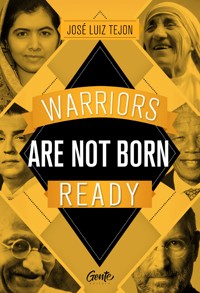
Carlinhos Brown | Ian MacNicol/Getty ImagesMalala Yousafzai | Dave J. Hogan/Getty ImagesNelson Mandela | catwalker/Shutterstock.comRoberto Shinyashiki | Fabiano AccorsiSteve Jobs | Castleski/Shutterstock.com
Desenvolvimento de ebook
Loope - design e publicações digitais | www.loope.com.br
Editorial Copyright © 2017 by José Luiz Tejon
All rights to this edition are reserved by Editora Gente
Rua Wisard, 305, sala 53
São Paulo, SP – CEP 05434-080
Telephone: +55 (11) 3670-2500
Website: http://www.editoragente.com.br
E-mail: [email protected]
International Cataloging Data
Tejon, José Luiz
Warriors are not born read / José Luiz Tejon. – São Paulo: Editora Gente, 2018.
ISBN 978-85-452-0274-5
1. Success in business 2. Self-realization 3. The psychology of work 4. Success 1. Title
CDD 650.1
Indices for cataloguing
1. Success in business 650.1
In honor of friends and eternal warriors that yearn for the future
WITH THANKS…
To all the team at Editora Gente, to my dear childhood friend, Roberto Shinyashiki, to Rosely Boschini and Marília Chaves.
To my team at TCAI: Edmea, Catherine, Mirella, Victor, Celsinho and Alberto.
To my team at Biomarketing and MCA: Doly, Coriolano, Camila, Luciana, Natasha, Bruno, Rafael and Lucas.
To my family, both known and unknown…
To the internationally acclaimed artist Ed Ribeiro, for the book’s striking and symbolic artwork, As Guerreiras (The Warriors).
To Alexandre Costa, from Cacau Show, to journalist Madeleine Lacsko, and to Carlinhos Brown, respectively, for their contributions to the preface, foreword and outside back cover of this edition.
To Adriana, our children, and our grandchildren, Alessandro and Anninha—and, last but not least, to a dear friend from Asturias, in Spain, who gave me the impetus to stitch together the pieces of the hidden warriors that exist in me: José Suarez.
PREFACE
This book, which I relished with each page turn, written by my brother Tejon, as we seasoned guitar strummers like to call ourselves, demonstrates in a very simple and, therefore, brilliant way (profound wisdom is always derived from simplicity) how we are able to transform ourselves into true warriors in this life.
Rest assured, if you are reading this book, what you hold in your hands is the opportunity to remodel something within you. Regardless of our achievements to date, or the distance we may have traveled thus far, or even the day-to-day strengths and fears that we embody, we all have something in common: we can evolve, improve, and change both ourselves and the world around us, be that our more immediate environment or that of a nation; so, I urge you to embrace the opportunity to truly live this experience.
Our objective in life is to “die alive” not “live dead,” a mission that forces us to adopt a genuinely sincere sense of humility, one which enables us to understand that “getting there”—accomplishing a much-coveted goal—does not really exist. We must accept that “there” is a constantly moving target, and that the most important thing is to evolve, each waking day, with a little ray of happiness; by the time we reach this conclusion we realize just how far we’ve come!
Reading this book helped me strengthen some of my most fundamental inner beliefs, such as how to uncover the truth of a matter by stripping it to its core and being certain to never mistake dreams for illusions, because sometimes we run the risk of being so human, so frugal, that we lose sight of reality.
I hope that reading this book allows you to identify with your inner spirit, and an energy to make things happen; after all, learning and theory are only validated by their potential to turn an idea into something more concrete. With this in mind, if you permit me to leave you with one piece of advice, it would be this: make it happen, believe in it, and transform your idea into a solid plan; turn a dream into reality through hard work, the sort of sustained efforts that trigger a sense of pride that is so true, so acute, that it becomes your most integral expression of how to be human.
Perhaps the greatest take away from this book is the recognition that to achieve our dreams and goals we need a team, people that can grasp the magnitude of a mission and dedicate all their energy to making it a reality, in my case a sweet reality. I was fortunate enough to find such a team, incredible people that share the unflappable faith that we can always do better, every day, with focus, determination, unity and happiness. They are friends who are always by my side, just like this esteemed author who, with his vivacious and youthful spirit, presents us with a work that is sure to become an evolutionary turning point for many readers! Welcome to a new heightened sense of awareness.
Sweet reading!
ALEXANDRE COSTAFounder of Cacau Show
PRESENTATION
You need to have a lot of faith in humanity to wholeheartedly claim that “warriors are not born ready.” But Tejon has it in spades. He sees people as works of art and interacts with them with the care and caution of someone building this precious thing we call the path of life, which in itself is made of many pathways.
Those in hope of tried-and-true formulas, will find in this book the impartial vision of someone who understands the beauty of human diversity, and the forthright suggestion that we can all be the best version of ourselves and not some ready-made and polished model taken from who knows where.
“Life will always be hard work,” according to Tejon. I agree. So, best not to cling to any romanticized ideas of happiness here, of a life shaped by an endless sequence of good fortune, and resulting in a magic formula to shield ourselves from any possible pain or suffering. Here you will unveil the beauty of the journey, even in all the jagged stones and stumbling blocks you encounter along the way.
Anyone who reads this book in one sitting, as I did, will marvel at the feeling that you are having a genuine chat with Tejon—who writes like he talks, like he laughs—about a sequence of ideas that alert the reader to the spark of new possibilities, fresh beginnings, and alternative steps along the same journey. Those who know him personally, or might have attended one of his lectures, will be able to decipher that familiar voice and deft timing: his tone, his humorous sense of irony, and, of course, the proviso of his words.
There are several practical lists and exercises throughout the book to help stimulate self-awareness, character assessment, group analysis, step-by-step planning, and heightened focus, as well as easy-to-follow approaches to help compile your own reflections. Each chapter, one after another, provides a sequential guide to cultivating our inner warrior and bringing it to the forefront of our day-to-day lives.
A collection of extracts from a number of fascinating and telling lives permeates the narrative. It not only depicts the success of people who are able to scale the upper rungs of power in their chosen profession, but also the strength of character that typifies the sorts of people that are able to bask in the joys of raising a child with a severe physical disability, despite the sea of difficulties they have to navigate.
Tejon’s personal story is inspiring, that of a boy who could have been left permanently incapacitated by the tragedy that befell him as a four-year-old, but instead decided to stand up to life and those that threw stones instead of reaching out a helping hand. It is with his own inimitable mix of sincerity and frankness that he shows us how to create an abiding antidote for each of life’s disappointments and cruelties.
Those with an appetite for a good battle like to think that they are born this way, and that as parents we are somehow able to teach our children to be indestructible warriors. But the truth is that a warrior is constructed, daily, and this work is, inexorably, individual and unrelenting. The good news, however, is that everyone, each one of us, is more than capable of this.
Tejon says that we have to choose our mentors and pushes us further to identify “who is your legend?” Before reading this book I had several, but these pages somehow unlocked my memories of yesteryear and in particular that of my grandmother, Angelica, whose smile was far broader than mine, and her tendency to punctuate stories with the same chortled expression: “don’t kick your luck, don’t kick your luck.”
I could never really afford that luxury. If God decrees that the temperature should match the blanket, he can be sure that I will knit one thick enough to melt an iceberg—if called upon, I really will. On the rare occasion that I feel inclined to tell people a little bit about my own life story, people think I am fibbing, because perhaps the reality is not fitting of quite so much laughter.
There are pains that pierce our flesh and others that damage our soul: the scars will always be there. However, our challenge, as warriors, is never to allow them to define who we are. And this, I learned in this book, is something extremely broad: “What I am now is much less than who I am.” It is not the more pronounced of life’s battles—those that we tend to chat about with our friends—that give oxygen to our warrior spirit, but more it is a gradual process fuelled by our courage to confront everyday decisions.
The construction of a warrior is not a solitary undertaking; it is a complex and joint effort, in which we select our mentors and our relationships. In my own life, it took me a long time to realize this. “If you are unhappy with your life, change your relationships,” Tejon advises. For me, this was a well-planned surgical operation, and one that yielded far more fruit than I had initially imagined. When you are open to making room for all that is good in life, it comes: people come.
The compelling metaphor concerning crabs in a fisherman’s basket will be a determining factor for anyone looking to map out a positive path towards the future. When placed in an over-crowded basket, crabs are unable to escape; those towards the bottom of the pile tend to drag down those clambering to the top, and hence hamper any chance of communal refuge. Pride and vanity are such imprisoning forces that we can effectively dispense with the iron bars.
The tender story of a young Tejon and his mother at the market draws a poignant parallel with our own daily battles; accepting or asking for help from our mentors; focusing on the task at hand; dealing with the hordes of people that inevitably try to drag us back down to the depths of life’s fishing basket; and true love, which acts both as encouragement and shelter in the act of resilience.
Many do, but no one has to accept that their fate is to amble through life with indifference. Life is a blessing, a sacred gift of boundless joy, even at times of profound pain, the likes of which torture our soul. Our inner child must be kept alive and well, as it is through their eyes that we see novelty and beauty, and discover creative solutions to the troubles that burden our world. There is a very interesting Brazilian documentary called, A pessoa é para o que nasce (People are who they are born to be, in English), which tells the uplifting story about three blind sisters who are naturally confined by their own circumstances and limitations. I firmly believe that we are born to become the best person that resides within us.
“Faith allows us to see first; science allows us to understand later,” according to Tejon. Those that harbor faith stick together, and this is what allows us to find the time to discuss such frivolous subjects alongside such serious matters amidst the whirlwind of people and the frenzied pace of my work. I have faith, we all have faith. We might not be moving mountains, not yet anyway, but every day we move something, or someone, and revel in each step of the imperfect path, that which symbolizes the perfection of living.
I hope this will whet your appetite and entice you to read this book with an open heart, to accept the beauty of your own story, to identify what is in your soul as well as what might be missing, and to observe the people around you through a rational and positive lens. Perhaps warriors are not born ready for a reason, because it would be cowardice of destiny to deny us the pleasure of becoming one.
MADELEINE LACKSOJournalist
CONTENTS
Introduction
Chapter 1 What interests me is your victory
Chapter 2 What are you afraid of?
Chapter 3 Slay the imaginary giants
Chapter 4 When the outside world knocks on our door it wants to come in and trouble us
Chapter 5 Willpower: the basis for everything. How to generate willpower, but not just any willpower
Chapter 6 Uroboros, a snake that devours its own tail. Faith comes first, science explains later
Chapter 7 The saint warrior, who educates the great warrior
Chapter 8 An adult chat: now it is just you and I – method 1
Chapter 9 Values and engagement at the highest level – method 2
Chapter 10 An extended pain threshold stretches the horizons and amplifies the success of warriors – method 3
Chapter 11 In the kingdom of uncertainty, there is wisdom and a formula for attracting luck – method 4
Chapter 12 The right to be happy with the duty to conquer – method 5
Chapter 13 Warrior leaders never abandon ship; the greatest pleasure is the ability to return home – method 6
Chapter 14 How adoptive parents taught me to fight life’s battles with dignity
Chapter 15 There is a formula for success, and a warrior’s success
Chapter 16 The warrior’s rest
Chapter 17 The Power to Trouble
Afterword Brilliant
Bibliography
Further information: warriors featured on the front cover of this edition
Introduction
“A master is not always someone who teaches, but rather someone who suddenly learns.”
João Guimães Rosa
If I were to offer advice to a young man, just one tip, what would it be?
Learn.
To an adult? Learn.
To someone aged 100? Learn, with much haste.
Warriors are not born ready is unsettling. Deeply unsettling. We are not born ready and we will never be complete. Life is the art of survival, competitiveness, competence, intelligence, wisdom, choices and decisions. Luck represents what we decide to do with that thing we call misfortune and which many, at this precise moment, do. And bad luck will always be what comes of the luck we let slip through our hands, which we berate whilst being led astray by the corrupting powers of distraction.
Never kneeling before destiny is the essence of a soul forged with the strength and resolve of great warriors. “Learning is changing,” Buddha teaches us. I further that with what Alvin Toffler once said: “The illiterate of the twenty-first-century will not be the one who cannot read or write, but the one who cannot learn, unlearn and relearn.” And, if you allow, let me illustrate my point with just one more quotation, taken from Ovid: “It’s right to learn, even from your enemy.” Take special note of these three statements, they will prove invaluable throughout this book.
We all have dreams and aspirations; this is part of being human. We want to earn money, acquire assets, lead successful careers, gain recognition and fame, and be the chief protagonists in a happy and healthy life, one teeming with beauty and prosperity. We hope that our dreams turn to reality, that we are loved and that everything works out just as planned. Our wish is to “get there,” irrespective of our personal interpretation of what “there” stands for.
Just desires, dignified human thoughts, a drive to progress in life, ethically and aesthetically—after all, we deserve as much, we are entitled to such things.
And at the same time as we pang for such things, “everything would be so much easier if it weren’t for the difficulties,” once wrote the famous Brazilian satirist, Apparício Fernando de Brinkerhoff Torelly, perhaps better known by his pseudonym, The Baron of Itararé. Unquestionably, the story of humanity is a saga replete with dreams, but the dreams are anything but simple, or rather, they are not as simple as they seem. They cannot materialize overnight, or by magic, but they can become reality if we understand, and the sooner the better, the secrets to creating legitimate warriors: winners.
Legitimate warriors learn never to confuse dreams with illusions. This betrayal of the senses has been the downfall of many a man and woman.
The fight that we concern ourselves with throughout this book bears no relation to armed combat. Military operations do, however, serve as useful examples and teach us important strategies and tactics in the art of victory. History’s most successful civilizations enjoyed unrivalled success on the battlefield, where, not surprisingly, they first understood how to fight as a group. Not as individuals, but as a whole. The discipline of the team made them more powerful as a unit. The weak became stronger, and the less-gifted in warfare had their frailties exposed and breached. And therein lies one of the principal insights of this book: the law of the minimum. We seek to create superhumans, but seldom is our attention drawn to the more humble, simple and ordinary people of this world. If not for the millions of anonymous everyday people on Earth (and I include myself in this category) there would be no superhumans. And, furthermore, if not for their ability to manage their own internal basic necessities, these superhumans, those who we revere so highly, would never turn out to be such high-performing leaders (this will become evident throughout this book). The strength of the group, by learning to fight together, maximized the propensity for dominant and natural-born warriors to emerge, whilst the exponential talents of these commanders was able to stir the less-competent to enact their fullest potential. Indeed, the power of the whole bolsters the strong and mobilizes the common man. Wisdom is the gathering of strategies to neutralize the effects of uncertainty and chance.
Do you believe in luck? This book, by examining the role of warriors and assertively saying that they are not born ready, also deals with the question of uncertainty and the improbable. What about bad luck? Yes, of course. Edgar Morin, a French sociologist, said: “We are taught the certain and not the uncertain, and the uncertainties are right.” Daniel Kahneman, Nobel laureate in Economics in 2002, said: “Luck, chance, uncertainty, is a determinant of change in the world, and is much more present than we like to admit.” Therefore, wise warriors dedicate much of their trust and thought to the world of uncertainty. And distinguishing exactly what I mean by trust is also essential here: trust, or faith, refers to the unequivocal absence of doubt. Whether good faith or bad, it works in the same way. And, in our daily lives, this trust is represented by micro-choices—minute actions, split seconds and centimeters—that write and rewrite our existence, shaping the difference between intended success and evident failure.
When I was 17, I met a youngster who changed my life forever, even though we really only hung out together for about three months. His name was Kolhy and he was 18. We both wrote music at the time, so decided to enter into a music festival competition. Telles, who was the festival’s organizer, a man I had never met in person, said to Kolhy: “Find Tejon, you write great lyrics and he writes great music: do something together.” Back then there were no cellphones or Internet, so Telles gave him my address, and one day Kolhy turned up at my house. 45 years later, we got back in touch. It was only then that he confessed to me how embarrassed he had felt on that day, when he showed up at my door: he anxiously scaled the stairs to my first-floor apartment several times. He hesitated, clearly reluctant to ring the doorbell. He thought he was a joke, worthless. Nevertheless, he finally plucked up the courage and, fortunately, I was home. I could have just as easily been out, or asleep. I opened the door and he mustered the words: “Fancy writing a track together? We have a decent chance of being shortlisted and even winning.” I could have nonchalantly sent Kolhy on his way, with an air of arrogance and skepticism about the sincerity of such a proposal. But, instead, we sat on my living room floor and composed our new song, right there and then. We were indeed selected, and that ultimately defined my future path and destiny. I would not be who I am today, and I would not be writing this book, if Kolhy had chosen not to ring the doorbell... When we met up many years later, I asked after Telles, the person who had initiated the whole thing. Kolhy gave me his phone number, so I called him up and said, “Man, I cannot tell you how grateful I am that you were so true to your work. You had no idea who I was, had never even laid eyes on me in fact, but had listened to my music. You liked what you heard, and so sent a new collaborator my way. Thank you so much, you changed my life in such a positive way.” Sadly, two weeks later, I received a phone call from a close friend, Carmela, who also knew Telles, with the somber news that Telles had passed away. According to Carmela, he had mentioned to everyone how happy our phone call had made him.
The song itself was classic tropicália, a Brazilian music movement that experimented with unorthodox time signatures and melodies, and provided us with a soundtrack to the 1960s, a time marked by the Vietnam War, an emergent hippie culture and a student uprising against military dictatorship in Brazil and Latin America. “...in the times we face, visions of life and war in death await... we live, not knowing where to turn, because in the end, there is nothing...” Music and lyrics were the instruments of our struggle, and we were beginning to understand the first steps towards learning from life itself and the good friends that surrounded us, and that turning bitterness into something of value, something positive, would be the greatest wisdom in the face of such adversity. Warriors are not born ready. True wisdom is learning to learn. One of life’s most fascinating observations is how the maximum of each person is dependent on a sweeping series of minimums.
Over the course of my life, I have witnessed how scores of courageous people, professionals brimming with gumption and determination, consistently fall short in their endeavors; success eludes them because they are simply unaware of the focus and attention required, and the higher meaning of letting oneself try new things... the small minimum that triggers mighty maximums. The road to perdition starts by swapping dreams for illusions, a mistake fraught with danger.
Our greatest potential is not in the maximum we can give, but in the minimum that we can learn to tolerate. That is why this book seeks to empower you to get what you deserve. This book aims to dramatically expand your opportunity to succeed. We need to learn to dream. OK, fine, everyone tells us to “dream big,” but life teaches us that every big dream results from a sequence of smaller dreams, those already successfully fulfilled. Yes, we will deal with success, a word we all use unsparingly, but not with reference to the greed or individualism associated with despicable, unscrupulous and uncooperative competitiveness. Quite the opposite, in fact. In this book you will come to see that everything you want from life is there for the taking. And you will also see that most people neglect to grab what life insists on offering them. They fail to do this because they simply lack sufficient preparation, education and understanding of the powerful laws of nature, the ever-present forces of the universe, to which we are all powerless to resist, each hour of every day. The fact that we forsake these opportunities is our fault, and ours alone.
We can, and must, learn from the woes and suffering of human history. We can, and must, learn from the loves and passions of bygone times. We can, and must, learn from the mad, insane, demented, murderous, and torturing armies of the past. We can, and must, learn from the generous, just, upstanding, heroic, and powerful people that decide to go out into the world and dedicate themselves to providing for others. Equally, we can, and must, learn from the overwhelming masses of alienated, amorphous, submissive, wishful, languid, and overly reliant individuals that lack the necessary strength, vigor and empathy in the wake of change. Their lives, thus far, are deficient of the required love to evoke change.
We can, and must, learn. And as we learn, we enable ourselves to be what we can become—which will always be far more than what we are right now. The chief protagonists of Tolkien’s gripping adventures, The Lord of the Rings and The Hobbit, are patently not superhumans; they are in fact the simplest and purest of characters that, with each step of their journey, are transformed into warriors. They could never have foreseen how things would turn out. But, emboldened by a sense of unconditional faith, a positive spirit, and a willingness to fight without surrender, these mere mortals evolve into true warriors and inspirational heroes. The fable imitates life.
In our final moments of life here on Earth, we discover sensorial meaning that gives flight to our eternal souls. With significant wealth, patrimony, power, and fame, we are able to master the act of sublimation and reach even greater heights, learning how to leave this world, understanding how to depart.
I know José Mindlin, the founder of Metal Leve and board member of the Estado de S. Paulo newspaper, where I worked for almost 20 years. He is resounding proof that warriors are not born ready and that they never stop learning, even after they generate wealth, a reputation, and undoubted success. I remember being involved in a meeting once to decide what to buy our dear “Zé” Mindlin as a gift. Someone suggested a magnifying glass. An excellent idea, a magnifying glass to help him read his prized books, a collection he cherished above all else. So we settled on that. He was delighted with his new acquisition; he used to read every day, almost religiously. On passing, he left behind a magnificent catalogue of titles, which he had carefully cultivated since he was 13—a monumental legacy and enduring hallmark of his warrior life. The Biblioteca Brasiliana Guita and José Mindlin, a library in honor of this couple’s life, was inaugurated in 2005. Every book was donated to the University of São Paulo (USP), where the library remains to this day. The inventory consists of 60,000 titles, a compilation assembled with true passion over a period of more than 80 years by bibliophile José Mindlin, alongside his wife, Guita. There is plenty to life besides money, fame and beauty. Or, who knows, above and beyond all these things.
I also used to work with Shunji Nishimura, the founder of Jacto, a first-class example of organizational and managerial merit in Brazil. When Nishimura was about 70, he decided to create a technology foundation. Before his death, at 100, his last words were: “My children, why did everything work out?” Today, the Fundação Shunji Nishimura de Tecnologia in Pompeia, in the state of São Paulo, is thought to be the benchmark for excellence in Brazil’s precision agriculture industry. Why did everything work out? Examine each case of exceptional human undertaking and ask the very same question: “Why did everything work out?”
This book cares about you and your future. With the forces of evolution running at an ever-alarming pace, life is, in every sense, short. And this meaningful realization needs to be reflected in the quality of your material life. We no longer live in the age of “this or that.” We, henceforth, live in the age of “and this, and that.” Of course, regulated by some consciousness of sustainability, reminding us that stealing from the future in order to profit the present only cheats us of time, which now passes ever-fleetingly and is subject to a relentless barrage of mounting choices. Money, success, fame, happiness, health and beauty are all wonderful things, and most welcome. And, contrary to the prejudices of the past, they are not without dignity, honesty, and character, and indeed often associated with noble work and arduous study, peace and the advancement of human and emotional sensibilities.
Warriors live, fight, grow and learn in the here and now of our contemporary world. Hence, they develop an ever-competent capacity for harmonizing the material world with the spiritual one. One feeds the other, and, in perfect balance, neither can maximize its sublime potential without the support of the other. Later in life, as ageing warriors consider their final swan song, they find voice to serenade the younger generations yet to stretch their wings, offering the veteran guidance that fighting will always be necessary, but that peace, too, will always be the greatest of rewards: the peace of their consciences.
We are summoned at birth to become trained warriors. Whether we like this or not is purely academic, life will always be a struggle, a conflict of opposing forces. To live will always mean creating friendships. And by living, we will always come face-to-face with the unexpected, and be required to confront pain. To live will always be to enjoy the pleasures, the delights and the happiness that we would ideally wish to prolong, indefinitely. And our mission will be to “die alive,” and never to “live dead.” Welcome to life; welcome to the effervescent joy that fuels this blissful life. Welcome to the fight worth fighting for, the fight for life, our life, your life, the life of your loved ones: the people for whom you would sacrifice everything and anything.
Let us go forth together, for warriors are not born ready.
And those that refuse to fight this imperative battle, this conflict that besieges us all, place the weighty and objectionable burden of his or her own existence on the shoulders of others. They only delay the inevitable.
Those who love, create warriors. Great warriors love their mentors and makers, and gather wisdom by admiring them. We will, ultimately, be the end result of this admiration. And the ability to be a warrior, the secret of which is revealed in the pages of this book, is the catalyst for achievement: it is the void between near-achievement and resolute success. It is that which can make us grow both individually and collectively.
Humans are imperfect beings, but their creation—that is, the craft and process of being—is something quite wondrous... That is why we will never stop carving ourselves, like chiseled stones, and from our fragments there may emerge perfections recognized by God. Warriors are not born ready. The truth is in the millennia.
The secret?
Apply the secrets of the millennia to the present day.
C H A P T E R 1
What interests me is your victory
“The bad thing about victories is that they aren’t definitive. The good thing about defeats is that they aren’t either. “
Jose Saramago
“[…] As the next thousand years unfold—and the thousands beyond that—many will be born, and live, and die. And history will continue to unfold, as strange, complex, and compelling as my humble pen was able to lay before you here. No man can say with certainty what the future may hold. But perhaps, in knowing what has already transpired, we can all do our part to avoid the mistakes of our forebears, to emulate their successes, and to create a world more harmonious for our children and their children, for generations to come.”
George R. Martin, The World of Ice and Fire
To get us started, what interests me now, dear warrior, is your victory. Ed Ribeiro, who today is an incredibly successful and internationally acclaimed artist, and a legitimate warrior that was not born ready, sent me a painting as inspiration for this book, which he entitled Warrior Ogum and Warrior Iansã. Ed became a one-of-a-kind painting sensation, thanks to his unique style of pouring paint. “An artist of free-flowing paint,” as I like to refer to him. Without question, the paints on his canvas flow freely. In the same way, your life comprises of free-flowing paints and canvases. We garner our faith from admiring the patterns and arrangements of each splatter. Ed, however, was not always conscious that he would, one day, become a celebrated artist, but rather went through a process of spectacular change. Alone? Certainly not. But rather by paying close attention to people and their observations, guidance and advice: input that could have fallen on deaf ears. He listened, and went from there. And from working in a snack bar called “Point do Acarajé” in Salvador, Bahia, he embarked on an incredible and glorious international career. No longer making acarajés, a local savory delicacy in his homeland, but rather letting his paints flow in accordance with whatever the human imagination is able to conjure.
Time for a few bare and naked truths, as our progress will be negligible without them.
I met Daniel Goleman once, at a meeting of the Caliper group in Philadelphia, USA. He is a brilliant man and the originator of emotional intelligence, the ability to identify and manage one’s own emotions and the emotions of others. He is also the author of several books and his latest, Focus, is nothing short of extraordinary. The book centers on research that suggests how we ought to direct our attention, and to think about our lives, our results and ourselves. Goleman showed, believe it or not, that only 11% of us are fully engaged. That is, people who go about their lives with sharp focus; they seize opportunities that come their way and seek perfection in everything they do. They are followed by another 19%, called adherents. These people tend to look up to the 11%, those deemed to be society’s most competitive, competent and engaged citizens. They are also able, when they grab their chance, to latch onto this upper tier of achievers and make things happen through association. The plight, however, rests among the 50% of the population labeled as “tourists,” people who spend the majority of their time on Earth working in a passive capacity for other people and entities. The remaining 20% are dubbed “terrorists,” who generally destroy organizations, institutions, families and the planet itself.
These indicators, these percentages, are not absolute. It really depends on the capacity and quality of leadership, and its inclination towards humanism and a clear sense of ethical commitment to evolutionary progress. Undoubtedly, with these emerging tendencies and the establishment of shared values and virtues, we, as a people, have been able to positively improve the output of human life. I recommend taking a closer look at regions of Brazil that showcase the work of cooperatives, organizations that unite thousands of people in specific places as a means of improving the population’s overall quality of life, education, technology, and income. Progress is far more pronounced and fluid, when compared to similar settlements that show signs of equivalent potential but lack a well-managed model of cooperation and leadership. Of particular note: Chapecó and the surrounding area, in Santa Catarina, which has enrolled more than 100,000 families under the leadership of the Aurora cooperative; Campo Moura, in Paraná, under the steer of Coamo, benefitting almost 30,000 families; Rio Verde, in Goiás, with Comigo; in Espírito Santo, Coopeavi; in Rio Grande do Sul, Cooperativa Santa Clara, and Cotrijal; and in Greater São Paulo, the colossal Coop. There are dozens of other valid examples of proactive associations that prove the intrinsic value of such initiatives. However, when we look at Goleman’s indices and apply them more broadly to the wider Brazilian population—companies, neighborhoods, communities, and cities—we observe the depressing accuracy of these percentages, and, in contrast to countries renowned for strong leadership, we might even detect a somewhat tragic “worsening” of these percentage splits, with increasing numbers slipping into the categories labeled as “tourists” and “terrorists.”
With this in mind, dear reader, we come to our first crossroads: a moment to stop, think and reflect. Stop reading, if only just for a few minutes. Free your mind of any prejudice. Analyze, as you look around you. Think about all the people you know, individuals with whom you share your day-to-day life, and consider how you might distribute them into these attitudinal categories.
After assessing the people in your life, both past and present, continue to dive deeper and contemplate the following: who do you consider to be successful, what are they like, who do they associate with, and how do they spend their time? And compare this select group to others, people you regard as unsuccessful; unhappy; nondescript; detached; unfocused; unambitious; and all the other groaners, complainers, accusers, and predators, people who always lash out aggressively and delude themselves that they are somehow plagued by bad luck and obstinate harassment.
Once you have charted those around you, it is time to think about you, and yourself. Yes, we were born to be warriors, and warriors we are. The difference, however, is that some are openly aware of this quest, this pleasure of living and the transformation of life, whilst others are plainly oblivious. Therefore, everything appears bleak, negative, and difficult, and this dismal outlook often disenchants people to the point that they abandon their original plans. Or worse, they give up on themselves. They give up on the planet, their country, their work, their study, their friends, and even their lives. However, “everything would be so much easier if it weren’t for the difficulties,” to underscore the words of the Baron de Itararé. If we were automatically conscious of all this, perhaps everyone could gladly accept that warriors are not born ready, and that it is, however, possible to learn, grow, and conquer this life, by transforming the circumstances that surround us.
So, what really interests me here and now is not the 11%, the gifted, highly-esteemed, and primed warriors, nor is it, far less so in fact, the 20%, those “terrorists” devoid of the basic faith and belief in a better world, one in which human potential is fully championed.
I relinquish the latter, not by ruthlessly expulsing them from our concerns, but because at this juncture in this book we cannot spare them our time, nor do words—in this text or any other—further the chances of success amongst this notoriously predatory, unscrupulous and corrupting segment of society. The path of least resistance typically orientates their pursuit of happiness, unrestrained convenience with zero ethical conformity and in total ignorance of any notion of sustainability. This layer of society will only have a limited amount of time in which to enjoy their false illusions. On the other hand, the greater the awareness of the remaining 80%—not only in terms of their right to their warrior skillset and its implicit worth, but also in terms of the advantages of creating systems and societies of shared value—, the more we can curb the proliferation of more egocentric, shameful types. I am interested in the majority here. In the 80% of people on this planet, a group to which I earnestly subscribe, having learnt from life’s lessons to never stop learning.
I want to know more about you now. Or perhaps more importantly you need to know about yourself. However, it would be unbecoming of me to ask you to rummage into your past without allowing you to explore mine first. Talking about others is easy enough, but putting oneself in the limelight, for all to see, is far more challenging.
I have been guilty of being a tourist on several occasions in my life, no doubt. But each time, a valiant warrior yanked me from this comfort zone. I am grateful to them. I concede, too, that at certain moments I have also earned the “terrorist” tag. I was miraculously saved by virtuous warriors, comrades that taught me to channel the fury and wrath of ignorance towards the impassioned pursuit of my conscience. I was lucky, and I remain lucky to this day. Nobody can achieve anything alone. Invaluable warriors taught me to redirect my focus and shine a light on my passions. They made me see that the most primordial of choices lies in the answer to the question, “who?”. With “who” I go, “whom” I choose to follow. No matter the place, no matter the situation. And this “who” transcends life and death. Suffice to say, the “who” refers to my personal choice of mentor, warrior hero, and my legion. We need to know how to cope with everything, and everyone, in our world. However, the home to which we return must be our sacred altar of regeneration, where we purge ourselves, and provoke stoic change and self-criticism. Listen to Tente outra vez, or Try Again in English, a song by Brazilian artist Raul Seixas, it will help. And be around friends. We will never be warriors without the courage and strength that sincere friendship brings. Warriors never abandon other warriors.
Life itself, with its never-ending curriculum, has been a top-flight education for me. “Impossible,” is often the response when people first hear my story. It has certainly been a remarkable story, of defying the odds. In addition to the forces of nature and fate—which meant being born to a single mother, being adopted at the age of two, suffering severe facial burns at four, and living twelve years in and out of hospitals in order to undergo countless procedures of corrective plastic surgery—I began my education in a school for exceptional children in the Santa Casa de Santos, and grew up with a badly scarred face, in a poor family, and with very few signs that making successful strides would be remotely possible. Everything that I have achieved thus far, society would consider a success. I got rich living life. I have amassed riches in the sense that I have a great standard of living. I ended up studying at some of the best academic institutions in Brazil, and the rest of the world. At this very moment, I am writing part of this book in the French city of Nantes, the land of Jules Verne and Audencia University, where I also teach part of an international MBA course. For someone who never dreamt that attending university would be even feasible, I cannot help but be taken aback by all that has happened. Holding a Master’s degree, and having already completed a PHD course, being recognized as a shrewd executive, as a director of large reputable corporations, as an international conference speaker, an award winner… well, you can take a look at my site if you wish to find out more: www.tejon.com.br. This impresses many people. So, more important than reading or talking about other people, which can be very insightful, life has allowed me to live. Moreover, life forced me to learn, to become a warrior. After all these years, I now know, thanks to the wisdom that living this life has granted me, that we are all summoned to be warriors but we are not born ready. And that the large majority of people end up throwing in the towel. And why do they give up? For the same reasons that people give up mathematics, history, and biology: the schools and educators lack sufficiently creative approaches to inspire.
* * *
In Cocal dos Alves, Piauí, a city with a population of about 20,000, the students of a particular public school are notorious for scoring excellent marks in the Brazilian Mathematical Olympiads. The reason? A team of researchers went in search of the answer and met with their teacher, Antonio. They asked him about his formula for success, and he replied, “I get the strongest students to teach the weaker ones, that way everyone makes progress simultaneously.” As simple as that. The law of the minimum. Of course, the students with the greatest aptitude for mathematics teach those with the least. The reward, the pleasure, is derived from how this time is utilized effectively, to focus on learning, team building, and establishing shared values and aspirational qualities among this micro-community. However, there are others that suppress the urge to give up, but instead end up taking the wrong path—one based on illusions. They fail to respect time, causing them to repeatedly make wrong choices in the short-term, in the hope that they will locate a convenient shortcut to a source of endless happiness. And this, later in life, culminates in the most bitter of feelings, assuming this warrior still has the capacity to evaluate his or her decisions and the path they opted for in life. The emphasis now is on the student to seek out the teacher: we are no longer in elementary school. The child in us lives on, and as every child has a natural thirst for knowledge, it goads us forward in search of answers, driven by our innate curiosity.
When weakened, we anxiously seek approval. When fragile, we falter and act hesitantly in our decision-making.
I have made an abundance of errors in the past, but I always reflected on each one. I have fallen down many times, and life has taught me that everyone makes mistakes, everyone falls down. But the secret to being a great warrior is the ability to evaluate the fall, learn from it, and rise again with strength and resolve.
Bankrupting a business, quitting a career, losing an important job, walking out on children, failing to love people who love us, ignoring friendly advice along the way, turning your back on those that once lent a hand, betraying, lying, fabricating the truth without substance, patronizing people from lofty positions of power and respect, thinking that we live forever, refusing to forgive.... We are imperfect, we are human beings that need to be shaped, forged and matured in the fires of emotional and logical reasoning. I am neither a saint, nor a guru. I am just a man whose life forced me to open my eyes, to be looked upon with inquisitiveness—with superiority by some and inferiority by others—and become an obvious target for bullying. I was destined to amount to nothing, but somehow achieved the unimaginable in the eyes of almost every person that accompanied my childhood and teenage years. Life, dear reader, obliged me to understand that we are the result of the people we learn to admire and respect, but, above all, life forced me to appreciate what philosophers, saints and scholars alike have been proffering for millennia: what we are does not define who we are.
We can become something far greater than what we glean from any snapshot self-evaluation.
This realization represents a supreme victory, the first step to becoming one of life’s great warriors and, most importantly, the warrior of your life. Great warriors create great warriors. So, therefore, if you love your children, your parents, your company, your friends, for them to become great you must consciously act in pursuit of greatness, strive to identify the dignity, strength and resilience that lies in each of us. Therefore, as my close friend Ricardo Morganti, jiu-jitsu master and the famed trainer of MMA fighters, once told me: “A great fighter is one that is able to increase their pain threshold.” Once more, we address a reoccurring theme of this book: the law of the minimum will always limit one’s potentiality. In MMA, if the fighter is unable to extend their pain threshold, irrespective of how hard he fights back, they will ultimately lose as a result of their inability to withstand the pain dished out by his or her opponent.




