


Erhalten Sie Zugang zu diesem und mehr als 300000 Büchern ab EUR 5,99 monatlich.
- Herausgeber: Luath Press
- Kategorie: Lebensstil
- Sprache: Englisch
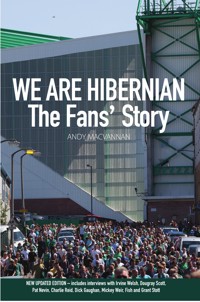
By delving into the lives and backgrounds of an entire network of avid supporters, We are Hibernian explores how people become so involved in football, and is it the binding of tradition, memories and experiences off the pitch that make them believe their first choice was the right one? There are stories here from men and women who were taken to the football grounds as youngsters and now take their own kids, showing how the religion that is football can be passed down from one generation to the next, providing entertainment and family folklore for years to come. Essentially this book is not just about football, but about the stories that surround it!
Sie lesen das E-Book in den Legimi-Apps auf:
Seitenzahl: 546
Veröffentlichungsjahr: 2015
Das E-Book (TTS) können Sie hören im Abo „Legimi Premium” in Legimi-Apps auf:
Ähnliche















ANDY MACVANNAN, Enchanted by stories of Hibernian told to him by his father, experienced his first Hibs game at the age of ten in 1980. Hooked on the phenomenon of football, he became an avid supporter of the Hibees, regularly attending matches both home and away.
At the beginning of the 1990S another passion took hold in the shape of punk rock. Embarking on a journey of discovery, his enthusiasm for playing and writing about music saw him enter into the world of the music fanzine.
Football was temporarily kicked into touch but still tugged at his heartstrings from the sidelines, eventually leading him back to the club he loves.
We are Hibernian
the fans’ story
ANDY MacVANNAN
LuathPress Limited
EDINBURGH
www.luath.co.uk
First published 2011
New edition 2015
ISBN: (EBK) 978 1 910324 76 9
(BK) 978 1 910745 30 4
The author’s right to be identified as author of this book under the Copyright, Designs and Patents Act 1988 has been asserted.
© Andy MacVannan 2011
In loving memory of my dad Bobby, who took me to my first Hibs match.
Contents
Acknowledgements
Hibernian Football Club – a brief chronology
Introduction
Charlie Reid
Colin Whitson
Liz and Bill McBain
Bruce Findlay
Eilidh Munro
Dougray Scott
Jim Slaven
Dick Gaughan
Andy Blance
Don Morrison
Lord Martin O’Neill
Irvine Welsh
Irene and David Birrell
Grant Stott
Jim Hendren Hayes
Tom Wright
Gordon Munro
Stephen Young
Alistair Findlay
Derek Dick (Fish)
Ger Freedman
Pat Nevin
Mickey Weir
Acknowledgements
I especially wish to thank Gavin and all the staff at Luath, my interviewees for their time, help and enthusiasm and especially Don Morrison, Tom Wright and Gordon Munro, Estefania (for encouraging me to do this), Dave Gilchrist, Jennie Renton and Alan Laughlin. I am grateful for permission to reproduce Gordon Wright’s photograph of Irvine Welsh (www.scottishphotolibrary.net) and Genia Ainsworth’s photograph of Dick Gaughan. Thanks are also due to Joe Tree, Davey Johnstone, the Hibs Supporters Club and, of course, my mum.
Hibernian Football Club
a brief chronology
1875
Hibernian are formed by Father Hannan and Michael Whelehan.
1891
Sir Tom Farmer’s grandfather and great-uncle meet with others in the High Street to set up a fund to resuscitate Hibernian.
1893
Hibs move to the current site of their stadium in Easter Road.
1902
Hibs win their second Scottish Cup.
1903
Hibs win the League Championship.
1911
Jimmy Hendren signs for Hibs.
1941
Gordon Smith joins Hibs.
1945
Lawrie Reilly debut with Hibs.
1948
Hibs win the Scottish First Division.
1951
Hibs win the Scottish First Division.
1952
Hibs win the Scottish First Division.
1954
First game played under floodlights at Easter Road.
1955
Hibernian are the first British team to enter the European Cup.
1957
Joe Baker makes his debut with Hibs.
1958
Lawrie Reilly plays his last game for Hibs.
Hibs lose to Clyde 1-0 in the Scottish Cup Final.
1959
Gordon Smith leaves Hibs to join Hearts.
1961
Hibs beat Barcelona in the Fairs Cup.
Joe Baker joins Torino for £75,000.
1971
Eddie Turnbull appointed Hibs manager.
1972
Hibs lose 6-1 to Celtic in the Scottish Cup Final.
Hibs beat Celtic 2-1 in the League Cup Final.
1973
Hearts 0 Hibs 7.
1976
Pat Stanton transfers to Celtic.
1979
Hibs lose to Rangers in the Scottish Cup Final.
1980
Hibs relegated for only the second time in their history.
1982
Pat Stanton returns as manager.
1985
Hibs are beaten 3-0 by Aberdeen in the League Cup Final.
1990
Wallace Mercer takeover attempt – the ‘Hands Off Hibs’ campaign begins.
Season 1990–91 Sir Tom Farmer becomes the majority shareholder.
1991
Hibs win the Skol Cup 2-0 Against Dunfermline.
1998
Alex McLeish appointed as manager.
1999
Franck Sauzee joins Hibs.
2000
The Easter Road slope is levelled.
2004
Tony Mowbray appointed manager.
Hibs lose to 2-0 Livingston in the CIS Cup Final.
Formation of the Hibernian Historical Trust.
2005
Hibs fans form the Dnipro Kids Appeal (to help Ukranian orphans).
2007
Hibs open East Mains training ground.
John Collins becomes manager.
Hibs beat Kilmarnock 5-1 in the CIS Cup Final.
2009
John ‘Yogi’ Hughes appointed manager.
2010
Hibernian FC Open a Learning Centre at Easter Road.
Colin Calderwood appointed new manager.
2011
Pat Fenlon appointed new manager
2013
Terry Butcher appointed new manager
2014
Hibs are relegated to the Scottish Championship
2014
Hibernian appoint Alan Stubbs as new manager and Leeann Dempster as new Chief Executive.
2015
A new fan-based share scheme (Hibernian Supporters Limited) is announced by the club.
2015
Hibernian begin their second season in the Scottish Championship – the second tier of the Scottish league system.
Introduction
THE FANS INTERVIEWED forWe are Hibernianall talk frankly and with honest emotion about the impact the remarkable football club called Hibernian has made on their lives. Despite their widely varying backgrounds and circumstances, they share an equal passion for the club and the book’s title is intended to reflect this sense of loyalty, belonging and ownership.
I missed witnessing many of those great teams and those vast Easter Road crowds of old, but they have come alive through the recollections of others. I wanted to know how we acknowledge the club’s origins and whether people think they are relevant in the modern age. Do those roots dating back to the 19Th century still have resonance for today’s fans? Are there real differences between Hibs and local rivals, Hearts? Do our closest neighbour’s help us to define our identity, or are we so different after all? What is it we really remember about watching football and why is it we often remember the strangest things?
Throughout the book, feature boxes pick up on themes touched upon and carry a direct quote from the interviewee relating to the subject matter. As well as historical reference points, I have included topics such as Lees’ Macaroon Bars and Subbuteo to give an extra flavour of football’s sights, sounds and even tastes.
Many of the original chapters in the first edition ofWe are Hibernian(2011) have been updated to reflect some of the significant events that have taken place in the last few years of the club’s history. New interviewees have also been added to the last three chapters of this second edition. As in the first edition, every effort was made to chose fans from varied backgrounds and varied opinion. My own story of coming to love Hibs might be the best way to demonstrate what brought me to the point of conceiving this book.
When I was a kid my dad worked abroad for many years. I too lived out of Scotland for a short time and greatly missed Edinburgh and my friends. One of my father’s pals used to enchant me with his stories of Leith, Edinburgh and the Hibees but although his stories would always interest me, it was my dad’s recollections of going to Hibs games in the late ’50S and early ’60S, which fascinated me. He talked about the crowds and the expectation he felt when Hibs ran down the tunnel onto the pitch. Of course I heard about the great players and the Famous Five but it was the story of the fans that most intrigued me. Little snippets, like his description of tiny bursts of light dancing over the huge East Terrace (actually fans lighting and smoking cigarettes) transported me to the scene. I believe that those tales cemented my connection to the club before I ever set foot inside Easter Road.
I had a certain feeling of trepidation before that first Hibs game, for understandable reasons – my mum had told me that my dad had come back from the football soaked in urine after a trip through to Hampden Park. Apparently he was forced to endure 90 minutes of piss-filled beer cans being chucked back and forward all around his head. I’m glad to say that my first game was not quite as dramatic in that way. It was a friendly tournament against Coventry at Easter Road in 1980. I don’t remember much about the actual game, apart from the fact that Coventry played in a dull brown strip but the stadium and the sense of occasion are imprinted on my memory. My dad took me to the Centre Stand with its creaky wooden floors and benches, in a ground that had barely changed in 40 years. As we reached the top of those stairs, the vast terracing opposite was dramatically revealed to me, although only a quarter full. It was exactly as I imagined the stadium of a big football club would be like. Although huge and impressive, it was in reality a crumbling shrine to decades of domestic and European success. But that was in the past; the crowds that it craved had yet to return.
I think my mum only ever came along to one game, down in Ayrshire against Kilmarnock. I remember nothing about the game itself but I retain the image of the friendly old woman who served us a tasty pie at half time and the impressiveness of Rugby Park’s pristine pitch still remain in my memories. When I listen to the Proclaimers song ‘The Joyful Kilmarnock Blues’ it takes me back to that game:
I’d never been to Ayrshire
I hitched down one Saturday
Sixty miles to Kilmarnock
To see Hibernian play
The day was bright and sunny
But the game I won’t relay
And there was no Kilmarnock bunnet
To make me want to stay…
© (Reid/Reid) Warner/Chappell Music Ltd.
I have to confess that in the days before I could truly distinguish between right and wrong, I requested a Celtic top for my Christmas. My wish was granted and I got one. I still console myself that I was only half way through my ‘green revolution’ and it was a minor blip on my true course to becoming a Hibs fan. That unfortunate phase didn’t last for long and my passion for the colour green achieved its rightful expression not long after that when the next window of opportunity came a few months later: for my birthday I requested a Hibs strip. Its first test came a few months later when my dad took me to watch an East of Scotland select game at Tynecastle. As we walked along Gorgie Road towards the stadium and I realised that I was not just in the minority, but was the only one wearing green. At only nine years of age perhaps I can be forgiven for my naive assumption that because this was essentially an Edinburgh select team, both Hibs and Hearts fans would be there, backing the same cause. I was soon relieved of this illusion, for as we walked along Gorgie Road every Hearts fan who passed us muttered ‘fucking shite!’ under their breath. I felt scared but mostly I couldn’t believe that my dad didn’t tell me it wasn’t a good idea to wear green in the first place. Or maybe I had chosen selective deafness and blocked out his desperate pleas?
As a young man with a rapidly growing interest in Hibs I wrote a letter to the club. The previous week I had been at a Hibs v Celtic game and was annoyed at the state of the crumbling stadium. The late Kenny Waugh replied to my letter, point for point, which I found quite impressive. He closed: ‘Finally, regarding your rather cheeky postscript, money is indeed hard to come by and the money from the sale of Gordon Durie has already been reinvested in the club, both for the purchase of players and the general running of the club. I can assure you that we do not need your advice on how the club should be run and I hope that having answered honestly all your points that no further correspondence will be entered into.’ Needless to say, I did not enter into any further correspondence.
By the age of 14 I had loads of friends that loved to go to games but, being more compliant to their parents’ demands, they didn’t go to the bigger matches against Rangers and Celtic. On Saturday afternoons I would often say to my mum I was going to a pal’s for the afternoon. I would wave goodbye and jump on the number ten bus down to Leith. I can’t recall whether my mum ever checked if I was at my friend’s or whether I had an elaborate excuse ready in the event that she did. In fact, only recently did I tell her about my deception and her reaction was as shocked as she might have been 30 years ago. Looking back, I find it strange that I was quite happy to go to some of these games on my own. I suppose I was just so sold on the experience back then that nothing would stop me.
I would get off the bus half way down Leith Walk and then walk to the ground along Albert Street. That street became very familiar to me on Saturday afternoons. From Easter Road I would return by the same route and nearly always get myself bag of chips. On one occasion a half brick crashed through the window and landed on to the chippy floor and I was astounded at the staff’s lack of reaction – they barely raised an eyebrow. Only the understated, slightly disgruntled murmur of ‘That’ll be the fitba oot then’ seemed to pay recognition to the fact that, at the very least, one of us could have been nursing a large lump on our head.
Adults would affectionately laugh at my bad language. I assume that the sight of a little boy with a high-pitched voice shouting, ‘That’s fucking shite, Hibs!’ was the source of their amusement. At a game against Morton in the early ’80S I found myself in the enclosure underneath the old Main Stand. It was quite an unusual place for me to go as I usually frequented the East Terrace. I seem to remember that we got beaten and that it was another bad result in a longer run of bad results. When the game finished, frustrated at yet another lacklustre performance by the team and unable to contain my anger, I quickly walked down to the front of the crowd barrier and hurled my scarf onto the pitch. Any football fan will tell you that this is a last resort and not something you should ever take lightly. I was instantly made to regret my decision. A voice behind me said, ‘Come here, son!’ I turned to find an old man in a wheelchair who seemed extremely concerned by my behaviour. He urged me to go onto the pitch, pick up my scarf, and keep my belief in the team. ‘I’ve been following the Hibs for a long time and dinnae you worry, son, they’ll come good again,’ he said. Sheepishly I clambered through the gate, picked up my scarf and returned it to its rightful place round my neck.
I was an avid Subbuteo enthusiast. I played every day. I had my own leagues and I commentated on my own games. It goes without saying that Hibs were generally amongst the cup winners, I always made sure of that! In a ‘small’ way I got about as close as I would ever get to actually playing for the club. I believed that I should challenge my skills further and so I entered the Scottish National Subbuteo championships, downstairs in the Princes Street John Menzies toy department. Of course I had my mini-Hibs team with me and I was quietly confident of making it to the final. My confidence took a knock early on as I made my way down the escalator. As I reached the bottom I saw two of my competitors methodically polishing and buffing the bases of their players. I remember thinking, ‘God, these guys take it even more seriously than me.’ In my first game I took a two-goal lead in the first five minutes. Perhaps I shouldn’t have allowed my opponents comment of ‘this guy’s really good’ to go to my head. He clawed back the goal deficit and scored a late winner. I was eventually knocked out on goal difference. Ah, that familiar feeling…
Later on I became one of the original ‘Hibs Kids’ and I remember that my membership would get me into games for free – about three or four times a season. I felt like I had been plucked from my traditional standing place on the East Terrace and maybe I was starting to think of myself as a man and not a ‘kid’. My membership unfortunately reached an early termination when me and my pal Stevie got thrown out the ground because he had chucked a Mars Bar onto the pitch.
We are Hiberniansets out to remember some of the great characters connected to the club. There was one large guy with a black beard who always wore a black donkey jacket and carried a mysterious, black sports bag. Me and my football-going mate, John, nicknamed him ‘The Doctor’. For some reason we always thought that there must be something potentially lifesaving in his bag and that this must be the reason he attended each and every game. We were almost worried when we didn’t see him at a game, in case his absence might have some dire effect on the team’s fortunes. Equally, there used to be a very old guy who always stood exactly on the centre line at the front of the old East Terrace. On one occasion when Hibs scored I watched him become beside himself with glee. He wore his scarf round his neck but clearly his limbs were more than a touch rigid, yet he managed to do something that he probably hadn’t managed in 20 years. Within seconds of that ball hitting the net he was physically assisted in lifting the scarf above his head by two young fans standing on either side of him. They slowly forced his arms up so he could enjoy that simple act of raising his scarf above his head. It was almost painful to witness and I remember wondering whether he would manage to get his arms back down again. Maybe he’d forever be frozen in that goal-scoring moment.
Some people who told me their story for this book say that football opened their eyes to the adult world. I think that was also true for me. I wonder whether going to games as a kid was a way of trying to identify with my father and trying to understand what he saw. It was definitely a way of accessing the adult world, rallying to a single cause and being accepted as an equal.
I took Hibs so seriously, at the point of third year in secondary school, I even stood up one of the cutest girls in our year. I had decided to go and see Hibs against Aberdeen and promised myself that I would leave the game early to go and meet her. But once I was over the threshold, the old stadium got the better of me and I was hypnotised by one of the most toxic atmospheres I have ever encountered. Brutally, the linesman was hit on the head with a large stone and had to be replaced. Jim Leighton, the Aberdeen goalkeeper, could barely take his bye kicks because of the myriad of missiles raining down on to the pitch from The Cowshed. There had been a simmering sense of violence prior to the game and now it broke into something akin to a frenzy. I was so utterly compelled that I just couldn’t leave the ground.
Ugly moments for some people sometimes throw up comical moments for others. I remember a small minibus full of Rangers fans getting rocked back and forward by a large crowd of Hibs fans, on St Clair Road. I bet the driver wasn’t a popular man when they realised he had parked in the wrong place. It was amusing because the Rangers fans inside acted like they were still driving along the M8 from Glasgow, desperately ignoring the fact that they were being rocked back and forward. It eventually took the intervention of the police to get them on the real road home.
At the age of about 14 I attended Ian St John’s football school in Redford Barracks. The reward for our hard work was to meet Ian St John and then play five-aside with players from Hibs and Hearts. I vividly remember the moment that I skipped past Walter Kidd of Hearts, like he wasn’t there. Please allow me some exaggeration. Before I knew it, he had obliged me with a scything chop to my right leg, sending me nose down on to the cold, wooden floor. I looked up expecting a sympathetic hand to pull me back to my feet. Instead I was met with a vengeful glare, as though to say, ‘Dinnae try that again!’ I met some of the young Hibs team that was later to be part of Alex Miller’s side – Mickey Weir, Kevin McKee and maybe Paul Kane were there. My only previous encounter with Paul Kane had been one winter night at a reserve game. Me and a friend from school went along to an unremarkable reserve match at Easter Road – our implacable hunger for anything Hibs knew no bounds. At games for the second team you could freely walk round the empty terraces but the other people at the game generally did the sensible thing and took advantage of the seats in the Centre Stand. Picking a temporary spot behind the corner flag at the Dunbar End, Kano sauntered up to take a corner kick and Stuart shouted, ‘C’mon Kano, fucking hurry up!’ Kano instantly turned round and snarled ‘Fuck off!’ It made us think twice about shouting at a player again.
One season in the mid-’80S I missed just one game home and away. I was proud of this at the time and that was the point where I still believe that I earned my ‘colours’ for life. I’m not sure this would have applied had it been in the glory period of the 1950S, but following Hibs in the ’80S was not necessarily a pleasurable experience. Going to away games in Glasgow was sometimes pretty scary as well. I went to Parkhead once with a broken arm freshly set in a plaster cast. Me and my pal walked towards the ground, assuming that we were blending into the green and white tapestry of the approaching crowds. Somehow a group of youths of around our age seemed to smell our allegiance wasn’t of the Celtic persuasion and started throwing stones and rocks at us from the other side of the road. Naturally a broken arm is a wee bit of a hindrance when you are trying to make a quick get-away, but we somehow got away unscathed.
In 2001 we played Celtic in the Scottish Cup Final and our woeful record in the competition was to continue for yet another year. We were beaten 3-0. We were determined to enjoy the occasion while we wondered what the outcome of the match would be. The usual ritual of going for a ‘few’ beers was rigidly adhered to and ‘a quick pint for the road?’ inevitably delayed our journey to Hampden. We rushed to find a taxi. An unusually willing taxi driver picked us up straightaway but soon the driver’s chat turned to. ‘Aye boys, it’s an all-Fenian final! Nae Huns at Hampden this year…’ I remember wondering whether the driver would be so jovial if we were to beat them. I very much doubted it. Sadly, we also had to endure a 20-minute monologue about his love of Edinburgh’s ‘sauna scene’. That was a long journey but at least the sun shone brightly, as it always seems to when cup final day comes around. The scene really was set. ‘We were first to wear the green, we were the first to wear the green’ was belted out from the Hibs end and I will never forget the uncomfortable murmuring sound from the Celtic end as they desperately tried to think of a suitable retort. They obviously knew a wee bit more about their history than I suspected.
I was fortunate enough to have the incredible experience of playing bass guitar with a band called The Process in Tokyo at a venue called Waseda Zone B. Me and the band became engaged in conversation with some Japanese guys upstairs in the bar. ‘You are from Edinburgh? That is Scotland, yes?’ I was initially surprised at their knowledge of geography but was shortly to be even more astounded at their knowledge of Scottish football. Flabbergasted would be a better word to describe my reaction to their next comments: ‘I hope you are no Jambos! You must be Hibees… yes?’ ‘How the fuck do these guys actually know this?’ I thought to myself. What are the odds of finding three Japanese football fans who have taken on Hibs loyalties at an underground Grindcore gig in Tokyo? It turned out that they had adopted Hibs as their favourite team due to the introduction of Shunsuke Nakamura into the SPL. As we exchanged enthusiastic handshakes, the surreal nature of this encounter was not lost on me. I briefly indulged myself in the thought that Hibs must be the club I always thought they were – known the world over but still appealing to those involved in extreme, underground music from the heart of Japan.
Back in the 1980S when I was in my teens I went through to Dens Park to watch a League Cup Semi-Final against Aberdeen. I used to travel to away games with a big group of people. I don’t remember much about the game but I do know we were well beaten. At half time we heard one of our names being read out over the tannoy system. You have to remember that this was in the days before mobile phones, so it was important that your folks knew exactly where you where. ‘Would Gerald Aitken please report to a police officer as soon as possible.’ Naturally we thought something really bad must have happened. Gerald quickly reported himself and was hurriedly escorted up the touchline, down the tunnel and into the bowels of Dundee’s Main Stand. As he entered the control room, a phone lay off the hook in front of him. Expecting the worst, he picked up the phone. ‘What are you up tae the night, Gebbo?’ asked his pal. I have to take my hat off to the person that made the phone call because it had us laughing for the rest of the day and helped to mask a bad defeat for the Hibees.
Of course the main reason we watch our team is for the football. We may have other reasons for our allegiances but it is the game itself that draws people into the stadium every second week. The 2007 CIS Cup Final win will always live with me. I think everyone that day felt a huge sense of emotion and relief at having finally lifted a trophy after so many years. I really was choked up when we beat Kilmarnock. I just remember thinking about all those people who are sadly no longer with us and how they would loved to have been there. I am not remotely religious but I did have a feeling that somehow, from afar, they were contently smiling to themselves. That game seemed to mean more to me than just what happened on the day. It was almost like my time as fan had somehow been validated. I had often missed out on entire seasons of Hibs games through other interests, apathy or circumstance – but the Hibees were never far from my thoughts.
We believe that we have clear memories of players gone by but when I try to recall a distinct moment or action of play it is much harder. There is something almost ghostly that is engrained somewhere in my memory when I try to remember my favourite Hibs players. You will read more about many great players in the chapters ahead but I still feel duty bound to mention some of my favourites.
Ralph Callaghan was a player that passed the ball with true distinction and complete conviction. I just remember that he seemed to have so much time on the ball in an era where tackles came thick and fast and challenges were never shirked. Eric Schaedler was another that relished the physical side of the game and he was a true winner. He competed like his life depended on it and if anyone played with more passion and commitment for Hibernian then I have yet to see him. I often content myself with being lucky enough to see players like these even though they were coming to the end of their career in the early 1980S. Despite the fact that Andy Goram later signed for Rangers he was simply an amazing goalkeeper who could have played for any club side in the world. I always had a soft spot for Alan Rough and Jim Leighton too as they also performed magnificently for Hibernian. It is the players of my childhood, and early teens, that seemed to impact most on my memories. Perhaps my pickings are not as rich as many other fans in this book, but if I had to choose an all-time favourite player it would have to be wee Mickey Weir. Fans use to sing, ‘He’s here, he’s there, he’s every fucking where, Mickey Weir, Mickey Weir…’ and he was everywhere with his weaving forays on the wing. I am extremely proud to add Mickey Weir to the 2Nd edition of this book and I think that he would have found a place in most of the great Hibs teams.
Since the first edition ofWe are Hibernian(in 2011) the club has endured a torrid time on the field of play. This is best illustrated by the fact that Hibs have been led by three different managers in the last four seasons. We suffered the hellish torment of a 5.1 Scottish Cup Final defeat to Hearts in 2012 and were then defeated 3.0 by Celtic in the 2013 final. But the most defining moment of recent times came for the club came in 2014.
It followed an extremely poor season where the only possible consolation for Hibs fans lay in the strong likelihood of Hearts relegation to the Scottish Championship. But we found ourselves sucked into the Gorgie vortex and facing a relegation play off. After leading by two goals in the first leg, Hibs returned to Easter Road and were ultimately relegated by the last kick of the ball in a penalty shoot out against Hamilton. Any gloating rights over our city rivals evaporated in a split second and Hibernian reluctantly joined Hearts for the start of the 2014 Scottish Championship season.
For most of our long suffering supporters this was the final straw. Demonstrations against the board of directors quickly followed that game and a large rally was organised just a couple of weeks after when several former players such Paul Kane and Pat Stanton led a supporter ultimatum for change and control of the club. There is no doubt relegation was one of the darkest days for the club and we have a very long road to travel before we can recover from it.
Just prior to the beginning of the new 2014–15 season, Hibs appointed Alan Stubbs as their new manager. In all my time as a Hibs fan I don’t recall a new appointment being met with less enthusiasm. Not for the new manager himself but perhaps by a lack of faith in whether the club had the ability to make a successful appointment. Maybe Hibs fans had not counted on new Chief Executive Leeann Dempster’s ability to competently recruit a manager who could at least breathe some life into a demoralised and humiliated squad of players. Many before Stubbs had spectacularly failed and some fans had begun to question whether the club itself had a hand in being unable to foster a winning mentality or adequately invest in a higher standard of player. But of course the football world is an unforgiving beast and their appointments will tell their own story in the years to come.
Hibs failed to gain instant promotion from the second tier in the 2014–15 season but they did finish runners-up ahead of Rangers. We therefore qualified for the play offs but ultimately failed in our first knock out round against a recently rejuvenated Rangers side. Many fans applauded them off the park that day, perhaps in recognition of a team who had finally begun to entertain and fight for the jersey. In reality they had failed to beat a very poor Rangers team who ultimately failed to gain promotion, as they were comprehensively beaten in the play off final by Motherwell.
We are Hibernianis packed full of opinion about the way that Hibs fans see their club in the modern day. I think we should cherish the history of this remarkable football club but we should also encourage the clubs benefactors to open their doors and give access to their facilities. It is the supporter that gives so freely every week to watch the team that they love. We should remember how important our club has been to our past but enthuse about the positive role they could play in uniting our communities and paving our future.
There is no doubt that Hibernian have made some strides forward in reaching out to their immediate community and to those whom have recently settled in Edinburgh and Leith. This is more important than it first may seem. Hibs were ultimately born from Edinburgh’s emigrant Irish population so perhaps the clubs efforts on this front can be seen as an acknowledgement to its roots and contemporary identity.
Hibernian can always do more. They can ultimately reinforce and build a genuine sense of community spirit. Scottish clubs will never consistently compete with the glamorous and much hyped fare served up by the English Premiership or the Champions League. Our strength surely lies with cementing genuine links to its supporters. This is the path that will likely endear Scottish clubs to potential fans of each new generation and it was an issue highlighted by many of my original interviewees in the first edition of the book.
Other fans expressed their opinions on the rivalry between both of Edinburgh’s football clubs. Some say that the rivalry appears to have become more hateful and intense over the years. Perhaps this is true on a visible level but I believe that this rivalry was just as strong in days gone by. Perhaps the way that it manifests itself has become more defined by the type of song that supporters sing or even the fact that we live in an era of crowd segregation where tribal affiliations are allowed to flourish. I suspect that Hibs fans celebrated just as much in the 1950S with a win over Hearts than they do in the modern day. I would imagine that they also felt equally as disappointed with a defeat.
The team we support has an influence on the way we learn how to interact with others. Particularly our close family and friends. The journey we enjoy supporting a club usually begins as a child, but what may be overlooked is this rare opportunity for children to bond with their parents. It certainly helped me to recognise that my dad was an individual and that he had his own life experiences. It also made me connect with the past in a way that no history book could ever do.
My father passed away a couple of years after the first edition of this book. He suffered for many years with Alzheimer’s but I will always remember how much he enjoyed attending the launch night ofWe are Hibernian. He seemed to be revitalised by the occasion and his connection to the club – it was his last social occasion in public. The whole evening left me in no doubt that football is much more than just a game and it has a positive influence that reaches far deeper and wider than many people can possibly imagine. Behind it there lies a rich seam of stories that recount moments of joy, humour and sadness. Supporters of the game routinely nurture and often centre their friendships round their attachment to the game of football and the team that they love.
I thoroughly enjoyed hearing what other supporters had to say on their own connections to the club and how Hibernian played such a huge part in forming their identity. Hibernian is living, breathing and it is important. It has a remarkable past that is alive within every single one of us and we all have a story to tell about it. So the next time you catch a glimpse of Easter Road Stadium try to stop and think about its history. Imagine the thousands who have sat and stood in its stands and terraces. Remember the players of bygone days who played for the love of playing and for the love of entertaining.
Consider the events still to happen and the stories that have yet to be told.
Andy MacVannan
Charlie Reid
Musician, born1962.
‘I still think about that match every couple of days, and what it means to me, how it shaped me.’
I FIRST STARTED going to games with my dad in 1972. At the time we lived in England and we were up visiting family in Edinburgh, so we went along to Easter Road. Hibs were starting to have an excellent side again and we watched them beat St Johnstone 7-1. It had such an impact on me. I still think about that match every couple of days, and what it means to me, how it shaped me. I had never been to a game before. My dad came from a family that mostly supported Hearts, but he was kind of more Hibs-leaning. After the Second World War he used to go along and support Hibs and he even had trials with them – he played a bit of juvenile football.
From that win against St Johnstone onwards, that was it for me, I thought they were fantastic! I wanted to learn a bit more about them. My dad had told me about the Famous Five, Joe Baker and all those guys because he had watched them on a regular basis. I read about the history of the club back to its foundations and I found Hibernian to be a unique and groundbreaking club in so many aspects. Not just in the way that they were founded, but how they struggled against the prejudice there was against them. I view the club as forward-looking, progressive, a force for good. Over the time that I have supported them the football has often been pretty poor, although when it has been good it has been great! My favourite period, even more than the 1970S, was when that team came through under Mowbray. It was like a golden age. It might be many years before we see a team like that again at Easter Road.
That first time I saw Hibs, as a ten-year-old boy, they attacked a lot and I particularly remember Pat Stanton and the young John Brownlie with his surging runs up the wing from the full back position. But St Johnstone were also a pretty good team – Willie Ormond was managing them and he had done a tremendous job. I think they were in the Fairs Cup that year. I remember very clearly the old high terracing, the way it looked in front of the flats at the back of Lochend. There wasn’t a huge crowd at that match, maybe 11,000. Hibs were just starting to become a very interesting team and you felt something was beginning. Within the support there was a real sense of excitement, especially given the way they destroyed St Johnstone that day.
After we moved back up to Scotland towards the end of the 1970S me and my brother used to go and watch them, but the team wasn’t as good by then. I still felt they were a better side than Hearts, I just found them an altogether more interesting club. I mean I have been to Tynecastle many times – funnily enough, my dad, the week after he took us to Easter Road, took us to Tynecastle and we saw them beat Falkirk, with Donald Ford and players like that in the team. But I just found in all the times that I went to Tynecastle, and I don’t believe in putting down another club, that Easter Road was a more stimulating place and the football was more interesting.
I think Hibs are at their best when they remember that it isn’t just about winning. I know that we don’t concentrate on winning often enough but it’s really important to play proper football and Hibs are at their best when they do that. If you look at the League Championship Winners statistics it’s all square between Hibs and Hearts; if you look at the European record, then Hibs are probably still ahead. When it comes to the cups, particularly the Scottish Cup, then Hearts are more successful. It’s interesting that up until they won the Scottish Cup in 1998 Hearts hadn’t won it for something like 37 years, so they have gone through long periods without winning anything. I do think there’s a different ethos at Tynecastle. Hibs are more about playing football and there’s more of an emphasis on how you do it. It has to be said that when Hibs have had more money invested in players they have had the better team. Equally, when Hearts have had more money invested in players, then they have had the better team – it is quite simple!
It’s important to understand the background of the last few games against Hearts, since the bulk of our good side has been sold. You get what you pay for. Although Hibs are well run off the park there is a lack of ambition that comes from the owner and the chairman. They have done a good, efficient job in terms of a business but there is a lack of drive to win. We need a bit more of that back. Tom Hart, who owned us in the 1970S, wanted to win and although we didn’t win much then either, we came close on a number of occasions. We also faced a Celtic team that was probably as good as the Lisbon Lions and still had several of them left in the team. Celtic were a team who made European finals and semi-finals – that’s how good they were. Had they not been as good then Hibs probably would have won a couple of league championships round that time. I think Hibs lack ambition at the moment. That’s not to say we should win at any cost in an Old Firm or Hearts kind of way, but I think we need new investment. I think we have needed it for a long time.
Nowadays I go to watch Hibs at Easter Road every weekend I can, although I don’t tend to go to the away games as much. I buy a season ticket but I rarely use it because I’m away most of the time. I think the stadium has really changed for the better. I remember talking to my dad about when they put another level on the terracing, in 1948 or 1949, and made it into a huge bowl with the massively high concrete terracing – I loved that stadium! When they cut down the East Stand it was never the same, so I was glad to see it knocked down recently. It’s funny looking on the internet because you can see bits of film of it when it was full and when it was empty. When they put up The Shed, after they cut the terracing, it wasn’t great, so I’m glad to see the back of that.
The atmosphere was tremendous at the last derby – the Singing Section has really worked. It’s a good idea and I hope its going to grow, as hopefully the support will grow over the next couple of years. Hibs have done really well keeping their average crowd up. Some of that is down to the better facilities they have now, so really I’m very much a ‘new stadium man’. I’m ambitious for the club. Eventually I’d like to see us add another 10,000 seats, but if the club has real ambition they’ll maybe have to look for another site. At the moment the stadium’s capacity is more than adequate. For all of the criticisms I have of the board, on the business side they have got it right and they also got the training facility built quickly. Unlike Hearts, they managed to get the new stadium finished. It’s now an excellent medium-sized stadium, but let’s see some ambition on the park. I should say that the ground’s looking really good though, so the club should be commended for that.
I’m glad the club is acknowledging its roots – in the past there’s been some reluctance to do so. The club is now at peace with its culture in a way that maybe some other clubs are not and I would like to see more done to acknowledge our history, without that ‘greeting into the beer glass’ thing that so persists at Celtic. Hibs can do it with a little bit more dignity. As a Scottish football club with Irish roots, that identity should be celebrated and integrated into what we all are as Hibs supporters. I have no problem seeing the Irish tricolour at the ground but what I really love is seeing the Irish harp. I don’t think the tricolour says ‘Hibs’, whereas the harp does – to me, the harp symbolises the club. That’s what it’s about, not ancestry or nationality.
Hearts supporters will piss themselves laughing at this: my brother and I always try to keep Scottish Cup Final day free. Why the fuck do we bother doing that, you might think. But one day Hibs will make the final and one day we will win! Scottish Cup semi-finals I can bear to miss. There have been many times my brother and I have said, ‘Damn it, we have a gig booked that day!’ and I always get frustrated if there are big games that I can’t see, but it really would hurt if I missed a final.
When we were out in Australia we were asked us along to a sports event. Football is a minority sport there, it’s a cricket, Aussie Rules or Rugby Union country, so we felt a wee bit like outsiders. Aussies are always friendly though, and they said to us, ‘Get up and do your club song.’ We said, ‘Yeah, alright!’ Stuart, the guitar player at the time, and Stevie, our keyboard player, who is also a Hibs supporter, loved it. We got up and did a verse of ‘Glory to the Hibees’ and it went out on Australian TV. I think some people knew that we were going to play it because there is quite an active Australian Hibs supporters branch and there were definitely a few of them in the crowd. It was funny doing it there – we’d never been asked to play it in Scotland. I don’t think that as the Proclaimers we have any songs that have a direct reference to Hibs as such, but if a club means as much to you in your life as it does to us, it’s likely to come through in your songwriting. Not necessarily in any other than a humorous way, but it does come through. The likelihood is that, hopefully, we will make a few more records before we die, so at some point I would imagine there will be references to Hibs.
At the CIS Cup Final when they played ‘Sunshine on Leith’, it was kind of surreal. You can understand that to see them in a final is amazing, but to see them score five goals and winning it is something I will probably never see again. What moved me the most, apart from the singalong at the end, was when the players came over with the cup. I was in the main stand, quite close to the centre line (Craig was behind the goal that day), and when I looked down at Scott Brown and Whittaker I just realised how young they were, and I really felt how old I was, because when I first started watching Hibs these boys weren’t even born. I actually got a wee bit tearful on that subject – it wasn’t because the song was being played, that felt very uplifting to me and I was extremely grateful that all the Hibs supporters have taken the song up like that. I just felt a wee bit old in the realisation of the many years that I have watched Hibs, and how this was a high point I hoped to be repeated. Who knows when, given the history of the club, and how long it had been since we had seen them win anything, and how long it had been since they had really, really performed brilliantly? I speak to people who were there in 1958 when we lost to Clyde, a match nobody ever thought we would lose. We had beaten Rangers and Hearts on the way to the final and Hearts were the best team in Scotland at the time. We beat Rangers in the semi-final and that was it – it seemed destined we were going to beat Clyde, but we fucked it up! We fucked it up against Aberdeen in 1947 as well. Christ, the one final I have missed in my lifetime was the Livingston one in 2004 – we were away in America at the time – and I’m really glad I missed that! I’m also glad Hibs came back a few years later with the bulk of that same team and beat Kilmarnock. That felt amazing. And we were also still in the Scottish Cup, although that ended in disappointment. But there you go, swings and roundabouts.
‘I just felt the whole takeover idea was wrong and I reckon that a lot of Hearts supporters thought that as well.’
A Hands Off Hibs campaign sticker.
At the Dunfermline final I felt pretty tense because the expectation was huge. There must have been 40,000 Hibs fans there that day, it was an amazing crowd. We all knew beforehand Hibs’ tendency to screw things up in finals, but I thought we deserved to win on the day and it was a very exciting game. Walking away from the match I said to someone, ‘The club will survive now.’ You have to remember, it was still very touch and go. Sir Tom had taken over and the situation had been stabilised, but it was still touch and go. I felt that because the debt was being managed and the club had won something, that it would put some much needed money into the coffers. Winning that game got us in to Europe the following season but the most vital thing of all was that the club would survive.
I don’t know what other Hibs fans feel, but I always feel that the club should have young players coming through and playing their football on the deck. So what, if occasionally Clyde beat you 3-0 or you get hammered by Celtic 3-0; it’s disappointing, but I don’t want Hibs to be like other clubs where it’s only about winning and staying in the league and hating the opposition. I think Hibs should be much bigger than that. To me Hibs is an international club, albeit a small international club, and should embrace new ideas. The two things that the supporters are entitled to in a league that is pretty poor are decent attacking football and bringing through young players.
I lent my name to the ‘Hands off Hibs’ campaign and through that I got to know an awful lot of people, like Kenny McLean, junior and senior, Willie McEwan and George Stewart, who are all real stalwarts of the club and really good people! I just felt the whole takeover idea was wrong and I reckon that a lot of Hearts supporters thought that as well. Mercer, being originally from Glasgow – and for all the time he had been involved with Hearts – still didn’t really get it that the Edinburgh rivalry is older than Celtic and Rangers. You just don’t do that to people and I wouldn’t want it done to them either. At some point there will be a reckoning at Hearts because of their debt. I don’t want to see them cease to exist and equally I wouldn’t want to see us take them over. But potentially the next takeover could come from us, because they could be on their arse with no ground or anything. I wouldn’t want to see it because it’s the wrong thing to do and Edinburgh is a more interesting place when you have that rivalry. For all it was upsetting to see Hearts beat us in that semi-final and then win the cup, at least a couple of years later we won the League Cup against Kilmarnock. I think Hearts’ success provokes the Hibs board, players and supporters into wanting a bit more, so it’s not necessarily bad if they win things occasionally. Mind you, I may get strung up for saying that! I would like to see us get to the stage that we were in during the 1970S, where we were ahead of and beating them more than they beat us, but that would require more investment.
In1990Hibernian were to face one of their toughest tests. Wallace Mercer – the then Hearts Chairman – proposed a merger of the two Edinburgh clubs. Hibs fans believed that in reality this was nothing more than a takeover attempt that would ultimately swallow Hibs whole. Fans quickly rallied to form the Hands Off Hibs group and set about campaigning to save the club. High profile celebrities lent their weight to the campaign and John Leslie even appeared onBlue Petersporting aHands Off HibsT-shirt. The campaign united all Hibs fans in a last stand to save the club.
When Sir Tom Farmer was persuaded to take a controlling interest in Hibernian, which he did despite the fact that at the time he had no great interest in the game itself, the campaign reached its rightful conclusion: the club was saved. The huge sense of relief turned to outright elation when the team went on win the League Cup in1991.
George Best was one of the top players the world has ever seen. We had him when he was well past his peak but he was still a hell of an amazing player. It’s hard on Jim Leighton and Alan Rough, who were both good keepers, but to me Goram was perhaps the finest goalkeeper I have ever seen. Rangers maybe got a couple of better seasons out of him than we did, but his last two seasons at Easter Road were as good as anything he did in his career. I remember when he kicked the ball down the slope and it went over the other goalie’s head, at the last game of the season against Morton. He was utterly, utterly brilliant – an absolute world-class player! John Brownlie similarly, but for the leg break, would have been a more successful player than Danny McGrain and arguably he was more skilful. Guys like Pat Stanton and Alex Edwards were absolutely brilliant. John Collins – what a total professional and a fantastically gifted player! Paul Kane was a good player and guys like Michael O’Neill, who was maybe not the hardest working, could certainly play. Mickey Weir, Yogi Hughes, Brown and Thomson were all outstanding players as well but I will stand up and say it, I think Derek Riordan is the most naturally gifted footballer I have seen Hibs produce since Pat Stanton! I was a massive Riordan fan, he was an extremely gifted football player, but his relative lack of success is disappointing, I can’t help thinking that he could have played at a much higher level, and had he been advised correctly, or maybe if he had more ambition, then he would be doing a little bit better than he has been doing. For those who criticised him – they will look back and be hard pushed to see anyone from that tremendous bunch of players who contributed more to Hibs’ game than he did.
Steven Whittaker was fantastic as a goal scorer as well, and Gary O’Connor – what a player! He slipped down a wee bit when Brewster left because he was a help for him when he first came through. And Alan Gordon was some player as far as goal scoring was concerned. If we had a guy like that coming through for Hibs now he would definitely be on the Scottish team. We’ve had some fantastic players, but out of all of them the best to watch was Stanton, so I think he’s my favourite.
When I first started going to watch Hibs I always stood on the main terrace. When I came down from Fife with my brother we’d get to Edinburgh at about one o’clock and we’d go into the stadium and just walk about, maybe get a pie or whatever. We loved being in the place. I’m sure a lot of supporters feel like that at their football clubs, you love being in the ground. I like the fact that they’ve widened the pitch and it really looks like a modern stadium. It’s got a really good atmosphere about it.
We used to go to away games at places like Tannadice or Dens Park and I remember going to see a semi-final just at the start of the great Aberdeen team. They beat us 1-0 or something like that in the semi-final of the League Cup in about 1979 and I remember the fantastic atmosphere in The Shed at Dens Park with the Hibs support. Turnbull was still manager then. For the Cup Final against Rangers in 1979 we were behind the goal at the old Celtic end. It wasn’t a great game because it went to two replays and then we got beaten. McCloy brought down one of our guys – Colin Campbell (who ran the sports shops) was pulled down about five minutes from time and there’s no doubt it was a penalty. It was a penalty, a stonewaller, and we didn’t get it! I don’t believe in the conspiracy theory thing and I don’t believe referees, or the bulk of them since the war, have operated an absolute pro-Rangers agenda but you did have your suspicions after watching that. It was outrageous. We were robbed. I told myself we’d win other finals, but we didn’t. It really would have been nice to win that one. Maybe if we had, we wouldn’t be talking about a hoodoo on the Scottish Cup for Hibs.




