


23,99 €
Mehr erfahren.
- Herausgeber: Crowood
- Kategorie: Lebensstil
- Sprache: Englisch
Once seen as a niche practice, the craft of weathering has now become firmly rooted in the railway modelling mainstream. Not simply a means of rendering models in layers of dirty paint, weathering involves a myriad of techniques aimed at improving realism, including distinctive surface textures, highlights and shading, burnishing and peeling paint finishes. The weathering process brings out the best in a model, making moulded relief or a lustrous livery really stand out. As well as replicating the real world more closely, weathering also helps a model to look at home within a scenic setting. Aimed at modellers of all abilities and eras, this book is an essential guide to creating the most realistic locomotives and rolling stock in any scale. It includes: a guide to tools, paints, washes, dry pigments and other innovative media; the correct techniques for model preparation; a wide range of techniques for wagons, carriages, locomotives and multiple units in any scale; how to replicate authentic surface textures and effects, from polished surfaces to corroded metal and worn timber; how to bring models to life with faded paintwork, peeling and chipped finishes and subtle highlights and shading; the secret to successful airbrushing. This book will be of great interest to railway modellers of varying abilities, particularly those interested in rolling stock and locomotives, and is fully illustrated with 660 colour photographs.
Das E-Book können Sie in Legimi-Apps oder einer beliebigen App lesen, die das folgende Format unterstützen:
Veröffentlichungsjahr: 2017
Ähnliche
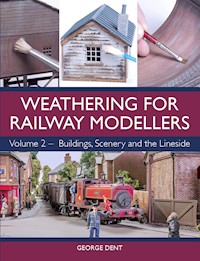













WEATHERING FORRAILWAY MODELLERS
Volume 1 - Locomotives and Rolling Stock
GEORGE DENT
THE CROWOOD PRESS
First published in 2017 by
The Crowood Press Ltd
Ramsbury, Marlborough
Wiltshire SN8 2HR
www.crowood.com
This e-book edition first published in 2017
© George Dent 2017
All rights reserved. This e-book is copyright material and must not be copied, reproduced, transferred, distributed, leased, licensed or publicly performed or used in any way except as specifically permitted in writing by the publishers, as allowed under the terms and conditions under which it was purchased or as strictly permitted by applicable copyright law. Any unauthorised distribution or use of this text may be a direct infringement of the author’s and publisher’s rights, and those responsible may be liable in law accordingly.
British Library Cataloguing-in-Publication Data
A catalogue record for this book is available from the British Library.
ISBN 978 1 78500 331 8
Frontispiece
Small details, such as using washes on the light surrounds and the masked wiper trails, combine to raise the level of realism.
Acknowledgements
For the supply of tools, paints and materials, my sincere thanks go to Alex Medwell and Lisa Munro at The Airbrush Company, Alan Taylor at Modelmates, John Peck at Precision Labels, and John Bristow at Deluxe Materials. Thanks also to Richard Foster, Chris Leigh, Mike Harris and Chris Nevard at Model Rail magazine.
I’d also like to thank Jeanne Carr for her hospitality in Settle, where the first draft of this book was written, along with the mysterious cat who kept me company as I typed furiously. And, of course, a big shout out to all members of the Dent Collective, especially J-M – thanks Duckie!
This book is dedicated to the memory of Pep. Sleep tight, little sausage.
CONTENTS
1WHY WEATHER?
2PAINTS, WASHES AND DRY PIGMENTS
3TOOLS AND PREPARATION
4WAGONS: FIRST FORAYS
5WAGONS: NEXT STEPS
6AIRBRUSHING: THE BASICS
7AIRBRUSHING IN PRACTICE
8TURNING TO DUST: CEMENT AND SCRAP WAGONS
9RUST IN PEACE: PART ONE
10RUST IN PEACE: PART TWO
11RUST IN PEACE: PART THREE
12TIMBER WORKS
13SHADY TECHNIQUES
14COACHING STOCK: PART ONE
15COACHING STOCK: PART TWO
16MULTIPLE UNITS
17DIESEL AND ELECTRIC TRACTION: PART ONE
18DIESEL AND ELECTRIC TRACTION: PART TWO
19DIESEL AND ELECTRIC TRACTION: PART THREE
20STEAM TRACTION: PART ONE
21STEAM TRACTION: PART TWO
22STEAM TRACTION: PART THREE
23STEAM TRACTION: PART FOUR
LIST OF SUPPLIERS
INDEX
CHAPTER ONE
WHY WEATHER?
Weathering is a blanket term for a myriad of techniques aimed at making our models appear more realistic. While many assume it refers solely to the act of throwing dirty paints on to a surface, there is actually far more to it than that.
Adding highlights, shading and faded livery colours is all part of the weathering process. So, too, is the creation of authentic textures, burnishing, woodgrain effects, and peeling or worn paint finishes. Even the art of ‘bulling up’ a locomotive – recreating highly polished paintwork – can be classed as weathering. These processes also serve to bring out the best of a model’s profile and detail relief. Indeed, even a seemingly basic or bland budget model can be transformed into something eye-catching.
Everything, be it a train, building, tree, car or even a human being, displays some degree of weathering. It might be ingrained dirt, water staining or a tatty pair of jeans, but if you look closely at any object, there are bound to be shadows visible in a recess, a highlight created by sunlight catching a surface, or damp fungus growing on a tree trunk. Indeed, training our eyes to look more closely at an object and appreciating textures, tones and sheens – not simply ‘counting the rivets’ – is a useful skill. It can also become an obsession: I still find it difficult to walk past a rotten shed door, murky stone wall or greasy fuel tank without being inspired!
There are countless weathering processes and materials to help create a range of textures and tones.
Weathering isn’t just about making something look dirty: it’s a means of helping objects blend into their surroundings, be it a train, car, building or human figure.
Freight stock can be treated in such a way that its purpose can be surmised even if the wagons are empty. A fine layer of limestone dust covers this train as it heads back to the quarries of the Peak District.
THE TRAINS
Objects that spend their lives outdoors, operating in harsh environments, are likely to weather quickly and extensively. Railways have always provided a tough proposition for traction and rolling stock, from the steam age to the modern high-speed network. Exposure to the weather through all seasons, staining from exhausts, fuel, lubricants and brake dust, and the constant buffing and scraping from human traffic, all take their toll. Freight wagons, loaded and unloaded daily with anything from bitumen to coal, cement or limestone, take a real battering, which is reflected in their outward appearance.
Despite regular cleaning, trains quickly regain a range of gritty and oily deposits. Note the ingrained dirt visible on the yellow ends and the dusty bonnet tops, which appear to be cleaned less frequently than the sides and ends.
Contrasting sheens are just as important as fine misted layers of dirt. Note how the shiny red carriage sides offer a counterpoint to the dusty underframes and roofs, just like the real thing.
The sides are mostly clean, but the grilles and recesses feature dark shading, and the dusty edges of the roof are distinctive. There’s also plenty of tonal variation in the blue livery. Closer inspection reveals footprints in the dirt, from fitters clambering over the roof!
A multi-layered approach to weathering creates a more visually interesting and realistic finish.
An ostensibly clean Class 60. But closer scrutiny reveals plenty of streaks emanating from the roof, dirt and scuffs around the cab door, and deposits of grime on the bogies and underframe. Training your eye to search for these features is part of the weathering skill set.
The other end of the same locomotive reveals peeling paint and corroded steel on the roof line, and more concentrated streaking and greasy stains around the fuel tank.
Even well tended, preserved steam traction offers plenty of textural contrasts for us to capture. The finish on the smokebox is visibly flatter than the shiny tanks and cylinders, and there’s even a small patch of rust near the hinges. Ingrained dirt on the otherwise clean bufferbeams brings out the detail in the rivet heads.
There are more extreme examples that we can recreate, with areas of corrosion and peeling paint easy to reproduce using some innovative materials and methods.
Many vehicle types feature characteristic weathering, such as oil tanks with dirty stains down the barrel. But this example also boasts traces of old brandings and plenty of chipped paintwork.
While the most prestigious trains were traditionally cleaned on a regular basis, it doesn’t take long to accrue more dead flies on the windscreens, and exhaust staining or dust and grime on the underframes. The less glamorous passenger trains, especially in the post-1960s world, were generally less well cared for, in terms of outward appearances.
Weathering also helps us to place railway vehicles in specific places and times, as well as giving them a distinct identity. Traction and rolling stock near the end of its life needs to be portrayed as such, with shabby paintwork, corrosion and leaking oil, while newer types can offer a convincing contrast in sheen and cleanliness. The depot or branchline ‘pet’ locomotive, polished and fussed over by its crew, will also have a character all of its own, with a greasy patina from years of cleaning with oily rags. Similarly, freight vehicles ought to wear the scars of carrying their intended burdens, such as coal, iron ore or stone, identifying their purpose even if they’re empty.
THE BOOK
This volume aims to share the results of my experiments in weathering over the past twenty or so years. I must have been about thirteen when I first began distressing and dirtying my rolling stock, using Humbrol enamel paints. My memory gets hazy these days, but I seem to recall that the impetus came from building a couple of plastic rally-car kits (a Peugeot 205 and a Lancia Delta!). My dad suggested I build a scenic diorama on which to display them, and with a muddy track forming the base, complete with puddles, it followed that the cars would have to be dirty too. Being a talented modeller himself, Dad gave me a few pointers, and having been satisfied with the results, I must have wondered if I could improve the locomotives and rolling stock on my model railway in a similar fashion. After all, I spent much of my youth watching grubby freight trains around Warrington, so my pristine recreations of the contemporary 1980s scene were not exactly accurate.
Looking as if it has been the target in a paintball shootout, this aggregates wagon has plenty of tones and textures worth capturing.
The dry-brushing method was an early staple, followed by the idea of painting the whole model in a filthy shade of brown/dark grey enamels and then wiping most of the paint away. This left traces and streaks of dirt behind, and the effect could be endlessly manipulated and refined until I was satisfied. Having happily started down the road to weathering, there was no turning back.
There are complex processes involved in weathering, but there are also plenty of simple techniques. Painting individual planks in slightly different shades prior to a weathering wash creates greater depth. Coloured pencils are great for mimicking burnished and exposed metalwork.
As well as the streaky deposits of dirt trapped in the planked bodywork, it’s the small details, such as the less-than-perfect markings, that add extra realism.
Even amongst similar vehicle types, variety is important. If we weather them all identically, the overall picture will be spoilt.
There are plenty of quick ways of weathering wagons, with hand-applied paints and dry pigments …
… or we can take things further and suggest ad hoc repairs and re-branding, telling the story of a hardworking vehicle that has passed through the workshops a few times.
THE CONTENT
This book is arranged in a number of loose sections, initially dealing with the theory behind the various paints, dry pigments and other weathering media, along with tools and application methods. The practical work begins with the onus on rolling stock, as this forms the ideal basis for developing aptitude and, more importantly, confidence. Most of the processes discussed in these early chapters are transferable to any railway (or non-railway) vehicle, in any scale and any country. Just because I have demonstrated one particular method on a British Railways coal wagon doesn’t mean that it’s not suitable for use on something completely different.
Looking at the prototype is an essential part of the weathering process. While I rarely seek to copy slavishly the characteristics of individual vehicles, study of the real thing teaches us what effects are likely to appear on specific wagon, carriage or locomotive types in certain situations. There isn’t the space to include many images of real trains in this book, as I have striven to give the reader as much practical advice as possible. Therefore, before embarking on a new project, do have a look at images of the real thing (or similar vehicles) to help you visualize the ends to which you’ll be working. That is, if your primary concern is for prototype fidelity. Not everyone cares about such things, which I completely understand!
Areas of peeling paint bring plenty of interest to humble freight vehicles, revealing previous liveries and bare timber. Chapter 12 describes how effects like this can be captured in miniature.
For the ambitious, we can correctly structure a weathering job so that the rusty metal appears beneath the peeling paint, as it does in reality.
Pre-shading is a fascinating technique that looks difficult but can actually be easier than many other weathering tasks. It certainly helps to add life to an otherwise anonymous vehicle.
With a well-observed weathered finish, we can divert attention away from a model’s shortcomings. This ancient Mainline ‘Dean Goods’ doesn’t look so archaic at first glance, taking attention away from the terrible tender drive unit, complete with plastic wheels!
An intensive course in airbrushing is provided in Chapters 6 and 7, while this key weathering device crops up increasingly as the content becomes more advanced. Indeed, the projects in this book are arranged roughly in order of difficulty and can be followed from the beginning if desired, while modellers with some experience may be happy to dip in to specific chapters.
With freight stock out of the way, we move on to the unique weathering characteristics of coaching stock, where different processes and aspirations are discussed. Motive power then follows, beginning with multiple units and some interesting ideas on filtering, fading and colour modulation. How do you make a train look shabby without making it dirty? This, and more, is revealed in Chapter 16.
Finally we get to the meaty subject of locomotives, and I have split the content between modern (diesel and electric) traction and steam locomotives. While both traction types share common processes up to a point, there are some methods that particularly suit steam subjects, such as recreating limescale stains, greasy connecting rods and coal dust.
Again, space and budget precludes the use of models to suit all countries, periods and scales, yet virtually everything featured in this book can be translated to any subject. All you need is to gain an understanding of the core practical principles, which can be endlessly tweaked and adapted to suit your own modelling tastes.
Weathering can also make a great model even better. This Hornby ‘B1’ will soon be transformed …
… into a later period Departmental locomotive. Most of the LNER livery remains under the many layers of airbrushed weathering, with just a few patches of BR lining and tender crest being applied in strategic areas.
THE GOALS
Weathering can become addictive in many ways and the rewards are plenty, with great satisfaction to be had from a successful project. However, having created a more lifelike wagon, carriage or locomotive, the surroundings in which they operate will look incongruous unless they, too, are weathered. Indeed, a follow-up volume is being planned to deal with the subject of weathering buildings and scenery.
As well as describing and demonstrating a whole host of possible projects, materials and techniques, the ultimate goals of this book are to offer inspiration and encouragement, and to show just how much fun weathering can be.
CHAPTER TWO
PAINTS, WASHES AND DRY PIGMENTS
When I first got into weathering there was very little in the way of off-the-shelf products aimed at this pursuit. Instead, improvisation was essential, with regular hobby enamels and artists’ pastels being pressed into use. While results were acceptable, there was a lot of unnecessary effort – and mess – involved. Happily, recent years have seen not only an upsurge in modellers’ interest in weathering, but also in the variety of weathering media on offer. Products range from straightforward dry pigments (commonly known as weathering powders) and specific ‘dirty’ paint shades, to innovative ‘chipping’ formulas, realistic rust effects and weathering washes designed to be manipulated in various ways.
It’s important to note that the majority of weathering products are not aimed solely at the railway hobby. Indeed, it pays to keep your eye on what may be happening in the worlds of aviation, military, figure and maritime modelling, as much of the innovation has originated from these communities. Furthermore, browsing through the wares of non-railway modelling stores is also recommended. Indeed, a good many of the products showcased throughout this book were discovered through my subscriptions to magazines such as , , and . I am also indebted to acquaintances in other modelling fields, who have informed me of certain new products and techniques.
Lesen Sie weiter in der vollständigen Ausgabe!
Lesen Sie weiter in der vollständigen Ausgabe!
Lesen Sie weiter in der vollständigen Ausgabe!
Lesen Sie weiter in der vollständigen Ausgabe!
Lesen Sie weiter in der vollständigen Ausgabe!
Lesen Sie weiter in der vollständigen Ausgabe!
Lesen Sie weiter in der vollständigen Ausgabe!
Lesen Sie weiter in der vollständigen Ausgabe!
Lesen Sie weiter in der vollständigen Ausgabe!
Lesen Sie weiter in der vollständigen Ausgabe!
Lesen Sie weiter in der vollständigen Ausgabe!
Lesen Sie weiter in der vollständigen Ausgabe!
Lesen Sie weiter in der vollständigen Ausgabe!
Lesen Sie weiter in der vollständigen Ausgabe!
Lesen Sie weiter in der vollständigen Ausgabe!
Lesen Sie weiter in der vollständigen Ausgabe!
Lesen Sie weiter in der vollständigen Ausgabe!
Lesen Sie weiter in der vollständigen Ausgabe!
Lesen Sie weiter in der vollständigen Ausgabe!
Lesen Sie weiter in der vollständigen Ausgabe!
Lesen Sie weiter in der vollständigen Ausgabe!
Lesen Sie weiter in der vollständigen Ausgabe!
Lesen Sie weiter in der vollständigen Ausgabe!
Lesen Sie weiter in der vollständigen Ausgabe!




