


Erhalten Sie Zugang zu diesem und mehr als 300000 Büchern ab EUR 5,99 monatlich.
- Herausgeber: Polaris
- Kategorie: Lebensstil
- Sprache: Englisch
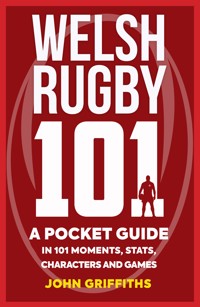
Welsh Rugby 101 is a compendium of fascinating facts, stats, stories, personalities and trivia – perfect for all fans of Welsh rugby. From the very first Test match against England in 1881 all the way through to the present day, Welsh rugby's rich history is distilled into 101 facts, stats and stories. This entertaining volume is an instructive, if sometimes irreverent – but always affectionate – guide to some of the groundbreaking firsts, controversies, innovations, characters, achievements and disasters that have taken place in the Principality over the years. Whether an expert or a novice, this is the perfect companion for those who follow Wales's exploits on the field and love to bask in light of its glorious (and sometimes inglorious) past.
Sie lesen das E-Book in den Legimi-Apps auf:
Seitenzahl: 120
Veröffentlichungsjahr: 2019
Das E-Book (TTS) können Sie hören im Abo „Legimi Premium” in Legimi-Apps auf:
Ähnliche


















This edition first published in 2019 by
POLARIS PUBLISHING LTD
c/o Aberdein Considine
2nd Floor, Elder House
Multrees Walk
Edinburgh, EH1 3DX
Distributed by
ARENA SPORT
An imprint of Birlinn Limited
www.polarispublishing.com
www.arenasportbooks.co.uk
Text copyright © John Griffiths, 2019
ISBN: 9781909715790
eBook ISBN: 9781788851800
The right of John Griffiths to be identified as the author of this work has been asserted by him in accordance with the Copyright, Designs and Patents Act 1988.
All rights reserved. No part of this publication may be reproduced, stored or transmitted in any form, or by any means electronic, mechanical, photocopying, recording or otherwise, without the express written permission of the publisher.
The views expressed in this book do not necessarily reflect the views, opinions or policies of Polaris Publishing Ltd (Company No. SC401508) (Polaris), nor those of any persons, organisations or commercial partners connected with the same (Connected Persons). Any opinions, advice, statements, services, offers, or other information or content expressed by third parties are not those of Polaris or any Connected Persons but those of the third parties. For the avoidance of doubt, neither Polaris nor any Connected Persons assume any responsibility or duty of care whether contractual, delictual or on any other basis towards any person in respect of any such matter and accept no liability for any loss or damage caused by any such matter in this book.
Every effort has been made to trace copyright holders and obtain their permission for the use of copyright material. The publisher apologises for any errors or omissions and would be grateful if notified of any corrections that should be incorporated in future reprints or editions of this book.
British Library Cataloguing-in-Publication DataA catalogue record for this book is available on request from the British Library.
Designed and typeset by Polaris Publishing, Edinburgh
Printed in Great Britain by MBM Print SCS Limited, East Kilbride
Photos courtesy of:InphophotographyGetty ImagesJohn Griffiths’ archiveArena Sport archive
Contents
Acknowledgements
Introduction
1 The people’s game
2 An Aussie captain
3 Leading the dragon
4 The creation of the WRU
5 The other side of the whistle
6 The Welsh system
7 Welsh rugby’s first legend
8 Living up to his nickname
9 Leading skippers
10 Living with Lions
11 The confident Mr Bancroft
12 Beating England at Cardiff
13 The Triple Crown
14 The prince of centres
15 Most tries in a Test by a player
16 The Bullet
17 Champions of the world
18 Longest winning streak
19 The Grand Slam
20 The First World War
21 Through the card
22 Wales’s oldest player
23 Three times for a Welshman
24 Unchanged through the season
25 The sacrificial car of Juggernaut
26 Welsh rugby’s only Test cricketer
27 An expensive headwear bill
28 The full back who caused a stir
29 The schoolboy who beat the All Blacks
30 That lovely point
31 The last four-point dropped goal
32 The Second World War
33 The Second World War
34 Capped either side of the war
35 The fastest man in Wales
36 Ken’s run
37 The Cardiff legend
38 The changing value of the dropped goal
39 The lineout expert
40 The first Triple Crown for 39 years
41 The unique Mr Gwilliam
42 The King of Rugger
43 The great tactical controller
44 Still unbeaten at Cardiff against New Zealand
45 Good enough to be an honorary All Black
46 The most successful Welsh international of all time?
47 The fastest striker in Wales
48 Entire Welsh XV sent off
49 A firm favourite
50 The modern back row forward
51 Wales’s lowest-scoring results
52 Top Cat
53 Captains on debut
54 The match of 111 line-outs
55 On tour
56 Winner takes it all
57 First replacement referee in a Welsh Test
58 Replacement referees
59 The King
60 The master of the shimmy
61 The best in the world
62 Record points on debut
63 Wales’s first replacement player
64 The most-capped subs
65 The super sub
66 Home run
67 The indestructible JPR
68 Try-scoring full backs
69 Merve the Swerve
70 The team of all the talents
71 The changing value of the try – part I
72 The Duke
73 The Viet Gwent
74 A fixture at tight-head
75 The crowning years
76 The early bath
77 The fifty club
78 Winner takes all
79 A double record-holder
80 The dropped goal king
81 Rugby World Cup record
82 The record points-scorer
83 The points machine I
84 The points machine II
85 The changing value of the try – part II
86 Highest scores and record margins
87 Wales’s longest-serving international player
88 Record defeats
89 Opening the new stadium
90 The Great Entertainer
91 The top try-scorers
92 Wales’s oldest try-scorer
93 The unique dropped goal
94 Getting the monkey off their backs
95 The Hundred Club
96 Babes in arms
97 Wales’s youngest try-scorers
98 Warren Gatland’s Grand Slam record
99 Welsh head coaches
100
101 The international record
Acknowledgements
I am indebted to John Jenkins, Howard Evans and Tony Lewis, three longstanding Welsh friends, for making freely available the fruits of their research into Welsh rugby. Cuttings from the Western Mail, Wales’s national daily, have also been a constant source of reference and I am indebted to their former rugby correspondents, notably John Billot, JBG Thomas and WJ Hoare for the accuracy with which they reported Welsh international rugby. But above all, thank you to the 1151 players capped by Wales since 1881: without them there would be no book.
Introduction
Welsh rugby fans have never had it so good. As this pocket guide goes to press, the national side is enjoying a record run of successive victories and occupies its highest standing, to date, in the official rankings calculated by World Rugby, the sport’s governing body.
So is the class of 2019 the best Welsh team of all time? That debate will be a part of rugby chat in pubs and clubs throughout the Principality as Warren Gatland’s team prepares for the Rugby World Cup in Japan later this year.
As the only perspective on the present is the past, this collection might help inform the arguments. In a distillation of 101 facts and stats, famous characters and matches, I have set out to capture the achievements and some of the disappointments of the national side from its modest entry to Test rugby in February 1881 to the joy of its recent Grand Slam triumph in Cardiff in March 2019.
The choice of what to include is mine and inevitably others will have different views. ‘How could you leave out Percy Bush or Dai Watkins?’ will be the cry from Cardiff and Newport. Or the million who claim to have been there might ask why accounts of Wales beating England at Wembley in 1999 and Cardiff in 2013 are omitted. Readers can suggest alternatives, but in the meantime here is my selection of the 101 men, matches and moments that stand out from more than 138 years of Welsh rugby.
The statistics go up to 31st March, 2019
1
FAMOUS FIRSTS
The people’s game
It was probably near Newport (Mon) that the Romans, during their western raids, first unveiled to the people of South Wales a game that resembled rugby. Then, in medieval times, West Wales was a stronghold of the mob game known as cnapan, which featured handling and kicking between two teams of mauling, brawling masses and which, with modifications, survived into the early 19th century. So when the Rugby School code of football was introduced to South Wales by students, teachers and doctors returning from English institutions where the game was practised, its distinctive feature of running with the ball struck a chord with young Welshmen.
Rugby football had established a foothold in Welsh schools and colleges before, in 1866, the first competitive match on Welsh soil was staged at Lampeter in rural West Wales, the participants being the local St David’s College and Llandovery College, Wales’s leading public school. Welsh scholars departing their cloistered confines subsequently assumed the lead role in spreading the game. The rapid industrialisation of South Wales, moreover, was the driving force of a population explosion that brought English, Scots and Irish to the area to support the native workforce in the coalfields and furnaces. Many joined with students and clerical workers supporting the heavy industries to establish the rugby clubs that sprouted in the 1870s, helping rugby football become the game of the Welsh people by the end of the decade.
2
FAMOUS FIRSTS
An Aussie captain
Newport were the leading Welsh rugby club of the late 1870s and early 1880s and it was a Newport initiative taken by their ambitious secretary, Richard Mullock, that led to Wales placing her first international fifteen on the field. Newport were affiliated to the Rugby Football Union and Mullock persuaded the RFU’s grandees to grant the Principality a fixture with England for the 1880/81 season. Mullock took it upon himself to raise the team.
The first Welsh captain chosen by Mullock was Australian-born James Alfred Bevan, who stares out from the team group photo for that encounter with England at Blackheath in 1881 wearing the red jersey and Prince of Wales feathers that became the permanent emblem of Welsh rugby fifteens. Bevan had first seen the light of day in St Kilda in Victoria on 15th April 1858 but was sent to the Welsh marches to be educated at Hereford Cathedral School after he was orphaned as a child. The future captain was a gifted sportsman who excelled at cricket, golf and rugby, winning Cambridge Blues in 1877 and 1880. But his single match in charge of the Welsh rugby team proved an utter disaster, the Principality suffering a humiliating defeat by seven goals, six tries and a dropped goal to nil – an 82–0 hiding in today’s money.
3
Leading the dragon
All told, 137 men have worn the captain’s armband since Wales made their inauspicious entry to international rugby in 1881.
Name
First captaincy
JA Bevan
19 Feb 1881
CP Lewis
28 Jan 1882
HJ Simpson
12 Apr 1884
CH Newman
3 Jan 1885
FE Hancock
9 Jan 1886
R Gould
26 Feb 1887
TJS Clapp
12 Mar 1887
AF Hill
22 Dec 1888
AJ Gould
2 Mar 1889
WA Bowen
3 Jan 1891
WH Thomas
7 Feb 1891
WJ Bancroft
18 Mar 1898
EG Nicholls
11 Jan 1902
TWR Pearson
10 Jan 1903
GL Lloyd
7 Feb 1903
W Llewellyn
6 Feb 1904
RM Owen
12 Jan 1907
WJ Trew
2 Feb 1907
RT Gabe
9 Mar 1907
AF Harding
18 Jan 1908
G Travers
1 Feb 1908
E Morgan
2 Mar 1908
HB Winfield
14 Mar 1908
RA Gibbs
12 Mar 1910
JL Williams
28 Feb 1911
J Bancroft
9 Mar 1912
TH Vile
25 Mar 1912
JP Jones
8 Mar 1913
Rev JA Davies
17 Jan 1914
G Stephens
21 Apr 1919
H Uzzell
17 Jan 1920
JJ Wetter
15 Jan 1921
T Parker
26 Feb 1922
JMC Lewis
20 Jan 1923
A Jenkins
10 Mar 1923
J Rees
19 Jan 1924
J Whitfield
2 Feb 1924
R Harding
27 Mar 1924
TAW Johnson
17 Jan 1925
S Morris
7 Feb 1925
RA Cornish
28 Feb 1925
WI Jones
14 Mar 1925
WJ Delahay
5 Apr 1926
BR Turnbull
15 Jan 1927
BO Male
5 Feb 1927
WC Powell
26 Feb 1927
IE Jones
26 Nov 1927
WG Morgan
2 Feb 1929
HM Bowcott
18 Jan 1930
JA Bassett
8 Mar 1930
WG Thomas
21 Jan 1933
JR Evans
20 Jan 1934
C Davey
3 Feb 1934
JI Rees
18 Jan 1936
W Wooller
3 Apr 1937
CW Jones
15 Jan 1938
H Tanner
18 Jan 1947
WE Tamplin
20 Dec 1947
JA Gwilliam
21 Jan 1950
J Matthews
7 Apr 1951
BL Williams
7 Feb 1953
JRG Stephens
16 Jan 1954
WR Willis
27 Mar 1954
KJ Jones
10 Apr 1954
CI Morgan
21 Jan 1956
MC Thomas
19 Jan 1957
RCC Thomas
4 Jan 1958
RH Williams
16 Jan 1960
BV Meredith
6 Feb 1960
DO Brace
12 Mar 1960
TJ Davies
3 Dec 1960
LH Williams
25 Mar 1961
DCT Rowlands
19 Jan 1963
AEI Pask
15 Jan 1966
D Watkins
11 Mar 1967
NR Gale
11 Nov 1967
GO Edwards
3 Feb 1968
SJ Dawes
9 Mar 1968
B Price
1 Feb 1969
DJ Lloyd
15 Jan 1972
WD Thomas
2 Dec 1972
AJL Lewis
20 Jan 1973
TM Davies
18 Jan 1975
P Bennett
15 Jan 1977
TJ Cobner
11 Jun 1978
TGR Davies
17 Jun 1978
JPR Williams
11 Nov 1978
J Squire
19 Jan 1980
SP Fenwick
1 Nov 1980
WG Davies
5 Dec 1981
ET Butler
5 Feb 1983
MJ Watkins
4 Feb 1984
TD Holmes
2 Mar 1985
DF Pickering
17 Jan 1986
RD Moriarty
12 Jun 1986
WJ James
4 Apr 1987
J Davies
3 Jun 1987
B Bowen
7 Nov 1987
RL Norster
28 May 1988
PH Thorburn
21 Jan 1989
RN Jones
4 Nov 1989
KH Phillips
2 Jun 1990
IC Evans
4 Sep 1991
GO Llewellyn
22 May 1993
MR Hall
27 May 1995
JM Humphreys
2 Sep 1995
NG Davies
25 Sep 1996
IS Gibbs
11 Jan 1997
RG Jones
5 Jul 1997
P John
19 Jul 1997
R Howley
7 Feb 1998
KP Jones
27 Jun 1998
D Young
5 Feb 2000
M Taylor
11 Nov 2000
LS Quinnell
26 Nov 2000
AP Moore
10 Jun 2001
CL Charvis
6 Apr 2002
ME Williams
8 Mar 2003
G Thomas
16 Aug 2003
SM Jones
23 Aug 2003
DWMM Davies
27 Aug 2003
MJ Owen
13 Mar 2005
DJ Jones
11 Jun 2006
DJ Peel
9 Sep 2007
GD Jenkins
24 Nov 2007
RP Jones
2 Feb 2008
A-W Jones
14 Mar 2009
M Rees
6 Nov 2010
SK Warburton
4 Jun 2011
BS Davies
8 Jun 2013
MS Williams
8 Aug 2015
DJ Lydiate
19 Mar 2016
JH Roberts
16 Jun 2017
TT Faletau
11 Mar 2018
EL Jenkins
2 Jun 2018
CL Hill
9 Jun 2018
JJV Davies
9 Feb 2019




