


Erhalten Sie Zugang zu diesem und mehr als 300000 Büchern ab EUR 5,99 monatlich.
- Herausgeber: Books on Demand
- Kategorie: Ratgeber
- Sprache: Englisch
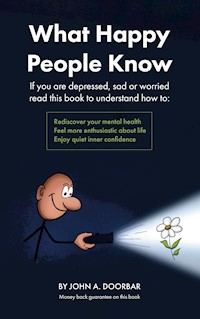
If you are depressed, sad or worried read this book to understand how to: Rediscover your mental health Feel more enthusiastic about life Enjoy quiet inner confidence
Sie lesen das E-Book in den Legimi-Apps auf:
Seitenzahl: 182
Veröffentlichungsjahr: 2022
Das E-Book (TTS) können Sie hören im Abo „Legimi Premium” in Legimi-Apps auf:
Ähnliche




















To Michili
Thank you for your love and support in so many ways
Einstein
The most important decision anyone can make is whether we choose to believe we live in a friendly or a hostile universe.
Contents
Testimonials
Timeless Insights
Letter to My Readers
The farmer and his horse
My mum and the rugby match
How the Principle of Consciousness works
My Dad the beekeeper
The Three Principles and other mental models
About This Book
Overview of the book
Prologue
The Origins
Personal and practical
Everything begins as an idea
Aims of this Book
In the beginning
A compelling truth about life
Recognizing the Three Principles
Touching every part of life
A new way of seeing
CHAPTER 1
The Search
Searching for the depression cure
Looking to a doctor for help
The university ‘cure’
Neurolinguistic Programming (NLP)
Powerful pills
Cognitive-behavioral therapy
The avatar worshippers
The Byron Katie seminar
Hypnosis
Family and friends
Mental health professionals
Running as therapy
The work cure
The birds
Transcendental Meditation (TM)
Manic tendencies
An important tip
Astrology
Natural “feel better” remedies
Turning to beer
The end of the road – or a fresh start?
CHAPTER 2
Hopeful
Hopes raised
Looking for happiness one more time
CHAPTER 3
Looking Deep Inside
Johnny, the human skull
Playing a Good Act
A prized academic life
The happiness “secret” revealed
The golden Buddha
Chapter 4
Meet the Three Principles
Meet Sydney Banks
What is a principle?
Introducing the Three Principles
Healthy and unhealthy
Thought – the first Principle
Mind – the Second Principle
Consciousness – the Third Principle
Chapter 5
Going Deeper
Stories and metaphors
How can we define the Three Principles?
What is reality?
The short story of Pablo Picasso
Different types of thoughts
Universal Thought
The power of personal thoughts (with a small “t”)
The source of thoughts
The mobile phone story
The source of thoughts
Scratches on the window to our world
Serious stuff
The 1952 “PPenny”
The Mind component
The power of Consciousness
The attic metaphor
Consciousness – Aliveness
Mind – Oneness
CHAPTER 6
Lessons Learned
The Basis of Spirituality
Lesson 1 - Realising mental health
Lesson 2 – Religion and modern science
Lesson 3 – Our sensory experience
Lesson 4 – The source of all possibilities
Lesson 5 - Dealing with our stuff
Lesson 6 - Spiritual insights
Lesson 7 - Contemporary Masters
Lesson 8 - Life and death
Lesson 9 – Feeling Compassion
Lesson 10 - Returning to our true state
Lesson 11 - Films as metaphors
CHAPTER 7
How the Three Principles Help
Three short case studies
Case study 1 - Jack in the pool
Case study 2 – The brand-new cello
Case study 3 - I had a very old teddy bear
11 ways the Three Principles help in everyday situations
1. Presenting
2. Help with Meetings
3. Relationships
4. Help with bad moods
5. Help with confidence
6. Help with stress
7. Help with money
8. Help with fear and insecurity
9. Help with avoiding suicide
10. Help with Coaching, Training and Counselling
11. Help with Learning
We can always choose which train to take
Acknowledgments
A few words about me
Contact
Testimonials
A simple, deceptively profound book
What Happy People Know us an honest, simple, deceptively profound book. John Doorbar beautifully uses personal stories, including his own experience of depression, to show readers how the human experience works. I most highly recommend this book. The insights John writes about are available to you, too!
Amy Johnson, Ph.D. Author of The Little Book of Big Change: The No-Willpower Approach to Breaking Any Habit and Just a Thought: A No-Willpower Approach to End Self-Doubt and Make Peace with your Mind
An Uplifting Book
In this beautiful, uplifting book John not only shares his own story; he hands people the key. Will they use it as he did?
Many say miracles don’t happen. John is living proof.
Dr Jack Pransky, author of numerous books including Somebody Should Have Told Us; Seduced by Consciousness; Modello; Hope for All; and many more...
Practical Wisdom
John Doorbar has written a colorful, glorious book of practical wisdom to inspire hope and creativity in all of us. His personal journey from despair to a life of love and light is pure inspiration for us all.
Steve Chandler, Author of Time Warrior and 40 books on coaching and helping people achieve their dreams.
Positive change
“John explains the fundamental insights of awakening to show you who you really are.
However, beware! This book could have a positive change on your life”
Michael Fritsche, Curriculum Developer I, John Deere GmbH Co. KG
Change
In a clear and light-hearted way, John unveils the change in his experience of everyday life and moods, thanks to the understanding of the Three Principles as described by Sydney Banks.
Thank you, John!
Dr. Angela Scarano, medical consultant and psychologist who specializes in working with children.
The right message at just the right time
John Doorbar's new book offers the right message at just the right time. As the entire world has plunged into a pandemic, our lives have been severely disrupted and, in some cases, destroyed. While we may be feeling the repercussions for generations, one immediate and widespread effect has been an alarming increase in mental health issues. Depression has never been more prevalent, and John understands this first-hand. His book goes deeper than the usual empty platitudes, and instead focuses on practical solutions. Get the book for you or someone you love.
Lou Bortone, author entrepreneur and video marketing specialist, who works wonders if you need marketing films.
Inspiring
I have witnessed John’s transformation from fighting depression to embracing exploring and thriving. I'm thrilled that he is sharing his story about what has helped him. Inspiring!
Dr. Ana Melikian, who helps high-value clients create transformational businesses worldwide.
Condensed Wisdom
This is a gem of a book written by a gem of a human being, who like Job, wrestled with Life until it was his own. This book is the condensed wisdom from a classic hero's journey where you can see the gift humbly revealed behind decades of depression. This book is a gift to thousands of others who suffer from the relentless “Leprechauns” in their own heads, whispering in the background a repetitive, negative story that just isn’t true.
Justin Perkins, Founder of New Edge Coaching. Justin is transformational coach who supports companies and their executives to achieve their true potential.
The book had me laughing and crying…
"An open, honest and touching story of a man's transformation from despair to wellbeing. The book had me laughing and crying, feeling John's struggles and insights.
I too had a huge transformation from a life of misery and alcohol addiction. The 3 Principles pointed me to my innate wellbeing and gave me a new life of peace and freedom from addiction. The book will inspire you and point you to your own innate wellbeing. In John’s words.
"This stuff works." It’s the truth.
Sally Wyse, 3 Principles Professional Practitioner
Improved knowledge and understanding
While reading this book and getting to know more background information, I was able to look at some of the challenging phases of John's life from a different angle. Together with the profound knowledge and examples he gave in each context, I have generally learned a lot about the 3 principles and other related topics. Some of it made me rethink my own experiences and knowledge, and others were so clear that they immediately helped me to understand better and broaden my perspective.
Christiane Neuss
Inspired by hope and a sense of possibility
“Inspired by hope and a sense of possibility, John Doorbar brings us “What happy people know.” His newer found peace of mind and joy after many decades of distress and trying to get better is what fuelled him to share a simple understanding of how people function at the most basic level. As I was reading this book I often felt as if we were having a cup of tea in the backyard, his sharing is down to earth, friendly and often humorous. “
Gabriela Maldonado Montano, 3 Principles Expert
Copyright 2022 John Doorbar
All rights reserved.
The scanning, uploading, and electronic sharing of any part of this book without the permission of the author is unlawful piracy and theft of the author’s intellectual property. If you would like to use material from the book (other than for review purposes), prior written permission must be obtained. Thank you for your support of the author’s rights.
The author is not responsible for websites (or their content) that are not owned by the author.
This book contains advice and information relating to health care. It should be used to supplement rather than replace the advice of your health care professional. If you know or suspect you have a health problem, it is recommended that you seek your physician’s advice before embarking on any medical program or treatment. All efforts have been made to assure the accuracy of the information contained in this book as of the date of publication. The publisher, author, and editor disclaim liability for any medical outcomes that may occur as a result of applying the methods suggested in this book. Any use of the information in this book is the reader’s sole responsibility. This book is not intended to diagnose or treat any medical condition and is not a substitute for a physician.
Timeless Insights
Throughout time, human beings have experienced insights that spontaneously and completely changed their behaviour and their lives, bringing them happiness they had previously thought impossible…
Achieving mental stability is a matter of finding healthy thoughts from moment to moment. Such thoughts can be a second away.
The Missing Link by Sydney Banks
A Book of Stories
This is a book of stories which I very much hope will help you to see something new.
“Metaphors, stories, musings speak to the heart, not to the brain. Listen with your heart, that is where we all find inner truth”
Dr George S. Pransky - Life is a Metaphor
Letter to My Readers
What on earth are these Three Principles? As you open this book you might be thinking this to yourself. What is this 3 Principles stuff all about? “Some weird new-age psycho-babble garbage?”
If that is what you are thinking, then we have a lot in common. Because that is exactly what I was thinking when I first heard of these principles. So what are the these principles?
The Three Principles are a way of understanding where our experience of life and feelings come from. People often look questioningly when they hear this sentence. Let me begin with a simple example to illustrate what I mean.
The good news about happiness
This good news gave me hope, especially when I felt unhappy and depressed. People we call happy do not always feel happy.
I always used to think that being happy or being unhappy was a continual life-long state. You were either one or the other. However, this is not true. How we feel in life changes quite often and our feelings depend on our thinking.
Happy people sometimes feel unhappy too. But they do not think about it very much. They do not see their unhappiness as affecting who they are deep-down. They do not think of themselves as being permanently unhappy people. The do not identify with their temporary unhappiness and low mood. They know that the bad feelings will pass if they do not hold onto their stressed, hectic and overwhelming thoughts.
My dad was like that. He knew that he was fine just the way he was. He did not try to change. He just waited for his innate happiness to come back. Then he got on with his life once again in his own jovial, inimitable way.
These are the things my dad used to say when he was feeling low. “I am not really feeling quite myself - “I am not quite on form today.”
“Dad, can I help you to feel better?” I used to say when he was feeling “out of sorts” as he called his feeling. “No, I will be alright, John. I am fine. I just need a few minutes. Just leave me alone and I will be back to normal soon.”
Mental health
Mental health is not about trying to change. It is rather to do with really understanding deep down that we are all OK exactly as we are. Our moods go up and down but our basic nature is to be happy and peaceful. Little kids do not feel happy all the time but when they feel unhappy they do not think about it too much. They just forget about it and go back to enjoying themselves.
If our basic nature is to be happy you might be asking, why on earth do I not feel happy? How on earth can I feel happy? I sincerely hope that the answer to this question will become clear as you read through this book.
Let me begin with a simple example
This short story has a worrying beginning and a happy ending. It even has a P.S. (a postscript) at the end.
A dear friend of mine, Barbara, lives about 30 kilometres away from us in Germany. She has, over the years, become a close family friend of Michi and me. (Michi is my lovely girlfriend and partner). I quite often call Barbara to see how she is getting on. I had not heard from her for about 8 days. So, on a Saturday morning in June about four years ago something strange happened that made me think. Barbara did not answer the phone. And she did not call back.
During this period, I went through 6 levels of thinking.
Step 1: I thought to myself, “that is no big deal.” “Just give it some time. Maybe she has just gone out to do some shopping.” Then I forgot about it and went for my regular Saturday run.
Step 2: Towards mid-afternoon on the same day, I still had not heard from her. I called again. No reply. Oh, I now noticed that my thinking was starting to get a bit noisy, “I hope she is OK. I am sure she will be fine. Maybe she has gone for a drive. Drivers are sometimes crazy in Germany. They drive much too fast. Oh, she will be OK. She can look after herself…and so on.”
Step 3: I noticed myself getting a bit more concerned. The thinking was getting to me. I was starting to feel my worried thinking. I started to pace around my flat a bit like a lion in a cage. So, around 19.00 I called again and again. Now my thinking started to go into overdrive. My imagination took over.
Step 4: “Maybe she has fallen and hit her head on her bath and was lying unconscious in her bathroom in a pool of blood. Or perhaps someone had broken into her flat.” My thinking was getting darker by the minute. I hardly got any sleep that night and woke up at 6.30.
Step 5: My thoughts were still going round and round in circles and getting worse. I noticed that my blood pressure was going up.
Step 6: I telephoned her once again. Barbara still wasn’t at home. So, I took my jacket and picked up her keys (She had given me a copy of her keys in case of an emergency)
I got in the car and drove much faster than usual over to her flat. The drive was not very nice, and my head was full of lots of crazy thoughts. When I got there, I put the key in the lock and opened the door. I was greeted with my friend hiding behind the door holding a very big dictionary in her hands. She was ready to bash me on the head as I came in. As you might have imagined, we were both surprised when she recognized that it was me! And I was relieved. Barbara smiled at me and asked me what on earth I was doing there at 6.30 on a Sunday morning. I explained what I had been thinking.
This story ended happily. Barbara had been at home the whole time. Her phone had been out of order for 6 days or so. She had not been able to hear the phone ringing even though, from my end of the line there had been a normal ring tone.
In this situation with Barbara, I had “thought myself” into a state of panic.
This book is about how our own feelings are created from our own thinking. We do not consciously do this. It just happens. These feelings are so strong that they feel real. And these feelings are what we experience in the world as our personal reality. This story taught me that my experience of an event (i.e. how I feel) is created 100% by my thoughts.
P.S. There is a postscript to this story.
From 10thNovember-12thNovember, 2022 I was fortunate to attend a wonderful course with Robin Charbit and Ken Manning, two of the leading practitioners in the “understanding of human experience” which this book is based on. On day two of this course, I called Barbara to see how she was getting on.
I had called Barbara 4 years earlier and had created the horrible scenario in my mind which I have explained above. This time I had a new thought, which I had not had 4 years previously, “oh that is nice, I thought – I am sure she has gone for a run and is enjoying herself in the lovely November sun.” I felt great that she was having fun!
This was the same event, an unanswered telephone call, both on a very early morning on sunny, summer Sunday, separated by 4 years. But I had a very different experience – the first very negative, the second extremely positive.
With this new thought my experience had changed. And this was a completely different feeling for me. The experience which I had was being created in my mind by my incredible power to generate my own experiences.
This is how we experience our own personal world, and this is what the Three Principles are about.
If you feel depressed
As you read this book you will see why it can be so useful and important to know about this if you are feeling sad or depressed. And as you will see, I have known what it feels like to be low and depressed. So, I can imagine where you are coming from and how you could be feeling.
A different experience of life
The Three Principles are remarkable in that they are easy to grasp and once grasped have the power to change lives. They helped me personally to experience my life differently.
Although my outside life has not changed very much, I have felt very different. I feel much freer and more relaxed. I do not take things as seriously anymore. I go with the flow of life. Not always. But a lot of the time.
For me, this new feeling is worth its weight in gold. And I never imagined that this change would ever be possible.
It is strange but we never really know that good things can come out of what, at first, seemed such a negative experience.
Nevertheless, being depressed can be deadly. Literally.
I know well what it feels like to be depressed. I have personally “done that” and got the T-shirt. This is the reason why I have written this book. If I had not experienced being sad and depressed, I could never have written it. I now see this as something good. Something good can now come out of my previous sadness and unhappiness. I hope that I can help other people to see that their life can get better, even if they think it can’t.
A parable
There is a great Chinese story that shows us how good things can come out of something bad. Maybe you have this great parable before. It is called “The Farmer and his Horse.”
The farmer and his horse
There was once a farmer in ancient China who owned a horse. “You are so lucky!” his neighbors told him “to have a horse to pull the cart for you!”
“Maybe,” the farmer replied.
One day he didn’t close the gate properly and the horse ran off. “Oh no! What a disaster!” his neighbors cried. “Such terrible misfortune!”
“Maybe,” the farmer replied.
A few days later the horse returned, bringing with it six wild horses. “How fantastic! You are so lucky,” his neighbors told him. “Now you are rich!”
“Maybe,” the farmer replied.
The following week the farmer’s son was breaking in one of the wild horses when it kicked out and broke his leg. “Oh no!” the neighbors cried, “Such bad luck, all over again!”
“Maybe,” the farmer replied.
The next day soldiers came and took away all the young men to fight in the war. The farmer’s son was left behind. “You are so lucky!” his neighbors cried.
“Maybe,” the farmer replied.
So, what is the point of the story?
Whenever we interpret a situation as being a ‘problem’ or an ‘opportunity’ it shapes the way we feel. This shapes the way we respond.
The story of the Taoist Farmer shows that we can never know how a situation is going to turn out. There are no intrinsic ‘opportunities’ or ‘problems’: there is only what happens. We never know what to expect.
I never thought I might feel better. But I really do.




