


14,99 €
Mehr erfahren.
- Herausgeber: John Wiley & Sons
- Kategorie: Fachliteratur
- Serie: Where am I?
- Sprache: Englisch
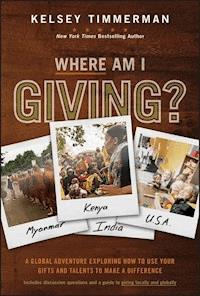
Your gifts connect you to a world of giving Americans are generous with their pocketbooks, but trying to make a difference and actually making a difference are two different things. Where Am I Giving? by New York Times bestselling author Kelsey Timmerman takes you on a journey to meet people who will inspire you to live a purpose-filled, generous life and make the greatest impact you can through your career, time, consumer dollars, and donations. Starting in his hometown of Muncie, Indiana, and then traveling all over the world (Myanmar, Kenya, India, Nepal, and more), Kelsey explores not only different ways of giving--as a worker, consumer, volunteer, giver, local and global citizen--but also the benefits and effectiveness of these methods. He spends time with monks, students, a refugee, a Marine, a former Hollywood executive, Peace Corps Volunteers, and seasoned aid workers to explore how they give, as well as with the people on the receiving end of their giving. Along the way he struggles to be a more informed giver as he becomes a "voluntourist," starts his own local non-profit, and searches for a balance between rationality and passion in how he gives. This book will help you: * Reveal the amazing opportunities you have to make an impact using your own gifts--and it doesn't have to be money * Understand the sociology, philosophy, anthropology, and neuroscience of giving * See how giving can make you more connected and happier * Examine types of giving, including microlending, volunteering, donating, ethical consumption, mission trips, voluntourism, child sponsorship, etc. * Dive into a nuanced view of effectiveness of international aid and its intersection with development, politics, and culture Where Am I Giving? is a fast-paced narrative combining compelling stories collected over 15 years of travel to 90+ countries, mixed with practical advice on how to make giving a part of our everyday lives.
Sie lesen das E-Book in den Legimi-Apps auf:
Seitenzahl: 484
Veröffentlichungsjahr: 2018
Ähnliche
















Table of Contents
Cover
Introduction: The Trash Picker, the Slave, and the Garment Maker (The World, 2001–2018)
Notes
Part I: WHY GIVE (WHEN I HAVE PROBLEMS OF MY OWN)?
1 Life After College (Nepal, 2001)
Notes
2 One Night in a Slum Showed Me How Poor I Was (Kenya, 2010)
Notes
3 We Aren't the Heroes (Kenya, 2010)
Notes
4 Confessions of a Volunteer Addict (Indiana, 2010)
Notes
5 What Can One Person Do? (Cambodia, 2017)
Notes
6 Happiness Isn't Having a Lot; It's Giving a Lot (Cambodia, 2017)
Notes
7 Giving Is Complicated: Ethnic Cleansing in the Most Generous Nation on Earth (Myanmar, 2017)
Notes
8 Seeing Differently to Make a Difference (Myanmar, 2017)
Notes
9 Giving on Purpose (Myanmar, 2017)
10 The Gift of Tasting Ice Cream (Myanmar, 2017)
Note
Part II: WHAT CAN I GIVE?
11 Science of Do-gooding (Kenya, 2017)
Notes
12 Money for Nothing (Kenya, 2017)
Notes
13 No Justice, No Peace (Kenya, 2017)
Notes
14 Giving Is Immeasurable: Change One, Change 100 (Kenya, 2017)
Part III: START LOCAL
15 Growing Up Gandhi (India, 2017)
Notes
16 Start with Your Local (India, 2017)
Notes
17 Start Small (India, 2017)
Note
Part IV: THE GIFT OF TRAVEL
18 Should You Go on a Slum Tour? (India, 2017)
Notes
19 Joy in a Hopeless Place (Kenya, 2017)
Notes
20 See Yourself in the Lives of Others (Kenya, 2017)
Note
21 Travel If You Can – It's Fatal to Prejudice (Kenya, 2017)
Notes
Part V: IS HELPING HELPING?
22 The Kiva Controversy (Cambodia, 2017)
Notes
23 Sponsor a Child, Save the World? (Zambia, 2017)
Notes
24 Marine Wages War on Poverty Through Locally-Led Change (Kenya, 2010)
Kenya, 2017
25 The Little Village That Was Supposed to Change the World (Kenya, 2017)The Little Village That Was Supposed to Change the World (Kenya, 2017)
Notes
Part VI: OUR GIFTS CONNECT US TO THE WORLD
26 The Strength in Your Story (US, 2011–2018)
Note
27 The X Factor in the Good Person Equation
Note
About the Author
Acknowledgments
A: Giving Appendix
TEACHING GIVING
SPEAKING OF GIVING
DISCUSSION QUESTIONS
GUIDE TO GIVING LOCALLY & GLOBALLY
End User License Agreement
List of Illustrations
Introduction
Figure I.1 The girl at the Phnom Penh dump (Cambodia, 2007).
Chapter 1
Figure 1.1 Khenpo Sange and the author.
Chapter 2
Figure 2.1 James and Thomas overlooking Mathare.
Chapter 4
Figure 4.1 The author (back left) with students from Ball State University.
Chapter 6
Figure 6.1 Scott with the granny.
Figure 6.2 Ratana in 2017 with her husband and son who is holding a picture of her from 10 years earlier.
Chapter 7
Figure 7.1 Thet Naing Oo and the children of The Good Samaritan Orphanage.
Chapter 8
Figure 8.1 Tim Aye-Hardy standing in front of one of myME's mobile classrooms.
Chapter 10
Figure 10.1 Pyay Way, a former monk, standing in his art gallery.
Chapter 11
Figure 11.1 Farmer John (left), his wife (beside him), his daughter Beryl (fourth from left), and family.
Chapter 12
Figure 12.1 Benter surveying her greenhouse.
Chapter 13
Figure 13.1 The Legend of Kenya (From left to right): Samson, Neileh, Tyson, Rozy, Kelvin, and George.
Chapter 14
Figure 14.1 Rozy and George planning the peace event.
Chapter 15
Figure 15.1 Tushar Gandhi and the author.
Chapter 16
Figure 16.1 Ashok in his office/bedroom on the phone with his girlfriend.
Chapter 17
Figure 17.1 Maruti (right) talking to OSCAR players after a scrimmage.
Chapter 19
Figure 19.1 Umra talking and listening to women in an isolated village in Lamu.
Chapter 20
Figure 20.1 The kids helping the author's mom to shore.
Figure 20.2 Ahmed standing with his children. One of them holds Ali.
Chapter 21
Figure 21.1 The author and his mom with staff from Safari Doctors.
Chapter 22
Figure 22.1 Phos and her grandkids.
Chapter 23
Figure 23.1 A boy with his makeshift guitar.
Chapter 24
Figure 24.1 Jake on his morning walk in 2010.
Figure 24.2 Josephat and his family.
Chapter 26
Figure 26.1 The author championing The Facing Project.
Guide
Cover
Table of Contents
Begin Reading
Pages
C1
i
ii
iii
iv
v
xiii
xiv
xv
xvi
xvii
xviii
xix
xx
1
3
4
5
6
7
8
9
10
11
12
13
14
15
16
17
19
20
21
22
23
25
26
27
28
29
30
31
32
33
34
35
37
38
39
40
41
42
43
44
45
46
47
48
49
50
51
52
53
54
55
56
57
58
59
60
61
63
64
65
66
67
68
69
70
71
72
73
74
75
76
77
78
79
80
81
82
83
84
85
86
87
89
90
91
92
93
94
95
96
97
99
100
101
102
103
104
105
106
107
108
109
110
111
112
113
115
116
117
118
119
120
121
123
124
125
126
127
128
129
130
131
132
133
134
135
137
138
139
140
141
142
143
144
145
146
147
149
150
151
152
153
154
155
157
158
159
160
161
162
163
164
165
166
167
169
170
171
172
173
174
175
177
178
179
180
181
182
183
184
185
186
187
188
189
190
191
192
193
194
195
196
197
198
199
200
201
202
203
204
205
207
208
209
210
211
212
213
214
215
216
217
219
221
222
223
224
225
226
227
228
229
231
232
233
234
235
236
237
238
239
240
241
242
243
244
245
246
247
248
249
250
251
252
253
254
255
256
257
258
259
260
261
263
265
266
267
268
269
270
271
272
273
279
275
276
277
281
282
283
E1
Kelsey Timmerman has been where very few donors go, and has seen the positive impact of the highly effective giving I advocate, as well as the negative impact of less desirable forms of giving. Where Am I Giving? offers thought-provoking and often entertaining insights into the importance of thinking carefully about where we give.
—Peter Singer, professor of bioethics, Princeton University, and founder of The Life You Can Save
Charity should never be motivated by pity because that causes dependency. Charity must always be the result of compassion leading to constructive action making the recipient independent and productive member of society. Where Am I Giving? is a good guide to constructive giving. A must read for all charity-minded people.
—Arun Gandhi, founder-president, Gandhi Worldwide Education Institute, Rochester, NY
Kelsey Timmerman has written a compassionate and compelling book about the people who run the international charities many of us donate to. To do so, he visited these organizations in person, spanning the globe, and bringing to the fore the realities that shape the daily lives of both the helpers and those being helped. Along the way, he intersperses his own advice as to what charity should—and shouldn't—mean for his readers. An inspirational book that's also a fascinating travelogue, it deserves a wide audience. We'll all be better off if our friends and neighbors read this.
—Pauline Frommer, publisher, Frommer Guidebooks
I loved this book. Kelsey has managed to write an exciting adventure of a how-to book on giving, volunteering, and generally making the world a better place through his own thrilling and heart-wrenching tales. Kelsey has done it all and lived it all. Where Am I Giving? is hugely entertaining while offering practical, real lessons and guidelines that he has lived. He has seen success and failure and shares where we can be most effective. Kelsey shows us where we can offer our time and resources, large and small, to impact the planet. He takes us along on his adventures to meet the people, learn about the causes, and show us the long-term victories and failures so we don't have to make the same mistakes. It's the most entertaining how-to book I've ever read, and few books are more timely.
—Conor Grennan, founder of Next Generation Nepal (NGN) and author of Little Princes
Traveling with Kelsey Timmerman in the pages of Where Am I Giving? will inspire you to do the most good you can do.
—Will MacAskill, president of the Centre for Effective Altruism and author of Doing Good Better: How Effective Altruism Can Help You Help Others, Do Work that Matters, and Make Smarter Choices about Giving Back
KELSEY TIMMERMAN
WHERE AM I GIVING?
A GLOBAL ADVENTURE EXPLORING HOW TO USE YOUR GIFTS AND TALENTS TO MAKE A DIFFERENCE
Copyright © 2018 by John Wiley & Sons, Inc. All rights reserved.
Published by John Wiley & Sons, Inc., Hoboken, New Jersey.
Published simultaneously in Canada.
No part of this publication may be reproduced, stored in a retrieval system, or transmitted in any form or by any means, electronic, mechanical, photocopying, recording, scanning, or otherwise, except as permitted under Section 107 or 108 of the 1976 United States Copyright Act, without either the prior written permission of the Publisher, or authorization through payment of the appropriate per-copy fee to the Copyright Clearance Center, Inc., 222 Rosewood Drive, Danvers, MA 01923, (978) 750-8400, fax (978) 646-8600, or on the Web at www.copyright.com. Requests to the Publisher for permission should be addressed to the Permissions Department, John Wiley & Sons, Inc., 111 River Street, Hoboken, NJ 07030, (201) 748-6011, fax (201) 748-6008, or online at www.wiley.com/go/permissions.
Limit of Liability/Disclaimer of Warranty: While the publisher and author have used their best efforts in preparing this book, they make no representations or warranties with respect to the accuracy or completeness of the contents of this book and specifically disclaim any implied warranties of merchantability or fitness for a particular purpose. No warranty may be created or extended by sales representatives or written sales materials. The advice and strategies contained herein may not be suitable for your situation. You should consult with a professional where appropriate. Neither the publisher nor author shall be liable for any loss of profit or any other commercial damages, including but not limited to special, incidental, consequential, or other damages.
For general information on our other products and services or for technical support, please contact our Customer Care Department within the United States at (800) 762-2974, outside the United States at (317) 572-3993 or fax (317) 572-4002.
Wiley publishes in a variety of print and electronic formats and by print-on-demand. Some material included with standard print versions of this book may not be included in e-books or in print-on-demand. If this book refers to media such as a CD or DVD that is not included in the version you purchased, you may download this material at booksupport.wiley.com. For more information about Wiley products, visit www.wiley.com.
Library of Congress Cataloging-in-Publication Data:
Names: Timmerman, Kelsey, 1979- author.
Title: Where am I giving? : a global adventure exploring how to use your gifts and talents to make a difference / Kelsey Timmerman.
Description: Hoboken, New Jersey : John Wiley & Sons, Inc., [2018]
Identifiers: LCCN 2018019679 (print) | LCCN 2018021118 (ebook) | ISBN 9781119454236 (Adobe PDF) | ISBN 9781119454410 (ePub) | ISBN 9781119448129 (hardcover)
Subjects: LCSH: Humanitarianism. | Voluntarism. | Charities. | Social action.
Classification: LCC BJ1475.3 (ebook) | LCC BJ1475.3 .T56 2018 (print) | DDC 201/.76—dc23
LC record available at lccn.loc.gov/2018019679
Cover Design and Images: Rule 29 Creative
To Annie, Harper, and Griffin,
who give me so much,
including more reasons to give
IntroductionThe Trash Picker, the Slave, and the Garment Maker (The World, 2001–2018)
One of the most beautiful sights I've seen is an 11-year-old girl laughing in the worst place I've ever been.
She haunts me to this day.
Smoke and stench – fire and brimstone – surrounded her as she threw her head back, shoulders shaking. Her eyes closed to the hellscape of Phnom Penh's municipal dump. She had been sifting through previously picked-through trash looking for something of value. Treasure or trash? Discard or keep?
She and the other children earned a dollar per day, if they were lucky, by selling their findings while their parents picked through fresh trash brought by a parade of garbage trucks. Most of the trash pickers were former farmers.
What must have life been like back on the farm?
“Life in our village is tough,” I imagined the parents saying. “Farming is no way to make a living. I hear there's this garbage heap in the city where we could work and even the kids could earn a dollar per day.”
They packed up their belongings and moved to the city. My hell on earth was someone else's opportunity.
That thought coupled with the sight and the smell of the dump made me physically ill. I had to fight from puking. I didn't want them to see that what they did and where they did it disgusted me.
Until visiting the dump, I didn't realize that people lived in places like this.
The adults wore rags across their noses and mouths, their vacant, almost lifeless eyes searching through the trash.
But the girl …
The girl still had life and light in her eyes (see Figure I.1). I wanted to do something. I wanted to grab her hand, walk her away from the dump, and give her … an education? A chance? A future? But there were hundreds like her in this one dump.
Figure I.1 The girl at the Phnom Penh dump (Cambodia, 2007).
What could I do? We live in a world where 1.2 billion people live on less than $1.25 per day. Where half the world's population lives on less than $2.50 per day.1 Where 21% of American children live in poverty.2 I was just one man, researching my first book, traveling on my second mortgage. And she was just one girl.
I pulled out my Frisbee and tossed it to her. She threw it to a barefoot boy, who put down his burlap bag of trash treasures to catch it. I taught them how to throw a Frisbee and for 15 minutes we escaped into a world of throwing and catching, of laughing and smiling. Then they got back to work and I went to my $11 per night guesthouse and showered three times until the stench of the dump lingered no more.
But no amount of scrubbing could wash away the memory of the dump. Are awareness and empathy treasures that can enhance our lives? Or are they burdens that would be better off discarded because awareness without action leads to guilt and apathy?
When do we act? How do we act to make a positive difference?
I was faced with this same dilemma a few years ago when I traveled to Ivory Coast to meet cocoa farmers while researching my second book.
I never expected to meet a slave in my lifetime, but then I met a man named Solo who showed me a view of another world. He was from the neighboring country of Ghana and had followed false promises to a cocoa farm. He had asked to leave, but wasn't allowed to go. He told me the donkeys got treated better than he did because at least they were fed when they weren't working. He told me they do worse things to him than beat him. Solo called the guy he worked for “master.”
For me hearing a human being call another human being “master,” in this day and age, shook me to my soul. I knew modern slavery existed, but knowing about it and witnessing it were two completely different things. Sitting next to Solo, a living breathing slave and listening to his story, I felt compelled to act, to help, to make a difference.
I hatched a plan where I hired Solo as my translator away from the farm for the day. It worked.
At the end of the day, I paid Solo $40 and asked him where he wanted to go.
“Home,” he told me. “To Ghana.”
Solo's master figured out what was going on and sent me a text, threatening to have me arrested. Solo was trying to figure out a way home when we got separated.
But the slave …
Days later I learned Solo was back on the cocoa farm. Was he captured and taken back? Maybe. But it's more likely that he looked at the opportunities before him and chose to go back. Solo chose slavery.
When I learned Solo was back on the farm, I worried what repercussions he may have suffered from my actions. I acted. I did something, but I wish I had done nothing. Good intentions aren't enough; it's the results those intentions produce that matter.
I regretted not acting to help the girl at the dump. I regretted helping Solo.
I was a recent college grad when I met the man who made my favorite T-shirt outside the factory in Honduras where he worked. It was awkward. The T-shirt cost nearly as much as a day of his labor. There I was, skipping around the globe, and there he was in a sea of workers with a chain link fence and a long workday at his back, kind enough to stop and chat with me, puzzled as the security guard at the front gate had been.
Why was I there?
A degree in anthropology had inspired my curiosity and I left the flat fields of the Midwest to meet people who lived differently than I did. I'd save up money working a retail job or as a scuba instructor, and then I'd blow it all traveling. I started to write about my travels and would get paid a whopping $10 from publications for stories like spending the night alone in Castle Dracula in Romania. I could go anywhere in the world and have adventures worth writing about. It was the world's most expensive hobby.
I was looking for that next place to go, and my favorite T-shirt had a funny picture of a guy from a TV show in the early 1980s and these words: “Come with me to my tropical paradise.” “So,” I thought, “why not?” I put on the shirt and showed up at the factory half expecting the factory management to laugh at the randomness and silliness of it all and throw open the factory gates. They didn't, so I waited to the side of the factory to meet someone who possibly made my shirt.
When Amilcar stopped to talk with me, the randomness and the silliness faded, replaced by awkwardness and questions from a forgotten sociology course: Does this job provide a better life for you and your family? What are you paid? Is this one of those sweatshops?
Of course, I didn't ask any of these questions. I think deep down I didn't really want to know. Amilcar and I were the same age, but our lives were vastly different. I was traveling on a whim, following my curiosity wherever it led, and he was working in the factory that made my T-shirt. I looked at myself through his eyes as I had once looked at myself through the eyes of a beggar in Nepal, and I saw the privileges and opportunities of my own life. I wrestled with the fact that people make the clothes we wear, and we have it made.
I went to Cambodia where my jeans were made and while there I met the girl. I wondered what life was like for her and other rural farmers who were leaving the fields for factories, and I traveled around the world to meet farmers. That's when I met Solo on the cocoa farm. One person, story, and question flowed into the next.
I'm privileged, but I'm not Batman's alter ego Bruce Wayne by any means. In the 16 years of travel covered in this book, at times I earned a poverty wage, once I was unemployed, but mostly I earned a solid, but very unpredictable, middle-class income. Yet I received an education. I have access to health care. I have not known hunger or war, nor have my wife and kids. There are privileges beyond financial ones. Being a straight, middle-class, able-bodied, white dude in Muncie, Indiana, certainly comes with its own privileges.
I've traveled to some of the poorest places on our planet, and there are people I wish I could forget, like the girl trash picker, Solo the slave, and Amilcar the garment worker, but I never will. These are people who live in circumstances that have often paralyzed me to the point of inaction. But from the very beginning, I began to feel the responsibility of my privilege, and of the opportunities in my life that I have, that you likely have, that most of the world's people don't.
This is something I've been struggling with for years.
My global searches for connection have inspired me to try to be a better giver, activist, and global and local citizen. They inspired me to cofound a community storytelling nonprofit, The Facing Project, which has engaged more than 200,000 people nationwide. But still, when I think about the girl and Solo and Amilcar, I feel like I'm not doing enough.
Awareness without action feels irresponsible. I believe I have a responsibility to act, to do something, and I believe you do as well. If you make $52,000 per year, you are in the top 1% of global earners. Even if you live on $11,000 per year, which is below the poverty line in the US, you are richer than 85% of the world's population.3 If you graduated from college, you are more educated than 90% of the rest of the world. If you are fortunate enough to have the education and time to read a book, you've probably been dealt a reasonably good hand in terms of privilege compared to the rest of the world. If you aren't convinced that you have a responsibility to make a positive impact with the opportunities you've been given and the privileges from which you benefit, part of my job is to convince you. I'll do that by introducing you to the experiences and people who've convinced me.
This book isn't about a middle-class, overeducated white dude, giving to the world or “saving the world” as overeducated white dudes are wont to do, but about the world inspiring and teaching that dude to be a better giver. And through my discovering the amazing opportunities I have to give and the benefits of giving and learning how to do so more meaningfully, I hope you will as well.
This book is about more than financial gifts. You don't have to have money to make an impact. In India I'll introduce you to a 26-year-old who lives in a slum and spent $6 on a soccer ball that led to 3,000 kids going to school. In Kenya, I met a group of former gang members who risk their lives promoting peace in the most violent slum community in Nairobi. They each had much more to give than money.
The scale and complexity of global and local issues can overwhelm us to the point of inaction, but I choose action. I'm choosing to make an impact and not just blindly accept that doing good or meaning well is enough, because it isn't. In a world where good intentions are no longer enough, where helping can hurt, how can I, a landlocked American with an average income and 2.54 kids (if a cat, hamster, and two goldfish add up to 0.54 kids) make a difference? We are about to find out together.
I'm not alone in my desire to make a difference. Ninety percent of Americans have donated money, goods, or services to causes.4 Eighty-four percent of Millennials report that making a positive difference in the world is more important than career recognition.5
Trying to make a difference and actually making a difference are much different things. My volunteer opportunities haven't ended well. The boy I mentored through Big Brothers Big Sisters went to “kid jail.” The cashier at PetSmart will ask me if I want to donate $1 for orphaned puppies. What kind of jerk says no to orphaned puppies? Sometimes, me!
Ethicist Peter Singer believes, when it comes to giving of our time and resources, we are being immoral by not giving more. Singer believes that it is our moral obligation as Western citizens to give as much as we can to help save the lives of those facing extreme poverty and disease. In his eyes, we should be giving at least 10% of our incomes. Yet only 5.6% of Americans' donations go to global causes.6
Singer's work The Life You Can Save inspired a movement – effective altruism – that asks us not just to give more but to give better. In Kenya, I visited a nongovernmental organization (NGO) that is one of the darlings of the effective altruism movement. It simply gives cash, no strings attached, to people in poverty.
I address the aid debate highlighted by economists such as Jeffrey Sachs (if we gave more, we could end poverty) and William Easterly (we need to rethink aid and focus on development). Dambisa Moyo, who was born in Zambia and got her PhD from Harvard, said, “Aid has been and continues to be an unmitigated political, economic, and humanitarian disaster for most parts of the world.”7A disaster. Yikes! When I read that it almost made me want to give up on giving.
I visited a village where the United Nations and Sachs tried to end poverty. I think you'll be surprised about what the villagers had to say. I spent time with one of the world's largest NGOs and the biggest proponent of child sponsorship in the world, and sometimes they even let me get out of the SUV to meet the people whom they help.
I think we need a balance of head and heart, and local and global giving. We need to question our altruistic motivations, measure our impact, and work with – not just for – those we help. We need to empower people and at the very minimum do no harm in our efforts to do good. We need to explore how we've received gifts, our gratitude or lack thereof for them, and how we are putting them to use. Giving is so much more than writing a check; it's a practice that connects us to our communities and the world and helps us find purpose and meaning in our lives.
I want there to be a “Good Person Equation,” something to tell us how much we should give, volunteer, and engage in acts of local and global activism and altruism. Actually, you'll see that at times I was quite desperate to fill the variables of such an equation.
Throughout the book I'll share Giving Rules that can help guide your giving. Think of them more as suggestions, my takeaways from the narrative you are reading.
Giving Rules: Gratitude first, then giving. When you look at your life, time, money, and talents as gifts, you will give more of them all.
This journey is not about my travels around the world helping people – that would be pretty annoying – but it's about seeing the world and our lives through the lens of giving, and meeting people who have something to teach us about it. It's learning from a Hollywood executive who left a life of yachts and actress girlfriends for that dump in Cambodia where I met the girl. It's meeting a Burmese refugee who returned to see his country in a new way that changed his life. It's students time and again acting as agents of change, leading the way. It's sitting down with Gandhi's great-grandson and asking him, perhaps a little too desperately, how I should live my life.
We were born into relative prosperity and a wealth of opportunity. When faced with global poverty statistics and local harsh realities, it can be easy to feel guilt. This book isn't about how to absolve yourself of your first-world guilt. It's about helping you recognize your own privilege and the amazing opportunity that comes with it for each of us to impact the lives of people in our communities and around the world and our own through giving.
Giving Rules: We are products of the gifts others have given us.
Notes
1
United Nations Development Programme, “Sustaining Human Progress: Reducing Vulnerabilities and Building Resilience,” Human Development Report, 2014 (February 2014) 19.
2
Yang Jiang, “Basic Facts About Low-Income Children,” National Center for Children in Poverty (January 2017).
3
William MacAskill,
Doing Good Better: How Effective Altruism Can Help You Help Others, Do Work That Matters, and Make Smarter Choices About Giving Back
(New York: Avery, 2015), 18.
4
Robert D. Lupton,
Toxic Charity: How Churches and Charities Hurt Those They Help
(New York: HarperOne, 2011), 2.
5
Bentley University Center for Women's & Business, “Millennials in the Workplace” (2011), 4.
6
Giving USA Foundation, “Giving USA 2017: The Annual Report on Philanthropy for the Year 2016” (2016).
7
Dambisa Moyo, Dead Aid: Why Aid Is Not Working and How There is a Better Way for Africa,
(New York: Farrar, Straus and Giroux, 2009), xix.
Part IWHY GIVE (WHEN I HAVE PROBLEMS OF MY OWN)?
1Life After College (Nepal, 2001): The mission / The responsibility of privilege
AS A 22-YEAR-OLD RECENT COLLEGE GRAD, I loved flying. Thirty thousand feet in the air, my book marked with a ticket to somewhere, was the only time in my life I knew where I was going and when I was going to get there.
I was on my way to Nepal – the next destination in a series of one-way tickets away from the expectations that surround a graduate who had moved back in with his parents. It wasn't that I had an issue with not knowing what I was doing with my life; it was that I had an issue with other people having an issue with it.
The maroon robe of the Tibetan monk in the seat next to me spilled over my armrest. He was in my space, and each time he moved his robe pulled at my headphone connection, interrupting the audio of the movie Osmosis Jones. Chris Rock was the voice of the white blood cell fighting infection on the streets of Bill Murray.
The monk would move; I'd sigh, and push my headphones in again. Occasionally we'd chuckle at the same point. I'm not sure if a white blood cell blowing his hair dry with a fart is physiologically correct, but it was humorous enough in a cross-cultural sort of way to make us share a moment.
We were on a flight from Bangkok, Thailand, where I had spent a few weeks island hopping. For less than 10 bucks a night, I rented beachside bungalows accessed by water taxis.
Before that I was budget backpacking through Australia.
This sounds luxurious, and in all of the important experiential ways it was, but I traveled on the cheap. Ate ramen. Camped in my tent. I knew my budget would run out before my desire to keep going waned.
My grandma, Frances Wilt, gave all of her grandchildren $5,000 when they graduated from college. This gift was why when my peers at Miami University were talking about the jobs they landed and how much they were going to get paid, I was shopping for a one-way flight away. Gone. I worked a few months swinging a hammer after I graduated to earn some money to add to Grandma's so I could be gone longer.
I graduated in 2001 with a degree in anthropology or, as one Cultural Anthropology textbook that wrote about me put it, “With only a bachelor's degree in anthropology, he set out on a global tour …”1 But I didn't only have a bachelor's degree. I had the curiosity that earning that degree inspired and the tools to pursue that curiosity. As someone who grew up in the rural Midwest at a school that had a “drive your tractor to school” day, I wasn't exposed to a lot of cultural diversity or diversity of thought. College, specifically my anthropology courses, introduced me to cultures I had never imagined.
College students are filled with potential. Seventeen years of building a base of knowledge and skills on which to build a career. As a first-year college student there is pressure to declare a major, to decide what you want to be when you grow up. Senior year is when all of the education and potential success and world-changing rubber meet the road. The “I want to be [blank]” becomes an “I am doing it!” or “I am not doing it because …” Potential and expectations are realized or they aren't.
In the eyes of many, I had not realized my potential, and I had not met expectations.
I envied the future med students and teachers and anyone else who knew what they wanted to do. Their itinerary was set. They'd have to go to school for so many years and then start a career with benefits. I didn't even know what I was going to do when I landed in Kathmandu.
I sort of hated arriving anywhere. I was more comfortable going – permanently in transit. My travels really didn't have a purpose and neither did I, but the monk next to me was about to change that.
Osmosis Jones ended. I took off my headphones.
We sat in silence. The monk chanted while turning the wooden beads of a necklace like my grandma praying the Rosary. A half hour before landing, our bond strengthened over stupid human tricks – a video of people spinning plates or juggling chainsaws, and one man who pulled a string out his ear after having inserted it into a small wound on his little toe.
“How to do? How to do?” The monk, whose name was Sange, laughed. His resting grimace turned into a face-swallowing smile.
“Is the airport close to the city?” I asked him.
“When you get to Kathmandu,” Sange said, “where do you stay?”
I didn't have any plans or a guidebook or reservations, just an idea of wanting to go hiking in the Himalayan Mountains we were flying over.
“You come with me,” he said. “If you good … stay longer … if not so good, we find you hotel.”
We walked out of the airport and were greeted by signs held by his followers. There were flowers, and people came up to him with white cloths known as khata. They'd bow before him and then he'd place the cloths around their necks.
Sange was your exact mental picture of a monk – chubby, glowing smile, shaved head, and bright robes – but apparently, given the welcome, he was not an average monk.
I thought he must've been some reincarnated, black belt, sensei monk. Obviously, I didn't know much about Buddhist culture.
We went to Sange's brother's house, where Sange held court.
Young lamas filled a brass cup with Coca-Cola before a straight-faced golden Buddha on an ornately decorated shrine. All of this world is suffering, but Lord Buddha needed his Coke. They lit two sticks of incense, backed away from the shrine, bowed, and left.
I sat across from the shrine on the floor, a steaming cup of putrid, buttery, salt tea before me, jealous of Buddha, wishing I could get a swig of his Coke to wash down my heaping bowl of noodles.
At the head of the room, Sange greeted a steady stream of people coming to pay their respects. They called him Khenpo Sange or simply Khenpo. Think of the title Khenpo as a terminal degree in Buddhist teaching. The respect payers did double takes in my direction, bowed three times, and discussed matters with Sange. Conversations took place in Tibetan, Nepalese, Taiwanese, and, occasionally, even a little English directed at me.
Hours passed, each marked by a plastic cuckoo clock, which chimed out “Happy Birthday” pathetically as if its batteries were running low.
We sat and ate so much – he entertaining audiences, me bored out of my mind.
“Are you bored?” he'd ask.
“Just mindful,” I'd respond instead of screaming.
When there was a lull in visitors, we'd chat. He asked about my travels in Thailand and I told him about a guy named Porn who said he would take me to the post office to mail a package and then took me unexpectedly to a whorehouse, which I promptly left. From his position at the head of a small gathering, he rolled in laughter.
My original intent was to go hiking in the Himalayan Mountains, maybe visit Everest base camp. When I told Sange this, he consulted his scrolls to see if it was a good day to start a journey.
“Not today,” he'd say.
“Tomorrow?” I'd ask.
And then tomorrow would come, and we'd load into the SUV and see some sights before heading back home.
It was like I was being held hostage by hospitality.
At night we'd walk around the local stupa, a large multitiered structure with a dome in the center and a spire on top. He'd answer my questions about Buddhism. He never evangelized. His lessons were about understanding the world, not understanding a religion – a philosophy more than a faith. Sange was a Mahayana Buddhist. As he described it, our compassion and happiness promote compassion and happiness toward all sentient beings. All living things are connected, and our lives should be in service to them.
Khenpo Sange showed me a world and a worldview vastly different from the mental landscape of the flatlands of the Midwest.
He'd answer some of my questions by buying me books on our nightly walks to the stores surrounding the stupa. I read a lot. I wondered around the compound where monks would be lost in chants or creating intricate art using colored sand, only to wipe it away on completion – a reminder that everything is temporary and therefore attachment could only lead to suffering. Or something like that.
One evening Sange and I walked to the stupa with his nephew Dorjee. Om mani padme hum, a common Buddhist chant, droned from a speaker above. We were part of a mass of humanity walking clockwise around the local stupa.
As we walked the required three laps, we passed Internet cafés, tailors, bakeries, and souvenir shops. A legless beggar sat on a board with wheels and lashed out at my shin with her cane. She wanted me to give her money, but I had no money. I didn't need money. Sange took care of everything, even donating on my behalf when I lit 108 prayer candles.
Up to this point in my travels, I went the places tourists were supposed to go and saw what tourists were supposed to see. On the way to the stupa we had passed cows licking their calves, human and animal waste on the street, intestines covered with flies spread out on wooden tables, and a guy with a fridge strapped to his back. On the tourist path, I saw the world through my eyes; but in the eyes of the legless beggar, I saw myself through the eyes of the world, and it made me uncomfortable.
The thick smell of dirt and hot wax hung in the evening air as we finished our third lap and continued on to a fourth.
“I thought that we were doing three laps,” I said.
“You do something once,” Sange said, “it is not a big deal. Two times, it is a little more important. But three times it is really important. Three laps good. Seven laps better.”
I felt the chanting as much as I heard it. A group of robed men sitting on the floor gave life to the damp morning air at 5 a.m. The incense slowly burned, releasing musky overtones in long, black, rising wisps of smoke.
My room sat high on the hillside, overlooking the comings and goings of life in the valley below. From a down cocoon of warmth and comfort, I unzipped my sleeping bag and entered a place and culture that I barely understood.
We were at Sange's monastery south of Kathmandu in the village of Pharping.
Breakfast was ladled out of a smoldering cauldron on a terrace cut in the hillside.
Soon the monastery and its ramparts were swarming with local villagers, pilgrims from Kathmandu, and brightly robed lamas. All were here to welcome Khenpo's teacher, His Holiness Penor Rinpoche, and to dedicate a new shrine at the lamasery to Padmasambhava, an eighth-century Buddhist master who was born out of a lotus and often depicted giving the “rock on” sign meant to repel demons.
“His Holiness is very powerful,” Sange explained as we waited for his arrival. “When Chinese forced us away from our homeland, he was one of the last to leave. He left with many men and women. The Chinese follow them to the mountains with guns. They shoot and kill many people around His Holiness, but the bullets fall at his feet and their grenades do not explode until he has passed. The hike over the Himalaya is very difficult and others die of cold and hunger. His Holiness injures leg, which hurts him even today. Three hundred left Tibet; only 30 make it to India.”
I tried to make myself useful during the preparation for His Holiness's visit. I helped lug a welder up the hillside, and, well, that's about all I did. Mostly I ate and played hackey sack and practiced kung fu kicks with the young lamas in training.
As the car of His Holiness Penor Rinpoche, the present-day reincarnation of a monk first born in 1679, came to a stop at the base of the monastery, the gathered crowd surged forward hoping to glimpse or touch him. A robed Secret Service emerged and cleared a tunnel for the short, squat holy man to limp through. Khatas were thrown at his head like panties at a rock star.
One by one we filed up to His Holiness, who was seated on an elevated throne. I knelt before him and presented him with a khata. He smiled warmly and placed his hand upon my head and ruffled my blond curls – I hadn't had a haircut in months.
The brightly colored walls, the smell of incense, the gold Buddha at the front of the room, the bulletproof monk with my friend Khenpo Sange at his side – it all was so exhilarating. It's not that I was caught up in the religious fervor and believed in reincarnation or bulletproofness; it was that I was a witness experiencing an ancient culture. I was a participant and I was an observer.
Participant observation is a research method employed by anthropologists in which a researcher isn't simply a fly on the wall scribbling in a notebook, but part of the action – sitting in prayer, lighting 108 candles, watching monks gift a gold Buddha Coca-Cola, and getting blessed by a smiling monk with a silk khata around my neck.
I felt like I was an anthropologist doing something I was meant to do, something important.
In my anthropology senior seminar we discussed a debate within the scientific community about how much an observer's presence impacts the data. The postmodern school of thought believes that when anthropologists go into the field, they bring back stories rich in context and meaning. The stories can't necessarily be quantified, but they can be appreciated for what they are: glimpses of people at a particular moment that provide value in the act of attempting to see, appreciate, and understand them.
If there is any anthropology occurring in my work, this is it. At least the authors of that anthropology textbook seemed to think so: “Employing an anthropological lens as a journalist and traveler, Timmerman enables us to see and feel the impact the global economy has on people …”
It's weird now to be an example of applying anthropology. At the time, I was rudderless and felt like the classic example of what not to major in and what not to do with your college degree. I kept seeing anthropology consistently at the top of majors not to major in if you want to be a responsible adult.
Up until I met Sange, I was on the traveling circuit, ticking the boxes of all the things a backpacker should do. It wasn't until meeting him on the plane and his invitation and all the time he put into me that I had my first really amazing cultural experience. He showed me something so different from what I was used to. He made me fall in love with the world and writing about the people I met.
It's the age-old story. Injured traveler meets monk (see Figure 1.1). Monk takes traveler to lamasery in the foothills of the Himalayan Mountains, consults prayer cards, blesses traveler, and fills traveler's belly with rice and lentils. Traveler gets better – and 16 years later realizes the importance of it all.
Figure 1.1 Khenpo Sange and the author.
Sange had accepted me into his world and, although I didn't recognize it at the time, helped me discover what I was meant to do. My studies in anthropology weren't going to waste. He had given me the gift of purpose.
In hindsight, his impact is immeasurable on my life.
His wasn't the only gift to influence my trip. The trip was paid for in large part by Grandma's gift, and I wrote about it in the journal my Aunt Cathy gifted me.
In The Gift: Creativity and the Artist in the Modern World, Lewis Hyde encourages readers to “think of the gift as a constantly flowing river” and that we are the channels. The river shapes the channel and the channel defines the river. The time, talent, kindnesses, and resources we share – our gifts – don't stop; they are passed on and shared. They flow through us and connect us.2
Our lives are shaped by the gifts of others, people making small and large impacts that seem to embed into our DNA and change the course of our lives. Unless we recognize the people who have shaped our journey, we'll think we arrived on our own.
“I have a lot to be thankful for,” I wrote in my journal on Thanksgiving Day when I was at Sange's monastery. “Over the last four months I have been living a dream, but also I have seen children in such poverty. I cannot imagine that they will ever have the gift of dreaming. When one has to dream about life's necessities anything else such as traveling seems superfluous.”
I had witnessed global poverty, had a beggar whack me with a cane, and was wrestling with what it meant to live in this world of haves and have-nots. I didn't recognize all of this when I was 22 traveling alone. I had a long way to go, and probably still do, but I can see an awakening of gratitude and struggle with privilege in that entry. I began the search for the Good Person Equation. I left Nepal different.
My aunt had written a quote by Sue Ebaugh a few pages ahead of my Thanksgiving post: “Within our dreams and aspirations we find our purpose.” “I am a better person for having met Khenpo Sange,” I wrote in my journal. “And I will become better in the future.”
We have to have gratitude for what has been given to us before we can give in an impactful way. If it weren't for Sange, my grandma, and so many other people, maybe even Osmosis Jones, I wouldn't have had the opportunity to follow my curiosity around the world to meet the people who've helped give my life purpose.
Notes
1
Gary Ferraro and Susan Andreatta,
Cultural Anthropology: An Applied Perspective
(Belmont, CA: Wadsworth, Cengage Learning, 2017), 177.
2
Lewis Hyde,
The Gift: Creativity and the Artist in the Modern World
(New York: Random House, 2007). 9.
2One Night in a Slum Showed Me How Poor I Was (Kenya, 2010): Why should we care when we have our own problems? / My problem with missionaries / Giving thoughts and prayers
TO ME KENYA FELT LIKE AN ESCAPE. Back home the world was shrinking.
The financial crisis of 2008 that had introduced chaos around the world first came to my attention in the monthly sales reports of my family's business, aka my day job. I had worked on and off for Timmerman Truss since I was in eighth grade. The American Dream my parents had built over four decades ended and the nightmare began.
The US economy neared collapse as the housing bubble, which had fueled the success of the business, burst. Our problem became everyone else's.
Main Street pointed to Wall Street's follies. Wall Street blamed Main Street's irresponsible borrowing. But on countless, nameless, and forgotten streets around the world, lives hung in the balance.
I lost my job along with my 40 coworkers. We weren't alone. Tens of millions of workers around the world also lost their jobs, but I became too lost in the epicenter of my own crisis to think of the impact it was having elsewhere. After two years of suffering meetings with bankers, lawyers, potential investors, and advisers, all hope of salvaging the business was gone, so I ran for the hills of Africa.
I had a wife who loved me and a 14-month-old daughter with whom I danced and laughed daily, but I felt like we had lost everything. We could barely make it to the next unemployment check and pay our health insurance.
We were not fine.
Unlike my father, I had another life.
A few times a month I traveled to universities that invited me to talk about the garment workers I met and wrote about in my first book, Where Am I Wearing?.
During the height of our depression I was visiting with a group of sociology professors talking about my book and one asked, “Why should we care about the people who make our clothes when we have so many problems right here?”
I was taken aback by the question, and even more so by my inability to answer it.
The room went quiet. I said something, but I don't remember what. The truth was I had become so focused on my own family's problems, I had forgotten why we should care about other people. It's natural; the closer to home our problems are, the harder it is to see a world beyond them. But I expected more from myself.
One day a friend sent me an e-mail highlighting the global impact of the financial crisis. As a result of the financial crisis, a substantial amount of people became food insecure1 and 64 million people fell back into extreme poverty (living on less than $1.25 per day in 2010).2
The e-mail floored me. It reminded me how connected we all are and how local issues go global and global issues become local ones. I realized how small my world had become.
Why should we care?
We should care because our lives impact the lives of others around the world. It wasn't just our depression.
It was like one of those Western movies where the drunk's head is dunked in the horse trough, and he's helped to his feet to refocus on a world and reality that was beyond the fog.
“I'm going to Africa,” I told Dad one day as we sat in the factory the bank had shut down, and the factory which he laced up his boots and traveled to each day even though there was no work. My announcement sounded an awful lot like “I give up.” I suspected that's what Dad heard, too.
Justin Ahrens, a friend who owned a design firm (and designed the cover of this book), was going to shoot a documentary for Life in Abundance, a Christian NGO that works with churches in impoverished areas to lift their communities out of poverty. He invited me to come to Kenya.
“Hmm,” Dad said, his response to most news, whether it be the mail is here or the name of his first grandchild. “How long?”
“Not sure. Maybe six to eight weeks.” We didn't project our lives that far out anymore. We lived in the tyranny of the moment, handling the crises as they came. In eight weeks, the plant could be up and running under a new owner or, more likely (and what eventually happened), the plant and all of its equipment would be auctioned off to the highest bidder in an afternoon.
No one knew what was going to happen. But I knew one thing: I was not myself. I felt helpless and hopeless – a victim of forces beyond my control.
My world had indeed shrunk.
Giving Rules: A world exists beyond your own problems. Even when you are in need, you have something to give.
The night was dark and all that was Nairobi's Mathare slum was unseen: the valley lined with rusting tin shacks, the mother sleeping on a wooden bed with her foot on the floor to act as an early warning in case the nearby river happened to rise, the food scraps and plastic and cardboard and people in various stages of decomposition and degradation.
Behind a wall of sheet metal, a carefree whistle rose into the darkness along with an arm. A puddle seeped out forming tributaries of soap and islands of dirt.
Someone passed and said something in my direction.
“What did they say?” I asked James, one of the local boys who introduced me to life in the slums, as I took a break from helping the documentary crew.
“They say that you are easy to see.”
I looked down at my arms covered in blond hair that all day had enticed the children of Mathare to pet me. They glowed.
You may have heard of the slum of Kibera, Africa's second largest slum, because it appeared in the movie The Constant Gardener. Mathare is Nairobi's other slum, home to more than 500,000, where only 5% of adults have formal jobs and 80% of kids don't go to school.3
James was 16. He had a crooked-toothed smile and the beginnings of a mustache. We small talked while waiting for his cousin, Thomas, to finish showering. Thomas was dirty from a pickup game of soccer that had begun with him expertly gliding past dusty clouds of stampeding defenders, and, after the sky opened, ended with him sliding and falling in the mud like a mere mortal.
I had watched the game with Thomas's younger brother, Moses. Moses was too shy to speak to me, but his smile, equal parts top and bottom teeth, and his eyes spoke volumes. When he beat me thumb wrestling he didn't say anything, just beamed. When he pointed out a rainbow, he burst with pride. When the downpour had started, it was Moses who brought a banana leaf for me to hold over my head as an umbrella.
“Thomas is taking a pretty long shower, huh?” I said to James.
“When it rains,” James said, “the water is warmer.”
The water wasn't actually warmer; it just felt like it, but it was not my place to correct James.
“Have you ever taken a warm-water shower?” I asked James.
“Only in the rain,” he said.
The whistling in the shower stopped and Thomas, 17, emerged, bringing with him the clean smell of soap.
We spent the day cleaning Thomas's corner of the slum, a dusty alley lined with single-room apartments.
I expected to have a long walk ahead of us to fetch water, but it was the rainy season so the nearby cistern was full.




