


Erhalten Sie Zugang zu diesem und mehr als 300000 Büchern ab EUR 5,99 monatlich.
- Herausgeber: THP Ireland
- Kategorie: Geisteswissenschaft
- Sprache: Englisch
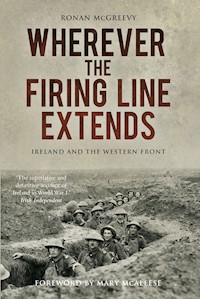
The First World War was the biggest conflict in Irish history. More men served and more men died than in all the wars before or since that the Irish fought in. Often forgotten at home and written out of Irish history, the Irish soldiers and their regiments found themselves more honoured in foreign fields. From the first shot monument in Mons to the plaque to the Royal Irish Lancers who liberated the town on Armistice Day 1918, Ronan McGreevy takes a tour of the Western Front. At a time when Ireland is revisiting its history and its place in the world, McGreevy looks at those places where the Irish made their mark and are remembered in the monuments, cemeteries and landscapes of France and Flanders.
Sie lesen das E-Book in den Legimi-Apps auf:
Seitenzahl: 759
Veröffentlichungsjahr: 2016
Das E-Book (TTS) können Sie hören im Abo „Legimi Premium” in Legimi-Apps auf:
Ähnliche



















For my wife Rebecca and our two children, Rosamund and Leo, with all my love.
This book is dedicated to the memory of Private Michael Ryan (1st Royal Munster Fusiliers) from Knocklong, County Limerick, who was killed during the Battle of Passchendaele on 12 August 1917. Ryan is Rebecca’s great-grandfather.
ACKNOWLEDGEMENTS
I am conscious in writing this book that I am neither the first nor likely to be the last author to write about the Irish in the First World War. There is now a fine body of literature on the subject. There are many informative regimental diaries and soldiers’ reminiscences from the 1920s. In the last 25 years, Keith Jeffery (Ireland and the Great War), Tom Johnstone (Orange, Green and Khaki), Terence Denman (Ireland’s Unknown Soldiers and A Lonely Grave: The Life and Death of William Redmond), Kevin Myers (Ireland’s Great War), Neil Richardson (A Coward if I Return, A Hero if I Fall) and Myles Dungan (Irish Soldiers and the Great War) are among those who have greatly expanded our knowledge of Irish involvement in the First World War.
My agent Faith O’Grady of the Lisa Richards Agency and publisher Ronan Colgan encouraged me in this project from the beginning. Beth Amphlett and Chris West from The History Press have been patient editors and designers respectively.
I am grateful for the support of Françoise Scheepers (Visit Belgium), Anita Rampal (Visit Flanders), Marine Catalogna and Agnès Angrand (Atout France) who facilitated my many visits to the Western Front. Angie Grant (Notorious PSG) and Shane Cowley (Canon Ireland) supplied the equipment which allowed me to photograph and film these monuments. I also have a YouTube channel and there are many films relating to stories in this book which can be accessed there using my name in the search bar. I hope this book will inspire other authors to embrace film-making as another means of storytelling.
I would like to thank Peter Francis from the Commonwealth War Graves Commission
for allowing me access to its archives. I hope this book highlights some of the wonderful work the commission does in affording to so many men the dignity denied to them in their violent deaths.
The staff of the National Library of Ireland were unfailingly polite and helpful in my many inquiries. Both the former President Mary McAleese and the former Taoiseach Bertie Ahern were generous with their time and deserve great credit for the manner in which they have rescued these proud Irishmen of the First World War from the ‘memories in shoeboxes’ as Mrs McAleese described it.
Many relatives shared their knowledge. They include Ben Thomas (Ernest Edward Thomas), Peter Bland SC (Maurice Dease), Thomas Fitzpatrick (Thomas William Fitzpatrick), Willie Malone (William and Michael Malone), William ‘Sonny’ Condon and John Condon Jnr (John Condon), Tommy Weldon (John Brien), Doug Armstrong and Harry Lindsay (Robert Armstrong), Michael Riordan (John Nash) and Michael McDowell SC (William McDowell).
Tom Burnell has been an invaluable help in his determination to ensure that the Irish war dead are counted and are therefore remembered properly. He also gave me access to his huge database of provincial Irish newspaper cuttings from the war period. Professor Hedley Malloch assisted me in putting together the chapter on the Iron 12 and deserves our thanks for ensuring those unfortunate men who were brutally executed are no longer forgotten.
Similarly, Michael Desmond has resurrected the memory of the Battle of Le Pilly and he advised me on that the chapter. I would like to thank the Mayor of Herlies Marie-Françoise Auger for the hospitality afforded to me on my visit there. Yvon Papeghin showed me the Le Pilly battleground and Franck and Dorothée Gil allowed me access to their home.
Aurel Sercu was generous with allowing me access to his research about John Condon; and Isadore Ryan helped with the chapter on Robert Armstrong.
Tom Burke (Royal Dublin Fusiliers Association), Liam Nolan (Royal Munster Fusiliers Association) and Paul Malpass (Connaught Rangers Association) were patient with all my inquiries.
Many of the chapters in this book arose originally out of articles in The Irish Times. I would like to thank my editors, Kevin O’Sullivan, Paddy Smyth, Donncha O’Muirithe and Mark Hennessy, for allowing me the space and time to cover this fascinating period of Irish history.
I wish to acknowledge Kevin Myers for the inspiration he provided for many years in his dauntless journalism writing about this subject, and also for alerting me to the incredible story of Robert Armstrong. Dermot Bolger did likewise with the chapter on Francis Ledwidge.
I am very fortunate in having a good friend, Tommy Conlon, whose diligent attention to the text improved it immeasurably. Tommy also accompanied me on one of my trips to the Western Front as did another friend Micheál Coughlan. From start to finish, he has been a great editor, wise counsel and adviser. This book would not be the same without his input.
Dr Tadhg Moloney from Limerick was another who gave careful attention to the text and supplied me with photographs of the cross at Limburg. His knowledge of the period and passion for the subject was a reassuring resource. Jean Prendergast also helped with the chapters on the Royal Munster Fusiliers.
My wife Rebecca and children Rosamund and Leo proved to be endlessly patient with my absences. I could not have written this book without the support of my wife.
My brother John and his wife Marie Claire helped out while out while my father Eamonn, brothers Conor and Paul, and sister Nollaig have been a constant support.
Finally, I would like to thank my mother Chris who passed away suddenly during the writing of this book. To her I owe everything. Flights of angels sing thee to thy rest Mum. RIP.
CONTENTS
Title
Dedication
Acknowledgements
Introduction
1. The First Shot Memorial at Casteau
2. The Plaque at Nimy Bridge
3. The Celtic Cross at La Bascule
4. The Cemetery at Étreux
5. The Cross at Limburg
6. The Railway Station at Le Pilly
7. The Monument to the Iron 12
8. The Sign at Rue du Bois: The Last General Absolution of the Munsters
9. Brothers in Arms: The Bronze Plaque at Mouse Trap Farm
10. The Grave of John Condon
11. The Grave of John Kipling
12. The Statue of Notre Dame des Victoires at St Martin de Noeux-les-Mines
13. The Monument to the Tyneside Irish and Tyneside Scottish at La Boisselle
14. The Ulster Tower
15. The Cross at Guillemont
16. The Thiepval Memorial to the Missing
17. The Cross at Wytschaete
18. The Grave of Major William Redmond MP
19. The Island of Ireland Peace Park
20. The Monument to Francis Ledwidge
21. The Marble Plaque to the 5th Royal Irish Lancers at Mons
22. The Plaque to Robert Armstrong
Bibliography
Plates
Copyright
INTRODUCTION
In every generation the Irish people have asserted their right to national freedom and sovereignty; six times during the past three hundred years they have asserted it in arms.
The Proclamation of the Irish Republic, 1916
In addition to being Irish Catholics,
we have the honour to be British soldiers.
Irish officers at Limburg, 1914
You could not call it war. It is murder and nothing
like the game as it is played in Africa and the
Chitral Expeditions, through both of which I went.
Colour Sergeant John Cooper, 2nd Royal Irish Regiment,
killed at Ypres 1915
If we are going to have a shared history and share
our traditions and share our peace, we have to
share the whole history of the war dead.
Bertie Ahern, former Taoiseach
The heroic dead of Ireland have every right to the homage of
the living: for they proved, in some of the heaviest fighting
of the World War, that the unconquerable spirit of the
Irish race - the spirit, that has placed them among the
world’s greatest soldiers - still
lives. France will never forget her debt to the heroic Irish dead.
Marshall Ferdinand Foch, 1929
It is perhaps the great paradox of Irish history that more Irishmen died fighting for the Crown than ever died fighting against it.
Irishmen in every generation were willing participants in an army which was regarded by many of their compatriots as an instrument of oppression. The historical reality confounds the modern Irish mind, conditioned as it was until recently, to see the relationship between Britain and Ireland only in adversarial terms. The willing participation of so many Irishmen in the British armed forces was nationalist Ireland’s secret and one that it sought to either explain away or conveniently forget after independence in 1922.
More Irishmen fought in British uniforms during the First World War than in any other single conflict, foreign or domestic, before or since. The Irish who joined up between 1914 and 1918 were following a long tradition. Numerous antecedents had been enthusiastic contributors to the great colonial adventure of the nineteenth century which made Britain a superpower. Indeed, they were proportionately over-represented in the armed forces for the whole of that century when British supremacy reached its zenith and the sun never set on Queen Victoria’s Empire. The Irish represented 28 per cent of Admiral Nelson’s crew at the Battle of Trafalgar in 18051 and 30 per cent of the Duke of Wellington’s troops at the Battle of Waterloo in 1815.2
Catholic soldiers had been banned from joining the British army until 1799. A year later the Act of Union abolished the Irish parliament altogether and brought the country under the direct governance of Westminster. Irish Catholics were not allowed to sit in parliament until Catholic Emancipation in 1829. Yet none of these pernicious circumstances seemed to deter Irishmen from joining the Crown forces in great numbers. Some 159,000 had been integrated into the British army by the eve of the Battle of Waterloo.3 And they continued their disproportionate prominence in the British army after that date. In 1830, Ireland constituted a third of the population of the United Kingdom, yet 42.2 per cent of all non-commissioned officers and other ranks were Irish.4 There were more Irishmen than Englishmen in the British army during that decade.5 Irish numbers in the British army subsequently declined as the century progressed. This was not a measure of waning interest but of catastrophic demographic trends which saw the population of Ireland plummet while that of the rest of the United Kingdom increased rapidly. The Great Famine of the 1840s was the major factor in this devastating diminution of the native population. By 1861, Ireland’s share of the UK population had fallen to 22 per cent – but it still made up 30 per cent of the army.6
Parallel with the phenomenon of mass Irish participation in the British armed forces was the process whereby nationalist Ireland sought greater freedom from the British Empire. The majority used constitutional means through the Repeal Movement and later the Irish Parliamentary Party and its decades-long campaign for home rule and a peaceful resolution of the differences between Ireland and Britain. A smaller cohort resorted to military action. Of the six rebellions mentioned in the Proclamation of the Irish Republic (1641, 1798, 1803, 1848, 1867 and 1916), those staged in the nineteenth century were poorly organised affairs, lasting only a single day. These rebellions were often quashed in part by fellow countrymen who had become professional soldiers in the British army.
The Irishman in the British army was typically from a rural area. In other parts of the United Kingdom they more often came from urban slums. The Irish recruit was regarded as healthier, better nourished and sturdier than his city-based English, Scots or Welsh equivalent. He was less likely to be turned down for military service. He could bear more hardship.7
The Irish also came with a martial reputation, burnished in the armies of the continent, most notably in France during the eighteenth century. The same reputation was also gilded across the Atlantic by their actions in various American wars. The ‘fighting Irish’ became a cliché but it was one many Irishmen were keen to embrace, most notably the Irish Parliamentary Party leader John Redmond, who could, at the outbreak of war in 1914, summon up ‘that gallantry and courage which has distinguished our race all through its history’.
By 1829, the Duke of Wellington had become Prime Minister of the United Kingdom of Britain and Ireland. In the same year, after a long, formidable campaign led by Daniel O’Connell, Catholic Emancipation for Ireland was passed by the houses of parliament in London. In a telling contribution to a sceptical House of Lords, Wellington imagined an exchange he might have had with his Irish Catholic soldiers:
You well know that your country either so suspects your loyalty, or so dislikes your religion, that she has not yet thought it proper to admit you amongst the ranks of her free citizens; if, on that account, you deem it an act of injustice on her part to require you to shed your blood in her defence, you are at liberty to withdraw. I am, quite sure, my lords, that, however bitter the recollections which it awakened, they would have spurned the alternative with indignation; for the hour of danger and of glory, is the hour in which the gallant, the generous-hearted Irishman, best knows his duty, and is most determined to perform it.8
It was, he acknowledged, ‘to the Irish Catholic that we all owe our proud pre-eminence in our military careers’.9
Wellington was Irish by birth and represented another strand of identity: the Anglo-Irish Protestant ascendancy. The Anglo-Irish were also disproportionately represented in the British armed forces, though they were mainly in the officer class. This would still be the case 100 years after Waterloo.
Why did so many Irishmen join? In 1878, Lady Butler, the well-known artist who specialised in military scenes, painted Listed for the Connaught Rangers after honeymooning in Kerry. Two recruits are on the way to join the British army. They are dressed in dun-coloured rags. One has a stooped gait; the other insolently dangles a cigarette from his mouth. The upright recruiting sergeant beside them is dressed in his redcoat and gloves. He is a symbol of organisation and strength of purpose. He represents civilisation. Following him are three drummer boys, suggesting continuity of service from one generation to the next.
The setting is unmistakably the west of Ireland. There are mountains in the background and an austere beauty to the scenery – but you cannot eat scenery. One of the new recruits casts a forlorn look at an abandoned and ruined cottage. The only alternative to emigration for many of these men was a career as a soldier. The inference was clear: the British army was a route out of poverty and a path to the civilising influences of the Empire. But for all the appeal of regular pay and at least one square meal a day, the army was a harsh sanctuary for its lowliest recruits – Irishmen included, as the nineteenth-century ballad‘The Glen of Aherlow’ acknowledges:
Bereft of home and kith and kin, with plenty all around,
I starved within my cabin, and slept upon the ground;
But cruel as my lot was, I never did hardship know,
Till I joined the English army, far away from Aherlow.
‘Rouse up there,’ cried the corporal, ‘Ya lazy Irish hound!
Why don’t you hear the bugle, its call to arms to sound?’
But it was a way out, too, for the hordes of landless Catholic boys scattered throughout the country in penury and in rags. If they could withstand the rigours of the regime, the Army represented opportunities not available in civilian life. In 1881, an Irishman could earn £25 a year agricultural labourer, but £40 a year as a private in the British army.10 The army guaranteed lodgings, a full belly, clothing, steady employment, an outside chance of promotion, a modest pension and foreign adventure. It was not a political act for those who signed up, despite the protestations of some advanced nationalists who considered it tantamount to treason. Neither was it taboo.
The average Irish recruit to the British army was a ‘Catholic, poor, sometimes of an adventurous bellicose sort, apolitical and he saw himself as a soldier by occupation’, history professor Peter Karsten surmised in his 1983 paper ‘Irish Soldiers in the British Army 1792–1922’.
Most Irishmen were neither enamoured by nor hostile to the British Empire. They were professional soldiers. It was as good a living as any other. Karsten points out that Irishmen in the nineteenth century did not join the British army; it was simply ‘the army’. It was as much their army as anyone else’s. ‘Seven centuries of British rule, of one sort or another, had led most Irish people to accept the fact that, like it or not, they were part of the United Kingdom.’
The British army was so integrated into Irish life that even those who sought a violent separation from Britain were mixed up in it. Of the seven signatories of the 1916 Proclamation of the Irish Republic, James Connolly had been in the British army. Tom Clarke was born into it as his father was a sergeant based on the Isle of Wight. Éamonn Ceannt’s brother William Kent was a British army regular who was killed during the First World War;11 their father had served in the Royal Irish Constabulary, the police force which maintained civilian rule in Ireland. Joseph Mary Plunkett, the chief military planner for the Rising, attended Stonyhurst College in Cheshire which had an Officers’ Training Corps for the British army. Joseph Mary was too delicate, but his brother George, who participated in the Rising, had been in the OTC. Stonyhurst would produce the first Victoria Cross winner of the First World War, an Irishman named Maurice Dease (the subject of chapter 2). Michael Mallin, one of sixteen men executed after the Easter Rising, had joined the British army as a drummer boy and served for 14 years.12 Many of those nationalists who had been in the British army protested, by way of explanation, that they had known nothing of their own history when they joined.
The writer Seán Ó Faoláin, who was born in Cork in 1900, grew up during the twilight of British rule in Ireland as the son of an Royal Irish Constabulary constable. But it was not apparent at the time that British rule would soon come to an end. Ireland, he remembered, was then only a geographical entity. It did not exist politically, culturally or psychologically. Ó Faoláin, who would later go on to fight against the British in the War of Independence, was not perturbed by this. Sixty years after the Rising, he remembered:
I was tremendously proud of belonging to the Empire, as were at that time most Irishmen. I gloried in all its trappings, Kings, Queens, dukes, duchesses, generals, admirals, soldiers, colonists and conquerors, the lot. My childhood had been filled with the colonial glories of Gordon of Khartoum, the Relief of Lucknow, the Charge of the Light Brigade, Irish-born Wellington, the Munster Fusiliers, the glory of the flag, the belly stirring rumble of the preliminary roll of God Save the King, Lord Kitchener, the Angel at Mons, but above all the dream of every well-bred imperial boy of one day becoming a Gentleman.13
For Ó Faoláin, the Easter Rising came as such a profound shock that he felt he was living in a different country. His fellow Corkman Tom Barry, who went on to become one of the most feared IRA commanders of the War of Independence, had joined the British army when he was 17. He served in the Royal Field Artillery during the First World War and was present at the siege of Kut, one of the great British military defeats of the war. The Easter Rising changed everything for him too, as he recalled in his well-known memoir Guerilla Days in Ireland:
I went [to join the British army] because I knew no Irish history and had no national consciousness. I had never been told of Wolfe Tone or Robert Emmet, though I did know all about the kings of England and when they had come to the British throne. I had never heard of the victory over the Sassenach at Benburb, but I could tell the dates of Waterloo and Trafalgar.14
For the Anglo-Irish class, the army offered greater possibilities. Many, like Wellington, were not particularly wealthy by the standards of their peers in England. Military service was their means of achieving status and income. The British army was often the only route to a successful career for a middle or younger son of the gentry and became increasingly so as the fortunes of the Anglo-Irish waned over the course of the century.
The percentage of Irishmen in the British army continued to decline as the century progressed and Irish depopulation continued. In 1890, the Irish represented just over 15 per cent of the British army, but Catholics constituted 18.7 per cent of the same army, many of them Irish emigrants or their descendents, James Connolly being one of them.15
The outbreak of the Second Boer War in 1899 roused a lot of pro-Boer and anti-British feeling in Ireland. Nationalist Ireland saw in Boer resistance to British rule a template for Ireland too. Nationalist sentiment had been running high in 1898, the centenary year of the 1798 Rebellion. Maud Gonne, the wife of Major John MacBride and muse of the poet W.B. Yeats, went on an anti-recruitment drive and reminded the Irish public that it had been the same British army which had put down the 1798 Rebellion. She pleaded with those going off to fight the Boer War to ‘even at the eleventh hour remember that they were Irishmen, and cast off the hideous English uniform’.16 Major MacBride would go on to command an Irish Brigade in South Africa that would fight alongside the Boers. He would later be executed for his part in the Easter Rising.
The battle for hearts and minds in Ireland intensified as the nineteenth century gave way to the twentieth. Nationalists sought to turn back the tide of the Anglicisation of Irish society, which Séan Ó Faoláin alluded to in his memoirs.
The turn of the century brought a revival in Irish nationalist sentiment. The Irish Literary Renaissance, the Gaelic League, the GAA and a united Irish Parliamentary Party all questioned what it meant to be Irish and, just as keenly, what it meant not to be British.
The activists who saw it as the British army, and not just ‘the army’, were growing in number and getting louder. An apolitical, ordinary Irishman was no longer enlisting in an apathetic vacuum. Nationalist critics were liable to cast aspersions on his decision. The slurs hurled at him if he served in British uniform during the Boer War were particularly vicious. He was one of the ‘meanest curs in creation’ and a ‘traitor to his country and an enemy of his people’.17
Yet popular sentiment was still very much on the side of the Irishman in British uniform. In 1907, the Fusiliers’ Arch was erected in St Stephen’s Green to remember the Royal Dublin Fusiliers killed in the Second Boer War. A large, enthusiastic crowd turned out for the event, though the Irish Parliamentary Party had called on Irish people to ‘inculcate an attitude of aloofness from the Army because it was the Army which held Ireland by force’.18 It became known to nationalists as ‘traitors’ gate’. This bitter hostility between those pro and anti the British army would be heightened by the time of the First World War.
—
In 1914 Ireland had eight recruiting districts for the British army:
Royal Irish Rifles: Antrim, Down
Royal Irish Fusiliers: Armagh, Cavan, Monaghan, Louth
Royal Inniskilling Fusiliers: Donegal, Derry, Fermanagh, Tyrone
Connaught Rangers: Galway, Mayo, Roscommon, Sligo, Leitrim
Leinster Regiment: Meath, (King’s County) Offaly, (Queen’s County) Laois, Westmeath, Longford
Royal Dublin Fusiliers: Dublin, Kildare, Wicklow, Carlow
Royal Munster Fusiliers: Cork, Kerry, Limerick, Clare
Royal Irish Regiment: Waterford, Kilkenny, Tipperary, Wexford.
The home barracks of these regiments were the dominant employers in their towns. Tralee (Royal Munster Fusiliers), Birr (Leinster Regiment), Renmore (Connaught Rangers), Enniskillen (Inniskilling Fusiliers) and so many other rural towns were known first and foremost as ‘garrison towns’. Dozens of other towns throughout Ireland had smaller barracks.
In 1888, twenty-one of the fifty-one towns in Munster with a population of more than 2,000 had a military barracks. The pattern was similar in the rest of the country. By comparison, as historian Dr Aoife Bhreatnach has observed, the present Irish defence forces have just sixteen military stations for the whole State. The British army was much more ubiquitous. ‘Anyone living in a country with a small standing army will struggle to imagine how pervasive was the military presence,’ she states on her blog Garrison Towns.19
By 1914, just under 10 per cent of the British army, including reservists, were Irish – again proportional to the Irish share of the UK population.20 This comprised 28,000 Irish-born soldiers and 30,000 reservists. Nearly one in five reservists in the British army was Irish. Within two months, all of them were fighting in France or Flanders.
In 1914, Ireland was in an extreme state of agitation. Two opposing armed militias were smuggling guns with the intention of starting a military conflict if necessary. The Ulster Volunteer Force, founded in January 1913, was the better armed force. It was determined to oppose the introduction of home rule in that part of the province of Ulster which had a Protestant majority. In response, the Irish Volunteers was set up in November 1913, determined to ensure that the British government would not backslide on its commitment to home rule.
In the middle was the British army in all its garrisons. Assumed and obligated to be scrupulously neutral in the political arena, the Curragh crisis of March 1914 came as a shock to the self-same political establishment. Faced with the prospect of moving north to quell unionist unrest, dozens of officers, most of them English or Anglo-Irish and in cavalry regiments, offered to resign their commissions rather than obey government orders. The looming collision between unionist and nationalist forces on the island had now embroiled different factions of the army. This was an extraordinary act of defiance against the will of the sovereign government. It convinced many Irish nationalists that the British army could not be relied upon to enforce the law of the land.
The future British Prime Minister David Lloyd George understood what this nascent mutiny really meant:
We are confronted with the greatest issue raised in this country since the days of the Stuarts. Representative government in this land is at stake. In those days our forefathers had to face a claim of the Divine Right of Kings to do what they pleased. Today it is the Divine Right of the aristocracy to do what its pleases. We are not fighting about Ulster. We are not fighting about Home Rule. We are fighting for all that is essential to civil liberty in this land.21
The Third Home Rule Bill had been introduced into the House of Commons in April 1912. It granted a very limited form of autonomy to a devolved Irish parliament, with Westminster still retaining control over foreign policy, military affairs and taxation. The Parliament Act of 1911 had removed the most significant obstacle to home rule by ending the unelected House of Lords’ power of veto over legislation passed in the Commons. Nevertheless, the House of Lords could still delay a bill for two years and did so before the Third Home Rule Bill finally passed all stages.
This two-year delay proved fatal to the prospects of home rule ever being implemented. It was finally put on the statute book in May 1914. It still needed the king’s assent to make it the law of the land, but the Ulster question remained intractable. The principle of Ulster’s exclusion from any prospective home rule parliament had been conceded by the British Prime Minister Herbert Asquith. But would that exclusion be permanent or temporary? And how many counties would be involved? Would it be just the four where there was a solid Protestant majority, or six, or all nine counties of Ulster? Irish Parliamentary Party leader John Redmond reluctantly conceded a six-year opt-out for Ulster, but Sir Edward Carson, the uncompromising unionist leader, dismissed this as a mere stay of execution.
Talks convened by King George V at Buckingham Palace in late July ended in stalemate. The respective leaders, Redmond and his deputy John Dillon, Carson and Captain James Craig, departed without agreement. The only semblance of any personal rapport was contained in an offering from Craig to his fellow second in command. ‘Mr Dillon, will you shake my hand?’ Craig, a Boer War veteran, asked his opponent. ‘I should be glad to think that I have been able to give as many years’ service to Ulster as you have to the service of Ireland.’ Asquith, witnessing this temporary outbreak of bonhomie, observed, ‘Aren’t they a remarkable people? And the folly of thinking we can ever understand, let alone govern them.’22
While all this was going on, the crisis precipitated by the assassination of the Archduke Franz Ferdinand and his wife Sophia had escalated from a regional quarrel into a situation which was rapidly becoming the most serious threat to peace that Europe had ever faced. On 23 July 1914, Austria-Hungary’s ultimatum to Serbia, which the country couldn’t possibly accept, jolted the British Cabinet into recognising the true gravity of the situation.
The ultimatum was read aloud by Foreign Secretary Sir Edward Gray as other Cabinet members were poring over a large-scale map of Ulster counties. The British Cabinet ‘toiled around the muddy byways’ of Tyrone and Fermanagh, as Winston Churchill described them, to try to ascertain the religious composition of individual parishes.23 Tyrone, which had a Catholic majority, proved to be a particularly exasperating county. ‘We sat again this morning for an hour & a half, discussing maps & figures, and always getting back to that most damnable creation of the perverted ingenuity of man – the County of Tyrone,’ Asquith lamented in a letter to his mistress Venetia Stanley.24 Churchill, the First Lord of the Admiralty, understood immediately that this regional quarrel was a mere irritant in comparison with the cataclysm that was to come. ‘The parishes of Fermanagh and Tyrone faded back into the mists and squalls of Ireland,’ he would later recall, ‘and a strange light began immediately, but by perceptible gradations, to fall and grow upon the map of Europe.’25
The failure of the Buckingham Palace talks had convinced many unionists that the time had come to stage a coup d’état. If they couldn’t remain within the United Kingdom, then an independent Ulster would be a bearable alternative. Secession and independence were still preferable to home rule. It was time to declare the Ulster Provisional Government. On 29 July, Craig wrote to Carson, ‘You may take it that immediately you signify by the pre-arranged code that we are to go ahead, everything prepared will be carried out to the letter unless in the meantime you suggest any modification. All difficulties have been overcome and we are in a very strong position.26 Food was stockpiled, work on a new currency had begun and plans were afoot to evacuate women and children to Scotland.
In the final days before war was declared, the British army was in bad standing with much of nationalist Ireland. Disquiet about the Curragh crisis turned to outrage when the security forces attempted to stop the importation of arms by the Irish Volunteers at Howth on 26 July. During protests that evening, three unarmed civilians were shot dead by the King’s Own Scottish Borderers at Bachelors Walk in the centre of Dublin. The killings maddened nationalist Ireland and generated bitter comparisons with how the authorities had failed to stop gunrunning by the Ulster Volunteer Force that April in Larne. A mass rally was held on 28 July in Dublin city centre. The killings had mobilised all shades of Irish nationalist opinion.
Events elsewhere intervened. From Russia’s partial mobilisation on 29 July to 4 August when the United Kingdom declared war – just a week – the major powers embarked upon the bloodiest war in history to that date.
The unionists and nationalists put aside their differences to face a common foe, much to the relief of the British government. ‘The one bright spot in the whole of this terrible situation is Ireland,’ the British foreign secretary Edward Gray told the House of Commons in a speech on 3 August, the eve of war.27 Gray’s speech, one of the most significant in the history of the British parliament, managed to convince a majority of British MPs that Britain had no choice but to fight and would face dire consequences even if she didn’t.
John Redmond responded with equal forcefulness. His voice trembling with emotion, he offered the Irish Volunteers and the Ulster Volunteer Force to the government to defend the shores of Ireland and so release the garrisons based in the country for foreign service. He was satisfied he had secured the measure of control of Irish affairs, albeit within the British Empire, for which he and his predecessors had striven. The shared history of Ireland and Britain was troubled, he acknowledged, but those enmities would not be continued, not in this hour of supreme trial for the British Empire. Redmond became an impassioned advocate for the British war effort. The Empire’s war would be Ireland’s war. Home rule was given royal assent on 18 September but its implementation was suspended by agreement for the duration of the war. Two days later, Redmond came upon a group of East Wicklow Irish Volunteers who were drilling in the beautiful surroundings of Woodenbridge near his home. Remarking that the wider world beyond this idyllic setting had turned ugly, he told the assembled volunteers that it was time for Irishmen to prove their ancient valour. Their duty was not only to defend the shores of Ireland at all costs from an ‘unlikely’ foreign invasion, but to venture further afield as ‘the interests of Ireland, of the whole of Ireland, are at stake in this war’.28 There in the beautiful surroundings of the Vale of Avoca, he told Irish nationalists to go ‘wherever the firing line extends in defence of right, of freedom and religion in this war’.
For the first time, an Irish nationalist leader had openly encouraged Irishmen to join the British army. Redmond accepted the established wisdom that the war would be short. Prior to the outbreak of the war, his party had gained control of the Irish Volunteers from more strident elements who wanted to foment armed rebellion. But his call for Irishmen to serve in France lost him a wedge of the organisation. Of the roughly 170,000 Irish Volunteers, 158,300 (93 per cent) stayed with Redmond and became the National Volunteers; the remaining 12,300 broke away from Redmond, but retained the title Irish Volunteers. Some 22,000 of those who stayed loyal to Redmond would go on to serve in the British army during the war.29
The response to Redmond’s early call was a reflection of Irish nationalist support for the British war effort. The war effort had the support of the Irish political establishment, the major Christian denominations and the mainstream press. Most of them sincerely believed Germany was a threat to civilisation. The invasion of Belgium, a small, predominantly Catholic country, was another galvanising factor. Reports of German atrocities there, some of them accurate, some of them exaggerated, had a particular resonance in Ireland.
Redmond had ostensibly triumphed. He was dismissive of the Irish Volunteers who had scorned his cry for unity. They were gadflies and cranks, he believed, who did not represent the bulk of Irish public opinion.
His eventual nemesis Pádraig Pearse, the man who would go on to become the first president of the Provisional Government, was not dismayed by the small numbers who had defied Redmond’s call. Better, he maintained, to have a covert, determined cadre of true believers than a leaderless and divided National Volunteers. Within days of the declaration of war, the reservists attached to the National Volunteers were all called up, depriving the organisation of those with valuable military training.
What the remaining Irish Volunteers lacked in numbers, they made up for in a fervent sense of opportunism. They would use the war to fight against British rule in Ireland. England’s difficulty would once again be Ireland’s opportunity.
It was in this volatile climate that tens of thousands of Irishmen set sail for England and France, while hundreds remained at home to prepare for the forthcoming insurrection.
When the war ended in November 1918, the melancholy audit could begin: those who lived, those who died; the numbers injured; the numbers imprisoned; the numbers lost; the numbers who served. It is estimated that at least 210,000 Irishmen served in British uniform during the First World War. This comprises 58,000 of those already serving at outbreak of hostilities – the ‘Old Contemptibles’, as they were known – and 140,460 who volunteered later.30 Conscription was imposed in Britain in January 1916. It did not apply to Ireland, but 95,000 Irishmen had already signed up by then and became part of ‘Kitchener’s Army’. The remaining 45,460 signed up in the following months and years. Some 10,000 joined up in the last three and a half months before the Armistice of 1918. All of this was achieved without conscription in Ireland.31
Historian Keith Jeffery estimates that between a quarter to a third of all Irishmen of military age (15 to 35) signed up to fight in the war.32 This is a base figure. The naval historian Karen O’Rawe estimates that more than 10,000 Irishmen served in the Royal Navy during the war, of whom at least 1,657 died, 350 alone at the Battle of Jutland. In his book Irish Aces of the RFC and RAF, Joe Gleeson estimates that 6,000 Irishmen were in the flying corps during the war.
A total of 19,327 Irish-born men served in the Canadian Expeditionary Force,33 another 5,774 with the Australian Imperial Force34 and 1,300 with the New Zealand forces. The number who served in the American Expeditionary Force remains uncertain. The Americans never listed their recruits by country and the records were destroyed by fire in 1973.35 However, diligent detective work by the historian Megan Smolenyak, based on the New York and New Jersey war dead, concluded that 975 Irish-born men died in American uniform and approximately 16,500 served overseas with the ‘Doughboys’ during the First World War.36 In any event, the combined total dwarfs the number of Irish who fought in the Easter Rising and the War of Independence.
The number of Irish dead from the First World War is also disputed. In 1922, a project entitled the Irish National War Memorial Records sought to record all those Irishmen who died to find a definitive figure. By then, however, the Irish Free State was beginning to construct an alternative narrative of recent Irish history. The Irish National War Memorial Records was established by Lord Ypres (Sir John French), the former commander-in-chief of the British army and Lord Lieutenant of Ireland, and compiled by a committee led by Eva Bernard, from a well-known unionist family. The eight volumes, published in 1923, were beautifully illustrated by Harry Clarke, one of the era’s most distinguished Irish artists. It was put together at a time when record keepers were still grappling with the scale of the tragedy. As a visual tribute, it is unsurpassed; as a historical record, it is a flawed endeavour with many elementary errors. Recent research proves that more than 10,000 of the men listed within the records to have died in France actually fell in Belgium.37
The memorial records name 49,647 Irishmen who died in the war, but these were not all Irishmen.38 The records include men such as John Kipling (see Chapter 11) and George Edwin Ellison, the last British soldier to die in the war. Both were English, but served in Irish regiments. Service in an Irish regiment or Irish birth was the criterion for inclusion in the memorial records. Many Irishmen who served in regiments based in Britain or who had emigrated to Britain were not listed in the memorial records.
One set of the records was presented to the city of Ypres – or the ruin of Ypres, as it could be more accurately described in the aftermath of the First World War. The In Flanders Fields Museum is a First World War museum at Ypres Cloth Hall. It is now engaged in updating and correcting the records.39
The memorial records list 30, 986 men born in Ireland who died in the war and an additional 7,405 with no place of birth. The rest came from elsewhere, most notably England. Of those born in Ireland, 18,946 (61 per cent) came from what is now the Republic of Ireland and 11,299 (39 per cent) from Northern Ireland.40
Modern research suggests that this figure for the Irish war dead may be a considerable underestimation. The military historian Tom Burnell has spent seven years attempting to accurately collate the number of Irish dead from the twenty-six counties of the Republic. He has trawled through local newspapers, digitised books, the database of the Soldiers Who Died in the Great War and officers’ records, and then checked them against the Irish National War Memorial Records, the records of the Commonwealth War Graves Commission and the two censuses of 1901 and 1911.
Burnell has found confirmation that 23,858 were born in what is now the Republic of Ireland, a 26 per cent increase on the 18,946 listed in the memorial records. However, when the number of servicemen who give their address, their next of kin or are buried in the 26 counties is included, the figure rises to 29,354, a 54 per cent increase.
If extrapolated out to the whole island using the initial 30,986 (born in Ireland) as a baseline figure, it would indicate that the true number of Irish war dead is between 39,042 (a 26 per cent increase) and 47,718 (a 54 per cent increase), more than the 35,000 figure conventionally given as the best rough estimate.
Separate research carried out in Sligo by local historian Brian Scanlon would also indicate the memorial records have underestimated the number of Irish who died. His research has found at least 546 Sligo men who died in the war; the memorial records figure is 395.41 Some 720 men from Mayo are listed as having died in the war in the memorial records, but the Mayo Peace Park in Castlebar includes 1,100 men on its memorial wall.42 A similar exercise in Fermanagh found nearly 300 men who were not originally recorded in the records.43
The research points to one unmistakable trend – many more Irishmen died than we assumed therefore. Whatever the final figure, and it may never be determined definitively, the First World War was the biggest and bloodiest military engagement ever entered into by the people of Ireland.
—
This book arose from a trip to the Belgian border town of Mons in February 2014. Mons was the place where British involvement in the First World War began and ended. There are four monuments with an Irish theme there.
This prompted me to look for the other memorials on the Western Front. It has taken me on a physical and historical journey across northern France, southern Belgium and central Germany. From the Ulster Tower, opened in 1921, to the incomparable Island of Ireland Peace Park, built as late as 1998, the Irish have left a remarkable legacy on the Western Front. That legacy is remembered in the many monuments and cemeteries scattered across the region.
Most of the monuments were built in the 1920s, when memories of the war were still vivid and many survivors were able to tell their stories. At the unveiling of the Guillemont Cross in College Green, Dublin, on Armistice Day 1924, a crowd estimated at 50,000 turned up.44 It was a day of the rawest of emotion. After 1916 and the War of Independence of 1919-21, Ireland was a cold country for those who had served in British khaki, but there was a strong, lingering seam of empathy too. The deaths of tens of thousands of Irishmen and the maiming and traumatising of countless more could not be ignored in an island with a population of just 4.4 million. The British Legion estimated that 164,000 Irish children had lost a parent during the war – mostly a father. Everybody knew somebody who had served or been injured. Even successive Irish Free State governments proved to be surprisingly generous in providing funds for a national war memorial.
Yet the story of the Irish who fought in the First World War faded away as the men themselves faded away. As the decades passed, the Irish State adopted only one national narrative. The opposite happened in the North, where the dead were venerated as proof of Ulster’s unswerving loyalty to the Union. The fact that the majority of Irishmen who fought in the war were from a nationalist Irish Catholic background was conveniently forgotten here too. The Ulster and Free State establishments had this much in common. It did not suit the self-images of the two political entities that emerged after the partition of Ireland.
In 1967, a year after the fiftieth anniversary of the Easter Rising, the historian F.X. Martin famously deployed the term ‘national amnesia’ in his essay ‘Myth, Fact and Mystery’. Those who had served in British uniform in the First World War, or those who had been involved in the Irish Parliamentary Party’s long campaign for greater autonomy for Ireland, had been subjected to a ‘great oblivion’.45 Martin offered a telling statistic: for every Easter Rising rebel, there were sixteen Irishmen fighting on the Western Front. Furthermore, he suggested four out of five Irish people had been in favour of the British war effort in the beginning.46
Despite Martin’s intervention, national amnesia remained the prevalent condition well into the 1980s. The decrepit state of the Irish National War Memorial Gardens, on the banks of the River Liffey in Islandbridge, was representative of Irish attitudes at the time. Ireland’s national memorial, with its beautiful, sunken rose garden and sturdy pergolas, was only completed in 1939, twenty-one years after the war had ended. It was not officially opened until 2006, for the ninetieth anniversary of the Battle of the Somme, when both President Mary McAleese and the Taoiseach Bertie Ahern were in attendance.47 This tranquil place of memory, created by Edwin Lutyens, the architect who designed the Cenotaph in London and the Thiepval Memorial in the Somme, had become a graffiti-strewn, rubbish tip. And its location was peripheral, on the edge of the city, out of sight and out of mind.
In the memorable words of the journalist and historian Kevin Myers, who had been one of the few voices to challenge the national amnesia, Irish people had not merely ‘forgotten, but they’d forgotten they had forgotten’.48 In an interview with Myers, Sebastian Barry, whose novel A Long, Long Way told the story of one Irishman caught up in the maelstrom of the war and the Easter Rising, also expressed his remorse at official attitudes. ‘These men deserved a most wondering thanks for their ordinary divine courage. That they were not thanked when they came home was a profound indictment of a state that could not find it in its narrowing heart – though its own way a brave narrowing heart – to include them.’49
—
The monuments erected on the Western Front were built to endure. They were built with a sense of finality, a profound conviction that the human race could not possibly sink to such horrors again. The First World War therefore became the Great War, because those who lived through it could conceive of no greater war. It would be the last catastrophic rupture in the soul of human civilisation. It would be ‘the war to end all wars’. Within twenty years, the continent would again be in flames, the machinery of war ever more violent. The trenches of one war led to the gas chambers of the next.
The Irish monuments and gravestones of the First World War have stood the test of time and the vicissitudes of Irish memory. They will remain there in their stoic dignity, open to anyone who stops to visit and contemplate and maybe offer a prayer. In these centenary years, they may be discovered by a few more people who wish to pay tribute to these men of ‘ordinary divine courage’.
In the last two decades, a new awareness of those men and their times has seeped into the Irish consciousness. This renaissance of memory has coincided with the Northern Ireland peace process. The two developments are not unconnected. Better relations between Britain and Ireland, and nationalists and unionists have opened up a space for both communities to commemorate their war dead with more open hearts.
In the Republic, the old monocultural history for a monocultural state has been replaced by a deeper understanding of the complexity of the story, with all its competing loyalties and narratives.
It was in this more generous spirit that the Island of Ireland Peace Park was opened in 1998, the year the Good Friday Agreement was signed. The presence at its opening of Queen Elizabeth II and President of Ireland Mary McAleese was probably the most significant act of remembrance for the Irish war dead since the war ended eighty years previously. In 2011, Queen Elizabeth II, during her first visit to the Republic of Ireland, visited the Irish National War Memorial Gardens in Islandbridge and the Garden of Remembrance in Parnell Square, built for those who had died fighting against British rule in Ireland. In 2013, the Taoiseach Enda Kenny and the British Prime Minister David Cameron visited the grave of Major Willie Redmond in Flanders. It was also an acknowledgement of shared history, not only of Irish involvement in the British armed forces, but also the Irish contribution to British parliamentary life. As an MP who fought and died in the First World War, Willie Redmond embraced both traditions.
The last two decades have seen new memorials on the Western Front. In 1998, the Francis Ledwidge Memorial dedicated to the Irish poet and soldier killed at the Battle of Passchendaele was completed. In 2011, the monument to the Iron 12 provided a permanent memorial to the extraordinary execution of twelve men, six of them Irish, a dark chapter of the war which had been almost completely forgotten. In 2015, after many years of negotiation, a sign commemorating the site of the Last General Absolution of the Munsters, the most famous Irish painting of the war, was finally erected on the Rue du Bois in Richebourg. In November 2015, the London Irish Rifles Association unveiled a plaque in Loos town centre.
These monuments tell a story of human heroism, tragedy and grief in the most awful conditions imaginable.
When the Irish politician Paddy Harte proposed a round tower, a symbol of permanence, for the Island of Ireland Peace Park, he envisaged a memorial that would ‘last for centuries and be as meaningful in 500 years time as when it was built’.50 The round tower is now there. The graves, the cemeteries and the monuments were there long before it. As long as they silently stand sentry, they will tell of the men who left Ireland’s shores never to return.
These monuments are a reminder to never forget. These monuments are forever Ireland.
Mons, the place where the British started and ended the war and where there are four Irish monuments.
An estimated 12,500 Irishmen died in Belgium during the First World War, most in Flanders fields around the town of Ypres where the Irish have left a tangible presence.
The Battle of the Somme was the biggest of the First World War and the tens of thousands of Irish who fought and died there have left their mark.
Sometimes called ‘forgotten front’, the area to the west of Lille has many reminders of the horror of the First World War and the Irish who fought there.
Notes
1 UK’s National Maritime Museum and the UK National Archives, October 2013. Based on surviving records, 3,573 sailors from Ireland out of 12,000.
2 Lt Col. Harvey, A Bloody Day: The Irish at Waterloo (2015). He estimates that 8,500 of the Duke of Wellington’s 28,000 British soldiers, including Wellington himself were Irish.
3 Peter Karsten, ‘Irish Soldiers in the British army 1792–1922: Suborned or Subordinate’, Journal of SocialHistory, Vol. 17, No. 1 (Autumn 1983).
4 Ibid.
5 Graham Davis, In Search of a Better Life: British and Irish Migration (Stroud, 2011), p. 17.
6 Ibid.
7 Ibid.
8 Quoted in John Talbot, Earl of Shrewsbury, Reasons for not Taking the Test (London, 1828) Introduction, p. CXXX.
9 Wellington’s speech to the House of Lords 1828, as reported in The Newfoundlander, 4 May 1880.
10 Great Britain Parliamentary Accounts and Papers, Trade Wages, 1893–1894, Vol. 34, Part II, 454–55.
11 Company Sergeant William Leeman Kent was killed at the Battle of Arras on Tuesday, 24 April 1917, a year to the day after the Easter Rising broke out. Bill, as he was known, was in the 3rd Reserve Battalion of the Royal Dublin Fusiliers. In September 1916, he was posted to the front and fought in the Battle of the Somme. His family was informed of his death on 8 May 1917, the anniversary of his brother’s execution.
12 <http://www.easter1916.ie/index.php/people/a-z/michael-mallin/>
13 Seán Ó Faoláin, ‘A portrait of the artist as an old man’, Irish University Review (1976)
14 Tom Barry, Guerilla Days in Ireland (Dublin: 1949), p.8.
15 Peter Karsten, ‘Irish Soldiers in the British army, 1792–1922: Suborned or Subordinate’, Journal of Social History, Vol. 17, No. 1 (Autumn 1983), pp.31–64.
16Freeman’s Journal, 16 January 1898.
17 Peter Karsten, ‘Irish Soldiers in the British Army, 1792–1922: Suborned or Subordinate’, Journal of Social History, Vol. 17, No. 1 (Autumn 1983) pp.31–64.
18 Stephen Gwynn, John Redmond’s Last Years (New York: Longman’s Green and Co., 1919).
19 Dr Aoife Bhreatnach, ‘What is a garrison town?’ (2 March 2012), Irish Garrison Towns [website] <http://irishgarrisontowns.com/what-is-a-garrison-town/#fn-51-3>.
20 Harold E. Raugh, The Victorians at War, 1815–1914: An Encyclopedia of British Military History (Santa Barbara, California: ABC-CLIO, 2004).
21 David Lloyd George, the House of Commons, 30 March 1914.
22 Letter from Herbert Asquith to Venetia Stanley, 24 July 1914.
23 Winston S. Churchill, The World Crisis (New York: Charles Scribner’s Sons, 1932), p. 94.
24 Quoted in The Fateful Year: England 1914. Taken from a letter Asquith sent to his mistress Venetia Stanley.
25 Winston S. Churchill, The World Crisis (New York: Charles Scribner’s Sons, 1932).
26 Quoted in Jack Beatty, The Lost History of 1914: How the Great War Was Not Inevitable (London: Bloomsbury, 2012).
27 Sir Edward Gray, the House of Commons, 3 August 1914.
28Freeman’s Journal, 21 September 1914.
29 ‘Statement to the Irish Volunteers, 24 September 1914’, History Hub [website] <http://historyhub.ie/statement-to-the-irish-volunteers>.
30 Professor Keith Jeffery, Ireland and the Great War (Cambridge: Cambridge University Press, 2000).
31 Patrick Callan, ‘Recruiting for the British army during the First World War’, The Irish Sword, Vol. XVII, No. 66, 1987.
32 Professor Keith Jeffery, ‘Ireland and the First World War: The Historical Context’, Ireland History Live [website], Queen’s University Belfast <www.qub.ac.uk/sites/irishhistorylive/IrishHistoryResources/Articlesandlecturesbyourteachingstaff/IrelandandtheFirstWorldWar/>.
33 Ronan McGreevy, ‘New figures show almost 20,000 Irishmen fought for Canada in WW1’, The Irish Times [website], 1 August 2015 <www.irishtimes.com/news/social-affairs/new-figures-show-almost-20-000-irishmen-fought-for-canada-in-ww1-1.1885044>.
34 Ronan McGreevy, ‘Irish in Australia “were not shirkers” in first World War’, The Irish Times [website], 17 October 2014 <www.irishtimes.com/news/ireland/irish-news/irish-in-australia-were-not-shirkers-in-first-world-war-1.1967446>.
35 <www.archives.gov/st-louis/military-personnel/fire-1973.html>
36 Irish Central April 7 2015 www.irishcentral.com/roots/history/Nearly-1000–Irish-died-serving-US-army-in-World-War-I.html
37 ‘Ireland’s Memorial Records’, In Flanders Fields Museum [website], <imr.inflandersfields.be>.
38 ‘Find your ancestors in Ireland’s Memorial Record: World War 1: 1914–1918’, Find My Past [website], <www.findmypast.ie/articles/world-records/full-list-of-the-irish-family-history-records/military-service-and-conflict/irelands-memorial-record-world-war-1>.
39 ‘Ireland’s Memorial Records’, In Flanders Fields Museum [website], <imr.inflandersfields.be>.
40 ‘Find your ancestors in Ireland’s Memorial Record: World War 1: 1914–1918’, Find My Past [website], <www.findmypast.ie/articles/world-records/full-list-of-the-irish-family-history-records/military-service-and-conflict/irelands-memorial-record-world-war-1>.
41 Ronan McGreevy, ‘Irish first World War dead “may be higher than claimed”’, The Irish Times [website], 12 June 2014 <www.irishtimes.com/culture/heritage/irish-first-world-war-dead-may-be-higher-than-claimed-1.1829795>.
42 ‘Mayo Great War Memorial’, Irish War Memorials [website] <www.irishwarmemorials.ie/Memorials-Detail?memoId=679>.
43 <http://fermanaghherald.com/2014/11/fermanagh-war-memorial-book-of-honour-launched/> The Irish War Memorial Records records 498 men from Fermanagh who died in the war. The Fermanagh War Memorial in Belmore records 581, with an additional 200 names that are not listed on the memorial but are in the memorial book.
44The Irish Times, 12 November 1924.
45 Fr F.X. Martin, Studia Hibernica, No.7, 1967, pp. 7–126.
46 Ibid.
47 ‘History of Irish National War Memorial Gardens’, Óglaigh na hÉireann [website] <www.military.ie/info-centre/df-ceremonial/history-of-war-memorial-garden/>.
48 Kevin Myers, Ireland’s Great War (Dublin: Lilliput Press, 2014), <http://www.irishtimes.com/culture/books/kevin-myers-on-ireland-s-great-war-1.2060463>.
49The Irish Times, 9 April 2005.
50 Paddy Harte, Young Tigers and Mongrel Foxes (Dublin: O’Brien Press, 2005), p. 328.
1
THE FIRST SHOTMEMORIAL AT CASTEAU
There are events so cataclysmic in history that it impossible to conceive of the world without them. The First World War was such an event. Had it not happened, Europe might have continued, as it had done in the first decade of the twentieth century, on the path of incremental social and economic progress. Inevitably, there would be regional conflicts and occasional flashpoints between the great powers, but these would have been defused by pragmatic politicians reluctant to commit a generation to the slaughterhouse of total war.
Before the First World War, Germany was a progressive society. The country had only been unified in 1871. Its first chancellor, Otto von Bismarck, sensed the great issues of the day would be decided by ‘blood and iron’, but it was more iron than blood after their victory in the Franco-Prussian war, which ended in 1871.
Under Prussian leadership, the patchwork of thirty-nine smaller kingdoms and principalities were united into one nation. Germany had an abundance of natural resources, but its greatest resource was the ingenuity and industry of its people. In the three decades before the First World War, Germany’s population grew from 41 million to 68 million.1 Steel production rose twelvefold, coal production by five. Its world-class chemical and machinery industries trebled in size. The Germans grasped how the nexus between research and innovation could generate continuous economic prosperity.2
Firms such as Krupps, Siemens, Bayer and Mercedes Benz were already world leaders in their fields. After the United States, Germany was the biggest industrial power in the world.3




