


13,99 €
Mehr erfahren.
- Herausgeber: John Wiley & Sons
- Kategorie: Fachliteratur
- Sprache: Englisch
The essential guide to building a culture of creativity and innovation throughout an organization
Your help is needed to crack an unsolved crime: creative thinking is critical for future fulfillment and survival, and yet it is now declining at an alarming rate. In this original mystery-style approach, you will have the opportunity to match your knowledge against that of the latest brain researchers, psychologists, and sociologists as you are taken on a humorous and often startling journey to discover why creativity is dying an untimely death. The '7 Rescue Strategies' then provide proven innovation solutions, from personal issues through to organizational imperatives. Authors Andrew and Gaia Grant have travelled the world for more than 25 years working with more than 20,000 international keynote and workshop participants in more than 30 countries at all levels.
With a fascinating forensic approach, revealing carefully researched facts and anecdotal insights, this is a compelling modern tale. And there is a final twist that will leave you wondering.... Can we really live happily ever after?
Sie lesen das E-Book in den Legimi-Apps auf:
Seitenzahl: 421
Veröffentlichungsjahr: 2012
Ähnliche

















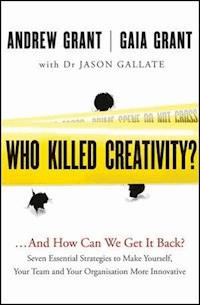
Who Killed Creativity?...And How Can We Get It Back? Seven Essential Strategies To Make Yourself, Your Team And Your Organisation More Innovative
Table of Contents
WHO KILLED CREATIVITY?
…And How Can We Get It Back?
Seven Essential Strategies to Make Yourself, Your Team and Your Organisation More Innovative
Andrew Grant Gaia Grant
with Dr Jason Gallate
First published in 2012 by Jossey-Bass A Wiley imprint
www.josseybass.com
John Wiley & Sons Australia, Ltd 42 McDougall St, Milton Qld 4064
Office also in Melbourne
Typeset in Bembo Regular 11.5/12 pt
© Andrew and Gaia Grant 2012
The moral rights of the authors have been asserted
National Library of Australia Cataloguing-in-Publication data:
Author: Grant, Andrew.
Title: Who killed creativity? ... and how can we get it back?: seven essential strategies to make yourself, your team and your organisation more innovative / Andrew Grant, Gaia Grant and Jason Gallate.
ISBN: 9781118232521 (pbk.)
Notes: Includes index.
Subjects: Creative ability in business.
Creative ability.
Other Authors/ Grant, Gaia.
Contributors: Gallate, Jason.
Dewey Number: 658.4063
All rights reserved. Except as permitted under the Australian Copyright Act 1968 (for example, a fair dealing for the purposes of study, research, criticism or review), no part of this book may be reproduced, stored in a retrieval system, communicated or transmitted in any form or by any means without prior written permission. All inquiries should be made to the publisher at the address above.
Cover design by Adrian Morgan
Cover images: Tape © iStockphoto.com/Ivan Bliznetsov; Bullet holes © Thinkstock/iStockphoto.com
Printed in China by Printplus Limited
10 9 8 7 6 5 4 3 2 1
Limit of liability/Disclaimer of warranty:
While the publisher and authors have used their best efforts in preparing this book, they make no representations or warranties with respect to the accuracy or completeness of the contents of this book and specifically disclaim any implied warranties of merchantability or fitness for a particular purpose. No warranty may be created or extended by sales representatives or written sales materials. The advice and strategies contained herein may not be suitable for your situation. You should consult with a professional where appropriate. Neither the publisher nor authors shall be liable for any loss of profit or any other commercial damages, including but not limited to special, incidental, consequential, or other damages.
To Zoe and Kallen, our wonderfully creative children who have inspired us to continue to innovate and teach about the importance of creative thinking for the next generation.
About the authors
A dynamic husband-and-wife team, Andrew and Gaia Grant are the founders and directors of the consultancy Tirian International. Focusing on organisational innovation, they design and deliver highly creative educational experiences for leaders and teams. Over more than 25 years and in more than 30 countries they have worked at all levels — from the classroom to the boardroom, from tribal education to corporate coaching. Tirian’s seminars and experiential learning programs are now presented under licence in a number of countries around the world. Andrew is a highly sought after and engaging keynote speaker for senior executives from Fortune 500 companies, and Gaia is the author of a number of books and other resources, including A Patch of Paradise and The Rhythm of Life. They have also co-authored educational resources directed at all levels, including the ‘Schools Total Health Program’, which has helped improve the lives of more than 25 million children in developing countries worldwide. When not travelling, Andrew and Gaia live with their two children between Sydney and Bali.
Dr Jason Gallate, a special guest contributor to this book, is an award-winning scientist and a registered psychologist with a doctorate in neuroscience. Jason’s experiments in creativity have established the importance of non-conscious processing for innovation. His research has been published in several international peer-reviewed scientific journals.
Visit www.whokilledcreativity.com for more information and resources, including: seminars, workshops, keynotes, articles, blogs, surveys, videos and the ‘Who Killed Creativity?’ whodunit-style board game. Visit www.tirian.com for the full range of programs Tirian offers. Readers can email <[email protected]> for a complimentary download pack.
Acknowledgements
In preparing this book we worked closely with our team at Tirian, who contributed to case studies and stories and assisted in revising the ideas and information. Tirian executives Lloyd Irwin and Carol Fusek helped design and rework the seminar material, and contributed to relevant sections of the text, so we are extremely thankful for their input. Many thanks also to the creatively talented Bruce Haddon, who was there when we started on this journey and helped to shape our initial ideas. We also appreciate the valued feedback we received from other members of our team, including our creative comedy mastermind Darren McCubbin along with Dr Peter Downey, Cindy Malifa and Rowena Wynfeld.
Introduction
Murder and mayhem in paradise
On 1 October 2005 at 6.50 pm two unassuming men dressed in t-shirts, jeans and sport shoes and carrying small backpacks walked into two beach cafes in Bali, Indonesia, and blew themselves up. By that simple act they instantly killed 20 people and wounded up to a hundred others. The remnants of the backpacks and their severely mutilated legs and heads were found later, but no torsos were recovered — an indication that they were suicide bombers. Although not the biggest suicide bombing to hit Bali (200 people had died in a coordinated car bomb attack just two years earlier almost to the day) this event had a particular impact on us. You see, the restaurants they attacked were located only 50 metres from the front doorstep of our quiet home.
The Indonesian island we had chosen as our home was a peaceful tropical retreat when we had first moved there 13 years earlier. Bali has a fabulously rich cultural heritage that has been preserved over time, and its people have a unique creative energy that comes from living in a lush, fertile land. The small corner where we had chosen to live out our escapist dreams, Jimbaran Bay, had been the epitome of exotic tropical perfection. But as international events such as 9/11 changed the shape of the world, local tensions grew and our own quiet haven was no longer immune.
For us the bombing was not just a one-off, random incident. It was the culmination of a long series of increasingly alarming events, as though there had been a scheme to destroy this unsuspecting patch of paradise. We share this story with you because we think in many ways it mirrors the dramatic chain of events that we believe may be leading to the death of creativity …
First, a bit more on the background. Ten years before that fateful day our sleepy fishing village at the southern tip of the island was relatively unspoiled and pristine. Although barely 10 kilometres from the hustle and bustle of the overcrowded tourist centre of Kuta, it was so quiet and unaffected it could have been on another planet. The women made beautiful colourful daily offerings and decorations for the gods; the men carved incredibly delicate images from wood and stone. Then the tourists came, and hot on their heels, the entrepreneurs, keen to get a piece of the tourist action. And that is when the focus changed dramatically.
The first changes seemed innocent enough. Then, six months after a few locals had opened four small barbecue seafood cafes on the beach, we woke one morning, not to the usual gentle sound of waves lapping on a sandy shore, but to the grinding crunch of a cantankerous chainsaw. The trees out the front were being ruthlessly cut down to make way for a string of identical seafood cafes. Soon the trees were pretty much gone, the cows had been moved to greener pastures, and the field was radically transformed into a huge paved car park ready to take large numbers of tourist buses. The locals no longer had time for their religious devotions and cultural arts, and there was friction over who owned the cafes, who got the jobs and who made the money. As the trucks carrying building materials rolled in, the green field edging the sand in front of our house was transformed. It became the site for an amazing 110 tightly packed, smoke-filled cafes, each an almost exact replica of the one next to it. No originality or creativity, just rows and rows of sameness driven by the promise of financial reward.
Now thousands of tourists packed into the area, and soon the garbage piled up, the tourist buses clogged the tiny streets, soupy polluted water started lapping up on the once pristine sands. Suffocating smoke from the barbecues clogged the air, leaving your eyes streaming as you walked through, and no doubt poisoning the local people daily.
Yes, tourism had arrived big time in our patch of paradise, and it was going to leave an indelible mark. Over time, our local area had been trampled by a mass influx of people, smothered in smoke, hit by commercial greed and finally invaded by terrorists. This was no longer the place we had fallen in love with — it had become something else entirely. And the once-innocent village was heading towards almost certain self-destruction. The degeneration of this pretty beach community was not due to one thing in particular but to a combination of factors, an apparently irreversible chain of events. No-one deliberately set out to destroy the beach or the village community. No-one would have admitted even to contributing to the slow and painful murder. And yet the impact was clear.
In the same way, we believe creative innocence is being gradually trampled, suffocated and more directly attacked in all areas of life and all around the world. In our individual lives, in our communities and in our organisations, we are confronted by the realities of radical change so rapid that we are finding it difficult to cope. One of the first victims of this process is usually creativity, which cannot easily withstand such external pressures. Like the destruction of Jimbaran Bay, the suffocation of creativity is not necessarily deliberate. No criminal or institution (we hope!) has a master plan to turn us into unimaginative zombies. The creative naivety that defined and characterised us as children simply seems to be lost in the pursuit of personal or institutional goals. It’s as though we lose sight of the principles and passions that give us purpose, and in the process lose our creative drive and ability. While everyone in Bali was busy making money from the tourists, the pristine beach was dying and the core values of the creative Balinese community were being destroyed. Many organisations today are falling into the same trap — chasing short-term profit at the expense of long-term values. This is a clear example of innocence lost.
The latest research shows that while average IQ has been rising with each generation, CQ (the Creativity Quotient) has stagnated and since 1990 has actually fallen. Many of us lose the creativity we had as kids over time. We enter school enthusiastic, open and with fresh ideas, but we leave 12 years later having learned, in most cases, the importance of being ‘correct’ rather than ‘creative’. This suppression of creativity can be seen in many organisations as well. Although entrepreneurs start with fresh, innovative ideas, those who ultimately run the organisations learn to create systems and structures that ensure stability, and that process can often be at odds with the need for creative thinking.
So what exactly is creativity, and why do we feel it is so important to save it from destruction? Although everyone seems comfortable to use the term in daily conversation, readily asserting that someone has ‘more’ or ‘less’ of it, the experts struggle to come up with a simple definition. It is generally accepted that it involves the process of using the imagination to develop new, original ideas. For pragmatic creative thinking, the practical application of creativity, it is agreed that two key qualities are involved: originality and usefulness. This wide net captures a lot of things (see if it fits with the way you define creativity), but it also misses what is most special about the quality. We believe that creativity is far more important and broad than this — we believe it is an essential response to life.
After all, life is a series of choices or forks in the road. At each fork you can choose to do things the way you have always done them or to do something different, something new and original. You can accept the established wisdom or methods, or you can find a better way, making adjustments and improvements as you go. Each approach to life has pros and cons, and a successful life probably involves a combination of both. However, we will argue throughout this book that many people and organisations have become far too comfortable with, or addicted to, doing ‘what already works’ or what is risk free. Sometimes this apparently safe choice can unintentionally lead to degeneration and destruction. Sometimes, also, more sinister forces are at work that will directly attack your freedom of choice and limit your ability to think creatively.
Rather than simply passing on a set of principles and strategies for rescuing creative thinking, we are first going to examine how and why we believe creativity has died through a comprehensive murder investigation, asking and investigating the question: Who killed creativity? The inquiry into why we often choose the more destructive path, and who or what is responsible for this, will inform the initial stages of our investigation. We will then examine the alternate path — the more original and perhaps idealistic path that rescues creativity and leads to a richer quality of life.
Is it important to spend time considering the impact the death of creativity may have? We think so. Although the cost of simply doing what works or what is safe is not always immediately obvious, the problem is that it will work only until someone else does it better, and it may not work for everyone or in the best possible way to benefit all. This pragmatic argument for the necessity of innovation — for example, developing new products, processes, markets and business models — although strong, is by no means the only reason why creativity is important. It has a myriad other more and less tangible benefits. But the jewel in the crown, the boon that we hope this book amply illustrates, is that creativity makes life much richer and more interesting, and when applied well can also make life more meaningful and satisfying. What a truly amazing gift this is! Any boring or negative or unsatisfying process, place or thing can be brought to life by bringing creativity into the picture. We hope this book will give you some practical ideas as well as the passion to rescue this process in your life, in your community and in your work.
We will need you to enter into the spirit of our chosen approach, though. Instead of simply offering straight principles, we personify these into characters with whom you can readily identify. We then conduct a crime scene investigation to uncover any evidence that may exist for the murder of creativity through these characters. Consider how glamourised crime scene television has become big business: the hugely popular CSI TV franchise has had an estimated worldwide audience of over 73.8 million viewers.1 These shows, in which the usually mundane and tedious job of analysing evidence is represented as incredibly slick and sexy, are believed to have changed the way many real trials are run today, with prosecutors now pressured to deliver more forensic evidence in court. Much of what is presented is pure Hollywood fabrication, but the shows do help to reveal a meticulous process, and that is the process we would like to utilise here.
One of the ways we will approach our investigation is through a ‘pre-mortem’, since prevention is always going to be preferred to conducting a post-mortem after the fact. This will mean that ideas, systems and processes can be improved before disaster occurs. Through imagining that an event has already occurred (applying what is known as prospective hindsight), people have actually been found to be able to correctly better identify reasons for future outcomes by as much as 30 per cent,2 so this will no doubt be an invaluable tool.
In Part I we investigate the crime scene and explore why we believe creativity is on the decline (chapter 1) before using psychological profiling to identify the potential murder suspects and analyse their motives (chapter 2). We will also look at possible locations for the murders (chapter 3) and discuss in more detail why it is important to save creativity (chapter 4). In Part II we delve into the latest exciting brain research to explore how the skill of creative thinking can be acquired (chapter 5). We provide psychological profiles of the potential rescuers and explore some simple strategies that can be used to save creativity (chapter 6), as well as the locations creativity can be saved (chapter 7). At the end of Part II we will leave you with a challenging twist to the tale — as with a real crime scene, reality is usually not uncomplicated. We therefore hope to challenge you to engage more deeply in the rescue process (chapter 8), and to provide you with a practical case study as an example and template for change (chapter 9). But rather than presenting all this in a dry, scientific way, we plan to involve and entertain you by combining convincing evidence and fascinating facts with insightful case studies and stories. While many books offer creative thinking ‘tools’, we hope that in this book we will help to fill a gap — and perhaps fittingly to make the synaptic leap — in the information revolution by connecting all the great information and ideas out there with your own personalexperience.
If you played any kind of whodunit-style game as a child you will already have a sense of the simple murder investigation approach we are using. In true whodunit style, we will be attempting to find out together:
• Who or what kills creativity?
• How is it killed — with what weapon?
• Where is it killed?
During the investigation we will show how creativity has been killed, not by a single agent, but by a combination of contributing factors. And we will together discover that many of these factors are actually within our control. The good news is that, unlike physical death, creativity can never be fully extinguished. The potential remains ingrained within us. It is possible to go through the whole investigative process in reverse in order to find out:
• Who or what can rescue creativity?
• How can it be rescued — what strategies can be used?
• Where can it be rescued?
That will be the second stage of our investigation — to explore some simple strategies for developing creative thinking and applications at all levels.
Let’s now start the process of sifting through the smoke and debris of what may have been destroyed to revive the creativity that has long been left dormant and lifeless. We hope you enjoy playing the detective with us in this complex investigative process.
Part I: Who killed creativity?
Chapter 1: Investigating the crime scene
Creative thinking CSI
Crunch.
‘Look Dad, a sailing ship!’
Sitting in the back of the car, our five-year-old son Kallen had taken the first bite out of a large, round biscuit — and opened up a world of possibilities.
Crunch.
‘Look, it‘s a moon now!’
Kallen was beside himself with excitement, but he wasn’t getting much response from Dad up front. You see, Andrew’s mind was engaged in serious work, and he couldn’t afford to be distracted by childish play. He had a keynote to prepare for, a presentation on groundbreaking new research into creativity and innovation, but he was having trouble coming up with a creative opening. Feeling under pressure to produce something suitably dazzling for the afternoon session, he knew he needed to maintain his focus on the task at hand.
‘Sorry Kallen, I’ve got work to do.’
Crunch.
‘But look Dad, you gotta look! It’s become a mountain.’
‘Son, not now! I’m trying to be creative.’
Crunch. Crunch.
Undeterred: ‘Hey Dad, now it’s a bird!’
Mostly out of a guilty sense of parental obligation, and probably also as a way to help stop the interruptions, Andrew turned to look at his son, who held a biscuit wedge a couple of bites short of complete annihilation, and grunted a cursory acknowledgement, before turning his attention back to the serious challenge confronting him.
But then it hit him. In a Eureka moment, Andrew suddenly recognised that while he had been busy trying to conjure up creative solutions, Kallen was expertly demonstrating the creative mind at work. It became apparent that while we approach these sorts of tasks with academic rigor and discipline, creative development is really about being able to imagine and to dream. In that moment Andrew truly appreciated that creativity is more an attitude than an action, and that creative development flies in the face of conventional wisdom. Instead of becoming more ‘expert’ in the field, instead of accumulating more facts about creative thinking and problem solving, he saw that we need to know how to open ourselves up to new ideas and possibilities, how to better utilise and harness the innate curiosity we are all born with.
Lesen Sie weiter in der vollständigen Ausgabe!
Lesen Sie weiter in der vollständigen Ausgabe!
Lesen Sie weiter in der vollständigen Ausgabe!
Lesen Sie weiter in der vollständigen Ausgabe!
Lesen Sie weiter in der vollständigen Ausgabe!
Lesen Sie weiter in der vollständigen Ausgabe!
Lesen Sie weiter in der vollständigen Ausgabe!
Lesen Sie weiter in der vollständigen Ausgabe!
Lesen Sie weiter in der vollständigen Ausgabe!
Lesen Sie weiter in der vollständigen Ausgabe!
Lesen Sie weiter in der vollständigen Ausgabe!




