


14,39 €
Mehr erfahren.
- Herausgeber: Luath Press
- Kategorie: Lebensstil
- Sprache: Englisch
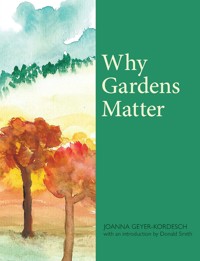
So many gardening books tell you what to plant and where and when. But how often do they tell you to just sit and enjoy them? And when you do, you can find yourself thinking of things in a different way.With an exceptional academic career in natural history and medicine, writer Joanna Geyer-Kordesch found 'reflection, consolation and healing' in the soothing, healing powers of gardens after suffering from a major stroke. Sharing profound reflections on how gardening has helped her regenerate, Why Gardens Matter is as enlightening as it is inspirational. With contributions from Donald Smith, this is a powerful plea for us to reflect on our gardens and to acknowledge the life-affirming values of our green spaces.
Das E-Book können Sie in Legimi-Apps oder einer beliebigen App lesen, die das folgende Format unterstützen:
Seitenzahl: 219
Veröffentlichungsjahr: 2020
Ähnliche



















JOANNA GEYER-KORDESCHhas had a distinguished academic career bridging the disciplines of history of medicine and cultural history as embodied in our landscapes. After becoming the first woman to direct The Wellcome Unit for the History of Medicine at the University from 1990to 2001, she became Professor of European Natural History and History of Medicine at that university where, after retiring in 2006, she remains a Professor Emerita. Since retirement Joanna has continued her research interests while developing a parallel career as a poet, artist and creative essayist. In this latest phase of her life, following a debilitating illness, gardens have become central to her thinking, as well as places of healing, stimulus and reflection.
DONALD SMITHis a storyteller, novelist, playwright and founding Director of the Scottish Storytelling Centre. Donald’s non-fiction books includeFreedom and Faithon the Independence debate,Pilgrim Guide to Scotlandwhich recovers the nation’s sacred geography and four books, co-authored with Stuart McHardy, in the Luath Press Journeys and Evocations series. Donald has also written a series of historical novels, most recentlyFlora McIvor. He is currently Director of the Scottish International Storytelling Festival.
First published 2020
ISBN: 978-1-910022-32-0
Typeset by Carrie Hutchison
The authors’ right to be identified as authors of this work under the Copyright, Designs and Patents Act 1988 has been asserted.
© Joanna Geyer-Kordesch and Donald Smith 2020
Why Gardens Matter
Joanna Geyer-Kordesch
with Donald Smith
Contents
Acknowledgements
Introduction
PART ONE – HISTORIC GARDENS
The Medieval and Monastery Garden
Parterres
Landscape Gardens
Landscape and Botanic Gardens
The Picturesque and the Countryside
CONVERSATION IN A GARDEN – DONALD SMITH WITH JOANNA GEYER-KORDESCH
PART TWO – CREATIVE GARDENS
Gardens in the Mind
Paradise – The Ideal Garden
Secret Gardens
Art in the Garden
CommunityGardens–by Donald Smith
Epilogue
POEMS
May
Weeping Copper Beech
Trees
SOURCES AND FURTHER READING
Acknowledgements
THE SEED OFWhy Gardens Matterwas nurtured by a series of talks and discussions presented at the Royal Botanic Garden in Edinburgh as part of the2015Scottish International Storytelling Festival. It was then developed following my debilitating stroke. It is illustrated by historical prints and sketches and poems from the journals I kept during my long period of recuperation.
My love of conversations brought this book to life. In the first days of my stroke I realised that I could not say words of any kind out loud – I then knew how crucial communication was. I visualised words. And this was when I received comfort, encouragement, kindness and sympathy.Those near me did not treat me as un-knowledgeable,unlearned or disabled in my mind.
Thank you all heartily. But especially Jim Paterson, my husband; Donald Smith, Director of the Scottish International Storytelling Festival at the Storytelling Centre; Gavin MacDougall at Luath Press who accepted my book for publication; Alice Young and Carrie Hutchison (Luath Press), who did so much in assisting me in bringing the book to fruition both in words and artwork; and Lauren Grieve (Luath Press), who realised how difficult it is for people with disabilities to get out and about and hold talks. I also want to thank everyone who worked on this book for their patience and words of encouragement, and those special people everywhere that take the time and trouble to help those with disabilities.
Introduction
GARDENS HAVE Aspecial place for each and every one of us. Whether owning one, planting one, or just looking at different gardens while ambling down the street, they are part of our lives. They matter. And in many more ways than we might imagine.
This book puts gardens and their history at its core, but in a different way. The many and varied historical gardens make a claim on our attention. It is interesting to know what meanings were attached to them. But, beyond these actual gardens, there is also the garden of our mind and imagination. This garden too is very real. It allows us to perceive gardens as stories, as projections and as part of our emotions and feelings. We do not just try to keep a garden next to the house or go for a walk in the park; we can let plants speak to us as we become part of their growth. This is encountering gardens as places of healing. Both aspects are vital.
In the garden you can plant up, dig and mulch, wait for roots to take hold, watch for flowers to emerge and dead-head the roses to let them bloom afresh. There is always plenty to do. In fact, there is no end to the garden chores. In spring all the plants come out and start showing in a new green. The anticipation is high. The buds swell. The leaves show in their sweetest and lightest and most innocent, fresh, childlike colours.
It is this seasonal change which is important. It seems conventional and not worth noticing except for the labour it demands – the weeding and the pruning. But change also carries the message that we alter and we age. To do this gracefully, we can think of how the garden expresses time’s passing.
After spring, summer comes. And there is a riot. Every bush and tree and flowerbed pushes out its own colourful glory. The variety of hues and shapes is endless. Roses abound, in small patio dimensions or tall tea-roses, or perhaps climbers and ramblers. Diversity abounds; daisies in many shapes have mostly a white beauty, but there are also Leucanthemums with a faint yellow. Kniphofias are red-hot pokers. Lavateras, or mallows, run wild. Petunias fill baskets or pots, and they too are multi-coloured. These random names call up only a few flowers which ring their changes all summer long. The season rolls on with cone flowers, a prairie plant in white or red or yellow. Monardas are now acclimatised in Scotland to brighten the late summer scene.
Then there is autumn with its decline, but also its striking features. The trees dominate with their change in colour. They begin to mutate their green into more riotous tones. Scarlet, yellow and brown fill out the hazy sunshine that is the best of the season’s bowing out. Autumn means letting go. The leaves fall. The shrubs join the chorus. Even some small plants turn a startling red before they let their leaves drift loose. The winds get up. Bareness begins to dominate. The branches show their hitherto secret structures. Then pale trunks become mighty. The vibrant shades of green are gone.
Winter has set in. Now there is time for meditation. Now the bare earth becomes visible. The rivers flow past vegetation turned brown. There is a possibility of snow. Everyone shivers in the falling temperature. Our planet rotates away from the sun.
This book will follow this cycle to learn from high and low points, from the flowers, shrubs and trees changing in each season, as well as from the different ways gardens have followed the seasons. It is not a manual on how-to-garden; instead it expresses why gardens matter in human terms. Whether real or in the mind, gardens refresh the spirit. This book seeks to encourage everyone to stop andlistento how things grow and fade and grow and fade again. Gardens can do this for real and in the imagination. The reader should do both. Instead of fighting to have city lights, radiators turned on and hiding in the house the reader can glory in nature. Especially in winter when nature seems to go underground, reflection is penetrating, silent and worthwhile.
There should be space for deliberation in cold winter. Few things are flourishing above ground, yet roots are developing, where we cannot see them. Like thoughts they need the time and space of bareness to reach glorious colour. The silence nurtures strength. The pauses are natural and beneficial.
Why Gardens Matteris for those who garden for real and those who cannot. The encounter with a fictional garden is also of value. The idea of this book is that no one should be left out – least of all children, the elderly or those with disabilities. One of the great virtues of gardening is the ability of plants to come up green out of a rough brown or black soil and even to bloom when neglected. Gardens can be enjoyed in books. It was, for example, crucial in the 1860s when children began to be the subjects of stories on their own account, that gardens became their creative places. Children were read to and adults encouraged the little ones to bring gardens and nature into their homes.
Imaginary gardens are appreciated by all ages. They provide more than herbal cures: they are the deep well of healing. Some can be visited in the imagination and in reality. The hermitages, groves, temples, cascades and waterfalls constructed in 18th century landscape gardens reflect thoughts and emotions. They are the constructions of people with their ability to make you linger and meditate, to imagine and remember.
Lingering and meditating, what the Picturesque and the Romantics called ‘the insights of solitude’, were essential to landscape gardens. But this is not time-bound. Today the natural landscapes of the famous ‘Capability’ Brown, who assembled clumps of trees, lakes and lawns around patrician houses, makes one aware of natural space and the capacity to dream too. Each person striding and stopping in these wide, nature-imitating spaces learns to take themselves seriously. The landscape is designed to give vistas into a rural infinity. To arrest cares and woes, or to think more deeply upon them, or to dispel them, is the essence of all landscape gardens.
This mirrors, curiously enough, the search for paradise or the paradise of the imagination in children’s literature. The healing garden is just that: healing means not standing still, in the mind or physically. Through meditation on plants or views, or garden art, a movement of thought is engendered, alongside physical journeys. It was the children inThe Secret Gardenwhobecame aware of the silent language of growth. They became different from the stunted selves each had thought epitomised them. They were born into tyrannising others and they learned through the growth in gardens that they could be better than that. Nature, although not speaking in a direct voice, gave them space and inspiration enough to seek fresh air and be healed – to find happiness.
‘The child is father of the man’, so the saying goes, and all genders are included. There is truth in that, especially when contemplating change. This life is certainly not static. Healing gardens point in the right direction. Whether accepting the thorns on the rose or the beauty of the petals, all is change and growth. Rainer Maria Rilke, the poet, famously said that under so many rose petals there is a contemplation of emptiness. We should knowingly accept and absorb this ‘emptiness’ to induce healing.
Such is the intention. This is a book to find locations and to develop ourselves. It is not here to command or provide solutions; its reason for existence is openness – to find, to imagine and to grow.
***
Gardens are all around us. This book will give you an overview of their history. Armed with this knowledge you can go and enjoy them more fully. The history allows insight, but our presence in the garden, in all its aspects, is your own. Being able to learn about gardens leads us to love them, their stories and just what it is that speaks to us, Then they give us the joy of being there in every weather, each mood of the season. In the second part ofWhy Gardens Matterwe explore these creative responses.
Myriad garden books talk about the planting. This is important if you are creating a garden, but standing in one is just as important. Landscape gardens are about meditation more than planning where to situate trees, lakes and shrubs. Looking along a sightline and locating a ruin – usually an artificial one placed strategically in order to contemplate the passing of time – is equally significant. Many gardens of the past are arranged to bring the visitor up short or to have them puzzle over which direction to take. This is well thought out since stopping and thinking creates worthwhile crossroads before embarking on the one road or the other.
In the history of gardens there are of course distinctive variations. Some gardens are good for looking and taking a meandering path. Some gardens are made to be enclosed. Some gardens are scented and give you back what is lost in memory. Some provide green space for a much-needed pause. To engage with specifics you can read the appropriate book or gather the best advice. But whatever or wherever you are in this designed space of ‘second’ nature, the thread of the healing garden will entwine with aspects of the human spirit. The bare soil and luxurious flowers are partners. You need an elemental root below to throw a flower up. Good soil is needed for growth. Who knows what may flourish then – what grows is not only the flower which you see.
PART ONE
HISTORIC GARDENS
The Medieval and Monastery Garden
THE HEALING GARDENis not there for just the physical. It encompasses the mind and emotions. It can and should help us cope with the ups and downs experienced in life and always make us remember joy as well as pain.
Folk cures looked not just to the healing power of herbs, but to the chants and invocations which accompanied them. These invoked the great chain of being where everything was spiritual as well as physical. God as well as mud or worms had a settled hierarchy. The unseen powers of the healers in Celtic cultures often evoked the human by crying to divine power to grant mastery over pain and suffering. The healers were the trained and knowledgeable advocates of the Divine who acted together with the sufferer.
These chants and prayers went into realms we consider strange today. We do not often see the need to delve deep into uncanny powers. But Scottish Gaelic folklore did; and these customs persisted for centuries and are still practised today. What remains meaningful is the invocation of something more than the individual ailment: the inclusion of that single element in all the powers that be. It is not the isolation of illness or pain, but what it has in common with dynamic forces we cannot see. If you believe that what happens is fortuitous, there may be a greater whole included in the workings of both mind and body.
The medieval garden inherits that philosophy but also goes in the direction of sensory pleasure. Abbeys and priories, which welcomed the sick and gave succour to the traveller, gloried in the paradise that was the church, heaven on earth. They allowed walks in their orchards of blossom to revive the soul, while treading the same orchards with baskets full of autumnal fruit for the table. Planted with healing herbs, their gardens allowed for a cure beyond this physical medicine, an inestimable, allusive and powerful scent that transcended the earthly wear and tear. Introducing calmness where there seemed to be turmoil, the cloister attached to the church was a place to think more extensively and quietly. It was a place to slow down. This is as true today as of the past.
In contrast to later gardens, the medieval garden was small and conducive either to romance or retreat. Medieval gardens had seats in bowers, and in the square and oblong lawns, and well-cultivated plants with symbolic meanings on show. These gardens in time intermingled with old manuscript paintings in Herbals and devotional primers. The sweet scented white lily is not only exemplary to grow, but speaks of purity and headiness in ethereal ways. Heaven is thus connected with earth. Roses too, the old-fashioned ones grown in the medieval gardens such as the rosa alba, the rosa gallica, the dog rose and the damask rose had meanings beyond their use. They bloomed only once, at the end of May and in June, so conveying allusions to moral perfections and the passing of beauty.
Engraved title page of John Gerard’sHerball, with representations of Theophrastus and Dioscorides, 1636. (Wellcome Collection. Attribution 4.0 International (CC BY 4.0))
There are many possible places to start examining the importance of the garden through time. But, in terms of the garden and its significance to humankind, a good place to begin is with their medieval development, both as a place to grow plants for food and for medicine and also as a place for enjoyment and exercise of the mind. It seems that we must continually rediscover the truth of these core purposes. The first Herbals in manuscript form described plants and flowers alongside their medicinal uses. They were familiar to the Greeks, translated by the Arabs and applied by learned medieval monks. Treatment of the ill meant a study of plants and their characteristics, and this grew into a fine art dependent on scrutinising leaves, stems, flowers and roots. It was anything but a simple operation: those who could see what was effective, when and how to apply it, were highly valued and this knowledge built on the tradition of Herbals.
Dioscorides, in his famousDe Materia Medica, developed the Herbal in manuscript form that everyone referred to and used for centuries beyond its inception, around 500AD. Later Herbals also included plants from further north with descriptions of new plants that were encountered in specific regions. It was practical to have plants specified in the medical sense, but also described for their own sake. Alas, the Herbals and their illustrations did not distinguish old from new. The theoretical knowledge of plants was there, but usage was increasingly dependent on being familiar with what actually grew in the ground.
By medieval times, salvation of the physical body, as well as of the soul, was in the hands of learned monks and abbots, who advanced their knowledge in special gardens near their infirmaries. Monks increasingly lived many tiered working lives, centred on communal prayer and private silence, but practising advanced study, horticulture, open hospitality and care for the ill. Those who could read did so in several languages, especially Latin. Herbals were often in this tongue as well as later in the vernacular. They had plant descriptions in words and pictures, but these were often stylised. You had to know the herbs in practice alongside the description in the book or manuscript, as there was always the danger of applying the wrong plant or the wrong dosage.
As the manuscripts were converted to printed books, after 1470, plants were valued more and more for their specific characteristics in their locality and were recorded in this way for publication. The plants whose features were delineated became objects whose natural qualities were worthy of study in their own right. In a sense the written and printed Herbals were the first books to demand that plants be characterised apart from their medicinal use. In this way medicine helped evolve the description and classification of plants into taxonomy and botany.
The monks in their cloisters were not dispensers of health as we understand it. They knew the efficacy of herbs, but they considered health to be both physical and spiritual. Even today the lore of herbs is not just physical. Enticing smells were as important as the division of plants into their organic parts. The cloisters were places of walking and meditating. The garden as an experience was as important as the medicinal properties of the plants that grew there. Pleasing odour was what sent those deep in thought heavenwards, not earthwards. Many flowers included in these cloisters were sweet smelling, and symbolically conveyed that the Virgin Mary or saints were present. There was not a great divide between these invisible presences and belief. Flowers and herbs were prevalent in enclosed gardens near the church and often accessible only through the church.
When the cloister garth, as it was called, remained green and grassy, it was meant for relaxation, a refreshment of the eyes, but nonetheless it was a constant reminder of the goodness of God. Flowers had their own language and this reached down to Victorian times, when composed bouquets were devised and presented. These meanings have however evolved. During the dominance of the Roman Catholic Church, before the Reformation, most roses and lilies referred to Mary, the mother of Jesus. Other faiths had their symbolic flowers too, extending the meaning of each flower to the spiritual realm. The mix of floral scent and meaning was part of spiritual life – herbs too had scent and meaning, but it was more applied. The expression through flowers, their colour, scent and even just their presence, can still elevate us into the spiritual realm. The symbolic meaning of flowers combines with their natural beauty to help each person to go beyond just the floral composition. The spiritual realm opens avenues of exploration of many kinds from joyousness to steady calm.
Two medieval lovers in a garden at Château de Chantilly, France. (© Thaliastock / Mary Evans)
Most abbots were versed in medicine. St Benedict had delineated two essential rules: one was to accept all travellers; the other was to heal the sick. Although not all orders were of Benedictine descent most communities followed these rules. The great religious orders were international communities. This led to extensive grounds and innumerable networks across the world as the more powerful among them travelled. Monasteries were lively places, dedicated to God, but also busy fulfilling the necessities of life. The monks tended to grow crops as well as the smaller gardens of herbs and flowers. They had orchards in their care; the fruit trees included pears, cherries, plums, quinces, almonds, mulberries and varieties of apples. Orchards were not only there for food. In the spring they provided colour and sweetness. New trees and new seeds were received from many sources, drawing on the international connections between the orders.
Self-sufficiency was important to each community. There were fish ponds for meals, the orchards for fruit in different seasons and herbs for flavour. Plots were in rows within designated areas. The rows could be readily managed from each side. This regimen of types of herbs, types of flowers and edible plants allowed for rotation. Some were left to lie fallow, a practice common in most gardens, but inspired here by the Biblical belief in a ‘Sabbath’ rest.
As the social scale moved upwards and outside monasteries, the garden became courtly and treasured as an elite preserve. In these activities beyond the monasteries, behaviour became more secular. Gardens invited dances, music and romance. This courtly behaviour went with castles and knights and ladies. It is how we idealise these long-ago times. Some of these gardens still survive in their sadly scant records and beautiful illustrations. On the castellated towers the wide view went out over forested lands enclosing wild beasts. These lands were walled in and the pheasants, rabbits, hares, deer and sometimes exotics, were held in these pleasant enclosures until hunted. Smaller enclosures were made within the walled garden, mostly using trellises of flowers and vines. Seats were placed in these small formal gardens, or herbers, upon which ladies and gentlemen sat, alone or conversing.
There were many variants, but all the herbers were tight enclosures and sweet smelling, whether from white or red old roses, lilies or violets. Many of the basic plants we have today have their origins in the medieval centuries. They were specially planted and cultivated in the geometric layouts of lawns and flowers in the herbers. Walls and trellises kept them safely enclosed and bowers and small trees provided shade, while water or fountains made soothing sounds. The Virgin Mary is often depicted in such gardens holding the infant Jesus.
Pathways lead around the herber and within orchards and pleasure gardens. None of the careful lawns, sweet smelling beds, orchards in bloom or with fruit were without walks. Reading, meditating or conversing were the preferred activities in these verdant gardens. It is as if the thoughts expressed in medieval gardens reach out, heightening awareness of an ordered life where each person has many tasks to fulfil, while traversing through many patterns of growth and so many different experiences of life.
Pathways and seats in the herber were for thinking and reflecting. The whole meditative life of medieval times was an intertwining of hard and short lived years with an order that went far beyond the merely physical. The spiritual life, or that of sincere emotion, ran toward completion in individual realisation. It grasped immateriality as an essence. Life was, so to speak, too short to delve into the merely material.
When the monarchs of Scotland founded their abbeys and priories, they not only saw heaven on earth reaching up in stone pillars and prayer ascending with their spiritual needs. They were investing in a whole array of community support, from hours in divine supplication for the living and the dead, through to tending the sick and infirm. Later centuries would arrange gardens to set off the remains of abbeys and priories in their ruined state, half covered in green shoots of ivy, but this was a sad retrospect wrought by the Reformation. In their heyday monasteries were efficacious centres of healing and sanctuary.
Two royal figures sit in their enclosed garden in medieval Britain fromIn Feudal Timesby EM Tappan. (Mary Evans Picture Library/TAH Collection)




