


15,99 €
Mehr erfahren.
- Herausgeber: John Wiley & Sons
- Kategorie: Geisteswissenschaft
- Sprache: Englisch
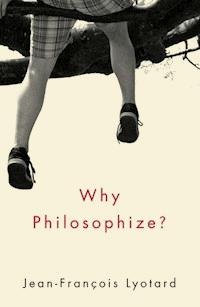
Why Philosophize? is a series of lectures given by Jean-François Lyotard to students at the Sorbonne embarking on their university studies. The circumstances obliged him to be both clear and concise: at the same time, his lectures offer a profound and far-reaching meditation on how essential it is to philosophize in a world where philosophy often seems irrelevant, outdated, or inconclusive.
Lyotard begins by drawing on Plato, Proust and Lacan to show that philosophy is a never-ending desire - for wisdom, for the ‘other’. In the second lecture he draws on Heraclitus and Hegel to explore the close relation between philosophy and history: the same restlessness, the same longing for a precarious unity, drives both. In his third lecture, Lyotard examines how philosophy is a form of utterance, both communicative and indirect. Finally, he turns to Marx, exploring the extent to which philosophy can be a transformative action within the world.
These wonderfully accessible lectures by one of the most influential philosophers of the last 50 years will attract a wide readership, since, as Lyotard says, ‘How can one not philosophize?’ They are also an excellent introduction to Lyotard’s mature thought, with its emphasis on the need for philosophy to bear witness, however obliquely, to a recalcitrant reality.
Sie lesen das E-Book in den Legimi-Apps auf:
Seitenzahl: 127
Veröffentlichungsjahr: 2013
Ähnliche



















Why Philosophize?
Why Philosophize?
Jean-François Lyotard
Translated by Andrew Brown
polity
First published in Pourquoi philosopher? © Presses Universitaires de France, 2012
This English edition © Polity Press, 2013
Ouvrage publié avec le concours du Ministère Français chargé de la Culture – Centre National du LivrePublished with the assistance of the French Ministry of Culture – NationalCentre for the Book
Polity Press65 Bridge StreetCambridge CB2 1UR, UK
Polity Press350 Main StreetMalden, MA 02148, USA
All rights reserved. Except for the quotation of short passages for the purpose of criticism and review, no part of this publication may be reproduced, stored in a retrieval system, or transmitted, in any form or by any means, electronic, mechanical, photocopying, recording or otherwise, without the prior permission of the publisher.
ISBN-13: 978-0-7456-7996-9
A catalogue record for this book is available from the British Library.
The publisher has used its best endeavours to ensure that the URLs for external websites referred to in this book are correct and active at the time of going to press. However, the publisher has no responsibility for the websites and can make no guarantee that a site will remain live or that the content is or will remain appropriate.
Every effort has been made to trace all copyright holders, but if any have been inadvertently overlooked the publisher will be pleased to include any necessary credits in any subsequent reprint or edition.
For further information on Polity, visit our website: www.politybooks.com
Contents
Acknowledgements
Editorial note
Introduction
1 Why desire?
2 Philosophy and origin
3 On philosophical speech
4 On philosophy and action
Acknowledgements
The publisher wishes to thank Dolorès Lyotard and Corinne Enaudeau, as well as the team of the Bibliothèque littéraire Jacques Doucet (especially Marie-Dominique Nobécourt Mutarelli, the Head Librarian), for their generous help in preparing this edition. Corinne Enaudeau teaches philosophy to khâgne and hypokhâgne classes at the Janson de Sailly and Henri IV lycées in Paris.
Editorial note
The translation follows a typed text preserved at the Bibliothèque littéraire Jacques Doucet (shelf mark JFL 291/2). This constitutes the second manuscript version of the lectures given by Jean-François Lyotard soon after they had been written. The Bibliothèque Doucet also preserves (shelf mark JFL 291/1) a first typewritten version of the same text – but one that is heavily annotated by Lyotard himself. All these annotations have been carried over, without modification or alteration, into the second typescript, so it has not been thought useful to point out the differences between the two versions. On the other hand, a few minor corrections have been made when they turned out to be necessary (punctuation mistakes, quotation marks missing); likewise, the quotations indicated by abbreviated references in the original text have been re-established. No notes have been added, so as to leave the oral character of these lectures intact.1
Corinne Enaudeau
1 I have added a minimum of notes where I felt they were necessary. [Trans. note]
Introduction
Corinne Enaudeau
Philosophy does not desire wisdom or knowledge; it teaches us neither what is true nor how to behave. People will say that it wears itself out wondering what it is – and what is – in a solitude that disturbs nobody. At best, it might sometimes offer us an idea useful for the production of wealth or the dream of a completely different social system or the metaphysical opium of consolation. Philosophers, it would seem, are those crazy chatterboxes whom history carts along with it throughout its history, without profit but without any great loss either. They may well interpret the world, but they stay standing at its door and will never change it. So their discourse may be interrupted, may return to silence, without the face of the world being changed. After all, their discourse has, in the final analysis, a single thread: a strange attachment to loss, the desire not to lose the loss that undermines all human activity and separates it from itself, the desire not to let go of the lack whose dagger death sticks into life. So, in 2012, we may well ask, as Jean-François Lyotard asked in 1964: why philosophize? What reason was there, is there still, to philosophize, to plunge back down into the depths of the gaps in meaning – each time anew, in a re-found naivety that will be judged childish? Put this way, the question may appear rhetorical. It is self-referential, since its utterance actually gives the answer to the question uttered, for we have already started philosophizing when we wonder whether it’s worth the trouble to do so all over again. But it is the lot of language itself, which has to speak so as to worry about its own interruption; it is the lot of wakefulness and life, which must deny in practice the sleep and death that they are investigating. Since we speak, act and live under the threat of loss, we won’t emerge from this circle where absence makes itself present and presence is hollowed out by absence. For it is not easy to be a dumb beast, Lyotard tells us, we cannot stun ourselves with a wordless given, a perfect plenitude, a dreamless night. So we will philosophize for the simple reason that we cannot avoid doing so: ‘attest to the presence of lack by our speech’.
Lesen Sie weiter in der vollständigen Ausgabe!
Lesen Sie weiter in der vollständigen Ausgabe!
Lesen Sie weiter in der vollständigen Ausgabe!
Lesen Sie weiter in der vollständigen Ausgabe!
Lesen Sie weiter in der vollständigen Ausgabe!




