


2,99 €
Mehr erfahren.
- Herausgeber: Edizioni Savine
- Kategorie: Geisteswissenschaft
- Sprache: Englisch
An Account of the Important Contribution of the United States to Aircraft Invention, Engineering, Development and Production during the World War
Das E-Book können Sie in Legimi-Apps oder einer beliebigen App lesen, die das folgende Format unterstützen:
Veröffentlichungsjahr: 2021
Ähnliche




















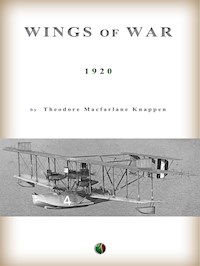
The NC 4, Liberty-Engine-Driven Conqueror of the Atlantic, in Flight at Pensacola, Florida - Navy Photo
Wings of War
An Account of the Important Contribution of the United States to Aircraft Invention, Engineering, Development and Production during the World War
By
Theodore Macfarlane Knappen
With an Introduction by Rear-Admiral D. W. Taylor
Chief Constructor U. S. N.
With 43 illustrations
G. P. Putnam’s Sons New York and London
Copyright, 1920
New digital edition
© 2021 - Edizioni Savine
PREFACE
The manuscript of this book was written in 1919. The numerous Congressional investigations of the management of the war which have taken place since the writing have revealed many shortcomings in both the army and navy that were concealed during the conflict period—and aircraft production is no longer singled out for a monopoly of hostile criticism and sweeping condemnation, as it was in the unhappy days when its managers were seeking to accomplish the impossible. Time is a great adjuster of judgments as well as a healer of wounds, and it is the writer’s belief that the ultimate verdict of history will virtually coincide with the conclusion reached in the following pages that instead of being, as was once universally believed, the outstanding industrial fiasco of America’s part in the World War, the aircraft achievements deserve to rank with any of those of our “second line of defense,” which, taken as a whole, were highly creditable.
The war happily came to an end too soon for our huge industrial conversions and mobilizations to enjoy the spectacular triumph that would have been theirs in the spring of 1919. Nevertheless, the knowledge of the Central Empires that a country that was as innocent of knowledge of the art of making military aircraft in the spring of 1917 as it was before the Wright Brothers made their first flight in a heavier-than-air machine, was, in the fall of 1918, producing air service engines in greater volume than all the rest of the Allies together, with a similar preeminence in the production of ’planes rapidly approaching and a magical expansion of all related productivities, had its certain and conclusive though undramatic effect on the moral and mental processes that led to the collapse of Germany before the death-blow was delivered.
T. M. K.
Washington, D. C.
May 1, 1920.
INTRODUCTION
The story of the United States army aircraft production program is essentially a story of confident hopes, bitter disappointments, failures, and successes such as inevitably attend the creation from nothing of an immense industrial organization. The existing publications which give the history of this undertaking are largely the voluminous reports of congressional and other investigating committees which throw into strong relief all failures and unfortunate circumstances, and gloss over with very scant mention the successes and the fortunate circumstances. For this reason, it is especially desirable that a less one-sided account of the army air effort be published, and, hence, I am glad to see the appearance of this book.
The conception of a tremendous air program, and the courage to undertake it in spite of the obvious difficulties is, in my opinion, due to General Squier and Colonel Deeds, and, since these officers have received public criticism for any and all shortcomings in the program, it is no more than fair that they should also receive the credit for the wonderful success of other parts of the program.
The entire American aviation program centered in the conception, development, and production of the Liberty motor, and this I consider one of the outstanding achievements of the War. The army staked much on the Liberty engine, but the navy staked everything. The navy, in fact, for its service ’planes adopted a 100% Liberty motored program, calling for a series of large flying boats engined with one, two, or three Liberty motors. This program was adopted by the Navy Department before the Liberty motor was fully proved. It is of interest to record the fact that the first Liberty motor to fly was mounted in a naval seaplane, the first twin Liberty motors were flown in a naval seaplane, and, finally, the Atlantic was crossed by four Liberty motors in a naval seaplane.
Since the navy relied upon the army for its Liberty motors upon which its program was based, and since the army delivered the goods in this respect so that the navy program was not delayed a day by failure to have those wonderful motors ready when the navy ’planes were ready for their installation, it is natural that those of us in the navy who had to struggle with the production of ’planes should have in our hearts a warm spot for our brothers in the army who conceived and produced, with such astonishing success, the Liberty motor.
The history of the navy’s aircraft production program has not been covered by the proceedings of investigating committees. The navy’s problem was undertaken successfully with the existing naval industrial organization. The navy was, therefore, spared the tribulations incident to organizing a brand new industrial machine, tribulations which are little understood or appreciated by the layman. Also, the navy’s problem was of less difficulty than the army’s because not on such a gigantic scale. The navy entered the war with an existing shipbuilding organization, provided with aeronautical engineers, wind tunnel research facilities, training seaplanes and airships, and an adequate training station.
The naval program of service ’planes was adopted in the fall of 1917, and was never changed except to be increased twice as to numbers. Production was going ahead with full volume in the spring of 1918, and, by September, 1918, all fifteen naval air stations abroad, as well as our own coast-patrol stations, had been shipped full complements of service ’planes. Shipments were then stopped, and steps taken to slow production. The armistice came before shipments abroad had to be resumed. “Happy the people whose annals are uninteresting.”
D. W. Taylor,
Rear Admiral (C.C.), U.S.N., Chief of Bureau of Construction and Repair.
Washington, May, 1920.
CHAPTER I
THE TASK SET BEFORE THE BUILDERS
The entire air force of the United States of America broke down and disappeared in the trifling contest with the Mexican bandit, Villa, in 1916. A year later the nation whose air forces and material were so pitifully small that they were unable to cope with the reconnaissance problems offered by the activities of a Mexican bandit was called upon to plunge into the greatest aircraft production program and into the training and organization of the largest flying personnel the world had seen.
It was almost as if some armorer of the feudal ages, after making his first arquebus, had been called upon to make modern rifles by the millions. Or, as if the artificers who cast the fifteenth-century “mystery” guns that conquered Constantinople and crushed the Byzantine Empire for the Turk had in a moment been ordered to produce the fifteen-inch guns of a modern battleship or fortress.
We knew nothing, one might say, of aircraft; and we were required to know all. We had done nothing; and it was demanded of us that we should do all. We had altogether of every kind and description, when the war with Germany came, some 60 planes all told. In the preceding year we had ordered 366 machines, had succeeded in getting 64 delivered, and so great was this task for our manufacturers that they had asked to be relieved of most of their contract obligations. They had tried to build 366 airplanes in a year and confessed to an 80 per cent, failure.
We lacked aeronautical engineers, we lacked large plants, we lacked skilled workmen, and, although the war in Europe had been raging for almost three years, we lacked absolutely knowledge of aeronautical military requirements. In fact we had not built a single land combat plane of any description either for ourselves or the Allies. We were as ignorant as a child unborn of the nature of the equipment of a military ’plane.
Suddenly we plunged all unprepared into the war and with a unanimous voice the Allies and our own people declared that perhaps our greatest contribution to the war would be such vast numbers of airplanes that the German army would be blinded and the whole German Empire overhung with a cloud of hostile airplanes. Almost gayly in our ignorance we undertook within three months after the declaration of war a program calling for the completion within one year of 22,500’planes. We proposed to manufacture and maintain at the front 4500 machines. At this time France and England between them, after many years of preparation and three years of active combat, had been able to maintain at the front not more than 2000 combat machines. Had it not been for our blissful ignorance of the magnitude and complexities of the task, we would never have undertaken it. We were fools, rushing in where angels feared to tread. Yet if we had not undertaken so much we would not have done as much as we did. Had it not been for our optimism and our sublime confidence we would have undertaken little and accomplished less. The impossible was undertaken and its accomplishment was glowingly foretold; it was not achieved but the spirit that dared so much and predicted so much was the spirit that made it possible actually to do so much.
The task was of such unparalleled magnitude and so bewildering in its complexity that the men who undertook to carry it through were only able to stimulate themselves for the stupendous work by dwelling on its colossal proportions as something that they must and would overcome, without reflecting overmuch on the relations between its dimensions and the caliber of the instrumentalities with which it was to be accomplished. They refreshed themselves for the daily effort against the awesome job by the continual contemplation of it as a thing accomplished. They lived and worked in a sort of dream of mighty deeds that must be done. They were self-hypnotized and ofttimes spoke and acted as if the will to do was the thing done. Their enthusiasm and confidence were communicated to all who were associated with them. Everybody undertook the impossible and was sure it could be done. Manufacturers who had never built an airplane engine contracted to produce them more rapidly and in greater volume than the greatest builders of Europe would have dreamed of. Optimism reacted on optimism, confidence was expanded by answering confidence. Thus arose a sort of dreamland of herculean effort united with an illusory sanguineness, out of which came magnificent courage, wonderful audacity, and almost superhuman achievements, which were still short of what had been confidently predicted.
The aircrafters were judged not by what they did, but by what the public came to believe that they could do. They went at their task as a climber approaches a high mountain—by looking always upward to the eternal snows and proceeding steadily in the direction of the summit without discouraging himself by visualizing the intervening difficulties. Had our aircraft managers and manufacturers fully realized at the start how many gullies and valleys and canyons, how many rough slopes, how many precipices and crevasses were in their way, how much they would have to go down in order to go up, before they reached the summit, they would have given up in despair. Looking back now in the fatigue and reaction of achievement they would not dare to undertake what they finally did accomplish.
In the making of almost everything else that was essential to the material side of the war, America was more or less experienced. We had built ships before and we knew all the arts of cannon-making. We were expert armorers, we were the world’s premier makers of rifles, and we had built vast quantities of machine guns. We were the chief manufacturers of military explosives. We even had the nucleus of a great army and we had a powerful navy. But in the building of aircraft we were as children; yet to us was assigned the greatest effort, comparatively, in that of which we knew least.
Ignorant of the aerial arts, the task set for us was nothing less than the conquest of the air. The war was to be won in the air. All the efforts of France, England, and Italy had not been sufficient to produce that vast aerial armada that was to encompass the German armies and the German Empire above as fleets and armies had encompassed them below. Ignorant as we were, our task was to convert our vast manufacturing resources and genius for mass production from known to unknown work, do it with surpassing speed, and gain for the Allies the dominion of the air.
CHAPTER II
BEFORE THE WAR
The heavier-than-air flying machine was invented in America. It was used and applied elsewhere. The Wright brothers first flew in a selfpropelled airplane, at Kittyhawk, North Carolina, on December 17, 1902. Sixteen years later, the birthland of the airplane, drawn into the vortex of the very world war the Wrights believed the airplane would make impossible, when sufficiently developed and multiplied, was woefully lacking in knowledge of the science and art of aeronautics and aircraft manufacture.
When the Germans struck their sudden and treacherous blow in August, 1914, they had 1200 military airplanes, France had 300, England 250. The United States had practically none. Three years later when the war engulfed us we still had practically none. There was not a man in the American army who had ever flown in a fighting ’plane of any sort, unless possibly as a guest; scarcely anyone except the military observers had even seen such a thing as a modem military ’plane. Our little aviation section of the Signal Corps had some machines but by no stretch of the imagination could they be called fighting ’planes. The total personnel' of the aviation section was 52 officers, 1100 enlisted men, and 210 civilians. Probably not more than a dozen of this force were expert flyers. There were not enough of them to make even a respectable start in training recruits. This meager body of men had at their disposal less than a hundred machines—of almost as many types as there were machines. The government whose inventive sons, the Wright brothers, had given the aeroplane to the world, had during eight years of mild and skeptical Congressional interest in aeronautics managed to collect 54 machines and had actually ordered 59. In 1916, after the war in Europe had been raging with frightful and ominous intensity for two years, we got around to ordering 366 airplanes; but only 64 were delivered. It cook the nine leading manufacturers of the country a year to produce an average of five ’planes a month, and most of them asked to be relieved of a part of what they had undertaken to do. From the standpoint of quantitative production the business of aircraft manufacturing was almost non-existent in the United States. There was only one ’plane plant that was entitled to be called a large factory. The rest were hardly more than shops—some of them ludicrous shops. There were many manufacturing concerns on paper and quite a number had offices, but there were only six or seven that had really done anything even in the small prebellum way.
There were perhaps a dozen aeronautical engineers in the whole country who were men of marked ability and recognized achievements, but not one of them was then competent to design a complete up-to-date fighting aeroplane without further acquainting himself with the development of military aircraft in Europe. In brief, in a broad way of speaking, we had neither factories, manufacturers, nor engineers. We were as helpless technically and industrially as we were militarily—if not more so.
Some manufacturing had begun of engines of foreign design on orders from the Allies. Thus the Wright-Martin Company, of New Brunswick, N. J., had taken up the manufacture of the Hispano-Suiza engine; and the General Vehicle Company, of Long Island City, N. Y., had begun to make some Gnome motors. The Curtiss Company was making its own engines, the OX and the OXX, the former being of about 100 horsepower for use in training machines and the latter being of 200 horsepower for navy training ’planes. The Sturtevant Company was building an engine of 135 horsepower and the Thomas-Morse Company was producing an engine that was to be an improvement on the Sturtevant. The Hall-Scott Company was next to the Curtiss the largest producer, and was making four- and six-cylinder engines. The Packard Motor Car Company, the Pierce-Arrow Company, the Knox Motors, the Duesenberg Motors Corporation, the Union Iron Works, the Wisconsin Engine Company, and others were developing engines.
Among the engineers were Glen Curtiss of the Curtiss Company and several associates; Orville Wright; Willard of the L. W. F. and later of the Aeromarine Company; Charles Day of the Standard Aero Corporation; Starling Burgess of the Burgess Company; Grover C. Loening of the Sturtevant Company; B. D. Thomas of the Thomas-Morse Company; C. M. Vought of Lewis & Vought, New York City; Glenn L. Martin of Los Angeles; J. C. Hunsaker of the navy; and Capt. V. E. Clark of the Signal Corps.
J. G. Vincent, chief engineer of the Packard Motor Car Company, had been engaged in motor research and development work for two years and had produced several different models of 12-cylinder aviation engines of from 125 to 225 horsepower with the result that he had collected a vast amount of data regarding aviation engines and had gathered around him an efficient experimental and laboratory organization. This recent experience was added to a rich experience in the designing and quantity production of automobile engines—the sort of experience the aircraft manufacturers and engineers proper mostly lacked.
E. J. Hall of the Hall-Scott Motor Car Company had worked developmentally on aviation motors for eight years and had got into a very considerable production of a number of different types which his company had delivered to the governments of Russia, Norway, China, Japan, Australia, Canada, and Britain. He had also completed a 12-cylinder engine of 300 horsepower, but like the Vincent models it was too heavy in relation to its horsepower to be suitable for military purposes. Mr. Hall thus had a long and very practical experience in aviation motor engineering and was familiar with the problems of quantity production.
The largest order any manufacturer had ever had from the United States Government before 1917 was 22; and the Curtiss Company, which received that, had only made a limited number of training and some experimental seaplanes on foreign account. None of the manufacturers or engineers knew much about fighting ’planes. None of them had ever sent any except seaplanes to Europe. No land airplane made in America had ever except, possibly, experimentally carried a machine gun or any but the most ordinary and civilian equipment. Such things as oxygen apparatus, radio telegraph and telephone, landing flares, electric lighting apparatus, bomb-dropping devices, observation cameras, special compasses, machine guns adapted to airplanes, instruments for measuring heights and speed, and many others were an unopened book to American ’plane designers and manufacturers. Yet their importance and the difficulty of designing and procuring and adjusting them to the machines were so great that they afterwards came directly or indirectly to be the chief factor in the retardation of quantity production. Had it not been for them combat ’planes would have been produced in the United States on a large scale several months earlier than actually was the case.
This, then, was the situation of aviation and aeronautical science and art in the United States at the beginning of the war: only a handful of experienced flyers, of whom none had real military experience; only seven or eight manufacturing plants that could even by courtesy be called such; not more than a dozen aeronautical engineers, and none of them competent, by reason of inexperience, to design a fighting ’plane; some engineering and manufacturing experience in the development and production of aviation engines; no military organization worthy of mention; very few workmen used to the refinements of manufacture required in the production of such a delicate and yet powerful machine as an aviation motor.
This was the preparation with which in 1916 we looked forward into the dread year that was to see our entry into the tempest of the European War.
This was the domestic foundation on which resolute men were within a few months to be called to build the greatest aircraft industry in the world. No proper understanding of the magnitude and difficulties of their task, no measure of their degree of success or failure is possible without first of all a full comprehension of what they had to begin with.
CHAPTER III
THE BEGINNING
The, National Advisory Committee on Aeronautics had been created by Congress in 1915 and, though chiefly charged with scientific and technical phases of the general development of aeronautics, it began in the latter part of 1916 to collect some data regarding military aviation potentialities. Soon afterwards the Council of National Defense, authorized by Congress in the summer of 1916, began to function and established its Advisory Commission which early took up aerial defense. Some consideration was given to possible locations for flying fields, a sort of survey of existing aviation plants was made, some attempt was made to stimulate manufacturers’ interest in the production of aeroplanes and engines, and a feeble effort was made by the Signal Corps (which despite all its efforts had received but the scantiest financial support from Congress) to bring into its slender organization some experience and ability drawn from civil life.
As the outcome of a visit of the National Advisory Committee to Detroit in November, 1916, Sidney D. Waldon, a Detroit manufacturer, who had been keenly interested in aviation since 1910 and had been active in the Aero Club of that city and in providing for aviation training in the Michigan National Guard, was induced to apply for admission to the Signal Corps. He did not receive his commission as Captain until some time in February, but in the meantime acted as a civilian assistant.
At that time the executive offices of the aviation section of the Signal Corps occupied a few rooms in the Anson Mills building in Washington. Capt., later Brig. Gen., William Mitchell, was then Aviation Executive Assistant to Lt. Col. Geo. O. Squier, later Major General, chief of the Signal Corps; Maj., later Brig. Gen., B. D. Foulois was in charge of the first aero squadron at San Antonio, Tex., Capt. De Witt Milling was in charge of engineering; Capt. Virginius E. Clarke, later Lieutenant Colonel, was assigned to engine design and W. H. H. Hutton, later Colonel, looked after the records of production. There were then only two flying fields controlled by the Signal Corps, there were only 28 officers and 1106 men in the enlisted and civil personnel. As stated above, there were less than a hundred serviceable machines of any kind and as late as January 1, 1917, the total number of machines that had been made for the army from the beginning of the air service was only 118.
In view of the imminence of the peril that then confronted the nation, it is almost pathetic to read of Howard Coffin—then a member of the Council of National Defense (Advisory Commission), who was devoting special attention to aeronautical matters and had made a preparedness industrial survey of the country for Secretary Daniels of the Navy— and S. D. Waldon making trips to inspect the few aircraft factories of the country, encouraging the aeronautical exposition in New York and scratching on the surface of the towering mountain of difficulties and tasks that were to be overcome. One of these early tasks was the working out of a plan whereby patent monopolies would not interfere with a general national effort in case of need. About the first order given at this time to stimulate production was one to the General Vehicle Company for one hundred Gnome engines, half for the army and half for the navy, at a price of $5000 apiece.
As showing how trivial were American official aviation efforts, Mr. Waldon relates that on investigation of the records he found that from 1908 to 1916 the army had ordered 59 ’planes and received 54 and that during 1916 it ordered 366 and received 64—so that three months before the United States plunged into a war, every report of which for more than two years had told of the vital importance of airplanes to its successful waging, the army had received altogether only 118 machines, of which many had been destroyed or were obsolete. The original 54 ’planes came from four makers—and the largest number awarded to a single manufacturer in the whole eight years since the Signal Corps had taken up aviation was 22. It took nine factories to turn out the 64 machines that were tardily delivered to the army during 1916. This was the kind of support the United States gave to the building-up of an industry which was really as vital to national defense as the army and navy. It was not until 1914 that Congress became liberal enough to appropriate $300,000 for the purchase of airplanes. It was in the same year that five officers were sent to the Massachusetts Institute of Technology for a special course in aeronautics. These five men were the regular army technically trained personnel with which to face one of the greatest engineering tasks ever imposed upon any body of men.
The situation improved little with the certain approach of war and was no better for a month after we declared war, except that there had been a rapidly developing dismay that was to be the father of enterprise and that there was a daily expanding understanding of how much must be done. As late as May 12, 1917, the outstanding orders for ’planes for both the army and navy were as small as 334, a number which was later to be exceeded by the weekly production schedule of a single company.
These orders were distributed between sixteen actual or so-called manufacturers, and the fact that most of them were never filled illustrates how large a proportion the latter constituted. The orders covered ten distinct types and thirty-two different designs, each manufacturer being permitted to produce about what his yearnings or his ingenuity suggested. The Curtiss Company— then the only aeroplane manufacturing concern in the country of important capacity—led with orders for 126 and their 53 R-4’s were the largest number of any one design, and the largest number of any one type was 116 twin-engine hydroplanes. There were 72 training ’planes of eight different types; 85 were land reconnaissance machines of four designs; 26 were seaplanes of four designs; two were bombers of the pusher type and there were 31 pursuit ’planes of seven different designs.
The many different types, the few contractors, and the limited number of contracts reveal painfully that we had no program, no funds, and but a limited comprehension of what was necessary. Of the contractors only one—the Curtiss Company— was large, as an all around airplane manufacturing company—and the rest were either motor makers only, adjuncts, or feeble in resources or personnel and generally lacking in the organization and understanding of quantity production. Their value consisted more in their engineers than in their realized production ability. The list of these contractors is deserving of publication and record, for most of them subsequently played a great part in the engineering or production sides of the stupendous building program that was finally embarked upon. They were the Curtiss, the Standard, the Burgess, the L. W. F., Thomas-Morse, Wright-Martin, Sturtevant, Aero-Marine, Gallaudet, General Vehicle, Pacific, Christofferson, Heinrich, New York Aero, Pigeon Frazer, James V. Martin. Competent authority states that the first six in the list were the only ones that had ever built more than ten machines. That, perhaps, is a sufficient answer to the question so often asked : Why did automobile and other manufacturers who were not previously in the business of making aircraft have so much to do with the production program?
The domestic manufacturers or would-be manufacturers were profuse in their advice and suggestions, each believing in his particular aeroplane or engine or whatever else he had to offer and each eager to win distinction and to contribute to the success of the war. After and with them swarmed the representatives of foreign manufacturers who were anxious to dispose of their American rights and sometimes to establish American plants. Their offers ran into very high figures. The royalties asked by some of them, reduced to a basis of one thousand units for each, are as follows:
These offers and the support advanced for each of them added to the bewilderment of the aircraft officials and to the great body of criticism that began to engulf them. Each representative whose proposition was not promptly accepted or was eventually rejected could demonstrate how the aircraft organization was thereby failing to measure up to its opportunities and responsibilities. This was also true of some of the domestic manufacturers, though of the latter it must be said that in the end, whether they considered that they had been justly and understandingly dealt with or not, they loyally undertook the task that was assigned to them whether great or small. Nor can it be asserted confidently that they all received their deserts. Mistakes may have been made, doubtless were made. It could not be otherwise. Decisions, right or wrong, had to be made or the early confusion and indecision would have continued indefinitely. The odds were all in favor of following foreign practice, both in 'planes and engines— so far as combat airplanes were concerned.




