


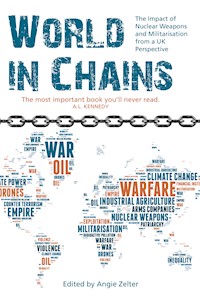
11,99 €
Mehr erfahren.
- Herausgeber: Luath Press
- Kategorie: Geisteswissenschaft
- Sprache: Englisch
This book is dedicated to the next generations. World in Chains is a collection of essays from well-reputed experts, all of which deliver engaging and analytical critiques of nuclear warfare. In the past I have often wondered why obviously unethical or inhumane horrors were able to take place, what people were doing at the time to prevent them or what kind of resistance was happening, how many people knew and tried to stop the genocide, slavery, poverty and pollution… I want those who come after my generation to know that, yes, we do know of the dangers of nuclear war, of climate chaos, of environmental destruction. This book will show you that there were many people working to change the structures that keep our world in chains. - Angie ZelterIt is simply very hard to read, or think, about oneself and all of one's loved ones - all of the people one knows - strangers, everyone… being evaporated, or burned alive, being poisoned, blinded, tormented, genetically altered, starved, deprived of all they own and so forth… Thinking about nuclear weapons is just hard. - A. L. Kennedy[Angie Zelter] is committed to working to prevent nuclear mass murder, and by her own personal example and through her organizational skills, she has inspired and empowered many people. - Mairead Corrigan Maguire (1976 Nobel Peace Prize Winner)
Das E-Book können Sie in Legimi-Apps oder einer beliebigen App lesen, die das folgende Format unterstützen:
Veröffentlichungsjahr: 2014
Ähnliche




















ANGIE ZELTERis a well-known campaigner on peace, justice, environmental and human rights issues. She works at the grass-roots level in theUKand abroad, encouraging and supporting global citizens, acting in the public interest, and showing by her example, creative and nonviolent ways to resist the cruelty, waste and pollution of society’s present-day structures. She is a founder member of the Institute for Law and Peace, Trident Ploughshares, the International Women’s Peace Institute – Palestine, Faslane 365 and Action Atomic Weapons Eradication. She is a recipient of the 1997 Sean McBride Peace Prize (for the Seeds of Hope Ploughshares action), and the 2001 Right Livelihood Award (on behalf of Trident Ploughshares). She now lives in Wales working with others to manage woodlands for local use whilst preserving bio-diversity and on various local organic food growing projects.
As ActionAWEfounder, she was also one of the four activists who made history in 1996. The four women were on trial after causing an estimated £1.5 million worth of damage to a Hawk. The aircraft was to be exported to Indonesia where it would have been used to continue the genocidal attacks on East-Timorese villagers. She was acquitted by an English jury on the grounds that the use of the aircraft by the Suharto regime would have been a breach of international humanitarian laws. She is a well-travelled campaigner on human rights and environmental issues and has been active in nuclear disarmament since the early ’80s. In 2012, Zelter was nominated for the Nobel Peace Prize.
ActionAWEis aUK-based grassroots peace campaign dedicated to banning and eradicating nuclear weapons. ActionAWEcome together as groups and individuals to undertake nonviolent action against the Atomic Weapons Establishment (AWE). They use education and outreach to raise awareness of the humanitarian, health and security consequences of nuclear weapons. Their basic mission is to halt nuclear warhead production at the currently operating nuclear facilities,AWEAldermaston andAWEBurghfield. Britain has over 180 nuclear warheads in its current nuclear weapons system, called Trident. ActionAWE’s campaign is focused on theUKgovernment’s pledge to improve and replace the nuclear submarines that carry Trident. If this pledge is fulfilled, by 2016 theUKgovernment would have spent an estimated £76– 100 billion to build a new generation ofUKnuclear weapons. This is more than the current planned public spending cuts of £81 billion. ActionAWEmobilises for concerted, persistent, politically effective actions to highlight and prevent the deployment and renewal of Trident, and to build public and parliamentary pressure for Britain to disarm and join other countries in negotiating a global treaty to ban nuclear weapons.
World in Chains
Nuclear Weapons, Militarisationand their Impact on Society
Edited by ANGIE ZELTER
LuathPress Limited
EDINBURGH
www.luath.co.uk
First published 2014
ISBN (PBK): 978-1-910021-03-3
ISBN (EBK): 978-1-909912-87-8
The authors’ right to be identified as author of this work under the Copyright, Designs and Patents Act 1988 has been asserted.
© Angie Zelter and the contributors 2014
DEDICATION
These essays are dedicated to the next generations.
In the past I have often wondered why obviously unethical or inhumane horrors were able to take place, what people were doing at the time to prevent them or what kind of resistance was happening, how many people knew and tried to stop the genocide, slavery, poverty and pollution… I want those who come after my generation to know that yes we do know of the dangers of nuclear war, of climate chaos, of environmental destruction. This book will show you that there were many people working to try to change the structures that keep our world in chains. Working around the world, on many of the interconnected problems we face, there are many millions of us trying desperately hard to resist the abuses of power and to enable constructive, sustainable and humane transformation to a better world. I am not sure we will succeed but we are trying.
We are aware of our responsibility to you, the future.
Contents
Foreword – A. L. Kennedy
Acknowledgements
CHAPTER ONE Introduction
Angie Zelter
CHAPTER TWO Chances for Peace in the Second Decade – What is Going Wrong and What We Must Do
Professor Paul Rogers
CHAPTER THREE The Climatic and Humanitarian Impacts of the Use of the UK’s Nuclear Weapons
Dr Philip Webber
CHAPTER FOUR Why Climate Change and Nuclear Disarmament Talks Must be Linked
Kevin Lister
CHAPTER FIVE Finance, War and Conflict
Professor Mary Mellor
CHAPTER SIX Ploughshares into Swords – Industrial Agriculture as Warfare and the Need for a Paradigm Shift
Helena Paul
CHAPTER SEVEN Who Profits from the Atomic Weapons Establishment?
Tom Anderson
CHAPTER EIGHT Arms Companies, Nuclear Weaponry and the Military
Kaye Stearman
CHAPTER NINE Nuclear Weapons and Militarisation in the UK
Owen Everett
CHAPTER TEN Refugees and Asylumseekers: Human Debris of the West’s War Machine
Dr Trevor Trueman
CHAPTER ELEVEN The Use of Radioactive Material in War
Joanne Baker
CHAPTER TWELVE Civil Nuclear Power and Nuclear Weapons Proliferation
Pete Roche
CHAPTER THIRTEEN A Vast Endless Experiment – Military Radioactive Pollution
John LaForge
CHAPTER FOURTEEN Of Sledgehammers and Nuts: Counter-Terrorism and Anti-nuclear Protest
Siân Jones
CHAPTER FIFTEEN Women, Men and Nuclear Weapons
Professor Cynthia Cockburn
CHAPTER SIXTEEN Linking US Military Empire and UK Nuclear Weapons
Bruce Gagnon
CHAPTER SEVENTEEN ‘The Future of the United Kingdom’s Nuclear Deterrent’: An Ethical Critique
Professor John M. Hull
CHAPTER EIGHTEEN Banning Nuclear Weapons: necessary and achievable (in our lifetimes)
Dr Rebecca Johnson
CHAPTER NINETEEN Drones, Cyberwarfare and Democracy
Paul Mobbs
Foreword
A. L. KENNEDY
A. L. Kennedy is a writer and broadcaster and proud to have occasionally demonstrated at Faslane amongst better and braver company.
THIS IS ONEof the most important books you may never read. You may even give it to someone else to not read after you. I don’t mean that badly, or as any kind of criticism, it is simply very hard to read, or think, about oneself and all of ones loved ones – all of the people one knows – strangers, everyone… being evaporated, or burned alive, being poisoned, blinded, tormented, genetically altered, starved, deprived of all they own and so forth… Thinking about nuclear weapons is just hard. And you bought the book, you made an effort, maybe you don’t have to think… After Richard Feynman helped develop the bomb, he would see ground zeros, possible targets on all sides, imagine expanding rings of damage – who wants to live like that?
That’s even without recalling the way survivors of the Hiroshima and Nagasaki blasts wandered through the ruins with their arms outstretched – as if B movie horror flicks had been prescient about the way the undead would walk – slowly, stumbling, moaning and keeping their raw flesh from touching other areas of raw flesh. Who wants to think about that? When there’s X-Factor and Strictly? Or when there’s the Welfare State to bury? When you can’t pay your bills? When the Red Cross feel they have to intervene to assist the poor in your country, a ‘first world’ country, who wants to think of something apparently much more distant and long ago like having to pay for weapons which threaten Armageddon all the time, every moment of every day, watching and wakeful when we are not? Who wants to consider how unclean and foolish one would feel when voting for and indulging regimes that find threatening hell on earth consistently acceptable, useful, statesmanlike?
I’m only thinking about all this, because I was asked to write a foreword here that is in some way cheering and light-hearted. Which is tricky – because human beings apparently love to make money out of misery and death and nuclear weapons are as far as we have managed to go in that line. We can subtly starve or diminish, threaten others, secretly massacre, openly massacre, abuse, but nuclear weapons – they’re the ultimate, the daddy, the glitzy, showbiz, phallic death threat to everyone. They put you at the sexy, exclusive high table of wannabe mass murderers. Which isn’t funny. It will only be funny when it has gone, when the madness has passed.
As I was growing up, my government used to run films onTVabout how much they were doing to detect nuclear weapons when they were on their way, or had already exploded. Even though I had no idea about what death meant, their reassurances worried me. Telling me how to Protect and Survive using door frames and paper bags seemed inadequate. As a teenager, I hoped we would get the three minute warning so that everyone could have sex for three minutes – the impending extinction of all life everywhere seemed the only reason that would ever happen for me and three minutes didn’t seem too long to put up with something if it turned out not to be nice. I still wasn’t worried about death. I was approaching the perfect age for military recruitment – I had very little to lose, was strong, ingenious and – in my head – immortal. But I wasn’t quite pliable enough mentally to think nuclear weapons weren’t too complex and dreadful a toy for any of us to play with. As an adult, I was able to know that putting my head in a paper bag, or following the pointless last minute instructions of my government, listening to the specially selected soothing voices, would simply keep me occupied while those responsible for my impending death scrambled for safety. Which was, I suppose, why my government quietly discontinued the broadcasts, helped me not think.
In middle age, I was able to inspect a nuclear bunker in Berlin – a really classy one – the privacy-free toilets to discourage suicides, the outer door with a small thickened glass panel through which to scream goodbye, the generator with limited fuel, the kitchen with limited food, the bunks stacked deep and high and so horribly reminiscent of a concentration camp… it was very clear that survival would not be the best option. Which was unthinkable. And not funny. And we couldn’t even use the bunker – it was a museum piece. Now there was no bunker – but still bombs. All over the world, a range of inadequate shelters, or defunct shelters, but still bombs. All over the world, the possibility of accidents, of ‘defensive’ escalations. All over the world, the need to keep arms manufacturers busy, well-rewarded and secure. All over the world, people dying in the unpeaceful peace nuclear weapons have created, starving and living diminished lives, paying for the weapons which are killing them in so many ways. All over the world, politicians deciding they need the power of life and death and using it badly.
Not funny. But as my German editor and I stumbled away from the bunker we did laugh. We laughed uncontrollably. We laughed the way people do when they would rather not cry in public. We laughed the way that angry, outraged people do when they remember to think the unthinkable. Thinking the unthinkable is a very tiny step away from doing what you have been told is undoable – reforming what is deeply wrong in the world. To paraphrase Bevin – what we were able to do wrong, we will be able to put right.
And then we will be able to really laugh. Because it will be over. And while we laugh, we’ll keep wakeful and watching so we don’t go wrong again.
Acknowledgements
Thanks to all the contributors who have provided their essays freely. They point to the changes needed to re-structure society so that it is based on compassion, co-operation, love and respect for all. Their words inspire us to resist the growing militarisation and corporatisation of our world.
Thanks to Camilla, David, Mick, and other friends for their encouragement and help.
Special thanks to Gavin of Luath for once more generously publishing a book needed by a current campaign – ActionAWE(Action Atomic Weapons Eradication) www.actionawe.org
CHAPTER ONE
Introduction
ANGIE ZELTER
A peace, justice and environmental campaigner
OUR WORLD IS IN CRISIS. We mostly live in dysfunctional, nationalistic states led by corrupt politicians and their corporate interests, who are more concerned with short term money-making and growth at any cost than in the fate of the vast majority of the population. A population that just wants to live in peace and security. Rather than dealing with the true underlying causes of insecurity (unequal distribution of resources, environmental degradation, human rights abuses, climate chaos… to name but a few), our states support the institutions and corporations that perpetuate and profit from injustice and inequality. We, the public, for many complex reasons allow them to get away with it. Governments manipulate fears that they then use to justify their erosion of domestic civil liberties, foreign military interventions and nuclear blackmail.
Despite the horrors of colonialism and the disastrous wars of the 20th century, our ‘leaders’ seem not to have learned that if we truly want peace and security, then we need to make some deep structural changes to our institutions and systems. We need to move from a debt-based money system that favours a small minority of rich and powerful people and corporations to a socially just system that favours all people and supports a sustainable environment. We need to promote global citizenship, not national interests. This book explores some of the issues that need to be addressed. It does so from a mostlyUKperspective, centred around the abuse of power engendered by the continued reliance upon nuclear weapons and militarism.
In 2016 theUKgovernment may finalise the decision to build a new nuclear weapons system to replace the present Trident set-up. The nuclear submarines that carry Trident are getting old, so the Government has pledged to finalise contracts to replace them in 2016 in order to build a new generation of nuclear weapons at an estimated cost of £76–100bn. At the same time, current planned public spending cuts amount to £81bn. If the contracts go ahead, the warheads would be designed and manufactured atAWE(Atomic Weapons Establishment) Aldermaston and Burghfield, in Berkshire, about 50 miles west of London.1
Such a replacement and modernisation of a nuclear weapon system would be illegal under international law, as it breaches the commitment to nuclear disarmament that nuclear weapons states made under the Non-Proliferation Treaty (NPT). The long delay in implementing ArticleVIof theNPTplaces the world in a perilous situation. As theUNSecretary-General Ban Ki-moon recently said:
Delay comes with a high price tag. The longer we procrastinate, the greater the risk that these weapons will be used, will proliferate or be acquired by terrorists. But our aim must be more than keeping the deadliest of weapons from ‘falling into the wrong hands’. There are no right hands for wrong weapons… I urge all nuclear-armed States to reconsider their national nuclear posture. Nuclear deterrence is not a solution to international peace and stability. It is an obstacle.2
It is not just the Secretary-General who is frustrated by the nuclear weapon states. The non-nuclear states, which are in an overwhelming majority, are now actively campaigning for an international treaty to ban all nuclear weapons: ‘Three in four governments support the idea of a treaty to outlaw and eliminate nuclear weapons.’3
However, unless there is a massive movement by civil society, that includes nonviolent direct action, all the nuclear weapon stateswillmodernise and replace their nuclear arsenals, more states will build their own, more accidents will happen and the unthinkable may happen. The bad example of the original five nuclear weapon states (USA, Russia, France, China and theUK) continuing to depend on nuclear weapons has not only encouraged Israel, India, Pakistan and North Korea4to acquire them, but is inciting ever more states to join in.
In theUK, anti-nuclear activists (including those who supported Trident Ploughshares and Faslane 365) helped galvanise public opposition to Trident. This succeeded to the extent that the present Scottish Government have promised to ban all nuclear weapons from Scotland if the Scots vote for independence in the Referendum (to be held in September 2014) and they come to power in a newly independent nation. It is important now that there is a special focus on the English dimension – the atomic weapon establishments at Aldermaston and Burghfield. If we succeed here, then the potential for worldwide disarmament is great. Once theUKabandons its reliance on nuclear weapons, we can expect a ‘good domino’ effect to cascade around the world.
A new grassroots campaign called ActionAWE(Atomic Weapons Eradication)5has recently formed to take up this struggle and to combine the strengths of as many peace, justice and environmental groups as possible. European groups as well asUKgroups are being asked to join this campaign. ActionAWEis dedicated to halting nuclear weapons production at the Atomic Weapons Establishment factories at Aldermaston6and Burghfield. The campaign aims to encourage groups and individuals to undertake autonomous actions and events to raise awareness of the catastrophic humanitarian consequences of nuclear weapons. Now more than ever, we need to exert political pressure on Britain to end the production, replacement and deployment of Trident, and to join other countries in negotiating a global treaty to ban nuclear weapons.
This book has been produced to expose some of the structures and links that keep our world chained to a militaristic, exploitative and abusive system and helps point to some of the changes required if we wish to create a healthier, happier, more sustaining and moral world order.
The essays in this book have been freely written for ActionAWEby a wide range of people including academics, researchers and activists, and will hopefully inspire us all to think more deeply about the impact that nuclear weapons, war and militarisation have on our society.
Paul Rogers’ essay draws threads from around the world and provides an overview of the many problems facing us. He shows us the inter-relatedness of socio-economic inequality and environmental constraints, especially climate change. He comments on the greater global access to information leading to a ‘revolution of frustrated expectations’ amongst the growing majority of marginalised and dispossessed people. Exploring the folly and danger of nuclear weapons and wars, he urges the more hopeful application of sustainable transformation.
Philip Webber explains the effects of the use of nuclear weapons and presents evidence that the launch of the nuclear missiles of even just one Trident submarine could cause devastating climatic cooling. Not only would there be far reaching environmental effects, way beyond the immediate conflict area, but the economic impacts across the globe would also be severe.
Kevin Lister provides a bleak appraisal of the links between what he describes as the ‘two existential threats, runaway climate change and nuclear war’, describing them as the ‘flip sides to the same coin:industrialisation’.
Mary Mellor’s article demonstrates how finance, trade and military conflict are closely linked with war. She provides a historical overview of the money system and illustrates how ‘the present globalised money system creates many areas of actual and potential conflict’.
Helena Paul provides a stimulating, thought-provoking insight into the present industrial agricultural system and how this intertwines closely with our militarised society.
Whilst pondering the money system, Tom Anderson investigates who is profiting from the Atomic Weapons Establishment, and Kaye Stearman discusses the specific arms companies involved in theUK.
Britain’s colonial past and present involvement in wars has led to an increasing militarisation of our society, and this is tackled by Owen Everett.
Trevor Trueman gives us a short reminder of the impact that violence and war have on ordinary people and the resulting trauma of the refugees who try to survive the war machine.
Joanne Baker’s essay exposes the use of radiological weapons, which are poisoning people and the environment and causing major birth defects. Uranium weapons, depleted or otherwise, are both radioactive and toxic. She reminds us that the half-life of uranium is 450 billion years. The uranium dust from the use of these weapons is neither containable nor easily cleaned up.
Pete Roche scrutinises further the links between the civil nuclear power system and the military, a link that the nuclear industry tries to cover up. He tells us about the spread of uranium enrichment technology – ‘a route to proliferation’ and that ‘peaceful nuclear energy is a myth’.
John La Forge’s detailed essay on military pollution is based mainly on research from theUSAthat he has been collecting over many years. The findings are relevant to everyone, as all the nuclear weapon states are implicated in similar experiments, to a greater or lesser extent, and the air, sea and earth connect the planetary environment. The sheer extent of the long-lasting contamination caused by the nuclear military industry is horrifying.
Siân Jones describes some of the ways that our civil liberties and rights to protest have been undermined by the use of police intelligence gatherers, undercover agents infiltrating the movement and by anti-terrorist legislation. The erosion of civil liberties in highly militarised nuclear states was foretold by the peace movement many decades ago. She also reminds us of the many creative acts of resistance that have taken place over the last decade.
Having noticed that the majority of the anti-nuclear activists that Siân used to illustrate her essay were women, it is pertinent to read Cynthia Cockburn’s essay on the gendered dimensions of nuclear weapons.
Bruce Gagnon gives us a timely reflection on how theUKis closely tied intoUSplans for global domination through armed force, as shown through its hundreds of foreign bases, space technology, and the expansion ofNATO. The build up of military might around China and the Arctic are especially dangerous.
A thoughtful essay by John Hull examines the ethical dimensions of a reliance on weapons of mass destruction, concluding that the denial that accompanies it leads to a deadening of the conscience and a repression of natural human kindness.
Rebecca Johnson explains the recent international approaches aimed at achieving a new international treaty to ban nuclear weapons that will bypass all the objections of the reluctant nuclear weapons states and ‘fundamentally change the legal and political context within which nuclear-armed states and proliferators operate’.
Lastly, Paul Mobbs takes up many of the themes mentioned in the essays above in an examination of the use of technology and machines by the State to command and dominate, posing questions about civil democracy in a cybernetic world. He expresses his concern for society in general at ‘the increasingly close links between the military and security services, defence andITcompanies, and the wider body of corporate interests who those security companies service. As a result of these links the boundary between the military, the public and the private has becoming increasingly blurred’.
All of the essays stimulate us to think more deeply about the structural and moral distortions in our societies brought about by the desire for power and control over others and most clearly identified by looking at nuclear weapons, militarisation and war.
I hope that you will be motivated to take part in ActionAWEevents. Most especially that you and your friends and neighbours do not vote in the next general election for any prospectiveMPwho supports the replacement of our nuclear weapons, but instead vote for those who are serious about nuclear disarmament. These next couple of years are vital. We have to change many of the institutions that are destroying our world and transform them into ones capable of engaging our humanity. This will be underpinned by a major transformation of our defence and security structures, starting with nuclear disarmament.
Notes
1 ActionAWE: http://actionawe.org/awe-burghfield-maps-gates/.
2 Secretary-General Ban Ki-moon, ‘Advancing the Disarmament and Non-proliferaton agenda: Seeking Peace in an Over-armed World’, Address at the Monterey Institute of International Studies, 18 January 2013.
3 ICAN: [http://www.icanw.org/why-a-ban].
4 Nine countries spent over $100bn on nuclear weapons in 2011. Ban Ki-moon (Ibid.) stated: ‘Disarmament cannot be considered in isolation from other global challenges. The world spends more on the military in one month than it does on development all year. And four hours of military spending is equal to the total budgets of all international disarmament and non-proliferation organizations combined. The world is over-armed. Peace is under-funded. Bloated military budgets promote proliferation, derail arms control, doom disarmament and detract from social and economic development… The profits of the arms industry are built on the suffering of ordinary people – in Mali, Syria, Afghanistan, the Democratic Republic of Congo. At the foot of the pyramid lie small arms. At the top are nuclear weapons.’ This is $100bn they didnotspend on climate, health, education, food, water, development…
5 ActionAWE: http://actionawe.org/.
6 Rob Edwards, ‘SecretUKuranium components plant closed over safety fears’,The Guardian, 24 January 2013. ‘A top-secret plant at Aldermaston that makes enriched uranium components for Britain’s nuclear warheads and fuel for the Royal Navy’s submarines has been shut down because corrosion has been discovered in its “structural steelwork”,The Guardiancan reveal. The closure has been endorsed by safety regulators who feared the building did not conform to the appropriate standards. The nuclear safety watchdog demands that such critical buildings are capable of withstanding “extreme weather and seismic events”, and the plant at Aldermaston failed this test.’
CHAPTER TWO
Chances for Peace in the Second Decade – What is Going Wrong and What We Must Do
PROFESSOR PAUL ROGERS
Paul Rogers is Global Security Consultant to Oxford Research Group (org) and Professor of Peace Studies at the University of Bradford. He writes regular reports and monthly global security briefings. This briefing originally appeared on the website of the Oxford Research Group on 14 December 2012.
Where to Start?
WE SURVIVED THECold War, the most dangerous period in human history so far. Well, most of us did.
In reality, more than ten million people died and tens of millions more were wounded in proxy wars involving the superpowers – in Korea, Vietnam, the Horn of Africa, Central America, Afghanistan and elsewhere. Some places took decades to recover, others never have.
It is true that at least an all-out nuclear war was avoided, but there were huge risks, many accidents and some exceptionally dangerous crises. Put bluntly, we were very lucky to come through it without a catastrophe.
Moreover, for 45 years, massive amounts of money and immense human resources were diverted away from far more important tasks to fuel war machines which, at their peak, employed tens of millions of people, wasted billions of pounds, produced vast masses of armaments, including over 60,000 nuclear weapons and threatened worldwide destruction. The many millions of lives that were lost through poverty, disease and malnutrition across the world through this appalling waste are rarely acknowledged.
More than 20 years later, the nuclear dangers are still far from over, even if we are on something more like a slippery slope to a proliferated world, rather than staring over the edge of an appalling nuclear abyss, and there is still much to do to save us from our capacity for self-destruction.
Even so, in the early 1990s, after the end of the Cold War, there seemed the prospect of a more peaceful world order, but it disappeared in the face of deep and enduring conflicts, not least in the first Gulf War, and the bitter conflicts in the Balkans, the Caucasus and the African Great Lakes.
Bill Clinton’s firstCIADirector, James Woolsey, characterised the changed world in the mid-1990s as one where the West had slain the dragon of the Soviet Union but was now facing a jungle full of poisonous snakes.1The jungle had to be tamed to maintain stability, and this was an attitude that came to the fore in an extraordinarily robust response to the 9/11 atrocities. It failed to control political violence and led to two major wars and persistent conflict across the Middle East and South Asia.
These are trends of the immediate past and present, but the issues that will come most to dominate international conflict relate only partially to them. What is much more necessary is to recognise the underlying trends that could be at the core of insecurity and conflict in the decades to come, and to understand how we can avoid their becoming the drivers of conflicts that may dwarf the problems of recent years, including even the ‘war on terror’.
Divisions and Constraints
There are two root issues that will increasingly interrelate – socio-economic divisions and environmental constraints, especially climate change.
1 Rich-Poor World
In the past 60 years, the world economy has experienced almost continual growth. Until 1980, that was largely on the basis of a mixed economy model competing with the centrally planned economies of the Soviet bloc and China. From the early 1980s, the trend was toward a much more neoliberal free market approach with privatisation of state assets across many countries, the freeing up of markets and less regulation of trade and financial markets.
Ideas of a more planned world economy linking fair trade with development had been proposed in the 1960s, especially by theUNConference on Trade and Development (UNCTAD). They reached their peak with the intended New International Economic Order of 1974, which would have promoted integrated commodity agreements, tariff preferences and other processes designed to improve the trading and development prospects of the Global South. These progressive proposals withered away by the end of the decade in the face of a determined neoliberal economic agenda.
This was pursued, in particular, by the Reagan administration in the United States and the Thatcher Government in theUK, but was more generally embraced by other states and especially by international financial institutions, such as the World Bank and the International Monetary Fund, in what became known as the ‘Washington Consensus’.
It was an outlook that got a boost with progressive deregulation of financial institutions in the late 1980s, especially the ‘Big Bang’ for the London’s financial institutions in 1986. There was then a further boost because of the collapse of the centrally planned system of the Soviet bloc in 1990–91, even though Russia’s subsequent embrace of unbridled capitalism actually set back its own economy by a decade or more, wrecked the lives of millions of people, and still leaves a legacy of bitterness.
Across the world, economic growth continued, albeit at a slower rate than 1950-80, but what became increasingly clear was that it was becoming more and more unbalanced, with the benefits of growth falling mostly into the hands of around one fifth of the global population. While the poorest people did not generally get poorer, levels of malnutrition actually increased substantially, but what was even more significant was that by the early 21st century, the great majority of all the world’s wealth and annual income – close to 85 per cent – was shared by about 1.5 billion people out of a world population heading towards seven billion.
This division had become steadily more pronounced in the last two decades of the 20th century, but one major feature of the change was that it was no longer a matter of ‘rich country/poor country’ – more a very large trans-global elite disproportionately sharing the benefits due to the entire world community.
This now includes hundreds of millions of people in China, India, Brazil and many other countries across the South, even if the ‘old rich’ countries of the Atlantic alliance still dominate. On top of this is a very much smaller trans-global ‘super-elite’, including many thousands of multi-millionaires. At the same time, along with the marginalised majority of billions of people across the South, there is also a marginalised minority, sometimes of tens of millions of people, in the old rich states of the West.
This failure to deliver socio-economic justice is particularly evident in the fast-growing Asian development region. According to the Asia Development Bank’s 2012 Asia Development Report, if there had been more even distribution of the fruits of growth, ‘another 240 million people in the 45 countries that make up developing Asia would have moved out of poverty in the last two decades’2.
What is insidious is that we are faced with a deep-seated trend, which is persistently disguised by the more obvious signs of economic development. City tower blocks, beach hotels, safari parks and many other accoutrements of partial economic success all too frequently disguise deep and enduring divisions, with richer people living and travelling in cocoons of wellbeing, not seeing the slums that ring the cities or the endemic rural poverty.
Because of the size of the successful elite – more than one fifth of the world’s population – it acts as a self-contained, if large, global entity that benefits from material wellbeing that is largely taken for granted. Moreover, it is for the most part a community that persistently fails to recognise the endemic mal-distribution of world wealth and income.
Thus the minority world lives alongside the majority world but is hardly conscious of the very existence of the divide. Rarely does it acknowledge the sustained benefit gained from appalling low wages and working conditions of hundreds of millions of people producing cheap goods, nor the existence of a trading system dominated by transnational corporations and favouring production of low-cost commodities at the expense of poor farmers and miners across the world.
A Success with Consequences
At the same time, none of this should diminish the progress that has been made in some aspects of international development, not least education. Forty years ago, one of the greatest challenges facing the countries of the South was the impoverishment of education, with only a minority of children getting even four years of primary education. That has changed dramatically, and most children now get a basic education. Even the pernicious gender gap is slowly narrowing.
This success has been achieved mostly by determined efforts of peoples and governments and it has more recently been combined with huge improvements in communications. There are still many communities that are notably ‘data poor’, but the combination of improved education, literacy and communications has been one of the great development success stories of the past four decades.
Yet, there is a very powerful consequence of this in that far more people are aware of their own marginalisation. It is a phenomenon that particularly affects young people across the majority world who are educated at least to high school level but have few job prospects or hopes for a reasonable standard of living. With the current recession, this is also being experienced in rich states such as Greece and Spain, with eruptions of discontent and protest onto the streets as well as the ‘Occupy’ and other new social movements. It has certainly added greatly to the much more widespread frustration and anger with Middle East autocracies that has underpinned the Arab Awakening that started early in 2011.
In the 1970s, it was common in countries such as Britain to talk of a ‘revolution of rising expectations’ as the consumer society and economic growth always promised more. People would be reasonably content, because, whatever the particular problems of national economies, the overall picture was of a promise of economic growth and innovation delivering better material wellbeing. What is more likely in the early 21st century is a ‘revolution of frustrated expectations’ as people among the marginalised majorities become more aware of their own marginalisation, leading to despair, resentment and anger.
2 Environmental Limits
On its own, the problem of a socio-economically divided world is ethically unacceptable, as well as being potentially unstable. The more the divisions endure in an increasingly connected world, the more there is the risk of anger and revolts from the margins, but what is even more important is that these persistent divisions are working in parallel with global environmental constraints – the inability of the global ecosystem to absorb human impacts, especially the carbon emissions that are leading to climate change.
Environmental constraints are many, and they include major issues of water resource use, as well as competition and conflict over strategic minerals, especially in Central Africa. The buying up of land by foreign interests, not least in Africa and Latin America, is a further example. In terms of the world’s non-renewable resources, the concentrated location of oil and gas is the most remarkable. More than 60 per cent of the world’s readily accessible high quality oil is found in just five countries around the Persian Gulf – Iran, Iraq, Kuwait, Saudi Arabia and theUAE– with another 20 per cent in Russia, Kazakhstan and Venezuela. The concentration of natural gas is even more extreme, with over half the world reserves in just three countries – Russia, Iran and Qatar.
Such a narrow resource base for these energy reserves is at the root of the strategic importance of the Persian Gulf and does much to explain recent and current conflicts, but the even greater global concern stems more from the potential impact of climate change.
Put in its most basic form, huge fossil fuel reserves of coal, oil and gas were laid down over millions of years, mainly during the Carboniferous Era, and large quantities of the carbon locked up in these reserves are now being released into the atmosphere, not in millions or even thousands of years but in centuries and, to some extent, even just decades. Most of this carbon release is in the form of carbon dioxide and this gas increases the absorption of the sun’s radiation in the atmosphere. The overall impact is one of increasing temperatures and that is already happening, but this is not a uniform process across the world.
Until about 20 years ago, climate research suggested that the most pronounced impacts of climate change would be felt in the temperate latitudes. For the most part, these were the wealthier regions of the world and might best be able to cope. That view has changed dramatically, and it is now clear that the impact of climate change will indeed be asymmetric, but not in the way originally thought.
It is true that the northernmost latitudes will probably be greatly affected, with the near-Arctic already seeing a substantial rate of change that is much greater than elsewhere, but there will also be dramatic effects on the tropical and sub-tropical land masses.
In overall terms, climate change looks likely to have relatively little impact in atmospheric temperatures over the world’s oceans. By contrast, temperature increases across Central America, Amazonia, the Middle East, Central Africa and South and South-East Asia will be well above average. The impacts are likely to include the drying out of the tropical rain forests of the Amazon and South-East Asia, and the progressive loss of the ‘reservoirs in the sky’, the glaciers in the Himalayas, the Karakorams and the Tibetan Plateau that feed the great rivers of southern Asia.
The overall impact is likely to be a substantial decrease in the ecological carrying capacity of the tropical and sub-tropical crop lands, making it far more difficult for the majority of the world’s people to access affordable food. This is particularly serious, because these are precisely those parts of the world in which people have least material wealth and are least able to cope.
Consequences
If we stay for the moment with present trends, not with what will happen if we make many positive changes, then the outlook is bleak. Leaving aside for now the huge issue of environmental limits, the socio-economic divisions alone point to a very disturbed future. Nearly 40 years ago the economic geographer Edwin Brookes pointed to the circumstances we had to avoid of ‘… a crowded, glowering planet of massive inequalities of wealth, buttressed by stark force yet endlessly threatened by desperate people in the global ghettoes…’3
In many ways we can see Brooke’s dystopian prognosis already becoming evident. The heavily protected gated communities increase in size and frequency in cities across the world, and more extreme protests are common. China now has a formidable problem of endemic social unrest to which the authorities respond with more heavily armed internal security forces. The Arab Awakening has many elements, but among the driving forces are the poor economic prospects and lack of opportunity facing millions of young people.
India will soon be the world’s most populous country and has been enjoying impressive rates of growth, but economic development is hugely skewed in favour of a minority, with the country having to face up to a bitter and wide-ranging insurgency from the neo-Maoist Naxalites. They are active in close to half the states of India and stem from the marginalisation of millions, especially as mining and industrial developments take little notice of peoples’ rights.
These are early indicators of problems that arise from the existing organisation of the world economy, but the real issue is to add these to the growing impact of climate change. What we are therefore likely to face is not just Brooke’s ‘crowded, glowering planet’, but a constrained planet leading to a degree of desperation that will transcend the problems we already face. There is a particular risk of mass migration as people become desperate in their own communities and seek something better, and we are talking about much greater pressures than are already apparent. There is also a great risk of ‘revolts from the margins’ as people turn to radical action to try and ensure their survival.
A previous analysis, written more than a decade ago and pointing to ‘markers of rebellion’ put it this way: there is sufficient evidence from economic and environmental trends to indicate that marginalisation of the majority of the world’s people is continuing and increasing, and that it is extremely difficult to predict how and when different forms of anti-elite action may develop. It was not predictable that Guzman’s teachings in Peru would lead to a movement of the intensity and human impact of Sendero Luminosa, nor was the Zapatista rebellion in Mexico anticipated. When the Algerian armed forces curtailed elections in 1991 for fear that they would bring a rigorous Islamic party to power, few predicted a bloody conflict that would claim many tens of thousands of lives.
What should be expected is that new social movements will develop that are essentially anti-elite in nature and draw their support from people, especially men, on the margins. In different contexts and circumstances they may have their roots in political ideologies, religious beliefs, ethnic, nationalist or cultural identities, or a complex combination of several of these. They may be focussed on individuals or groups but the most common feature is an opposition to existing centres of power. They may be sub-state groups directed at the elites in their own state or foreign interests, or they may hold power in states in the South, and will no doubt be labelled as rogue states as they direct their responses towards the North. What can be said is that, on present trends, anti-elite action will be a core feature of the next 30 years – not so much a clash of civilisations, more an age of insurgencies.4
‘Liddism’ Rules OK
More than a decade later, we can see that the expected impact of climate change will exacerbate these trends, and the problems we face in the future stem from this unique combination of a divided and constrained world. It is a predicament that leaves us, in its most basic form, with two possible choices – trying to maintain control or working to confront the challenges.
The first is ‘liddism’ – we keep the lid on the problems and maintain the status quo. We stay rigidly with the belief that the free market is the only economic system and that the world economic system as it has evolved is, without question, the only way to operate. When threats to this system arise, they are dangerous and must be countered. This means vigorous support for elite regimes facing revolts from the margins, it involves stringent control of migration, persistent intervention in failed and failing states when they threaten ‘our’ interests and extending even to the violent termination of regimes deemed to threaten the security of the established international system – ‘our’ world.
Economic migrants are after our jobs. Asylum seekers are scroungers, living on welfare paid by our taxes. If more than a thousand people drown in the Mediterranean trying to reach Europe in the early months of 2011, it is of little account and no concern of ours. If people riot in cities in the West, they are criminals pure and simple, and there is no need for any further discussion. If rebels oppose a friendly autocratic government in the South, they are terrorists, a dangerous threat to established order and to be repressed with all necessary force.
In short, it is a matter of taming Woolsey’s ‘jungle full of snakes’, secure in the belief that the jungle can be tamed and order maintained.
Lessons from a War
In a very real sense, the response to the appalling 9/11 atrocities and the consequent war on terror are striking examples of this approach and provide strong markers for future behaviour. At the peak of that response, when Bush delivered his ‘mission accomplished’ speech on 1 May 2003, Afghanistan was thought to be transforming into a pro-western developing state with a geopolitically usefulUSmilitary presence and enhanced influence in Central Asia. Al-Qaida was dispersed and degraded.
Under the guidance of the Coalition Provisional Authority, Iraq would become a shining example of a true free market economy, a pro-western beacon for the Middle East with, as in Afghanistan, a usefulUSmilitary presence. The most dangerous threat, Iran, would be thoroughly constrained by this new regional order. More generally, the idea of a New American Century of an unrestrained free market world order, led by the United States, would be ‘back on track’.
The 9/11 attacks were visceral in their effect and it was almost impossible for the Bush administration and its closest allies to see them as grievous examples of a grotesque transnational criminality. Instead, they could only be seen as the starting point for a war against Islamo-fascism that even came to include whole states that threatened the western world in an ‘axis of evil’ .
What happened was radically different to expectations. A three-week regime termination in Iraq turned into a bitter eight-year war, with the country even now in a deeply unstable state and with millions of people still displaced. Iranian influence in the region is actually stronger than before the war and that of the United States is diminished.
In Afghanistan, an ‘eight-week campaign’ against the Taliban is now in its second decade. Even the al-Qaida idea survives in a diffuse yet potent form, much dispersed but with affiliates active across the region, not least in Yemen, Somalia, Mali and Nigeria.
According to a report from the Eisenhower Research Project at Brown University in 2011: At a conservative estimate, the overall death toll in Iraq, Afghanistan and elsewhere, including civilians, uniformed personnel and contractors, is at least 225,000.
There have been 7.8 million refugees created among Iraqis, Afghans and Pakistanis.
The wars will cost close to $4 trillion dollars and are being funded substantially by borrowing, with $185 billion in interest already paid and another $1 trillion likely by 2020.5
In so many respects, the conduct of the war on terror was an example of what some call the ‘control paradigm’, the early recourse to re-gaining control with little attention given to the reasons for conflict. The human costs have been appalling. If no lessons are learnt from this experience, then there is every probability that ‘taming the jungle’ will be the order of the day – no doubt with prolific use of armed drones and Special Forces, but this will only make matters far worse. If the deep injustices of the present world economic and environmental order are not addressed, then the result will be greater suffering and instability, leading rapidly to more conflict. The idea that the elite world can close the castle gates is a myth – it is simply not possible in a globalised and highly connected world.
Choices
‘Liddism’ may be the first choice but the second is addressing the underlying causes of future insecurity. In the simplest of terms it is straightforward, but translating the obvious into the actual is far from easy. Severe climate change has to be prevented by a rapid transition to low carbon economies, with the main carbon emitters of the North decreasing carbon outputs by 80 per cent in less than two decades. Lesser emitters must be enabled to develop along economic paths that are truly sustainable, aided substantially by the states of the North that have been responsible so far for the great majority of emissions.
Such an environmental transition has to be paralleled directly by an economic transformation to a far more equitable and emancipated system, both transnationally and within states. For the Global South, this involves much greater debt relief and the linking of trade with development in a manner similar to what was advocated byUNCTADnearly half a century ago but never implemented – a genuine New International Economic Order. Technological innovations may well help, not least in adapting to that level of climate change that is already inevitable, and a rapid transition to versatile renewable energy sources, often seriously localised, can readily enhance economic emancipation.
These two paragraphs summarise the changes needed, but they seem so vast that there is an immediate feeling of powerlessness. That may be understandable but needs to be met head-on with a sense of hope. Thirty years ago, in the early 1980s, there was a palpable fear of nuclear annihilation and doubts whether we would make it to 1990, yet we did. Thirty years before that, some far-sighted politicians sought European economic cooperation as a means of preventing a third European civil war. Whatever we think of the European Union, a Franco-German conflict is now hardly likely.
There are also many examples where events prompt action, even more so when the necessary thinking and planning is already there. Take just a few examples:
Municipal engineers like Sir Joseph Bazelgette were already working on plans for proper sewage disposal in the squalid and cholera-ridden London of the 1850s, but it took the ‘Great Stink’ of the 1858 summer to prompt sustained and effective action, with London leading the way for many other cities and resulting in sustained improvements in health.
A century later, 4,000 people died in 1952 in the four-day ‘Great Smog of London’, but this prompted radical improvements in air pollution control across Britain that were already being called for.




