


10,49 €
Mehr erfahren.
- Herausgeber: Elliott & Thompson
- Kategorie: Lebensstil
- Sprache: Englisch
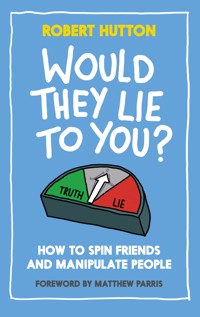
How do you apologise when you're not sorry? Where can you make a fortune out of pretending to know the future? What's the best way to steal credit and avoid blame? These are the vital life skills that people need if they're going to make their way in the world. And they all involve one ingredient: flannel, the art of not saying what you mean. It's not exactly lying, but it's definitely not telling the truth. In Romps, Tots and Boffins, Robert Hutton brilliantly 'laid bare' the true meanings of the words we read in the papers. Following popular demand, he now turns his razor-sharp eye to the best, worst and most outlandish examples of waffle, fudging, obscurity, blame-shifting and point-scoring. In areas from politics to sports, academia, religion and self-help, it seems that glory, money and power flow far more freely to those who sidestep bald, ugly realities. You can steer a truck through the gap between a lie and the simple truth. This book tells you how to load the truck.
Das E-Book können Sie in Legimi-Apps oder einer beliebigen App lesen, die das folgende Format unterstützen:
Seitenzahl: 141
Veröffentlichungsjahr: 2014
Ähnliche


















Praise for Romps, Tots and Boffins: The Strange Language of News
‘Never has the weird language of headlines been so wittily defined.’
Libby Purves, ‘Books of the Year’, The Times
‘Robert Hutton . . . has set himself up as the Dr Johnson of this strange, widely read, hardly spoken, language.’
Matthew Engel, Financial Times
‘A right romp’
Paul Dietrich, The Metro
‘A fascinating code-breaker of the clichés, inanities and banalities which fill our newspapers. Or, if you prefer, “News Secrets Revealed Leaving Bosses Shamefaced”. I’m not sure I dare write another word.’
Nick Robinson
‘Finally, I understand what my fellow journalists are writing about.’
Simon Hoggart
‘I’m loving a little book just out by my fellow political journalist Rob Hutton. It’s . . . so much more than a hilarious compendium of the ghastly cliché to which our trade is prone.’
Matthew Parris, The Times
‘Long journey to Lib Dem Conference enlivened by Robert Hutton’s journalese book, Romps, Tots and Boffins – hilarious, wonderful and very true – a mini classic.’
Andrew Sparrow, Guardian Politics blogger
‘Very funny new book by Robert Hutton – a must-read page-turner.’
Iain Martin, former editor of the Scotsman and Scotland on Sunday
‘For readers, it promises to explain what journalists really mean. And for journalists, it also provides a guide to some of the hackneyed, arcane and clichéd phrases that are probably best avoided.’
Axegrinder, Press Gazette
‘An essential guide to finding out what you are reading about. Some people may dismiss this as a “loo book” but, actually, it’s so much more.’
Ann Treneman, The Times
‘An amusing dictionary of arcane hack-speak.’
Michael Deacon, The Telegraph
‘The world of journalism was rocked to its foundations last night as a top newsman claimed to have discovered the secret of “journalese”.’
John Rentoul, The Independent
At one level no one trusts politicians, and politicians are obliged from time to time to conceal the full truth, to bend it and even distort it, where the interests of the bigger strategic goal demand it be done … Without operating with some subtlety at this level, the job would be well-nigh impossible.
–TONY BLAIR, A JOURNEY
I wasn’t lying. You didn’t ask the correct questions.
–TORONTO MAYOR ROB FORD
CONTENTS
Foreword
Introduction to the Text
Introduction to the 14th Edition
1. Essential Uncommunication
2. Unbending Minds
3. Undamage Control
4. Creating an Unimpression
5. Political Uncommunications
6. Unearning Your Keep
7. Keeping Uncount
Acknowledgements
Copyright
FOREWORD BY MATTHEW PARRIS
The best satire tells us things we know in our bones already. Holding up for scorn absurdities of which we were already aware, it illuminates them in all their preposterousness. C. Northcote Parkinson wasn’t the first to observe (in his famous 1950s Parkinson’s Law) that ‘work expands to fill the time available’; mankind had long noted that the human race love to busy themselves with pointless duties. Nor was it he who found out the reasons for this. The reasons are obvious: anyone who studies human nature can guess.
No, Parkinson simply said it so much better and with such elegantly ruthless humour and such wicked examples. The deliciousness of satire is not discovery but display.
Rob Hutton has understood this. As a working political journalist he knows better than most the myriad ways in which human beings avoid telling the truth. He collects dissimulations as a lepidopterist collects butterflies, and this book is, not least, a magnificent anthology. But to the pleasures of collection he adds wit: Hutton’s ‘translations’ from what people say to what they mean are ten-chuckles-a-minute.
Would They Lie To You? is satire, not sociology. Were the book enquiring rather than scornful, Hutton might have remarked on something rather intriguing in his collection. Amid a wealth of half-truth, euphemism and evasion, you will find very few downright lies here. Out-and-out falsehood is the exception rather than the rule.
There is a reason for this. Human beings – even bankers, lawyers and politicians – shrink from what Shakespeare called the Lie Simple. We will duck and dive and twist and turn ourselves into the most fearful knots in order to avoid telling a complete porkie. In a curious way, it’s a matter of honour with us.
Many, many years ago, as a young officer in the Conservative Research Department, it was my occasional duty to put Tory politicians and would-be politicians through their paces by engaging with them in mock TV debates. Conservative Central Office would film these jousts, after which a professional tutor would take them through the recording and tell them how to improve their performances.
I was once asked to play the part of a corrupt Third-World despot, with whom a Tory hopeful did battle in our mocked-up TV studio. He came equipped with all the evidence, all the facts and figures, to prove my villainy.
But my strategy defeated him. I decided simply to lie. I did not fudge or hedge, attempt explanations, downplay the horrors or make excuses. I didn’t even try to change the subject. I just flatly denied every accusation he threw at me. I said it was all made up by my enemies. ‘I am the father of my people,’ I kept assuring him, ‘they love me. Ask them.’ My poor assailant stared at me open-mouthed, and finally fell silent. He longed for a half-truth or a something-short-of-the-truth or a not-quite-the-truth to expose; but I gave him only the Lie Simple. I never gave him his ‘Aha!’ moment.
Study Rob Hutton’s collection which follows. Note how much of the most infuriating dissimulation consists in avoidance tactics, or euphemisms, or sly ambiguities. Laugh at how often his cast of non-apologisers pretend to say sorry, or don’t quite say it, or apologise for something different; but ask yourself, too, why they don’t just lie: what stops them simply feigning a humiliating admission of their error?
It’s because we have our pride. It’s because we cling desperately to the tortured grammar and awkward vocabulary that might be just – but only just – reconcilable with the truth. We shrink from the barefaced lie. Lying hurts, and only a psychopath feels no pain. This is why polygraph lie detectors work. Normal people sweat. The complete answer to the question ‘Would they lie to you?’ is ‘No, not exactly lie’.
And it is this avoidance technique, this verbal dance, a dance with the truth that falls short of telling the truth, a dance with falsehood that falls short of the Lie Simple, that yields the rich entertainment you will find in the pages that follow.
INTRODUCTION TO THE TEXT
When my children started school, I was inevitably reminded of my own schooldays, and the strong sense I’d always had that I must have missed a day early on when someone explained what was going on. Not just where the toilets were, but all the unwritten rules that explained things like why some children got to pick the teams or how some people got to start crazes while I joined in as everyone else dropped them. This sense has never entirely left me. In adolescence, it was clear that the definition of cool behaviour had been agreed while I was out of the room. Even in adulthood, it has been hard to escape the nagging sense that I missed a vital briefing.
Which is why I was so relieved when the document that follows fell into my hands. I don’t know who sent it, or why they chose me, but it arrived on my desk shortly after I’d been at a government seminar. I’d been talking about journalese, the language of news. After my usual spiel about how newspapers use journalese to cover up the gaps in their knowledge, and to make things sound more exciting than they are, I mused aloud that this wasn’t so different from what companies and governments must do, except that they are trying to make things seem less exciting than they are. I think I wondered what the word for it would be, perhaps ‘officialese’.
A few days later, I found a package on my desk in Westminster. Inside was this book, minus its cover, or anything else that might identify its title or author. There was no note, only a Post-It with the word ‘uncommunication’.
It seemed to be some kind of textbook, a course on the uses of language by the powerful. But despite extensive searches of the archives, I can find no evidence it’s ever been published. Nor can I find any evidence of any such course at an English-speaking institution. Still, this is clearly a long-standing work – one page bore the words ‘14th edition’. I wondered if it was a civil service manual, but while some of the content seems to be aimed at those in public life, it also covers salesmanship and even publishing, suggesting some kind of all-purpose manual for success, but one issued only to a select group. After some debate, I have decided to publish it, partly in an effort to spread knowledge more widely, but mainly in the hope that it’ll sell a few copies. The text speaks for itself. Some may find it cynical or sinister, but I enjoyed its honesty. I haven’t made many alterations, but where I have been able to independently verify something or add useful insight, I have inserted a footnote.
I don’t know my source, so I can’t say whether publication was their intention, or if my action will place them in jeopardy. If it does, I can only plead the journalists’ defence: that our first duty is to the truth. I hope that if my source is forced to flee to Moscow, Venezuela or the Ecuadorian embassy, they will be able to forgive me.
Perhaps it’s produced by the Illuminati, or the Free-masons, or the Bilderberg Group. I don’t know. My own theory: it was given out on the first day of school, while I was still trying to find a peg to hang my coat on.
Robert Hutton Westminster, June 2014
INTRODUCTION TO THE 14TH EDITIONSuccess Through Obscurity
You hold in your hands a guide that very few will ever read. Even to have been given this book means you have already distinguished yourself in some way. We have high hopes for you: past students have used our guidance to rise to the top of their chosen fields.
As you proceed through the upper echelons of society, you’ll sometimes find yourself in seminars on communication, in which people in off-the-peg suits accompanied by out-of-work actors will talk about body language and ‘clarity’. ‘Say what you mean,’ they’ll tell you. Use short words, simplify your message.
We cannot emphasise too strongly how much these people miss the point.
The world can be divided into people who make complicated ideas seem simple, and people who make simple ideas complicated. Whatever area you choose, from finance to academia to the church, you’ll find that glory, money and power flow far more freely to the complicators than the simplifiers. If that seems harsh, think of the most basic of human relationships. Anyone who’s ever been on a date will recall that success rarely comes from saying what’s on your mind.
This isn’t a book about dating, but it is about how to succeed through obscurity. Not by lying. Lying is dangerous if you’re caught, and it’s quite unnecessary. You can steer a truck through the gap between a lie and the simple truth. We will now tell you how to load the truck.
The Importance of Uncommunication
Beauty is truth, and truth beauty. That may indeed be all that some people need to know, but we who follow a higher calling often deal in ugliness. From that, the world should be protected. This is why we study uncommunication, or uncomms,* as it is sometimes known.
We have explained that uncommunication isn’t the same as lying. Neither is it ‘waffle’. Waffle is what amateurs produce when they attempt uncomms. It fills the air and leaves no one in doubt that you’re avoiding something. Uncommunication is a more subtle art. It sounds precise and firm to the casual listener, but it imparts no information and offers no commitments.
It is the way we smooth over life’s difficult realities. It anaesthetises unpleasantness. It gets you from the point of having something that you don’t quite want to say to having something you haven’t quite said. It can be used to persuade people to want things they don’t need or support things they don’t agree with. It can give the appearance of action when there’s nothing to be done.
When the ideas you’ll find in this book were first set down, there were no such things as computers, and messages were sent by telegram or letter. We now live in a world of instant communication, and that calls for instant uncommunication. Indeed, this subject has become more important than ever. A well-crafted uncommunicative response can buy you the time you need to come up with a plan or distance yourself from a disaster.
This textbook covers the following areas:
Essential Uncomms• the building blocks of the subject, including the Statement of Fact and the Undenial.
Unbending Minds• how to win people to your side and sideline opponents.
Undamage Control• how to manage disasters, defend your side, and give an Unapology.
Creating an Unimpression• how to develop an undeserved reputation.
Political Uncomms• including a guide to taxation, and the only speech you’ll ever need to give.
Unearning Your Keep• how to make your way in commerce.
Keeping Uncount• using statistics to your advantage.
.
* Although I can find no references to ‘uncommunication’, the author Steven Poole came up with the term ‘Unspeak’ for his 2006 book on the manipulation of language. I don’t know whether this is coincidence, or if he too was privy to a leak.
1. ESSENTIAL UNCOMMUNICATION
We first look at the building blocks of uncommunication, the tools and techniques to which you will find yourself returning again and again. Mastery of these will enable you to move through life in a haze of obscurity.
In this chapter, you will learn about:
Statements of Fact
Undenial
Unbriefing
Unanswers
Pivots
Unbusiness Meetings
The Statement of Fact
A basic tool in any uncommunicator’s armoury is the Statement of Fact. This is a truth placed before your audience not to impress in its own right, but to act as scaffolding from which the rest of your uncomms can be hung.
A good Statement of Fact is incontestable. Your goal is that no one should possibly be able to criticise you for it. Its chief effect is what it leaves unsaid.
You can see this effect in the following 2006 Washington Post interview with Gordon Brown, who at the time was working to shift Tony Blair out of Downing Street and replace him. The interviewer asked if he was happy with the way Blair was giving up power. Brown responded: ‘It’s a matter for him and the Labour Party. It’s not really a matter for me at all.’
The interviewer asked about his relationship with Blair, which Blair would later compare to domestic violence, to which he replied, ‘We’ve been working with each other for more than twenty years … I’ve been chancellor while he’s been prime minister for nine years, and we continue to work together.’
To see how effectively a Statement of Fact can be deployed, let’s look at an area where they come into their own: when you are called upon to say something nice about someone towards whom you have absolutely no nice feelings. Perhaps you’ve succeeded in persuading a hated underling to quit, and now have to give a speech at their leaving party. Or maybe a lifelong enemy has finally died.
In this context, the Statement of Fact should sound like it might be admiring, without quite managing it. No one will be able to deny that you’ve ‘paid tribute’, and yet at the same time, if the subject is later shown to be a bad ’un, no one will be able to use your statement in evidence against you. It’s the equivalent of writing ‘Good luck!’ on someone’s leaving card.
Drafted correctly, Statements of Fact can fill all of the space between ‘many people will be sorry to hear of the death of …’ and ‘my thoughts are with their family at this difficult time’.
Here is Ed Miliband, leader of the British Labour party, following the death of the Conservative Prime Minister Margaret Thatcher in 2013:




