


Erhalten Sie Zugang zu diesem und mehr als 300000 Büchern ab EUR 5,99 monatlich.
- Herausgeber: BoD - Books on Demand
- Kategorie: Lebensstil
- Sprache: Englisch
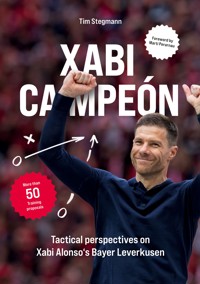
October 2022: Things look bleak for Bayer Leverkusen. The team struggles in the Bundesliga relegation zone, when a new coach, Xabi Alonso, takes over their fate. June 2024: Bayer Leverkusen concludes the 2023 / 2024 Bundesliga season as German champions and DFB-Pokal winners, securing the domestic double while losing only one game allseason. Shortly afterwards, Spain claims victory at the UEFA European Championship in Germany. What led to this remarkable transformation? What tactical innovations are behind Alonso's dynamic and dominant style? What influential methodologies from Spanish football form the foundation of his philosophy? And why do coaches from the Basque Country? In his book, Tim Stegmann weaves these influences into an engaging tactical portrait of Bayer 04 Leverkusen's championship-winning team and the exceptional leadership of their coach: Xabi Campeón!
Sie lesen das E-Book in den Legimi-Apps auf:
Seitenzahl: 443
Veröffentlichungsjahr: 2025
Das E-Book (TTS) können Sie hören im Abo „Legimi Premium” in Legimi-Apps auf:
Ähnliche

















The work and its components are protected by copyright. Any reproduction, distribution, translation and reprinting, including photomechanical reproduction, microfilming and storage or processing in electronic systems may only be carried out with the written permission of the author Tim Stegmann. The automated analysis of the work in order to obtain information, in particular about patterns, trends and correlations in accordance with §44b UrhG ("Text and Data Mining") is prohibited.
Note on the use of language: For reasons of better readability, the masculine form is used in the text. However, it includes the female and diverse forms. All personal designations apply equally to all genders. Therefore, when referring to coaches or players in the context of a general explanation, female coaches or players are always included.
Some sources have been translated from Spanish or German into English by the author to the best of his knowledge and belief, always with the intention of retaining the meaning and essence of the quotation. This book has been prepared very carefully. However, all information is provided without guarantee. Neither the author nor the publisher can accept liability for any disadvantages or damages resulting from the contents presented in the book.
Furthermore, no liability is assumed for content that can be accessed via links to third-party websites, as the content of these websites is not adopted as one's own, but is merely intended to indicate their status at the time of publication of the book.
To Mi, Samuel Quique, Isaiah João.
Power, inspiration, and home.
Thank you for everything.
“When we look at the present moment with all our senses, we invite the world to fill us with joy. The pains of the past are behind us. The future has yet to unfold. But the now is full of beauty and awaits for our attention.”
TARA BRACH
“Every team needs a Basque.”
JOHAN CRUYFF
Table of Contents
Foreword Martí Perarnau
Prologue
Excursus: What Is a Game Model?
A Tactical Dictionary – Basic Concepts
A Typical Spanish Element – Positional Play
Apprenticeship at Home: Alonso’s Time at Real Sociedad San Sebastián
Excursus: How the Real Sociedad Academy Works
A Pragmatic Start
Excursus: Stage Spaces
Creating Champions
Excursus: Shared Intentions
Position Profiles of the Game Model
Outlook
Training considerations
Training proposals
Acknowledgements
Bibliography
Foreword Martí Perarnau
“You park it!“ Xabi yelled as he jumped out of the still-moving car. He ran like a madman through the Allianz Arena until he reached the changing room. He'd arrived to hear the final pre-match talk. Just in time.
This is the character of Xabi Alonso: calm, rigorous, serious, and concise — yet simultaneously capable of going against the current just to arrive before his teammates. Fast and furious.
It was March 11, 2015, and Bayern were playing the second leg of their Champions League round of 16 tie in Munich. Their opponents were Shakhtar Donetsk — a rugged team featuring talented Brazilians such as Douglas Costa and Fred. The first leg had been a difficult one: a goalless draw, with few scoring chances, a rather conservative tactical approach from Pep Guardiola, and Xabi Alonso's sending off. The Catalan coach hadn't wanted to expose his team to the risk of the Ukrainians' rapid transitions, so he left Lewandowski on the bench and minimized any potential dangers. His experience told him that the round of 16 often proved far more dangerous than most imagined — and he didn't want to concede any goals in the first leg. His reasoning didn't spare him the unanimous criticism from the German press, which deemed the goalless draw a poor result for Bayern.
The atmosphere in Munich for the second leg was tense. Xabi Alonso's suspension left the team's midfield somewhat exposed, and they were also without their other great pillar, captain Philipp Lahm, who had fractured his ankle in training. In this context, Guardiola adopted what became known as the Cambridge Pyramid as his system of play. The 2-3-5 was an explosive idea because it grouped all the team's attackers at once: Coman, Ribéry, Lewandowski, Götze, and Robben. And at the same time, it was a high-risk system against Shakhtar's counterattacks.
When Bayern's daring lineup became known, Xabi Alonso was on the Sky Sports television set, sharing the analysis desk with Franz Beckenbauer. Everyone present received Guardiola's decision with skepticism, and some with harsh criticism, as they understood it to be too risky. Xabi had known the lineup for a few days, as the coach had started practicing it in training, and he defended Pep's idea with arguments and passion. He explained that the five men at the back— two central defenders, the holding midfielder (Schweinsteiger), and the two fullbacks—would form a wall that would cut off any opposing counterattack, while the five men up front would relentlessly pepper Shakhtar's goal. Despite Xabi's extensive explanations, no one in the Sky Sports debate panel seemed overly convinced by the idea.
Xabi left the set quite angry, got into his car, and looked at his watch. The match was half an hour away, and we weren't far from the stadium, but very soon we realized there was a big problem: the roads to the Allianz Arena were gridlocked with fan vehicles. At that moment, the "fast and furious" version of Xabi emerged. He wanted to get to the final pre-match talk, scheduled for five minutes before they took the field. He didn't just want to get there: he "needed" to get there. He felt he had to support his teammates, be with them, back them in those risky moments, and tell them to play without fear and with passion.
He grabbed the wheel and began driving against the flow of traffic, inciting the fury of other drivers. Luckily, no one was heading in the opposite direction to the vast crowd moving towards the stadium, but this didn't lessen the storm of horns from enraged fans who watched a black vehicle speeding, overcoming obstacles and traffic jams, even if it meant driving in the forbidden lane. The conversation inside Xabi's car was limited to a few brief onomatopoeias and the player's monotonous comment: "I have to get there on time." Neither his wife Nagore nor I had anything to say about it. In fact, we had no choice but to close our eyes to the obvious driving risk and cover our ears against the huge commotion brewing. Three minutes from arrival, with the stadium already in sight, we had to descend a rather steep curve, and Xabi didn't hesitate to launch himself in the opposite direction, as if an important trophy of his career were at stake.
With a furious brake, he swerved the car right to the stadium's entrance and left us with the task of parking the vehicle, while he bolted towards the private meeting. He arrived just in time, as Pep was giving the final instructions and the huddle of players embraced before the battle. Xabi was sweatier than the footballers who were about to play, a result of the tension experienced inside the car. Before the talk ended, he let out a shout: "¡Vamos!"
For Xabi, arriving on time and fully participating in the talk with his teammates was like playing the match and winning it. He would have to be in the stands, biting his nails due to the suspension, but he wasn't absent from the team; instead, he was an intimate part of it. His teammates would play knowing that Xabi was with them.
This is the character Tim Stegmann portrays for us in this splendid book: a man measured and calm, rigorous and serious, diligent and honest, respectful of collective internal rules, yet at the same time passionate, volcanic, and transgressive. A polyhedral Xabi, cold and ardent, ice and fire simultaneously. A model family man, "Fast and Furious" driver… an outstanding player, a superlative coach.
On that night in 2015, Bayern crushed Shakhtar 7:0. Pep's idea, which Xabi had so fervently defended on television, was brilliant.
Martí Perarnau
Prologue
On October 5, 2022, the world of football in Germany was about to change forever: Xabi Alonso was appointed as the new head coach of Bayer 04 Leverkusen and introduced one day later at a press conference before the 9th matchday against Schalke 04. Almost a year earlier, there had been rumors about a move to Germany to join Borussia Mönchengladbach. Now, the Basque actually decided to gain his first coaching experience in Germany's top division. The fact that Xabi Alonso, after a very successful playing career, would now also make history as a coach, was something that José Mourinho, his former coach at Real Madrid, had already expressed little doubt about in 2019: "His father was a coach, he grew up similarly to me. Then he became a player – much better than me, of course.”1 Xabi has outstanding positioning and knowledge of the game and was trained by the best coaches of his time, so Mourinho concluded: "If you put all that together, Xabi has the best prerequisites to be a very good coach!"2 The Portuguese was not alone in this assessment: Carlo Ancelotti also shared his confidence: "If I had to bet on a player back then who would become a coach, it would have undoubtedly been Xabi. Someone who has played in midfield has more advantages on the bench. A midfielder (...) must have the quality, be tactically clever, have a good view of the game… And Xabi Alonso was one of the best midfielders I ever coached, very intelligent, with fantastic feet and extraordinary professionalism."3
For me, having spent a lot of time in Spain since 2021, particularly in Barcelona and Madrid, it was clear that a new level of coaching was likely to arrive in the Bundesliga. After the first rumors about a move to Germany in spring 2021, I had already taken a closer look at coach Xabi Alonso. At that time, Alonso was coach of the second team of his hometown club Real Sociedad San Sebastián and had gained his first “professional experience” as a coach. The young coach Xabi Alonso quickly achieved something special with his team: In the 2021/2022 season, Sanse, the second team of Real Sociedad San Sebastián, was the only second team in LaLiga2, the second Spanish division. For me it was obvious: I didn't just want to use video to analyze the team's goals and playing style, but also to experience the game alive. Once it was in my mind, I have started making it happen: During my master's degree in Madrid and my internship at the youth academy of Real Madrid, a window of opportunity arose for a visit to a second division game between Fuenlabrada (a suburb of Madrid) and Sanse. So on May 7, 2022, I was sitting with my friend from the course on the regional train from Madrid to Fuenlabrada to watch LaLiga2 bottom table duel (21st against 19th) enjoying the best afternoon sunshine. Alonso's team showed a lot of energy, dynamism and passion right from the start, but also demonstrated why they had not collected many points up to that moment: As with many second teams, the issues of experience, maturity (one would call it "ruthlessness") and efficiency played a big role. It almost seemed that Xabi Alonso's team, which still had a realistic chance of staying in the league, would (again) not be rewarded for a good performance, because at halftime the score was 1:0 for the home side of Fuenlabrada, even though they had not contributed much to the game until then. In the second half, Sanse finally equalized – but it was clear that Real Sociedad would need a win to maintain a realistic chance of staying in the league. Long before the myth of “Laterkusen” was born, Xabi Alonso’s team managed to score the much-celebrated winning goal with a lot of heart and increasing pressure in the 95th minute. In fact, it was this moment, which I captured in a photo (see chapter image), in which all the energy and joy culminated in the jubilation of finally being rewarded for the effort and the good, proactive play.
So when Xabi Alonso was introduced as the new coach at Bayer Leverkusen at the beginning of October 2022, my interest and curiosity were reignited. I was eager to see how a Spanish coach, who had played under so many outstanding coaches during his playing career, would enrich the Bundesliga outside the context of Bayern Munich. When I spoke about Pep Guardiola with some of my Spanish coaching colleagues, for example, they were relatively quick to say: "Yes, but you also have to see: Pep has always had good players. Now at City he even has the best…“. While none of them intended to downplay the achievements and in particular the coaching quality of the outstanding Catalan, there was always a certain doubt as to whether a similar performance would have been possible with other players. A coach heavily influenced by Guardiola, among others, arrived in the Bundesliga, taking charge of a struggling team. From that moment on, I followed the games with increasing intensity and attention - an interest whose findings now flow into this book. This is not about declaring Xabi Alonso as a coach or of filtering out the unique influences of the many successful coaches in his career (starting with his father, Periko Alonso, and including Rafael Benítez, José Mourinho, Pep Guardiola, Carlo Ancelotti). Rather, it is about explaining my point of view to the tactical concepts and details his team has mastered and I have studied and deepened through my Master courses and visits, my exchanges and conversations with dozens of Spanish coaches. These concepts not only have a high recognition factor within Spanish football but can also serve as a source of inspiration for any other coach. At the same time, many things are based on those perspectives that have not only shaped Spanish football to a considerable extent but also world football: We are, of course, talking about FC Barcelona's methodology, its view and its interpretation of the game.
So at no point is it about an absolute “truth claim” in the analysis (if such a claim can even exist in football, especially from an external perspective), but rather about enriching our understanding of tactics and shared intentions to help our teams and players in reaching even higher level and offering the coaches a new perspective to football game. The aim is not always that the situations shown will reveal a wealth of previously unknown information, nor will they provide maximally innovative new knowledge. Rather, it is often the fundamental details, the skills that are nowadays overused under the term “basics”, to execute simple actions and principles successfully and effectively (and efficient), that are a quality feature that can make the difference in any game.
All of the situations analyzed were interpreted and implemented exceptionally well by the players themselves, guided by their own intuition and feelings and in response to the specific game situation. But as with all things that are "interpreted", these are existing concepts or ideas that, when paired with a special talent (like all the players in the Leverkusen squad) or even a specific genius (think of Florian Wirtz or the free-kick skills of Grimaldo, among others), can become something wonderful and create special moments in football. Some of the concepts or tactical situations may be new to the viewer, while others may feel more “old school”. Ultimately this just goes to show that this highly successful Leverkusen team can cover the full spectrum of outstanding behaviors on the pitch - and, as always, in this game where chance plays a significant role - they were also able to rely on the necessary luck in the 2023/2024 season (or rather, earned it through hard work).
Xabi Alonso's career has been shaped by four key influences. First, his upbringing in San Sebastián, where being Basque and playing for his boyhood club was central to his development. Second, the meticulous approach of Rafael Benítez. Third, the relentless winning mentality of José Mourinho. Finally, in the later years of his career, the influence of Pep Guardiola, the leading figure in positional play, alongside the composed leadership of Carlo Ancelotti—whose impact extends far beyond just man-management. To understand Alonso's football philosophy, one must consider both the Spanish perspective on the game and, more specifically, the methodology of FC Barcelona. No other club has had a greater influence on Spain’s playing and training approach, the style of the Spanish national team, and, ultimately, football worldwide. This chapter is therefore about the origins and the specific concepts which, as already mentioned, recur in Spanish football (as well as in world football), even if they may be expressed in different ways. What helps us is that Spanish is a very lively language where it is possible to convey a particular intention or feeling just by choosing a particular word or term.
A particularly good example of this is the wide range of descriptive words that are now used for the word “pass” in football within the Spanish language:
The Pass in Spanish Football
The special thing about almost all of these expressions is that each one can express an intention and an image, and that each individual expression forms a (game-tactical) invitation to interaction. If you look at the German verb “passen”, the basic idea of making this “pass” “fit” is hidden in the root of the word – however, the deeper, socio-affective (connecting, community-building) meaning of the action remains hidden. There is also another layer of meaning in the English word "to pass" - the socio-affective meaning of the Spanish expressions remains still remains concealed in this sense. In addition to the simple "play" and the creative "make", the word "give" already implies the basic idea that the pass should be a gift that brings joy to the teammate. If we look at passes from this perspective, some teams have very few gifts to exchange between teammates. All other terms that do not already express a specific action (such as an interface pass that "filters" through the opponent's lines) are clear, connecting terms that encourage interaction and networking, which then automatically merge into a synchronicity that allows the team to play according to the same thoughts and intentions.
Therefore, especially in Spanish football (although, in football history, this idea is certainly not limited to Spain but – like many other such concepts – also has its origins in the Netherlands), the pass is the medium by which two or more people connect to achieve a common goal. The pass is the essence of the collective game. The pass is more than a mere technical action: it is the foundation and ultimate reflection of the collective and associative play in any team sport. Accordingly, the pass is also understood as 'sharing the ball among teammates', through which players can communicate with each other and experience the emotion and pleasure of dominating the game through possession of the ball. The connection between players created by the pass requires both to adapt to the characteristics of their teammate. The more the players in the team know each other, the better their communication through passing becomes. At its most extreme, all technical actions in football can be understood as passes: as a pass to yourself (dribbling), as a pass to a teammate, as a pass into the net
(finishing). All variable components of the game are summarized in the overall organization of the team, whose reference points are the ball and the pass. This is not about playing a pass for the sake of passing. Passes have one purpose: to eliminate opponents. If that is not possible, we keep the ball, dribble with it (take on defenders) and look for pressure from the opposition so that we can play a pass.4
The pass is the systematic, constant and deliberate repetition of interaction between all team members, using the ball to organize the team itself, disorganize the opposing team and achieve the ultimate goal: to score!
"In other words, when you pass the ball, you don't just pass the ball, you give an intention, you give space, you give time, you give energy, you give joy, you give trust - words that really make a team a team."5
PACO SEIRUL·LO
"When I make a pass, my goal is for [my teammate] to have the best possible path, with his right or left foot, to have an advantage. (…) Of course [my teammate] has to be in the right position - that is his job. But if I pass to the left, for example, he might have more trouble turning, so I pass to his right foot. That's my idea: to play a pass that brings an advantage and not to create a problem."6
XABI ALONSO
The atmosphere at the introductory press conference on October 6, 2022, was far from that of a team fighting relegation. Rather, Xabi Alonso spoke right from the start about the great honour of being at this club and the ambitious goals that the club had set. None of his words seemed artificial or staged – here was someone with great ambitions who spoke about them clearly. Nevertheless, it might have seemed confusing given the league table at the time: Bayer Leverkusen was second from botton in the table with five points from eight games. For the German media, however, it was a real spectacle that a coach was being introduced who did not even know the German word “relegation battle” ["Abstiegskampf"] and who also left little room for doubt: “If you don’t dare to take risks, you won’t achieve anything. Nothing is certain in life and even less so in football. If you don't try, you'll never achieve it. I am happy to be here and motivated because I believe we can achieve great things.”7 The energy, confidence and the sense of anticipation that this coach exuded at his introduction was certainly infectious and formed a strong contrast to the team's position in the league at the time. In the end, it was one of football's coincidence that his start - just like his Bundesliga debut as a player - was again against Schalke 04, although his debut as a coach was far more successful (his result as a player had been 1:1).
1 Mourinho quoted in Bundesliga online 2024.
2 Ibid.
3 Ancelotti quoted by Romero 2021.
4 Fernandez 2012.
5 Seirul·lo in Guasch 2024.
6 Alonso in Sports Illustrated 2016.
7 Alonso 2022 (recording of the first press conference); and Cáceres 2022.
Excursus: What is a Game Model?
“The game model is determined by the context in which players, coaches, club ideology and environment constantly interact.”8
DANIEL GUINDOS
“Football is a communicative and social game. It is therefore not recommended to remove the player from the context that affects his performance, since the functions of each player depend on a common function and are the result of constant interaction."9
ÓSCAR CANO
In order to delve deeper into Xabi Alonso's coaching philosophy and to gain a comprehensive understanding of the playing style, I will provide a detailed overview of the "game model" in the following section. The term "game model" is often oversimplified, neglecting crucial elements that are essential for coaches in developing a team's playing identity. By establishing a strong theoretical foundation, we can better comprehend the complexities of the game model and its impact on team performance. Even though the concept of the game model and all its facets will be explained in more detail in the following pages, we as coaches should always keep in mind: "The game is played by the players. (…) It's not just about the game; it's about people."10 Consequently, the primary goal of this theoretical framework is to facilitate the game for coaches and their players. Juanma Lillo, Pep Guardiola's assistant coach, offers a valuable perspective on coaching philosophy, stating: “I want to make it easier for the players to become aware of who they are and what they do. (…) It's about everything. Nothing can be decontextualized. How one lives, what one is, what meaning one gives to relationships, behavior, interaction... All of this affects how a team plays.”11
Two things are essential for a basic understanding of this book: Firstly, it is undeniable that in a circumstantial, chaotic and unpredictable sport like football, there is no single, irrefutable truth. This also applies to the choice of playing style that each team selects. That is why it is not possible to say objectively what constitutes “better” or “worse” football. Each coach chooses the approach they believe will produce the most success, and often this approach depends on their own strengths as well as the perceived capabilities of their team. Therefore, this book is not about putting one particular type or interpretation of football above another. For one thing, my research and reviewing countless games have shown me once again: Even in a more direct interpretation, as seen occasionally with Union Berlin under former coach Urs Fischer or Union Saint-Gilloise in Belgium with its former coach Karel Geraerts, all of these teams had a very good and clear idea that, when implemented well, was very difficult to play against making it difficult for opponents to find solutions.
Furthermore, when this book looks at football, it does so from the angle and perspective of complexity. This means that the things we observe often have complex reasons and are rarely attributable to linear, causal relationships. For Juanma Lillo, the role of the coach is crucial: “Science tries to turn us into machines. As far as my work [as a coach] is concerned, empathy is crucial. In any work environment, a person performs better in a good atmosphere than in a bad one. You have to make players aware of things they may not be able to see."12 In football, due to the sport's great tradition, certain traditional patterns of thinking are still deeply rooted, such as the belief that football performance can be measured solely by data and values. Frequently, metrics like total distance covered, number of accelerations, and sprints are used to assess a team's performance. It is frequently overlooked that all these values have to be contextualized, which means they must be examined in specific circumstances: Who played against whom? Where? Was it a normal league game or a cup game? What was the league standing of the teams at the time? How was the situation? What is the playing style of the two teams? What point of the season was it? All of this information influences the quantitative data that is collected in almost every game in professional leagues today. Therefore, performance cannot be reduced to individual, simple elements, as this would be more in line with the understanding of a machine in which individual parts that do not work can be replaced. Spanish coach Juanma Lillo once said that it almost seems as if what cannot be quantified does not exist in football.13 All this results in football players behaving in a rather “robotic” manner and only acting to a limited extent. Fortunately, the best of the sport show us almost week after week that football can work differently. As Italian coaching legend Arrigo Sacchi noted, football is “born in the brain, not in the body."14 This goes hand in hand with the request to the coach to stimulate neural plasticity through training with variable content and thereby ensure the creation of new synapses and connections in the central nervous system of the players. We will look at what this could mean in practice in the chapter on Training Proposals.
“Nature is very complex, but the laws that govern it are very simple.”15
JUAN MARTÍN MALDACENA
Complex Systems
In his book La mente bien ordenada (roughly translated as The Well Ordered Mind), the French philosopher Edgar Morin defines a system as something that is "represented by a set of elements that interact to achieve a specific goal."16 In his book Complex Football Spanish athletics coach Javier Mallo explains further: "The characteristics of a system depend on the way in which the components are configured , and they have four categorical properties: Interaction, Totality, Complexity and Organization."17 The properties of a system cannot be explained by looking at the individual parts, since not only does every change in these components have an impact on the whole, but they are also shaped by the connections between each part and the overall structure.18 A part of the whole therefore cannot be reduced to be understood in isolation from the totality to which it belongs. To illustrate this point, consider the human heart. While a scientist can study the physical properties of an isolated heart, they cannot fully comprehend its function without considering its role within the entire organism. The specific function of the heart can only be observed when viewed within the body examining the interaction with the other organs. Therefore, properties (or characteristics) that single parts do not have arise which Aristotle pointed out already a long time ago with the statement "The whole is more than the sum of its parts“. In football, this manifests itself in a different way, as Juanma Lillo explains: "It's not just that what works with one player doesn't work with another; it's that what works with one player doesn't work with the same player at a different time and under different circumstances."19 Professors Natàlia Balagué and Carlota Torrents summarize the properties of complex systems as follows:20
Unpredictability:
The behavior of a complex system cannotreliably be predicted in the long term.
Wholeness:
The whole is greater than the sum of its parts.
Interdependence / Interrelationships:
There is an constant interaction between all parts.
Spontaneous emergence:
The interaction of all parts creates a new whole that is distinct from the sum of all parts.
In addition, former Barça directors Isaac Guerrero and Xavier Damunt mention further characteristics of complex systems:21
Interrelatedness:
A system is constituted by its relationship to subsystems and suprasystems.
Irreducibility:
Despite being related, a system retains its unity, identity and autonomy due to a specific internal organization.
Dynamism:
Although a system naturally tends toward disorganization— ultimately leading to its decay and disappearance— it manages to maintain its internal equilibrium through negentropic processes (the reversal of the entropic process so that chaos returns to order) of reorganization and adaptation.
Adaptability:
A system reorganizes itself while maintaining its internal structure in response to disturbances that act on it.
Variability:
Since emergent properties cause permanent changes, a system is never completely defined or adapted.
Complex systems regulate themselves through continuous exchange, interaction and internal feedback loops in order to remain in balance.22 Spanish scientists Balagué and Torrents further argue that our knowledge of the individual components of living organisms is less important; without understanding how they interact and create relationships among themselves, we gain little insight about their behavior.23 Portuguese coach Marisa Silva puts it this way: "To understand the team as a whole, we must understand the relationships between the players and, in the same way, we must know these relationships in order to understand the team."24 For Davide Ancelotti, assistant coach and son of Carlo Ancelotti at Real Madrid, the "real challenge [for a coach] is to identify, among the countless bonds that are created between them [the players], those that need to be strengthened."25
This once again underlines the interconnections that exist within a complex system. Each individual player can therefore be described as a complex system which, depending on and together with the network of interpersonal relationships with their teammates, forms another (larger) complex system — the team — through joint training and a common (tactical) identity.26 The collective acts as a whole, generating different synergies and leading to different behaviors that constantly emerge.27 In its entirety, not just in football terms, a football team is first and foremost a social system that "can display extraordinarily complex behavior based on the possible combinations of the numerous possibilities offered by each of the different components that compose it."28 This should also be taken into account in the team management off the pitch.
In order to understand the phenomenon of football, both the broader context and the interactions between the players — as well as their interactions with their environment — are crucial. Javier Mallo puts it this way in his book Complex Football: "For this reason, quantifying and modeling team performance using objective data is an irresistible temptation for people who live in the environment of the sport but do not really understand it." But the main focus for a coach in competitive sports is actually to get the players to "work together to achieve tactical organization."29 This requires a holistic view, as Juanma Lillo explains: "The game is an indivisible unit, there is no defensive moment without an attacking moment. Both create a functional unit. (…) The thing is, you have to be able to reduce without impoverishing. And that applies to everything. You can't take things out of their context because they're no longer the same, even if you then intend to put things back together. You can't take one arm of Rafa Nadal and train it separately. If you have done so, reinserting it may cause an imbalance, a rejection of the organism. (…) Football is associative, combinatorial."30
“Stupid are those who, without belonging to us, look at us with derision and laugh at our unique habits. Fools, because although they examine us closely, they see nothing. Other experts want to advise us and explain how our team works. They will observe our behavior on and off the pitch; they will collect hundreds of pieces of data and classify everything that happens to us, comparing and evaluating it with other benchmarks. On the last day, they will summon us and show us their diagnosis of what we need to change or improve on a large, bright board. Our team is broken into a thousand pieces. And these scholars will believe they have discovered our secrets. But the team was never merely the sum of different elements, but rather a common spirit that dominates everything and in turn connects it. The team is a home, not just a house.”31
ANDREU ENRICH IN COACHING MEDITATIONS
Football can be understood in terms of “self-organizing dynamics”.32 This means that the course of the game was not “imposed” or “prescribed” by anyone else. Rather, the course of the game is created by the interactions of the players in specific environmental contexts—that is, by the information provided by each individual, tactical action of a player.33 Therefore, tactical behavior can be understood as the individual and collective adaptation of players to the requirements of the task within a dynamic environment.34
The topic of adaptability is fundamental not only in football, but also in evolution: when we talk about “survival of the fittest”, we do not mean the survival of the strongest. In fact, the most adaptable survives, which also explains why humans (the supposedly weaker) survived while dinosaurs (the supposedly stronger species) did not. They became extinct instead. Adaptation usually occurs through the development of functionally advantageous synergies (cooperation amongst individuals). The extent to which this process is beneficial within football, and in particular in actual gameplay, will be explored further in the "Shared Intentions" section. What is clear, however, is that versatility is far superior to one-dimensionality. Cooperation and competition are therefore not only pillars of biological evolution, but fundamental principles in sport.35
In order to ensure that the interaction between players does not occur arbitrarily, the principle of organization is crucial in this sense, since without the existence of organizational relationships between players, they could only be considered a group.36 When observing a team, one can often recognize certain patterns on the pitch that reflect the unique nature of the team's organization. In this sense, one can speak of habits, which, however, arise from certain relationship conditions.37
The relationships between the players influence and determine the game interactions, which must be shaped by the coach so that the intended collective dynamic (as envisioned by the coach) can be consistently by the team during the games.38 Vítor Frade, the "father of Tactical Periodization", also points out that the type of play that a team achieves results from the interaction between the players and that these relationshipsmay carry different meanings depending on the team's overall identity.39
This process does not happen immediately, as the system (or in our case, the team) “must go through unstable phases until a more effective organization finally emerges.”40 Training plays a decisive role here, in which appropriate behaviors should be stabilized without being fully automated, as situational flexibility is always required in football to adapt to the various game situations — and, by extension, in training.41 Instead, it's more about the players internalizing of the game idea and feeling secure in it so that they can subsequently act with more freedom and increasingly intuition (embodiment of the game idea).42 This is particularly successful when the players can identify with the coach’s game idea.
Spanish coach and tactical analyst Enric Soriano cites the example of Pep Guardiola when describing this process, which is crucial for the implementation of the game model: "He has managed to bring the collective game to an excellent level by getting each of his players to recognize themselves in the game and to recognize the others, so that the socio-affectivity [connection between players, author's note] is much stronger and the game is harmonious and effective."43
“The creators like themselves, the destroyers like themselves, but not that much.”44
ÓSCAR CANO
The organized interaction of a team can therefore be described as tactical organization, since the players work together toward a (common) game objective. Teams with good organization help individuals to appear “better”: players seem faster, always get the ball at exactly the right moment and (falsely) seem fitter.45 All this happens through the interaction of the players, which is why the training itself should not consist of repetitiveexercises, since the intended purpose of each action is crucial for retention.46
The coach is the one who, depending on the characteristics of his players, has to develop and configure a game idea with different game patterns that enable the creation and implementation of “his football”.47 Based on this, Xavier Tamarit defines the game idea as the “tactical culture” of the coach, who is constantly aware of both design and process — in the game and within training.48
A team begins with a prescribed, already known and prepared organization, and then reorganizes itself in each new space and each new phase of the game according to certain rules and guidelines, depending on the unforeseen events that may arise. The ability to self-organize allows the team to adapt to each game situation, which is by definition unique and incomparable, and enables different actions in response. This adaptation to the changing context is essential and allows the player to perform optimal motor actions based on his abilities, traits and characteristics, regardless of whether he is in possession of the ball or in the process of regaining it.
Understanding certain concepts is essential for structuring your team as desired. It is also important to understand that in order to play the game as a team, each individual must be active and act as a functional unit, given the unpredictability and chaos that the game itself brings.
The idea of basic organization, combined with the coach's idea of the game, gives rise to the concept of the game model, which, however, is frequently misunderstood in football. It is often referred to as a system or scheme of play or even a basic formation, but this refers more to the positional arrangement at the start of the game (basic formation) or in different, predictable, phases of the game (build-up phase, defensive moment like pressing, etc.) and is only visible for a brief moment. While this does address the positional organization of the players and thus the team, it does not do justice to the concept of the "game model".49 In this respect, it is important to distinguish between structure (in the sense of a basic formation) and function, since structure alone represents a very rigid side of a system, whereas the function takes into account the relationships between all elements. Therefore, the interaction of all players within a game system is more important than the skills of an individual player outside the system.50 At the same time, it is not the system itself that is important, but rather the meaning that the players give to the system.
Other authors, with regard to the game model, refer to the formulation of the coach's ideas, which is composed of overarching principles in conjunction with further sub-principles that articulate certain behaviors for different game moments and are thus intended to ensure a a cohesive, identity-forming organization.51 There are differing views on the elaboration of this "tree of principles", as some proponents of the methodology of Tactical Periodization perceive a fragmentation in this subdivision and multitude of sub-principles and further sub-(sub-)principles, which they argue violates the principle of the 'unbreakable wholeness' and is thus classified as a linear reductionistic approach that is alien to the game (because it is unnatural). Overarching, it can be stated that game principles should provide the team with reference points and guidelines and thereby shape the game model. The successful Portuguese coach José Mourinho, for example, affirms that through the clearly defined and prioritized principles that he has implemented in his team, he has given it a certain DNA (in the sense of identity).52
Portuguese coach Nuno Amieiro sees a team's identity as nothing more than the consistent reaffirmation of the organization that defines it up.53 This organization is displayed by the team at every moment of the game and recurs consistently.54 At the same time, this organization and thus the game model as a whole should be dynamic and constantly questioned, since “the future must be maintained as a causal element of game behavior.”55 The flexibility of the game model is essential, as different interpretations and needs arise depending on the different context, players and game conditions.56
Davide Ancelotti, currently assistant coach of Real Madrid, sees organization as a possibility of "creating a situation in which a certain connection can benefit the collective."57 He views the game model—and thus the idea and organization—as a fundamental decision of the coach, who can draw on the entire pool of resources (existing and still to be invented or developed) to decide which "outfit" he wants to dress the team in. Therefore, it must be well understood and carefully studied. When describing the nature of a coach, Ancelotti likes to use the example of the chameleon, an animal capable of constantly changing color to escape the dangers that surround it, to adapt to the reality that surrounds it. It is not tied to an identity. Nowadays, two completely different games can take place between the first and second half, just as one and the same team can play completely differently depending on their opponents.58
The Spanish author Martí Perarnau, who has spent a lot of time with Pep Guardiola in the course of his book projects, seesthe idea of the game as "not set in stone, but is constantly influenced by the competition, the opponent, incidents and adversities within the team, by fitness, technique and well-being, both individual and collective, by the calendar and its requirements. The game ideas are flexible and changeable throughout the entire time."59
Spanish coach Óscar Cano's view on the player organization indirectly refers to the idea of complex systems: "It is exactly (…) [the] network of relationships that determines the dynamics of the organization. It organizes the system and also enables the production of new elements that become part of the system."60 The main task of the coach is to recognize and strengthen these relationships and to ensure maximum outcome for his own team through the resulting synergy.
Every idea of a coach is highly dependent on the players and the interactions and interpretations that emerge from that idea.61 For Vítor Frade, it is essential that the game first takes shape in the minds of the players, by highlighting and improving their characteristics.62 Óscar Cano views the game model as the organization of conceptual tendencies that arise from the interaction of the natural abilities of the players.63 Juanma Lillo, Pep Guardiola’s assistant coach at Manchester City, comments: "It’s about awakening what the player already has. It's not about them incorporating it, which is what the coaches' vanity leads us to believe. The footballer is a reality in his own right. There are coaches who are annoyed that the team plays more like the players and not like themselves."64
"But my assistants are subject to the tyranny of the boards and argue that the game is only okay if the actions conform to the guiding principles of the model. A model that takes shape like a stencil through cutting and folding. And through its precision, it amputates the player's uniqueness to turn him into a mere pattern"65
ANDREU ENRICH IN COACHING MEDITATIONS
While Cano sees the role of the coach as more of a "facilitator" and "enabler" with a focus to the natural talents and abilities of individual players, he at times takes an extreme stance. However, it isundeniable that the game model reflects "the way players relate to each other and how they express their view of football".66 Former Real Madrid U18 coach Fran Beltrán makes it clear that this is fundamental: "When a coach leads a team, he must understand the nature of the players and the contexts in which these players can make the difference."67 Therefore, for Miguel Lopes, a Portuguese coach and professor in the Master of “Tactical Periodization” program, the game model emerges from the characteristics of the players within the context shaped by the coach.68
Italian coach Antonio Gagliardi sees another future competitive advantage in acknowledging the individual characteristics of each player: "This combination consists in bringing dynamism, fluidity and greater freedom into more rigid systems, taking into account the different characteristics of the available players."69 Óscar Cano follows a similar approach, seeing the coach's focus as "finding the strengthening bonds that arise when his players combine their characteristics. Rather than arranging a pre-determined procedure, the commitment focuses on composing a style that (…) [natural] characteristics of the players are taken into account."70
In any case, the game model reflects "the personality of the team (…) and thus the character of the coach".71 The Spanish author Martí Perarnau compares the game model to a piece of music: "The music always sounds similar, but if we compare the piece as it was at the beginning with how it is at the end, we notice that rhythm, harmony and interpretation have changed greatly. (…) A game model is ultimately a fixed and movable frame at the same time. It is a score that changes daily due to the opponent, the experiences and the evolution of the idea itself."72 Despite all the emphasis on flexibility, the aforementioned point of the "personality of the coach" is essential: a coach like Xabi Alonso or Pep Guardiola will always pursue and try to implement a certain game idea due to his character and basic attitude and values. Some coaches act more pragmatically, while others may be more idealistic—however, the core identity will only rarely change completely.
Overall, it can be said that the game model is reflected in the players’ actions on the pitch. However, it is created by the interaction between the coachs's game idea and the individual skills of the players. It can also be influenced by external factors such as the club, its history, or the league.
Looking at Xabi Alonso’s Bayer Leverkusen, a certain three-dimensionality can even be seen: within his game idea and his playing system, the players always take on the same roles, which, regardless of the individual player, are relatively fixed, binding and clearly defined (1st dimension). At the same time, the specific approach regarding how each position should be played depends on the opponent and the space they provide. There is therefore a strategy or a “match plan” that influences the execution and interpretation of the position or player role (2nd dimension). Finally, the personal attributes of each player influence how they execute their actions. There is a clear difference depending on whether Andrich or Palacios plays alongside Xhaka in midfield or whether Xhaka does not play at all. There are fewer qualitative differences between these variations, as Xabi Alonso has clearly demonstrated through his frequent squad rotation. Rather, it is about the typical tendencies, characteristics and behaviors that influence the coach's decision: whether it is Boniface's tendency to repeatedly drift to the left wing and thus open space in the center or the corresponding counterpart when Patrik Schick plays as a traditional nine. The dynamic shift when Borja Iglesias takes on this role and the clear clear contrast when Adli, Wirtz and Tella create havoc in the front with maximum flexibility—all this does not change the fundamental system but shapes the team's overall approach to the game. Nuances evolve due to the individual attributes, tendencies and abilities of the players, but also due to the interactions and the emerging synergies that develop between them.
Spanish coach Abel Mourelo particularly highlights the connection between the coach’s idea and the players, as well as the resulting synergy: “You not only have to understand the game, you also have to know your players. You have to know the game. Observation skills make the difference when it comes to getting to know the player—how he thinks, his abilities, his potential... And then we introduce him to the game. The player should recognize the game and recognize himself in the game.”73
This is where the coach comes in:
"To create connections without losing one's identity, without losing the backbone of everything. (…) He gets the most out of the game and empowers his players. He brings out hidden talents. He causes players to break the limiting beliefs they have acquired through previous life experiences. (…) He creates potential, but also limits. He is able to convince and seduce the player and show him that he can be better. How does he get player X to run under pressure? Well, because this player previously enjoyed what he did. He creates connections so that the player does something he wouldn't normally do because something happens beforehand that makes him happy. If I have the ball, I'm happy, if not, I run quickly."74
Mourelo's comment is crucial because it refers to a central point that Xabi Alonso has also stressed time and again, not least at his very first press conference: "The most important thing I have learned from all my coaches is that the players have to follow you. They have to believe what you say and you have to 'feed' them. They need to feel that they are improving because of you. They need to know that you are there to help them with your knowledge, your guidance, your motivation. The first thing is to lead the group and then you can talk about the tactic and the strategy."75 Mourelo now combines two key aspects: the leadership of the group and the development of the content—the individual “approach to the player” in connection with the practical implementation of one’s own idea. He also shows how important it is for the players themselves to be convinced of the trainer's core philosophy, to be fully engaged in it or at least to execute it with great enthusiasm. This ensures that even the physically demanding or challenging aspects of the idea arecarried out with joy and commitment—a mindset that may not have existed under another idea. Xabi Alonso himself defines football as “a question of emotional states.” Depending on the team, there are different ways of dealing with doubts and setbacks: "There are teams that digest such things naturally; others find it more difficult to find their way around and they have to learn that sometimes it really hurts if you want to be successful."76




