


4,99 €
Mehr erfahren.
- Herausgeber: Rohit Sahu
- Kategorie: Ratgeber
- Sprache: Englisch
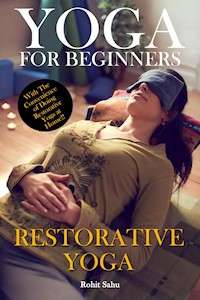
Unwind and Restore: Embrace the Tranquility of Restorative Yoga!
In a world filled with chaos and noise, do you yearn for a respite from the constant drama? Does your mind refuse to quiet down, no matter what you do? If you seek deep physical, mental, and emotional relaxation, then Restorative Yoga is the balm your soul craves.
Restorative Yoga is a practice that offers gentle meditation and fosters inner serenity. In a world where stress wreaks havoc on our hormonal balance, Restorative Yoga emerges as a natural antidote. By soothing the nervous system, this practice alleviates stress, reduces inflammation, and promotes overall well-being.
Join me on a journey through the realms of healing and relaxation as we explore the transformative power of Restorative Yoga. Within the pages of this comprehensive guide, you'll discover the essence of this practice and how it can positively impact your life.
It serves as a sanctuary for your weary body, providing the recovery and rejuvenation it craves. It's a slow-paced, soothing sequence where we hold calming postures that allow the muscles to strengthen, heal, and find solace. You get to experience blissful relaxation as this guide concludes with a guided meditation. Through visualization and mantras, you will harness the power to harmonize and align your energy, leaving you with a tranquil mind and supple muscles.
In This Guide, You’ll Discover:
✔️The Science Behind Restorative Yoga
✔️Who Can Perform It?
✔️Restorative Yoga Benefits
✔️Things You Need to Know Before Starting (What to wear, essentials, and the appropriate atmosphere)
✔️Ways to Prepare Your Props such as Bolster, Blocks at Home
✔️The Most Soothing and Calming Poses
✔️Visualizations and Mantras to Balance and Align Your Energy.
✔️Beginner's Common Mistakes and How to Fix Them
✔️Common Myths and FAQs
So, are you ready to dive into the realm of soothing and calming poses, allowing them to stretch and release tension throughout your entire body? This guide will guide you through each pose in intricate detail, ensuring that you can achieve correct alignment and avoid common mistakes. No matter your body type, Restorative Yoga offers modifications to suit your individual needs.
Don't delay—claim your copy now and embark on a journey of deep restoration and rejuvenation.
Das E-Book können Sie in Legimi-Apps oder einer beliebigen App lesen, die das folgende Format unterstützen:
Veröffentlichungsjahr: 2020
Ähnliche

Yoga For Beginners: Restorative Yoga
The Complete Guide to Master Restorative Yoga; Benefits, Essentials, Asanas (with Pictures), Precautions, Common Mistakes, FAQs, and Common Myths
-Rohit Sahu
Copyright © 2020 by Rohit Sahu. All rights reserved. No part of this publication may be reproduced, distributed, or transmitted in any form or by any means, including photocopying, recording, or other electronic or mechanical methods, without the prior written permission of the publisher, except in the case of brief quotations embodied in critical reviews and certain other non-commercial uses permitted by copyright law. For permission requests, write to the publisher at the email below.
Published by: Rohit Sahu
Contact: [email protected]
Published Worldwide
Acknowledgement
I highly acknowledge
Bellur Krishnamachar Sundararaja Iyengar
(14 December 1918 – 20 August 2014), better known as B.K.S. Iyengar, who was the founder of the style of yoga as exercise known as "Iyengar Yoga" and was considered one of the foremost yoga teachers in the world.
I highly acknowledge yoga teacher
Judith Lasater
who
taught her yoga classes in the 1970s in a simple rented room, hanging a photograph of Iyengar on the wall. She helped to popularize Iyengar Yoga in America, and was instrumental in creating the slow, gentle Restorative Yoga based on Iyengar-style asanas.
I highly acknowledge all the people whose pictures I’ve used in this book to illustrate poses.
Content
Introduction
Difference From Yin Yoga
Science Behind Restorative Yoga
Who Can Perform It?
Benefits of Restorative Yoga
Things You Need to Know Before Starting
Ways to Prepare Your Props At Home
The Soothing Restorative Yoga Sequence
Visualizations and Mantras to Balance and Align Your Energy
Beginners Common Mistakes and How to Fix Them
Common Myths and FAQs
Your Opinion Matters!
Here are Your FREE GIFTS!!
Books in This Series
Author Note
Dear Reader,
With great excitement and appreciation, I offer to you this book, the culmination of my Ayurvedic and spiritual studies. It’s been a labor of love, knitted together to impart timeless knowledge and practical insights to improve your knowledge on the subject of Yoga. I urge you to go on a transforming journey as you read through the pages of this book. Explore various Asanas (poses), Pranayamas (breathwork), and deep knowledge that you may incorporate into your everyday life.
Your thoughts and opinions are really valuable to me. I would be grateful if you could take a few seconds to leave a review and share your ideas and experiences. Your review will not only help other readers make an informed decision, but it will also give vital insight into how this book has touched your life.
I sincerely ask you to share your thoughts, observations, and any recommendations you may have. Your thoughts will not only encourage me but will also help to evolve and refine the information and wisdom contained inside these pages.
May this book serve as a beacon of light for you on your journey to self-discovery, health, and spiritual advancement. Thank you for joining me on this journey.
With the deepest gratitude,
Rohit Sahu
Introduction
Yoga's origin can be traced back to more than 5,000 years ago, but some researchers believe that yoga may be up to 10,000 years old. The word 'Yoga' first appeared in the oldest sacred texts, the Rig Veda, and is derived from the Sanskrit root "Yuj" which means to unite.
Yoga is primarily a spiritual discipline that focuses on subtle science, on achieving harmony between the mind and the body of the individual. According to the yoga scriptures, the practice of yoga leads an individual to a union of consciousness with that of universal consciousness. It eventually leads to a great harmony between the human mind and body, man and nature.
The Vedas is a series of texts comprising songs, mantras, and practices used by the Vedic priests, the Brahmans. Yoga was slowly refined and developed by the Brahman and Rishis (mystical seers) who documented their practice and belief in the Upanishads, a vast work containing more than 200 scriptures.
According to modern philosophers, anything in the world is merely a reflection of the same quantum firmament. One who experiences this oneness of life is considered being in yoga and is referred to as 'Yogi,' having achieved a condition of liberation referred to as Mukti, Nirvana, or Moksha. So the goal of yoga is self-realization, to overcome all kinds of sufferings leading to 'The State of Liberation’ (Moksha) or 'Freedom' (Kaivalya).
And yoga is not just for spiritual progress, it provides multiple health advantages as well, such as enhancing endurance, reducing depression, and improving overall wellness and fitness. It's a wonderful mind-body practice that encourages relaxation when you practice linking breathwork (Pranayama) to poses (Asanas). In addition, a recent study has also related the benefits of all types of yoga to enhanced bone density and better sleep quality.
As yoga has grown into mainstream popularity, many styles and variations have emerged in the wellness space. This centuries-old Eastern philosophy is now widely practiced and taught by people of all ages, sizes, and backgrounds.
There are 10 primary types of yoga. With so many different types, it may be a little difficult to determine which type is appropriate for you. But remember that there's no right or wrong—just that one might not be right for you at this moment.
You’ve to ask yourself what's important to you in your yoga practice: Are you searching for a sweaty, intense practice? Or are you searching for a more meditative, gentler practice that looks more appealing?
Like any sort of exercise, choose something you want to do; Bikram or Iyengar will attract you if you're a detailed person. If you're more of a free spirit, Vinyasa or Aerial yoga could be fun.
I've made a complete series on all 10 types of yoga. This is Restorative Yoga; others are also available!
So, What is Restorative Yoga?
Restorative Yoga is built upon the teachings of B.K.S Iyengar. An early disciple of B.K.S. Iyengar—a yoga teacher named Judith Lasater—helped to develop Restorative Yoga in the 1970s, based on Iyengar Yoga asanas and the use of props.
Restorative Yoga is certainly classified as a therapeutic form of yoga. It is a discipline that is about calming down and relaxing the body through passive stretches. When you opt for a Restorative Yoga session, you barely move, performing only a few postures over an hour. It's a completely different feeling from most mainstream yoga.Recovery is the most crucial aspect of it.
It is the practice of asanas that focuses on relaxing, lengthening, and allowing your muscles to recover. Practicing Restorative Yoga is a great way to relax your body and relieve stress. It is performed for longer than in traditional yoga, often accompanied by supports such as folded blankets to ease the body and guarantee that it is fully supported and relaxed.
Each pose is held for longer, sometimes for 20 minutes, so that the session may consist of only 4-6 asanas. It is often referred to as active relaxation. The poses often push the spinal column in all directions that go along with the traditional principle of physical yoga—the idea that a balanced spine encourages well-being.
If you are someone who struggles with chronic exhaustion and sickness, then Restorative Yoga might be for you. Restorative Yoga will make you relax completely, strengthening the immune system. It's a perfect stress reliever for those moments of your life when you're forced beyond your limits.
This type of yoga uses various props, such as blankets, straps, pillows, blocks, bolsters, walls, stools, chairs, or mats, to support the body, allowing you to hold longer poses. This eliminates unnecessary strains. The more support your body is offered, the more relaxed and restful you will feel throughout and after your yoga practice. As you begin to practice Restorative Yoga, you will be able to fall into a place of great contentment.
You should use whatever it takes to give your body the most support. It is one of the core goals of Restorative Yoga. It is known that the longer you can retain your pose, the more comfortable you'll become.
There are many benefits to the deep restfulness that come from Restorative Yoga. Some of the expected benefits include lowered blood pressure, balancing of serum triglycerides and blood sugar, increased good cholesterol levels, improved digestive function, reduced muscle tension, increased restful sleep, and reduced fatigue.
Restorative Yoga activates the Parasympathetic Nervous System (PNS), which slows down the heart rate, controls blood pressure, and relaxes the body. As such, Restorative Yoga is believed to be especially helpful for someone suffering from anxiety, depression, or headaches, as well as other stress-related disorders.
It is believed to boost the immune system and accelerate the natural healing process of the body. Restorative Yoga is also believed to improve fertility. With this Restorative Yoga guide, you provide your body with what it requires to heal.
You’ll experience deep relaxation with this Restorative Yoga guide. You’ll keep the poses long enough to improve the endurance and healing of the muscles. The practice concludes with a guided mediation that uses visualizations and mantras to regulate and align the energy. You will proceed through the rest of the day with healthy muscles and a calm mind.
I promise that after practicing this sequence, you will feel less tense and more relaxed!
So, are you interested in learning all about how Restorative Yoga can benefit you? This is a comprehensive guide to take a closer look at what this yoga style can do for you and how you can master it for your overall well-being.
Covering the fundamentals of each practice in-depth and how to correct the most common errors, this Restorative Yoga Guide has left nothing to help you attain mental, spiritual, and physical well-being.
Difference From Yin Yoga
B
oth Yin and Restorative Yoga styles are slow-paced. They encourage you to move gradually and focus on maybe 10 poses for the entire 90-minute session. Both ways of practice relax the mind and the nervous system and encourage you to shift your focus inward—on breathing.
Yin Yoga
Yin yoga is a gentle form of yoga that will help you switch to a more meditative state. A Yin Yoga practice aims to get deep into the poses and keep for a few minutes to target the joints, connective tissues, and bones rather than the muscles. It encourages regeneration, strength, and suppleness of the joints, fascia, and connective tissue that we lose as we grow or as a consequence of injury.
Yin Yoga is believed to improve energy transfer in the body and has special benefits for organ well-being. Founded by Paulie Zink, Yin Yoga focuses on Taoist yoga traditions to align our Yang (active) habits and workout routines. For this cause, Yin instructors also use words from Chinese medicine that introduce Meridians (channels by which energy passes through the body) and Chi (energy or life force) into the discussion.
Yin Yoga may be calming and soothing, but since the muscles are pressurized and the feeling is there, we’re not always fully relaxed. Yin Yoga may also be "restorative" in the way that it helps recover the vital energies of the body.




