


62,99 €
Mehr erfahren.
- Herausgeber: John Wiley & Sons
- Kategorie: Geisteswissenschaft
- Sprache: Englisch
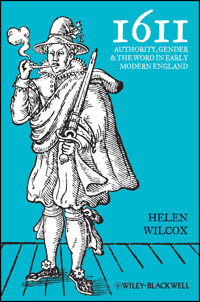
1611: Authority, Gender, and the Word in Early Modern England explores issues of authority, gender, and language within and across the variety of literary works produced in one of most landmark years in literary and cultural history.
- Represents an exploration of a year in the textual life of early modern England
- Juxtaposes the variety and range of texts that were published, performed, read, or heard in the same year, 1611
- Offers an account of the textual culture of the year 1611, the environment of language, and the ideas from which the Authorised Version of the English Bible emerged
Sie lesen das E-Book in den Legimi-Apps auf:
Seitenzahl: 575
Veröffentlichungsjahr: 2013
Ähnliche




















Table of Contents
Title page
Copyright page
Dedication
Preface
Acknowledgements
List of Illustrations
Chronology of Selected Historical, Cultural and Textual Events in 1611
Introduction: ‘The omnipotency of the word’
The Textual Culture of 1611
The Historical Moment
One Literary Year
1: Jonson's Oberon and friends: masque and music in 1611
Bringing in the New Year
The Originality of Jonson's Oberon
Love Freed from Ignorance and Folly
‘Ayry Musique’ in 1611
2: Aemilia Lanyer and the ‘first fruits’ of women's wit
‘To All Vertuous Ladies’
A Tale of ‘Too Much Love’
‘Turning Greene Tresses into Frostie Gray’: Lanyer's Cooke-ham
Arbella Stuart, ‘Patterne of Misfortune’
Women and Manuscript Culture
3: CoryatsCrudities and the ‘travelling Wonder’ of the age
‘Tending Both to Pleasure and Profit’: Travel in 1611
‘The Odcombian Legge-Stretcher’
‘Our Britaine-Ulysses’: Satire in 1611
Strange Wonders in 1611
4: Time, tyrants and the question of authority: TheWinter'sTale and related drama
The ‘Lascivious Stage’ in 1611
A King – or No King? James, Leontes and Other ‘Tyrants’
Alternatives to Tyranny: Female Authority in TheWinter'sTale
Topical Entertainment in 1611: Autolycus and Time
5: ‘Expresse words’: Lancelot Andrewes and the sermons and devotions of 1611
Preaching the Word in 1611
‘The Text, and the Time Together’: Lancelot Andrewes's Easter Day Sermon
A Learned and Fruitfull Sermon: Andrewes and Fellow-Preachers in 1611
‘Hearte Deepe Praises’: Sermons as Devotional Writing
6: The Roaring Girl on and off stage
Mary or Moll: Truth or Fiction?
‘Brave Captain, Male and Female’: Moll in The Roaring Girl
‘She That Has Wit and Spirit’: Wives and Widows
7: ‘The new world of words’: authorising translation in 1611
‘Verball Creatures’: Books and Translators
The King James Bible: ‘Happy Is the Man That Delighteth in the Scripture’
‘Yet More Worthy Yours’: Homer, the Prince and the Attraction of English Poetry
1611: The Translators' Year
8: Donne's ‘Anatomy’ and the commemoration of women: ‘her death hath taught us dearly’
‘She, She Is Dead; She's Dead’: John Donne on Elizabeth Drury
‘The Continual Remembrance of This Vertuous Gentlewoman’
‘Warble Forth Sorrow’: the Alchemy of Loss
9: Vengeance and virtue: The Tempest and the triumph of tragicomedy
‘My So Potent Art’: Aspects of Authority in The Tempest
‘Something Rich and Strange’: Wonder and Strangeness in The Tempest
‘Calm Seas, Auspicious Gales’
Conclusion: ‘This scribling age’
Appendix: A List of Printed Texts Published in 1611
Bibliography
Index
This edition first published 2014
© 2014 Helen Wilcox
Registered Office
John Wiley & Sons Ltd, The Atrium, Southern Gate, Chichester, West Sussex, PO19 8SQ, UK
Editorial Offices
350 Main Street, Malden, MA 02148-5020, USA
9600 Garsington Road, Oxford, OX4 2DQ, UK
The Atrium, Southern Gate, Chichester, West Sussex, PO19 8SQ, UK
For details of our global editorial offices, for customer services, and for information about how to apply for permission to reuse the copyright material in this book please see our website at www.wiley.com/wiley-blackwell.
The right of Helen Wilcox to be identified as the author of this work has been asserted in accordance with the UK Copyright, Designs and Patents Act 1988.
All rights reserved. No part of this publication may be reproduced, stored in a retrieval system, or transmitted, in any form or by any means, electronic, mechanical, photocopying, recording or otherwise, except as permitted by the UK Copyright, Designs and Patents Act 1988, without the prior permission of the publisher.
Wiley also publishes its books in a variety of electronic formats. Some content that appears in print may not be available in electronic books.
Designations used by companies to distinguish their products are often claimed as trademarks. All brand names and product names used in this book are trade names, service marks, trademarks or registered trademarks of their respective owners. The publisher is not associated with any product or vendor mentioned in this book.
Limit of Liability/Disclaimer of Warranty: While the publisher and author have used their best efforts in preparing this book, they make no representations or warranties with respect to the accuracy or completeness of the contents of this book and specifically disclaim any implied warranties of merchantability or fitness for a particular purpose. It is sold on the understanding that the publisher is not engaged in rendering professional services and neither the publisher nor the author shall be liable for damages arising herefrom. If professional advice or other expert assistance is required, the services of a competent professional should be sought.
Library of Congress Cataloging-in-Publication Data applied for.
Hardback ISBN: 978-1-4051-9391-7
A catalogue record for this book is available from the British Library.
Cover image: Mary Frith or “Moll Cutpurse” (c. 1584–1659), the notorious pickpocket and fence of the English underworld. Image taken from “The Connoisseur Illustrated”, 1903. © Hilary Morgan / Alamy
Cover design by Richard Boxall Design Associates
For Thomas and Joseph
Preface
The subject of this book is the textual culture of 1611, a very special year for English literature in print, performance, creation and translation. Through readings of a great variety of works for the stage, the chamber, the pulpit and the street, this study undertakes an exploration of a remarkable series of conjunctions in English literary and cultural history. After an introduction setting the scene and presenting the range of material, a series of chapters lead us through the year; each foregrounds a major text and sets it in the intriguing and enlightening context of the one year. It is my hope that this study will open up the textual riches of one early modern year and suggest ways in which the interrelation of co-temporaneous ideas, genres and metaphors can illuminate the texts and the era in which they were produced.
My fascination with the year 1611 grew initially from the experience of teaching early modern English literature. Along with colleagues at Groningen University, I devised an experimental method of looking in detail at one literary year as a means of conveying to modern readers a sense of the ingenuity, depth and interconnectedness of the works associated with this remarkable period. Although the book is the fruit of much subsequent reading and research, it is still organised in such a way as to make feasible the construction of a course around some or all of its key texts. However, it is also possible to dip into the book and read chapters on individual texts or genres in the context of the year of their production or publication. Ideally, reading this book as a whole should convey the most vivid sense of the vibrancy and rhetorical energy of textual culture in 1611 – but we all live in a less than ideal world, and I hope that readers will gain satisfaction and inspiration from the following pages in whatever ways are found to be appropriate.
Acknowledgements
In 1611, Nicholas Breton prefaced his Wits Private Wealth with a message that will ring familiarly with many authors and readers: ‘if [this book] be well I am glad you are pleased, if otherwise, it is past the print, and therefore too late to be mended’ (Breton, A3v). If this present book is not ‘well’ in any way, then the responsibility is mine. But if it is indeed ‘well’, as I hope, then this is thanks to the support and advice of many generous people.
I should first like to thank my students at Groningen University and Bangor University with whom I have discussed the texts of 1611, particularly Thomas Clifton, who wrote his dissertation on a choice few of them. I also wish to acknowledge the generous support and helpful scepticism of my colleagues from English Literature, History, Theology and Music in both institutions. Bangor University also allowed me a semester of study leave in the early stages of research for the book, for which I am most grateful.
Much of the material in this study was tested by being presented at research seminars, and I should like to express my thanks to colleagues in the universities of Birmingham, Liverpool, Malta, Nottingham, Oxford, Surrey, Turku (Åbo Academie, Finland) and York for giving me the opportunity to try out my ideas, as well as for their constructive responses.
The following individuals have, at different times, shared their knowledge and enthusiasm with me and I thank them here for their scholarly friendship: Hugh Adlington, Nadine Akkerman, Christopher Armstrong, Bill Baker, Peter Barta, Tom Corns, Nick Davis, Janette Dillon, Henk Dragstra, Barbara Eichner, David Evans, Ian Green, Achsah Guibbory, Brean Hammond, Johanna Harris, Andrew Hiscock, Jonathan Hope, Anthony Johnson, Kevin Killeen, Arthur Kinney, Arthur Lindley, Alasdair MacDonald, Judith Maltby, Mary Morrissey, Sue Niebrzydowski, Karin Olsen, Sheila Ottway, Joan Rees, Valerie Robillard, Thomas Schmidt-Beste, Roger Sell, Rina Walthaus, Martin Wiggins, Nicholas Wood and Marion Wynne-Davies.
Like countless scholars of earlier literature, I should like to acknowledge the incomparable contribution made by Early English Books Online (EEBO) to our researching lives. The EEBO database also makes it possible for readers of this book to experience further textual riches from 1611, should they wish to do so, at the touch of a keyboard or screen.
I am immensely grateful to the publishers for their initiative in building up a series of studies of individual years, and for their faith in this project. In particular, I should like to thank Ben Thatcher, Nancy Arnott and their colleagues for their patience and professionalism.
My aim has been to write this study in an accessible style, remembering George Herbert's Outlandish Proverb 302: ‘that is not good language which all understand not’. I am grateful to those who have read or commented on my work, but especially to two expert readers close to home: my father, James Boulton, and my husband, Allan Wilcox. Their time, skill and honesty have improved my future readers' experience enormously. My father died suddenly as this book was going into production, and I wish to commemorate him here and express my deep gratitude for his inspiring scholarly example.
I owe the greatest debt of thanks to my immediate family, Allan, Thomas and Joseph. I cannot thank Allan enough for splendid conversations, practical assistance of all kinds, love and confidence in me. Our sons, Thomas and Joseph, had to share their home with many noisy characters from 1611 for a number of years and, as it turns out, they also share a lot of the preoccupations of their early modern forebears: language, drama, music, translation, travel and philosophical discussion. This book is dedicated to Thomas and Joseph, with thanks and love.
List of Illustrations
Figure 1 Inigo Jones, design for the palace of the fairy prince in Ben Jonson's masque Oberon. Image from the Devonshire Collection, reproduced by kind permission of the Duke of Devonshire and the trustees of the Chatsworth settlement. Photographic survey, Courtauld Institute of Arts.
Figure 2 William Hole, engraved title page of Coryats Crudities (1611). Reproduced by kind permission of the British Library.
Figure 3 Title page of The Roaring Girl by Thomas Middleton and Thomas Dekker, performed at the Fortune playhouse and published in 1611. Reproduced by kind permission of the British Library.
Figure 4 Title page for the New Testament in The Holy Bible … Newly translated out of the Originall tongues … Appointed to be read in Churches (1611). Reproduced by kind permission of the archivist of Bangor University, from the copy of the King James Bible in the Bangor Cathedral Library collection.
Chronology of Selected Historical, Cultural and Textual Events in 1611
January 1, New Year's Day: Oberon (a masque sponsored by Prince Henry, written by Ben Jonson, designed by Inigo Jones with music by Alfonso Ferrabosco and Robert Johnson) is performed at the Banqueting House in Whitehall Palace.
January 8: James Forester signs and dates his epistle to the readers of The Marrow and Juice of Two Hundred and Sixtie Scriptures, published soon afterwards by Simon Waterson.
January 17: Lancelot Langhorne preaches at the funeral of Mrs Mary Swaine ‘at St Buttolphs without Aldersgate’, London (the sermon being published later in 1611 as Mary Sitting at Christ's Feet).
January 24: The original Latin version of John Donne's satirical prose work Ignatius His Conclave is entered in the Stationers' Register; his English version is entered on 18 May.
February: London theatres close briefly because of an outbreak of the plague.
February 3: Love Freed from Ignorance and Folly (a Jonsonian masque sponsored by the Queen) is performed at the Banqueting House, Whitehall.
February 5, Shrove Tuesday: London apprentices are ‘very unruly’ during their pre-Lenten festivities.
February 6, Ash Wednesday: Rioting breaks out between members of two Cambridge colleges, St John's and Trinity, over the performance of a comedy.
February 9: Parliament is dissolved (and not recalled until 1614).
February 26: Three London butchers are arrested for ‘abusing certen gentlemen’ at the Fortune playhouse.
March: The governor of the Virginia colony, Thomas West, Baron de La Warr, returns unexpectedly to London, justifying himself in The Relation of the Right Honourable Baron De-La-Warre, Lord Governour and Captaine Generall of the Colonie, Planted in Virginea.
March 3: Theophilus Higgons preaches at Paul's Cross and publicly recants his conversion to Catholicism; the sermon is said to last for 4 hours.
March 11: Giles Fletcher the Elder, poet and diplomat, dies in London; he is the father of the poets Giles the Younger and Phineas, and uncle of the dramatist John Fletcher.
March 24, Easter Sunday: Lancelot Andrewes, Bishop of Ely, preaches the Easter sermon before the King at Whitehall, also celebrating the eighth anniversary of the King's accession.
March 25, Easter Monday: Travel writer and court entertainer Thomas Coryate makes an oration before Prince Henry at St James's Palace.
Sometime in the spring: Middleton and Dekker's The Roaring Girl is performed by the Prince's Men at the Fortune playhouse.
April: Mary Frith (on whom Moll Cutpurse in The Roaring Girl is based) appears in man's clothing on the stage of the Fortune playhouse.
April 8: William Blundell discovers a hoard of Anglo-Saxon coins in Sefton, Lancashire.
April 8: ‘Three articles sett downe by the Councell of Virginia for 300 men to go thither' are handed to the Stationers’ Company for printing.
April 9: George Abbot is instituted as Archbishop of Canterbury.
April 14: A sermon is preached at Paul's Cross by John Denison on ‘the sinne against the Holy Ghost’.
April 20: Simon Forman attends a public performance of Macbeth at the Globe and writes a detailed description of it in his notebook.
April 27: A licence is granted for the Lady Elizabeth's Players (the company of which Princess Elizabeth Stuart, daughter of James, is the patron) to perform plays in Norwich.
May: Sir Robert Stewart, son of the Earl of Orkney and kinsman of the King, takes refuge in the court at Greenwich to escape his creditors.
May onwards: King James creates the order of baronets, leading to the sale of baronetcies for the rest of the year.
May 12, Whitsunday: Lancelot Andrewes preaches the Whitsun sermon before the King at Windsor Castle.
May 15: Shakespeare's tragicomedy, The Winter's Tale, is performed at the Globe.
May 31: A Royal Proclamation commands that the Oath of Allegiance to the King be administered according to the law.
June: Charterhouse School is founded by Thomas Sutton.
June 3: Lady Arbella Stuart, cousin of the King, evades custody by disguising herself as a man, and travels to Calais to rendezvous with her husband, William Seymour, who escapes from the Tower of London.
June 4: A Royal Proclamation urges citizens to help ‘apprehend’ Stuart and her husband.
June 5: Arbella Stuart is arrested off the French coast near Calais, from where she is returned to London and imprisoned in the Tower.
June 19: Thirty-three people die during a firework display in Norwich in celebration of the inauguration of the new mayor.
June 22: Henry Hudson is set adrift in the North Atlantic by mutineers from his ship, Discovery, and left to die.
July 25: The eighth anniversary of the coronation of King James as King of England.
July, August and September: John Frewen preaches controversial sermons at Northiham, Sussex (published in 1612 as Certaine Sermons on 2, 3, 4, 5, 6, 7 and 8 Verses of the Eleventh Chapter of S. Paule His Epistle to the Romanes).
August 25: Robert Milles preaches at Paul's Cross and attacks stage plays, which some people misguidedly think are as edifying as sermons.
Summer, before August 29: Ben Jonson's Catiline His Conspiracy is acted at the Globe by the King's Men but hissed off the stage after the second act.
August 29: King James hears (and approves) the case for William Laud, later Archbishop of Canterbury, to be made president of St John's College, Oxford.
September 8: Simon Forman, the astrologer, physician and diarist, dies suddenly while rowing across the Thames.
September 10: A Royal Proclamation prohibits further building in and about London and Westminster.
September 12: Having set sail in April, the Amitie returns to London from its trading voyage for the Muscovy Company with a cargo of skins and furs.
October 29: Sir James Pemberton is inaugurated as Lord Mayor of London while Anthony Munday's pageant Chruso-thriambos. The Triumphes of Golde is performed by The Goldsmiths' Company on land and water.
November: Edward Wightman goes on trial in Lichfield for heresy (and is condemned and burnt at the stake in 1612).
November 1, All Saints' Day: The first known performance of Shakespeare's The Tempest takes place at Whitehall Palace.
November 3: Henry Ireton, future Parliamentary leader and son-in-law to Oliver Cromwell, is baptised in St Mary's Church, Attenborough, Nottinghamshire.
November 5: Shakespeare's The Winter's Tale is performed before the King at Whitehall, on the sixth anniversary of the Gunpowder Plot.
December 11: John Gerard, author of The Herball (1597), signs his will.
December 25, Christmas Day: Mary Frith (‘Moll Cutpurse’) is arrested in Paul's Walk for dressing indecently and is sent to Bridewell prison.
December 26: Beaumont and Fletcher's tragicomedy A King and No King is performed as part of the court's Christmas festivities.
December 27: John Cooke's Greene's Tu Quoque is played at court by the Queen's Men, who have performed it earlier in the year for the public at the Red Bull playhouse.
December 29: Middleton's No Wit, No Help Like a Woman's: or, the Almanac is performed at court to round off the end-of-year celebrations.
Introduction
‘The omnipotency of the word’
The Textual Culture of 1611
1611 was a remarkable year for English writing. The richness and range of its textual culture – the works that were written, circulated, printed, bought, read, shared, performed, translated, reprinted and discussed in the space of 12 months in Jacobean England – form the central focus of this study. The purpose of the following chapters is to highlight the conjunctions of literary creativity to be found in this one early modern year, and to indicate ways in which the engagement and interrelation of co-temporaneous ideas, genres, tropes and topics can extend our understanding of the texts and their era.
From the point of view of conventional history, however, 1611 was (superficially) ordinary: it did not mark the beginning or end of a monarch's reign, nor were any major battles fought or political crises resolved. In this year, James VI of Scotland, who in 1603 had also become James I of England, Wales, France and Ireland, entered into the ninth year of his reign in London, along with his Queen, Anna of Denmark. Significantly, their elder son and heir, Prince Henry, began the first full year of his adult life in 1611, having come of age with his installation as Prince of Wales the previous June. There was no sitting of Parliament during 1611; the proceedings of the session originally summoned in 1604 had ground acrimoniously to a halt in 1610 because of members' criticism of James's spending, and Parliament was formally dissolved in February 1611. In October of the same year, Sir Henry Neville approached the king and undertook to help him to manage parliament in future, on condition that Neville himself could be made Secretary of State (Thrush, 85). Clearly nothing came of this unusual proposal, since Parliament was not recalled for another 3 years, the king ruling in the meantime without its formal financial assistance, but also without its ideological or practical interference. Although religious tensions in England continued to run high, just over 5 years after the Gunpowder Plot (the audacious but doomed Catholic conspiracy to blow up the King and Parliament together on 5 November 1605), the year 1611 was not marked by any similar rebellion, despite the almost daily jockeying for power or doctrinal supremacy among churchmen of all persuasions. Indeed, probably the most notable collective event of the year was the King's quite secular invention of the rank of baronet, an early modern equivalent of cash for honours by which the impecunious James allowed a significant number of favoured subjects to purchase this elevated rank. Walter Aston, for instance, who later became James's ambassador to Spain, paid the considerable sum of £1,095 for his 1611 baronetcy (Loomie, 1). For lowlier subjects, meanwhile, life went on much as usual – that is, if it continued at all. 1611 was not a year marked by excessive outbreaks of plague (unlike 1603, 1625 or the infamous 1665), but the London theatres were closed in the month of February because of a relatively brief outbreak of the ‘pestilence’, and there were still reports of deaths from such epidemics in many other parts of the country (Barroll (1991), 173). Even in moments of great joy, death (as ever) was lurking. On 19 June 1611, large numbers of citizens attended a public pageant in Norwich to celebrate the inauguration of the city's new mayor; the event culminated in an evening of ‘rejoicing’ including a great ‘fyer worke’ that went so disastrously wrong that 33 people were crushed and ‘slayne’ in the fleeing crowds ( Norwich, lxxxii). The prevailing sense of early modern life was, understandably, that it constituted a struggle against mortality, spiritual vulnerability and, very often, material poverty during one's brief ‘sojourne heer on earth’ (Tuvill, B5).
Lesen Sie weiter in der vollständigen Ausgabe!
Lesen Sie weiter in der vollständigen Ausgabe!
Lesen Sie weiter in der vollständigen Ausgabe!
Lesen Sie weiter in der vollständigen Ausgabe!
Lesen Sie weiter in der vollständigen Ausgabe!
Lesen Sie weiter in der vollständigen Ausgabe!
Lesen Sie weiter in der vollständigen Ausgabe!
Lesen Sie weiter in der vollständigen Ausgabe!
Lesen Sie weiter in der vollständigen Ausgabe!
Lesen Sie weiter in der vollständigen Ausgabe!
Lesen Sie weiter in der vollständigen Ausgabe!
Lesen Sie weiter in der vollständigen Ausgabe!
Lesen Sie weiter in der vollständigen Ausgabe!




