


9,49 €
Mehr erfahren.
- Herausgeber: Sonicbond Publishing
- Kategorie: Geisteswissenschaft
- Serie: Year In ...
- Sprache: Englisch
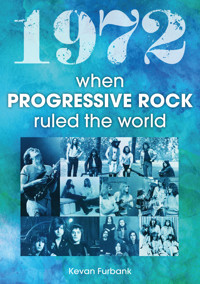
1972 was the year progressive rock came of age, when bands and artists still revered today produced some of their most ground-breaking, inventive and enduring musical creations. In this absorbing book, Kevan Furbank looks at some of the artists and albums that made 1972 such a watershed in musical achievement. He follows their development from the first tentative notes and chords to the full-blown recordings that, more than 50 years later, are still seen as masterpieces of the genre, and the gold standard by which all prog is judged.
Travel Close To The Edge with Yes, dance a Foxtrot with Genesis, tussle with Gentle Giant’s Octopus and discover you don’t have to be Thick As A Brick to enjoy Jethro Tull’s 40-minute opus. There’s a Trilogy by Emerson, Lake & Palmer, some Demons And Wizards from Uriah Heep, and a Grave New World courtesy of The Strawbs.
The author also ‘Focuses’ on manic yodelling, the End Of The World (Aphrodite’s Child), an island Obscured By Clouds (Pink Floyd) and a cult album by Bo Hansson that could be hobbit-forming. Written with passion and wit, the book is a must-have book for every music-lover with an open mind and open ears.
Now retired, Kevan Furbank was Managing Editor Reach Ireland, publishers of the Irish Daily Mirror and Irish Daily Star and a journalist on local and national newspapers for more than 40 years. He has published books on local history and written stories, articles and columns on practically every subject under the sun. This is his fourth book for Sonicbond. His music tastes encompass prog, rock, folk and jazz and in his spare time, he likes to pretend he can play guitar, bass and mandolin. He lives in Holywood, Northern Ireland, and is married with two grown-up daughters.
Das E-Book können Sie in Legimi-Apps oder einer beliebigen App lesen, die das folgende Format unterstützen:
Seitenzahl: 322
Veröffentlichungsjahr: 2025
Ähnliche
















1972
When Progressive Rock Ruled The World
Kevan Furbank
Contents
Introduction
1. The Solid Time of Change
2. New World
3. Jethro Tull – Thick as a Brick
4. Genesis – Foxtrot
5. Yes – Close to the Edge
6. Pink Floyd – Obscured by Clouds
7. Gentle Giant – Three Friends & Octopus
8. Aphrodite’s Child – 666
9. Premiata Forneria Marconi – Storia Di Un Minuto & Per Un Amico
10. Matching Mole – Matching Mole
11. Frank Zappa and the Mothers – The Grand Wazoo
12. Neu! – Neu!
13. The Strawbs – Grave New World
14. Focus – Focus 3
15. Santana – Caravanserai
16. Curved Air – Phantasmagoria
17. Can - Ege Bamyasi
18. Banco Del Mutuo Soccorso - Banco Del Mutuo Soccorso & Darwin!
19. Bo Hansson – Music Inspired by The Lord of the Rings
20. Uriah Heep – Demons and Wizards
21. They Also Served
22. Where Prog Went Next
Introduction
It was the year of Watergate in the US, the miners’ strike in the UK, murder at the Munich Olympics, Bloody Friday bombings in Belfast and cannibalism among jet crash survivors in the Andes. It was also the year a much maligned but much-loved (and, as it turns out, surprisingly resilient) genre of popular music arguably reached its zenith.
In 1972, bands such as Yes, Jethro Tull, Genesis, Gentle Giant, The Strawbs and Can produced albums that, more than 50 years later, are still regarded by many as the pinnacles of their achievements, their Mona Lisas, their Notre Dames, viewed with a mixture of adoration and awe. Some of these bands never produced anything quite as good ever again, even though they tried and, for a few, are still trying.
Many of them managed in that year to achieve the difficult balance between artistic fulfilment and critical acclaim. When the naysayers cast their slings and arrows at prog, they usually point to the musical endeavours that came later; the Passion Plays, Topographic Oceans and Arthurian dramas on ice that became bywords for ludicrous pomposity and bloated excess.
But in 1972, the genre was still fresh, new and exciting. Not only that, it was popular! Albums from Jethro Tull, Pink Floyd, Emerson, Lake & Palmer, Yes, Santana and The Moody Blues all reached the Top Ten in the UK charts – in the US, the Tull album had two weeks at number one. Today, it’s a cause for celebration when a prog album manages to limp its way into the lower reaches of the Top 40. In 1972, you could walk along the street with a copy of Close to the Edge under your arm and you wouldn’t be subjected to derision and abuse. Truly, the past is a different country.
For this book, I have chosen 22 progressive rock albums that I consider to be classics of the genre – influential, inspiring and downright entertaining. We can argue all night about whether these are the best albums the bands produced – that is, of course, a wholly subjective opinion. In any case, our favourite albums tend to be the first ones we heard, that served as gateways into the music. But these are albums that achieved critical acclaim and, sometimes, commercial success. And they have stood the test of time; 50 years later, we are still talking about them and listening to them, and they are still inspiring modern progressive rock bands.
With a shortlist of 22, it’s likely that one of your own personal favourites hasn’t got a look-in. That’s why I include a section on albums that deserve a mention in despatches, the ones that also served to make the year a little more colourful than it might otherwise have been. I also look at where progressive rock went next, and why it has seen a remarkable resurgence in the last few decades.
You will note that half of the albums I have chosen are British. This is not because I’m a rabid, xenophobic Englishman. It’s because, in the beginning, progressive rock was a particularly British phenomenon, perhaps because of our innate pomposity and pretensions. You will rarely, in my experience, find a race with their heads stuck so firmly up their own backsides, although we’re always ready to joke about it. But within my list, you will also find bands from the US, Germany, Holland, Italy, Greece and Sweden. Oh, and there will also be some yodelling.
So join me in my musical time machine as we journey some 50 years into the past, to a time when prog ruled the world. Well, almost...
The Solid Time of Change
Ask Alexa, or any other of your chosen personal digital assistants, to play music from 1972, and you will be lucky to hear any prog. But you will be reminded (or, if you are too young to remember, you will discover) that the musical landscape was wide and varied, certainly compared to the homogenised output of the 2020s. Indeed, I may go so far as to say ‘eclectic’, defined as deriving ideas, style, or taste from a broad and diverse range of sources.
It was the year of the singer/songwriter, such as Carole King, Cat Stevens and James Taylor; the beginning of glam rock, with hits from David Bowie, Elton John and T-Rex; when Motown joined the black power movement and Michael Jackson began forging his solo career. There were pretty boy singers such as David Cassidy and Donny Osmond, classic hits by easy-listening siblings, The Carpenters, and cries of defiance from 50s and 60s throwbacks including Elvis Presley, Chuck Berry and The Rolling Stones.
Even The Beatles were still at it, albeit as individuals instead of a Fab Four – John Lennon released the politically-charged and critically-panned album Some Time in New York City and commercially-toxic single ‘Woman is the N****r of the World’; Paul McCartney reached the UK Top 20 with the equally-controversial ‘Give Ireland Back to the Irish’, the risible ‘Mary Had a Little Lamb’ and the banned ‘Hi Hi Hi’; Ringo Starr had a hit with ‘Back Off Boogaloo’; and George Harrison pre-empted Live Aid by releasing a live recording of his Bangla Desh fundraising concert.
Swirling about in this musical soup were the chunky bits of progressive rock. Like all musical genres, it didn’t suddenly appear fully formed from out of the ether like Captain James T. Kirk arriving unannounced on a primitive planet. It evolved from earlier forms of music, such as psychedelic rock – indeed, it is sometimes difficult to see where one ends and the other begins. In 1967, Pink Floyd were the quintessential psychedelic rock band, producing three-minute nursery rhyme-style streams of consciousnesses or rambling,
20-minute sound collages with light-show accompaniment. By 1972, they were a prog band on the cusp of releasing the biggest prog album of all time.
Readers of my previous book, The Psychedelic Rock of 1967 (still available at all good online booksellers; don’t all rush at once) will know that I frequently blame/credit The Beatles for most of the musical changes since 1963 – and I’m going to do so again. But that’s not just my view; here’s Yes and King Crimson drummer Bill Bruford making the exact same point to Modern Drummer magazine in 2007:
Without The Beatles, or someone else who had done what The Beatles did, it is fair to assume that there would have been no progressive rock... They broke down every barrier that ever existed. Suddenly you could do anything after The Beatles. You could write your own music, make it 90 yards long, put it in 7/4, whatever you wanted
What The Beatles did, first and foremost, was to give artistic control to the artists. Previously, all decisions were taken by blokes in suits smoking fat cigars; managers, A&R men, record company bosses and producers called the shots and decided on the songs the artists would perform and how to record them. Then four cheeky Scousers came along who had their own ideas, and gradually took control of the content, sound and presentation of their own material.
It helped that they were on a minor EMI label, Parlophone, and were being produced by one of the younger employees at the EMI studios in Abbey Road who had cut his teeth on comedy records. And it also helped that The Beatles were talented songwriters who churned out hit after hit and made everyone concerned oodles of money. When they gave up touring in 1966, they spent most of their time in the studio tinkering, experimenting, innovating and spending months on end coming up with their next masterpiece.
By 1967, record companies were giving other bands free rein in the studio and trusting they would come up with the goods. And most of the time, they did because they were the same age and on the same wavelength as the fans buying the records. So by 1972, the artist was king and the studio was his or her domain – the idea that a manager or record company executive would have a say in the creation of the actual music had become a heresy in certain quarters. If a band wanted to take a year to create its masterpiece, then that’s what happened. The role of the record company was to be patient and wait for the magic to happen, while the role of the manager was to dangle concert promoters off the edge of balconies to make sure the artists got paid.
Technological changes also played a part. In 1967, The Beatles made Sgt Pepper’s Lonely Hearts Club Band with four-track recording machines. If you had more than four instruments and voices to record, you had to mix as you went along, then ‘bounce’ what you had to one track and wipe the other three clean to record the harmonies, or a sitar, or 20 pianos playing one chord in unison. The Fab Four didn’t have eight-track until Abbey Road in 1969.
By 1972, most studios had sixteen-track recorders, which gave artists much more freedom to do what they wanted and, consequently, enabled them to tinker for much, much longer. But, remember, this was still in the days before digital recording when editing meant literally taking a razor blade to a piece of tape. The days of being able to cut and paste at a touch of a mouse were still a long way off.
Other innovations were the development of the compact cassette and a machine that could record on them. The Beatles had to write memorable songs because that was the only way they could remember them. But by the late 1960s, artists could capture all their brilliant musical thoughts at home to present to the rest of the band in the studio, so the best bits could be cherry-picked and combined into something new and exciting. In 1972, Teac introduced four-track tape recorders for home use, so musicians could create entire songs in their living rooms.
They also had more instruments to play with. The mighty Mellotron, introduced in 1963, was heard in 1967 on The Beatles’ ‘Strawberry Fields Forever’ and on The Moody Blues’ album Days of Future Passed. But it was a big, unwieldy and unpredictable monster of a machine that practically required a degree in engineering to operate and a forklift truck to manoeuvre. In 1970, that changed with the introduction of the smaller, more lightweight Model 400 – now the Mellotron could actually be taken on tour and used on stage, so it became the must-have instrument for a lot of progressive rock bands who wanted that big orchestral sound, particularly King Crimson and Genesis.
Portable synthesisers became more widespread and, indeed, more portable. In 1970, Robert Moog introduced the Minimoog, which was about the size of a typewriter, while a year later, Malcolm Cecil and Margouleff debuted The Original New Timbral Orchestra, or TONTO, which could produce different synthesised sounds simultaneously.
In my 1967 book, I showed how changes in society, such as the improvement in education, the growing affluence of teenagers and the widening gap between generations, created a growing market for psychedelic rock. As these trends continued into the 1970s, they allowed progressive rock to briefly take centre stage.
For example, record buyers could more easily afford long-players, so the importance of singles began to diminish, and the LP became the ultimate artistic statement. In the UK, it was a long-standing tradition not to put the hit single on the album as it was feared fans would baulk at paying for the same song twice (in the US, the opposite approach was taken – the album wouldn’t sell unless it contained the hit). But by 1972, some bands had dispensed with singles completely – unless the record companies sneaked them out without their knowledge – seeing the constraints and triviality of the three-minute pop platter as being beneath them.
With up to 26 minutes of music space available on each side of an LP, artists began to stretch beyond the traditional song length of two to four minutes.
Now, long songs were nothing brand, spanking new – classical music was always as long as the composers wanted it to be, simply because recording technology constraints didn’t exist. The compact disc was initially designed to hold 74 minutes of music so the listener could hear Beethoven’s Ninth Symphony without interruption.
Jazz artists frequently created lengthy suites of music – John Coltrane’s A Love Supreme, released in 1964, originally contained an eighteen-minute track stretching across side two. In folk music, Arlo Guthrie and Sandy Bull experimented with side-long songs, while you could argue that Days of Future Passed contains two side-long pieces of music, with each song connected by orchestral links.
But it was in 1972 that the epic long song became ubiquitous, with ‘Supper’s Ready’ by Genesis, ‘Close to the Edge’ by Yes, Jethro Tull’s ‘Thick as a Brick’ and ‘Anonymous’ by Focus all testing the listener’s patience and bladder control. Some of these compositions began life as separate pieces until someone said, ‘Hey, we can link these together’, while others were always intended to be monsters – Ian Anderson of Jethro Tull deliberately set out to create a spoof concept album that would contain one piece of shifting, changing music, separated only by some windy sound effects that told you it was time to turn the record over.
The other social change that helped the development of progressive rock was education. Most songs are about love, and there’s nothing wrong with that. It makes the world go round and is allegedly all you need. Even the term ‘rock ‘n’ roll’ was a euphemism for the, ahem, physical demonstration of mutual attraction. When the bands of the 1950s were rockin’, rollin’ and shakin’ all over, they were, of course, singing about shagging.
But by the 1960s, young musicians had a wider palette of knowledge to draw from. Instead of being simple country boys or high school dropouts, they were graduating from art schools and universities with their heads full of literature and philosophy. It was inevitable that these ideas would find their way into the music. Elvis Presley sang, ‘Well, there’s-a one for the money’.
John Lennon sang ‘Turn off your mind, relax and float downstream’, quoting The Tibetan Book of the Dead. Jon Anderson of Yes made a career out of crafting dense, impenetrable lyrics inspired by such popular bestsellers as Autobiography of a Yogi by Paramahansa Yogan. Sure, we’ve all got a dog- eared copy in the bookcase.
With their heads full of stories, legends, myths and philosophies, prog artists wanted to do more than just write three-minute love songs – they wanted to spread ideas and tell tales through music and lyrics. Thus the concept album became ubiquitous. Again, the idea of creating a collection of songs that tell a story or are linked thematically was not a new, er, concept – Woody Guthrie did it with his 1940 album Dust Bowl Ballads, Frank Sinatra with his themed series of LPs for Capitol Records in the 1950s, and jazz artists such as Duke Ellington, whose 1957 release Such Sweet Thunder is a suite of melodies inspired by the works of William Shakespeare.
But it took the proggers to make the concept album a ubiquitous part of the musical landscape, and by 1972, it was rare to find a prog album that didn’t have some sort of theme running through the grooves and seeping into the cover artwork. The ultimate concept album was probably Thick as a Brick, on which more time was spent creating the lavish packaging than on recording the music.
Prog artists were also more musically educated. Keith Emerson and Rick Wakeman, for example, had piano lessons from an early age and learnt how to read music. Wakeman also played clarinet. As for the three Shulman brothers, who formed the core of Gentle Giant, they were encouraged by their jazz trumpeter father to master as many instruments as they could.
Another Giant, Kerry Minnear, graduated from the Royal Academy of Music in London and played eleven instruments on the band’s first album, including cello.
So musical proficiency became one of the bedrocks of progressive rock, to a point where even the drummer brought an academic approach to his (and it was usually a he) instruments, augmenting the basic setup of toms, bass drum and cymbals with all manner of things to hit, stroke and shake. Gone were the days when the drummer or bass player would wait for the guitarist and singer to decide how the song should go. Instead, every member of the band could throw in ideas, helping to stretch compositions even further or make a case for a short musical interlude involving double or triple-tracked bass guitar, or an acoustic guitar solo, or a burst of manic percussion in a time signature previously only known to Stephen Hawking.
With musical proficiency came a wider palette of influences. Keith Emerson of The Nice and ELP was inspired by Fats Waller, Oscar Peterson, Bach, Copland and Bartok. Rick Wakeman of The Strawbs and Yes loved (and probably still does) Trad Jazz, Prokofiev and Lonnie Donegan. Steve Howe of Yes credits Tennessee Ernie Ford, Barney Kessel and Chet Atkins. For Steve Hackett of Genesis, it was The Shadows and Segovia. For Evángelos Odysséas Papathanassíou – aka Vangelis, of Aphrodite’s Child – it was the Greek folk music of his youth. Frank Zappa’s musical career was kickstarted by the sound experiments of Edgard Varese but he also loved cheesy doo-wop.
All these influences inevitably found their way into the music they were making, by accident and by design, with the result that prog opened its arms and embraced any and all genres, stretching back into the distant past. Listen to Gentle Giant and you will hear baroque influences from the 17th century and even earlier. And you know what they say – if it ain’t baroque, don’t fix it.
New World
We could argue until the cows come home, make a cup of tea and sit down to listen to an entire box set over what was the first progressive rock album. Some commentators go back to The Beatles’ Revolver or The Beach Boys’ Pet Sounds. Others of a more purist bent wait until 1969 with In the Court of the Crimson King. But I am going to stick my neck out and give the honour to The Moody Blues’ 1967 creation: Days of Future Passed.
Why? Well, first of all, it’s a concept album – a day in the life, as it were, from dawn to night, with every song serving the story. To understand it properly, you have to listen from beginning to end, from ‘The Day Begins’ to ‘Late Lament’ (passing through ‘Nights in White Satin’, which, in 1972, became a belated hit single for the band). In doing so, it embraces rock, pop, soaring ballads, exotic Eastern scales and portentous poetry.
It’s also a classical and rock mash-up – initially intended to be an adaptation of Dvorak’s New World Symphony, it instead used an orchestra to link original songs into side-long suites, with conductor Peter Knight reprising melodic themes and composing new material to open and close the album. This isn’t just a collection of songs with classical backing – it is the orchestra and rock band weaving in and out to create a whole new musical experience.
And there’s a mighty Mellotron! Everywhere! In fact, it’s almost impossible to tell where the orchestra ends and the Mellotron begins. They blend together so well.
Psychedelic rock was made under the influence of LSD – that’s why it was psychedelic, maaan. But Days of Future Passed was so precise and intricate, it could only be made by musicians fuelled by nothing more stimulating than a cup of tea and some biscuits. It is a prog pioneer.
The Moodies continued in a similar vein but never reached the prog heights of their 1967 masterpiece. Never mind, there were plenty of other bands ready and willing to pick up the prog baton and wave it around. The Nice, led by keyboard maestro Emerson, went full-on prog for their second album, 1968’s Ars Longa Vita Brevis, which not only had a Latin title meaning ‘Art is long, life is short’ but featured a side-long suite inspired by Bach’s Brandenburg Concerto No3.
In the same year, the first mention of progressive rock appeared on a record sleeve on the debut album by Canterbury band Caravan. By the following year, prog was taking flight thanks to bands including The Who (Tommy), Pink Floyd (Ummagumma), Amon Duul II (Phallus Dei), Frank Zappa (Uncle Meat) and debuts from Yes, Van Der Graaf Generator and Renaissance.
King Crimson’s first LP that year was not only an instant prog classic that blended orchestral music, jazz and hard rock but showed that prog could be downright nasty and dirty. Even now, ‘21st Century Schizoid Man’ sounds like someone’s deranged idea of Armageddon while, live, the band channelled Holst’s Planets Suite and free jazz. Its importance is perhaps underlined by the fact that, 53 years later, King Crimson were until recently still touring under band leader Robert Fripp and still making music that sounds timeless.
Out of those early albums came a whole panoply of progressive rock sub- genres: progressive jazz, space rock, krautrock, symphonic prog, Rock in Opposition, the Canterbury sound, art rock, zeuhl, prog metal, neo-prog, to name but a few. Many labels, but the same intention – to break free of old restrictions, to demolish old boundaries, to stimulate both the body and the mind, to excite, entertain and inform. To mangle a phrase from Captain James T. Kirk, to boldly go where no music has gone before...
Jethro Tull – Thick as a Brick
Personnel
Ian Anderson: vocals, flute, acoustic guitar, violin, saxophone, trumpet
Martin Barre: electric guitar, lute
John Evan: Hammond organ, piano, harpsichord
Jeffrey Hammond: bass, spoken word Barriemore Barlow: drums, timpani, percussion
With:
David Palmer: strings arrangements & conducting
Recorded during December 1971 at Morgan Studios, London Produced by Ian Anderson and Terry Ellis
Engineered by Robin Black
Label: Chrysalis (Europe), Reprise (everywhere else) Release date: 3 March 1972
Chart placings: UK: 5, US: 1, Australia: 1, Canada: 1, Denmark: 1, Norway: 3,
Netherlands: 3, Germany: 4,
Tracks (subtitles taken from 40th-anniversary edition downloads): ‘Thick as a Brick, Part 1’ – i) ‘Really Don’t Mind/See There a Son Is Born’ ii) ‘The Poet and the Painter’ iii) ‘What Do You Do When the Old Man’s Gone?/From the Upper Class’ iv) ‘You Curl Your Toes in Fun/Childhood Heroes/Stabs Instrumental’, ‘Thick as a Brick, Part 2’ – i) ‘See There a Man Is Born/Clear White Circles’ ii) ‘Legends and Believe in the Day’ iii) ‘Tales of Your Life’ iv) ‘Childhood Heroes Reprise’
All tracks written by Gerald Bostock (but not really)
The story so far...
Originally, they were the John Evan Band, formed by Blackpool schoolmates Ian Anderson, Jeffrey Hammond and John Evans (he later lost the ‘s’) in 1964. They recruited drummer Barrie Barlow and guitarist Chris Riley, playing blue- eyed soul. Various personnel changes saw Hammond replaced on bass by Glenn Cornick and Riley by Mick Abrahams. By 1967, they were a four-piece blues band with Clive Bunker on drums. New name Jethro Tull came froma booking agent’s staff member, who was a history buff (Mr Tull invented the horse-drawn seed drill in 1700), and first single ‘Aeroplane’ – originally recorded by the John Evan Smash – released in 1968 on MGM Records (and famously credited to ‘Jethro Toe’). Signed to Island Records, the band recorded a blues album heavily influenced by Abrahams, who left soon after (or was pushed). The title, This Was, suggested changes to come. Recruiting new guitarist Martin Barre, leader Anderson took Jethro Tull in the direction of progressive blues and folk, releasing the UK number one album Stand Up in 1968 and number three single ‘Living in the Past’. Follow-up, Benefit, in 1970, fared less well despite the return of John Evan on keyboards but 1971’s Aqualung was a million-seller, cracking the US Top 10. Bunker left in May 1971 and was replaced by Barrie Barlow.
The album
They burned copies of Aqualung in the US. It had songs about religion on it that offended the Bible Belt, so they stoked up the fires of righteousness. That was in the days when an album could do that – Ian Anderson released one about religion in 2022 and no one really took much notice. But back in 1971, it seemed a few lyrics about Christianity in the vinyl grooves of a British band’s latest LP could make the baby Jesus cry.
Everyone thought it was a concept album about religion, or homelessness, or ... something. Ian Anderson denied it, but no one believed him. After all, that was surely him on the cover, greasy fingers feeling shabby clothes, lurking furtively like some bedraggled, perverted Fagin. And there did seem to be a sort of common theme running through it, something about the lost and dispossessed, abandoned by society but also by the followers of Yahweh, that was referenced in the mock bible verses on the back of the sleeve.
Anyway, the outcry and misinterpretation – as Anderson saw it – led him to make a momentous decision: the next Jethro Tull LP would be a concept album. In fact, it would be the mother of all concept albums, a spoof, a parody that would play on the gullibility of some of the fans and critics. And it wouldn’t just be the music – the mischief would extend to the elaborate packaging, even to the song credits. What fun! And, in the process, Anderson created one of the greatest progressive rock albums of the 1970s.
In my introduction, I pointed out that many of the progressive rock bands we meet in this book came out of the psychedelic era. Well, Tull were an exception. They were a soul band, then a blues band, before Anderson pulled in elements of prog and folk to create a richer musical stew. But his songwriting inspiration wasn’t The Beatles, Stevie Winwood or T-Bone Walker but a fellow Blackpool dweller, one Roy Harper, who penned stark, uncompromising blasts at religion, capitalism, drug laws, racism ... well, anything you’ve got, really. So vitriolic and impassioned could he be that audiences used to walk out during ‘I Hate the White Man’, his tirade against white rule in South Africa.
Anderson wasn’t the only other musician to be inspired by Harper – Led Zeppelin named a blues song ‘Hats Off to (Roy) Harper’ on their third album, and he sang ‘Have a Cigar’ on Pink Floyd’s Wish You Were Here. But the songwriting influence is clear to see in Anderson’s work, particularly in his acoustic numbers, and it’s not just that they both wrote songs about Blackpool. It was in their choice of targets, in their biting cynicism, and in their occasionally touching, gentle ballads augmented by strings. What made them different was how their characters dictated the songs – Harper was impassioned, unrestrained, angry, romantic and personal; Anderson more detached and controlled, more likely to create a character than write about himself, to stand outside the song and view it with wry cynicism.
Both also play acoustic guitar, Harper with a distinctive fingerpicking style and Anderson with more of a strumming approach while ringing out individual notes with his pick. The latter is best known for playing the flute while unaccountably standing on one leg, but he started off as a guitarist, changing instruments only when Mick Abrahams joined the band. Assuming the leadership of Tull, and taking the music away from blues purity, allowed him to slip in some acoustic numbers to provide a respite from the thundering drums and roaring electric guitar.
So in 1969’s Stand Up, we get the wistful ‘Reasons For Waiting’, on Benefit, the folkie ‘Sossity, You’re a Woman’, on Aqualung, the brief but beautiful ‘Wond’ring Aloud’ and ‘Slipstream’. But Thick as a Brick was to be the first album to have the acoustic guitar centre-stage, opening and closing proceedings and driving many of the sections. It was not an unexpected decision. At the end of 1971, after Barrie Barlow had joined on drums, Tull released an EP containing the pretty acoustic-based ‘Life is a Long Song’ (along with Anderson’s Blackpool tribute, ‘Up the Pool’) that reached the heady heights of number eleven in the UK charts, the last time the band would make an appearance in the UK Top 30 until 1976.
In fact, when he started composing material for the new album, all Anderson had was an acoustic riff in F (but played as a D with a capo on the third fret) and the line ‘Really don’t mind if you sit this one out...’. He says he didn’t originally envisage the album containing one long track split over two sides of vinyl, and that everything grew as it went along in rehearsals.
But at some stage, Anderson conceived the idea of writing a poem that would allegedly spring from the mind of a precocious eight-year-old called Gerald Bostock – giving the imaginary youngster the nickname Little Milton, after the 17th-century poet John Milton.
He has since said that Bostock is an exaggerated version of himself as a child. He told Prog magazine in 2016:
As a child, I was a bit of a rebel. Most of my peers aspired to go to grammar school, getting eight O Levels and three A Levels, then becoming part of conventional society. That never appealed to me. I was the sort of child who loved spending time collecting pond life and then analysing it. I also loved science fiction stories of the era (the 1950s), because they told of a different, exciting future. So, I stood apart from others of my age and drew on this for the character of Gerald Bostock. But he himself is a fiction.
As to the content of Little Milton’s ramblings, well, they are somewhat obscure and contain an almost kaleidoscopic jumble of images and references. As the album was meant as a parody, we shouldn’t necessarily expect the words to have much meaning anyway. But there are a few themes that come through, ones Anderson has touched on before and will do so again, such as the fragility of modern values, the ephemeral nature of power and the hypocrisy and helplessness of those who seek to rule over us, the dumbing down of education and the drive towards the average rather than the exceptional. Here’s another hint to their origin from a 1976 interview with John Alan Simon in Downbeat magazine:
It wasn’t a conception, really, just the act of writing a song, thinking about what I might have been, what I began life as being, what kind of childhood images moved me – dealt with in a very oblique fashion, because I’m not setting out to create a threadbare tale of emotional woe or to even delineate emotional happenings. I’m just creating a background lyrical summation of a lot of things I feel about being a contemporary child in this age and the
problems that one has – the problems of being precocious beyond one’s age or having interests beyond one’s age, and, to some extent, being ruled in a kind of heavy-handed, unexplained fashion by father-figures.
Heavy-handed father figures have appeared before in Anderson’s work: On ‘Son’, from Benefit, he depicts a toxic father-son relationship – ‘Permission to breathe, sir/Don’t talk to me like that, I’m your old man’ – and in ‘Wind-Up’, from Aqualung, he rages ‘How’d you dare to tell me that I’m my father’s son, when that was just an accident of birth’. Clearly, there had been some friction between the generations in the Anderson parental home, although probably no more than existed – and still exist – in a lot of homes, and the son paid the father a small tribute by wearing his bedraggled, tramp-like coat on stage.
Anderson also revealed in Psychology Today, no less, that he had been caned at school, a common occurrence in Britain at the time and seen as morale and moral-building. Eventually, at seventeen, he refused to be beaten and was kicked out of school instead. So it’s clear there are plenty of biographical elements in Gerald Bostock’s poetry, but heavily disguised so Anderson can plausibly say, ‘It’s not about me – I’m writing about some other bugger’. Perhaps writing it was a cathartic experience for Anderson, letting it all out but staying guarded and secretive at the same time.
There’s also an awful lot of silliness for silly’s sake on Thick as a Brick – this is the era of Monty Python’s Flying Circus, practitioners of the surreal, ridiculous and occasionally subversive humour introduced by Spike Milligan and the Goons. The words were not meant to be taken too seriously; they were a spoof of the apparently dense, murky and faux-intellectual lyrics some bands with an inflated opinion of themselves were producing at the time. Yes, we all know who I’m talking about. So, Anderson created images and ideas that were deliberately ridiculous – the babies wearing nylons, the cats getting an upgrade, the references to Superman and Biggles (fictional pilot and adventurer from 1930s, non-British readers) and the generally jumbled nature of the narrative, which goes nowhere and everywhere at the same time. Taken as poetry, you could rip this to pieces as bloated and unfocused. But as lyrics, they served their purpose – to give Anderson a framework upon which to hang his music.
The band had just finished up a US tour and had December 1971 off to concentrate on creating the next LP. During that time, Anderson would get up early in the morning to write and, in the afternoon, go into The Rolling Stones’ basement studio in London with the band to rehearse what he had just composed. The next day, he would write the next section and tack that onto the previous one, so after ten days, they had one long piece made up of about eight distinct parts (the titles listed above were not on the original album but appeared as separate downloadable tracks for the digital version of the 40th- anniversary box set). In the box set, talking to Dom Lawson, he explained:
It was a very speedy process and, because I was the only writer, it was like being a conductor, trying to get the other guys to realise the masterplan I was evolving. They didn’t have the foggiest clue what was going on and they probably thought I was faintly barking... But very quickly, we had it complete and in a form that allowed us to go in and play a lot of it live in the studio.
That was Morgan Studios in Willesden, north-west London, using studio two because it had a more intimate, dryer sound that suited acoustic instruments. Thanks to the earlier rehearsals, the album took about two weeks to record, in the order that the music appears, with a couple more weeks for overdubs. It was a tricky task, requiring engineer Robin Black to ensure he had enough tracks left at the end of each piece of music to start the instruments for the next. In the box set, Black reveals that during the mixing stage, it was discovered the tuning was wrong at the end of side one – the reason was the tape machine had started running slower at the end of 20-odd minutes of tape, so the entire mixing process had to start again from scratch. Black admitted: ‘I was quite depressed at this’.
The result is an album that, on side one at least, represents a slice of the most perfect Tullian prog you could hope to hear. From the gentle, whimsical acoustic guitar opening, through the thunderous, repetitive riffing of ‘See, there, a son is born’, the stomping ‘Poet and the Painter’, the jig-like ‘From the Upper Class’ and sprightly ‘Childhood Heroes’, the first side grows in stature and drama until stabbing chord triplets transition into some windy sound effects, telling us it’s time to turn the album over.
Had 74-minute CDs been around in 1972, there’s no doubt Anderson would have dispensed with the windy interlude and gone straight into side two, which takes up where the first side left off. The flip side, however, is less successful – less cohesive, bittier, with frequent reprises, some clumsy avant-garde percussion sequences, with barely audible muttering from Jeffrey Hammond, and a rather lengthy and dull section in the middle. It doesn’t really take off again until the stately ‘Childhood Heroes Reprise’ at the end, finishing with a repeat of the opening solo acoustic guitar figure under the line ‘And your wise men don’t know how it feels to be thick... as a... brick...’ and a final sardonic chuckle. And it seems Anderson agrees with me – after being performed in its entirety in 1972, the album settled down as a long standing part of the Tull live repertoire but as a truncated, 13-minute suite containing most of side one plus the side two ending.
But Thick as a Brick is not just about what’s in the grooves because we now come to the album’s cover: a fold-out, twelve-page A3 newspaper that famously took longer to produce than the music. By any standards you care to invoke, this was the progressive rock cover par excellence, an investment in time, imagination and money that was not to be repeated until the introduction of the wallet-draining box set.




