


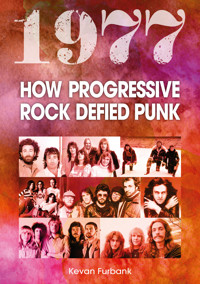
9,99 €
Mehr erfahren.
- Herausgeber: Sonicbond Publishing
- Kategorie: Geisteswissenschaft
- Sprache: Englisch
The prevailing wisdom is that, in 1977, punk rock killed prog – presumably by drowning it in spittle. But is this really true? Absolutely not! Prog didn’t just survive what turned out to be the short-lived rule of the barbarians, it evolved and arguably, prospered. In 1977 – the year punk supposedly conquered the world (well, the UK anyway) – many of our most well-established progressive rock bands released some of their best albums, including Pink Floyd’s Animals, Going For The One by Yes, Rush’s A Farewell to Kings, Jethro Tull’s Songs From The Wood and the debut from American band Happy The Man, while Godley and Crème released their astonishing triple album Consequences. Van der Graaf, ELP and Brian Eno each released two albums in a busy year. These were infinitely varied takes on a genre that was still, for a while at least, in rude health despite the column inches devoted to punk.
In this informative, readable and – for punk fans at least – annoying book, Kevan Furbank looks at the progressive rock bands and albums that left punk reeling in the moshpit. To misquote the Sex Pistols, never mind the b*llocks – here’s the progressive rock of 1977.
The Author
Now happily retired, Kevan Furbank was Managing Editor of Reach Ireland, publishers of the Irish Daily Mirror and the Irish Daily Star and a journalist on local and national newspapers for more than 40 years. He has published books on local history and written stories, articles and columns on practically every subject under the sun. This is his fifth book for Sonicbond. His music tastes encompass prog, rock, folk and jazz, and, in his spare time, he likes to pretend he can play guitar, bass, ukulele, bouzouki and keyboards. He is married with two grown-up daughters and lives in Northern Ireland.
Das E-Book können Sie in Legimi-Apps oder einer beliebigen App lesen, die das folgende Format unterstützen:
Seitenzahl: 344
Veröffentlichungsjahr: 2025
Ähnliche


















1977
Kevan Furbank
Contents
Acknowledgments
Introduction
1. Pink Floyd – Animals
2. Yes – Going For The One
3. Jethro Tull – Songs From The Wood
4. Emerson, Lake & Palmer – Works Volume 1 & Works Volume 2
5. Styx – The Grand Illusion
6. Peter Gabriel – Peter Gabriel I [Car]
7. The Alan Parsons Project – I Robot
8. Lol Creme/Kevin Godley – Consequences
9. Gentle Giant – The Missing Piece
10. Goblin – Suspiria
11. Anthony Phillips – The Geese & The Ghost
12. Rush – A Farewell To Kings
13. Steve Hillage – Motivation Radio
14. Van der Graaf – The Quiet Zone/The Pleasure Dome
15. John Greaves, Peter Blegvad & Lisa Herman – Kew. Rhone.
16. Camel – Rain Dances
17. Brian Eno – Cluster & Eno/Before And After Science
18. Happy The Man – Happy The Man
19. Hawkwind – Quark, Strangeness And Charm
20. They Also Served…
21. Where Prog Went Next
Acknowledgments
I would like to thank John Greaves and Stanley Whitaker for giving up their time to talk about their music. Thanks also to Stephen Lambe and his team at Sonicbond for making sense of my scribbles. Most of all, I would like to thank my wife, Elizabeth, for her endless patience, love and support, and my children, Sarah and Emily, for constructive criticism. Oh, and my new granddaughter, Maeve – please grow up to be a prog fan!
Introduction
The prevailing wisdom is that punk rock killed prog in the late 1970s – presumably by drowning it in spittle. Like the asteroid that wiped out the dinosaurs 66 million years ago, punk smashed into our planet with its snarling three-chord rebellion and creative use of safety pins, obliterating some of the bigger prog behemoths and forcing others to take shelter underground. Punk’s victory in this cataclysmic musical revolution was summed up by a T-shirt worn by Sex Pistols lead singer Johnny Rotten that defiantly proclaimed I HATE PINK FLOYD.
But is this really true? By heck, it isn’t! Prog didn’t just survive what turned out to be the short-lived rule of the barbarians, it prospered and evolved. In 1977 – the year punk supposedly conquered the world (well, the UK, anyway) – many of our most well-established progressive rock bands released some of their best albums.
There was Going For The One by Yes, arguably the last of their great classic albums (and the first Yes album I heard, giving it a special place in my musical heart). Jethro Tull’s Songs From The Wood was a return to form after the disappointment of 1976’s Too Old To Rock ‘N’ Roll, Too Young To Die, and is surely one of the top five best albums from one-legged flute warbler Ian Anderson. Rush’s A Farewell To Kings is a personal favourite of mine, and Steven Wilson’s, apparently, as is Animals from Mr Rotten’s hated Pink Floyd.
It is undoubtedly true that a few prog bands were close to extinction at this point. Emerson, Lake & Palmer released no fewer than six sides of vinyl in 1977, plus a hit single in ‘Fanfare For The Common Man’ – two years later, they were practically history. Gentle Giant’s The Missing Piece showed a band in a state of schizophrenic uncertainty – they struggled on for two more albums before being cut down to size. King Crimson were on an extended hiatus after breaking up in 1974, Genesis were about to transform into a world-conquering pop beast with the departure of guitarist Steve Hackett and Gong had lost main man Daevid Allen and were heading into the world of bland jazz fusion under percussionist Pierre Moerlen.
But the year also saw debut albums from defiantly uncommercial prog bands such as Happy the Man and Univers Zero, and from former Genesis frontman Peter Gabriel. Meanwhile, Godley & Creme’s bizarre first solo release was to have serious Consequences for 10cc.
In this book, I have picked a bunch of albums and artists that I think represent the pinnacle of the genre’s achievement in 1977. Some may be obvious choices, and I have already mentioned a few of them above. Others may be new to you, even if you consider yourself a bit of a prog cognoscente, and will hopefully encourage you to explore some new, hopefully ear- opening, sounds. All are studio albums released in 1977 – live albums don’t count, so no Seconds Out by Genesis or Livestock by Brand X.
This is obviously a subjective list, and you may find some of your own favourites given the cold shoulder. That’s why I include a section on albums that merit a mention in despatches, the ones that also served to make the year a little more colourful than it might otherwise have been. I have also tried to avoid making the list too UK-centric, although that is difficult because progressive rock has been (and still is) a very British preoccupation. So, you will find bands and artists from countries including the US and Italy within these pages.
Join me on a trip back to 1977. To mangle a quote penned by the immortal Bard of Avon, lend me your eyes and ears. I come to praise progressive rock, not to bury it. As for Mr Rotten Esq., he later admitted he loved The Dark Side Of The Moon. Cheeky little proghead he is.
Memories Of Old Days
They say if you can remember the 1960s, you weren’t there. If you can remember the 1970s, however, you may wish you hadn’t been there.
The decade is generally regarded as a grim nightmare, foreshadowed perhaps by the fatal stabbing of a fan at the Altamont festival in California in 1969 and the break-up of The Beatles in 1970 – events that signalled the 1960s dream was well and truly over.
It was a decade of strife, with energy crises, soaring inflation and political upheaval. In the UK, power cuts caused by striking coal miners and railway workers forced a Tory government to bring in a three-day working week before TWO general elections in one year – 1974 – kicked them out of office until 1979.
The nation was rocked by repeated IRA and loyalist massacres that spread from Northern Ireland to mainland Britain, the most notorious outrages being the Birmingham pub bombings in 1975 that killed 21 innocent people and injured 182, and the Dublin and Monaghan bombings a year earlier that slaughtered 34 people and an unborn child. Then there was Bloody Sunday in 1972 when British paratroopers shot dead 14 unarmed civilians – an act of State terrorism that has impacted Northern Ireland ever since.
In the US, the Watergate scandal in 1974 and the defeat in Vietnam the following year shook America’s view of its country as the ‘greatest in the world’. The racial conflict that had exploded during the 1960s spilt over into the following decade and the nation was wracked with riots and protests as people fought for long-demanded freedoms. Political instability continued throughout the 1970s with two one-term presidents, Jimmy Carter and Gerald Ford (actually a three-quarters of a term president as he failed to be elected after replacing the disgraced Richard Nixon). Carter’s presidency ended in chaos thanks to the Iran hostage crisis, the Soviet invasion of Afghanistan and another energy crisis.
The key events of 1977 include the death of the King of Rock ‘n’ Roll, Elvis Presley, notoriously while on the toilet at his Memphis, Tennessee, home, Graceland, after months of constipation. He had performed his final concert just eight weeks previously. The year also saw the deaths of three members of rock band Lynyrd Skynyrd in a plane crash near Mississippi, while another flight disaster in Indiana claimed the lives of 15 members of the University of Evansville basketball team. Marc Bolan was killed in a car crash in London at the very tender age of 29.
Amid the doom and destruction, it’s no wonder that people wanted to escape not just their miserable environments but the very planet itself – the big films of the year were the first Star Wars instalment and Close Encounters Of The Third Kind. If intergalactic travel was just a pipe dream, then perhaps we could dance our way to happiness with Saturday Night Fever, a film that not only established John Travolta as a star but also lit the blue touchpaper under disco music. The soundtrack, featuring songs by the Bee Gees, became one of the biggest-selling albums of the 1970s.
Indeed, we can join ABBA in saying ‘Thank You For The Music’ in 1977. The all-conquering Swedish combo released their second-best album, Arrival, in that year (the best was ABBA: The Album in 1978), while Fleetwood Mac’s Rumours eventually became the bestselling LP of the year. Other bands dominating the album charts included: 1960s legends The Shadows, who hit the UK number one twice in 1977, once with Cliff Richard; The Beatles with Live At Hollywood Bowl; Frank Sinatra with Portrait Of Sinatra – Forty Songs From The Life Of A Man; and, believe it or not, Connie Francis’s 20 All Time Greats. It was the same story in the US, where the Billboard 200 was topped by The Eagles, Fleetwood Mac, Barbra Streisand and Kris Kristofferson. Then, there was Wings’ ‘Mull Of Kintyre’ – nine weeks at number one in the UK, outselling anything The Beatles did.
It was also the year that saw the Electric Light Orchestra become an all- conquering beast with the release of Out Of The Blue, an album that, like Rumours, was packed with so many hit singles that critics complained it was TOO good. ELO were almost prog – their melding of pop and classical music was surely inspired by The Moody Blues’ Days Of Future Passed, the first album that can claim to be progressive rock, in my view. Earlier ELO releases, such as the second album and 1974’s Eldorado, certainly deserve the tag. In 1977, the pop content had certainly taken over, but there were still moments when ELO allowed their proggy side to come to the fore on tracks such as ‘The Whale’ and the four-song suite ‘Concerto For A Rainy Day’.
All this may come as a surprise to those who thought 1977 was Year Zero for punk rock, such as the music press, who gave the genre far more publicity than it merited. In reality, few punk artists came within spitting distance of the number-one spot in the album or even the singles charts, which were dominated by disco, soft pop and bloody ‘Mull Of Kintyre’. It is true that The Ramones, The Stranglers, The Buzzcocks and The Clash released albums that were later seen as important punk milestones, but, apart from The Stranglers, who were really too good to be punk, they rarely troubled the top ten in the charts.
The Sex Pistols were the real exception. Their controversial 1977 single ‘God Save The Queen’ – timed to coincide with Queen Elizabeth II’s silver jubilee – was kept off the top spot by some industry jiggery-pokery, while their album Never Mind The Bollocks, Here’s The Sex Pistols hit number one for two weeks (during which time, a court ruled the word ‘bollocks’ not obscene. So, bollocks, bollocks, bollocks). But then, so did Yes with Going For The One – a progressive rock album that topped the chart in 1977! Clearly, rumours of prog’s death had been greatly exaggerated.
Closer To The Heart
It is true that the first great progressive rock era, which we can say started in about 1969, was coming to an end. In that time, we saw prog evolve out of the psychedelic rock of the mid to late 1960s to reach its peak in 1972/73, with groundbreaking albums such as Jethro Tull’s Thick As A Brick, Yes’s Close To The Edge, Pink Floyd’s The Dark Side Of The Moon and Emerson, Lake & Palmer’s Trilogy and Brain Salad Surgery. These were albums that were both commercially and critically successful, released during a time when you could walk down the street with a prog album under your arm and not be subjected to ridicule and contempt.
What was – and is – prog? Greater minds than mine have wrestled with this question and still are. But we can identify a few key elements. One is the gumbo of genres – prog combined the compositional and structural ambition of classical music, the instrumental and improvisational flair of jazz and the storytelling of folk, plus a smattering of non-Western influences, particularly from the Middle East and India.
The three-minute pop song, with its rigid structure of verses and choruses, gave way to lengthy compositions that sometimes spanned entire albums. An almost obsessive dedication to technical skill meant players could treat their instruments as part of intricately arranged electric orchestras. Lyrical content developed from simple rhymes about boy meets girl to discourses on life, death, money, power, science, religion and the antics of little Pothead Pixies with propellers on their heads from the Planet Gong.
Thanks to the success of The Beatles, who showed record companies they could let the artists take creative control and still make money, prog bands used the recording studio as another instrument to piece together their creations. Thanks also to ever-developing technology, musicians had an armoury of new instruments and machinery to realise their visions. The Beatles recorded Revolver in 1966 on a four-track tape machine; by 1977, bands had at least 24 tracks to play with – even more if they linked two or more machines together. The first digital recordings were released in that year.
If you wanted an orchestra in the 1960s, you had to hire one. Then, the Mellotron, which played short tape loops of sound, was introduced and became a must-have instrument for prog bands in the early 1970s. By 1977, there was the Polymoog synthesiser, the Synclavier and the Yamaha CS-80, which had true eight-voice polyphony (that’s eight notes sounding at the same time) and touch-sensitive keys just like a piano.
As the 1970s wore on, some prog bands began to sink under the weight of their own excesses or found their artistic visions were out of sync with commercial reality. Take Yes, for example. Close To The Edge, with its side- long title track, achieved the perfect balance of artistic ambition and melodic accessibility. But 1973’s Tales From Topographic Oceans, a double album of four side-long tracks inspired by Hindu guru Paramahansa Yogananda’s Autobiography of A Yogi, became almost a symbol of self-indulgent over- reach. Some fans love it, but even Yes keyboardist Rick Wakeman hated it, dubbing it ‘Tales from Toby’s Graphic Go-Kart’ and quitting the band in disgust (he came back in 1977).
But he can talk. For didn’t Mr Wakeman release an album about King Arthur and his knights of the round table and then perform it ON ICE? Wearing A CAPE! Yes, he did, in 1975, losing bucketloads of money in the process. Perhaps he should have staged it in Toby’s go-kart.
So, by 1977, progressive rock artists were scrabbling about for ways to remain relevant. For most of them, the songs had become shorter and a bit more accessible, and the subject matter a little less esoteric. That doesn’t mean they were reflecting any of the political and social issues of the time. What is fascinating about prog is the way it pretty much ignored the musical and political landscape of 1977 and stuck to what it did best. For most prog bands, disco and punk weren’t even on the radar.
Part of the reason is that most of the prog albums of the year were recorded in 1976 before punk had really taken off. However, even if you fast-forward to 1978, you will struggle to find much prog that even acknowledged the musical landscape was changing. It remained in its little cape-wearing bubble.
I remember 1977 as the year I discovered prog. Until then, I was a rabid Beatles fan who had transferred his affections to Wings, a band who were later considered a bit naff – in Brett Easton Ellis’s 1991 book American Psycho, his disturbed protagonist prefers Wings to the Fab Four, clearly a sign of a deranged mind. Nevertheless, I will arm-wrestle anyone who doesn’t think Wings Over America, released at the tail end of 1976, is one of the greatest live albums of all time.
My revelation came when I heard the title track of Going For The One. I was hooked and immediately rushed out to scoop up every Yes album I could afford on my wages from a part-time job as an assistant chef at a Wimpey bar. Then, someone lent me In The Land Of Grey And Pink by Caravan, sending me down the labyrinthine rabbit hole of Canterbury music, helped along by a Christmas present of a 1977 live album by Aussie-Anglo-French space rockers Gong. In the next few years, I soaked up prog like a little soundwave sponge until, in 2024, I’m sitting in front of a computer writing books about a musical genre that has soundtracked my life for nearly 50 years.
The 1977 albums that follow in this book are some of my favourites, the ones I still listen to today. For those readers who also know and love these albums, perhaps this will inspire you to get them out, dust them off and play them again. For those who know nothing about them – well, what a wonderful world of musical joy you are about to discover.
Pink Floyd – Animals
Personnel:
David Gilmour: lead vocals, lead guitar, bass guitar, acoustic guitar, talk box
Nick Mason: drums, percussion, tape effects
Roger Waters: lead vocals, harmony vocals, acoustic guitar, rhythm guitar, bass guitar, tape effects
Richard Wright: Hammond organ, ARP string synthesiser, Fender Rhodes, Minimoog, Farfisa organ, piano, clavinet, EMS VCS 3, harmony vocals
Recorded at Britannia Row Studios, London, between April and December 1976
Produced by Pink Floyd
Engineered by Brian Humphries Label: Harvest (UK), Columbia (US)
Release date: 21 January 1977
Chart places: Holland: 1, Germany: 1, Italy: 1, New Zealand: 1, Spain: 1, Austria: 2, Norway: 2, UK: 2, Australia: 3, Sweden: 3, US: 3, Finland: 9
Tracks: ‘Pigs On The Wing (Part One)’, ‘Dogs’, ‘Pigs (Three Different Kinds)’, ‘Sheep’, ‘Pigs On The Wing (Part Two)’
All tracks composed by Waters except Dogs by Waters/Gilmour
The Story So Far…
London architecture students Roger Waters, Nick Mason and Richard Wright joined Sigma 6 in 1963 before changing the name to The Tea Set in 1964, rebranding themselves a year later as The Pink Floyd Sound after the addition of Syd Barrett. A performance at the Marquee Club in London interested economics lecturer Peter Jenner and business partner Andrew King, who became their managers.
Signed by EMI, their first singles, ‘Arnold Layne’ and ‘See Emily Play’, hit number 20 and number six in the UK singles chart, respectively (despite radio stations banning ‘Arnold’ over cross-dressing references), and their debut album, Piper At The Gates Of Dawn, was a top-ten UK psychedelic hit. Concerns over Barrett’s mental health resulted in the recruitment of Cambridge-born guitarist David Gilmour. Barrett was dumped in early 1968 before their second album, A Saucerful Of Secrets, which signalled a more space-rock direction. Subsequent singles failed to register, and the band went through a period of uncertain and patchy albums: More (1969), Ummagumma (1969) and Atom Heart Mother (1970). Meddle in 1971, with side-long epic ‘Echoes’, was critically well-received and commercially successful in the UK, Netherlands and Italy but failed to break the US. Obscured By Clouds (1972) was a patchy but interesting soundtrack album. Then, in 1973, Pink Floyd released The Dark Side Of The Moon, catapulting the band to megastar status. Wish You Were Here in 1975 was an inevitable disappointment in comparison, but still reached number one in the UK and US.
The Album
The punks were not the only ones to gob on their audience. Roger Waters did it in July 1977 at the Montreal Olympic Stadium on the final date of the In The Flesh tour. After weeks of playing cavernous arenas to stoned fans screaming for ‘Money’, Waters had become increasingly depressed and disillusioned. He was also unwell, suffering from stomach cramps from hepatitis, and relying on muscle relaxants to make him comfortably numb enough to get through the shows.
He was also highly irritated by some fans setting off fireworks, particularly through part two of the gentle acoustic number ‘Pigs On The Wing’. ‘Oh, for fuck’s sake,’ he exploded, ‘stop all that fireworks and shouting and screaming! I’m trying to sing a song!’ Then, incensed, it was said, by a fan at the front constantly demanding ‘Careful With That Axe, Eugene’, Waters stepped forward and spat directly into his face. Other reports suggested the fan threw a beer bottle on stage.
Afterwards, Waters was disgusted with himself. ‘Oh my God, what have I been reduced to?’ he said. David Gilmour was also mortified and sat out the encore behind the sound desk. In the massive stadium, with the band just tiny stick figures on a distant stage to most of the audience, no-one noticed he wasn’t there.
How had it all come to this for the Floyd, just a few years after their commercial and critical breakthrough? In many ways, The Dark Side Of The Moon had become a millstone around their necks. It had brought them fame and fortune, which sometimes can be as destructive to a band as penury and failure. They bought big houses, travelled separately to gigs, brought their bickering wives on tour and lost money in dodgy financial deals. The band were also under pressure to create equally successful follow-ups to The Dark Side Of The Moon, which most critics believe they never managed to do (although, as stated before, I rate Animals more highly). In fact, Pink Floyd always seemed on the verge of breaking up every time they went into a studio as their personal relationships began to deteriorate.
These days, Roger Waters likes to paint himself as the sole creative force in Pink Floyd and the rest of the band as lucky passengers just along for the ride. He told The Telegraph recently: ‘They can’t write songs, they’ve nothing to say. They are not artists! They have no ideas, not a single one between them. They never have, and that drives them crazy.’ Of course, it wasn’t true – Pink Floyd would have been nothing without David Gilmour’s languid, lyrical guitar solos and distinctive vocals, Richard Wright’s atmospheric, slightly jazzy keyboards and Nick Mason’s gentle, laidback drumming. Every band member contributes something to the recording and performance of a song, no matter whose name is on the credits – including Gilmour, who wrote or co-wrote at least a third of the tracks officially issued when he and Waters were in the band together.
However, it is true that Waters had started to take creative control of the music, deciding the themes and concepts around which he would pen most of the songs, culminating, of course, in The Wall (1979) and its spin-off, The Final Cut (1983). The ego had landed. So, it was he who decided on the concept of Animals, loosely based on George Orwell’s 1945 political fable Animal Farm, although with its anger directed towards capitalism rather than Stalinism (then again, all extremist ‘isms’ look the same in the end). It was Waters’ increasing sense of isolation and frustration – and his bitter cynicism towards the record industry and, sometimes, the fans themselves – that brought a harder, darker, more aggressive mood to the music.
In his highly readable biography Inside Out: A Personal History Of Pink Floyd, Nick Mason suggests the band may have been subconsciously influenced by the punk zeitgeist of the time. However, a look at the history of the songs on Animals doesn’t quite bear this out. Two of the three main tracks were actually composed in early 1974 when punk was but a twinkle in Malcolm McLaren’s eye, during writing sessions for the follow-up to The Dark Side Of The Moon.
The story of the band’s struggle to create Wish You Were Here is for another book, but it impinges on our little tale because, among the many start-stop attempts to produce something that was as successful but nothing like Dark Side…, there was a song called ‘Raving And Drooling’. Based on an insistent, pounding bass rhythm not unlike the one that underpinned ‘One Of These Days’ on Meddle, it had Waters yelling out lines such as ‘How does it feel to be empty and angry and spaced/Split up the middle between the illusion of safety in numbers/And the fist in your face’. It seems to be a song about a homicidal maniac, raving and drooling while he ‘fell on his neck with a scream’. On the recording of the track’s live debut in Paris on 24 June 1974, Waters does indeed scream, although it’s more of a long, drawn-out howl of pain and anger, while Gilmour supplies vicious slabs of guitar chords and Mason beats the hell out of his drum kit.
There was a slower, slightly less manic instrumental section in the middle that once again harked back to the same device used in ‘One Of These Days’, with Gilmour playing piercing guitar licks that would be repeated on the final recorded version. Then, we gradually go back into the screaming, the raving and the drooling, followed by a fantastic descending chord sequence by Gilmour that also made it onto the vinyl record three years later.
It has been suggested that ‘Raving And Drooling’ was a reaction to the breakup of Waters’ marriage to childhood sweetheart Judith Trim – although he admits it was HIS fault. Perhaps it was the feeling that the band themselves had become prey to the wolves of the record industry, feasting on Pink Floyd’s success, and a reaction to the press accusations of a sellout following a misguided decision to take part in an advertising campaign with French drinks company Gini. Perhaps it was an attempt to recreate some of the more disturbing music they used to make earlier in their career. Or maybe it was a wider comment on the ‘violent social disorder’ of the 1970s, as suggested in the (eventually withdrawn) sleeve notes for the new 2021 Animals remix (although most of the ‘disorder’ referenced there occurred later in the decade).
Whatever the reason, ‘Raving And Drooling’ wasn’t the only disturbing song to come out of Pink Floyd’s 1974 jam sessions. In November, another exercise in social cynicism was unveiled during a live concert at Wembley. ‘You’ve Got To Be Crazy’ was based on a four-chord acoustic guitar sequence in the key of E minor devised by Gilmour, with lyrics that seemed to foretell the sentiments of Wish You Were Here’s ‘Have A Cigar’ and ‘Welcome To The Machine’ – how we are all trapped in the straitjacket of social convention (‘You gotta keep your shoes and your car clean/You gotta keep climbing, you gotta keep fit/You gotta keep smiling, you gotta eat shit’) and how miserable life is for the poor successful, megarich rock star (‘Gotta be sure you look good on TV/Gotta resemble a human being … You gotta keep everyone buying this shit’).
Apart from the higher key and the tsunami of lyrics that tested Gilmour’s singing abilities, ‘You’ve Gotta Be Crazy’ has most of the musical and lyrical elements that became ‘Dogs’ on Animals. There’s the slightly yearning intro chords, played in a surprisingly jaunty, syncopated strum; the slow loping middle section with the emphasis on being ‘dragged down by the stone’; Gilmour’s lead guitar licks that seem to weep and howl like a wounded animal; the final slow chant and the repetition of ‘Who was’ at the beginning of each line (‘Who was born in a house of pain … Who was ground down in the end … Who was dragged down by the stone’).
Nevertheless, at this time, there were no animals in sight – no dogs, no sheep, no pigs – but there was one more new song, unveiled in Paris in June, that pointed the band in the direction of their next album. ‘Shine On’ was supposedly about Syd Barrett, Floyd’s original singer, guitarist, vocalist and guru-type leader who had descended into drug-fuelled schizophrenia; the band decided that this track and a few others penned during 1974 and early 1975 worked together as an album about alienation and the demands of the music industry. ‘Raving And Drooling’ and ‘You’ve Got To Be Crazy’ didn’t fit and were shelved … for the time being.
Whoosh! Hear that? It’s the sound of us fast-forwarding to 1976. Wish You Were Here, the follow-up to The Dark Side Of The Moon, was released to inevitable disappointment. The tours got longer, and the venues, stage effects, financial rewards and egos got bigger. The band bought a three-storey block of church halls in Britannia Row, Islington, in inner London and converted them into a recording studio, reasoning they could spend as much time as they wanted tinkering with their latest album. Perversely, the making of Animals was probably quicker and more straightforward than any of the post-Dark Side… releases before the big split.
After all, they already had two songs sitting on the shelf, one of which was about 18 minutes long. They didn’t need much more to finish two sides of vinyl, about 40 minutes of music. They also had the inspiration for a concept – George Orwell’s Animal Farm. Written between November 1943 and February 1944, Orwell’s novel was itself inspired by another book – a manual issued by the UK government’s wartime Ministry of Information on how the BBC should be nice to the Soviets because they were Britain’s allies at the time.
Orwell’s experiences in the Spanish Civil War left him deeply opposed to Stalinism, and Animal Farm was intended as a satirical tale ripping apart Stalin’s brutal Communist ideology. He used the allegory of a farm after seeing a ten-year-old boy driving a huge carthorse, whipping it to keep it in line. He wrote: ‘It struck me that if only such animals became aware of their strength, we should have no power over them and that men exploit animals in much the same way as the rich exploit the proletariat.’
So, the book imagines a group of animals who rebel against their human farmer in the hope they can create a society in which everyone is equal. The farm stands for Russia, the farmer Tsar Nicholas II, the pigs the revolutionaries and the dogs the secret police. The horses are the loyal, hard- working proletariat, and the sheep are the mindless conformist masses. However, there is no socialist utopia in the end – instead, the revolution fails and the pig Napoleon, who represents Stalin, becomes dictator. The pigs learn to walk on two legs, so they become indistinguishable from humans.
The book became a set subject for study in school English classes, so every child read it (or was supposed to if they had done their homework) and discussed its meaning. It is not surprising, therefore, that Waters saw some of the issues it explored reflected in 1970s British society as striking workers took on authoritarian governments in increasingly bitter battles. In the ‘banned’ sleeve notes published on his website, Waters ‘portrays the human race as three sub-species trapped in a violent, vicious cycle, with sheep serving despotic pigs and authoritarian dogs.’ It’s almost as if Animals, the album, is Animal Farm Part Two: What Happened Next.
As the recording sessions stretched from April 1976 into the following year, the two 1974 songs were taken out of storage and dusted off. ‘Raving And Drooling’ became ‘Sheep’, only these are ruminants who bite back. New lyrics depict them ‘harmlessly passing your time in the grassland away’, unaware they are about to end up as Sunday lunch until they are driven to turn on the dogs and fall on their necks with a scream. A rejigged centre section ups the resemblance to ‘One Of These Days’, with the bassline (played by Gilmour, not Waters, because the latter wasn’t good enough) sounding uncannily like the theme music to long-running BBC TV science fiction series Doctor Who, and an anonymous roadie’s voice put through a vocoder for a satirical take on Psalm 23, The Lord Is My Shepherd. In this version, the Lord ‘made me to hang on hooks in high places/He converteth me to lamb cutlets’. But these sheep, ‘through quiet reflection and great dedication, master the art of karate/ Lo, we shall rise up and then we’ll make the bugger’s eyes water’. The final major key guitar chords are like a triumphant release.
‘Sheep’ was also given a new introduction by Richard Wright, who was clashing with Waters over his lack of any writing contribution to the album. Wright admitted to Melody Maker in 1978: ‘I, in fact, didn’t contribute anything, and that was partly because there was enough material from Roger and also because I wasn’t feeling very creative anyway.’ Like Waters a few years earlier, Wright was having marriage problems that appeared to have sapped his energy. But he made his mark on the album with the improvised jazzy Fender Rhodes solo that opens ‘Sheep’, even though he didn’t get a writing credit.
‘You’ve Got To Be Crazy’ became ‘Dogs’ and was recorded with two major changes: the key was lowered from E minor to D minor and the lyrics thinned out to make them easier to sing. This allowed Gilmour to put much more emotion and feeling into the words now that he was able to draw breath occasionally. He also provides some gorgeous trademark solos that soar over the song like an inflatable pig over a power station. Waters then takes over on lead vocals for a calmer section in which he appears to realise that even dogs can be manipulated and misled by the pigs in charge and, by the end, it’s the dog who is ‘broken by trained personnel … fitted with collar and chain … dragged down by the stone’.
During the recording sessions, Waters came up with two new songs, both with very similar titles. ‘Pigs (Three Different Ones)’ is clearly a song written to the conceptual brief – each verse highlights someone Waters believed fitted the ‘pig’ profile, who had wealth and power and was feeding on the rest of society. One is a ‘big man’ with a ‘pig stain on your fat chin’, a general reference to fat cat (or fat pig) businessmen. The second is a ‘rat bag’ who is ‘hot stuff with a hatpin’, believed to refer to British politician Margaret Thatcher, who, in 1976, was the new leader of the Conservative Party and became Britain’s first female prime minister three years later.
The third ‘pig’ is clearly named as anti-smut campaigner Mary Whitehouse, head of the National Viewers and Listeners Association. A devout Christian and teacher who was shocked by the ‘immoral’ beliefs of her pupils, she spent most of the 1960s, 1970s and 1980s campaigning against what she saw as declining moral standards in the media, particularly within the BBC. She objected to homosexuality – writing a pamphlet for parents on how to help their sons avoid being gay – Opportunity Knocks presenter Hughie Greene, coverage of the Vietnam War, the TV comedy Til Death Us Do Part, ‘horrific’ plots on Doctor Who, Benny Hill, Dave Allen and Chuck Berry’s song ‘My Ding-A-Ling’.
She was a frequent cultural target, lampooned as ‘Mary Long’ on Deep Purple’s 1973 album Who Do We Think We Are (a mash-up of Whitehouse and the like-minded Lord Longford) and by publisher David Sullivan, who used her surname for a porn magazine. Waters blasts her as a ‘house proud town mouse’ who wants to ‘keep our feelings off the street’ – she considered suing him as a result. Speaking later to Mojo magazine, Waters said: ‘Oh, she was everywhere pontificating on TV. Interfering in everybody’s life, making a nuisance of herself and trying to drag English society back to an age of Victorian propriety.’
Musically, ‘Pigs (Three Different Ones)’ is a relatively simple song. The key is E minor and there are just three other chords. The three verses all follow the same chord pattern, and each verse repeats the line ‘Ha ha, charade you are’ and ends with the same refrain of ‘you’re nearly a laugh (a treat in the case of Mary Whitehouse) but you’re really a cry’. An instrumental section after verse two that alternates between the chords Em and C sees Gilmour using a ‘talk box’ on his guitar to mimic the sound of grunting pigs.
What lifts this song into a different realm is Wright’s simple but menacing keyboard intro, the short bass guitar solos played by Gilmour, the chopping guitar chords from Waters and Mason’s slightly swinging drum pattern and hypnotic cowbell. The song fades out on a suitably dramatic guitar solo from Gilmour.
The performances on these three tracks, which make up 95% of the album, belie Waters’ ridiculous claim that the rest of the band had ‘no ideas’. This is the sound of a band working together, each providing the musical elements and textures that were required to create something powerful and dramatic. They were also having fun – or about as much fun as four uptight Englishmen who didn’t like each other very much could have – by sprinkling the songs with sound effects of baa-ing sheep and barking dogs.
The final track to be written and recorded – ‘Pigs On The Wing’, which opens and ends the album – is a solo Roger Waters effort on acoustic guitar. A simple ballad in G major, it is a love song for Waters’ then-new wife Carolyne, daughter of aristocrats Hector Lorenzo Christie and Lady Jean Agatha Dundas. Its purpose is to provide a sunnier contrast to the dark, menacing nature of the other songs, although it is not without its own gentle sense of paranoia – Waters sings of ‘watching for pigs on the wing’, British pilots’ slang during World War 2 for enemy planes. So, even while he is expressing his love for his new wife (they divorced in 1992), he’s looking about him for signs of attack.
There is another version of this song on the eight-track format of Animals (a housebrick-sized tape cartridge once used in cars, kiddies) featuring future Thin Lizzy guitarist Terence Charles ‘Snowy’ White, who joined the band for their tour later that year. He turned up at the studio and was invited to overdub a Gilmour-like guitar solo between the two verses, probably as a subtle audition. The solo was cut when the track was split to bookend the album, but Snowy got the job.
As with many progressive rock albums in the 1970s, the album cover tells as much of a story as the music. In fact, most people are probably more aware of what’s on the outside of the LP than the inside, and the tale of the runaway inflatable pig over London has been told many times in print, TV and in a movie documentary, 2022’s Squaring The Circle (see it, it’s brilliant). So, we will give a brief resume of the surreal events of December 1976 when pigs – or a pig, at least – did indeed fly.
The job of designing the Animals cover went to design trailblazers Hipgnosis, run by Aubrey ‘Po’ Powell and the late Storm Thorgerson. They had a long association with Pink Floyd – in fact, they founded the company after designing the cover of the band’s second album, A Saucerful Of Secrets, in 1968, and were responsible for the cow on Atom Heart Mother, the prism on The Dark Side Of The Moon and the burning man on Wish You Were Here.
But their suggestions, which included a child watching his parents copulating like animals, were dismissed in favour of Waters’ idea of an inflatable pig flying over Battersea Power Station, which he drove past regularly on his way from his home to the studio. A 40ft pig was constructed, and on 2 December, it was filled with helium and attached by a line to the imposing building known for its four iconic white chimneys. A marksman stood by in case the pig, named Algie, broke free and had to be shot down.
Unfortunately, bad weather stopped photography, so the crew returned the following day – but the band’s manager, Steve O’Rourke, forgot to book the marksman. The pig broke free and floated over Heathrow Airport, alarming pilots and forcing flights to be cancelled, before crashing into a farm in Kent and scaring the cows. Learning nothing from this, a THIRD attempt was made to get the shot until it was decided to do what they should have done in the first place, which was to superimpose the pig on the power station back in the design studio.
The cover has become so iconic that it was referenced in the opening ceremony of the 2012 Summer Olympics in London, as well as in several movies, including Nanny McPhee Returns (2012) and Children Of Men (2006). In 1993, The Orb put a sheep over the power station for the cover of a live album.
Animals was released to mixed reviews. New Musical Express called it ‘extreme, relentless, harrowing and downright iconoclastic’, while Melody Maker hailed an ‘uncomfortable dose of reality’. Rolling Stone




