


8,49 €
Mehr erfahren.
- Herausgeber: The History Press
- Kategorie: Geisteswissenschaft
- Sprache: Englisch
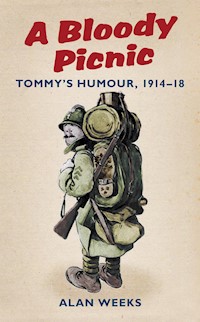
One of the crucial factors which kept Tommy going on the Western Front was his facility to see what was comic in the horror, deprivation and discomfort of trench warfare, an attitude which blossomed further in the rest areas behind the lines. The nature of the comedy ranged from gentle irony to a rougher hilarity that produced on belly laughs. Such laughter could arise from extreme physical pain and discomfort, from the provision of sustenance and from matters relating to dress, equipment and weapons. A further source of fun was bizarre events not dissimilar to situation comedy and pantomime. Moreover, a whole culture of humour surrounded Tommy's words and songs, and many trench pets – cats, dogs, horses, goats, even rats – were in on the joke in one way or another. Nor was it only the British soldiers who managed to find something to laugh about in the trenches – the Germans could sometimes see the funny side as well. A Bloody Picnic provides an unusual perspective on how soliders coped with the grim realities of the First World War.
Das E-Book können Sie in Legimi-Apps oder einer beliebigen App lesen, die das folgende Format unterstützen:
Veröffentlichungsjahr: 2010
Ähnliche
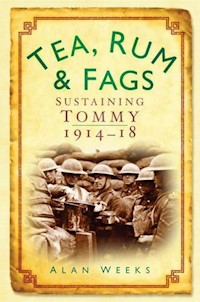


















Cover illustrations: Both images (front and back) are cartoons by Bruce Bairnsfather, courtesy of the Holts; originally in black and white, coloured for cover illustration purposes only
Contents
Title Page
ONE Do you Suffer From Cheerfulness?
TWO Comic Cuts
THREE Puckish, Wry & Buffalo Bill
FOUR Brass Hats
FIVE Panto
SIX Pratfalls
SEVEN Sitcom
EIGHT Sex
NINE Weather, Lice & Rats
TEN Letters, Words & Songs
ELEVEN Who Ate All the Pigeons?
TWELVE Three Sheets to the Wind
THIRTEEN Live & Let Live
FOURTEEN Animals – Round-Up
Bibliography
Copyright
ONE
Do you Suffer From Cheerfulness?
Cheerful on the Somme
When the horrific Battle of the Somme had been raging for a month, the trench journal The Somme Times, of 31 July 1916, posed the question: ‘Do you suffer from cheerfulness?’
Private Hudson, a veteran of the Lancashire Regiment, appeared to have this painful condition. Whilst on sentry duty, looking over the trench parapet during this fateful month of July 1916, Hudson was struck on the leg by a shell splinter but remained serenely at his post and even started to sing:
Ai love the ladies,
Ai love to be amongst the girls.
Not many days later a gas shell hit the parapet a few inches from Corporal Baker’s head. ‘Give me a proper ’eadache that ’as, sir, give you me word on it, sir,’ he commented breezily to Captain Charles Edmonds.
Not far away on the same day, ‘Spider’ Webb from Stepney was standing with two chums on the duckboards at the bottom of their trench when a shell landed at their feet. Spider’s comrades were killed instantly and one of his legs was blown away from the knee. ‘What’s happened, Webb?’ called an officer frantically.
Now Private Webb was a good cricketer. ‘Blimey, what’s happened, sir,’ he responded cheerfully, ‘is one over, two bowled.’ Then he glanced down at the mess where he once had a leg. ‘And I’m stumped, sir.’ Only then did he collapse into a faint.
Two ‘Leeds Pals’ (the 15th Battalion of the West Yorkshire Regiment, or 15/West Yorkshires) were among the 30–40,000 wounded on the first day of the Battle of the Somme (the ‘Black Day’ of the British Army during which another 20,000 or so were killed). At least these two were able to walk back to the field dressing station. They were directed to the ‘Elephant’, a round, corrugated structure.
‘Come on, Jack,’ said one, half-carrying his pal. ‘This way to the Elephant and Castle. They might even pull us a pint, mate.’
Jolly Officers
Cheerfulness was not confined to other ranks on that day (or any day). The commanding officer of the 1/Hampshires, mortally wounded and lying half-submerged at the bottom of a shell hole, offered advice to the private next to him, who could still move: ‘Well, if you knows of a better ’ole,’ he said, mimicking the caption on perhaps the most famous cartoon of the war (drawn by Captain Bruce Bairnsfather), ‘go to it.’
John Glubb (7th Field Company, Royal Engineers) recalled that during a severe enemy bombardment at Wancourt during the Battle of Arras (24 April 1917) an RE officer from another field company was desperately trying to get back to his own unit and was in grave danger in the open fields. He arrived breathlessly in Glubb’s ditch and asked if there was a regular interval between each explosion.
‘Three minutes,’ said Glubb.
So his visitor waited for the next crump and then prepared to make a headlong dash for it.
‘Well, tempus fugit, old boy, as the Chinaman say. Bye, bye,’ was his jolly parting shot.
Alfred McLelland Burrage of the Artists’ Rifles met a similar situation near Ytres during the massive German offensive of March 1918. He was in a sunken road and a platoon came scampering down a bank on to it, trying to take cover from a hail of shells. However, there was little similarity in the speech and demeanour of the officer compared to the one at Wancourt. He was shaking like a leaf and urinated in the road and passed wind vociferously from both ends.
‘Them bleedin’ shells don’t ’arf put the f***ing wind up me,’ he confessed to Burrage. He then issued orders to his men. ‘Git orf dahn this bleedin’ road in twos and threes. Let’s git aht of this bleedin’ place.’
So saying, he rapidly led the way up the road. He was, as Charles Edmonds would have described him, an example of the ‘urban soldier’, a typical Kitchener or New Army officer. These men, recruited as the old British Expeditionary Force (BEF) was decimated in 1914, came from many walks of life, very often holding positions of responsibility in civilian life – managers, supervisors, foremen, professional men, etc.
Edmonds served with a fellow subaltern whom he rated a perfect example of this urban soldier, possessing a ‘street arab’ sort of humour. This was Lieutenant Marriot, who maintained a flowing babble of silly little jokes and anecdotes unless he was asleep. He seized upon the slightest excuse to be amusing. It helped him to forget the open door of the dugout and what might come through it at any moment.
Captain Sidney Rogerson, travelling in a lorry to Amiens for a break in 1917, had only one companion, whom he called ‘B’. ‘B’ was gallant, floridly handsome, devil-may-care and a great womaniser. This officer’s ‘conversation’ during the journey consisted of a monologue about how drunk he was going to get in Amiens. ‘Solid ivory from the neck up’, was Rogerson’s verdict. But ‘B’ was undoubtedly cheerful if nothing much else.
Captain Tom Adlam (7/Beds and Herts), who was awarded a VC for his bravery during the Battle of the Somme, also kept up a steady stream of crude comments and dirty jokes and stories. ‘Who’s farted?’ was his catchphrase.
Trying to be Cheerful
Edmonds reckoned that cheerfulness reached ‘hysterical’ proportions as men were preparing to leave the comparative safety of the trench to venture into no-man’s-land, even just on night patrols. Trench ‘cheerfulness’, according to George Coppard (2/Queen’s Royal West Surreys, or just Queen’s for short), was not the same as the relaxed merriment of civilian life.
The soldiers tried to be cheerful in their letters home (more examples are shown in Chapter Ten), hoping to reassure their folks that they were ‘quite well’, as the official army postcards put it. These efforts may not always have been entirely successful, as you can see from the following example sent by a lance corporal in Robert Graves’ Company early in 1915:
Dear Auntie,
This leaves me in the pink. We are at present wading up to our necks in blood. Send me fags and a life-belt. This war is a booger, Love and kisses.
Published by kind permission of the family of Bert Thomas.
They didn’t laugh at anything. Graves noted that the rough-tough and habitually callous ex-Welsh coalminers of the 2/Royal Welch Fusiliers (or 2/RWF) saw nothing amusing in the spectacle of a comrade taking three hours to die after having the top part of his head blown off by a bullet fired from 20 metres away.
Indeed, persistent cheerfulness became more difficult as the war dragged on. Charles Carrington (alias Charles Edmonds) remarked that the inclination of officers in 1914, 1915 and 1916 to go ‘over the top’ (or ‘over the bags’ or ‘over the plonk’) into no-man’s-land kicking footballs (famously like Captain Billie Nevill on the first day of the Somme) or blowing horns, had evaporated by the end of 1916.
Tommy began to wonder if the war would go on forever – a depressing thought. A divisional follies show in 1917 featured a sketch entitled ‘The Trench 1950’. In it a fed-up Tommy and a fed-up Jerry stared at one another from their respective trenches separated by a no-man’s-land of about 6 feet. Major Pilditch recalled that he found this the most amusing entertainment he saw during the whole war.
Ironic
The humour could be powerfully ironic, and not only from officers or educated other ranks. The survivors of the 10/Durham Light Infantry (or 10/DLI ), reeling away from the dreadful Battle of Delville Wood, Somme (16 September 1916), had lost the majority of their comrades. As they staggered back to rest they were passed by a battalion who still had shiny buttons and some enthusiasm for the battle ahead. But catching sight of the Durhams wiped the smiles off their faces. ‘What’s it like up there, chum?’ one asked, somewhat anxiously.
‘A bloody picnic,’ came the grim reply. The Durhams trudged on.
Captain Julian Grenfell (1/Royal Dragoon Guards) was one of the small, original BEF which crossed the English Channel in August 1914, looking forward to the fun of teaching the Hun a painful lesson. ‘A picnic with a purpose’ was the way Grenfell looked at it. He belonged, like most of his fellow officers, to an Edwardian social class who enjoyed picnics. But it was doubtful whether any of the 10/DLI had ever supped an ‘Edwardian Champagne Cup’ at a country picnic. But at least one of them was a master of irony.
‘’Arf a Mo, Kaiser.’ – ‘’Arf a Mo’ was, in fact, a brand of fag which, according to many Tommies, tasted of seaweed. Drawing by Bert Thomas. Published by kind permission of the family of Bert Thomas.
There must have been many encounters like this one. On the ‘Black Day’ the South Staffordshires, having suffered catastrophic losses, were just as shabby, dirty, hollow-eyed and grime-streaked as the Durhams later at Delville Wood. A staff corporal had his version of the events of the day which he generously shared with passing units: ‘General F***-up was in command again!’ he informed them merrily.
Dislocation
Volunteer soldiers of working-class origin did not find it difficult to be disdainful about those who had sent them to this bloody war. Similar dislocation existed between officers and men who spent a lot of time on the front line and senior officers (‘Brass Hats’) who seldom appeared in it (also see Chapter Four).
Moreover, the real ‘Western Front’ often wondered if the ‘Home Front’ had any idea how horrific the front line was or whether they cared to know. Sarcasm reached new heights with this possibility. Early in 1915 a company commander of the Argyll and Sutherland Highlanders spent some leave in London. On his return to France he was quizzed by fellow officers about the main concerns in the capital. He reported that the overriding topic of conversation was the latest Charlie Chaplin film.
‘I was a bit anxious about things at home,’ reflected Major ‘Kemp’ (not his real name), the CO of this battalion, in response to this revelation. ‘But I see now there is nothing to worry about. It’s a great country. We shall win all right.’
Indeed, the advice from England to the boys on the front line at this stage of the war was ‘keep your heads up’. However, Private Bernard Livermore (2/20 Londons), known popularly as ‘Long ’Un’, was constantly advised in the trenches to ‘keep his head down’. All a German sniper needed was a four-second view of a potential victim.
In the Livermore case, a visiting (briefly) brigadier commented to the Londoner’s CO: ‘Man’s too tall for the trench.’ But Bernard’s rosy vision of a cushy job at Brigade HQ never materialised. Moreover, he didn’t even get the false teeth he had been promised to replace those molars knocked out by Huntley & Palmer’s No 4 ‘dog biscuits’, one of the mainstays of Tommy’s diet.
Help from Home
Of course, families and friends in Britain were terrified at the prospect of their loved ones being killed or wounded. Londoners turned out in their thousands to greet the hospital trains coming into Waterloo and Victoria, and threw flowers over their heroes. Millions of parcels were dispatched across the Channel to France and Flanders. Helpful ideas flowed across, too. Andrew Clark, Rector of Great Leighs in Essex, wrote to Lord Kitchener (26 January 1915) proposing the use of fishing tackle to send messages from the support trenches to the front trenches. Bigger and stouter reels and rods could be used to bring up supplies from the dumps. Kitchener’s office thanked Clark for his contribution to the war effort.
Horatio Bottomley, a well-known journalist, visited the Gavrelle front near Arras in September 1917, in preparation for one of his propaganda articles – ‘Somewhere in Hell: What I have seen. What I have done.’ This was some event: war correspondents in the trenches were rarer than generals and there had been calls for a new military medal – ‘For Distinguished Lying off the Field’.
On hearing of Bottomley’s imminent presence, the cinema sergeant of the 15th Highland Division asked Colonel Nicholson if he should ‘Get my gun, if I can find it’. Gavrelle Switch was 4,000 yards behind the front line and never under fire.
‘Stand on the fire step, Mr Bottomley, and you will see,’ invited the colonel, but the little man crouched nervously down in the bottom of the trench. However, he managed to raise himself a little for the official photographs, demanding that the caption for them indicate that they were taken a hundred yards from the enemy. They put him in a gas mask for one of the pictures and Colonel Nicholson was hoping that the little brute would suffocate (see illustration).
Horatio Bottomley, the journalist, tries on a gas mask.
The Mudhook, the Royal Naval Division trench newspaper, celebrated Bottomley’s visit and subsequent article, and suggested that they would inspire the troops to even greater efforts. In the meantime, The Mudhook wondered what steps were being taken to ameliorate the hacking coughs of our gallant soldiers. Brigadiers were sitting huddled over some distant fires drinking bottles of wine to soothe their lacerated throats. Young officers with a passion for oatmeal biscuits were being denied this delight. Bottomley was beseeched to send cough drops to alleviate all this suffering.
Bottomley was at work again in the John Bull magazine in November 1917, at a time when the Battle of Passchendaele (or Third Ypres) had more or less ground to a halt in the thick Flanders mud. His article was called ‘Non-stop to Berlin’, another supreme example of his journalistic craft.
The officers of the 2/West Yorkshires at Citadel Camp had just digested Bottomley’s latest offering when orders from Divisional HQ listed extra items to be carried up to the front by all men. Tommy already resembled a ‘Christmas tree’ when stumbling in the slime up dark communication trenches. Now, in addition to the existing heavy load, he had to lug as many trench boards as possible, plus extra picks, shovels, wire and screw pickets, and a large bottle of whale oil for their feet – apparently, according to Horatio Bottomley, all the way to Berlin.
In 1922 Horatio Bottomley, MP was imprisoned for fraud in connection with post-war Victory Bonds.
There were other interesting publications in John Bull. In 1916, before the Battle of the Somme, it predicted rapid and total victory. As a result, in 1917, with no end of the war in sight, there was a popular poem which went round the trenches:
We always keep our copies by
And that is why we prophesy,
The war was over last July,
It said so in John Bull.
Cuckoos Along the Menin Road
But wartime irony reached its most sublime levels in probably the most famous trench journal, The Wipers Times (and its various successors). The editors of this classic satire were Captain (later Lieutenant-Colonel) F.J. (‘Fred’) Roberts and Lieutenant (later Major) J.H. Pearson. They wrote or stage-managed irony of quality, based on dislocation with the Home Front, often expressed, when you consider the precarious situation these officers and their comrades found themselves in, via a painful but very comic nostalgia for home (there is more Wipers Times in Chapter Three).
In the first issue (12 February 1916), a ‘correspondent’ signing himself as ‘A Lover of Nature’ claimed to have heard the first cuckoo of spring along the Menin Road. This well-known thoroughfare ran east out of Ypres and had been the focus of two prolonged and fierce battles in 1914 and 1915, and would be at the centre of an even larger and bloodier confrontation in 1917.
In the second issue of the journal (26 February 1916), ‘One Who Knows’ disputed the claim made by ‘A Lover of Nature’. ‘One Who Knows’ had heard a cuckoo along the Menin Road at least two days before ‘A Lover of Nature’. He went on to accuse ‘A Lover of Nature’ of knowing nothing about ‘Nature’. What this twerp had heard in all probability along the Menin Road was a sniper calling to its mate.
The conflict broadened. On 6 March ‘A Lover of Nature’ hit back at the slurs on his reputation from this ‘scurrilous, lying effusion’ called ‘One Who Knows’. He resented this other’s claim to be the first in 1916 to hear the cuckoo along the Menin Road.
Another ‘correspondent’ – ‘A Nocturnal Prowler’ – joined in by asserting that he had heard a nightingale along the Menin Road, but yet another – ‘Fed-up’ – ended this vituperous exchange by condemning the waste of valuable space taken up by the cuckoo (and the nightingale) in such a renowned journal. Actually, Captain Roger Pocock of the 178 Labour Company did hear the song of a skylark one night at the time of year when this was impossible, at least, according to ‘Nature’. Staring into the gloom he discerned one of his men perched on top of a wagon imitating the bird. He could also do crows and tits.
What Were They Laughing At?
In October 1917 the 16/Sherwood Foresters were wallowing in a vast expanse of liquid mud in the Passchendaele battlefield near Kitchener Wood. The ground was totally pitted with shell holes and they were filled with water to varying depths. The trick, in order to move forwards or backwards, was to ascertain the depth of the water in front of you or behind. If you lost your footing you were in trouble.
The padre of the Foresters had stayed with them throughout the battle. He was the Rev. John Bloxam and it was he who fell headlong into the water. Fortunately, it was only a couple of feet deep and so the Foresters scrambled down to get him out. But, try as hard as they could, these brawny men could not shift Bloxam out of the morass. He was completely wedged in the glue. He looked at them in despair but, suddenly, he started to laugh uproariously. It was infectious: the Foresters lay back in the water and laughed their heads off, perhaps because they felt helpless. Even a passing stretcher party stopped to have a laugh, including the poor sod on the stretcher.
The story had a happy ending: they managed to get him out – soggy and plastered with mud and still laughing.
Jerry was shelling the Royal Horse Artillery from Hill 60 in the Ypres Salient in the summer of 1915. A shell fell on the dugout where a major was sleeping on a bunk. He was buried up to his neck in rain-sodden soil. He became dimly aware of the heavy weight on his chest but he was a very tired man.
‘How dreadful,’ he muttered and promptly went back to sleep.
A few moments later, 2nd Lieutenant Julian Tyndale-Biscoe went to the dugout. All he could see was his major’s head sticking out of the slime. He awoke him by tapping his face. They stared at one another and then burst into hysterical mirth. They got him out, too.
Corporal James Brown-Gingell of the Royal Engineers led a group of men back along a communication trench called ‘Lovers’ Walk’, carrying heavy bags of food in pitch darkness. Enemy shells were raining down around them. This ration party had to keep close together in case they got lost and so, when Brown-Gingell slipped and fell into the water at the bottom of the trench, all the men following him fell down as well like a pack of cards. As they squirmed about in the mud trying to disentangle themselves someone started roaring and shaking with laughter and that was it: they all joined in. Perhaps it was because the trench was called ‘Lovers’ Walk’.
Medical officers had a perennial problem trying to find suitable places for their front-line aid posts. They had to be near enough to the trenches to do their work and so were vulnerable to enemy fire. The MO of the 2/RWF thought he had cracked it when he discovered a miraculously unscathed two-storey building on the edge of the village of Cuinchy during the run-up to the Battle of Loos in September 1915. However, the drawback of using a two-storey building was that the top half might fall down on the lower half if the house was struck by a shell.
This was exactly what happened on 23 September. Several medical orderlies came cascading down with the ceiling on to wounded men lying on stretchers. Luckily, no one was seriously hurt and, moreover, everybody found it ludicrously funny.
On 27 February 1917 Armentières suffered one of its periodic heavy enemy bombardments. The road where John Reith was billeted was particularly badly hit. He rushed out into the street in his pyjamas. His groom stared out of an upstairs window, still half-asleep but with a broad grin on his face. He was covered in ceiling plaster: the ceiling had fallen on him. He regarded it as hilarious. ‘He was seeing something funny in it. And it was funny,’ wrote Reith later.
However, most of Tommy’s humour was pretty straightforward. There were just soldiers who constantly amused their chums. The war had only just begun when Billy and his mates of the 2nd Battalion, Royal Welch Fusiliers (2/RWF) arrived in Rouen on 10 August. They made straight for an estaminet and Billy ordered wine in a mixture of English, Hindustani, Chinese and an obscene French word which he had learned already.
The proprietor gave a Gallic shrug, pretending not to understand anything and Billy repeated the French word he had learned. His view of foreigners was that they all needed a good bashing. Such a threat produced a bottle of red wine, vintage unknown.
Our next view of Billy is a couple of months later, riding up the Champs Elysée in a nice carriage and in the company of two of these ‘foreigners’ – of the young and female type.
TWO
Comic Cuts
In the Dark
There was no shortage of comedy and comedians in the trenches at night. Near Gavrelle in the summer of 1917 an officer was trying to locate a company of the Artists’ Rifles. You couldn’t see your hand in front of your face. ‘Are you an Artist?’ he asked a dim shape.
The ‘dim shape’ in question was a member of the Drake Battalion, not known for polite conversation. ‘No, I’m a f***ing comedian,’ it responded crisply.
Lieutenant Blake of the Royal Fusiliers, running desperately along a trench seeking help for his men after a shell had struck the parapet, called into the dark interior of a dugout: ‘Where’s the company commander?’
‘If I knoo,’ came a thundering voice from the darkness, ‘I’d shoot the barstard!’
Major Frank Crozier commanded a battalion of the Royal Irish Rifles and was going up to the front on a dark night early in 1915 and was in grave danger of falling down one of the myriad holes in the trenches and getting more soaked than he already was – or drowned. Apart from Very Lights going off every few minutes there was no illumination. Crozier’s orderly lit a torch.
‘Put out that f***ing light,’ growled a nearby sentry, ‘you f***ing c*** – do you want us all shot up?’
‘Sorry,’ Crozier replied, ‘but you know where you are and I’m damned if I know where I am and I’d rather be shot than drowned any night.’
Corporal Robinson, known as ‘Buggy’, was a New Zealander in the 2/RWF and he was famous for all sorts of antics, one of which was running up and down the trench on the bitterly cold nights of winter 1914–15, shouting, ‘Shoo! Shoo! Look out, I’m an express train!’ We’ll meet him again.
Slapstick
During the day pure slapstick was more possible. Private M’Leary’s (Argyll and Sutherland Highlanders) contribution consisted of donning his gas helmet and pretending to drink his tea through it. Private Darrell’s party piece was more elaborate and usually in evidence during enemy bombardments, such as that inflicted by howitzers at Bois Grenier on 30 January 1915. He unfurled a battered and torn umbrella (it was also raining) and cried out for succour from St Mungo, a Glaswegian saint, before collapsing in a crumpled heap on the duckboards, legs kicking wildly in all directions. It made him feel better and his mates were used to it, and it did take their minds off the hails of metallic death coming their way – for a minute or two, anyway.
When he was a captain in the 2/Cameron Highlanders, James Jack (see also Chapter Three) was somewhat alarmed during the Battle of Loos (26 September 1915) to be confronted by an exuberant Highlander juggling with three live grenades and occasionally dropping one. Captain Jack, in his inimitable way, wondered whether the juggler could desist until his juggling skills improved. However, the Scot pointed out, with respect sir, that they wouldn’t unless he practised.
Callous
Tommy’s attempts at humour were sometimes callous. The 1/Hull Pals arrived from another theatre of war in the spring of 1916 and settled on the front at Beaumont Hamel in the Somme sector. On 29 March they suffered their first fatality on the Western Front. He was Private Stanley Horsfall, who happened to be the battalion’s goalkeeper. ‘He has stopped one at last,’ commented a ‘Pal’.
Such jokes were also directed at NCOs, officers, commanding officers and certainly at ‘Brass Hats’, whose work usually took them well away from the front line. Indeed, no one was spared. A friend said to Private Maxwell, ‘Kitchener will go down in history as one of our greatest soldiers.’
‘He’s gone down already,’ Maxwell pointed out, referring to the sinking of HMS Hampshire off the Orkneys, in June 1916 en route to Russia, with the loss of nearly all hands, including Lord Kitchener and his entire staff.
George Coppard, then in the 37 Machine Gun Company, recalled a hapless, ‘middle-aged’ 2nd lieutenant who was visibly terrified by enemy fire and rendered useless by it. He was also disfigured by a hump on his back (July 1917). ‘Why don’t you put that little bleeder down and give him a walk,’ someone suggested from a distance at dusk.
Private Joe Yarwood of the 94 Field Ambulance was up with the artillery on 28 June 1916 as the British bombardment and the enemy counter-bombardment, which preceded the Battle of the Somme, were in full swing. He was dutifully tending wounded men and was in great danger himself. But he was blessed with a less-than-kind section corporal. The medical orderlies used blankets to sow up around corpses. At one point the sneering, foul-mouthed corporal remarked: ‘You – you long bugger – if one hits you you’ll need more than one bloody blanket.’
Joe didn’t think that was very funny but he kept the corporal amused because every time the British guns fired, his helmet fell down over his face.
Something similar happened to Private Douglas Roberts (7/East Kents). He was one of a ration party carrying up heavy loads along a communication trench. He was already loaded up with a 2-gallon can of water, three Lewis gun panniers and some mortar ammunition. ‘Give that big barstard some more gear,’ shouted his sergeant. ‘Here, catch hold of this sack of bread, you f***ing gorilla.’
Wit?
But the rather more reflective soldiers of the 2/RWF seemed to have a more ethereal humour. They imagined the souls of those killed on the Western Front looking down on them and dancing a two-step and clicking their heels together in ‘holy glee’ that they were out of it.
The ‘Old Soldier’ ruminated on the mystery of appeals from the clergy of both combatants to bring down His wrath on the other side. ‘God’s truth!’ he exclaimed. ‘That poor old chap above must be nearly bald-headed through scratching his poll, trying to answer the prayers of both sides.’ Other ‘old soldiers’ derided newcomers in various ways but always opening with the phrase ‘I was here before your …’ Examples included ‘before your ballacks dropped’ and ‘before you lost the cradle marks on your arse’.
During the Battle of Poelcappelle in the Ypres Salient in 1917, the Cyclist Battalion of the XVIII Corps held aloft lifelike dummy Tommies on poles, worked by strings. The cunning plan was to convince Jerry that an attack was imminent. It was a ‘Chinese attack’: the real attack was planned for somewhere else. The dummies got an absolute pasting. ‘Them dummies is having a really rough time,’ observed Private V.R. Magill, as his puppet finally gave up the ghost.
An officer riding behind the parados of a busy trench was mortified when his steed urinated on the men below. He offered profuse apologies, but a soldier responded: ‘Never mind, sir, it could have been your horse.’
Corpse Humour
They were surrounded by death in the trenches. Corpses stuck out of trench walls, parapets and paradoses where they had been constructed near disused trenches or on former battle zones. Exploding shells could throw up even more of these horrors. When a brigadier visited the 2/Leinsters during heavy fighting in the Ypres Salient in 1915 he complained to Captain F.C. Hitchcock about the leg of a German corpse protruding from the parapet. Private Finnegan was ordered to remove it. But digging out the offending limb would have entailed dismantling and restoring a section of the parapet, so Private Finnegan hacked off the leg with a shovel. He was not a happy man. ‘And what the bloody hell will I hang me equipment on now?’ he demanded in exasperation to no one in particular.
When the 1/Herts took over a trench near Thiepval on the Somme it was full of corpses, which had been there for some time. They were bloated with gas; one lay right across the bottom of the trench and was not easily avoided and every time a 1/Herts trod on his chest, his tongue popped out. It never ceased to amuse them.
Corpses of British soldiers were not necessarily treated with any greater respect. Joe Yarwood remembered that he and his mates continually walked on the top of a head sticking out of the mud and daily checked on how bald it was getting.
A letter from Mildred, daughter of the Rev. Andrew Clark of Great Leighs, recounted an event described to her by a soldier on leave. Two men of a Scots regiment were shovelling earth on German ‘corpses’ when one of them came to and started screaming, ‘Me no deaded! Me no deaded!’ They stared at him dispassionately. ‘Agh!’ cried one in disdain. ‘Shove some earth on him, Geordie. Them Germans are such liars that no one can believe a word they say.’
After the Battle of Loos in September 1915, 2nd Lieutenant Norman Dillon of the Northumberland Fusiliers watched two of his men trying to remove German corpses from a trench they wanted to occupy. They were not totally devoid of humanity: some of the bodies were decapitated and they were trying to put the right head with the right body. They were rolling the heads about like footballs. ‘Get hold of this one, Bill, and see if it fits any of yours,’ called one of them.
The 10/Essex had a leg in a trench wall adorned in a green, expensive-looking, silk sock. ‘What a toff !’ reckoned an Essex Tommy.
In March 1916 the 2/RWF in the Cambrai line had a pulpy German arm to contend with. But the dreadful arm still sported an expensive watch and the Fusiliers liked to keep it wound up – and then someone pinched it.




