


13,99 €
Mehr erfahren.
- Herausgeber: The History Press
- Kategorie: Geisteswissenschaft
- Sprache: Englisch
It is said that 'an army marches on its stomach,' but histories of the First World War usually concentrate on its political and military aspects. The gargantuan task of keeping the British Expeditionary Force fed and watered is often overlooked, yet without adequate provision the soldiers would never have been able to fight. Tommy couldn't get enough tea, rum or fags, yet his commanders sent him bully beef and dog biscuits. But it was amazing how 2 million men did not usually go short of nourishment, although parcels from home, canteens and estaminets had a lot to do with that. Incredibly, Tommy could be in a civilised town supping, beer, wine, egg and chips, and a few hours later making do with bully beef in a water-filled trench. Alan Weeks examines how the army got its food and drink and what it was like.
Das E-Book können Sie in Legimi-Apps oder einer beliebigen App lesen, die das folgende Format unterstützen:
Veröffentlichungsjahr: 2011
Ähnliche


















TEA, RUM & FAGS
TEA, RUM & FAGS
SUSTAINING
TOMMY
1914 – 18
ALAN WEEKS
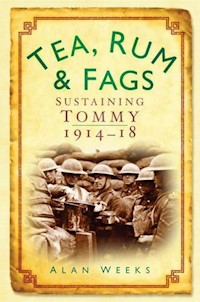
Cover illustrations: (front) Lancashire Fusiliers being dished out with stew from a dixie, March 1917 (reproduced by kind permission of the Imperial War Museum, Q.4843)
First published 2009
The History Press
The Mill, Brimscombe Port
Stroud, Gloucestershire, GL5 2QG
www.thehistorypress.co.uk
This ebook edition first published in 2011
All rights reserved
© Alan Weeks, 2009, 2011
The right of Alan Weeks, to be identified as the Author of this work has been asserted in accordance with the Copyrights, Designs and Patents Act 1988.
This ebook is copyright material and must not be copied, reproduced, transferred, distributed, leased, licensed or publicly performed or used in any way except as specifically permitted in writing by the publishers, as allowed under the terms and conditions under which it was purchased or as strictly permitted by applicable copyright law. Any unauthorised distribution or use of this text may be a direct infringement of the author’s and publisher’s rights, and those responsible may be liable in law accordingly.
EPUB ISBN 978 0 7524 7582 0
MOBI ISBN 978 0 7524 7581 3
Original typesetting by The History Press
Contents
One
Introduction – ‘Mutinous Mutterings’
Two
Bully Beef and Hard Biscuits
Three
Tea and Rum
Four
Fags
Five
Supplying the Front
Six
Cookers
Seven
Rations
Eight
Bread and Breakfast
Nine
Food and Drink During the Big Offensives
Ten
Parcels
Eleven
Canteens
Twelve
Special Occasions
Thirteen
On the Move – Retreats and Advances
Fourteen
On the Move – Moving to and from the Trenches
Fifteen
Egg and Chips in the Estaminets
Sixteen
Beer and Wine
Seventeen
Tommy Enterprises
Eighteen
Shops and Restaurants
Nineteen
Drunk and Disorderly or Incapable
Twenty
Officers’ Food and Drink
Bibliography
One
Introduction – ‘Mutinous Mutterings’
If Tommy Atkins was not getting as much tea as he wanted in the trenches, the rum ration had not arrived and he was short of cigarettes and eating little else but bully beef and hard biscuits, he was inclined to, as Private George Coppard put it, ‘mutinous mutterings’. However, there was a positive side to this: having a grouse was considered good for morale. Captain Rowland Fielding of the 3rd Battalion of the Coldstream Guards noted that it was ‘etiquette’ for men to grumble, almost a cultural requirement.
Private Cuthill of the 4th Battalion Black Watch (4/Black Watch) wondered how ‘they had the hard neck to say that the British Expeditionary Force [BEF] was the best fed Army in the world. Heaven help the worst fed army, then.’ He reported that he was getting one slice of bread a day along with plenty of hard toil in the trench. Private Richard Beasley complained that he lived on tea and dog biscuits. He was lucky to get meat once a week. In addition, he asked his readers to try and imagine standing in a trench full of water with the smell of dead bodies nearby (the live ones stank pretty badly, too).
It was traditional for Tommy to have a moan (he never called himself ‘Tommy’ except by way of derision). The ‘Old Contemptibles’ of 1914, the old soldiers who made up the original BEF, were described by Captain Ritchie of the Cameron Highlanders as calm and unexcitable as long as there was plenty of sleep, food and rum. It was the lack of any of these which upset their customary affability. In the frequently cold and wet trenches a meal or a drink was something to look forward to, a comforting and sustaining event in an otherwise terrifying and miserable existence.
It was not only the occasional absence and shortage of food which raised Tommy’s ire but also its monotony and the fact that it was sometimes uncooked or not as hot as it should be. Private W. Carson of the Hull Commercials hated the eternal sameness of bully beef and hard biscuits, and tea tasting of onions because it was brewed in the same container as the stew.
In 1914 and, for some battalions, a great deal of 1915, cooks were not even in the support areas just behind the front line but kept back in rest areas miles to the rear. When they did arrive in 1915 and thereafter they were not often in front-line trenches but in the reserve areas and the transport lines. Cooked food had to come up along communication trenches or tracks usually about half a mile long, and the ration parties carrying it up at night could take hours to arrive because of enemy action, damage to the trench and the weather conditions, not to mention the dark (see Chapter Five).
Until insulated containers were used later in the war the food arrived lukewarm at best, and even these ‘hay boxes’ could be rendered ineffective by delays, accidents and cold weather. Tommy continued to complain that the best way to ensure that food was hot was to have the cooks in the trench with him. In these circumstances, many soldiers collected a whole array of cooking devices (described in Chapter Six) to cook or warm up what food they had and, most importantly, to brew tea.
Another common grievance was that food could be depleted due to pilfering on its way up to the front. The ‘devils’ in this were Army Service Corps (ASC) personnel and drivers, who had a reputation for dealing in an enormous black market of stolen ration goods. They tended not to steal bully beef and hard biscuits – explaining why the Poor Bloody Infantry got so much of them in relation to other food which was easier to sell on the black market. Other suspects were the cooks themselves and their mates, NCOs and even the ration parties who were supposed to be delivering all the food to their company.
In the thick of dreadful battles like the Somme a lot depended on sustaining Tommy. According to 2nd Lieutenant Charles Edmonds it was the basics which concerned the troops most of all – enough bully beef and biscuits (no matter how fed up he was with them), tea, rum and fags. If Tommy got them he wouldn’t feel so bad, although he also liked a bit of fried bacon for his breakfast, some ‘dog and maggot’ (biscuit and cheese) for his dinner, and ‘rooty’ and ‘pozzy’ (bread and jam) for his tea.
The bully beef might be of poor quality, as well. The Fray Bentos product was good but other makes were very dry and too full of gristle, fat and ground-up bone. Tommy might also receive a ‘Maconochie’ – tinned dried meat and vegetables (M and V) but this could be a greasy hash with not a lot of any known meat. Tins of ‘pork’ and beans were notoriously short of meat. Dodgy profiteers made fortunes in the war supplying inferior food for inflated prices, such as jam made with marrows.
There were often justifiable excuses for the non-arrival of food in the trenches, not least enemy shelling and bombing which damaged roads and railways, lorries and trains, and the communication trenches and tracks. Cold and wet weather could also make life very difficult for those trying to bring up the grub. The winters of 1916/17 and 1917/18 were especially bad. Rainfall in August 1917 in Flanders was 127mm, the average for August being 70mm. When the Battle of Arras began in April 1917 it was still snowing.
Distances from the English ports to the front lines were relatively short – Londoners heard the bombardments on the Somme and the mining of Messines Ridge. Moreover, for a large part of the war the front lines were relatively static. For these two substantial reasons Tommy may have good cause to complain when the ‘scran’ failed to turn up. However, from the point of view of those working hard to organise and sustain methods and routes of supply there were many mitigating circumstances. At its largest in December 1917 the BEF numbered 2,077,000 men, of whom 1,250,000 were combatants. To get daily rations to this many soldiers in battle areas was a logistical nightmare demanding the complex employment of a fair proportion of the 827,000 who were not in the front line. This system only significantly broke down at the sharp end when the BEF was in rapid retreat in 1914 and 1918 (Chapter Thirteen). There were more local difficulties during the big British offensives, notably the Somme in 1916 and Flanders in 1917 (Chapter Nine), and the rapid advance in 1918, and when individual units were moving to and from the front line (Chapter Fourteen).
Another perspective on the ‘mutinous mutterings’ is to emphasise that they referred generally to the lack of food and drink in the trenches. When soldiers were back in the rest areas they not only had a good chance of getting all their rations but there were also numerous Army and other canteens and civilian establishments to provide extras. However, pay of a shilling a day tended to limit use of these places so they could have a good mutter about this, especially if there were no parcels from home.
So how much of the time was Tommy in the trenches? Charles Carrington provided a useful profile of this with his analysis for the 7/Royal Sussex. This battalion spent forty-two per cent of 1915–1918 in front-line or support trenches. Carrington also calculated he spent sixty-five days of 1916 in front line trenches, about a sixth of the year.
Another revealing point from Carrington was that he described most of the recruits to his battalion as skinny, sallow, shambling and nervous victims of an industrial system. Wartime shortages of food at home had made them even poorer specimens. Carrington recorded that after six months of regular nourishment, fresh air and hard physical work they looked twice as big as they did when they arrived. In fact, they were officially measured and weighed: their average development in six months was an extra inch in height and a stone in weight. An anxious mother wrote to Carrington complaining that her Johnny was half-starved. Johnny, in fact, had grown two inches and was two stones heavier. My father volunteered in the spring of 1917 (he was in a reserved occupation – docker) largely because he was half-starved. He weighed nine stone. When he left Cologne in November 1919 he weighed thirteen and a half stone.
Indeed, when Tommy got his full tot of rum early in the morning and there was bacon to fry and bully beef stew to follow for dinner and countless cups of ‘sergeant-major’ (very strong, very sweet) tea and plenty of cigarettes he wouldn’t grumble too much. Alfred McLelland Burrage, a short story writer in civvy street but in the Artists’ Rifles in 1917, described his pals as ‘perambulating stomachs’. Reasonable food and drink and cigarettes helped Tommy to endure the worst days in the trenches, whilst he could look forward to egg and chips and ‘van blong’ in a nice, warm estaminet, sitting in a chair and eating at a table, hopefully served by a pretty girl.
Two
Bully Beef and Hard Biscuits
A Tramway Accident for Meat
‘Boeuf bouilli’ had a Napoleonic origin but in 1914 ‘bully beef’ was re-translated by French urchins, hoping to persuade Tommies to hand over a tin or two of it, as ‘boolee biff’. It had been used by the British Army from about the 1860s. It formed a fundamental basis of trench diet and continued to be served up in the back areas. Songs and poems were composed about it. Lieutenant W.S. Dane’s My Bully Beef described it as a ‘tramway accident for meat’ and deplored its repeated delivery for breakfast, dinner, tea and supper.
In common with the rest of the 4/Seaforth Highlanders and nearly all the infantry he was fed up with the stuff. But, if famished, Dane considered each bite a joy. He was probably being sarcastic, although the type produced by Fray Bentos was acceptable. Less popular brands could be really dreadful. Edmund Blunden remembered befriending a stray terrier in the trenches, but when he tried to feed it with W.H. Davies’s bully beef it wisely cleared off.
Lieutenant Dane suggested in his last verse that if he were killed he would probably be ground up and served as bully beef. Indeed, an ugly rumour went the rounds of the Western Front that German ‘Rindfleish’ was of human origin. That certainly was the verdict of men of 2/West Yorkshire who discovered some tins of it in a captured trench in November 1916.
Calories
It was mostly the sheer monotony of a diet of bully beef and hard biscuits which depressed the front-line infantry, even if it was reasonably hot in a stew. But how did it fare in terms of nutritional value or calories? The official daily ration prescribed in 1914 was 4,193 calories. The detailed analysis of this in Chapter Seven tends to the view that the experts underestimated the amount of hard physical work the infantry had to undertake in the trenches. They had to carry rations to the front trenches, ammunition, equipment and other supplies under the cover of darkness. The construction, maintenance and repair of earthworks and wire entanglements were round-the-clock jobs, not to mention the small business of actually fighting and keeping an eye on the enemy.
The ration made provision for the substitution of fresh or frozen meat and bread by preserved meat and hard biscuits. In terms of nutrition the schedule provided 4,279 calories with fresh or frozen meat and bread but 4,625 with preserved meat and hard biscuits. A daily calorie count of 1,653 for hard biscuits meant that it was quite tempting to keep supplying this carbohydrate-high food in order to claim that the daily ration was being met. The preserved meat/biscuit diet, in fact, if not satisfying and morale-boosting, was scientifically sound.
This remained the case in 1917 when reductions in the schedule for meat and bread produced a calorie count of only 3,665. In fact, the preserved meat ration was maintained and the biscuit one only slightly reduced, producing a calorie count of 4,349, which was still above the official daily ration. So, by this time, there was even more of a temptation to concentrate on sending up bully beef and biscuits because the U-boat campaign had created serious fresh food shortages and rationing in Britain.
Maconochie and Pork and Beans
Preserved meat supplies could be tins of ‘Maconochie’ or pork and beans. Some battalions did quite well with these and it relieved the monotony of bully and biscuits. Others rarely saw either which made the culinary tedium worse for them. Cecil Withers of 17/Royal Fusiliers got Maconochie about once a month.
Maconochie was variously described as a sort of Irish stew in tins, or a beef stew with potato and mixed vegetables, or, succinctly, a dinner in a tin. In fact, this was George Coppard’s favourite meal as long as it was heated (cold, it was not so palatable). The original beef and vegetable tin was made by Maconochie Bros. of London. They claimed on the tin that the meat was prepared with all its natural juices with no extracts used. The company had won 143 gold medals and the highest awards. Testimonials to the quality of this food appeared in The Wipers Times: Corporal ‘Will Bashem’ proposed to call on Mr Maconochie on his next leave to personally thank him. Trooper ‘Smiler’ Marshall of the Essex Yoemanry wrote that James William Maconochie made a monarchy on his own with beans mixed up with turnips and carrots and all sorts of things (‘the troops did a funny’un when an onion came to light’).
The tin produced by Moir Wilson was also highly regarded. But, unfortunately, there were many inferior brands which it was unwise to eat in the dark. One contained a piece of rotten meat and some boiled rice. Some ran with liquid or were like a grisly hash.
Sometimes Maconochie was really scarce generally. Working at the St Jean Casualty Clearing Station near Ypres in December 1917 my father regarded it as a luxury, so when an RAMC corporal delivered a carton of ten tins, George was a very happy man.
Others had far too much of the stuff, and gluts like this usually meant that a lot of the rubbish Maconochie was being used. It could be powerful: a group in the 2/Field Company, Royal Engineers had the habit of hiding their tinned treasures in a home-made stove. They arrived back late to their billet in Fonquevillers one night and lit the stove, forgetting that the Maconochie was inside. The resulting explosion ripped out the sides of the flimsy stove (it was just an old dixie with holes punched in it). They really got their M and V hot that night.
Digging M and V cold out of the tin with a jack knife was not very satisfying, unless you were really starving. It was cooked in its tin to conserve fuel and how more men did not go down with tin or lead poisoning is a mystery. Perhaps their stomachs were already hardened by all the mud, sand and sandbag hairs they already swallowed with their food, not to mention what was in the tea.
Tins of pork and beans exhibited the same sort of varying quality. American brands were good but in some products Tommy was lucky to find any sort of pork and, if he did, it could be a little lump of fat hidden amongst the beans, another example of profiteering back home.
Lieutenant Tyndale-Biscoe complained to his HQ about this and received a reply suggesting that troops should not be disappointed if there appeared to be no pork in tins of pork and beans. This was simply a matter of the pork being absorbed into the beans. ‘In that case,’ replied Tyndale-Biscoe, ‘why not just send “meat lozenges”?’
Iron Rations
Not only was bully beef a solid part of daily rations, it also made up the bulk of emergency rations carried by the infantry in case food supplies dried up completely for some reason. These were ‘iron rations’ – also slang for hails of German shells at dawn. Lieutenant J.B. MacLean of 1/Cameronians described the package containing these iron rations as resembling a horse’s feed bag. It usually contained a twelve-ounce tin of bully beef (bigger one and a half or seven-pound tins were used for normal rations), hard biscuits, tea and sugar. In some bags there was a piece of cheese or a cube of meat extract.
Sometimes the tea and sugar were already mixed in a tin. Sometimes there was only tea. There was seldom any condensed milk so the sort of tea they would have to drink in an emergency would not have been palatable to the men. They carried two pints of water in a bottle on the right hip. This may not have been enough to make much tea and in conditions of advance or retreat there may not have been time to brew it up. The 2/Cameronians aimed to carry two days’ water supply on the Armentières Front in August 1915.
The troops were not allowed to start on their iron rations without an officer’s permission. Tom MacDonald of the 9/Royal Sussex asked his platoon commander when he could eat them. The answer was trenchant: ‘You can start on them when your belly button hits your backbone and your hip bones stick out of your trousers.’
There were occasions when the emergency rations had to be consumed because there was nothing else. This was common during the headlong retreats of 1914 and 1918 and in the big British offensives such as the Somme. The 1/1/Monmouths, including Private Dick Trafford, ate cheese and hard biscuits for several days in November 1916, and the London Rifle Brigade ate iron rations from 21–27 November 1917. Eventually they ran out of bully beef and existed on biscuits and contaminated water from the open trenches of shell holes which characterised this stage of the Third Battle of Ypres (Passchendaele).
Many troops never ate iron rations. Charles Carrington ordered it only once in three years and that was when marching away from the front after a few difficult days. Sometimes rats ate them, a fate suffered by the package belonging to Private Andrew Bowie of the 1/Cameronians in August 1917.
Stew
If there was nothing else but bully beef and biscuits at least it was a meal, and because of the calorie count it made men feel full up. Any meal was an oasis of pleasure in an otherwise dreadful day. It provided an opportunity to gather round a stove or a little fire (sometimes forbidden because of tell-tale smoke) and have a laugh and a joke.
There were ways of making bully beef more palatable. It could be fried with onions or crumbled with hard biscuit to make a hot hash. With vegetables (sometimes dried in packets) added all this could make a tasty stew, vastly superior to just digging a knife into a cold tin. When cooks came up to the transport lines they sent up stews like this in dixies – two-gallon iron containers. Tommy could cook some himself for a bit extra using Tommy Cookers, spirit cookers or improvised stoves, and using mess tins as pots or pans.
A hot stew was particularly satisfying after days of cold food. It could vary in quality – just like the cooks. At least if the Tommies stewed it themselves they probably knew what was in it. Private Mervyn Rees of the Royal Honourable Artillery remembered the bliss of hot stew at 4am on the morning of 7 December 1914, when he was soaked to the skin with little prospect of getting any drier. But Lieutenant Vaughan (1/8/Royal Warwicks) had a different experience of a lukewarm, greasy liquid in which floated half-cooked pieces of meat and shreds of sorry-looking cabbage. At least there was jam pudding to follow.
Men of the 7/Queen’s Own West Kents also recalled little bits of unhealthy-looking meat floating in some sad liquid. Tommy finished up getting too much stew (and also pea soup, another favourite and easy way of meeting the vegetable ration), because cutting up fresh or frozen meat and slinging it in a stewing pot was the simplest way to get it up to the trenches. There was a popular saying in 1917: if the sun rises in the East it is a sure sign there will be stew for dinner. ‘Eternal stew’, Winston Groom called it.
Tins – Full and Empty
The monotony of the diet is attested to by the litter of tins in No Man’s Land and disused trenches and saps. Lieutenant Pitt of the Border Regiment counted them in their thousands over a few square yards. Smiler Marshall reckoned it was a good way of tempting rats out of the trenches: the idea was to throw them (tins and rats) as far as you could. Many tins became entangled in the outer lines of barbed wire creating a strange cacophony of sound at night as the breezes moved them around.
The big seven-pound tins of bully beef came in handy as improvised stoves or chamber pots. A few men shot themselves in the foot through full bully beef tins in order to make a reasonable mess of it without blowing the appendage off or creating tell-tale powder burns around the wound; the hope was to get sent to hospital in Britain (a ‘Blighty One’). On the other hand, they could be court-martialled for a Self-Inflicted Wound (SIW). Robert Lothian Ramsay of the Black Watch was sheltering behind a haystack at the Battle of Loos (September 1915) when a bullet struck his emergency ration pack. This took most of the impact out of the missile and he got a Blighty One to Stobswell Hospital. Discerning Tommies discovered that early symptoms of trench fever could be accelerated by consuming large quantities of bully beef and biscuits, getting you out of the trench sooner rather than later.
Even in August 1914, at the very start of the war, Private Ernest Parker (10/Durham Light Infantry) recalled that French children soon realised that the food most likely to be given away by the Tommies was tins of bully beef and hard biscuits, hence their cries for ‘Boolee biff’ and ‘biskwi’ (followed by volleys of English obscenities – they learnt very quickly – if they didn’t get anything). Full tins of wasted bully beef were sometimes used to make the trench floor and support the walls, parapet and parados (rear bank). This was recorded as early as January 1915. Captain Gerald Burgoyne remembered seeing enough full bully beef tins to feed a battalion thrown away in Kemmel near Ypres because tinned salmon was available in this sector. There were thousands of full hard biscuit tins also discarded when fresh bread was available. Actually, they made very good fuel for fires. Burgoyne also spotted an artillery HQ where the tent floors and the paths were made entirely of full tins of bully beef. My father told me they made very good foot scrapers.
Men who were sentenced to field punishments because of misdemeanours had to live on bully beef and biscuits for seven to twenty-eight days, and received no pay. Subsisting on this diet caused constipation. Being tied to a wagon wheel for several hours a day was bad enough but simultaneously enduring digestive pains added to the suffering.
Dog Biscuits
The Army Biscuit – Huntley and Palmer’s No. 4 (although my father was eating ‘No. Fives’ in 1917) was commonly referred to as a ‘dog biscuit’. It was so hard that men with false teeth suffered badly. They were also a danger to perfectly healthy molars. They could be soaked in water to soften them, or broken up with some hefty blows from a trenching tool handle or any large stone, and crumbled to put in a stew. Private Pressey of the Royal Artillery tried to smash one with the corner of a brick but hit his hand instead. When he did manage to break it up he soaked the fragments in water for several days. He then heated and drained the hash, poured condensed milk over it and ate the lot. These whole-wheat biscuits were about four inches square and half an inch thick. They were so hard that John Osborne (4/Devons) was able to cut the middle out of one and stick a photograph of his mother in it.
No surprise, then, that dog biscuits were often referred to as ‘those f ****** biscuits’, especially by Private Pressey. This led the chaplain of the 2/Royal Welsh Fusiliers to try and persuade his commanding officer (CO) to put a guard outside the battalion canteen in case any biscuit attempted an act of indecency (Suzanne, 2 February 1917). They were often slung out into No Man’s Land in disgust and Harry Patch vividly remembered two dogs fighting over a pile of them.
Despite Tommy’s general low regard for bully beef and biscuits it was his staple diet and without it he would have found it almost impossible to endure the hardships and terrors of the trenches. What other inexpensive foods could have been eaten cold and carried about in tins? He knew he was eating real meat, even if it was accompanied by gristle, fat and bone. With Maconochie the amount of meat could vary enormously, and some of that could also be gristle, fat and bone. Tins of ‘pork’ and beans could also let the soldier down. But bully beef made a good, hot stew and eating a few biscuits could cram Tommy’s stomach with carbohydrates.
Three
Tea and Rum
‘Sergeant-Major’ Tea
Tea had to be hot, strong and heavily sweetened with sugar and condensed milk (‘sergeant-major’ tea – in the sense that the CSM would always get the best of anything) in order to sustain the soldier through the day and the night – mug after mug of the stuff. It must have been very comforting to have the hot, brown, nectar-like brew steaming in a mug near your elbow.
Tea, indeed, worked wonders. During the First Battle of Ypres on the last day of October 1914 the CO of the 2/Royal Welsh Fusiliers arrived at an artillery battery in a terrible state after the action at Gheluvelt. But when Lieutenant Ralph Blewitt handed him a mug of tea, with a fag and a slice of bread and jam, he was a rejuvenated man.
Frank Dunham, as a stretcher-bearer on the Somme in November 1916, soon learnt that the moment he got a wounded man back to safety his duty was to hand him some tea and help him to drink it if necessary. Men of the 2/West Yorkshires in the same month shouted, ‘Get a drop of tea for Fritz’, even though the poor blighter, badly wounded, would probably have preferred coffee with Schnapps in it.
‘Tea up! Char! Jildy!’ was the shout from the ration orderlies as they arrived with the blackened dixies full of hot tea. The first mug of the day was ‘gunfire tea’ – a salute to standing down from night duty. Men ran from all parts of the trench with outstretched mugs. Of course, the efforts of cooks in transport lines and ration parties could not produce enough tea. The Tommies had to brew, or ‘drum up’, some of their own.




