


Erhalten Sie Zugang zu diesem und mehr als 300000 Büchern ab EUR 5,99 monatlich.
- Herausgeber: The History Press
- Kategorie: Geisteswissenschaft
- Sprache: Englisch
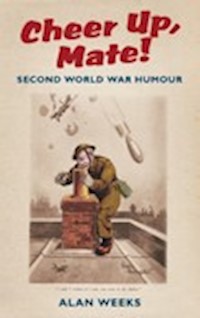
Cheer Up, Mate! is a compilation of comical tales and anecdotes from World War Two. Between 1939 and 1945 the world witnessed what is generally agreed to be the most horrific war in history. Millions died and millions more were physically or psychologically wounded by the conflict. Yet amidst the pain and devastation, people were not only able to survive, they also managed to maintain a sense of humour. For some, it was precisely this ability to laugh at their misfortunes (and those of the other side) that enabled them to solider on. This was especially true of the British, a nation whose reaction to more or less anything, up to and including someone's house being bombed to rubble, tended to be, 'never mind, have a cup of tea'. This 'Blitz Spirit' is perhaps best summed up by Mona Lott, one of the characters in Tommy Handley's radio show It's That Man Again (the show's title itself being a comical reference to Hitler): 'it's being so cheerful as keeps me going.' In this collection of stories, which covers the armed forces and civilians from both sides, Alan Weeks demonstrates how humour can survive even in the most unlikely of circumstances.
Sie lesen das E-Book in den Legimi-Apps auf:
Seitenzahl: 318
Veröffentlichungsjahr: 2011
Das E-Book (TTS) können Sie hören im Abo „Legimi Premium” in Legimi-Apps auf:
Ähnliche


















Cheer Up,Mate!
Cheer Up,Mate!
SECOND WORLD WAR HUMOUR
ALAN WEEKS
Cover illustration: Old Bill and Co. by Bruce Bairnsfather. (Illustrated London News Ltd/Mary Evans)
First published in 2011
The History Press
The Mill, Brimscombe Port
Stroud, Gloucestershire, GL5 2QG
www.thehistorypress.co.uk
This ebook edition first published in 2013
All rights reserved
© Alan Weeks, 2011, 2013
The right of Alan Weeks to be identified as the Author of this work has been asserted in accordance with the Copyright, Designs and Patents Act 1988.
This ebook is copyright material and must not be copied, reproduced, transferred, distributed, leased, licensed or publicly performed or used in any way except as specifically permitted in writing by the publishers, as allowed under the terms and conditions under which it was purchased or as strictly permitted by applicable copyright law. Any unauthorised distribution or use of this text may be a direct infringement of the author’s and publisher’s rights, and those responsible may be liable in law accordingly.
EPUB ISBN 978 0 7524 9688 7
Original typesetting by The History Press
Contents
ONE
The Bore War
TWO
Dunkirk
THREE
The Battle of Britain
FOUR
The Blitz
FIVE
North Africa 1940–41
SIX
The Blitz Continued 1941
SEVEN
Later in 1941
EIGHT
On Land, Sea and Air 1941
NINE
North Africa 1942
TEN
Elsewhere 1942
ELEVEN
Early 1943
TWELVE
April–August 1943
THIRTEEN
September–December 1943
FOURTEEN
January–May 1944
FIFTEEN
D-Day
SIXTEEN
The Second Front
SEVENTEEN
Elsewhere June–December 1944
EIGHTEEN
North-West Europe 1945
NINETEEN
Elsewhere January–May 1945
TWENTY
VE and VJ Day
Bibliography
ONE
The Bore War
‘Are they here?’
The day war broke out my mother said to me, ‘You can go out and play but don’t be late because the German bombers might come’.
‘Will they come down the 57 or the 56?’ I enquired. I was about three months short of my fifth birthday. The number 57 bus came south to Cubitt Town (Isle of Dogs, East London) from Poplar and the 56 went north from Cubitt Town to Mile End, Bow.
‘I don’t know,’ she admitted.
She needn’t have worried about the German bombers: they didn’t arrive for a year, not in my neck of the woods, anyway. Millions of children and their mums had been shifted out of the cities (600,000 between Friday 1 September and Sunday 3 September, 1939 alone) when war was announced. A lot of them returned home before Christmas because nothing seemed to be happening. It was ‘The Bore War’, later ‘The Phoney War’ (American terminology eventually won through here). Indeed, newspaper vendors got fed up with the lack of news and printed their own on the billboards:
Latest – Germans in Berlin. Evening Paper … Scots in Aberdeen.
Up the road from me in Romford a terrible storm was raging after the prime minister, Neville Chamberlain, had spoken to the nation, and little Alice Greer, who had heard that war was noisy, asked her mum, ‘Are they here?’
Just seven minutes after the prime minister announced war the first real air-raid siren began to wail (indicating that enemy bombers were twelve minutes away – according to official instructions) and the police pedalled furiously up and down streets bearing placards which read ‘TAKE COVER’. It was a false alarm.
One lady in Birmingham sympathised with Mr Chamberlain having to declare war on the Sabbath, but at least this lady and Alice had some idea that conflict had started. Donald Wheal’s mum didn’t tell him until the 7th. However, by then, he was probably wondering why they had all suddenly left home in Chelsea and gone to Woking.
Gas masks
The public had been warned about all sorts of gases – lung irritant, tear gas, sneezing gas, blister gas – and there were frequent panics caused by floor polish, mustard, musty hay, bleach powder, horseradish, geraniums, pear drops, etc.
Meanwhile, the BBC helpfully advised listeners not to try out their masks in turned-on gas ovens or by their car exhaust pipes. Small children had a ‘Mickey Mouse’ mask and soon discovered that by blowing through the rubber vent they could produce a rude noise. Infants were completely enveloped in something resembling a tent. The tops of many pillar-boxes were painted yellow with gas detector paint: when gas was around they were supposed to change colour. Special masks were designed for animals: the one for shire horses weighed a kilo (or 2.2 pounds, as they called it in those days).
People became particularly worried about their pet dogs. Mrs Parmenter of Plaistow, who boarded dogs, received a lot of enquiries about kennelling dogs during air raids. Perhaps she was known to be bombproof.
After the first air-raid warning Odette Lesley and her family frantically tried to don their new masks. Her mother’s ended up round the back of her head, her sister’s suspended from her left ear and Odette’s jammed inside her jumper.
However, a great deal of training went into the proper use of the masks. In fact, by 19 September Kay Phipps had been awarded her Chemical War Certificate, including the ability to respond correctly to the instructor’s vital question, ‘What do you do on receiving the warning “Gas Attack”?’.
In response, Kay and her fellow students, ‘Miss Twitter’ and ‘Miss Flaps’, had learnt to chant: ‘Attend to the wants of nature!’ At which point ‘Miss Twitter’ and ‘Miss Flaps’ collapsed into helpless giggles.
Even more assistance was forthcoming from newspapers, especially the advertisement for Sanotogen Nerve-Tonic Food, described as a ‘national necessity for preserving good nerves in the current situation’.
Evacuation
Operation Pied Piper moved nearly four million evacuees in 1939. The inhabitants of the village of Waltham St Lawrence in Berkshire were warned to expect hordes of these ‘shadow trekkers’. It could be hard going for evacuee and host. On a train from Birkenhead heads were examined and 10-year-old Doreen was interrogated: ‘Is your brother a breeder?’
Following due inspections there could be an ordeal by Dettol, grotesque bright pink or bright green disinfectants, or soft soap, paraffin or vinegar, plus a metal Derbac Comb (which hurt, I can tell you). Some nurses cut to the chase and sheared off whole heads of hair, such as ‘Nitty Nora’ of Pulborough, Sussex. One host in Lancashire purchased a cake of sheep dip from the local chemist shop.
Evacuation could also be hazardous: tiny Syd Smith, on his way to Frome by train from Paddington with his little suitcase, containing a bar of Fry’s Chocolate, an apple, a Tin Can Tommy comic and spare shirts and braces, stuck his head out of a window and his prized cap flew off in the breeze. Syd screamed blue murder and demanded that the train be halted so that he could retrieve his beloved headgear.
Indeed, he became so excited that a Bulls Eyes boiled sweet (guaranteed to last half an hour) lodged securely between his teeth. As anxious adults shook him about a bit he caught his finger in a sliding door.
At the same time, there were also difficulties for well-meaning hosts. The dirt accumulated on the legs and neck of a small boy from Salford resisted several applications of very hot water and carbolic soap. After the operation was eventually successful he exclaimed cheerfully, ‘Cor, I don’t half feel funny!’
At least they managed to get him into a bath: others adamantly refused to go in a tub through fear of drowning. Laying in a bed was considered inappropriate because back at some homes this happened only to corpses. Ignorance of country ways was also widespread: milk from cows was urine in the estimation of some children from the cities.
I was evacuated and went to Long Hanborough near Oxford with my sister, who was four years older than me (she was 9 at the time). It was a hard winter and I was eventually rescued by my family. Our hosts were a childless couple and really didn’t know how to look after us. The wife thought it was her duty to totally protect the well-being of her husband. During the evenings we had to stay in an unheated kitchen whilst our hosts sat round a roaring fire in the living room. I got frostbite in my feet.
Uncle Willie kindly brought my parents down in his Ford 8 (my sister had managed to smuggle a letter home). Uncle Willie was also able to trip up my father as he went to beat the hell out of the husband, and then bundle my dad back into the car. We sped off at speed whilst the wife ran to the phone box to get in touch with the constabulary.
Later in the war, my mother, older sister and I were evacuated to Nantgaredig in the wilds of Carmarthenshire. Soon after we arrived our host, an elderly and frail Mrs Jones living on her own, went down with pneumonia. My mother, in response to loud protests from cows crammed with milk, sat on a stool in a freezing barn in the dead of night delivering them from their torture.
Meanwhile, in Warrington, the discovery that there were apples hanging down from trees induced evacuee Lucy Gale to stuff some of them inside her knickers, but the elastic snapped as she was climbing the stairs and the fruit tumbled down before the gaze of her hosts (who owned the orchard).
Trying to pair evacuees with hosts in village halls created scenes like those at a Roman slave market or Selfridges’ bargain basement. Potential billeters looked out for clean, sturdy-looking children and this process eventually left a residue of dirty and scrawny ones, plus sisters and brothers who refused steadfastly to be parted, the last piece of advice from mum still ringing in their ears.
Finding themselves in strange and uninviting surroundings the more literary of the evacuees fired off quick letters:
Some young travellers could be assertive. An older boy from Paddington advised his two rather elegant spinster hosts in Oxford, ‘I’ll put meself to bed so that you two old geezers can get down the boozer.’
Indeed, the main character in the Richmal Crompton books, William, was asked by his chums to arrange their own evacuation away from the dreadful evacuees – fiction, but based on fact presumably. No wonder that some citizens, fortunately well-off, arranged to escape to faraway places. An actress who stopped at a luxury hotel in North Wales discovered ladies there who devoted their time to drinking, backgammon and knitting for the troops.
George Beardmore found himself employed in Wembley in November 1939 to try and trace householders who had made abrupt departures – without paying their rates (council tax). But knocking on neighbours’ front doors proved unproductive, and unpopular. Milkmen, postmen, road sweepers and dustmen were better sources of information, but best of all was the gasman, also concerned with unpaid bills. George arranged to meet him on Saturday mornings in the Express Dairy Café and buy him a cup of tea in exchange for relevant information.
Less affluent Cockneys decided to go ‘opping’ (picking hops in the Kent countryside), an annual event intended to add to the family income and get a change of air. In 1939 many ‘oppers’ negotiated a longer sojourn than usual.
Around this time, the Coalition War Government, in its wisdom, provided a Neurosis Centre and a War Emergency Clinic for ‘psychological victims’ of air attacks. They were finally closed within a few months for total lack of customers. Such resilience was possibly due to Horlicks Malted Milk, which, it said on the tin, provided a ‘third level of sleep’ (also claimed by Sanotogen Nerve-Tonic Food).
Waste not – and other tribulations
Back in the cities parents upset at the departure of their little ones could cheer themselves up with the rumour that Adolf Hitler went round with a gun in his pocket to shoot himself if things didn’t go according to his well-laid plans (he was no longer politely referred to as ‘Herr Hitler’). Even more welcome was the story that two of his food-tasters had been poisoned. There was widespread support for the view that Adolf needed a long, lingering death caused by rat poison and ground glass.
Meanwhile, back in the real world, belts and braces were being tightened. ‘Waste not, want not’ was the order of the day, backed by rather colourful advertising boards. One favourite depicted a mob of enthusiastic housewives pelting Hitler and co. with kitchen junk, Zeppelin parts, Pickelhaube helmets and diverse objets d’art.
Advice flowed in from many sources: slice up your Mars bars and enjoy just one slice at a time, grow cabbages on the roof of your Anderson air-raid shelter. The head chef at the Savoy promoted ‘Lord Woolton’s Vegetable Pie’ – potato, swede, cauliflower and carrot plus anything else left over (Lord Woolton was the Minister of Food).
There were suggestions for ‘perking up’ this official pie, such as ‘Symington’s Vita-Gravy’ and ‘Surprise Potato Balls’. Cynthia Gillett, evacuated from Woolwich to Edworth in Bedfordshire, remembered (not fondly) school dinners of bread spread with stewed rhubarb.
Similarly, on the BBC Home Service on 4 October, W.H. Barrington Dalby advised listeners to avoid opening their fridges (if they had one) more than 6in and to convert hot-water bottles into vacuum flasks – all in the interests of conserving energy. It was also ‘patriotic’ to have only 5in of water in your bath (no fear of drowning there).
The Daily Mail of 14 October 1939 announced the creation of the government office of ‘Controller of Shirts’, nonsense almost on a par with It’s That Man Again (ITMA) and their ‘Office of Twerps’. ITMA was the most popular radio comedy of the day, and starred Tommy Handley (or ‘Mr Handpump’) and favourites like the charlady ‘Mrs Mopp’ with her catchphrase ‘Can I do you now, sir?’.
There was also ‘Funf’, the German spy with feet of sauerkraut. The ‘Office of Twerps’ was part of the ‘Ministry of Aggravation and Mysteries’.
‘I have the power to seize anything,’ Mr Handpump informed Vera, his secretary.
‘Oh, Mr Handpump!’ gasped Vera, ‘and me sitting so close to you.’
Another favourite on the radio and the music hall stage at this time was Rob Wilton, a comedian from the North, whose catchphrase opening I borrowed for the first sentence of this book, except that he said ‘my missus’ and not ‘my mother’.
The Ministry of Information, it seemed, became the Ministry for Disinformation. Of course, the real ministry itself created many a laugh with its poster characters ‘Miss Leaky Mouth’, ‘Mr Glumpot’, ‘Mr Secrecy Hush-Hush’, ‘Mr Knowall’, ‘Miss Teacup Whisper’ and ‘Mr Pride in Prophecy’.
Given all these trials and tribulations, the government was keen on testing the morale of the people. The Ministry of Information set up a Home Intelligence Department in Senate House in London to test the state of the nation’s nerves. This had an enormous network of observers – bus and train inspectors, W.H. Smith managers, cinema supervisors, Citizens’ Advice Bureau staff, trade union officials, council officials, social workers and Mass Observation (M.O.) diarists.
M.O. was founded by Tom Harrisson and Charles Madge in 1937. Hundreds of ordinary people volunteered to attempt to write and submit a daily diary of their lives and those of the folk they knew. It is a rich source of social history, now kept in archives at the University of Sussex.
Blackout
The blackout on windows and street lighting was a further trial of nerves. Woe betide the householder who showed the merest chink of light: not only were you at the mercy of wily patrolling Air-raid Precaution (ARP) Wardens but also, in more select neighbourhoods, ‘Soroptimist Clubs’, perambulating groups of middle-aged, middle-class lady vigilantes. If they found you out it was a case of serving them tea and biscuits and conversation. The ARP might be preferable. It was a matter of conviction that a Dornier pilot could see you light a fag from 20,000ft.
Moving around at night was thus an ordeal. One estimate was that 20 per cent of the population was injured in the dark during the course of the war. Road accidents rose alarmingly; one woman collided with an elephant on its way to a circus venue. Even the buses just had dull sidelights and no inner illumination. Mrs Jane Steward dropped a bag of cakes on a bus in Bromley on 21 October: the conductor fell over a jam tart and all hell was let loose.
Meanwhile the ARP had to keep on their toes despite the lack of real action – which, to numerous critics, was no more than grown men playing games in the street. Unenthusiastic volunteers were pressed into service. One ‘casualty’ left a note: ‘Have bled to death and gone home.’
Come Halloween, Nella Last’s husband was determined to celebrate. Nella was one of the Mass Observationists, living in Barrow-in-Furness. Duly, on 31 October, he decorated his front door with elaborate and sinister designs adorned with the message ‘Abandon hope all ye who enter here’. Combined with the pitch-darkness of the house and street it was quite effective.
Air-raid warnings
Despite the lack of serious bombing in 1939 there were plenty of air-raid warnings; a siren rather like hundreds of vuvuzelas creating an undulating racket. The ‘All-Clear’ was at least on one note and it was a relief to hear it. There was such a warning in Barking on 6 October and elderly Edith Sims called to her husband:
‘What’s to do, Joe?’
‘Jerry’s over!’ Joe called back.
‘Never mind, Joe, have a cup of tea, mate,’ Edith consoled him. ‘You can mop it up in the morning.’
(A ‘Jerry’ was a bedroom chamber pot, or ‘po’, as well as a German. This drama was reported in the Berlin Liar, a publication dedicated to repudiating anything Lord Haw-Haw said.)
In the air
Meanwhile, Hitler was destroying Poland and the Russians were trying, unsuccessfully, to do the same to Finland. We supported the Finns but later in the war we supported the Soviet Union against the Nazis. The Royal Air Force (RAF) was trying to do its bit and was frequently over the Fatherland bombing the civilian population – with propaganda leaflets, which led to the story (possibly someone’s idea of a joke) of the air crew who jettisoned untied and heavy bundles of leaflets on defenceless civilians. On debriefing they were severely reprimanded by the wing commander; someone might have been hurt.
It was suggested to the Secretary for Air – Sir Kingsley Wood – that bombers could set fire to the Black Forest. He was horrified at the idea: ‘Are you aware that the Black Forest is private property?’ he demanded. ‘Why, you will be asking me to bomb Essen next!’
There is a similar tale about Spike Milligan’s uncle. He wanted to drop hundreds of wooden mushrooms (made by him in his shed) on the German populace in order to convince them that British craftsmanship was as good as ever. He was turned down by the Air Ministry, on the grounds that they had no desire to injure innocent Germans. A British cartoon of 6 September showed Hitler on his knees begging us to rain famine, bombs and gas onto these innocent Germans, but not the truth.
There was some real action in the air, however: some Junkers 88s attacked battleships at Rosyth on the north side of the Firth of Forth on 16 October. Four of the bombers were shot down by pilots of the Auxiliary Air Force.
‘Saturday Afternoon Airmen shoot down Nazi Bombers’ was the headline in the Daily Express the following morning.
The winter of 1939/40 was bitterly cold. Pilots sat around waiting for more action in freezing huts at Drem airfield in Scotland (‘the coldest spot on earth’) with only lukewarm stoves to thaw them out. They played ‘uckers’ (ludo). At least they could undo the top button of their tunics to indicate to impressionable young women that they were real pilots, and look forward to games of a different sort.
Later, in June 1940, the Luftwaffe dropped postcards on innocent civilians in Paris showing French soldiers attacking barbed-wire defences. Written across the picture was the caption, ‘Where are the Tommies?’. If the Parisians held the card up to the light they could also see British officers making indecent advances towards young French girls.
The British Expeditionary Force (BEF)
The BEF returned to France, previously vacated by its predecessor in 1918 in ‘the war to end all wars’. The 6th Battalion of the Durham Light Infantry was part of it. Private Thomas Russ’ pal was assiduously learning French in order to make himself understood abroad. As soon as he stepped foot in the county his first words were, ‘Where’s the NAAFI, mate?’
The dangers which confronted Tommies in 1914–18 were still in evidence. Young Wilfred Saunders joined a queue for ‘Fish and Chips’ only to discover that it was for a brothel. He ran off quickly before someone asked him for a donation.
Further north, in Flanders, Lance-Corporal Tony Bond, smothered in kisses and hugs from nice local girls, found time to send home a postcard telling his parents that ‘he was having a terrible time’ in the rain and mud.
William Campion of the 59 Medium Regiment, Royal Artillery, also visited a ‘maison de tolérance’ in Lille and claimed, in another card sent to home, that all he did was a spot of ‘intimate dancing’.
At home, meanwhile, we could do our bit for the military presence. I pleaded with my dad for the latest toy (resplendent in Hamleys’ display windows) – ‘Build Your Own Maginot Line’.
On the real Maginot Line Captain Anthony Rhodes saw his first German soldier. A major also spotted him:
‘Look, there’s a German,’ he exclaimed in some excitement. ‘Shoot him!’
‘I wouldn’t, sir,’ advised Captain Rhodes. ‘They might shoot back.’ It was early days.
RAF Fighter Command was also represented in France and carried out lots of patrols looking for the Luftwaffe. Pilot Officer Roland Beaumont, 87 Squadron, was also in Lille. However, the ‘airstrip’ being used by 87 was just a field and it hadn’t stopped raining since the Great War. As the terrain turned into a swamp the squadron decided to fly off to look for dry ground, but the only way to get airborne was to drive up the road. Beaumont successfully managed this and flew to Le Touquet, where he was sent to the local hospital suffering from pleurisy.
Flight Sergeant G.C. Unwin remembered Douglas Bader and his tin legs in 222 Squadron. Early in 1940 Bader crashed a Spitfire into a wall and mangled them. He was sent replacements and he spent many a night scraping and scratching them to get a perfect fit. Unwin, trying to get some sleep, politely complained. Snow White and the Seven Dwarfs was still all the rage at the local cinema and so Bader re-christened Unwin (politely) as ‘Grumpy’.
One of Grumpy’s tasks was to take charge of Bader’s left tin leg whilst Pilot Officer Tom Vigors looked after the right one. When the alarm went off it was their responsibility to screw the legs on.
‘Cobber’ Kain shot down a Messerschmitt 109 over Saarbrucken on 2 March 1940. Not long after he was drafted back to England to lecture trainee pilots on dogfight evasion.
‘It’s always one raider,’ he explained. ‘They haven’t got many planes and they’re also short of fuel.’
One of the trainees listening, Christopher Foxley-Ninns, was soon in the air over France and, having been alerted by the ‘Arse-End Charlie’ (squadron look-out), was chased around a church steeple by six Messerschmitt 109s.
Squadron Leader Roger Bushell was a pre-war barrister and famously flew up north to defend a ground crew member, changing into wig and gown and winning the case hands down. Commanding 92 Squadron on patrol he was shot down over Dunkirk (where Allied troops were rapidly heading – see the next chapter) on 23 May 1940 and captured. In March 1944 the Gestapo murdered him during the aftermath of the ‘Great Escape’ from Stalag Luft III.
At sea
Doreen Spencer reported for WREN (Women’s Royal Naval Service) training in Portsmouth and was sharply accosted by a warrant officer.
‘Why aren’t you wearing your raincoat?’ she demanded fiercely.
‘It ain’t raining,’ replied Doreen, who was a straightforward soul.
‘It’s the regulation of the day!’ screamed the warrant officer. ‘And why aren’t you running? Everyone runs on the quarter-deck!’
‘What quarter-deck?’ protested Doreen, yet to discover naval discipline. ‘It’s the pavement.’
‘It’s the bloody quarter-deck!’ screeched a thoroughly worked-up warrant officer.
Doreen couldn’t even boil an egg so was button-holed for culinary duties, reporting to a freezing ‘galley’ at 6 a.m. to peel dozens of buckets of spuds and carrots. Later in the war, promoted to telephone operator, Doreen had a call.
‘Who’s that?’ she enquired.
‘Ike.’
‘Oh, yes,’ scoffed Doreen. ‘And I’m Mickey Mouse.’
But it actually was General Eisenhower on the other end of the line.
Doreen eventually became engaged to a sailor but he was killed in the Mediterranean. Then she became betrothed to a petty officer but he lost his life in the Atlantic. She didn’t have a lot to laugh about.
It was certainly a culture shock for girls from posh backgrounds to be thrown in with ladies from more earthly environments. For instance, to the innocent (but educated) ‘on the game’ referred to high-level army intelligence on the North-West Frontier of the empire in India.
New Yorker James Goodson, a trained pilot, survived the sinking of the liner Athenia in the mid-Atlantic and, as soon as he made land, reported to the RAF recruiting office in Glasgow. Could he, as an American, join up?
‘Yeah,’ was the answer. ‘Seven shillings and sixpence a day.’
‘I’m sorry,’ explained Goodson, ‘I lost everything on the boat so I can’t pay yet.’
‘Pay?’ echoed an incredulous flight sergeant. ‘No, we pay you – seven and six a day.’
So James Goodson became a very happy man; allowed to fly a Spitfire and get paid for it into the bargain.
Rationing
New Year’s Day’s news for 1940 was that some food was to be rationed. Better news was that adolescent boys aged between 13 and 18 were to get an ‘arduous supplement’ – in fact, extra meat.
Workers in heavy industry would get the same treat. But further bad news was that, in the event, neither the lads nor the workers ever got any extra meat. German submarines made sure there wasn’t any.
Bombed-out civilians and service personnel on leave were placed in the same category for rations – a masterpiece of bureaucracy.
Yet shortages inspired creativity: Ethel Robinson’s husband, a docker in Liverpool, tried to slip past a policeman at the dock gates with a couple of nicked frozen pig hearts in an empty gas mask.
‘What you got there?’ demanded the copper.
‘Me gas mask – what do you bloody think it is, eh?’ retorted Mr Robinson.
‘Well, its nose is bleeding.’
News from Glasgow
Pam Ashford in Glasgow was another M.O. diarist. Early in 1940 her work colleagues, Miss Smith and Miss Bousie, conducted a discussion about service personnel on leave in the city. Miss Bousie suggested that they looked too serious. But Miss Smith was of the opinion that they wouldn’t be much good if they were not serious.
Miss Bousie was not to be denied, however, and further complained that some of these ‘serious’ sailors, soldiers and airmen were wearing fur coats. Since it was snowing in Corunna for the first time since 1800 Miss Smith explained that service personnel had been advised to keep warm: it was also well below zero in Glasgow so wearing fur coats seemed to be eminently sensible.
But Miss Bousie was persistent. ‘Well, what about if a bomb fell on them? They would catch fire and go up in smoke. What would that do for the war effort?’
‘No,’ insisted Miss Smith, ‘at worst they would only get singed.’
Perhaps these fur-clad soldiers and sailors had just returned from trying to secure a foothold in Norway, where it was even colder than in Glasgow. Here, General Sir Adrian Carton de Wiart, commander of the Central Norwegian Expeditionary Force, was surveying his men in the village of Harstaad. On 14 April, he noted, they were smothered in coats and socks and enormous boots and looked like ‘paralysed polar bears’.
Pam Ashford continued to entertain M.O. staff in London with her almost daily contributions. Her office in Glasgow was opposite the zoo. On 24 January Mr Mitchell, her boss, believed that the lions would have to be shot in the event of an air raid. Miss Ashford mused over the tricky problem. It was hard lines on the lions, but …
Miss Bousie also continued to make her views known. There was a solid rumour that the Germans were about to send over balloons filled with poison gas. She insisted that it was her patriotic duty, if she found one of these contraptions, to steadfastly stand by it until such time as a policeman came by, and to warn other passers-by of the danger.
Fear of air raids was widespread in the city. A friend of Pam Ashford’s, an elderly lady living alone, was concerned that her dog would catch fire in the event of an attack and had prepared a large, soaking wet flannel to wrap around the mongrel, plus a tea cosy to put on his head (it stopped him barking).
Pam worked for the Forth of Clyde Coal Company. A letter she penned on 11 June was in response to an esteemed order from the Alps:
‘In view of the present state of affairs in Europe we regret it will be impossible to suggest any route by which we could deliver a cargo of coal to Switzerland.’
Ways to win the war
Hector Bolitho, at the Air Ministry, was receiving many ideas from the public about how the war could be won, such as dropping lots of bombs down Mount Vesuvius and exploding southern Italy, or designing special aeroplanes which could pretend to run away from enemy aircraft and then squirt chloroform and narcotics from a rear vent to incapacitate pursuing pilots.
Another was to drop ‘sticky bombs’ in front of the Wehrmacht in order to halt the blitzkrieg – or coils of barbed wire. Obsolete British fighter planes (of which there were many) could fly past parachuting Luftwaffe pilots and cut their cords.
Millions of snakes could be shipped over from South Africa and dropped (on dark nights) over German cities, or even thousands of poisoned cabbage leaves on enemy cows, pigs and sheep.
The correspondent who sent the snakes idea actually lived in South Africa, in Durban. He added a footnote to the effect that the war would finish at 2.30 p.m. on 4 May 1945, with Britain as the winner.
Life goes on
Meanwhile, I had become 5 years old and started to sing silly songs:
Underneath the spreading chestnut treeHitler dropped a bomb on me,Now I’m a blinking refugee.
Thousands of enormous barrage balloons floated over my head like silver elephants waiting for Hermann Goering, they didn’t have long to wait. British social life went on: John White toured with his troupe of dancing girls, trying to entice customers through a loud hailer.
‘Margot will now demonstrate her fan dance. What you see keep to yourself and tell nobody. If you don’t see what you want to see let me know and I will see what I can do for you.’
The audience consisted mainly of plain-clothes policemen on the lookout for any affront to public decency. In fact, there had been a top-level conference on 16 April 1940 to decide on the amount of nudity which was to be allowed in theatres. P. S. Le Poer Trench, writing in the Evening News, dwelt on the relevant conundrum, ‘When is a nude girl not a nude girl?’ His solution was when she stood still on a half-lit stage with a wishing well behind her.
In the same month police were trying to stamp out illegal out-of-hours drinking and striptease clubs. They raided the Condor Social Club in Dagenham, housed in a re-conditioned garage, and arrested undercover colleagues posing as dancers.
Billy Hill, king of the London underworld, was released from Chelmsford gaol and celebrated his first night of freedom with established associates – Franny the Spaniel, Horrible Harry, Bear’s Breath, Soapy Harry, Tony the Wop and Square Georgie, known collectively as ‘The Heavy Mob’ – ready to resume lucrative raids on West End jewellers.
TWO
Dunkirk
Getting to the beaches
If you wanted to put a date on the end of ‘The Bore War’ for Britain it would possibly be 28 May 1940, when the BEF started arriving home from Dunkirk. But, already at this time, the news was bad enough to end any sense that this was not a real war. On 4 April the Germans occupied Denmark in one day and Hitler announced that this country, as well as Norway, was being protected from the ‘aggression of the democracies’. Holland surrendered on 15 May and Belgium on 28 May.
Today, historical attention on those who escaped from Dunkirk dominates and it is easy to forget the tens of thousands who were captured trying to get there (no one was left on the beaches alive). Rowland J.S. Young spent five years as a POW and, on capture, had to endure the sarcasm of a ‘comic’ German officer referring to a song on the current British hit parade:
‘So, Tommy, you hang out your washing on the Siegfried Line, yes? England? Caput!’
Valiant holding counter-attacks slowed German progress towards the coast. On 25 May Lance Corporal Edward Doe of the 2nd Battalion of the King’s Royal Rifle Corps (KRRC) decided, in some desperation, to let fly with one of the KRRC’s most powerful weapons – the ‘Boys’ anti-tank rifle. He had to be extremely careful: the recoil from the gun could dislocate a shoulder.
The shell hit a Tiger tank and made a plopping noise, rather like a ping-pong ball. Some of the paintwork was damaged.
However, overall, the British counter-attacks were so successful that General von Rundstedt ordered the German 4th Army to halt on 24 May, assuring Hitler that there was absolutely no chance of the Allied armies escaping by sea.
Those who got to the beaches had countless adventures in the wild and chaotic retreat. Harold J. Chalker (5th Battalion, Royal West Kent Regiment) arrived in the village of Benquin soaking wet. He didn’t have time to dry his clothes so changed into female attire which he found in a derelict house. Later he dreaded to think what would have happened to him had he been captured – probably shot by the Gestapo as a spy.
Albert Burrows, heading for Dunkirk but desperate for sleep, collapsed into a ditch. Yet his landing was agreeably soft and dry, onto what was apparently a log. In the dawn light he discovered that he was kipping on a dead horse.
As shells crashed down the remnants of the 9th Battalion of the Durham Light Infantry heard exuberant piano-playing coming from a nearby garden. Four enthusiastic soldiers stood in front of the instrument playing their hearts out, bashing out popular tunes, including We Shall Hang out the Washing on the Siegfried Line.
Trooper Albert Cheeseman of the 5th Royal Tank Regiment placed a heavily pregnant woman in his lorry and his sergeant delivered the baby. Another member of the tank crew, who had knowledge of horticulture, christened the child Viola Tricolor (Latin for wild pansy).
As the rush west became hectic, many troops arrived on the Dunkirk beaches (which also included those at Malo-les-Bains, Bray and La Panne – a stretch of coast about 10 miles long) on various forms of horseback. Bill Flaherty spotted one bloke on a splendid French cavalry beast and a glorious French cavalry helmet. He was loudly applauded on all sides by the retreating rabble and doffed his headgear in reciprocal salute.
‘Cheer up, mates!’ he bellowed at them. Bill Flaherty reckoned he must have been bomb happy or absolutely pickled by French wine (pinched along with the horse and the helmet).
Considerable numbers of French soldiers were also making rapid tracks for the coast, but a unit of cyclists did find time for some heavy drinking in an estaminet in Poperinghe. A few men of the 65th Field Regiment, Royal Artillery, came past with a comrade, Paddy, who had a smashed foot, so they requisitioned one of the bikes stacked outside.
However, the French were not entirely sozzled and came in hot pursuit. When they caught up with the gunners, Signaller Alfred Baldwin gave a shrug of which the cyclists would have been proud and simply pointed to Paddy’s foot. The French graciously retreated back to their vino minus a bike.
Elsewhere, Private David Elliot of the 141st Ambulance, Royal Army Medical Corps, was tending wounded French troops, one of whom was terribly constipated.
‘Cabernet! Cabernet,’ he called out loudly as at last there seemed to be signs of movement, and David rushed up with the bedpan. The poor soul strained and strained and then a seraphic smile crossed his face, indicating success. The medic removed the bedpan and discovered in it a little poo about the size of a rabbit dropping.
On the beaches
If the backs-to-the-wall fighting and haphazard retreat were painful enough the beaches between 28 May and 4 June were absolutely terrifying, as the Luftwaffe and the German artillery attempted to obliterate the BEF and a large contingent of the French army. Any examples of humour in these circumstances were demonstrations of a glorious fortitude in the face of overwhelming defeat.




