


14,99 €
Mehr erfahren.
- Herausgeber: John Wiley & Sons
- Kategorie: Fachliteratur
- Sprache: Englisch
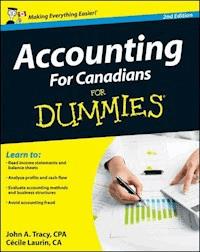
The only guide to accounting tailor-made for Canadians, nowrevised and updated Job prospects are good for those looking to enter the Canadianaccounting industry, and Accounting For Canadians, SecondEdition is the essential resource for anyone interested indoing so. Packed with the information accountants and auditors whowork in public and private industries and in government need toknow in order to stay on the right side of Canadian accounting law,the book is also a must-have for salary accountants working foraccounting, tax preparation, bookkeeping, and payroll servicesfirms. * Essential reading since the new GAAP became mandatory forpublicly accountable enterprises and government businessenterprises at the beginning of 2011 * Covers the new International Financial Reporting Standards * Addresses new standards for private enterprises that businessleaders need to know * Still the only trade book that covers Canadian accountingpractices The ideal book for both accounting professionals as well asstudents who are currently working towards a degree in accountingor auditing services, Accounting For Canadians For Dummiesprovides the applicable and helpful advice that you need tosucceed.
Sie lesen das E-Book in den Legimi-Apps auf:
Seitenzahl: 669
Veröffentlichungsjahr: 2015
Ähnliche















Accounting For Canadians For Dummies®, 2nd Edition
Visit http://www.dummies.com/cheatsheet/accountingforcanadians to view this book's cheat sheet.
Table of Contents
Accounting For Canadians For Dummies®, 2nd Edition
by John A. Tracy and Cécile Laurin
Accounting For Canadians For Dummies®, 2nd Edition
Published byJohn Wiley & Sons Canada, Ltd.6045 Freemont Blvd.Mississauga, ON L5R 4J3www.wiley.com
Copyright © 2012 by John Wiley & Sons Canada, Ltd. All rights reserved. No part of this book, including interior design, and icons, may be reproduced or transmitted in any form, by any means (electronic, photocopying, recording, or otherwise) without the prior written permission of the publisher.
Trademarks: Wiley, the Wiley Publishing logo, For Dummies, the Dummies Man logo, A Reference for the Rest of Us!, The Dummies Way, Dummies Daily, The Fun and Easy Way, Dummies.com, and related trade dress are trademarks or registered trademarks of John Wiley & Sons, Inc. and/or its affiliates in the United States and other countries, and may not be used without written permission. All other trademarks are the property of their respective owners. Wiley Publishing, Inc., is not associated with any product or vendor mentioned in this book.
For authorization to photocopy items for corporate, personal, or educational use, please contact in writing The Canadian Copyright Licensing Agency (Access Copyright). For an Access Copyright license, visit www.accesscopyright.ca or call toll free 1-800-893-5777.
Limit of Liability/Disclaimer of Warranty: The publisher and the author make no representations or warranties with respect to the accuracy or completeness of the contents of this work and specifically disclaim all warranties, including without limitation warranties of fitness for a particular purpose. No warranty may be created or extended by sales or promotional materials. The advice and strategies contained herein may not be suitable for every situation. This work is sold with the understanding that the publisher is not engaged in rendering legal, accounting, or other professional services. If professional assistance is required, the services of a competent professional person should be sought. Neither the publisher nor the author shall be liable for damages arising herefrom. The fact that an organization or Website is referred to in this work as a citation and/or a potential source of further information does not mean that the author or the publisher endorses the information the organization or Website may provide or recommendations it may make. Further, readers should be aware that Internet Websites listed in this work may have changed or disappeared between when this work was written and when it is read.
For general information on John Wiley & Sons Canada, Ltd., including all books published by Wiley Publishing Inc., please call our warehouse, Tel. 1-800-567-4797. For reseller information, including discounts and premium sales, please call our sales department, Tel. 416-646-7992. For press review copies, author interviews, or other publicity information, please contact our publicity department, Tel. 416-646-4582, Fax 416-236-4448.
Library and Archives Canada Cataloguing in Publication
Tracy, John A. Accounting for Canadians for dummies / John A. Tracy, Cécile Laurin. — 2nd ed.
Includes index.
ISBN 978-1-118-13346-0
1. Accounting. 2. Accounting—Canada. I. Laurin, Cécile II. Title.
HF5636.T73 2011 657 C2011-907363-3
ISBN 978-1-118-13346-0 (pbk); ISBN 978-1-118-22372-7 (ebk); ISBN 978-1-118-22381-9 (ebk); ISBN 978-1-118-22386-4 (ebk)
Printed in United States of America
1 2 3 4 5 RRD 15 14 13 12 11
About the Authors
John A. Tracy (Boulder, Colorado) is Professor of Accounting, Emeritus, at the University of Colorado in Boulder. Before his 35-year tenure at Boulder, he was on the business faculty for four years at the University of California in Berkeley. Early in his career he was a staff accountant with Ernst & Young. John is the author of several books on accounting and finance, including The Fast Forward MBA in Finance, How to Read a Financial Report, and Small Business Financial Management Kit For Dummies with his son Tage Tracy. John received his BSC degree from Creighton University. He earned his MBA and PhD degrees at the University of Wisconsin in Madison. He is a CPA (inactive) in Colorado.
Cécile Laurin (Ottawa, Ontario) is a Professor of Accounting at Algonquin College of Applied Arts and Technology in Ottawa. She also taught part-time at the University of Ottawa. Her career began in public accounting, performing audits with the firm now known as KPMG. She then became the chief financial officer of three engineering firms, and the international law firm Gowling Lafleur Henderson LLP. She obtained a B.Admin and a B.Comm (Honours) from the University of Ottawa, and is a member of the Ontario and Canadian Institute of Chartered Accountants. She is the co-author of Bookkeeping For Canadians For Dummies and has written several learning tools for professors and students in accounting. Cécile has also developed several distance-learning courses offered through Algonquin College.
Dedication
John: For our grandchildren — Alexander, Ryan, Mitchel, Paige, Katrina, Claire, Eric, MacKenzie, Madison, Tanner, Karsen, and Brody.
Cécile: For my son, Marc, and my daughter, Marie.
Authors' Acknowledgments
John: I’m deeply grateful to everyone at Wiley Publishing who helped produce this book. Their professionalism, courtesy, and good humour were much appreciated. I supplied some words, and the editors and production staff at Wiley moulded them into the finished product.
Out of the blue, I got a call in 1996 from Kathy Welton, then Vice President and Publisher for the Consumer Publishing Group of the For Dummies books. Kathy asked if I’d be interested in doing this book. It didn’t take me very long to say yes. Thank you again, Kathy!
I can’t say enough nice things about Pam Mourouzis, who was project editor on the first edition of the book. The book is immensely better for her insights and advice. The two copyeditors on the book — Diane Giangrossi and Joe Jansen — did a wonderful job. Mary Metcalfe provided valuable suggestions on the manuscript. Thanks to Holly McGuire and Jill Alexander who encouraged me to revise the book. The second edition benefited from the editing by Norm Crampton and Ben Nussbaum.
I thank Stacy Kennedy, acquisitions editor, for asking me to do this and the previous revision. Joan Friedman was the project editor on this and the previous edition. Evidently, Wiley assigned me the best editor they have. Joan kept a steady hand on the tiller as we sailed through the choppy waters of the revisions. Joan was a delight to work with, and it goes without saying that she made the book much better. Thank you most sincerely Joan, and I hope to work with you again on the next revision.
One reason I like to write books goes back to an accounting class in my undergraduate days at Creighton University in Omaha. I took a course taught by the Dean of the Business School, Dr. Floyd Walsh. I turned in a term paper, and he said that it was very well written. I have never forgotten that compliment. I think my old Prof would be proud of this book and might even give me an “A” on the assignment.
Cécile: I would like to thank Robert Hickey, my editor; my reviewer, Maria Bélanger; and my production editor, Lindsay Humphreys, as well as the team at Wiley, for making this process enjoyable and low-stress. I learned a lot through this experience and my students will be the beneficiaries, now and into the future.
Publisher’s Acknowledgments
We’re proud of this book; please send us your comments through our Dummies online registration form located at www.dummies.com/register/.
Some of the people who helped bring this book to market include the following:
Acquisitions, Editorial, and Vertical Websites
Acquisitions Editor: Robert Hickey
Production Editor: Lindsay Humphreys
Copy Editor: Kelli Howey
Technical Editor: Maria Belanger
Editorial Assistant: Jeremy Hanson-Finger
Cover Photo: ©iStock / Adam Radosavljevic
Cartoons: Rich Tennant (www.the5thwave.com)
Composition Services
Project Coordinator: Kristie Rees
Layout and Graphics: Carrie A. Cesavice, Lavonne Roberts
Proofreaders: BIM Indexing & Proofreading Services, Jessica Kramer
Indexer: Claudia Bourbeau
John Wiley & Sons Canada, Ltd.
Deborah Barton, Vice-President and Director of Operations
Jennifer Smith, Vice-President and Publisher, Professional & Trade Division
Alison Maclean, Managing Editor, Professional & Trade Division
Publishing and Editorial for Consumer Dummies
Kathleen Nebenhaus, Vice President and Executive Publisher
Kristin Ferguson-Wagstaffe, Product Development Director
Ensley Eikenburg, Associate Publisher, Travel
Kelly Regan, Editorial Director, Travel
Publishing for Technology Dummies
Andy Cummings, Vice President and Publisher
Composition Services
Debbie Stailey, Director of Composition Services
Introduction
You may know individuals who make their living as accountants. You may be thankful that they’re the accountants and you’re not. You may prefer to leave accounting to the accountants, and think that you don’t need to know anything about accounting. This attitude evokes the old Greyhound Bus advertising slogan “Leave the Driving to Us.” Well, if you could get around everywhere you wanted to go on the bus that would be okay. But if you have to drive most places, you’d better know something about autos. You do a lot of “financial driving,” so you should know something about accounting as well.
Sure, accounting involves numbers. So does watching your car mileage, knowing your vital health statistics, keeping track of your bank balance, negotiating the interest rate on your home mortgage, monitoring your retirement fund, and bragging about your kid’s grade point average. You deal with numbers all the time. Accountants provide financial numbers. These numbers are very important in your financial life. Knowing nothing about financial numbers puts you at a serious disadvantage. In short, financial literacy requires a working knowledge of accounting.
About This Book
This book, like all For Dummies books, consists of freestanding chapters. Each chapter is like a tub standing on its own feet. You can read the chapters in any order you please. You can tailor your reading plan to give priority to the chapters of most interest to you, and read other chapters as time permits. Of course, you could start on page 1 and continue straight through until the last page. The choice is yours.
We’ve written this book for a wide audience. You may be a small business manager who already has experience with financial statements, for example, but you need to know more about how to use accounting information in analyzing your profit performance and cash flow. Or, you may be an investor who needs to know more about financial statements, so your chief interest probably will be the chapters that explain those statements.
This book offers several advantages:
We explain accounting in plain English with a minimum of jargon and technical details.
We carefully follow a step-by-step approach in explaining topics.
We include only topics that non-accountants should understand; we avoid topics that only practising accountants have to know.
We include frank discussions of certain sensitive topics that go unmentioned in many accounting books.
We should emphasize one thing: This book is not an accounting textbook. Introductory accounting textbooks are ponderous, dry as dust, and overly detailed (in our judgment). However, textbooks have one advantage: They include exercises and problems. You can find out a lot by reading this book. If you have the time, you can gain additional insights and test your understanding of accounting by working the exercises in John’s Accounting Workbook For Dummies (Wiley).
Conventions Used in This Book
Understanding accounting requires a grasp of the fundamentals of financial statements. You get accounting information in other forms of communication (in bank statements and in business newspaper articles, for example), but financial statements occupy centre stage. To understand financial statements you don’t have to be an expert. But you should know how to extract the main messages from financial statements. Serious investors, investment analysts, lenders, and business managers, in particular, need a sure grip on financial statements.
Financial statements are presented according to established (one could say entrenched) conventions. Uniform styles and formats for reporting financial statements have evolved over the years and become generally accepted. The conventions for financial statement reporting can be compared to the design rules for highway signs and traffic signals. Without standardization there would be a lot of accidents.
We present financial statements throughout the book. Therefore, we want to take a moment now to explain the conventions for reporting financial statements. To illustrate these points we use the following example of an income statement for a business. Note: This business example is unincorporated and organized as a pass-through entity for income tax purposes and, therefore, does not itself pay income tax. (We discuss pass-through entities in Chapter 8.)
Income Statement for Year
Keep these conventions in mind:
It may seem obvious, but you read a financial statement from the top down. This example lists Sales revenue first, which is the total income from the sale of products and services during the period before expenses in the period are deducted. If the business’s main revenue stream is from selling products, the first expense deducted from sales revenue is cost of goods sold, as in this example.
Deducting the cost of goods sold expense from sales revenue gives gross margin (also called gross profit). The number of other expense lines in an income statement varies from business to business. Before interest expense is deducted, the standard practice is to show operating profit (also called operating earnings), which is profit before interest expense.
An amount that is deducted from another amount — such as the cost of goods sold expense — may be placed in parentheses to indicate that it is being subtracted from the amount above it. Alternatively, the accountant who prepares the financial statement may assume readers know that expenses are deducted from sales revenue, so no parentheses are put around the number. You see expenses presented both ways in financial reports, but you hardly ever see a minus (negative) sign in front of expenses.
Notice the use of dollar signs in the income statement example. In the illustration all amounts have a dollar sign prefix. However, financial reporting practices vary quite a bit on this matter. The first number in a column always has a dollar sign, but from here down it’s a matter of personal preference.
To indicate that a calculation is being done, the bottom is underlined once, as you see under the $3,267,000 cost of goods sold expense number in the example. This means that the expense amount is being subtracted from sales revenue. The number below the underline, therefore, is a calculated amount.
Note that three calculated amounts appear in the example: $1,951,000 gross margin; $467,000 operating profit; and $281,000 net income.
Dollar amounts in a column are always aligned to the right, as you see in the income statement example. Trying to read down a jagged column of numbers that are not right-aligned would be too much; the reader might develop vertigo.
In the income statement example, dollar amounts are rounded to the nearest thousand for ease of reading, which is why you see all zeros in the last three places of each number. Really big businesses round off to the nearest million and drop the last six digits. The accountant could have dropped off the last three digits in the income statement, but probably wouldn’t in most cases.
Many accountants don’t like rounding off amounts reported in a financial statement, so you see every amount carried out to the last dollar, and sometimes even to the last penny. However, this gives a false sense of precision. Accounting for business transactions cannot be accurate down to the last dollar; this is nonsense. The late Kenneth Boulding, a well-known economist, once quipped that accountants would rather be precisely wrong than approximately correct. Ouch! That stings because the comment has a strong element of truth behind it.
The final number in a column typically is double underlined, as you see for the $281,000 bottom-line profit number in the income statement. This is about as carried away as accountants get in their work — a double underline. Instead of a double underline for a bottom-line number, it may appear in bold.
We need to mention one more convention: We give several web addresses (URLs) in this book. Some need to break across two lines of text. If this is the case, rest assured that we haven’t put in any extra characters (such as hyphens) to indicate the break. So, when using one of these web addresses, just type in exactly what you see in this book, pretending the line break doesn’t exist.
What You’re Not to Read
While you’re reading, we assume you’re on the edge of your seat and can hardly wait to get to the next exciting sentence. Well, perhaps we get more pumped up about accounting than you do. So, one question you may have is this: Do I really have to read every sentence in the book? To be honest, you can skip the paragraphs marked with the Technical Stuff icon. You can simply leapfrog over these sections without missing a beat. If you have time, return to these topics later. Also, the sidebars in the chapters are interesting, but not essential for understanding the topics at hand. Sidebars are like when you say in a conversation, “By the way, did you know . . . ?”
There’s reading, and then there’s remembering what you read. You should read the examples we use throughout the book, but you don’t have to remember the numbers in each example. For instance, consider the income statement example in the previous section. You should understand that the bottom-line profit is the amount remaining after all expenses are deducted from sales revenue. But, of course, you don’t need to remember the specific amount of the bottom-line profit in the example.
Foolish Assumptions
Although we assume that you have a basic familiarity with the business world, we take nothing for granted regarding how much accounting you know. Even if you have some experience with accounting and financial statements, we think you’ll find this book useful.
We have written this book with a wide audience in mind. You should find yourself more than once in the following list of potential readers:
Accountants to be: This book is a good first step for anyone considering a career in professional accounting.
Active investors: Investors in marketable securities, real estate, and other ventures need to know how to read financial statements backward and forward.
Passive investors: Many people let the pros manage their money by investing in mutual funds or using investment advisers; even so, they need to understand the investment performance reports they get, which use plenty of accounting terms and measures.
People who want to take control of their personal finances: Many aspects of managing your personal finances involve accounting vocabulary and the accounting-based calculation methods.
Business managers (at all levels): Trying to manage a business without a good grip on financial statements can lead to disaster. How can you manage your business’s financial performance if you don’t even understand the financial statements?
Anyone interested in following economic, business, and financial news: Articles in the Financial Post and other financial news sources are heavy with accounting terms and measures.
Administrators and managers of government and not-for-profit entities: Although making profit is not the goal of these entities, the focus is still on the bottom line because the entity has to stay within its revenue limits and keep on a sound financial footing.
Politicians at municipal, provincial, and federal levels: These men and women pass many laws having significant financial consequences, and the better they understand accounting, the better their votes should be (we hope).
Bookkeepers: Strengthening their knowledge of accounting should improve their effectiveness and value to the organization.
Entrepreneurs: As budding business managers, they need a solid grasp of accounting basics.
Business buyers and sellers: Anyone thinking of buying or selling a business should know how to read its financial statements and how to “true up” the accounting reports that serve as the basis for setting a market value on the business.
Investment bankers, institutional lenders, and loan officers: We don’t really have to tell these folks that they need to understand accounting; they already know.
Business and finance professionals: This includes lawyers and financial advisers, of course, but even clergy counsel their flock on financial matters occasionally.
We could put others in the above list. But we think you get the idea that many different people need to understand the basics of accounting. Perhaps someone who leads an isolated contemplative life and renounces all earthly possessions does not need to know anything about accounting. But, then again, we don’t know.
How This Book Is Organized
This book is divided into parts, and each part is further divided into chapters. The following sections describe what you can find in each part.
Part I: Opening the Books on Accounting
In Chapters 1 and 2, we introduce the three primary business financial statements gradually, one step at a time. Rather than throwing you in the deep end of the pool, hoping that you learn to swim before drowning in too many details, we make sure you first can float and then move on to some basic strokes. The information for financial statements comes from the bookkeeping system of the entity. The financial statements of an entity are no more reliable and accurate than the reliability and accuracy of its bookkeeping system — and the integrity of the company’s management, of course. So, in Chapter 3, we offer a brief overview of bookkeeping and accounting systems. You could jump over this chapter, if you must. But we recommend at least a quick read.
Part II: Figuring Out Financial Statements
In Part II, we complete the explanations of the three primary financial statements of businesses (see Chapters 4, 5, and 6). In Chapter 7, we explain that businesses are not in a straitjacket when it comes to deciding which accounting methods to use for recording their revenue and expenses. They can select from two or more equally acceptable methods for recording certain revenues and expenses. The choice of accounting methods affects the values recorded for assets and liabilities.
Part III: Accounting in Managing a Business
To start a business and begin operations, its founders must first decide on which business structure to use. Chapter 8 explains the many types of entities that can be used for carrying on business activities. Each has certain advantages and disadvantages, and they are treated differently under the income tax law.
Chapter 9 explains an extraordinarily important topic: designing an accounting report template that serves as a good profit model, one that focuses on the chief variables that drive profit and changes in profit. A hands-on profit model is essential for decision-making analysis. A manager depends on the profit model to determine the effects of changes in sales prices, sales volume, product costs, and the other fundamental factors that drive profit.
In Chapter 10, we discuss accounting-based planning and control techniques, through the lens of budgeting. Managers in manufacturing businesses should be wary of how product costs are determined, as Chapter 11 explains. The chapter also explains other economic and accounting cost concepts relevant to business managers.
Part IV: Preparing and Using Financial Reports
In Part IV, we first explain how a financial report is put together (see Chapter 12). Next we discuss how investors and lenders read financial statements (see Chapter 13). Business managers need more information than is included in an external financial report to investors and lenders. In Chapter 14, we survey the additional information that managers need.
We close this part of the book with a chapter that explains audits of financial statements by public accountants and the very serious problems of accounting and financial reporting fraud (see Chapter 15). If there were no Nortels in the world, things would be a lot simpler. We hate to say it, but the next Nortel is just waiting to happen. Unfortunately, you can’t necessarily depend on audits to discover accounting fraud.
Part V: The Part of Tens
In the For Dummies style, we close the book with a pair of chapters in “The Part of Tens.” We condense the main lessons from the book’s chapters into two lists of ten vital points each. Chapter 16 reviews ten important ways business managers should use accounting information. Chapter 17 gives business investors handy tips for getting the most out of reading a financial report — tips on how to be efficient in reading a financial report and the key factors to focus on.
Glossary
The accounting terminology in financial statements is a mixed bag. Many terms are straightforward, but accountants also use esoteric terms that you don’t see outside of financial statements. Sometimes it must seem like accountants are speaking a foreign language. We must admit that accountants use jargon more than they should. In some situations accountants resort to arcane terminology to be technically correct, much like lawyers use arcane terminology in filing lawsuits and drawing up contracts.
Where we use jargon in the book, we pause and clarify what the terms mean in plain English. Also, we present a helpful glossary at the end of the book that can assist you on your accounting safari. This glossary provides quick access to succinct definitions of key accounting and financial terms, with relevant commentary and an occasional editorial remark. This is better than your average glossary.
Icons Used in This Book
This icon points out especially important ideas and accounting concepts that are particularly deserving of your attention. The material this icon marks describes concepts that are the undergirding and building blocks of accounting — be very clear about these concepts, because they clarify your understanding of accounting principles in general.
We use this icon sparingly; it refers to very specialized accounting stuff that is heavy going, which only a professional accountant could get really excited about. However, you may find these topics important enough to return to when you have the time. Feel free to skip over these points the first time through and stay with the main discussion.
This icon calls your attention to useful advice on practical financial topics. It saves you the cost of buying a yellow highlighter pen.
This icon is like a caution sign that warns you about speed bumps and potholes on the accounting highway. Taking special note of this material can steer you around a financial road hazard and keep you from blowing a fiscal tire. In short — watch out!
Where to Go from Here
There’s no law against you starting on page 1 and reading through to the last page. However, you may first want to scan the book’s Contents at a Glance and see which chapters pique your interest.
Perhaps you’re an investor who is very interested in finding out more about financial statements and the key financial statement ratios for investors. You might start with Chapters 4, 5, and 6, which explain the three primary financial statements of businesses, and finish with Chapter 13, on reading a financial report. (And don’t overlook Chapter 17.)
Perhaps you’re a small business owner/manager with a basic understanding of your financial statements, but you need to improve how you use accounting information for making your key profit decisions, and for planning and controlling your cash flow. You might jump right into Chapters 9 and 10, which explain the analysis of profit behaviour and budgeting cash flows.
The book is not like a five-course dinner in which you have to eat in the order the food is served to you. It’s more like a buffet line from which you can pick and choose, and eat in whatever order you like.
Part I
Opening the Books on Accounting
In this part . . .
Accounting is essential in the worlds of business, investing, finance, and taxes. In this part, you find out why.
Accountants are the “information gatekeepers” in the economy. Without accounting, a business couldn’t function, wouldn’t know whether it’s making a profit, and would be ignorant of its financial situation. Accounting is equally vital in managing the business affairs of not-for-profit and governmental entities.
From its accounting records, a business prepares its financial statements, its tax returns, and the reports to its managers. In financial reports to investors and lenders, a business must obey authoritative accounting and financial reporting standards. If not, its financial reports would be misleading and possibly fraudulent, which could have dire consequences.
Bookkeeping — the recordkeeping part of accounting — must be done well to ensure that the business’s financial information is timely, complete, accurate, and reliable — especially the numbers reported in its financial statements and tax returns. Wrong numbers in financial reports and tax returns can cause all sorts of trouble.
Chapter 1
Accounting: The Language of Business, Investing, Finance, and Taxes
Lesen Sie weiter in der vollständigen Ausgabe!
Lesen Sie weiter in der vollständigen Ausgabe!
Lesen Sie weiter in der vollständigen Ausgabe!
Lesen Sie weiter in der vollständigen Ausgabe!
Lesen Sie weiter in der vollständigen Ausgabe!
Lesen Sie weiter in der vollständigen Ausgabe!
Lesen Sie weiter in der vollständigen Ausgabe!
Lesen Sie weiter in der vollständigen Ausgabe!
Lesen Sie weiter in der vollständigen Ausgabe!
Lesen Sie weiter in der vollständigen Ausgabe!
Lesen Sie weiter in der vollständigen Ausgabe!
Lesen Sie weiter in der vollständigen Ausgabe!
Lesen Sie weiter in der vollständigen Ausgabe!
Lesen Sie weiter in der vollständigen Ausgabe!
Lesen Sie weiter in der vollständigen Ausgabe!
Lesen Sie weiter in der vollständigen Ausgabe!
Lesen Sie weiter in der vollständigen Ausgabe!
Lesen Sie weiter in der vollständigen Ausgabe!
Lesen Sie weiter in der vollständigen Ausgabe!
Lesen Sie weiter in der vollständigen Ausgabe!
Lesen Sie weiter in der vollständigen Ausgabe!
Lesen Sie weiter in der vollständigen Ausgabe!




