


16,99 €
Mehr erfahren.
- Herausgeber: John Wiley & Sons
- Kategorie: Fachliteratur
- Sprache: Englisch
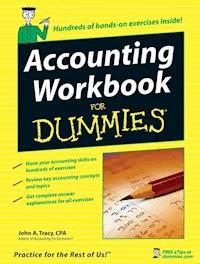
Balance the books -- without all the headaches! Trying to get certified and become an accountant? Own a small business but need a little help balancing your books? Don't worry! This hands-on guide provides the learning and vital practice you need to master important accounting concepts and basics. Perfect as a companion workbook for Accounting For Dummies -- or any other accounting textbook -- Accounting Workbook For Dummies gives you a wealth of real-world examples, demonstration problems, and handy exercises. With this helpful resource as your guide, you'll master balance sheets, income statements, and budgets in no time! 100s of Problems! * Record transactions, track costs, and manage accounts * Open and close bookkeeping cycles * Analyze business performance and profit * Choose the right accounting method * Master investment accounting fundamentals * Understand manufacturing cost accounting
Sie lesen das E-Book in den Legimi-Apps auf:
Seitenzahl: 500
Veröffentlichungsjahr: 2011
Ähnliche















Accounting Workbook For Dummies®
Table of Contents
Accounting Workbook for Dummies®
by John A. Tracy, CPA
Accounting Workbook For Dummies®
Published byWiley Publishing, Inc.111 River St.Hoboken, NJ 07030-5774www.wiley.com
Copyright © 2006 by Wiley Publishing, Inc., Indianapolis, Indiana
Published by Wiley Publishing, Inc., Indianapolis, Indiana
Published simultaneously in Canada
No part of this publication may be reproduced, stored in a retrieval system, or transmitted in any form or by any means, electronic, mechanical, photocopying, recording, scanning, or otherwise, except as permitted under Sections 107 or 108 of the 1976 United States Copyright Act, without either the prior written permission of the Publisher, or authorization through payment of the appropriate per-copy fee to the Copyright Clearance Center, 222 Rosewood Drive, Danvers, MA 01923, 978-750-8400, fax 978-646-8600. Requests to the Publisher for permission should be addressed to the Permissions Department, John Wiley & Sons, Inc., 111 River Street, Hoboken, NJ 07030, 201-748-6011, fax 201-748-6008, or online at http://www.wiley.com/go/permissions.
Trademarks: Wiley, the Wiley Publishing logo, For Dummies, the Dummies Man logo, A Reference for the Rest of Us!, The Dummies Way, Dummies Daily, The Fun and Easy Way, Dummies.com and related trade dress are trademarks or registered trademarks of John Wiley & Sons, Inc. and/or its affiliates in the United States and other countries, and may not be used without written permission. All other trademarks are the property of their respective owners. Wiley Publishing, Inc., is not associated with any product or vendor mentioned in this book.
Limit of Liability/Disclaimer of Warranty: The publisher and the author make no representations or warranties with respect to the accuracy or completeness of the contents of this work and specifically disclaim all warranties, including without limitation warranties of fitness for a particular purpose. No warranty may be created or extended by sales or promotional materials. The advice and strategies contained herein may not be suitable for every situation. This work is sold with the understanding that the publisher is not engaged in rendering legal, accounting, or other professional services. If professional assistance is required, the services of a competent professional person should be sought. Neither the publisher nor the author shall be liable for damages arising herefrom. The fact that an organization or Website is referred to in this work as a citation and/or a potential source of further information does not mean that the author or the publisher endorses the information the organization or Website may provide or recommendations it may make. Further, readers should be aware that Internet Websites listed in this work may have changed or disappeared between when this work was written and when it is read.
For general information on our other products and services, please contact our Customer Care Department within the U.S. at 877-762-2974, outside the U.S. at 317-572-3993, or fax 317-572-4002.
For technical support, please visit www.wiley.com/techsupport.
Wiley also publishes its books in a variety of electronic formats. Some content that appears in print may not be available in electronic books.
Library of Congress Control Number is available from the publisher.
ISBN-13: 978-0-471-79145-4
ISBN-10: 0-471-79145-8
Manufactured in the United States of America
10 9 8 7 6 5 4
1B/TR/QR/QY/IN
About the Author
John A. Tracy (Boulder, Colorado) is Professor of Accounting, Emeritus, at the University of Colorado in Boulder. Before his 35-year tenure at Boulder, he was on the business faculty for 4 years at the University of California in Berkeley. He has served as staff accountant at Ernst & Young and is the author of several books on accounting and finance, including Accounting For Dummies, The Fast Forward MBA in Finance,How To Read a Financial Report, and How to Manage Profit and Cash Flow with his son Tage Tracy. Dr. Tracy received his BSC degree from Creighton University 50 years ago this year, and earned his MBA and PhD degrees from the University of Wisconsin. He is a CPA (inactive) in Colorado.
Dedication
In memory of Gordon B. Laing, the original editor of my How to Read a Financial Report — a gentleman and editor of the first rank.
Author’s Acknowledgments
I’m deeply grateful to everyone at Wiley Publishing, Inc. who helped produce this book. Their professionalism, courtesy, and good humor were much appreciated. My editors, Tim Gallan and Elizabeth Rea, were exceptional. It was a pleasure working with them. I owe them a debt I cannot repay. So a simple but heartfelt “thank you” will have to do.
This book would not have been possible but for the success of my Accounting For Dummies (Wiley, 3rd Edition, 2005). I owe Wiley Publishing, Inc. and the several editors on the three editions of the book an enormous debt of gratitude, which I am most willing to acknowledge. Thanks to all of you! I hope I have done you proud with Accounting Workbook For Dummies.
Publisher’s Acknowledgments
We’re proud of this book; please send us your comments through our Dummies online registration form located at www.dummies.com/register/.
Some of the people who helped bring this book to market include the following:
Acquisitions, Editorial, and Media Development
Senior Project Editor: Tim Gallan
Acquisitions Editor: Stacy Kennedy
Senior Copy Editor: Elizabeth Rea
Editorial Program Coordinator: Hanna K. Scott
Technical Editor: Jill Gilbert Welytok
Editorial Manager: Christine Meloy Beck
Editorial Assistants: David Lutton, Nadine Bell, Erin Calligan
Cartoons: Rich Tennant (www.the5thwave.com)
Composition Services
Project Coordinator: Michael Kruzil
Layout and Graphics: Lauren Goddard, Denny Hager, Stephanie D. Jumper, Barry Offringa, Lynsey Osborn, Heather Ryan
Proofreaders: Jessica Kramer
Indexer: Estalita Slivoskey
Publishing and Editorial for Consumer Dummies
Diane Graves Steele, Vice President and Publisher, Consumer Dummies
Joyce Pepple, Acquisitions Director, Consumer Dummies
Kristin A. Cocks, Product Development Director, Consumer Dummies
Michael Spring, Vice President and Publisher, Travel
Kelly Regan, Editorial Director, Travel
Publishing for Technology Dummies
Andy Cummings, Vice President and Publisher, Dummies Technology/General User
Composition Services
Gerry Fahey, Vice President of Production Services
Debbie Stailey, Director of Composition Services
Introduction
First of all, I have to admit that accounting has an image problem. Be honest: What’s the first thing that pops into your mind when you see the word “accountant”? You probably think of a nerd wearing a green eyeshade who has the personality of an undertaker (no offense meant to undertakers, of course). Well, I’ve never worn a green eyeshade in my life, and I can assure you that I’m not a nerd. I own an iPod, I have a good sense of humor, and in addition to being an accounting professor for more than 40 years, I’ve also held several administrative positions. But to be honest, I was somewhat of a nerd when I decided to go into accounting. (I have pictures to prove it.)
I was a freshman at Iowa State University studying engineering but not liking it too well. On a whim, I dropped into the student counseling office and took some tests. The result was that they told me that I was a reasonably well-adjusted 18-year-old (little did they know), I had an IQ sufficient for what they were about to recommend (but they never told me my IQ), and I should switch to accounting. I was floored. Accounting? Well, I took the counselors’ advice and changed my major to accounting, and I’ve never regretted it.
Explaining accounting for nonaccountants is one of my passions in life, and I’ve written several books on the topic. About a decade ago, I had the opportunity to write Accounting For Dummies (Wiley), which is now in its third edition. One of my other books is How To Read A Financial Report (Wiley), which has been in print more than 25 years. This book, Accounting Workbook For Dummies, fills a gap in my other books: They don’t have questions and exercises. This book offers plenty of questions to test and improve your understanding of accounting.
This book offers a different take on accounting — one that offers new insights and perspectives. Having taught accounting for over 40 years, I have a pretty good idea of how the subject is taught. I don’t go out of my way to be contrary or confrontational, but accounting isn’t an exact science. Accounting is full of controversy and differences of opinion. In this book, I state my opinions forcefully and (I hope) clearly.
The spirit of this book is illustrated in two stories. One concerns the young and eager musician on her first trip to New York City, who gets off the train at Grand Central Terminal and asks the first person she meets on the street: “How do you get to Carnegie Hall?” The answer is: “Practice, practice, practice!” The second story concerns the legendary UCLA basketball coach John Wooden. At the first practice of each year, he taught the players how to tie their shoes so that they wouldn’t come loose during a game.
About This Book
Whether it’s a small mom and pop business or the gargantuan General Electric, every business keeps track of its financial activities and its financial condition. You can’t run a business without an accounting system that tells you whether you’re making a profit or suffering a loss, whether you have enough cash to continue or your checking account balance is approaching zero, and whether you’re in good financial shape or are on the edge of bankruptcy.
Accounting Workbook For Dummies is largely about business accounting. It explains how business transactions are recorded in the accounts of a business and the financial statements that are prepared for a business to report its profit and loss, financial condition, and cash flows. It also explains how business managers use accounting information for decision making. (The book doesn’t delve into business income taxation, which is the province of professional accountants.)
Most business managers have limited accounting backgrounds, and most have their enthusiasm for learning more about accounting well under control. But, down deep, they’re likely to think that they should know more about accounting. Business managers should find this book quite helpful even if they just dip their toes in.
If you’re a business bookkeeper or accountant, you can use this book to review the topics you need to know well. It can help you upgrade your accounting skills and savvy and lay the foundation for further advancement. One great thing about Accounting Workbook For Dummies is that it offers alternative explanations of accounting topics that are different from the explanations in standard accounting textbooks. The many questions and problems (with clearly explained answers) offer an excellent way to test your knowledge, and nobody knows your exam scores but you.
If you’re a student presently enrolled in a beginning accounting course, you can use this book as a supplementary study guide to your textbook, one that offers many supplementary questions and exercises. Perhaps you took an accounting course a few years ago and need to brush up on the subject. This book can help you refresh your understanding of accounting and help you recall things forgotten.
Foolish Assumptions
Mastering accounting is like mastering many subjects: First, you must understand the lingo and the fundamentals. In accounting, you have to work problems to really get a grasp of the topic and technique. Passive reading just isn’t enough. In writing this book, I assumed that you aren’t a complete accounting neophyte. I designed the book as a second step that builds on your basic accounting knowledge and experience. If you have no previous exposure to accounting, you may want to consider first reading Accounting For Dummies (Wiley).
You don’t have to be a math wizard to understanding accounting; basic high school algebra is more than enough. However, you do have to pay attention to details, just as you have to pay close attention to the words when you study Shakespeare. Accounting involves calculations, and using a business/financial calculator is very helpful. In my experience, many people don’t take the time to learn how to use their calculators. But that’s time well spent. In many of the questions and problems posed throughout the book, I explain how to use a business calculator for the solution.
How This Book Is Organized
Accounting Workbook For Dummies consists of four parts that cover topics including recordkeeping basics, financial statements, accounting for business managers, and investment accounting. I wrap it all up with some advice about financial statements and tips for management accounting.
Part I: Business Accounting Basics
The general theme of the chapters in this part is how an accountant records the transactions of a business (its financial activities) in an accrual-basis accounting system and how the effects of transactions are reported in the three primary financial statements of a business — the income statement, the balance sheet, and the statement of cash flows. This part also includes a review of the bookkeeping cycle, from recording original entries through the adjusting and closing entries at year-end.
Part II: Preparing Financial Statements
This part examines the accounting issues and procedures involved in preparing the three primary financial statements of a business. Compared with the standard textbook approach to these topics, I put much more emphasis on the interconnections between the three financial statements. The statements fit together like a tongue-and-groove joint, and the chapters focus on these connections. This part closes with the decisions every business must make in choosing which accounting methods to use for recording profit.
Part III: Managerial, Manufacturing, and Capital Accounting
This part of the book examines how managers use accounting information when making business decisions. In addition to financial statements, managers need profit models for their decision-making analysis, and accountants should take the lead in designing useful profit models for managers. This part also explains how the product cost of manufactures is determined and the difficult accounting issues involved in measuring product cost. The last chapter of this part discusses the accounting measurement of interest and return on investment. Most people have a basic understanding of interest and return on investment, but when it gets right down to a specific situation, they’re fuzzy on the details.
Part IV: The Part of Tens
Like all For Dummies books, Accounting Workbook For Dummies ends with a couple chapters that provide tips to help you recall and apply important points sprinkled throughout the book. The editors have decreed that there shall be ten of these tips in each chapter. I provide two such chapters in this book — one being ten things you should know about business financial statements, and one being a ten-point checklist for management accountants.
Icons Used In This Book
Throughout this book, you can find useful “pointers” that save you the trouble of buying a yellow highlighter pen and using sticky notes. These icons draw your attention to certain parts of the text. Think of them as road signs on your journey through accounting.
This icon marks the spot of an example question that explains and illustrates an important point. The answer follows the question. It’s a good idea to make sure that you understand the answer before attempting the additional questions on the topic. To get the most out of the example questions, don’t read the answer right away. First, try to answer the question, and then compare my answer with yours and how you got it.
This icon points out information that you probably would have underlined or highlighted while reading. These points are worth remembering. When reviewing each chapter, read everything with this icon attached in order to get the essentials.
I use this icon to indicate that I’m building on your background in accounting. Instead of starting at ground zero, I assume that you already know basic points about the topic. If this book were an elevator, this marker would mean that you’re ascending from the first floor to the second floor.
Simply put, this icon is a red flag that means “Watch out.” This warning sign means that the topic being explained is a serious and troublesome issue in accounting, so you should pay close attention and handle it with care.
Where to Go from Here
Accounting Workbook For Dummies is designed to maximize modularity. Each chapter stands on its own feet to the fullest extent possible. Of course, it makes sense to read the chapters in order, but you can jump around as the spirit moves you.
You may be a business investor who’s interested in interpreting return on investment (ROI) (Chapter 12), or you may want to review manufacturing cost accounting (Chap-ter 11). You may be a business manager who needs to know about analyzing profit behavior (Chapter 10), or you may be confused about cash flow (Chapters 7 and 8). If you’re a student studying for your first accounting exam, I suggest that you start with Part I and read the chapters in order.
In my view, a business/financial calculator has become as essential as a TV remote control, and I highly recommend that you invest in one (a business/financial calculator, that is, not a remote control). Hewlett-Packard (HP) and Texas Instruments (TI) make very good ones. If you can avoid it, don’t buy the cheapest model; the next one up usually has better financial functions and a good display. At the time of writing this chapter, my favorite two calculators are the HP 17B and the TI BA II.
Part I
Business Accounting Basics
In this part . . .
Accountants are the scorekeepers of business. Without accounting, a business couldn’t function; it wouldn’t know whether it’s making a profit; and it wouldn’t know its financial condition. Bookkeeping — the recording-keeping part of accounting — must be done well to make sure that all the financial information needed to run the business is complete, accurate, and reliable. This part of the book walks you through the basic bookkeeping cycle — from making original entries through adjusting entries, to financial statements. Before jumping into the mechanics of bookkeeping, however, I explain the financial effects and the manifold effects of sales and expenses on assets and liabilities.
Lesen Sie weiter in der vollständigen Ausgabe!
Lesen Sie weiter in der vollständigen Ausgabe!
Lesen Sie weiter in der vollständigen Ausgabe!
Lesen Sie weiter in der vollständigen Ausgabe!
Lesen Sie weiter in der vollständigen Ausgabe!
Lesen Sie weiter in der vollständigen Ausgabe!
Lesen Sie weiter in der vollständigen Ausgabe!
Lesen Sie weiter in der vollständigen Ausgabe!
Lesen Sie weiter in der vollständigen Ausgabe!
Lesen Sie weiter in der vollständigen Ausgabe!
Lesen Sie weiter in der vollständigen Ausgabe!
Lesen Sie weiter in der vollständigen Ausgabe!
Lesen Sie weiter in der vollständigen Ausgabe!
Lesen Sie weiter in der vollständigen Ausgabe!
Lesen Sie weiter in der vollständigen Ausgabe!
Lesen Sie weiter in der vollständigen Ausgabe!




